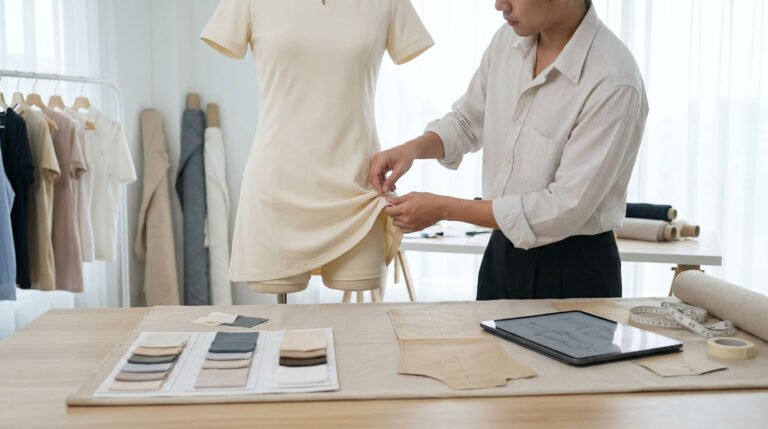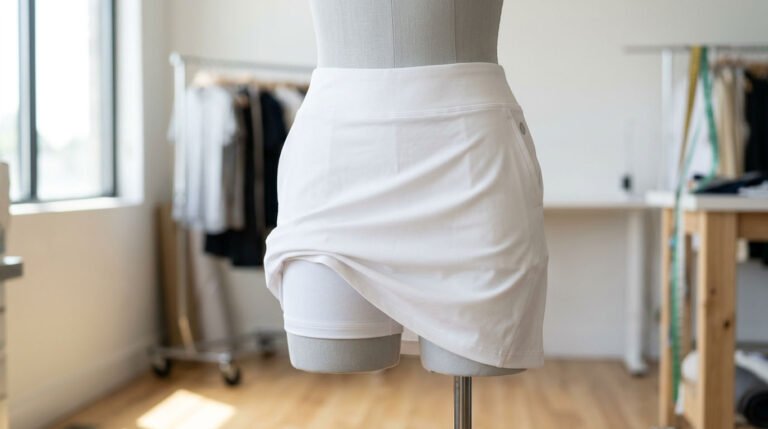
Choosing the right women's golf apparel manufacturer is not simply a matter of comparing unit prices and minimum order quantities.
Women’s golf apparel combines performance fabrics, specialized fit, movement requirements, decoration techniques, and product categories such as polos, skorts, dresses, shorts, pants, and lightweight layers.
For brands developing a women's golf collection, the key question is:
Can the manufacturer turn your design, fit expectations, fabric requirements, and artwork into a production-ready garment that can be reproduced consistently in bulk?
A practical way to evaluate potential partners is across six areas:
Women's Fit Capability → Product Range → Fabric Sourcing → Customization → Sampling & QC → Scalability
This makes manufacturer selection a development-risk decision, not just a price comparison.
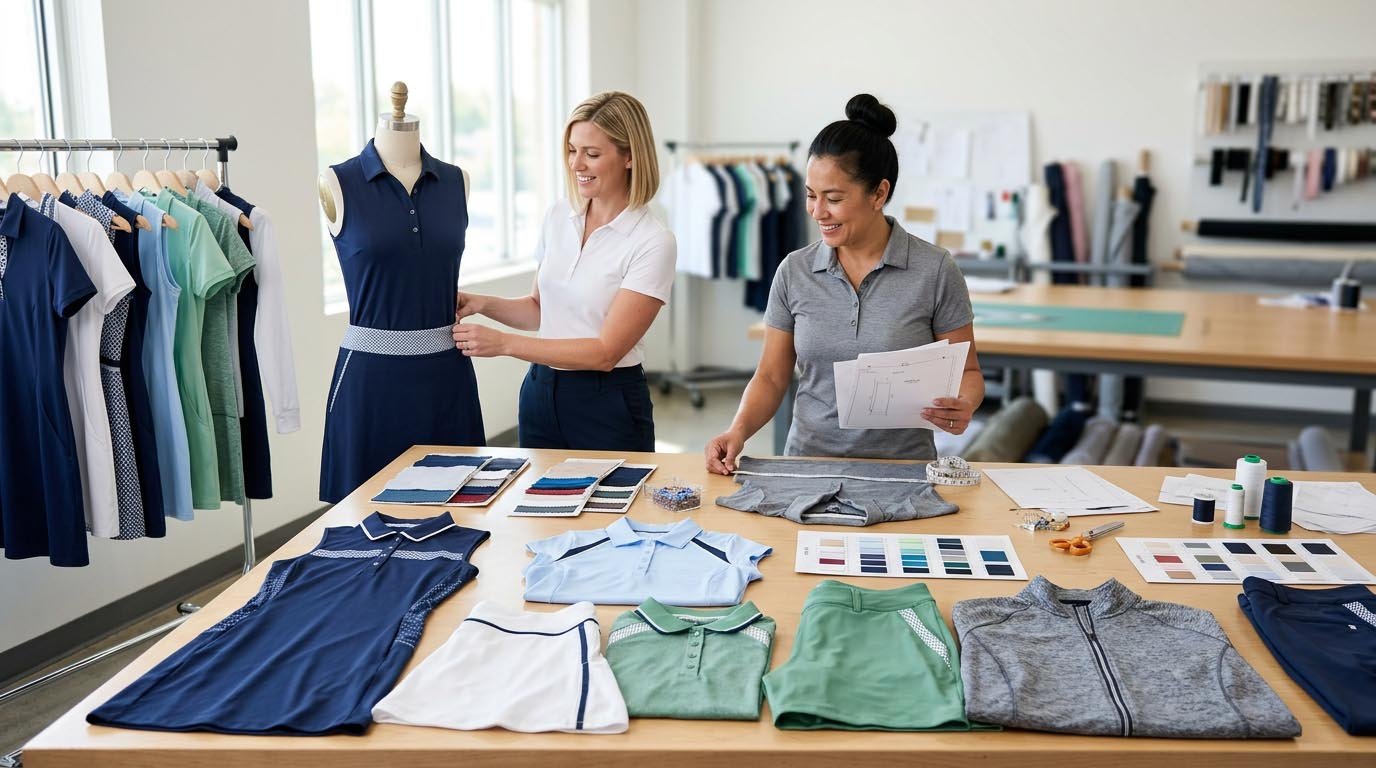
Quick Answer: How Do You Choose a Women's Golf Apparel Manufacturer?
Look for a supplier that can demonstrate:
- Dedicated women's pattern development
- Experience across relevant golf product categories
- Reliable performance fabric sourcing
- Appropriate customization and artwork review
- Structured sampling and quality control
- Clear MOQ, lead time, and scale-up capability
A strong manufacturer should ask questions before quoting or sampling. They should clarify your specifications, identify possible production problems, and explain what needs to be approved before bulk production.
For brands developing custom golf polos and related tops, review FUWAY's Custom Golf Shirts capabilities.
Why Does Women's Golf Apparel Require Specialized Manufacturing?
Golf apparel sits between sportswear and lifestyle clothing.
A garment needs to look refined while still allowing the golfer to rotate, bend, walk, and swing comfortably.
Women's golf apparel introduces additional fit considerations such as:
- Bust shaping
- Waist contour
- Hip allowance
- Shoulder width
- Armhole position
- Torso length
- Skort rise and liner fit
- Dress length
- Stretch recovery
A factory may be capable of producing a basic sports T-shirt but still lack the pattern-development experience required for a fitted women's golf polo, technical skort, or golf dress.
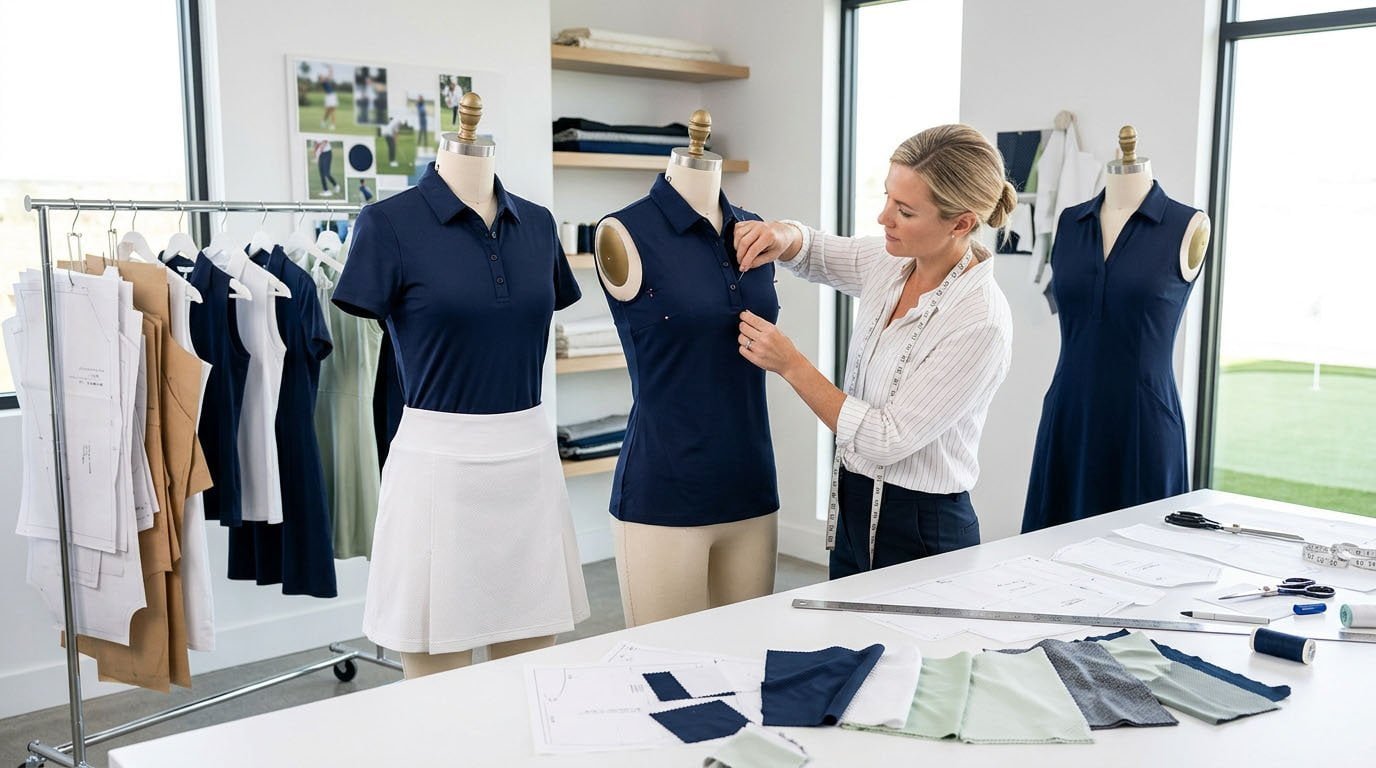
What Women's Golf Products Should a Manufacturer Be Able to Produce?
The right partner depends partly on your collection.
If you are building a coordinated women's golf line, the manufacturer should ideally understand multiple categories.
Golf Polos and Performance Tops
Key requirements may include:
- Moisture-management fabrics
- Stretch for shoulder rotation
- Stable collars and plackets
- Suitable sleeve shaping
- Consistent logo placement
- Correct bust and waist balance
Golf Skorts and Skirts
A skort combines an outer garment with a functional inner short.
Important development points include:
- Waistband stability
- Built-in shorts
- Stretch recovery
- Pocket placement
- Hem length
- Coverage during movement
Golf Dresses
Golf dresses require both upper-body fit and lower-body mobility.
Check:
- Bust and waist shaping
- Arm movement
- Dress length
- Fabric opacity
- Pocket construction
- Integrated or separate shorts
Golf Shorts and Pants
Women’s golf bottoms require careful control of:
- Rise
- Hip and seat shaping
- Waistband fit
- Pocket depth
- Leg opening
- Stretch and recovery
Quarter-Zips, Jackets, and Layers
Layering garments should allow movement without creating unnecessary bulk around the shoulder, armhole, or waist.
For brands building a broader collection, FUWAY's Private Label service supports multi-product development under one brand identity.
Why Can't You Simply Scale Down a Men's Golf Pattern?
One of the most important questions to ask a manufacturer is:
Do you develop dedicated women's patterns, or do you simply reduce an existing men's block?
A smaller men's polo is not automatically a correctly fitted women's polo.
Bust and Torso Shaping
Women's styles may require:
- Different front-to-back balance
- Bust shaping
- A more defined waist
- Additional hip room
- Different garment lengths
Depending on the intended silhouette, this may be achieved through pattern contouring, seams, darts, stretch, or a combination of these methods.
Armholes and Shoulder Mobility
Golf requires substantial upper-body rotation.
Poor armhole or shoulder geometry can cause pulling when the golfer:
- Raises the arms
- Rotates through the backswing
- Moves through impact
- Completes the follow-through
The objective is not simply to make the garment tighter.
It is to achieve the intended silhouette without restricting movement.
Hip and Hem Balance
If a women's polo is too narrow through the lower body, it may:
- Ride up
- Twist
- Pull across the hips
- Lose its intended drape
Fit Should Be Tested in Movement
Useful fit checks include:
- Address posture
- Arm elevation
- Torso rotation
- Putting position
- Walking
- Sitting
- Bending
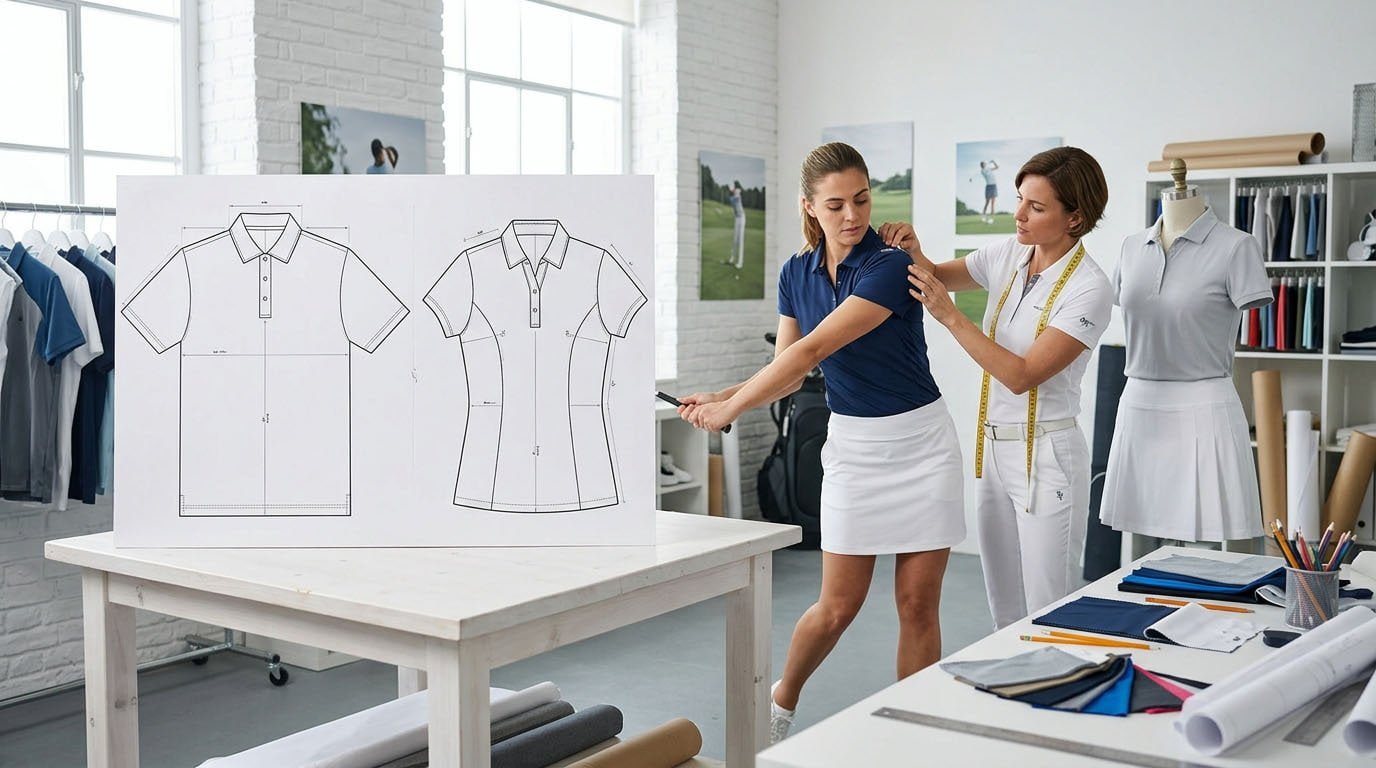
A manufacturer that can explain why a pattern needs adjustment is usually more valuable than one that simply follows measurements without considering movement.
Women's golf fit is also becoming a bigger part of broader collection planning. Our golf apparel trends guide looks at how dedicated women's fit, broader sizing, lifestyle styling, and changing fabric expectations are influencing future golf apparel development.
How Should a Manufacturer Evaluate Fabrics for Women's Golf Apparel?
Common women's golf fabrics include:
- Polyester
- Nylon/polyamide
- Polyester-spandex blends
- Nylon-spandex blends
- Jersey
- Piqué
- Interlock
- Lightweight double knits
- Mesh panels
The correct fabric depends on product type, hand feel, performance requirements, decoration, and price point.
FUWAY's Fabric Sourcing service supports projects that require specific compositions, weights, stretch properties, finishes, or performance characteristics.
Moisture Management
Moisture-wicking is common in golf apparel, but the final garment should still be evaluated after construction and decoration.
Stretch and Recovery
Stretch supports movement.
Recovery determines whether the garment returns to shape after repeated wear.
Poor recovery may create bagging around:
- Waistbands
- Knees
- Hips
- Seat
- Elbows
UV Protection
If a brand plans to promote a specific UV or UPF claim, supporting documentation should be requested rather than relying only on a general fabric description.
Opacity
Opacity is especially important in:
- Light-colored bottoms
- Golf dresses
- Leggings
- Skort liners
A fabric that appears opaque when relaxed may become more transparent when stretched.
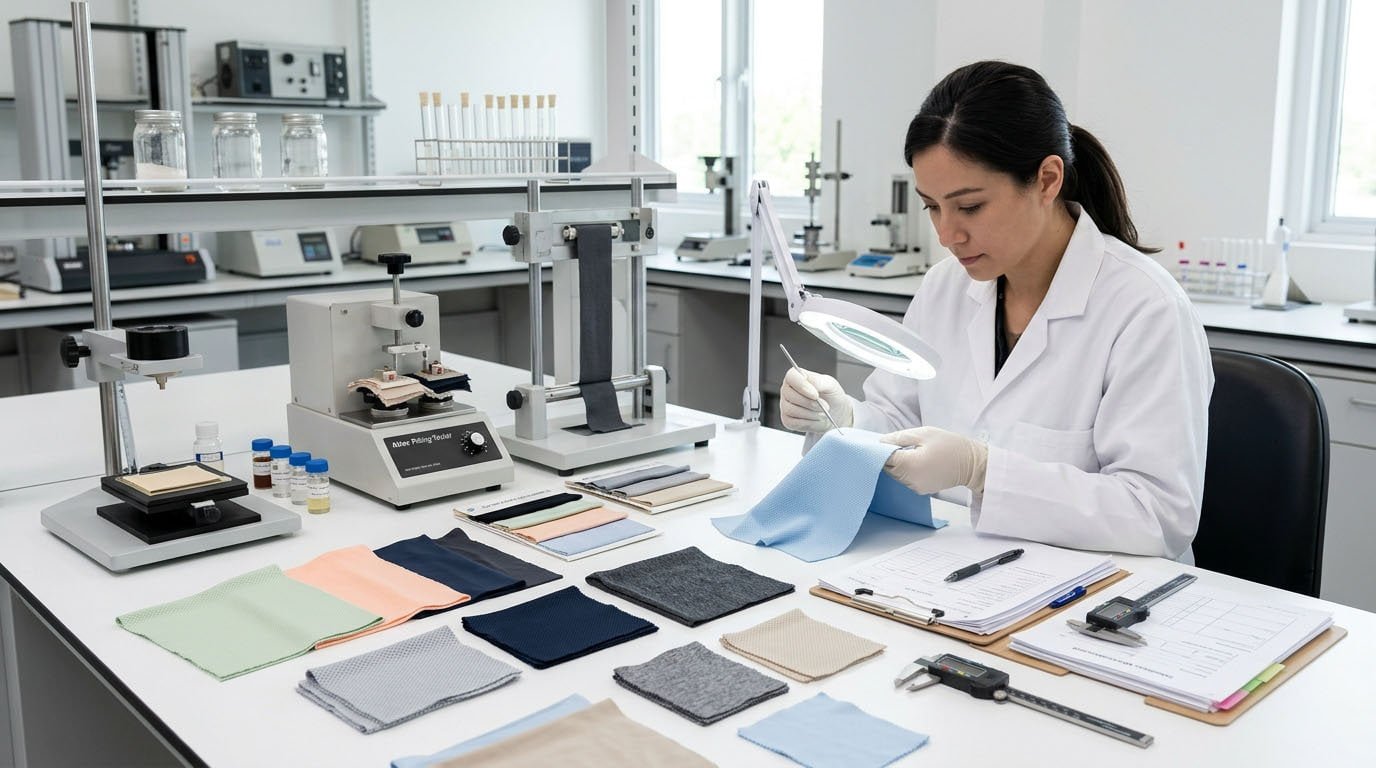
How Should You Verify Fabric Performance Claims?
Instead of accepting broad terms such as "performance fabric," clarify:
- What property is being claimed?
- Is the claim based on a specification or a test?
- Is supporting documentation available?
- Does the tested material match the fabric being supplied?
Relevant verification may cover:
- Color fastness
- Shrinkage
- Pilling
- Stretch and recovery
- UV protection
- Fabric composition
- Dimensional stability
Not every project requires extensive laboratory testing.
However, stronger commercial claims should have stronger supporting evidence.
Brands can also review FUWAY's Test Reports page for available testing documentation.
How Should a Women's Golf Apparel Manufacturer Handle Custom Artwork?
Women's golf apparel increasingly uses:
- Floral prints
- Geometric patterns
- Seasonal graphics
- Abstract artwork
- Repeating motifs
- Gradient designs
- AI-assisted graphics
But artwork that looks good on a screen is not necessarily ready for textile production.
A capable manufacturer should review the file before printing.
What Should Be Checked Before Sublimation or All-Over Printing?
Seamless Repeat
The edges of a repeat tile should connect correctly to avoid visible breaks in the printed fabric.
Resolution
Raster files need sufficient resolution at actual production size.
Repeat Unit
A defined repeat structure makes it easier to control scale and placement.
Color References
Screen colors should not be treated as final production standards when accurate color matching is important.
Panel Placement
Large motifs may need additional review around:
- Plackets
- Collars
- Sleeve seams
- Side seams
- Pockets
- Yokes
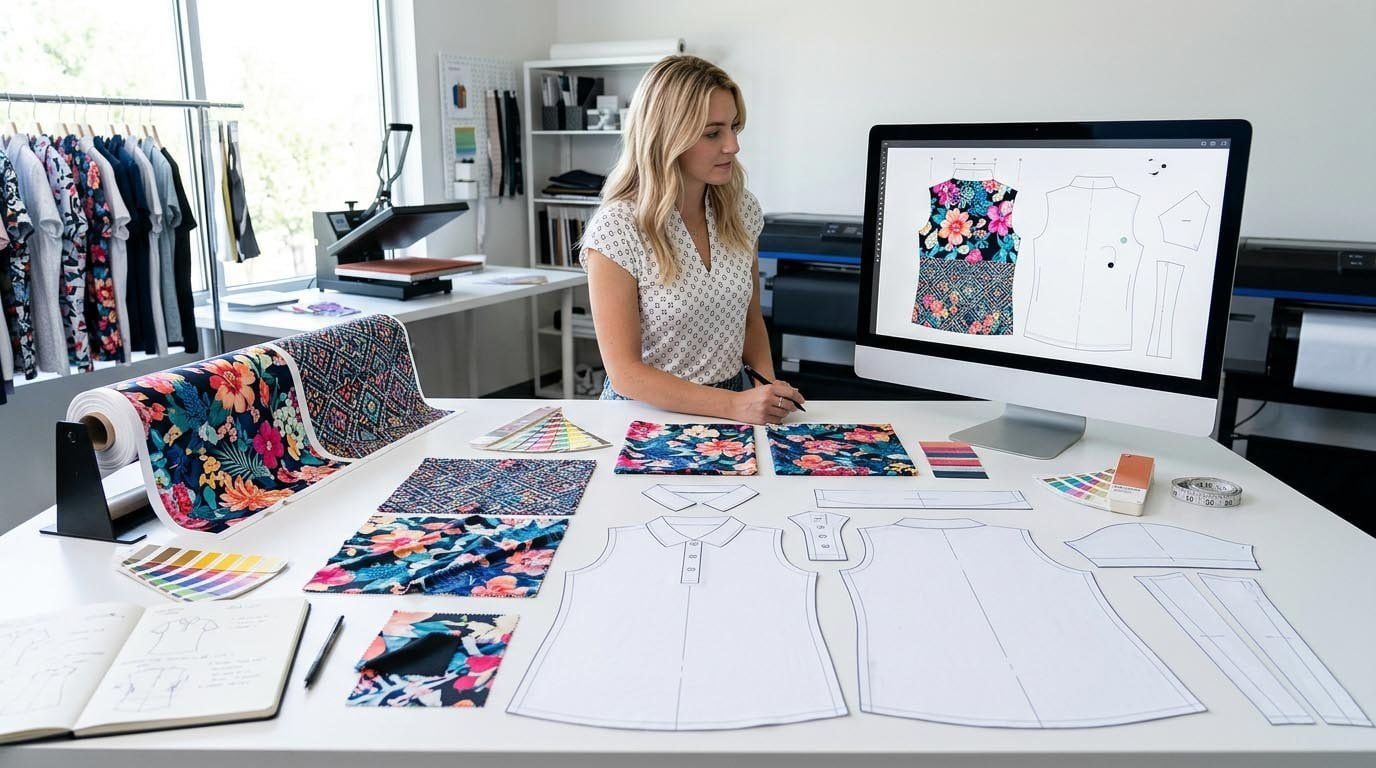
FUWAY supports different decoration methods depending on the design, including Sublimation Printing, Embroidery, and Screen Printing.
Can AI-Generated Artwork Be Used for Women's Golf Apparel?
Yes—but the file may need production preparation first.
The real question is not whether the artwork was generated with AI.
The question is:
Is the file production-ready?
A concept image may still require:
- Repeat correction
- Edge alignment
- Resolution improvement
- Motif cleanup
- Color adjustment
- Scale confirmation
- Production file preparation
A good manufacturer should identify these issues before the first print sample.
What Customization Capabilities Should You Check?
Typical customization may include:
- Fabric selection
- Custom colors
- Sublimation
- Embroidery
- Screen printing
- Heat transfer
- Labels
- Hangtags
- Zippers
- Buttons
- Packaging
The important issue is not how many customization methods a supplier lists.
It is whether the supplier can recommend a suitable process for your fabric, quantity, artwork, and desired appearance.
What Should You Check During Sampling?
Sampling is one of the best ways to evaluate a manufacturer before bulk production.
A typical process may look like:
Tech Pack / Requirements
→ Prototype
→ Fit Review
→ Revision
→ Pre-Production Approval
→ Bulk Production

Prototype Sample
Check:
- Overall silhouette
- Fabric
- Construction
- Collar
- Sleeve shape
- Length
- Decoration
- Key measurements
Fit Sample
Evaluate the garment during actual movement rather than only while standing.
Size Set
For new size specifications, checking several sizes can help reveal grading issues that may not appear in the base size.
Pre-Production Approval
Before bulk production, confirm:
- Measurements
- Fabric
- Color
- Artwork
- Logo placement
- Construction
- Labels
- Packaging
What MOQ Should You Expect for Women's Golf Apparel?
There is no single MOQ that applies to every golf garment.
MOQ can depend on:
- Fabric availability
- Custom dyeing
- Style complexity
- Printing method
- Number of colors
- Trims
- Size range
- Packaging
- Total order structure
At FUWAY, a typical starting point is around 100 pieces per style, with flexibility depending on the program.
For startups, a better question than:
"Who offers the lowest MOQ?"
is:
What level of customization is realistic at my target quantity?
Using an available performance fabric, for example, may allow greater flexibility than developing a completely custom material.
How Long Does Sampling and Bulk Production Take?
A typical planning range is:
- Sample development: around 7–10 business days
- Bulk production: around 3–4 weeks after approvals
Complex prints, custom fabrics, special trims, or repeated revisions may require additional time.
A supplier promising unusually fast production without first reviewing the project details should be questioned carefully.
Women's Golf Apparel Manufacturer Evaluation Matrix
Use this matrix when comparing potential suppliers.
| Capability | What to Ask | Strong Sign | Warning Sign |
|---|---|---|---|
| Women's patterns | Do you develop dedicated women's blocks? | Explains women's fit and grading | Simply scales down men's patterns |
| Product range | Can you make polos, skorts, dresses and bottoms? | Relevant women's golf examples | Limited to basic sportswear |
| Fit development | How do you approve fit? | Structured fitting and revisions | Only checks flat measurements |
| Fabric sourcing | Can you source by specification? | Offers relevant options and documentation | Uses whatever fabric is available |
| Artwork | Do you review files before printing? | Checks repeat, scale and feasibility | Prints files without review |
| Sampling | What happens before bulk? | Clear approval stages | Sample goes directly to production |
| Testing | Can technical claims be supported? | Provides relevant evidence | Broad claims without documentation |
| MOQ | What affects minimum quantity? | Explains fabric and process variables | Gives one vague MOQ |
| QC | How is bulk production checked? | In-line and final inspection | Only final spot checks |
| Communication | Who handles technical questions? | Clear, documented responses | Vague or inconsistent answers |
| Scalability | Can volume increase after launch? | Clear scale-up planning | Cannot explain future capacity |
How Do You Evaluate Quality Before Bulk Production?
You cannot fully judge a manufacturer's quality from a website or quotation.
Use sampling to evaluate how the supplier actually works.
Look for three things:
1. They Ask Technical Questions
A strong supplier may ask about:
- Fabric
- Fit
- Stretch
- Decoration
- Measurements
- Color
- Packaging
2. They Identify Problems Early
Useful feedback may include:
"This artwork needs adjustment."
or:
"This fabric may not suit the intended construction."
Early technical feedback is generally much cheaper than correcting problems after bulk production begins.
3. They Can Reproduce the Approved Sample
Bulk quality should remain consistent in areas such as:
- Measurements
- Stitching
- Color
- Logo placement
- Print quality
- Labels
- Packaging
What Red Flags Should You Watch for Before Paying a Deposit?
Watch for process problems rather than judging a factory only by price or MOQ.
Red Flag 1: Final Pricing Before the Product Is Understood
The supplier should understand fabric, construction, decoration, quantity, and packaging before confirming a realistic quotation.
Red Flag 2: No Discussion of Women's Fit
Women's polos, skorts, dresses, and bottoms need proper fit development rather than simple downsizing.
Red Flag 3: Artwork Is Accepted Without Review
Print files should be checked for production feasibility.
Red Flag 4: Fabric Information Is Vague
You should be able to confirm relevant details such as composition, weight, stretch, and available colors.
Red Flag 5: No Clear Approval Process
Measurements, fabric, artwork, trims, and construction should be clear before bulk production begins.
8 Questions to Ask a Women's Golf Apparel Manufacturer
Before selecting a partner, ask:
- Do you develop dedicated women's patterns?
- Which women's golf products do you manufacture regularly?
- How do you evaluate fit during movement?
- What performance fabrics can you source?
- How do you review print and artwork files?
- What sampling stages are required before bulk?
- What determines MOQ for my design?
- How do you control bulk consistency?
The quality of the answers often tells you more than the speed of the quotation.
FAQ About Women's Golf Apparel Manufacturing
What is a typical MOQ for custom women's golf apparel?
MOQ varies according to fabric, style, decoration, color, and customization.
For FUWAY projects, a typical starting point is around 100 pieces per style, with flexibility depending on the program.
How long does a women's golf apparel sample take?
A typical sample may take around 7–10 business days, depending on the product and development requirements.
Can men's golf patterns be converted into women's styles?
They can sometimes serve as a reference, but proper women's fit usually requires dedicated adjustments for bust, waist, hip, shoulder, length, and balance.
Can AI-generated artwork be used for golf apparel?
Yes.
However, repeat structure, resolution, edge continuity, scale, color, and file format may need adjustment before production.
What fabrics work well for women's golf apparel?
Polyester, nylon/polyamide, and elastane blends are common choices.
The best option depends on product type, stretch, hand feel, durability, opacity, decoration, and price level.
Should I choose the lowest-price manufacturer?
Price matters, but it should be considered together with fit development, fabric quality, sampling, communication, QC, MOQ, and lead time.
Final Checklist Before Choosing Your Manufacturing Partner
Before placing a bulk order, confirm:
- [ ] Women's golf manufacturing experience
- [ ] Dedicated women's fit development
- [ ] Suitable product range
- [ ] Approved fabric
- [ ] Approved fit
- [ ] Approved artwork
- [ ] Agreed MOQ
- [ ] Agreed timeline
- [ ] Clear QC process
- [ ] Relevant testing evidence where required
- [ ] Confirmed packaging
- [ ] Clear bulk approval process
If several of these items remain unclear, resolve them before committing to mass production.
Conclusion: Choose Development Capability, Not Just the Lowest Quote
Selecting the right women's golf apparel manufacturer is ultimately a product-development decision.
A strong manufacturing partner should help you control the areas most likely to cause problems:
- Women's fit
- Fabric selection
- Artwork preparation
- Sampling
- Decoration
- Quality
- Bulk consistency
The best supplier is not necessarily the one offering the lowest quotation or the lowest MOQ.
It is the one that can understand your product, identify risks early, and reproduce the approved design consistently in bulk.
For brands developing women's golf polos, skorts, dresses, bottoms, or private-label collections, FUWAY provides OEM/ODM manufacturing, fabric sourcing, decoration, sampling, and bulk production support.
Explore FUWAY Golf Apparel Manufacturing or contact our team to discuss your design, quantity, fabric requirements, and sampling plan.