
Sampling success depends on defining measurable approval criteria at each stage—color standards, fit tolerances, construction specifications, and performance requirements—so you can confidently approve or reject samples based on objective data rather than subjective feelings that shift between rounds.
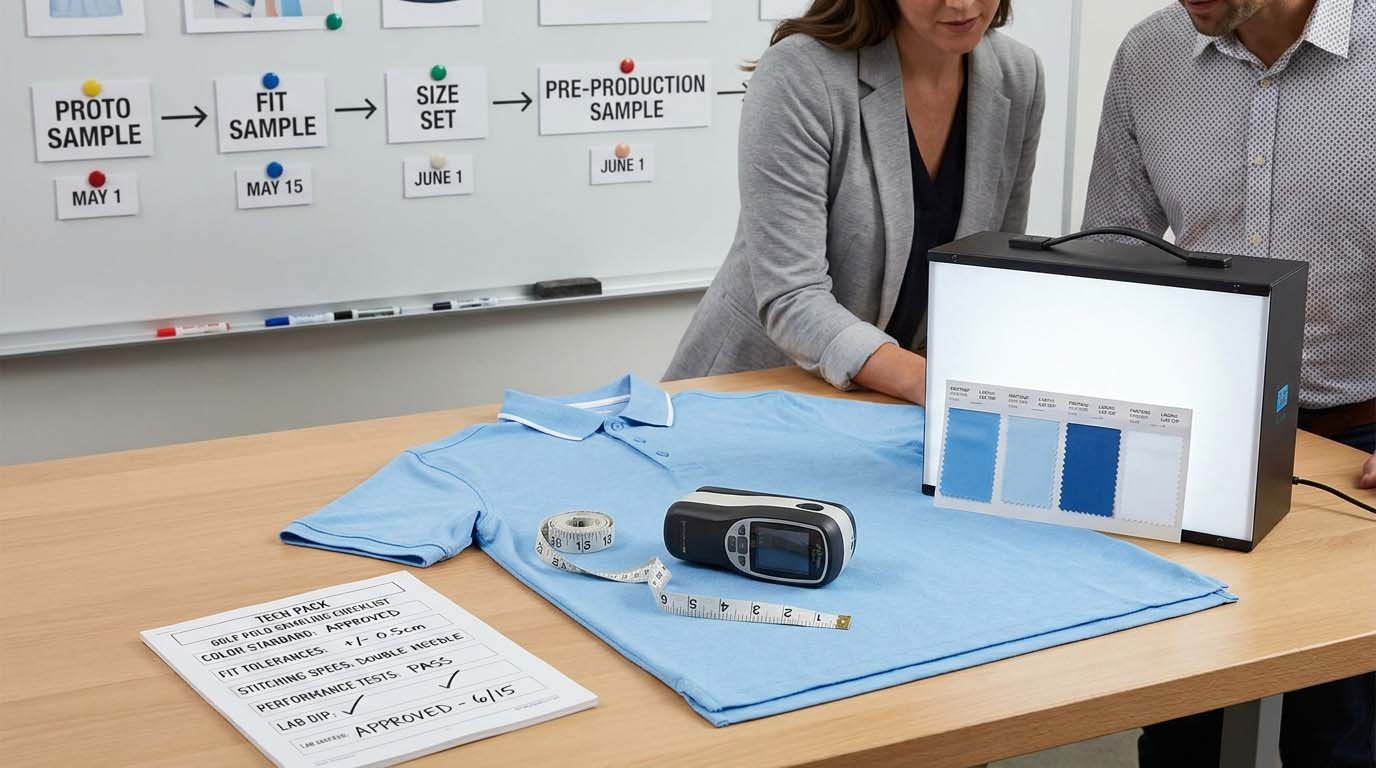
I am Will from FUWAY. I coordinate sampling communication for 150-200 golf polo projects annually. My role is translating between client expectations and factory capabilities—helping clients understand which sample variations are acceptable industry norms versus which require correction. Most sampling delays happen not because factories make mistakes, but because clients lack clear approval criteria and keep revising based on evolving preferences rather than defined standards. This guide shows you how to set up sampling workflows that give you confidence to approve samples and proceed to bulk production without fear of surprises.
Quick Answers: Golf Polo Shirt Sampling Process
How many sampling rounds should I expect for custom golf polos?
Typical path: 1 proto sample (2-3 weeks), 1-2 fit sample revisions (1-2 weeks each if needed), 1 pre-production sample (1 week). Total: 4-6 weeks from initial concept to bulk production approval. Simple designs with standard fits may skip fit sampling. Complex custom fits or new patterns may require 3-4 fit rounds.
What is the difference between proto, fit, and pre-production samples?
Proto sample: Tests overall design concept, fabric selection, and construction method—not precise sizing. Fit sample: Verifies dimensions and proportions across size range—may use substitute fabrics if production fabrics not yet available. Pre-production (PP) sample: Uses exact production fabrics, trims, and methods—what you approve here is what bulk production will deliver.
Should I wash samples before approving them for bulk production?
Yes, always. Wash samples twice using your customers' expected method (warm water, tumble dry). Check for shrinkage, color fading, collar twisting, seam puckering, and logo durability. Problems appearing after washing indicate construction or fabric issues that will affect entire bulk order. Unwashed sample approval is the most common mistake I see causing bulk rejections.
What color and measurement deviations are acceptable in bulk production?
Industry standard tolerances: Color variance within 0.5-1 shade under consistent lighting (acceptable dye lot variance), measurements ±3-5% from approved specs (±1-2cm for most measurements), fabric weight ±5% from specification. These variances are unavoidable in mass production and do not indicate quality problems. Deviations beyond these ranges require factory correction.
How do I provide clear feedback that speeds up sampling instead of causing more rounds?
Use specific, measurable feedback: "Chest measurement should be 52cm not 50cm" instead of "fits too tight." "Color should match Pantone 19-4052 TPX" instead of "too dark." "Logo should be 8cm wide centered 7cm below collar" instead of "logo looks small." Include photos with measurements marked. Vague feedback creates interpretation gaps requiring extra rounds.
Can I skip sampling and order directly from reference samples or photos?
Risky. Reference samples show construction details but do not account for your specific fabric choices, sizing requirements, or branding elements. Photos cannot communicate fabric hand-feel, weight, stretch, or accurate colors. Sampling costs $150-400 but protects $5,000-20,000 bulk orders from misalignment. False economy to skip sampling unless reordering proven styles.
What should I do if my sample looks perfect but I worry bulk production will differ?
Request pre-production (PP) sample using exact bulk production fabrics, same sewing line, same operators when possible. Approve with documented Golden Sample retained by both parties. Conduct pre-shipment inspection using AQL standards with Golden Sample as reference. Quality variance beyond specified tolerances triggers correction before shipment. This workflow prevents most bulk disappointments.
How Do You Set Sampling Goals That Actually Prevent Bulk Production Surprises?
Sampling effectiveness depends on defining specific, measurable outcomes for each sample type—not achieving subjective perfection but validating that production capabilities match your documented specifications within acceptable tolerances.
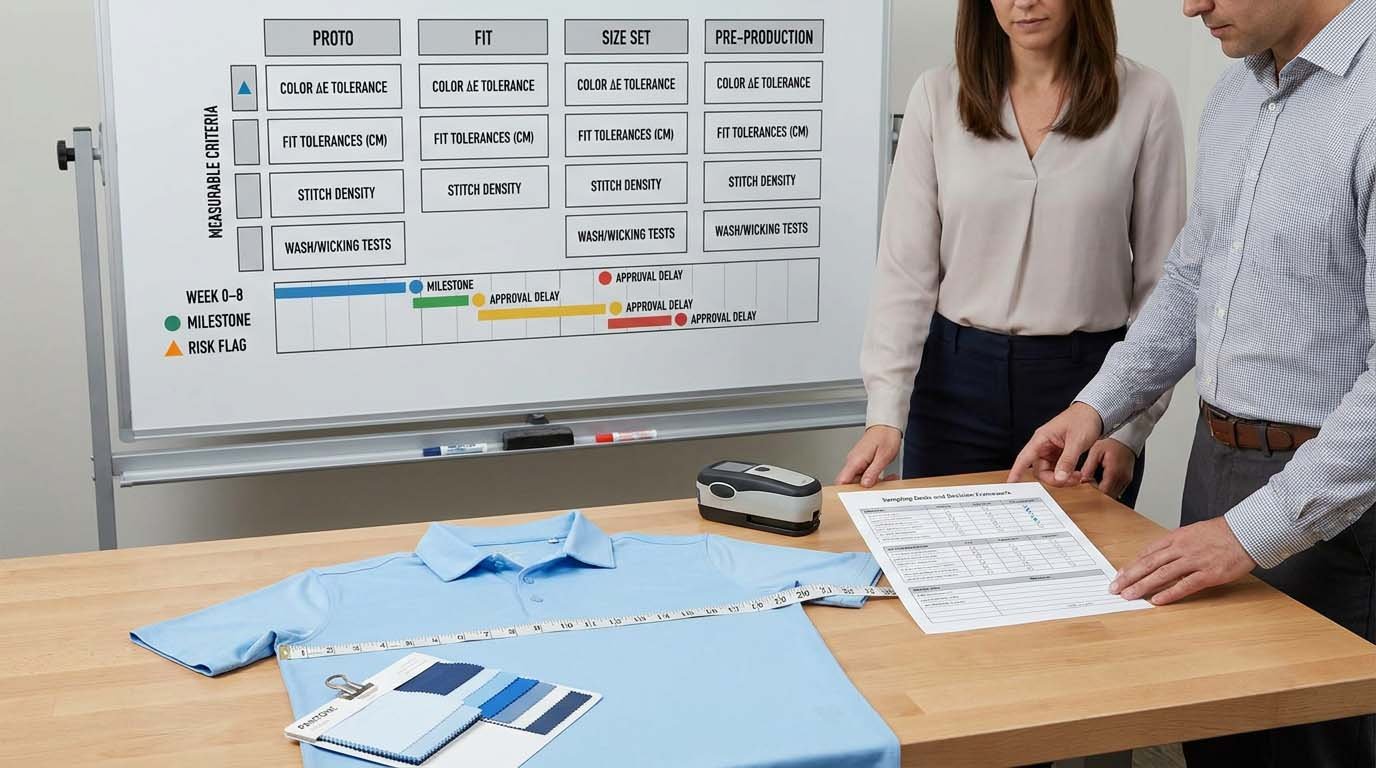
Your Role Versus Factory Role in Sampling
Your responsibilities:
Provide clear specifications: tech pack with measurements, Pantone codes, logo artwork, fabric performance requirements
Review samples within 2-3 business days and provide specific feedback
Maintain approved samples as reference standards for bulk comparison
Define acceptable tolerance ranges for measurements and colors
Make final approval decisions
Factory responsibilities:
Source materials matching your specifications
Produce samples according to provided tech pack
Communicate if specifications are not feasible and suggest alternatives
Maintain internal quality standards during sampling and bulk
Replicate approved samples in bulk production within standard tolerances
Common responsibility gaps:
Client expects factory to "design" the polo without providing detailed specs
Client changes preferences between rounds without documenting why
Factory assumes client understands standard tolerances and does not explain them upfront
I spend significant time aligning these expectations before sampling starts. Clients who understand their role approve samples 40-50% faster than those waiting for factory to "figure out what they want."
Sampling Timeline and Milestones
Realistic timeline for first-time custom polo:
Week 0: Client provides tech pack, reference samples, Pantone codes
Week 1-2: Factory sources materials and produces proto sample
Week 3: Client receives proto, reviews design concept, requests fit adjustment
Week 4: Factory produces fit sample with measurement corrections
Week 5: Client receives fit sample, approves or requests minor tweaks
Week 6: Factory produces pre-production sample with exact production materials
Week 7: Client receives PP sample, washes twice, verifies all specifications
Week 8: Client approves, factory begins bulk production
Critical path risks:
Delays in client approvals: Each 3-day approval delay extends timeline by 1 week when you account for production scheduling
Material unavailability: Custom fabric or trim sourcing adds 2-4 weeks if not planned early
Unclear feedback requiring clarification calls: Adds 2-5 days per round
I tell clients to budget 6-8 weeks for sampling before bulk production starts. Clients assuming 2-3 weeks face compromised quality or missed deadlines.
What Should You Actually Check at Each Sample Type and When Should You Reject?
A client received their fit sample and immediately said "I approve." I asked if they tried it on. They had not—just looked at it folded. I suggested they try it on someone matching their target size, measure all dimensions, and walk around to test mobility. They did. They discovered the armhole was too tight and sleeve length was 2cm short. If they had approved without testing, bulk production would have delivered 1,000 polos with uncomfortable fit. The $150 fit sample round saved them from $13,000 of unusable inventory.
Each sample type has specific validation purposes—proto tests design viability, fit samples test sizing accuracy, pre-production samples test production readiness—and skipping proper evaluation at any stage pushes risk forward into bulk production where corrections cost 50-100 times more.
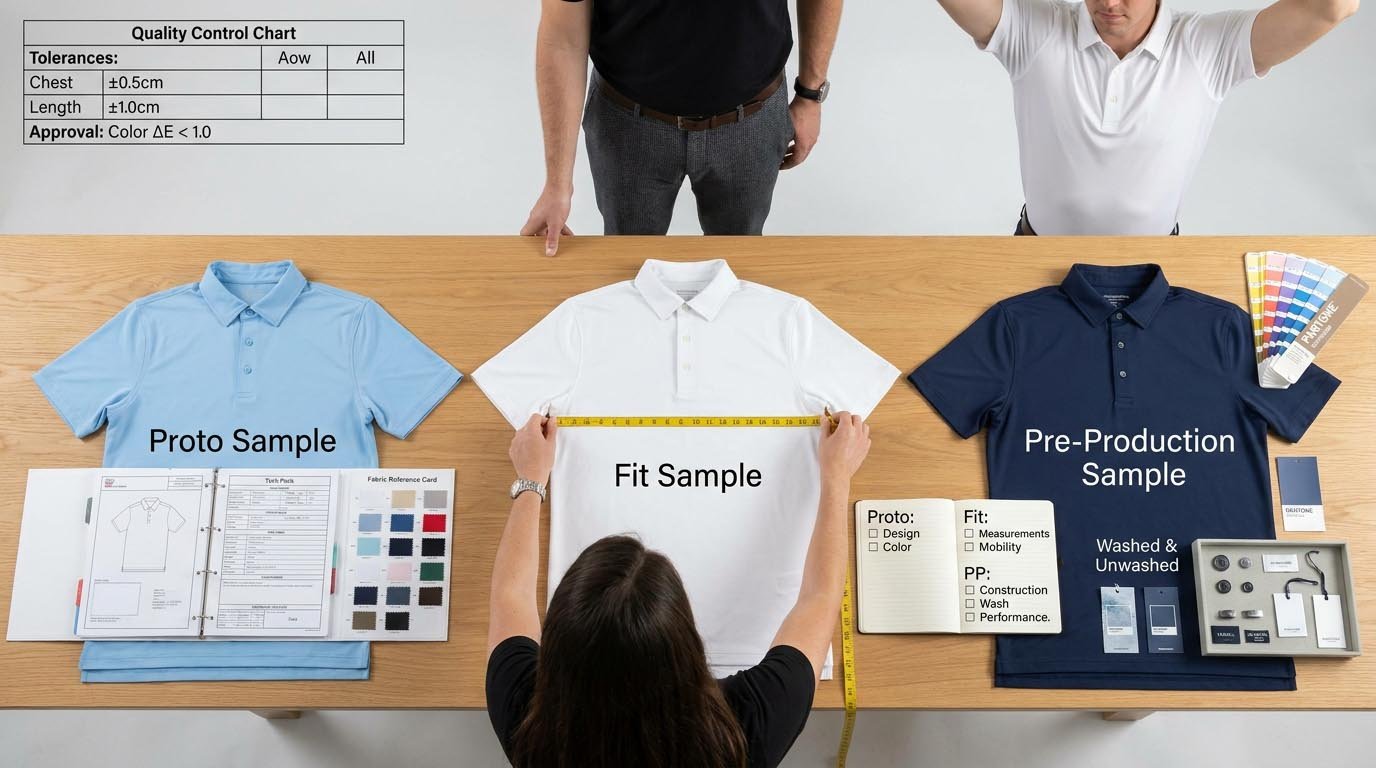
Proto Sample (Design Concept Validation)
Purpose:
Verify overall design feasibility, fabric choice appropriateness, construction method, and general styling. Not about precise measurements.
What to check:
Does the collar style work with your design intent?
Does the fabric hand-feel, weight, and stretch meet expectations?
Does the overall silhouette match your vision?
Are logo placement and size approximately correct?
Does construction quality appear professional?
What not to worry about:
Precise measurements (proto often uses sample sizing, not full grading)
Exact color matching (often uses available fabrics, not production colors)
Perfect trim details (buttons, labels may be temporary)
When to approve proto:
Design direction confirmed, fabric type validated, construction approach proven
When to request revision:
Fundamental design elements wrong (collar shape, fabric weight category, overall fit profile)
Construction method inadequate for performance requirements
Cost of proto revisions:
First proto: $80-150
Each revision: $60-100 + 7-10 days
Fit Sample (Size and Proportion Validation)
Purpose:
Verify measurements, proportions, and fit across size range. May still use substitute materials if production fabrics not yet available.
What to check:
Measure all key dimensions: chest, waist, hip, length, shoulder, sleeve length (flat measurements, not on body)
Try on corresponding body size and assess comfort and mobility
Check proportion relationships: torso length to sleeve length, shoulder width to chest width
Verify ease (how much larger garment measures than body): 4-6 inches at chest for standard fit, 2-4 inches for slim fit
Specific checkpoints:
| Measurement Point | How to Measure | Typical Tolerance |
|---|---|---|
| Chest width | Pit to pit, 1" below armhole | ±1-2cm |
| Body length | High shoulder to hem | ±1-2cm |
| Sleeve length | Shoulder seam to cuff | ±1cm |
| Shoulder width | Seam to seam across back | ±0.5-1cm |
When to approve fit sample:
All measurements within ±1-2cm of your specifications
On-body fit test confirms comfort and intended fit profile
Proportions look balanced
When to request revision:
Measurements off by 3cm+ requiring pattern adjustment
Fit profile wrong (approved slim fit but sample is standard fit)
Proportions unbalanced (sleeves too short relative to body)
Common fit sample mistakes I see:
Clients approve based on flat measurements without trying on—miss comfort issues
Clients try on wrong size then complain about fit—need size chart aligned to target customer
Clients request revisions for 0.5cm differences—within normal tolerance, will vary in bulk anyway
Pre-Production Sample (Final Production Validation)
Purpose:
Exact replica of bulk production using final materials, colors, trims, and construction methods. This is your contract—bulk production should match this sample within specified tolerances.
What to check:
Colors match approved Pantone or lab dip standards under consistent lighting
All measurements match approved fit sample specifications
Logos and branding exactly as specified in placement, size, and execution
All trims (buttons, labels, hang tags) are final production versions
Construction matches quality expectations
Critical: Wash test before approval
Wash PP sample twice using expected consumer method:
Warm water cycle (30-40°C)
Tumble dry medium heat
Measure again after washing—acceptable shrinkage is 3-5%
Check for collar twisting, seam puckering, color fading, logo distortion
When to approve PP sample:
Colors within 0.5-1 shade tolerance
Measurements within ±2-3% after washing
No construction defects (puckering, loose stitching, misalignment)
Performance holds up after washing (collar stays flat, logos intact)
When to reject PP sample:
Colors off by 2+ shades from standard
Measurements shrink more than 5% after washing
Construction defects visible (twisted collars, puckered seams)
Logo execution poor (uneven stitching, wrong placement)
How Do You Manage Color and Material Approvals Without Endless Lab Dip Rounds?
A client rejected four consecutive lab dip rounds saying each was "still not right." I asked them to specify their exact color target. They said "like the photo I sent." I explained photos vary dramatically based on lighting, screen calibration, and camera settings. I requested a Pantone code or physical reference swatch. They provided Pantone 19-4052 TPX. I sent lab dip matching that code. They approved immediately. Four rejected lab dips happened because they were comparing to inconsistent reference (photo on phone screen) rather than physical standard.
Color approval efficiency depends on using objective reference standards—Pantone codes, approved lab dips, or physical swatches retained by both parties—rather than subjective descriptions or digital images that vary across devices and lighting conditions.
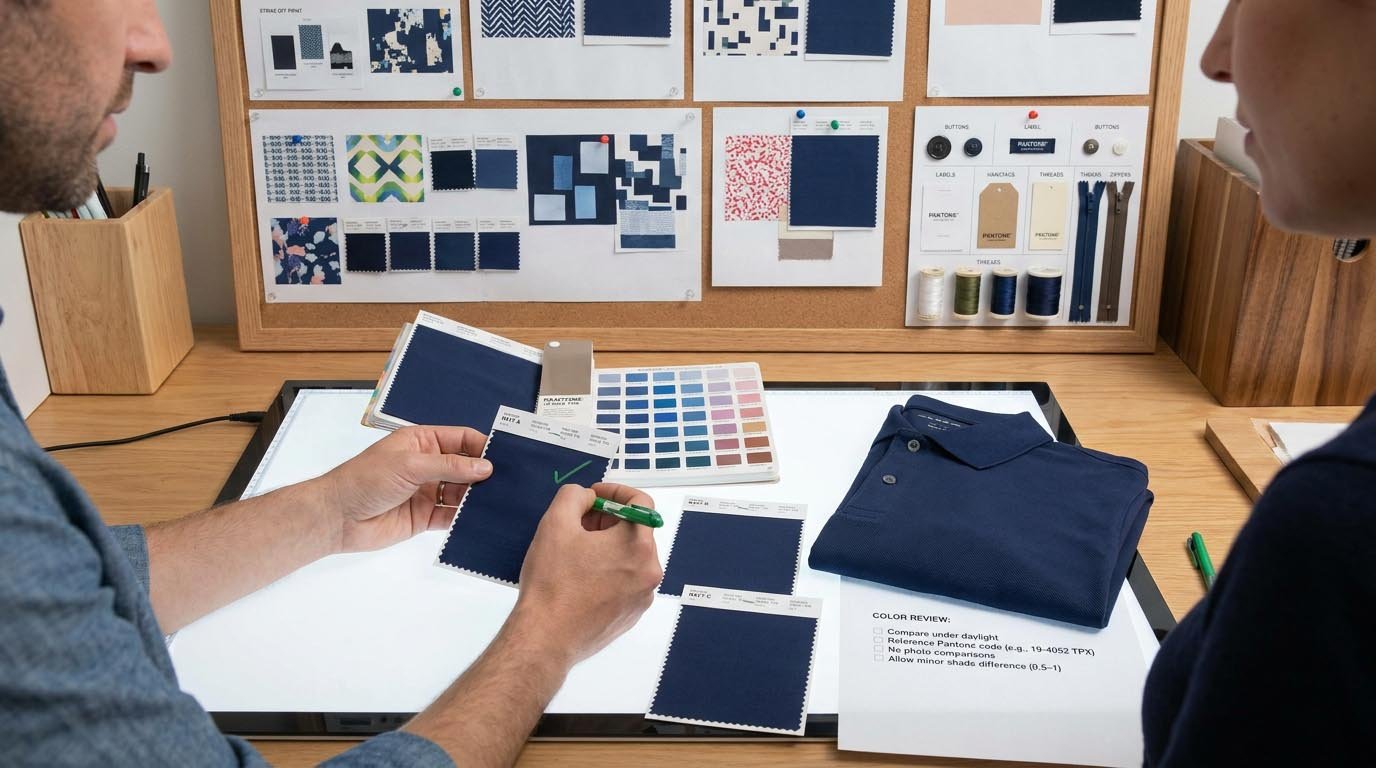
Lab Dips and Color Approval Process
What are lab dips:
Small fabric swatches (10cm × 10cm) dyed using proposed production dye formula. Sent to you for color approval before bulk fabric dyeing begins.
Why you need lab dips:
"Navy" has 50+ variations. Your navy versus our navy versus Pantone navy are all different.
Digital photos cannot represent accurate colors—lighting and screens distort everything.
Fabric type affects color appearance—same dye on cotton versus polyester looks different.
How to review lab dips properly:
Compare under consistent lighting (natural daylight or daylight-equivalent bulb, not fluorescent or incandescent)
Compare against your Pantone reference or approved physical swatch
Do not compare against photos on screens
Check multiple angles—some fabrics shift slightly based on viewing angle
Approval criteria:
Match within 0.5-1 shade is excellent (barely perceptible difference)
Match within 1-2 shades is acceptable for most retail applications
Difference of 3+ shades requires revision
Common lab dip delays:
Client compares to photo instead of Pantone—endless revisions chasing shifting reference
Client reviews under poor lighting—color looks different each time they check
Client does not respond within 2-3 days—extends timeline while fabric mills wait
I recommend: Get Pantone TPX (textile) swatchbook ($200-300) if you plan regular orders. One-time investment eliminates color guessing.
Strike-Offs for Prints and Patterns
If your design includes screen printing, heat transfers, or sublimation printing:
Strike-off definition:
Test print on actual fabric using production method. Shows colors, registration accuracy, and print durability.
What to verify:
Colors match approved Pantone standards
Print placement and size correct
Detail clarity (small text readable, fine lines clean)
Durability after washing (print does not crack or fade)
Typical strike-off timeline:
1 week for simple prints, 2-3 weeks for complex multi-color prints
Trim Cards and Accessory Approvals
What are trim cards:
Physical samples of all components: buttons, labels, hang tags, zipper pulls, thread colors. Ensures you see and approve actual production components.
Why trim cards matter:
Button colors that look "white" come in 20+ shades from ivory to bright white
Label quality varies dramatically—cheap labels fade or fray after 3-5 washes
Thread color mismatch makes topstitching or embroidery look cheap
Approval process:
Factory sends trim card with all components attached to cardboard
You verify each component meets expectations
You approve or request changes before bulk production begins
I have seen orders where clients approved everything except they never saw actual buttons. Bulk production used standard white buttons that did not match the premium positioning of the brand. Trim card review would have caught this.
What Measurement Tolerances Are Actually Acceptable and How Do You Communicate Them?
A client rejected bulk production because chest measurements were 52.5cm instead of specified 52cm. They demanded full remake. I asked if they understood standard measurement tolerance. They did not. Industry standard is ±3-5% for knit garments. At 52cm, tolerance range is 50.5-53.5cm. Their 52.5cm measurement was well within acceptable range. I explained this in writing with reference to industry standards. They accepted the shipment. The dispute happened because we never communicated tolerances during sampling approval.
Measurement tolerance alignment during sampling prevents bulk rejection disputes—because knit fabrics naturally vary by 2-5% due to stretch, and manual measurement contains ±3-5mm variance even when measurements are technically identical.
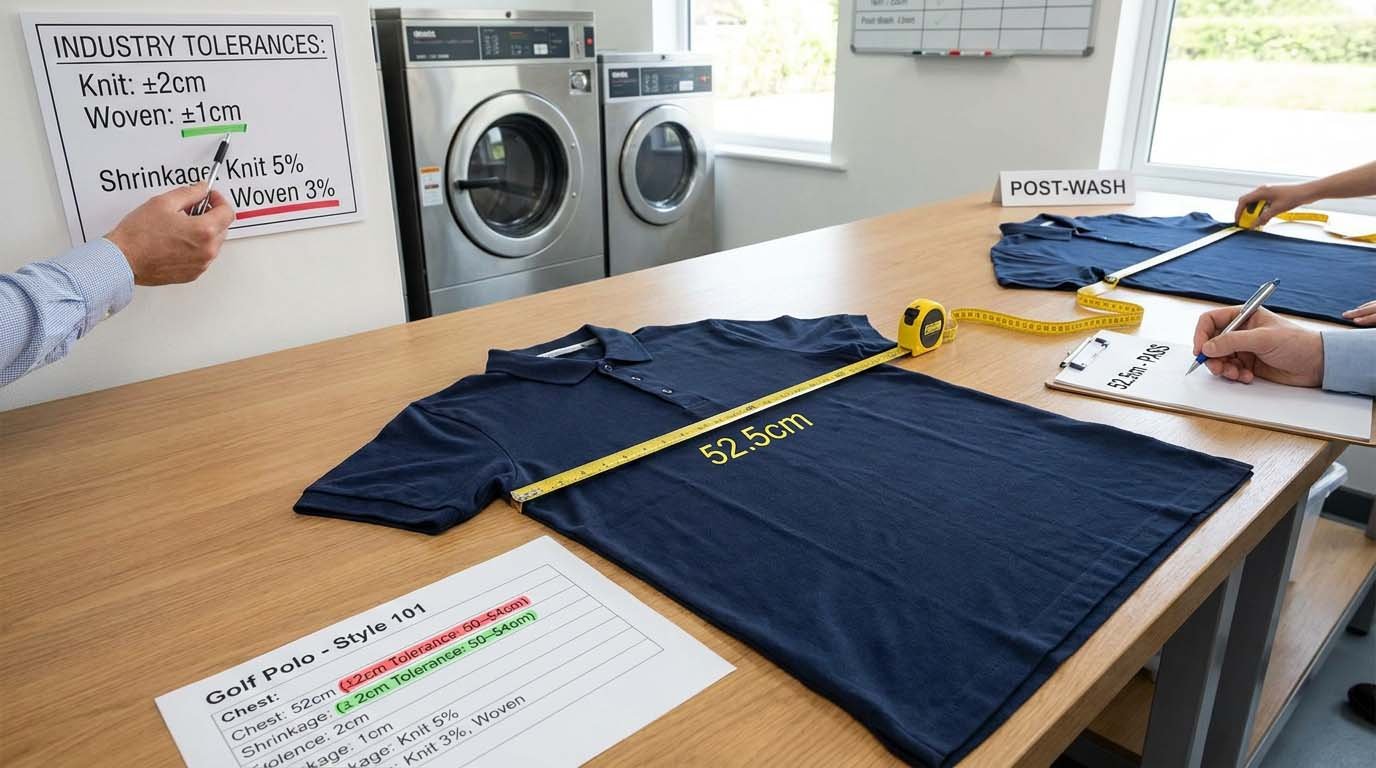
Industry Standard Measurement Tolerances
Woven fabrics (non-stretch):
Typical tolerance: ±1-2% or ±0.5-1cm
Knit fabrics (with stretch):
Typical tolerance: ±3-5% or ±1-2cm
Golf polos use knit fabrics. Expecting woven fabric precision is unrealistic.
Tolerance by measurement type:
| Measurement | Specified | Tolerance Range | Acceptable Range |
|---|---|---|---|
| Chest width | 52cm | ±2cm | 50-54cm |
| Body length | 72cm | ±2cm | 70-74cm |
| Sleeve length | 22cm | ±1cm | 21-23cm |
| Shoulder width | 46cm | ±1cm | 45-47cm |
Why tolerances exist:
Knit fabrics stretch—measurement varies based on tension applied during measuring
Manual measurement contains human variance—same garment measured by three people yields three slightly different results
Fabric relaxation—measurements shift 1-3% as fabric relaxes after production
Cutting variance—automated cutting is consistent within ±2-3mm, manual cutting within ±5mm
How to Specify Tolerances in Sampling Approval
During PP sample approval, document:
"Chest width approved at 52cm ±2cm tolerance (50-54cm acceptable range)"
"Body length approved at 72cm ±2cm tolerance (70-74cm acceptable range)"
"All measurements are taken flat, without stretching, at standardized points"
This creates shared understanding. Bulk production within these ranges is acceptable and not defective.
Shrinkage Tolerance
Expected shrinkage after first wash:
Cotton and cotton-blend knits: 4-7% shrinkage
Polyester and performance knits: 2-4% shrinkage
How to account for shrinkage:
During PP sample approval, wash sample twice and measure after washing
Approved measurements are post-wash measurements
Factory may intentionally make garments 2-5% oversize to account for shrinkage
Bulk production measurements should match your post-wash approved sample within tolerance
Common mistake:
Client approves unwashed PP sample measurements. Bulk production matches those measurements. After customer washing, garments shrink 5% and are too small. This is client error—should have tested wash shrinkage during sampling.
I always ask clients: "Have you washed and remeasured this sample?" If not, their approval is incomplete.
What Construction and Performance Tests Validate Production Readiness?
Performance validation during sampling requires physical testing—not trusting claims or visual inspection—because performance treatments are invisible and only verifiable through wash testing, wear testing, or lab certification that you document before bulk production begins.
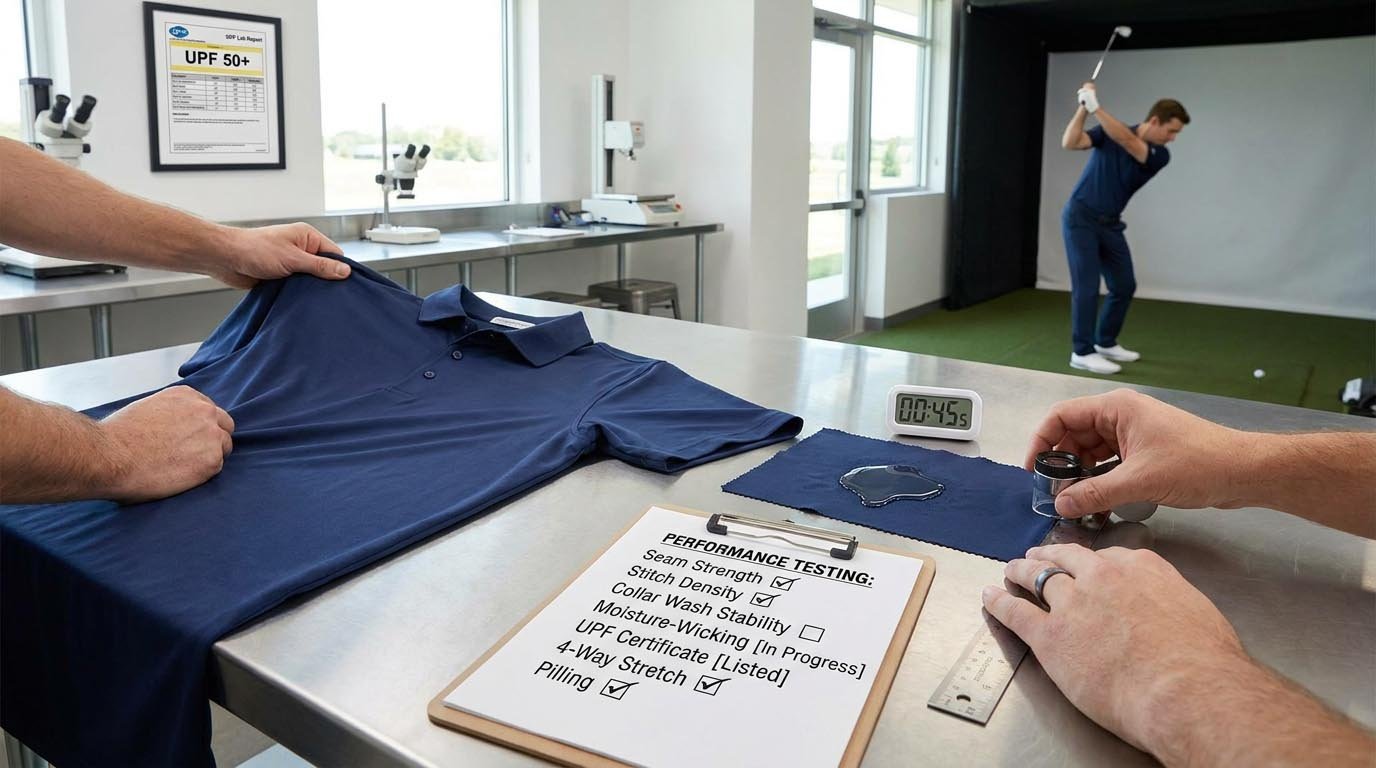
Construction Quality Checkpoints
Seam strength test:
Tug firmly on all seams—shoulder, side, sleeve attachment. Seams should not stretch excessively or show thread loosening.
Stitch density verification:
Count stitches per inch on critical seams (typically 10-12 stitches per inch). Too few stitches (under 8) weaken seams. Too many stitches (over 14) create rigid, brittle seams prone to breaking.
Collar stability after washing:
Wash PP sample twice. Check if collar twists, curls, or loses shape. Properly constructed collar maintains symmetry and flat appearance after washing.
Placket and buttonhole inspection:
Button and unbutton repeatedly—buttonholes should maintain shape without stretching. Placket should lay flat without puckling or rippling.
Logo and decoration durability:
Wash samples and check if embroidery or printing shows wear, fading, or loosening. Quality embroidery should look virtually unchanged after 2-3 washes.
Performance Feature Testing
Moisture-wicking verification:
Wet a section of fabric with water. True moisture-wicking fabrics spread moisture across surface and dry 30-50% faster than untreated fabric. If water beads up or dries at same rate as cotton, fabric does not have wicking properties.
UV protection (if specified):
Request UPF test report from certified lab. Cannot verify UPF visually. If factory claims UPF 50+ protection, they must provide documentation. No report = no substantiated claim.
4-way stretch test:
Pull fabric in both horizontal and vertical directions. Should stretch 30-40% in both directions and recover quickly without permanent distortion.
Durability and pilling resistance:
Wash samples 3-5 times and check for fabric pilling (small fiber balls forming on surface), seam integrity, and color fading. Quality fabrics show minimal pilling and maintain color vibrancy.
Hand-Feel and Comfort Validation
What is hand-feel:
Tactile sensation of fabric—softness, smoothness, weight, temperature perception.
How to evaluate:
Try on PP sample and wear for 30-60 minutes
Move through golf swing motions to test mobility and comfort
Note any irritation, excessive warmth, or restriction
Compare hand-feel to approved proto sample—should match
Red flags:
Fabric feels scratchy or rough (indicates poor fiber quality or excessive chemical residue)
Fabric feels clammy when damp (lacks moisture management)
Fabric feels excessively heavy or restrictive (wrong weight or poor stretch)
I tell clients to actually wear samples, not just look at them on the table. Problems you notice after 30 minutes of wearing will be the same problems customers complain about.
How Do You Use Pre-Production Approval to Control Bulk Production Quality?
Pre-production approval effectiveness depends on retaining Golden Sample as physical reference standard, documenting all approved specifications in writing, and using that documented approval as quality control baseline during bulk production inspection.
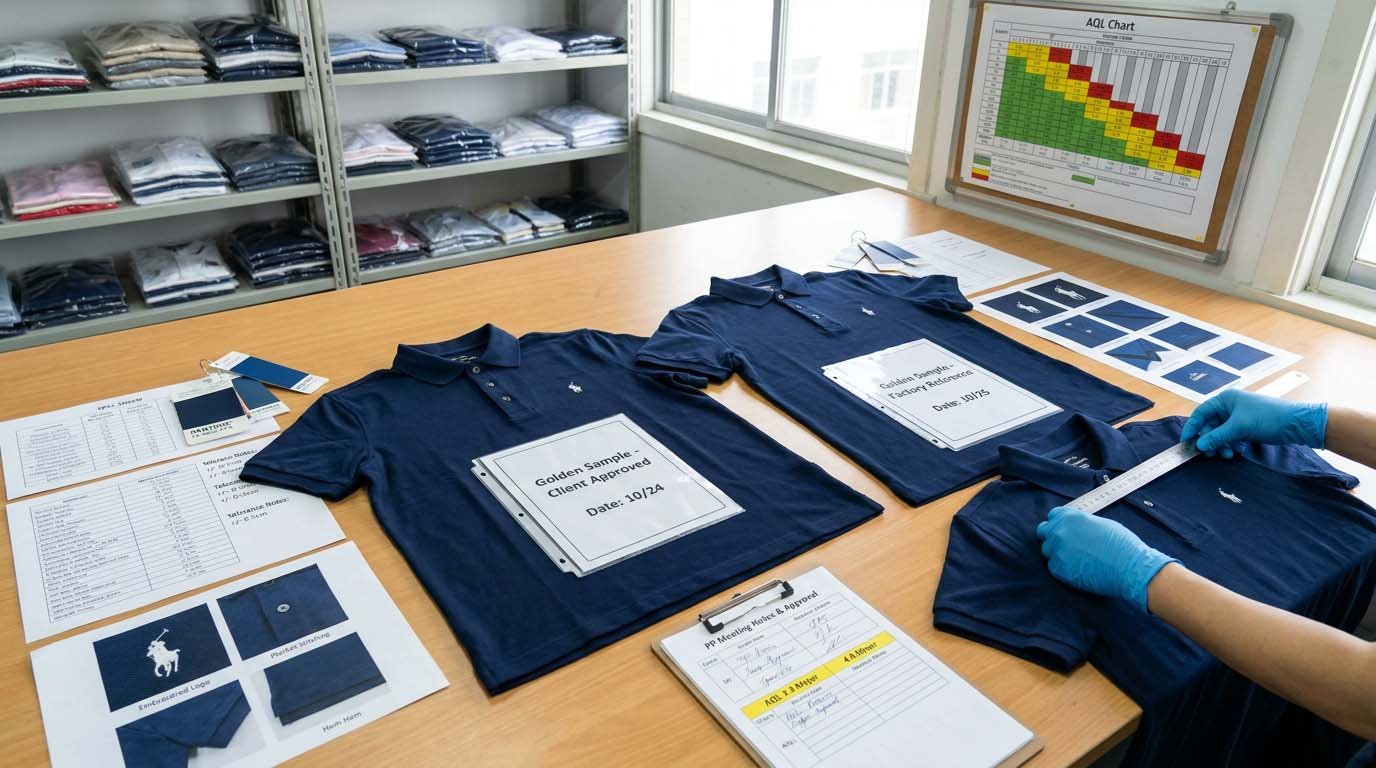
Golden Sample Retention System
What is Golden Sample:
Approved PP sample retained by both factory and client as physical reference standard for bulk production quality comparison.
How to use Golden Sample:
Client keeps one approved PP sample in original condition (unwashed)
Factory keeps duplicate approved PP sample at production line
During bulk production, factory compares output to Golden Sample
During final inspection, inspector uses Golden Sample as reference
Any deviation beyond specified tolerance requires factory correction
Golden Sample documentation:
Photos of all details: front, back, collar, placket, logos, labels
Written measurements of all key dimensions
Color references (Pantone codes or lab dip numbers)
Construction notes (stitch types, seam finishes, attachment methods)
Pre-Production Meeting (PP Meeting)
Purpose:
Final alignment on specifications, tolerances, quality standards, and inspection criteria before bulk production begins.
What to cover in PP meeting:
Review all measurements and confirm tolerance ranges
Verify color standards and acceptable variance
Confirm logo placement and size specifications
Discuss quality acceptance criteria (AQL levels)
Establish communication protocol during production
Typical PP meeting format:
Video call with PP sample on both sides for reference
Review Golden Sample details point by point
Document any clarifications or adjustments
Both parties sign off on written specifications
AQL Inspection Alignment
AQL (Acceptable Quality Limit) definition:
Statistical sampling method for quality inspection. Defines acceptable defect rates for critical, major, and minor defects.
Common AQL standards for golf apparel:
Critical defects (safety/usability issues): 0% acceptable
Major defects (significant appearance/function issues): 2.5% acceptable
Minor defects (small cosmetic issues): 4.0% acceptable
What to define before bulk production:
Which defects are critical (collar completely misshapen, wrong size labels, safety hazards)
Which defects are major (wrong color outside tolerance, measurement outside tolerance, logo misalignment)
Which defects are minor (small loose threads, slight color variation within tolerance)
Documentation prevents disputes:
"Major defect: Color variation exceeding 1.5 shades from Golden Sample"
"Major defect: Chest measurement outside 50-54cm range"
"Minor defect: Loose threads under 1cm length"
When inspection happens, inspector references this documented standard. No ambiguity about what passes or fails.
I have seen bulk shipments rejected for "quality issues" that were actually within agreed tolerance but client forgot what they approved. Written documentation and Golden Sample prevent this.
Conclusion
Golf polo sampling success depends on defining measurable approval criteria at each stage (proto validates design concept, fit samples verify measurements within ±3-5% tolerance, PP samples test production materials and must pass wash testing), retaining Golden Samples as documented reference standards, and aligning quality expectations through written specifications and AQL criteria—ensuring bulk production delivers consistent results rather than subjective disappointments caused by unclear approval standards or untested assumptions about normal manufacturing variance.