Choosing between pleated vs flat-front golf shorts is more than a styling decision. For golf apparel brands, the front construction influences the garment's appearance, fit, pattern development, and how it behaves during movement.
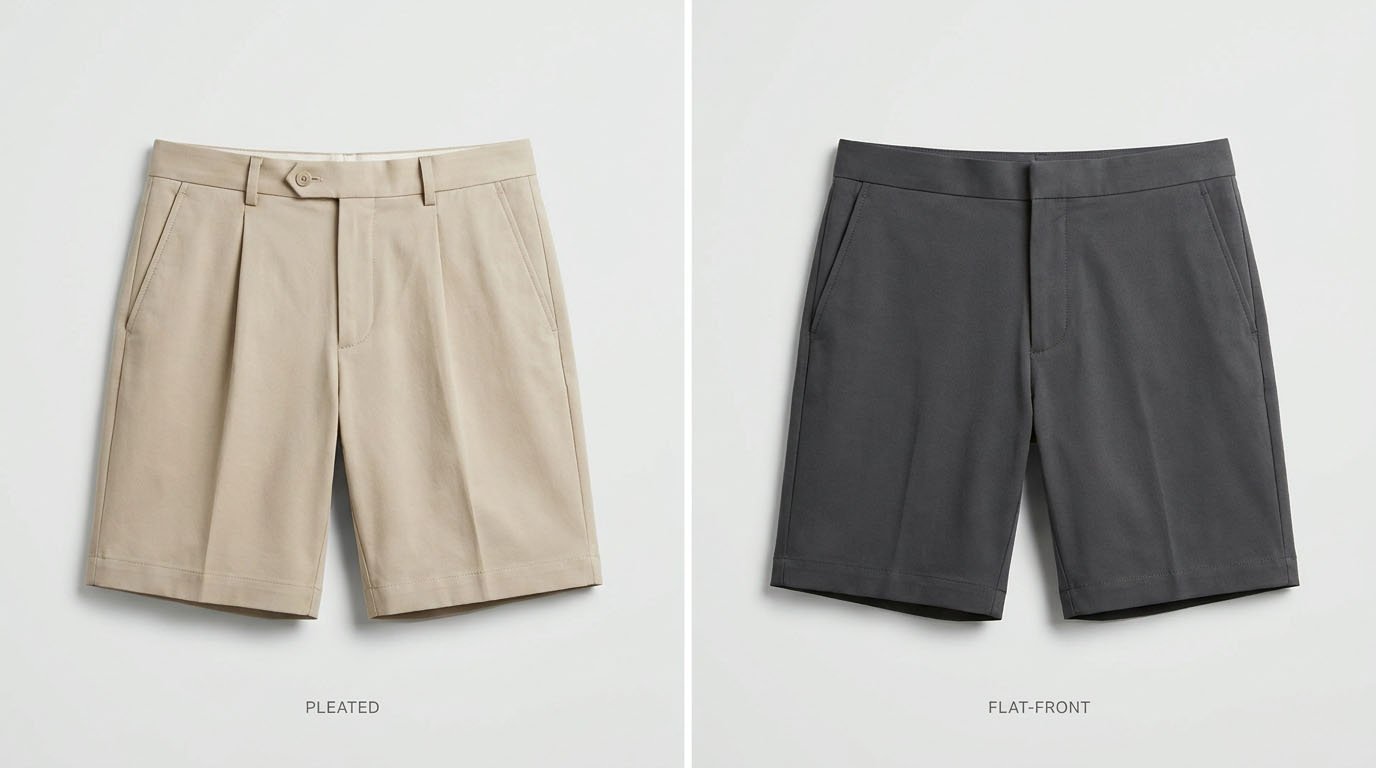
Pleated golf shorts use one or more folds of fabric below the waistband, while flat-front shorts have a smooth front without pleats.
Neither construction is automatically more comfortable or better for golf. The right choice depends on your target customer, intended silhouette, fabric behavior, and approved sample.
This guide explains the construction differences, what brands should include in a tech pack, and how to evaluate samples before production. It also includes an actual FUWAY men's flat-front golf shorts size specification to illustrate how garment measurements are documented across sizes.
Quick Answer: Pleated vs Flat-Front Golf Shorts
| Feature | Pleated Golf Shorts | Flat-Front Golf Shorts |
|---|---|---|
| Front construction | One or more folds below the waistband | Smooth front without folds |
| Appearance | Adds visible structure and front volume | Cleaner, uninterrupted front |
| Style direction | Classic, tailored, resort, or fashion-led | Minimal, athletic, or casual |
| Fit possibilities | Slimmer or relaxed depending on design | Slim, regular, or relaxed |
| Main construction risk | Bulky or unintentionally opening pleats | Front tension or pocket flare |
| Key sample checks | Pleat depth, position, drape, and movement | Front balance, pocket appearance, and movement |
Important: Flat-front does not mean slim-fit, and pleated does not automatically mean loose-fitting.
Key 1. What Is the Difference Between Pleated and Flat-Front Golf Shorts?
The main difference is the construction of the front panels, not the overall fit of the garment.
Pleated Golf Shorts
Pleated shorts contain folded fabric below the waistband. These folds create visible structure and can provide additional front volume when the construction allows them to open.
Common design variables include:
- Pleat count: Single or multiple pleats on each front panel.
- Pleat direction: The orientation of the folds.
- Pleat depth: The amount of fabric incorporated into each fold.
- Stitch-down length: How far the pleat remains secured below the waistband.
- Pleat position: Its location relative to the fly, waistband, and pockets.
A properly designed pleat may open slightly when the wearer sits or bends.
However, a shallow decorative pleat or one stitched down extensively may offer little additional movement ease.
Flat-Front Golf Shorts
Flat-front shorts have a smooth front panel without pleats.
Their appearance depends on the pattern, rise, waistband, thigh allowance, and leg opening.
A flat-front construction can be used for athletic, regular, or relaxed silhouettes.
Unlike pleated shorts, flat-front designs do not rely on folded front fabric to create additional volume. Instead, the required ease must be incorporated into the pattern and supported by suitable fabric behavior.
For a broader overview of shorts categories, see our Golf Shorts Styles, Fit & Comfort Guide.
Key 2. Which Construction Fits Your Golf Brand's Positioning?
Front construction contributes to a brand's visual identity, but it does not determine whether a product is traditional, modern, or performance-oriented by itself.
A pleated design can look contemporary when combined with a shorter inseam, wider leg, and suitable fabric. A flat-front design can also look classic when developed with traditional proportions.
Match Construction to Your Collection
| Brand Direction | Construction to Consider | Design Priority |
|---|---|---|
| Heritage golf apparel | Pleated | Tailored appearance and controlled drape |
| Modern performance golfwear | Flat-front or subtle pleats | Clean appearance and movement |
| Golf lifestyle or streetwear | Either | Intentional proportions and silhouette |
| Premium resort collection | Either | Fabric behavior and finishing |
| Club or tournament apparel | Either | Consistent fit and suitability for the intended setting |
These are design considerations, not fixed market rules.
Consider How the Shorts Will Be Worn
Before choosing a construction, consider whether customers will wear their polos tucked or untucked, how the shorts coordinate with the rest of the collection, and whether the product is intended for golf-only or lifestyle use.
For example, a prominent front pleat may be an important visual detail when paired with a tucked-in polo. The same pleat may be less visible beneath an untucked quarter-zip.
The construction should support the intended product identity rather than simply follow a trend.
Key 3. How Does Front Construction Affect Fit and Comfort?
Neither pleated nor flat-front construction guarantees comfort.
The finished garment must have appropriate ease through the waist, seat, hips, and thighs, along with a suitable rise and leg shape.
How Pleats Affect Front Ease
Pleats introduce additional fabric into the front panel.
When correctly positioned and constructed, this fabric can open during movement and reduce some of the tension across the front.
However, pleats cannot compensate for:
- An incorrectly shaped crotch curve.
- Insufficient room through the seat or thigh.
- A restrictive waistband.
- Poor pocket placement.
- Fabric that does not behave as intended.
If a pleat opens continuously when the wearer is standing, the issue may involve insufficient ease, pleat design, fabric behavior, or the wearer's waist position.
The cause should be assessed on the actual sample rather than assuming the pleat is too deep.
Common Flat-Front Fit Problems
A flat-front design can develop visible problems when the pattern does not provide the required ease.
| Fit Issue | Possible Cause | What to Check |
|---|---|---|
| Horizontal wrinkles near fly | Insufficient ease or pattern imbalance | Front hip, rise, and crotch shape |
| Side pockets opening | Hip tension or pocket construction | Pocket angle and front-panel ease |
| Tightness when sitting | Insufficient room or restrictive waistband | Waist, seat, rise, and fabric movement |
| Excess fabric around front | Incorrect shaping or excess ease | Front-panel balance |
| Restriction during squatting | Insufficient seat or thigh ease | Pattern and fabric behavior |
These issues are not exclusive to flat-front garments. Pleated shorts can develop similar problems if the underlying pattern is unsuitable.
Why Pocket Construction Matters
A pocket bag can influence how the front panel hangs.
In pleated shorts, the pocket opening should not interfere with the intended pleat movement.
In flat-front shorts, pulling around the pocket opening may reveal excessive tension across the upper hip.
For either construction, the sample should be checked with empty pockets and with the items the shorts are designed to carry.
Key 4. How Should Fabric Influence Pleated vs Flat-Front Construction?
Fabric should be evaluated together with the proposed front construction.
There is no universal fabric weight, fiber composition, or spandex percentage that makes one construction inherently better.
Four Properties That Matter
| Fabric Property | Pleated Shorts | Flat-Front Shorts |
|---|---|---|
| Drape | Influences how folds hang | Influences front-panel appearance |
| Thickness | May affect pleat bulk | May affect pocket visibility |
| Stretch | Can supplement front ease | Can support movement in closer-fitting patterns |
| Recovery | Helps maintain the intended shape | Helps reduce unwanted bagging and distortion |
A rigid fabric may produce a structured pleat, while a softer fabric may allow a more fluid fold. Neither effect is inherently better; it depends on the intended design.
Similarly, flat-front shorts can be developed from different fabric constructions, provided the pattern supplies sufficient room and the finished garment performs as intended.
Avoid Choosing Fabric by Spandex Percentage Alone
A fabric containing 10% spandex does not automatically have 10% elongation.
Fiber composition, actual stretch, and stretch recovery are different properties.
The fabric's performance should therefore be evaluated in the finished sample rather than inferred from the fiber label.
For a more detailed material comparison, read our Best Fabric for Golf Shorts: Polyester vs Nylon vs Spandex Blends.
Key 5. What Should Brands Specify in the Golf Shorts Tech Pack?
A design reference alone may not provide enough information for accurate sample development.
For pleated shorts, the tech pack must explain how each fold is constructed. For flat-front shorts, the pattern and measurements must clearly define the intended shape without relying on pleat volume.
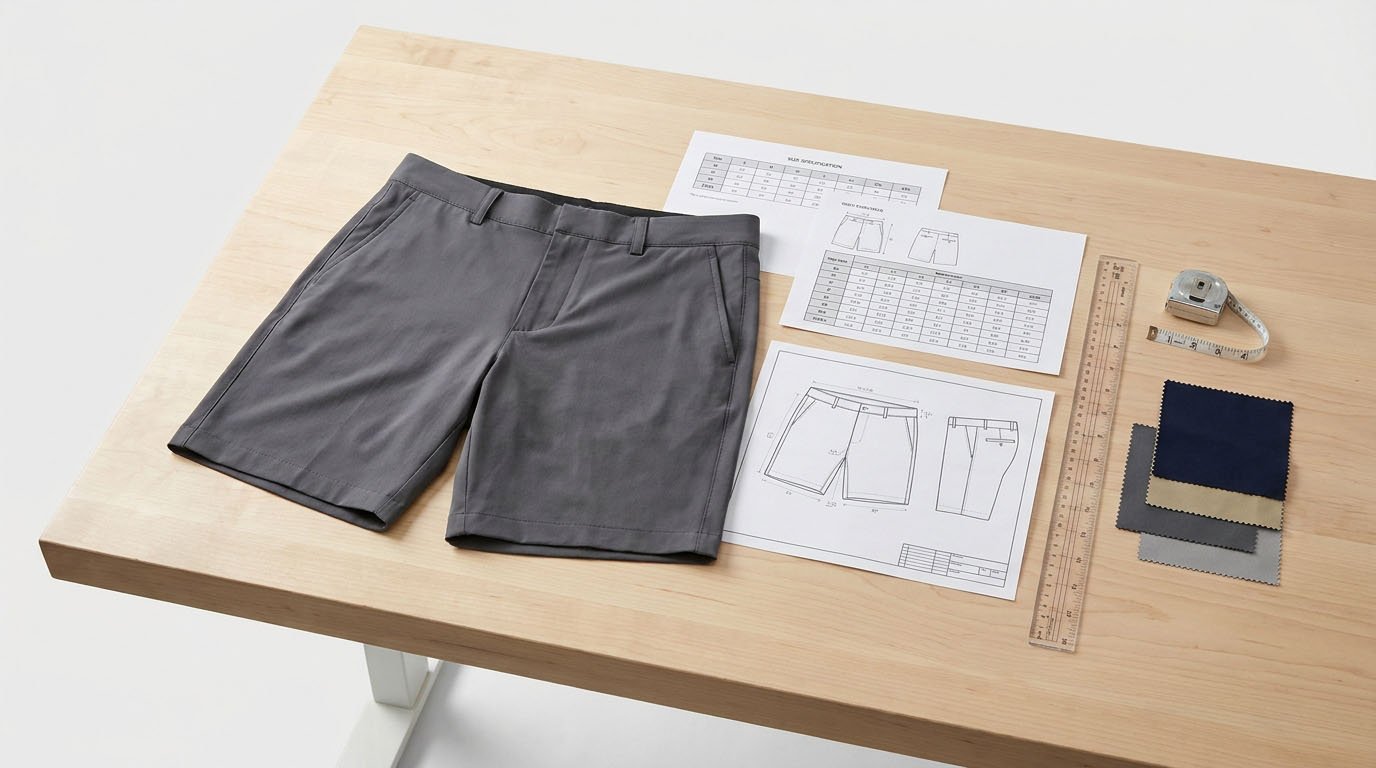
Front Construction Specification Checklist
| Technical Detail | Pleated Golf Shorts | Flat-Front Golf Shorts |
|---|---|---|
| Front panel | Specify pleat arrangement | Specify smooth front |
| Pleat direction | Define orientation | Not applicable |
| Pleat position | Define reference points | Not applicable |
| Pleat depth | Specify measurement and method | Not applicable |
| Pleat stitch-down | Define whether used and endpoint | Not applicable |
| Front rise | Specify measurement | Specify measurement |
| Hip and thigh measurements | Define required ease | Define required ease |
| Pocket construction | Check interaction with pleats | Check opening angle and tension |
| Waistband | Specify construction and flexibility | Specify construction and flexibility |
| Grading | Verify pleat position across sizes | Verify front balance across sizes |
For pleated designs, a measurement labeled "pleat depth" must clearly specify whether it means the visible folded depth or the total fabric intake.
This distinction matters because the two measurements are not interchangeable.
Real FUWAY Example: Pi-01ST1 Men's Flat-Front Golf Shorts
FUWAY's Pi-01ST1 men's golf shorts use a confirmed flat-front construction.
The following table reproduces the main size specifications from FUWAY's actual product size chart, covering six sizes from 30 to 40.
FUWAY Men's Flat-Front Golf Shorts — Style Pi-01ST1
Unit: centimeters (cm).
| Measurement | 30 | 32 | 34 | 36 | 38 | 40 |
|---|---|---|---|---|---|---|
| Shorts Length | 45 | 46 | 47 | 48 | 49 | 50 |
| Waist | 82 | 87 | 92 | 97 | 102 | 107 |
| Hip / Seat | 104 | 109 | 114 | 119 | 124 | 129 |
| Inseam | 20 | 20 | 20 | 20 | 20 | 20 |
| Leg Opening | 50 | 52.5 | 55 | 57.5 | 60 | 62.5 |
| Front Rise | 27 | 28 | 29 | 30 | 31 | 32 |
| Back Rise | 40.5 | 41.5 | 42.5 | 43.5 | 44.5 | 45.5 |
Source: FUWAY Pi-ST1 men's shorts size specification. Values are reproduced as documented. The applicable measuring method, including whether a particular width is recorded flat or around the garment, must be confirmed using the approved POM instructions. These are style specifications, not production inspection results.
What Does This Real Specification Tell Us?
Several observations can be made directly from the documented measurements.
1. Waist and hip follow the same increment.
Both measurements increase by 5 cm between consecutive listed sizes.
2. Front and back rise are graded separately.
The front rise increases from 27 cm to 32 cm, while the back rise increases from 40.5 cm to 45.5 cm. Both increase by 1 cm per size step.
3. Inseam length remains constant.
All six sizes specify a 20 cm inseam.
This demonstrates that not every measurement must increase with the labeled garment size.
4. Leg opening is specified independently.
The leg-opening values increase by 2.5 cm per size step, reflecting the grading specified for this particular design.
These measurements show how individual points of measure can follow different grading rules within a single golf shorts style.
They do not establish a universal size chart for all brands, nor do they independently prove the fit or comfort of the finished garment.
Why Measurement Methods Matter
A usable tech pack should identify the starting point, endpoint, and measuring method for each point of measure (POM).
For example:
- Waist: Define where the waistband is measured and whether the recorded value is flat or around the garment.
- Hip/Seat: Define the measuring line and its distance below the waist reference.
- Front and Back Rise: Specify the waistband and crotch measurement reference points.
- Leg Opening: Define whether the value represents flat width or full opening.
- Inseam: Identify the measurement from the crotch reference point to the hem.
At FUWAY, the standard finished-garment POM tolerance is ±1.0 cm, unless the approved tech pack specifies a tighter requirement.
The tolerance should be applied using the agreed measurement method. Pleat-specific details may require separately defined construction acceptance criteria.
For the broader design-development process, see How to Design Golf Shorts and Pants.
Key 6. How Should Brands Evaluate Both Constructions During Sampling?
Size specifications define the intended garment measurements, but they do not independently prove how the sample performs.
Before bulk production, brands should evaluate the actual garment's appearance, fit, and movement.
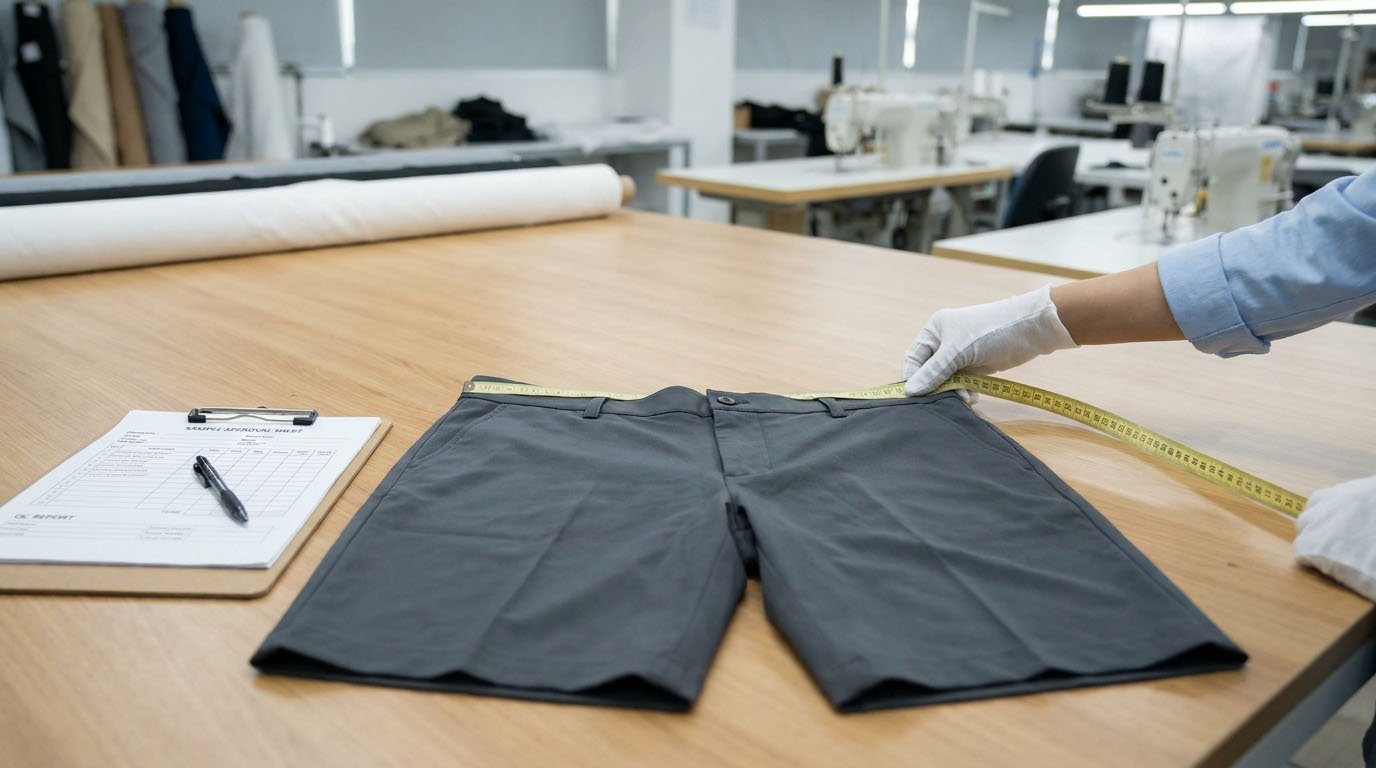
Step 1: Compare Relevant Sample Designs
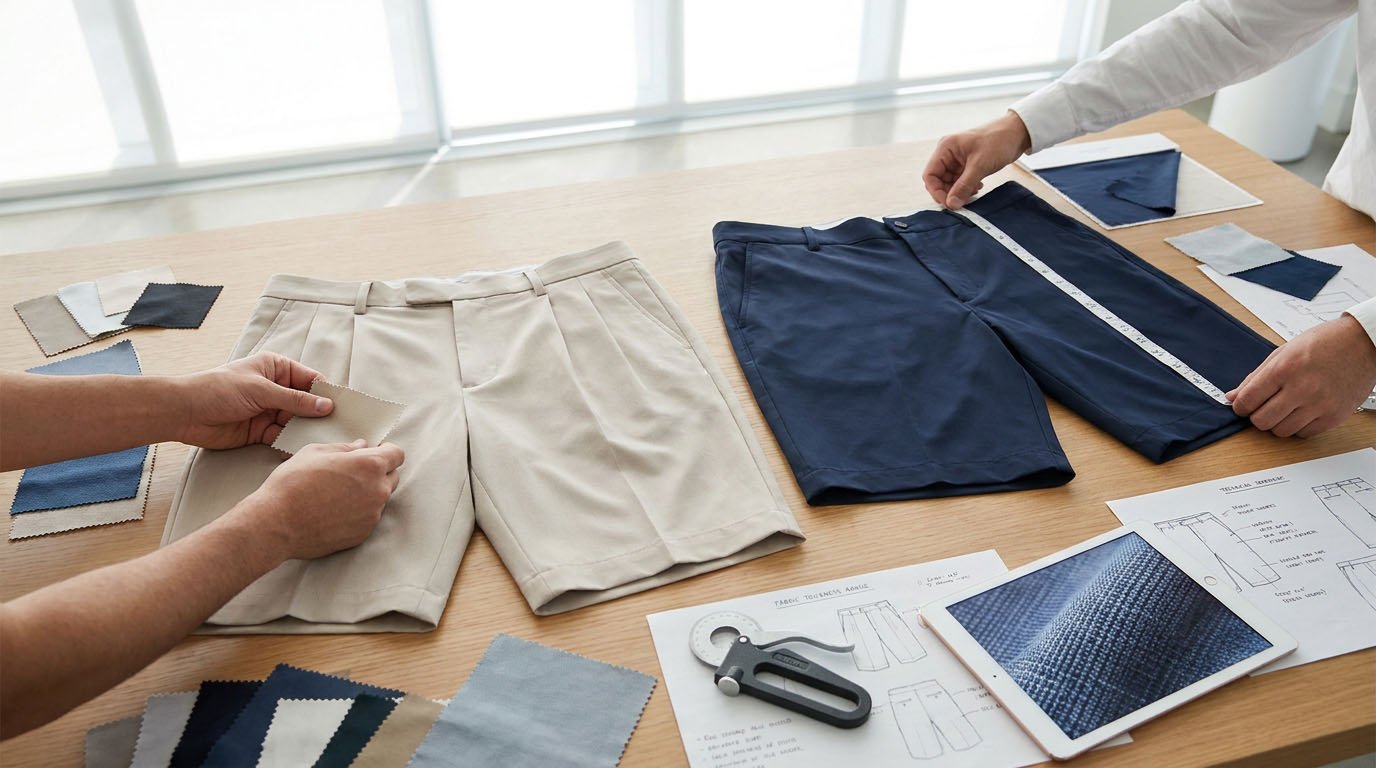
When both constructions are under consideration, brands can request comparative prototypes using the same base fabric and comparable target measurements.
However, a pleated sample should not be created simply by folding fabric into an unchanged flat-front pattern.
The pattern maker may need to adjust the front panel, pocket placement, pleat allowance, and overall garment balance.
Each prototype should be developed as a workable garment.
Step 2: Check Fit and Movement
| Sample Check | Pleated Shorts | Flat-Front Shorts |
|---|---|---|
| Standing | Pleats lie as intended | Front panel appears balanced |
| Sitting | Pleats open without excessive distortion | Front is not excessively tight |
| Squatting | Adequate hip and thigh movement | Adequate hip and thigh movement |
| Walking | Pleats behave consistently | Front and pockets remain balanced |
| Golf swing | No unacceptable restriction | No unacceptable restriction |
| Loaded pockets | No excessive pleat distortion | No excessive pocket flare |
| After washing | Pleat appearance remains acceptable | Front shape remains acceptable |
| Size-set fitting | Pleat proportions remain consistent | Front fit remains consistent |
The results should be evaluated against the intended product design and documented acceptance requirements.
These are recommended assessment activities, not a claim that every listed test has already been conducted on FUWAY's Pi-01ST1 style.
Step 3: Compare Actual Measurements With the Approved Specification
For a style such as Pi-01ST1, an inspection record can compare the approved POM values with actual measured garment dimensions.
A useful record includes:
| Inspection Field | Purpose |
|---|---|
| Style and size | Identify the inspected garment |
| POM name | Identify the measured feature |
| Approved specification | State the target measurement |
| Actual measurement | Record the observed result |
| Allowed tolerance | State the acceptance limit |
| Inspection outcome | Record whether the requirement was met |
For example, Pi-01ST1 size 34 specifies a waist measurement of 92 cm. A corresponding inspection record would need to show the actual measured value and the agreed measuring method before a pass/fail result could be established.
The specification value alone is not proof of inspection.
Step 4: Document Sample Approval
Before bulk production, brands should retain the relevant records:
- Approved sample identification and photographs.
- Final measurement specification and POM instructions.
- Confirmed fabric and trim details.
- Pattern and construction notes.
- Pleat specifications, when applicable.
- Size grading information.
- Documented sample corrections and approval decisions.
If a later reorder is required, these records help the buyer and manufacturer identify the approved construction.
Key 7. Which Golf Shorts Construction Should Your Brand Launch First?
For an emerging golf brand, the first shorts style should be selected based on its intended customer, product positioning, and ability to meet the approved requirements.
There is no universal rule that flat-front shorts must be launched first.
Consider Flat-Front Shorts If:
- A clean front appearance is central to your product concept.
- The intended silhouette does not require visible front folds.
- The fabric and pattern provide sufficient movement.
- The approved sample achieves the desired fit and proportions.
Consider Pleated Shorts If:
- Pleats are an intentional part of your design language.
- The desired silhouette benefits from folded front volume.
- The selected fabric supports the intended pleat appearance.
- Sampling confirms acceptable movement, drape, and proportion.
When Should You Offer Both?
Offering both constructions may make sense when they serve different customer preferences or distinct parts of a collection.
However, each construction requires its own appropriate technical specifications and sample approval.
Producing two styles should be a deliberate product-development decision rather than an assumption that more styles automatically mean stronger sales.
The best first style is the one your brand can define clearly, validate through sampling, and reproduce consistently.
FAQ: Pleated vs Flat-Front Golf Shorts
Are pleated golf shorts more comfortable than flat-front shorts?
Not necessarily. Pleats can provide additional front volume, but overall comfort depends on pattern ease, rise, waistband construction, fabric behavior, and fit. Well-developed flat-front shorts can also provide comfortable movement.
Do flat-front golf shorts have to be slim-fit?
No. Flat-front describes the absence of pleats. The garment can have a slim, regular, or relaxed silhouette.
Are pleated golf shorts suitable for modern golf brands?
Yes. Pleated construction can be used in contemporary golf apparel, including tailored, resort, and lifestyle-inspired designs. The result depends on the complete silhouette and fabric.
Does adding pleats increase manufacturing costs?
It can. Pleats may require additional fabric and construction operations. However, the actual cost difference depends on the design, material consumption, and production requirements. A comparable quotation is needed to establish the difference.
What specifications matter most for flat-front golf shorts?
Waist, hip/seat, front and back rise, thigh allowance, inseam, leg opening, waistband construction, and pocket placement are important. The required measurements depend on the intended fit and pattern.
Can the same size chart be used for pleated and flat-front shorts?
The same target wearer measurements may inform both designs, but the garment patterns and construction requirements can differ. A pleated design should not automatically reuse every finished measurement and construction detail from a flat-front style without validation.
Does FUWAY's Pi-01ST1 size chart prove that the shorts passed quality inspection?
No. It documents the intended measurements for a specific flat-front style. Actual inspection results require measured garment values and corresponding inspection records.
Should brands test their golf shorts before bulk production?
Yes. The selected design should be validated through appropriate sample fitting, movement checks, measurement verification, and size approval before bulk production.
Conclusion: Choose the Construction That Matches Your Brand and Product Requirements
Pleated and flat-front golf shorts offer different construction approaches, but neither is automatically the better choice.
Pleated shorts introduce folds that influence visual structure and front volume. Flat-front shorts provide a smooth front while relying on the overall pattern and material properties to deliver the intended fit.
For golf apparel brands, the most practical approach is to:
- Define the target customer and intended silhouette.
- Choose the front construction that supports the design.
- Document the construction and measurements in the tech pack.
- Evaluate the complete sample for fit, appearance, and movement.
- Approve the specifications and sample before production.
FUWAY's Pi-01ST1 flat-front shorts specification illustrates how real garment measurements can be documented across multiple sizes. It also highlights an important distinction: a clear size specification is the starting point for sample and production verification, not a substitute for it.
Developing Custom Golf Shorts for Your Brand?
FUWAY supports OEM/ODM golf apparel development, including custom golf shorts, fabric sourcing, sampling, and manufacturing.
If you are developing pleated or flat-front golf shorts, share your design reference, target fit, fabric preferences, size range, and estimated quantity with our team.
Explore our Custom Golf Bottoms capabilities or contact FUWAY to discuss your product requirements.