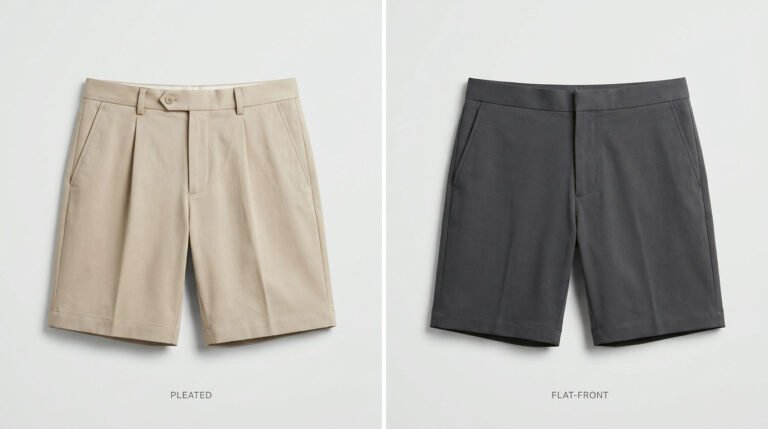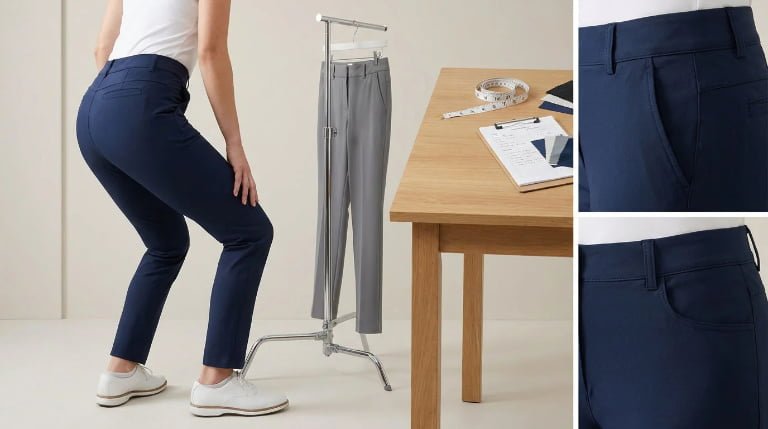
Choose an elastic waistband when controlled stretch and pull-on dressing are priorities. Choose a structured waistband when the design needs defined shaping, a closure or belt support. Consider a hybrid when your golf skort needs a clean front with flexibility at the sides or back.
These options overlap. A structured waistband can include stretch, and an elastic waistband can have a smooth, tailored appearance. For brands developing golf skorts, the decision should cover the complete assembly: waistband, outer skirt, built-in shorts, seams and closures.
The useful question is how that assembly fits, moves and recovers on your intended customer.

Elastic vs Structured Waistbands: What Is the Difference?
“Elastic” describes a source of stretch and recovery. “Structured” describes how the waistband is shaped and supported. Neither term fully defines the finished construction.
| Construction | How It Works | Useful Starting Point | Main Check |
|---|---|---|---|
| Elastic pull-on | An elastic-assisted band expands for dressing and wear | Styles prioritizing flexible fit and simple dressing | Comfortable tension, hip clearance and recovery |
| Structured with closure | Shaped waistband pieces, supporting materials and a zipper or other fastening define the waist | Styles requiring a defined front or belt support | Contour, sitting comfort and closure pressure |
| Hybrid | A defined front combines with elastic or stretch sections elsewhere | Styles balancing a clean appearance with waist flexibility | Smooth transitions and balanced tension |
A stretch-fabric waistband may also provide flexibility without a separate elastic tape. Specify the actual components rather than relying on labels such as “comfort waist.”
Do not assume that a pull-on waistband is inexpensive or that a structured waistband is automatically premium. Fit, materials, finishing and durability determine the result.
When Should Brands Choose Each Construction?
Elastic: Prioritize Dressing Ease and Controlled Flexibility
Elastic is worth sampling when customers want a skort that pulls on easily and accommodates some waist variation.
Possible constructions include enclosed elastic, exposed elastic or a fabric band supported by an elastic component. Compare samples for skin feel, edge stability, seam bulk and tension at the intended wearing position.
A pull-on skort must pass over the hips comfortably and then return to a secure fit at the waist. The narrowest part of the opening—including attachment seams—must allow that movement.
Maximum stretch alone is not enough. A band can expand easily yet feel too loose during walking, or stretch sufficiently only under uncomfortable force.
Structured: Prioritize Defined Shaping and Closure Details
A structured waistband is worth considering when the design calls for a defined waistline, a clean closure area or functional belt loops.
It does not need to be rigid. The finished flexibility depends on the shell fabric, facing, interlining, seams and any elastic sections.
Review the waistband contour at its intended height. A straight band and a shaped band fit differently; neither should be selected without checking the garment on representative wearers. More support will not automatically correct a mismatch between the pattern and the customer.
Check the closure while sitting and bending, including whether its backing keeps hardware away from the skin.
Hybrid: Combine a Clean Front with Targeted Stretch
A hybrid can use a flat front with elastic at the back or sides. A zipper may still be included when the opening needs additional dressing clearance.
This is a useful option when a brand wants both defined styling and some waist flexibility. It also introduces junctions between different materials or tension zones.
Approve those junctions carefully. Look for puckering, bulky overlaps, uneven gathering and pressure where the elastic begins or ends.
For decisions beyond the waist, use the Women’s Golf Skort Development Checklist.
Match the Waistband to the Shell and Built-in Shorts
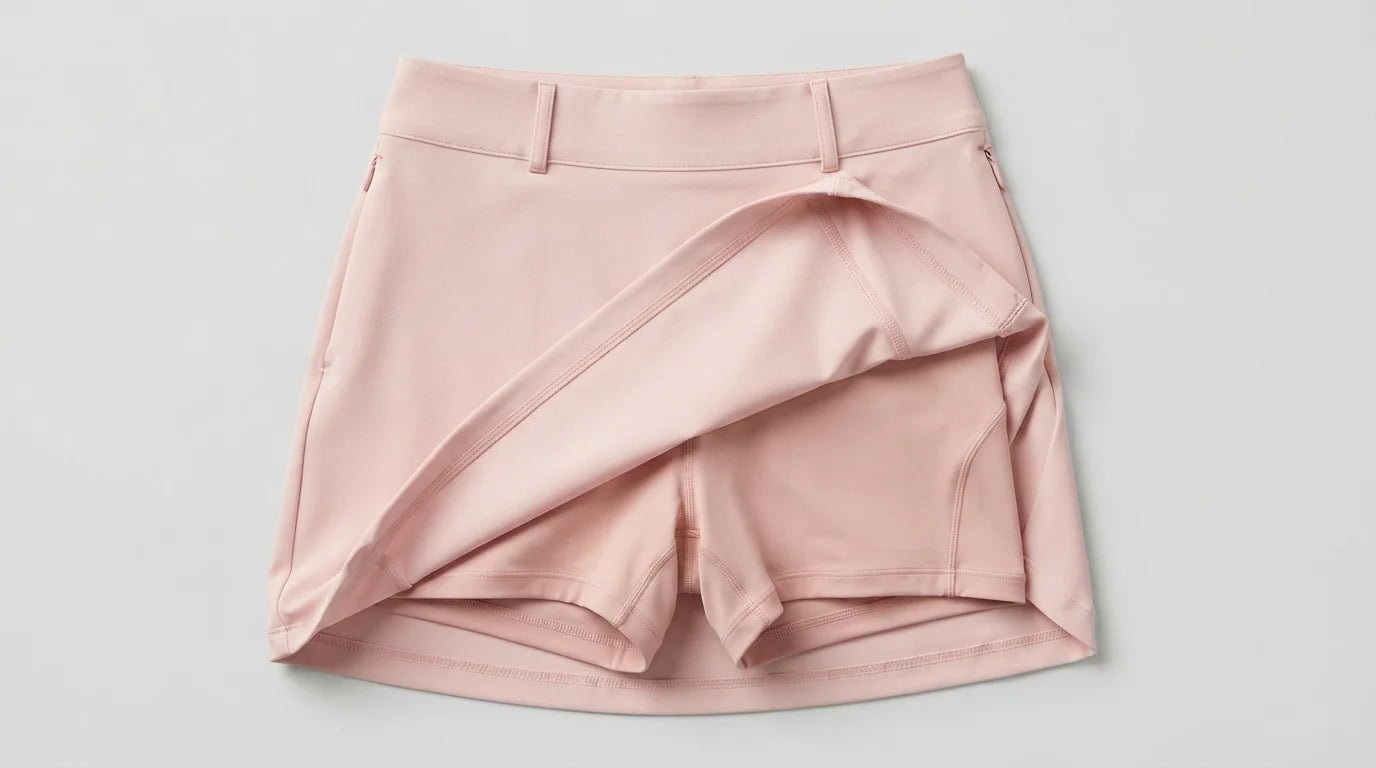
A waistband sample cannot be approved reliably as an isolated strip of material. It needs to work with both garment layers.
Check the Complete Stretch Path
Review the waistband fabric, elastic, facing, interlining and attachment seams together. A flexible outer layer does not compensate for an attachment seam that restricts the opening.
Ask the supplier to demonstrate:
- Comfortable extension for dressing and normal movement.
- Recovery after the agreed extension and rest period.
- A smooth seam without broken stitches or excessive distortion.
- Compatible appearance and dimensions after laundering.
Specify fabric orientation and component placement in the construction details. Requesting “four-way stretch” does not define the behavior of the assembled waistband.
FUWAY’s fabric sourcing service can support material selection around the project’s requirements.
Check Whether the Inner Shorts Pull on the Waistband
If the built-in shorts are too short through the rise, too restrictive or poorly balanced with the outer skirt, movement may pull on their waistband attachment.
Review the liner rise, gusset, leg opening, fabric recovery and attachment position before assuming that stronger elastic will solve slippage.
A shared waistband seam can be suitable when the pattern and seam extension are correct. Alternative attachment arrangements should be evaluated where needed; a floating connection is not a universal upgrade.
Include the Intended Pocket Load
Repeat movement checks with the items the customer is expected to carry. A phone in an inner-short pocket may affect the garment differently from the same item in an outer-skirt pocket.
Keep the test load consistent when comparing prototypes. Record whether the band drops, rotates or becomes uncomfortable.
For transparency and liner visibility concerns, see the White Golf Skort Opacity and Liner Quality Guide.
What Should Buyers Specify Before Sampling?
A reference photograph communicates appearance. It rarely explains the internal construction or the intended fit.
Include the following details in the tech pack.
| Specification | What to Define |
|---|---|
| Wearing position | Intended waistband height on the body, with front and back references |
| Finished band height | Measurement points and any height variation around the band |
| Relaxed waist | Flat or circumference measurement, fastening condition and preparation method |
| Extended opening | Required measurement with a defined load or measurement procedure |
| Elastic | Reference, width, location, joining method and attachment details |
| Supporting materials | Facing and interlining references, placement and orientation |
| Closure | Type, position, opening length and skin-facing protection |
| Inner-short attachment | Connection position, seam construction and required extension |
| Size development | Waist and hip targets, grading rules and representative fit sizes |
| Validation | Wear routine, wash procedure, recovery checks and acceptance criteria |
Keep body measurements, garment measurements and production tolerances separate. A body-size chart explains who the garment is intended to fit. A garment specification defines its finished dimensions. Tolerance defines the acceptable production variation.
For elastic measurements, document the test condition so different inspectors can reproduce it. “Stretch to maximum” is too ambiguous for reliable approval.
How to Validate a Golf Skort Waistband Before Bulk Production
Use a documented routine so revised samples can be compared under similar conditions.

1. Confirm Dressing and Standing Fit
For pull-on styles, check that the opening passes over the hips without excessive force or seam strain. For closure styles, check fastening access and the opening length.
At the intended wearing position, inspect front smoothness, back contact, side balance and liner tension.
Include representative sizes and body shapes. A successful base-size fitting does not confirm the full size range.
2. Repeat Golf Movements and Sitting
Have wearers walk, take an address position, rotate through a swing, bend to retrieve a ball and sit as they would in a golf cart.
Agree on repetitions and test duration before comparing samples.
Record:
- Waistband movement from its starting position.
- Rolling, folding or elastic twisting.
- Back gaping.
- Local pressure or closure discomfort.
- Liner pulling and the need to readjust the garment.
Repeat relevant checks with the agreed pocket load and a representative tucked shirt if that is part of the intended styling.
3. Check Recovery and Wash Compatibility
Measure the waistband before testing, after the agreed rest period and after laundering according to the proposed care instructions.
Inspect elastic behavior, dimensional change, seam distortion, interlining bubbling and any bonded areas.
Where laboratory measurement is needed, ask the laboratory to select a method suitable for the component. ASTM D4964, for example, addresses tension and elongation of elastic fabrics. Its public guidance calls for agreed testing conditions; it does not establish a universal pass limit for every golf skort.
4. Diagnose the Cause Before Changing Construction
| Observed Problem | Possible Contributors to Investigate | Sample Revision to Evaluate |
|---|---|---|
| Top edge rolls | Band height, contour, tension or insufficient support | Revise the pattern or component balance |
| Skort slips downward | Relaxed dimension, weak recovery, pocket load or liner pulling | Check fit and layer balance before increasing tension |
| Back waist gaps | Waistband contour, waist-to-hip relationship or wearing position | Adjust shaping and verify across sizes |
| Opening is difficult to pull over hips | Insufficient extension in the band or joining seam | Revise the opening or consider a closure |
| Closure presses into the body | Position, stiffness, overlap bulk or inadequate backing | Revise placement and protection |
| Waist changes after washing | Component shrinkage, elastic behavior or process incompatibility | Compare components and repeat the assembled test |
These are investigation paths, not automatic diagnoses. Similar symptoms can have different causes.
5. Record the Approval Conditions
Keep an approved sample alongside the confirmed pattern, component references, measurements and test records.
Before bulk production, agree on which defects require correction and which measurable limits apply. A photograph of a smooth waistband cannot establish recovery, dressing comfort or stability during wear.
Frequently Asked Questions
Can an elastic golf skort waistband have belt loops?
Yes, where the construction supports them. Check that loop placement and reinforcement do not restrict the intended stretch or distort the band. Test the sample with a representative belt.
Is a wider waistband always more comfortable?
No. Width changes coverage and support, but comfort also depends on height, contour, tension and the wearer’s body shape. An unsuitable wide band can still fold or press into the body.
Does a bonded waistband perform better than a sewn waistband?
Not automatically. Bonding may reduce visible stitching or bulk, but material compatibility, extension and wash durability need verification. A well-executed sewn construction may better suit the design and care requirements.
Which construction costs less to manufacture?
Compare quotations for defined assemblies. Elastic references, supporting materials, closures, bonding, sewing operations and inspection requirements can all affect cost. The labels “elastic” and “structured” are not enough to predict the difference.
Develop the Waistband Around Your Product Brief
Start with the intended wearing position, body-size range, dressing method and appearance. Then compare suitable constructions using the same fit and validation routine.
For custom golf skort development, send FUWAY your technical sketch or reference sample, target size chart, preferred materials and waistband requirements. Use the sample review to confirm the construction before bulk approval.