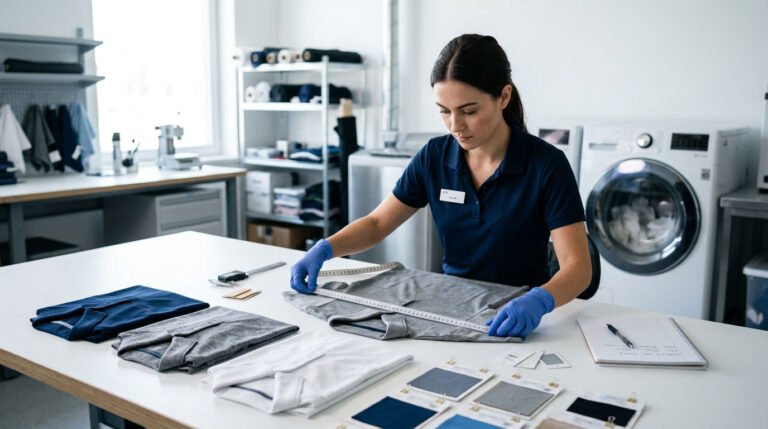
Choosing the best fabric for golf shorts is not as simple as deciding between polyester and nylon.
Two fabrics can carry almost the same fiber content but feel completely different on the course. Fabric weight, weave, stretch construction, finishing, fit, and even the climate where the shorts will be worn can change the final result.
For most golf shorts, polyester offers a practical balance of durability, quick drying, and cost control. Nylon usually provides a softer and more premium hand feel. Polyester-spandex and nylon-spandex blends are better suited to golf shorts that require additional stretch and freedom of movement. However, there is no single best fabric for every golf brand.
The right choice depends on your target customer, price positioning, climate, fit, and performance requirements.
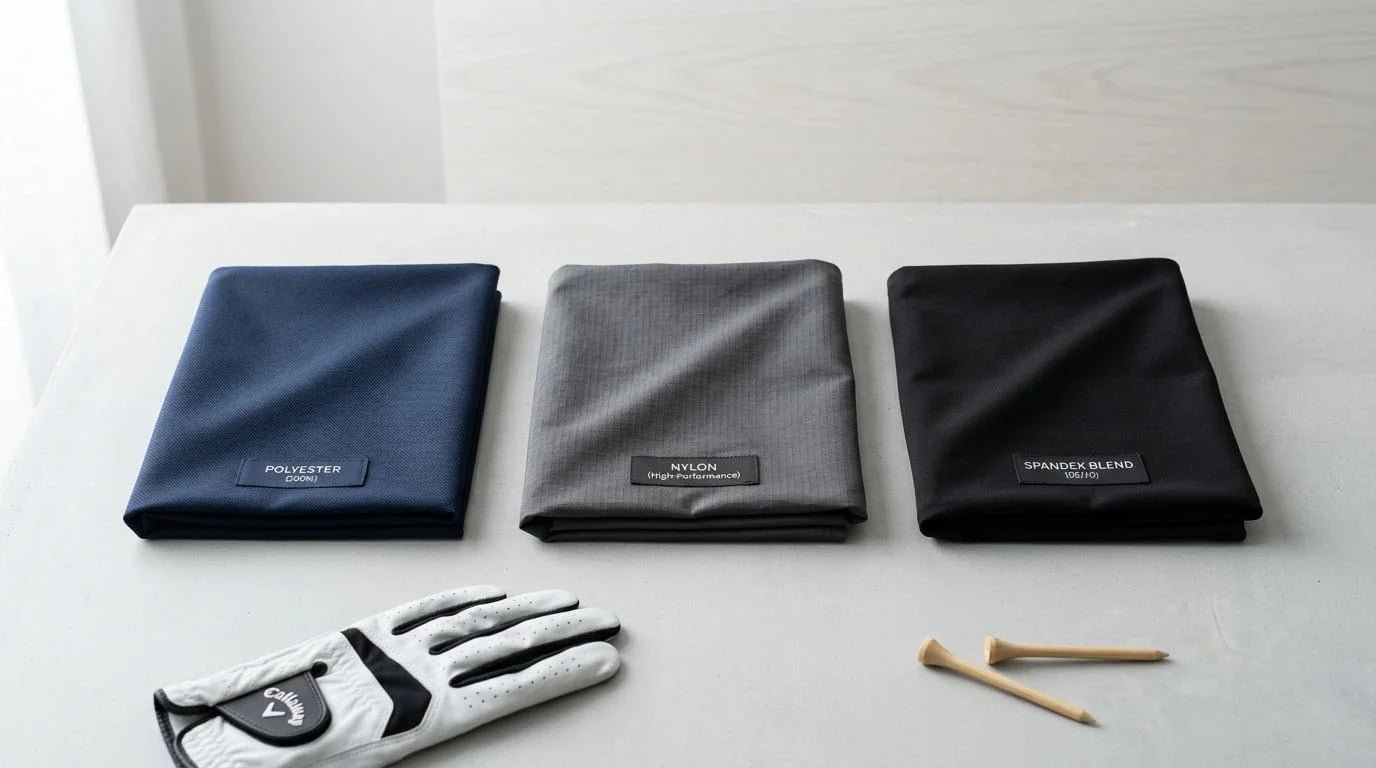
In this guide, I will explain how we evaluate these fabrics when helping golf brands develop custom shorts at FUWAY.
Quick Answer: Which Fabric Is Best for Golf Shorts?
If you need a quick starting point, use this comparison:
| Your Priority | Fabric to Consider |
|---|---|
| Cost-effective performance golf shorts | Polyester |
| Lightweight summer golf shorts | Lightweight polyester or polyester-spandex |
| Premium soft hand feel | Nylon or nylon-spandex |
| Maximum mobility | Polyester-spandex or nylon-spandex |
| Modern athletic fit | 4-way stretch blend |
| Relaxed lifestyle golf shorts | Polyester, nylon, or lower-stretch blends |
| Premium golf collection | Nylon-spandex or higher-grade polyester-spandex |
| Easier color and fabric sourcing | Polyester-based fabrics |
But fiber composition is only the beginning.
A good golf shorts fabric should be evaluated as a complete specification.
What Actually Makes a Good Golf Shorts Fabric?
Many buyers start by asking:
Should I use polyester or nylon?
That is useful, but it is not enough.
When we help a golf brand through fabric sourcing, we usually look at at least six factors.
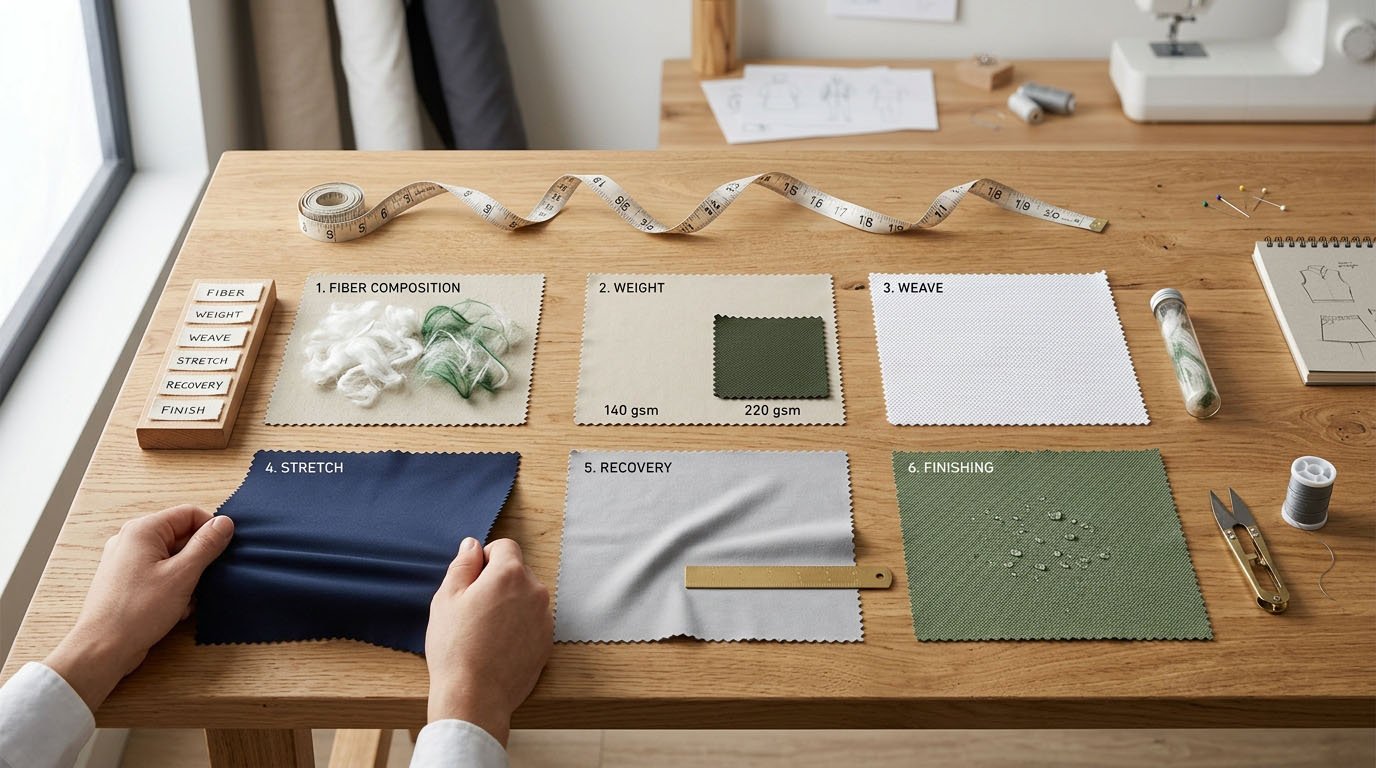
1. Fiber Composition
The fiber provides the basic characteristics of the fabric.
For example:
- Polyester is durable and widely available.
- Nylon often feels smoother and softer.
- Spandex adds elasticity and recovery.
But fiber alone does not determine performance.
2. Fabric Weight
Fabric weight affects:
- breathability
- drape
- opacity
- structure
- durability
- overall garment feel
A lightweight fabric may feel excellent for hot-weather golf but could become too thin in pale colors.
A heavier fabric may provide a more structured appearance but can feel warmer during summer play.
There is therefore no single GSM number that works for every golf short.
3. Weave or Fabric Construction
The same polyester yarn can produce very different fabrics depending on how it is woven.
Common constructions can include:
- plain weave
- twill
- micro-twill
- dobby
- ripstop
- mechanical-stretch constructions
The weave influences airflow, stretch, texture, drape, and surface appearance.
4. Stretch
Golf involves rotation through the hips, bending at the knees, walking, sitting in carts, and repeated movement during the swing.
Stretch can therefore improve comfort.
But more spandex does not automatically mean better shorts.
The stretch must work with the garment fit.
5. Stretch Recovery
Stretch tells you how far a fabric moves.
Recovery tells you whether it returns to its original shape.
Poor recovery can cause problems such as:
- bagging around the knees
- loose seat areas
- stretched waistbands
- distorted garment shape
For a golf brand, recovery can be more important than simply asking for the highest possible stretch percentage.
6. Finishing
Performance characteristics can also come from finishing.
Depending on the fabric and product requirement, golf shorts may use finishes for:
- moisture management
- water resistance
- softer hand feel
- UV-related performance
- wrinkle resistance
- anti-odor performance
This is why we recommend testing the actual fabric instead of judging performance only from the fiber label.
How Does Polyester Perform for Golf Shorts?
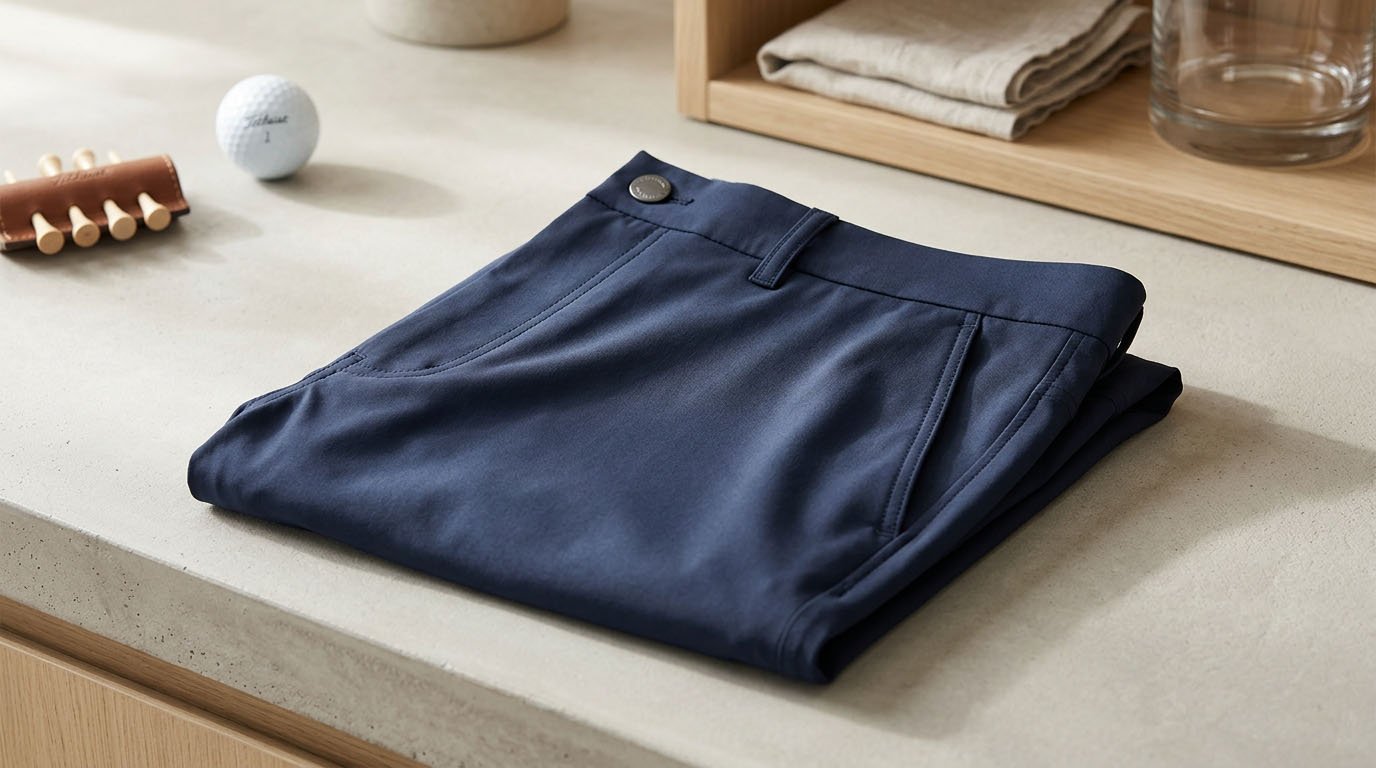
Polyester is one of the most practical materials for golf shorts.
It is widely used because it can provide a useful balance between performance, durability, availability, and cost.
Advantages of Polyester Golf Shorts
Durable
Polyester generally handles repeated wear and washing well.
For brands selling everyday performance golf apparel, this makes it a practical foundation.
Lightweight Options Are Easy to Develop
Polyester is available in many different weights and constructions.
A golf brand can therefore develop:
- lightweight summer shorts
- structured golf shorts
- stretch performance shorts
- casual lifestyle shorts
from different polyester-based materials.
Good Shape Retention
Polyester normally maintains its shape well, which helps golf shorts keep a clean appearance.
Strong Color Options
Polyester is widely used in sportswear because it supports a broad range of colors and performance constructions.
Cost-Friendly
Compared with many premium nylon fabrics, polyester usually offers more sourcing options across entry-level and mid-market price positions.
Does Polyester Automatically Wick Moisture?
No.
This is an important misunderstanding.
A garment label saying 100% polyester does not automatically mean the fabric will provide excellent moisture-wicking performance.
Actual performance depends on factors such as:
- yarn construction
- weave
- fabric density
- surface structure
- finishing
A cheap dense polyester fabric can still feel hot and sticky.
A well-engineered lightweight polyester can feel completely different.
What About Mechanical-Stretch Polyester?
Golf brands that want some flexibility without adding much spandex can also consider mechanical-stretch polyester.
Mechanical stretch comes primarily from yarn and fabric construction rather than elastane content.
This can be useful for:
- relaxed golf shorts
- corporate golf apparel
- value-focused collections
- styles that need moderate movement rather than maximum stretch
However, it usually does not provide the same range of motion as a well-developed 4-way stretch blend.
Why Do Premium Golf Brands Use Nylon?
Nylon is another strong option for golf shorts, particularly when hand feel is important.
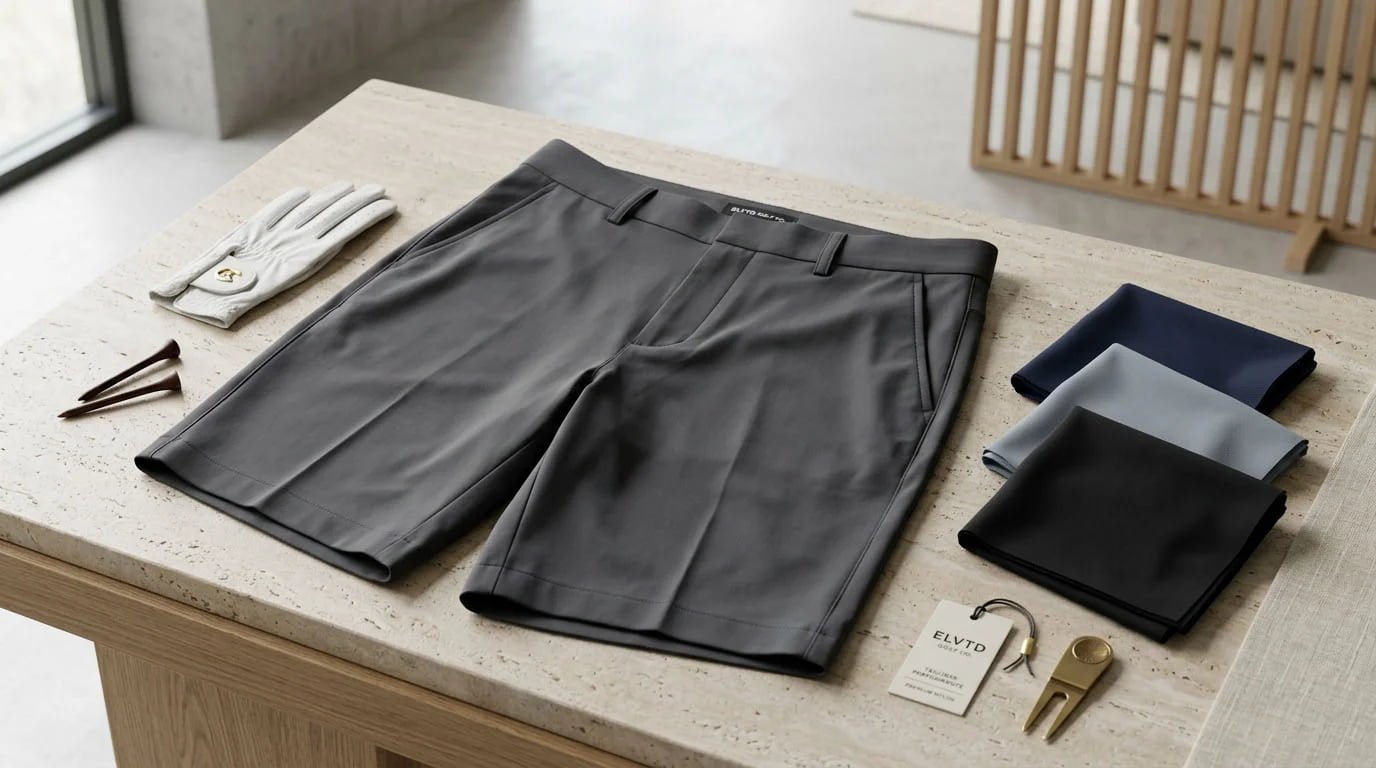
The first difference many buyers notice is touch.
A good nylon fabric can feel:
- smoother
- softer
- quieter
- less synthetic
- more premium
This makes nylon attractive for higher-end golf and resort collections.
Advantages of Nylon Golf Shorts
Soft Hand Feel
This is one of nylon's strongest selling points.
For brands that want the customer to immediately notice fabric quality when touching the garment, nylon can work very well.
Good Abrasion Resistance
Nylon is commonly selected for active apparel where durability against rubbing and abrasion matters.
Clean, Premium Appearance
Many nylon fabrics can create a matte, refined appearance that works well for:
- premium golf shorts
- lifestyle golf collections
- resort wear
- travel-oriented golf apparel
Lightweight Possibilities
A good nylon fabric can provide strength without requiring a very heavy construction.
What Are the Trade-Offs of Nylon?
Nylon is not automatically better than polyester.
Depending on the specification, it can:
- cost more
- require more careful sourcing
- respond differently to dyeing and finishing
- require greater attention during heat-transfer decoration
For many brands, nylon therefore makes the most sense when its premium feel supports the intended retail positioning.
Why Is Polyester-Spandex So Common in Modern Golf Shorts?
Polyester-spandex is one of the most common choices for athletic golf shorts.
Spandex adds elasticity to the polyester base.
This allows the fabric to move more comfortably during:
- the backswing
- hip rotation
- knee bending
- walking
- sitting
- crouching to read a putt
The result is usually a more athletic and forgiving garment.
How Much Spandex Do Golf Shorts Need?
There is no universal percentage.
Golf shorts frequently use relatively modest levels of spandex, but the right percentage depends on:
- fabric construction
- target stretch
- garment fit
- fabric weight
- recovery
- price target
For many developments, blends in approximately the 5%–15% spandex range may be considered.
However, the number itself should never be the only specification.
A well-engineered lower-spandex fabric may perform better than a poorly constructed high-spandex fabric.
More Spandex Is Not Always Better
This is a common mistake in tech packs.
A brand may think:
More spandex = more comfortable.
Not necessarily.
Too much stretch for the garment design can potentially create:
- excess fabric movement
- poor drape
- waistband instability
- heavier hand feel
- unnecessary cost
If you are developing loose-fit golf shorts, you may not need the same stretch specification as a slim athletic short.
The stretch should match the pattern.
Not the other way around.
What About Nylon-Spandex Golf Shorts?
Nylon-spandex deserves its own category because many premium performance golf brands use this combination.
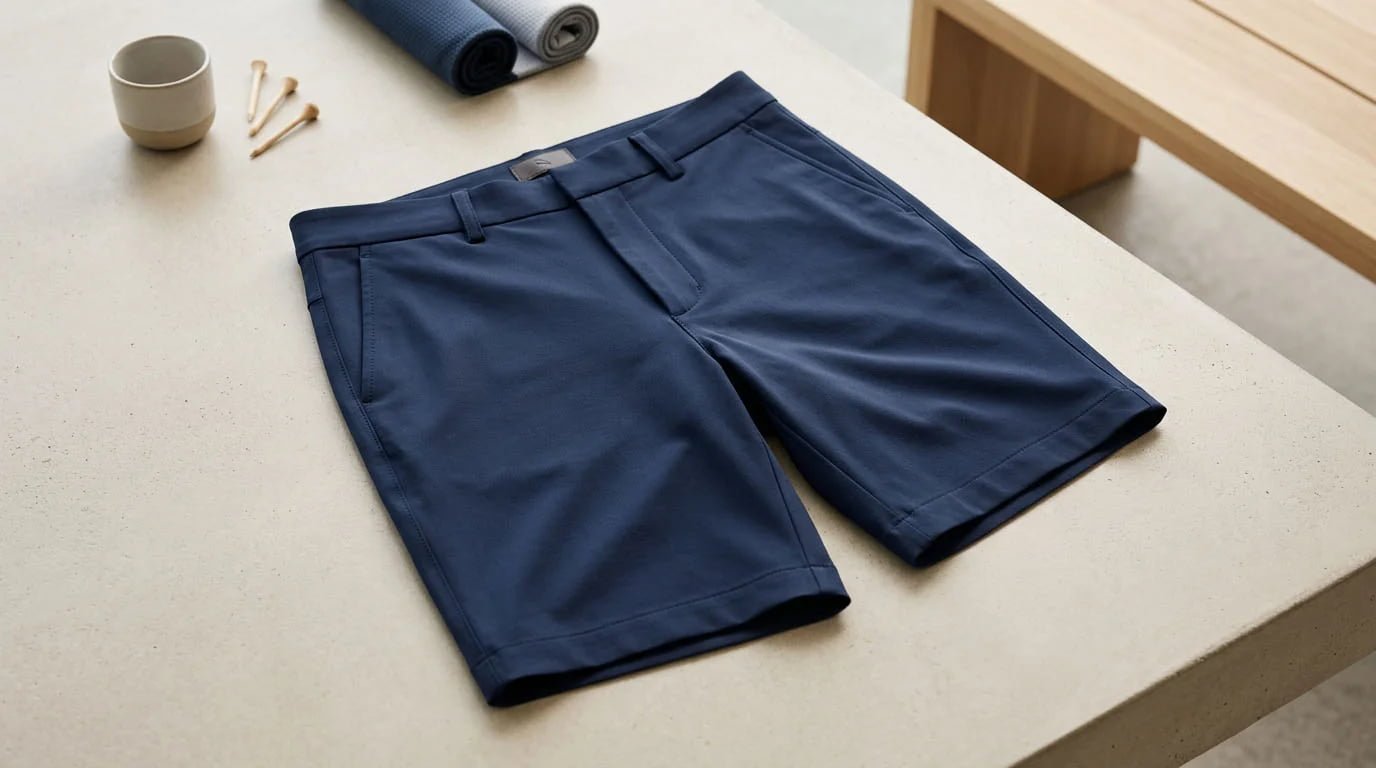
It combines:
Nylon
with its:
- smooth hand feel
- premium appearance
- abrasion resistance
and:
Spandex
with its:
- elasticity
- movement
- recovery
This makes nylon-spandex especially interesting for premium golf shorts that need both luxury feel and athletic mobility.
When Does Nylon-Spandex Make Sense?
Consider it when your brief includes several of the following:
- premium retail positioning
- lightweight feel
- soft touch
- matte appearance
- high mobility
- athletic cut
- resort-to-course versatility
The main trade-off is usually cost.
For a brand selling lower-priced golf shorts, a high-quality polyester-spandex fabric may make better commercial sense.
Polyester vs Nylon vs Spandex Blends: Quick Comparison
| Feature | Polyester | Nylon | Polyester-Spandex | Nylon-Spandex |
|---|---|---|---|---|
| Cost control | Excellent | Moderate | Good | Moderate |
| Soft hand feel | Good–Very Good | Excellent | Good–Very Good | Excellent |
| Stretch | Low–Moderate* | Low–Moderate* | Excellent | Excellent |
| Shape retention | Excellent | Good | Excellent if well engineered | Excellent if well engineered |
| Premium feel | Moderate–High | High | High | Very High |
| Lightweight options | Excellent | Excellent | Excellent | Excellent |
| Athletic mobility | Moderate* | Moderate* | Excellent | Excellent |
| Sourcing flexibility | Excellent | Good | Excellent | Good |
| Good for startup brands | Excellent | Depends on budget | Excellent | Depends on budget |
*Depends strongly on the fabric construction.
The table is useful for narrowing down options.
But it should not replace physical sampling.
Which Golf Shorts Fabric Is Best for Hot Weather?
For hot and humid golf courses, prioritize the overall fabric construction rather than only the fiber.
Look for:
- lightweight construction
- good airflow
- moisture-management performance
- low skin cling
- suitable stretch
- quick drying
- comfortable inner surface
A lightweight polyester or polyester-spandex fabric can work very well.
A lightweight nylon-spandex construction can also be excellent for a more premium collection.
The bigger mistake is choosing a dense fabric just because the composition sounds technical.
Which Fabric Is Best for Premium Golf Shorts?
If premium hand feel is your priority, start with:
Nylon
or
Nylon-Spandex
But premium polyester should not be ignored.
Modern polyester fabrics can also be engineered with:
- matte surfaces
- soft finishing
- micro-textures
- brushed backs
- fine yarns
- sophisticated dobby structures
A premium golf short therefore cannot be identified by fiber composition alone.
Which Fabric Is Best for Startup Golf Brands?
For many startup brands, I would normally begin the sourcing process with polyester or polyester-spandex.
Why?
Because these fabrics often provide more flexibility when balancing:
- performance
- cost
- MOQ
- color availability
- repeat-order consistency
Once the brand understands its customer better, it can expand into more specialized fabrics.
If you are building your first golf bottoms collection, you can also review our Custom Golf Bottoms capabilities.
2-Way Stretch vs 4-Way Stretch: Does It Matter?
Yes.
But you should select it according to your product.
2-Way Stretch
Usually stretches mainly in one direction.
It can work well for:
- relaxed fits
- classic golf shorts
- lower-cost products
- casual golf collections
4-Way Stretch
Provides movement in multiple directions.
It is usually better suited to:
- athletic fits
- performance golf shorts
- slim cuts
- highly mobile garments
For a modern performance-focused golf brand, 4-way stretch can be an important selling point.
But it should still be tested in a complete garment.
What Is the Best GSM for Golf Shorts?
There is no universal ideal GSM.
That is worth repeating.
Golf shorts fabric should be selected according to the complete product brief rather than one GSM number.
For example:
A light performance short for Florida may require a different weight from a structured lifestyle golf short intended for spring in northern Europe.
The target weight also interacts with:
- weave
- yarn size
- opacity
- color
- pocket construction
- waistband design
- stretch
- finishing
Instead of asking:
What GSM should golf shorts be?
Ask:
What fabric weight gives this particular golf short the right balance of opacity, airflow, structure, mobility, and hand feel?
That leads to better product development.
How Should B2B Buyers Evaluate Golf Shorts Fabric?
If you are a brand founder, sourcing manager, wholesaler, or product developer, do not approve a fabric based only on a digital photo.
Evaluate physical samples.
Step 1: Check Hand Feel
Ask:
- Is it soft enough?
- Does it feel too plastic?
- Is it noisy when moving?
- Does it match the intended retail price?
Step 2: Check Stretch
Test both directions.
Then check whether the fabric returns to shape.
Step 3: Check Opacity
Light colors deserve special attention.
White, beige, light grey, and pastel shades can become more transparent than dark colors in lightweight constructions.
Step 4: Check Drape
Hang the fabric.
Then make a complete garment.
Fabric behavior changes after:
- pockets
- waistband
- fly
- seams
- labels
- trims
are added.
Step 5: Test Real Movement
Do not stop at a table-top stretch test.
Wear the sample and test:
- golf swing
- walking
- sitting
- bending
- squatting
- pocket use
Step 6: Check Finishing
If you requested moisture management, water resistance, or another functional finish, ask your supplier how that performance is tested.
Where appropriate, buyers should review available fabric and garment test reports rather than relying only on marketing descriptions.
Why Is Sampling So Important Before Bulk Production?
A fabric swatch can look perfect.
A finished pair of golf shorts can behave completely differently.
That is why sampling is one of the most important stages of development.
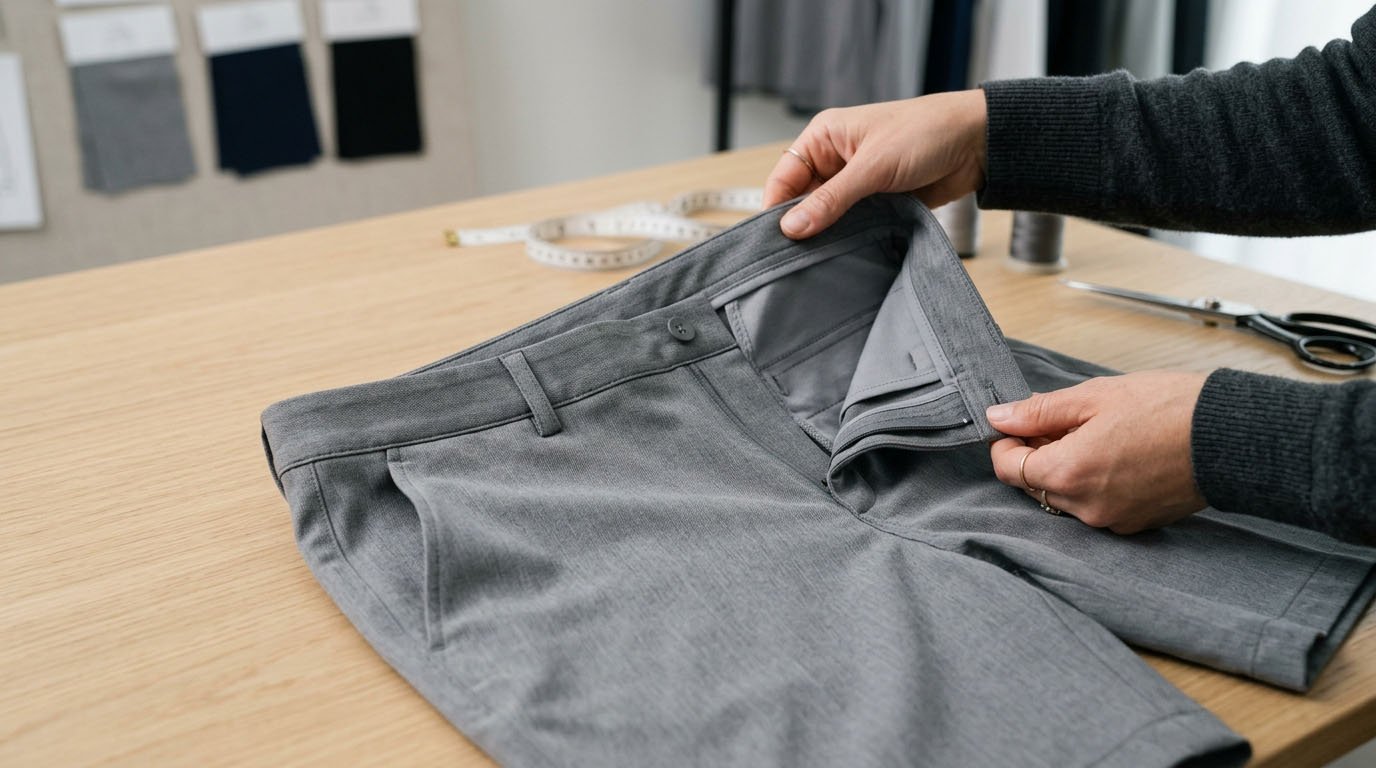
During sampling, evaluate:
Fit
Does the fabric work with the pattern?
Stretch
Is there enough freedom during movement?
Waistband Stability
Does the waistband stay in position?
Pocket Behavior
Do pockets flare or distort?
Seam Appearance
Does the stretch fabric cause puckering?
Hand Feel
Does the garment feel the same after sewing and pressing?
Wash Performance
Does shape or surface appearance change?
Color
Does the fabric look different outdoors than it did inside the sample room?
Only after these questions are answered should a brand move toward bulk production.
What Should You Send Your Manufacturer Before Fabric Sourcing?
The clearer your product brief, the faster your manufacturer can find suitable fabrics.
Try to provide:
- target customer
- target market
- expected retail price
- preferred fiber composition
- target hand feel
- stretch requirement
- color range
- garment fit
- reference garment
- expected order quantity
- required performance features
You do not need to know every technical textile term.
A good manufacturer should help translate your product goal into an appropriate fabric specification.
At FUWAY, our fabric sourcing service can start from either a full tech pack or a simpler reference garment and performance brief.
Common Golf Shorts Fabric Mistakes to Avoid
Mistake 1: Choosing by Fiber Name Only
“Polyester” is not a full fabric specification.
Neither is “nylon.”
Mistake 2: Assuming More Spandex Means Better Performance
Stretch must match the fit and construction.
Mistake 3: Ignoring Recovery
A very stretchy fabric with poor recovery can produce worse shorts than a slightly less stretchy fabric with excellent recovery.
Mistake 4: Choosing Fabric Only by Price
Saving a small amount on fabric can become expensive if it causes:
- poor reviews
- returns
- re-sampling
- production delays
- inconsistent repeat orders
Mistake 5: Approving Only a Loose Swatch
Always evaluate the fabric in a finished prototype.
Mistake 6: Forgetting Bulk Consistency
The production fabric should match the approved sample standard as closely as possible.
Color, hand feel, weight, stretch, and finishing should all be checked before cutting bulk production.
FAQ About Golf Shorts Fabrics
What is the best fabric for golf shorts?
There is no single best fabric.
Polyester is excellent for cost-effective performance shorts, nylon works well for premium soft-touch products, and polyester-spandex or nylon-spandex blends are strong choices when extra mobility is required.
Is polyester or nylon better for golf shorts?
It depends on the product.
Polyester normally provides more sourcing flexibility and cost efficiency.
Nylon often provides a softer, smoother, more premium hand feel.
Are polyester-spandex golf shorts better?
They are better when the design needs additional stretch.
They are not automatically better for every style.
A relaxed-fit short may require far less stretch than a slim athletic short.
Is nylon-spandex good for golf shorts?
Yes.
Nylon-spandex can be particularly suitable for premium performance golf shorts because it combines nylon's soft hand feel with the mobility provided by spandex.
How much spandex should golf shorts contain?
There is no universal percentage.
Many performance fabrics use a modest proportion of spandex, but the appropriate level depends on construction, fit, recovery, and target stretch.
Do not choose fabric using the fiber percentage alone.
What is the best golf shorts fabric for hot weather?
Lightweight fabrics with good airflow, moisture management, low skin cling, and suitable stretch normally perform best.
Both polyester-based and nylon-based fabrics can work.
Is 4-way stretch necessary for golf shorts?
Not always.
It is especially useful for athletic and slim-fit performance golf shorts.
Classic or relaxed styles may work perfectly well with 2-way or mechanical stretch.
Should I test the fabric before placing a bulk golf shorts order?
Yes.
Always develop and evaluate a finished sample before bulk production.
Where performance claims are important, ask for appropriate test information and confirm that bulk fabric matches the approved standard.
Final Thoughts: Which Golf Shorts Fabric Should Your Brand Choose?
The best golf shorts fabric is not determined by one fiber name.
Start with your golfer.
Then work backward.
Ask:
- Where will they play?
- How hot is the climate?
- How athletic is the fit?
- How much stretch do they need?
- What hand feel fits the brand?
- What retail price are you targeting?
- What level of durability do you expect?
For many brands:
Polyester offers the strongest balance of cost, durability, and sourcing flexibility.
Nylon is attractive when a softer and more premium hand feel matters.
Polyester-spandex works particularly well for modern performance golf shorts.
Nylon-spandex is worth considering for premium collections that need both comfort and mobility.
But the final decision should always be made from the full fabric specification—and confirmed through sampling.
At FUWAY, we help golf brands develop custom golf apparel from fabric sourcing and sampling through bulk production.
If you are developing a new golf shorts collection, explore our Custom Golf Bottoms, review our Fabric Sourcing capabilities and Test Reports, or contact our team to discuss your fabric, fit, MOQ, and product requirements.