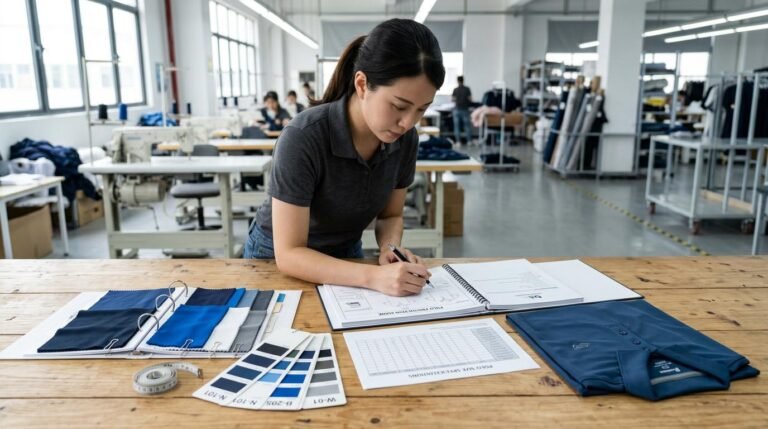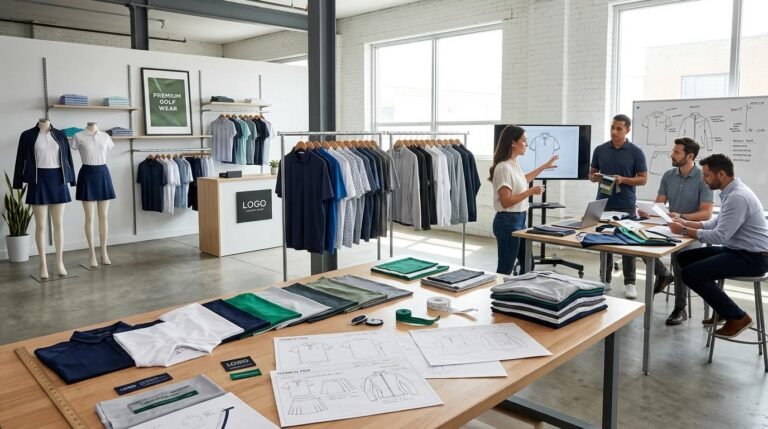
I've spent years helping brands turn their golf apparel ideas into real products. And here's what I've learned: most design mistakes in golf bottoms don't show up on your sketches—they show up when someone tries to swing.
Golf shorts and pants need four things working together: stretch that lasts, pockets that don't dump your stuff during a backswing, waistbands that stay put, and a fit that looks tailored but moves freely. The design challenge isn't picking features—it's balancing visual appeal, movement freedom, durability, and cost through pattern-making and fabric choices.
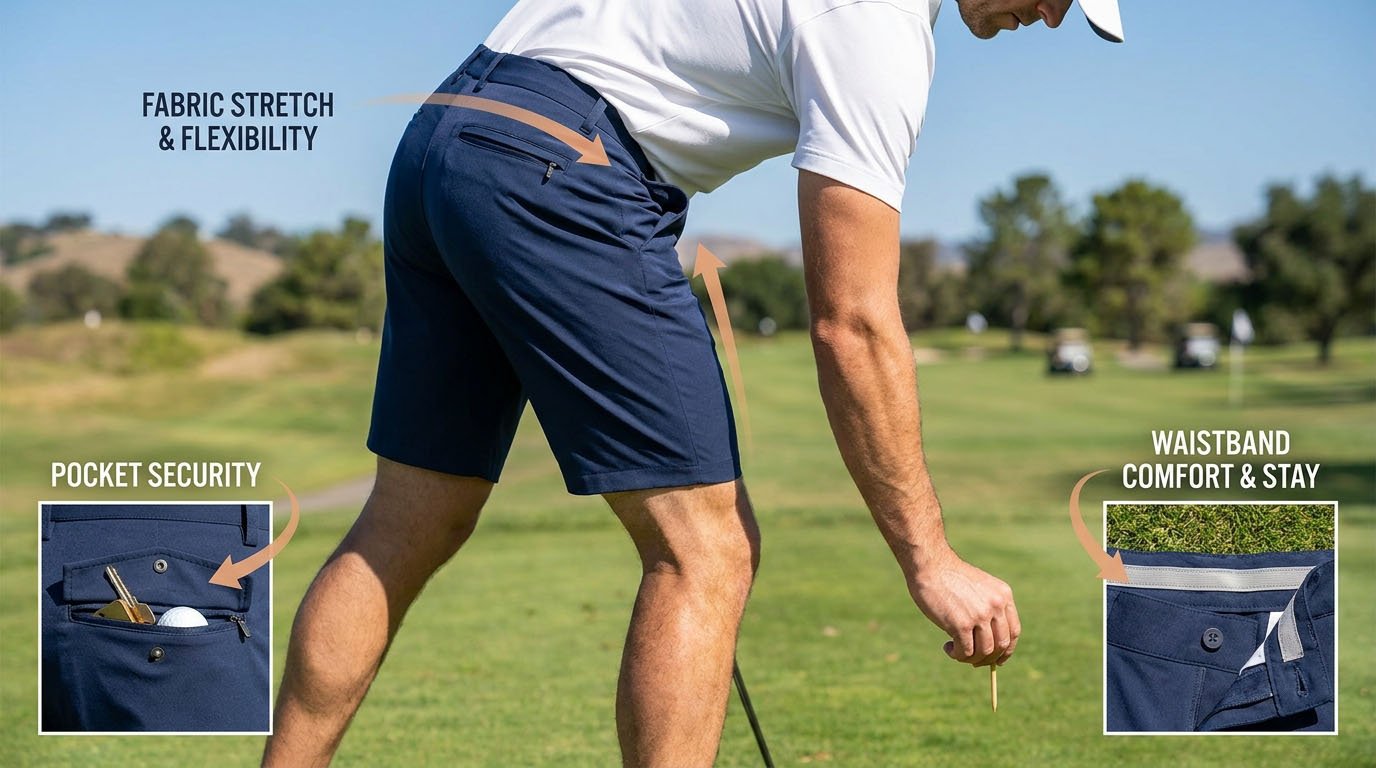
I remember one brand that came to us with beautiful tech packs. Perfect specs on paper. But after the first sampling round, their testers couldn't bend down to place a tee without the waistband digging in. That's when I realized: you can't design golf bottoms by just listing features. You need to understand the trade-offs.
If you're still deciding whether to launch with polos, shorts, or pants first, begin with how to start a golf apparel line.
Quick Answers: 5 Things You Need to Know Before Designing Golf Bottoms
Q: What's the minimum stretch percentage I need?
A: It's not about the number. A 15% stretch with fast recovery beats 30% stretch that stays loose after three washes. Ask suppliers about recovery rate and wash cycles, not just extension percentage.
Q: Should my first collection focus on shorts or pants?
A: Shorts have lower MOQ costs (less fabric) and simpler sizing issues. Start with shorts unless you're targeting cold-weather markets or older golfers who prefer full coverage.
Q: How many pockets should golf bottoms have?
A: Two front + one back is the functional baseline. More pockets = higher cost and pattern complexity. Each additional pocket adds $0.80-$1.50 to production cost and increases bulk around the hips.
Q: What's the ideal inseam length for golf shorts?
A: 9-10 inches is the current market standard—long enough for club rules, short enough to show you're not stuck in 2010. But length matters less than thigh circumference for swing freedom.
Q: Can I use regular athletic fabric for golf pants?
A: No. Golf requires 4-way stretch with moisture management, not just flex. Running tights stretch in one direction. Golf pants need lateral stretch for rotation plus vertical stretch for squatting—and they need to dry fast in humid conditions.
What golf bottoms need to do?
Golf pants and shorts aren't just athletic wear. They sit between formal trousers and gym shorts.
Here's what they actually face on a course: 180-degree torso rotation during a full swing, squatting to read greens, walking 6-7 miles in heat, and sitting in golf carts. That's four different movement patterns and two climate challenges.
I've seen brands focus only on the swing. They make the fabric super stretchy. Then golfers complain the pants look baggy after walking 18 holes. The fabric stretched out and never recovered.
The real design question is this: how do you make pants that look tailored at address but don't restrict movement at impact?
You can't just make everything loose. That looks sloppy. You can't make everything tight and stretchy either—high-stretch fabrics cost more and can feel compression-like in heat.
The answer is strategic looseness. You add ease (extra room) where the body bends: the crotch, the knee area, the hip-to-waist transition. You use 4-way stretch to compensate for the tapered look everywhere else. Then you cut the pattern at specific angles so the fabric stretches along the body's rotation axis, not against it.
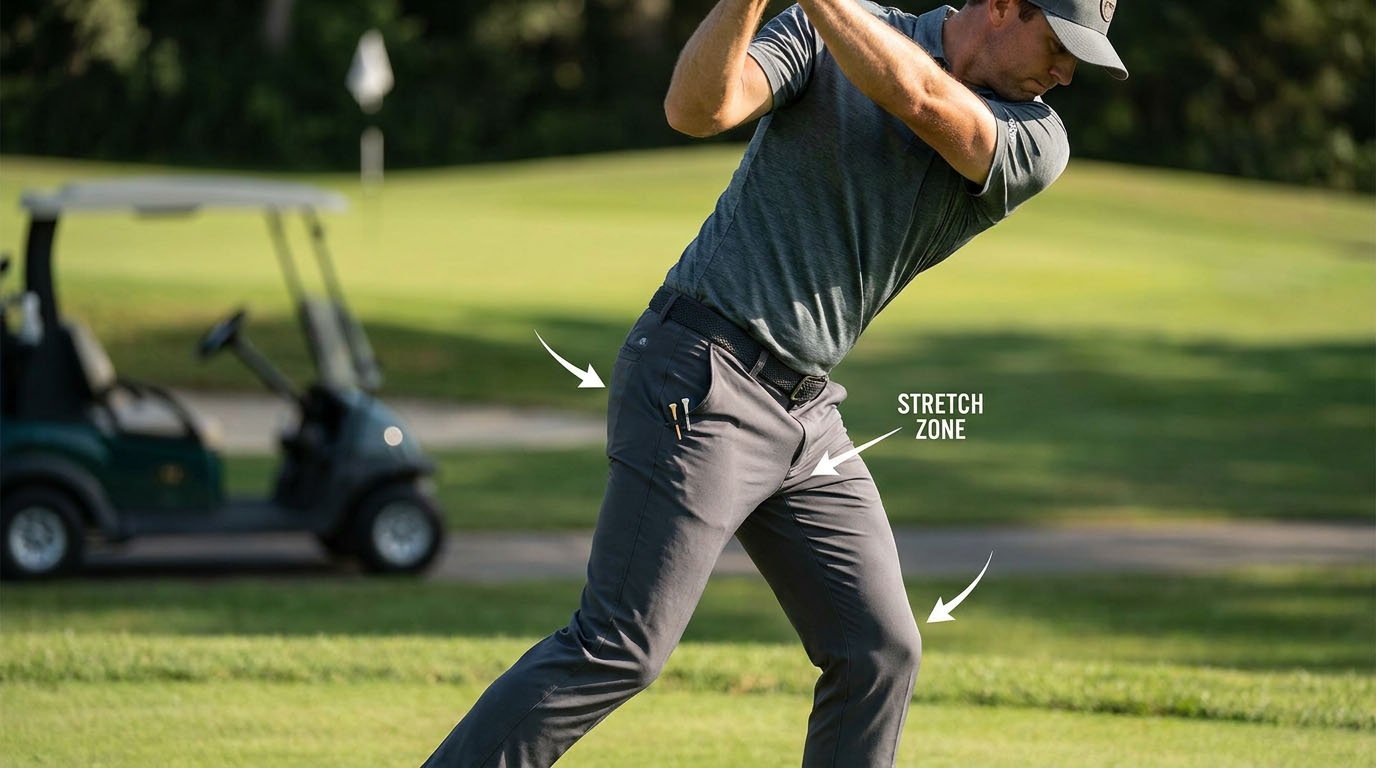
Here's a table breaking down the movement requirements:
| Movement Type | Body Area Affected | Design Solution | Common Mistake |
|---|---|---|---|
| Full backswing | Hips, shoulders, core | 4-way stretch + gusset at crotch | Only stretching waistband |
| Squatting (reading putts) | Knees, glutes, lower back | Extra ease at knee, mid-rise waist | Low-rise waist that gaps |
| Walking/sitting transitions | Waist, pockets | Stable waistband, deep pockets | Elastic-only waist that rolls |
| Heat/humidity | Full body | Moisture-wicking outer, breathable weave | Water-resistant coating that traps heat |
I once worked with a startup that wanted to copy a premium brand's tapered fit. They sent us photos and measurements. We made the samples exactly to spec. But during wear testing, golfers couldn't finish their backswing without the pants pulling at the hips.
Why? Because the original brand used a specific polyester-spandex blend with 25% recovery rate. My client wanted to save money and picked a cheaper fabric with 15% recovery. Same stretch percentage, different performance.
That's when I started asking clients: "Are you designing for the photo or for the swing?" Both matter, but you need to know which one you're compromising on.
Golf shorts vs golf pants for a first collection?
If you're launching a golf apparel brand, start with shorts.
Here's why: shorts use 40-50% less fabric than pants. That means lower MOQ costs, faster sampling, and less risk if the fit is wrong. A pair of golf pants might need 1.5-1.8 yards of fabric. Shorts need 0.8-1.0 yards.
In production terms, that's the difference between $18-$22 per unit (pants) and $12-$16 per unit (shorts) at mid-tier quality levels with 4-way stretch fabric.
Shorts also have simpler sizing issues. With pants, you need to manage both waist and inseam length. That creates size matrix complexity—do you offer 32x30, 32x32, 32x34? Or do you go with one inseam per waist size and hope it fits most customers?
Most emerging brands can't afford to stock 12-15 SKUs per style. With shorts, you only worry about waist sizes. That cuts your inventory risk in half.
But there's a market consideration too. North American and European golfers buy more shorts. Asian markets and cold-weather regions prefer pants. If your target audience is over 50, pants might be the better choice—older golfers often want more coverage.
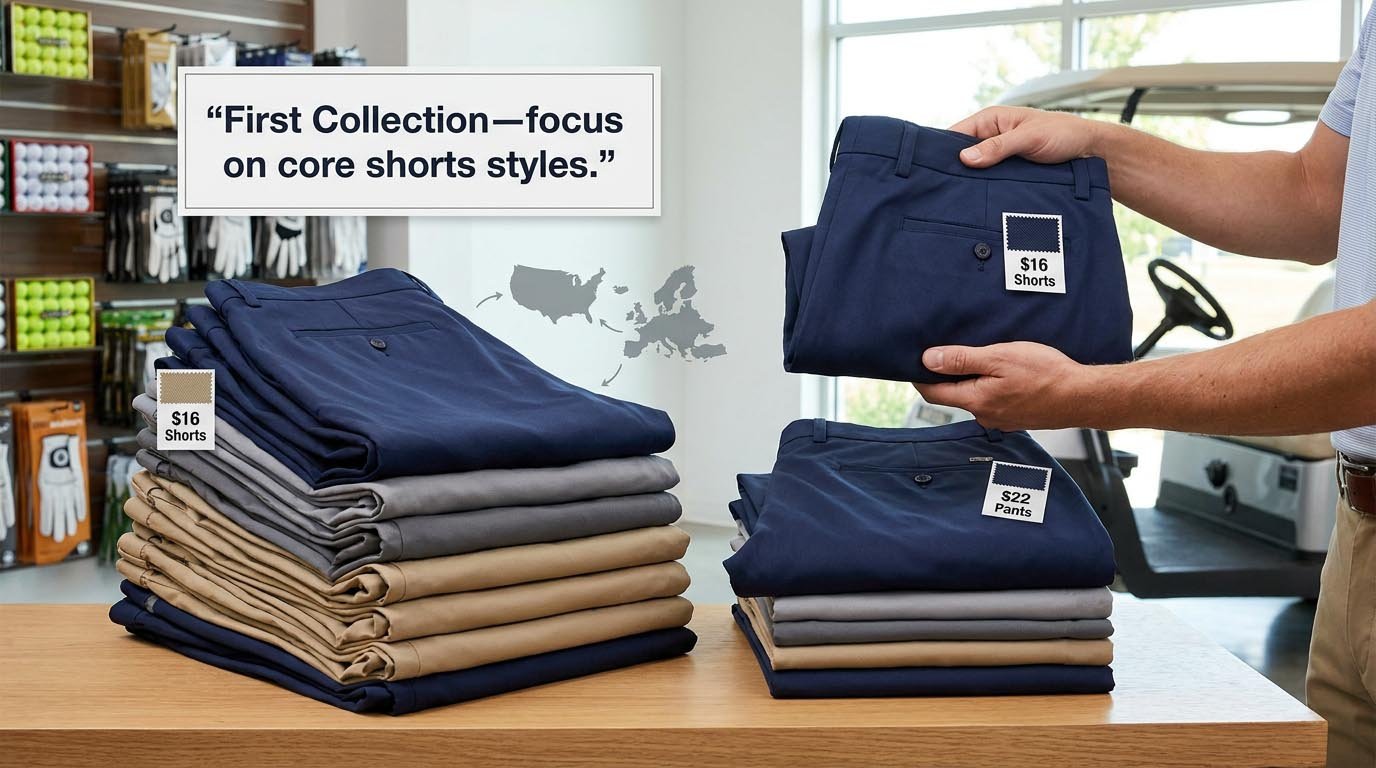
I tell new brands to do this: launch with 2-3 short styles in core colors (navy, grey, khaki). Test the market response. Then add pants in your second production run based on actual customer requests.
One client ignored this advice. They launched with pants only because they thought it looked more "premium." They got stuck with inventory because summer buyers wanted shorts and they had nothing to offer for three months.
Best fabrics for golf bottoms?
Let me clear up the biggest fabric misconception: stretch percentage doesn't tell you if the fabric is good for golf.
A fabric can stretch 30% in the lab and still be terrible for golf pants. Why? Because it might take 5-6 wash cycles to return to original shape. By then, your customers have baggy pants.
What you actually need to ask suppliers:
- Recovery rate: How fast does it snap back? (Should be 90%+ recovery within 3 seconds)
- Wash cycle durability: Does it maintain stretch after 30-50 washes?
- Stretch direction: 2-way (vertical only) or 4-way (vertical + lateral)?
- Weight: 180-220 GSM is the sweet spot for golf bottoms
I've worked with three fabric categories that work for golf:
Polyester-spandex blends (most common)
- Composition: 88-92% polyester, 8-12% spandex
- Cost: $4.50-$6.00 per yard
- Best for: Everyday golf bottoms, moderate stretch needs
- Trade-off: Can feel warm in high humidity, but wicks moisture well
Nylon-spandex blends (premium performance)
- Composition: 85-90% nylon, 10-15% spandex
- Cost: $6.50-$9.00 per yard
- Best for: Slim-fit designs, aggressive tapered silhouettes
- Trade-off: More expensive, but softer hand feel and better recovery
Cotton-stretch blends (traditional look)
- Composition: 95-97% cotton, 3-5% spandex
- Cost: $3.50-$5.00 per yard
- Best for: Heritage-style golf wear, relaxed fits
- Trade-off: Less moisture management, can feel heavy when wet
Here's the real decision framework:
| If your design priority is... | Choose this fabric | Because... |
|---|---|---|
| Slim fit with movement freedom | Nylon-spandex blend | High recovery compensates for tight cutting |
| Budget-friendly with good performance | Polyester-spandex | Best cost-to-performance ratio |
| Traditional tailored look | Cotton-stretch blend | Matches classic golf aesthetic, needs looser cut |
| Hot/humid climate focus | Lightweight polyester (under 200 GSM) | Fast-drying matters more than stretch |
I once had a brand that insisted on 35% stretch because "more is better." We made samples. The testers said the pants felt like compression tights. We switched to a 20% stretch fabric with better recovery rate and the fit problem disappeared.
The lesson: fabric selection is about matching the stretch to your pattern, not maximizing the stretch number.
Waistband, pockets and construction details?
This is where most brands mess up. They treat waistbands and pockets as styling choices. But these are functional components that affect comfort during 4-5 hours on the course.
Waistband structure: three options, three trade-offs
- Comfort: Best for all-day wear, no pressure points
- Stability: Can roll down during aggressive swings
- Cost: Cheapest option ($0.50-$0.80 per unit)
- When to use: Relaxed-fit shorts, athletic style
2. Partial elastic with zipper/button
- Comfort: Good, but can dig in when sitting
- Stability: Excellent—doesn't shift during movement
- Cost: Mid-range ($1.20-$1.80 per unit)
- When to use: Tapered pants, modern slim-fit shorts
3. Traditional belt loops (no elastic)
- Comfort: Depends on belt quality
- Stability: Most stable option
- Cost: Higher due to extra construction ($1.50-$2.00 per unit)
- When to use: Classic/formal golf styles, older demographic
I always ask brands: "Do your customers play with their shirts tucked or untucked?" Tucked-in shirts need stable waistbands—elastic-only designs create bunching. Untucked styles can use elastic waistbands because the shirt covers any rolling.
Pocket placement: function vs aesthetics
Most design mockups show pockets in nice symmetrical positions. Then we make the sample and discover the back pocket is too high—it pokes the golfer when they sit in the cart. Or the front pocket angle is too vertical—golf balls fall out during the backswing.
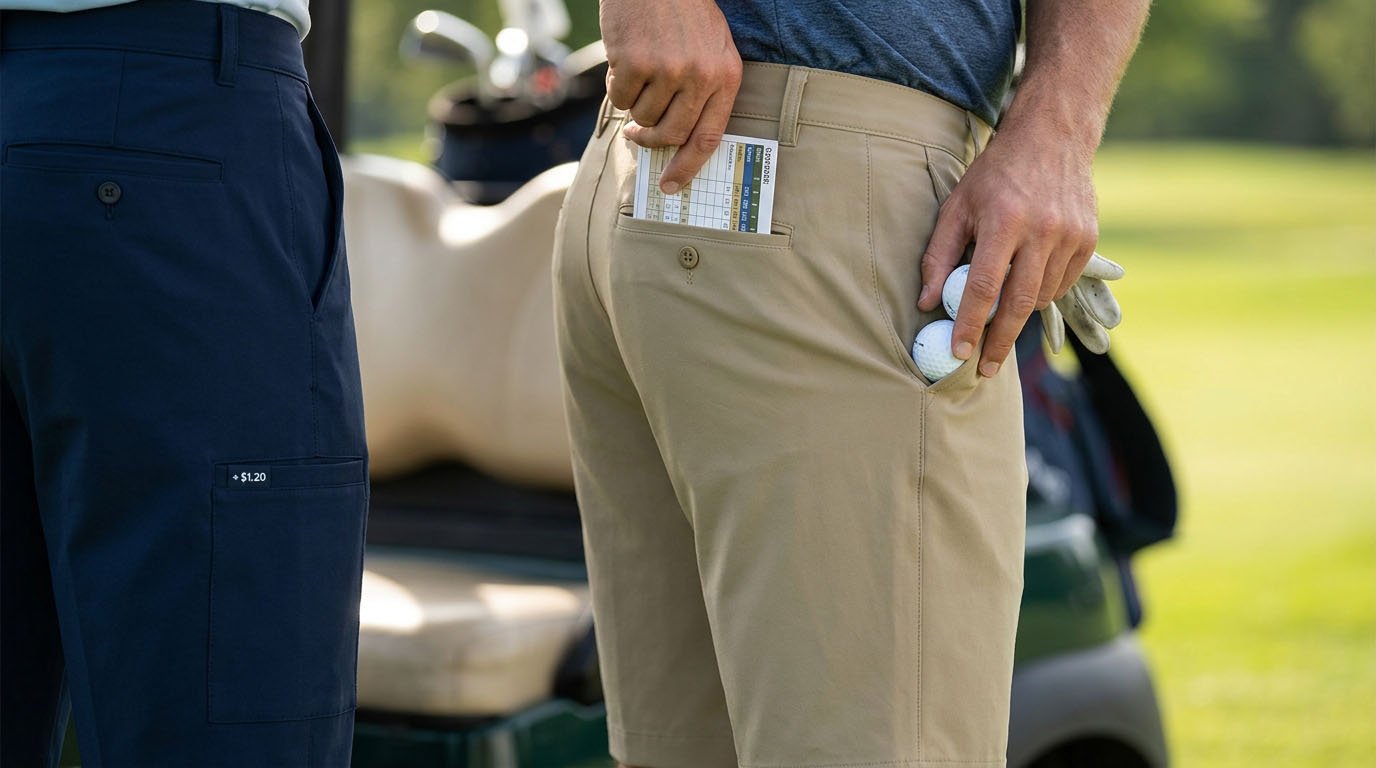
Here's what actually works:
Front pockets:
- Angle: 15-20 degrees forward-slanting (keeps items secure during swing)
- Depth: 7-8 inches minimum (full hand entry without items falling out)
- Opening width: 5-6 inches (too wide = items shift, too narrow = hard to access)
Back pockets:
- Position: Top of pocket should sit 1.5-2 inches below waistband
- Size: 5x5 inches for scorecard, but limits phone storage
- Closure: Button or zipper adds $0.60-$1.00 per pocket but prevents loss
Side cargo pockets (if you must add them):
- Cost impact: +$1.20-$1.80 per unit
- Pattern complexity: Adds bulk to hip area
- Real usage: Most golfers don't use them—consider carefully
One brand wanted five pockets because "more is premium." We explained that each pocket adds construction time and cost. They insisted. After sampling, they realized the pants looked bulky and the side pockets went unused. We removed them and saved $2.00 per unit in production costs.
The smart approach: start with two front, one back. Add more only if your customer research proves demand.
Fit, length and silhouette choices?
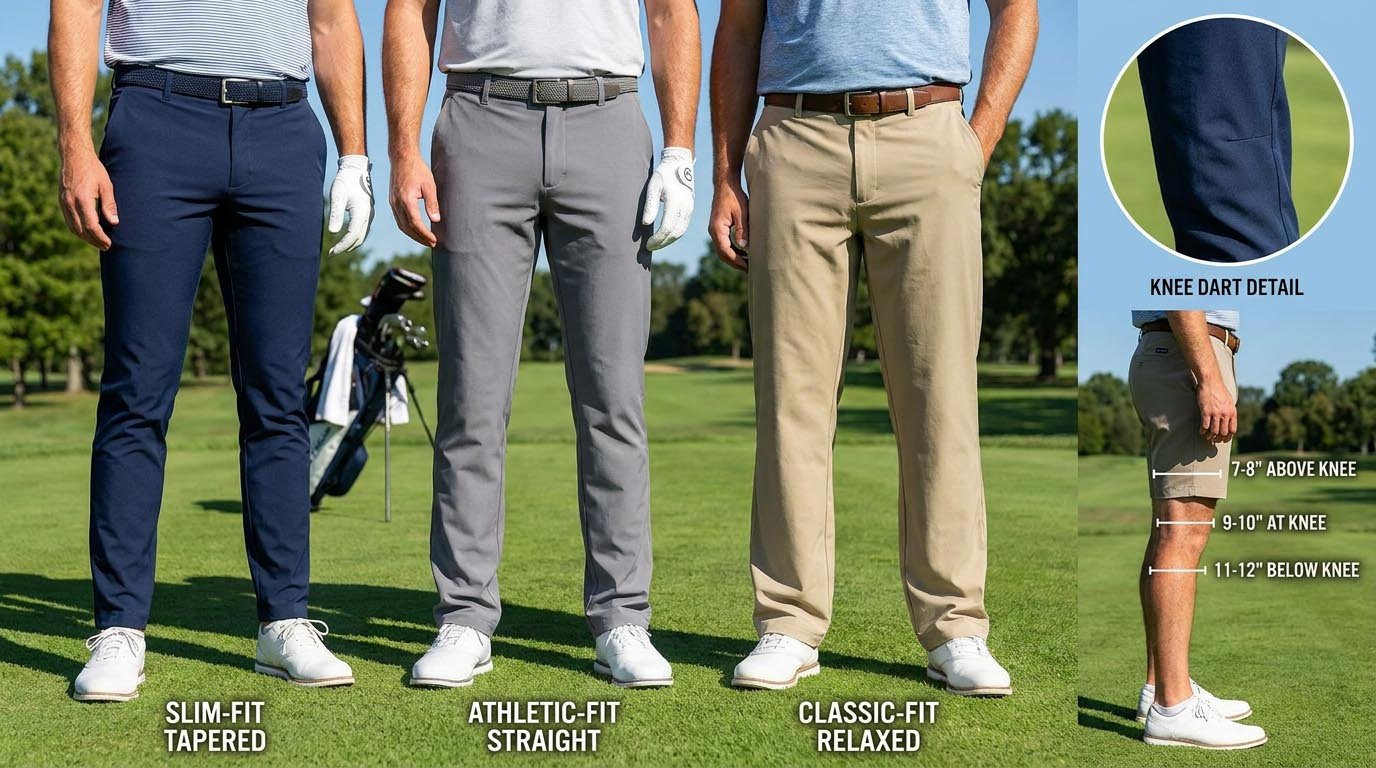
The golf bottoms market is split into three silhouette camps: slim-fit tapered, athletic-fit straight, and classic-fit relaxed. Your choice isn't about fashion—it's about which demographic you're targeting and how much you want to spend on fabric.
Slim-fit tapered
- Target demographic: Ages 25-40, fashion-conscious golfers
- Fabric requirement: Must use high-recovery 4-way stretch
- Cost: Higher due to premium fabric needs
- Key measurement: Thigh circumference is critical—too tight restricts movement, too loose loses the silhouette
I've worked with several brands that wanted slim-fit but tried to cheap out on fabric. They used basic polyester-spandex instead of nylon-spandex. The samples looked great standing still. During the swing test, the fabric pulled at the hips and created visible stress lines.
Here's the reality: slim-fit golf pants need 20-25% stretch with 90%+ recovery rate. Otherwise, you're making fashion pants that happen to be worn on a golf course—not actual golf pants.
Athletic-fit straight
- Target demographic: Ages 30-50, performance-focused
- Fabric requirement: Mid-range stretch (15-20%) is sufficient
- Cost: Most cost-effective for good performance
- Key measurement: Hip-to-knee taper should be minimal (1-2 inches total)
This is the best fit for first-time brands. It forgives small pattern errors better than slim-fit. It works with mid-tier fabrics. And it appeals to the broadest age range.
Classic-fit relaxed
- Target demographic: Ages 50+, traditional golfers
- Fabric requirement: Can use cotton-blend with minimal stretch
- Cost: Lowest fabric cost, but may require more yardage
- Key measurement: Generous through seat and thigh (3-4 inches more ease than athletic-fit)
Length considerations for shorts
The current market standard is 9-10 inches inseam. But here's what matters more: where the hem hits relative to the knee.
- Above knee (7-8 inches): Too casual for most clubs, but growing with younger players
- At knee (9-10 inches): Standard, accepted everywhere
- Below knee (11-12 inches): Dated look, older demographic only
For pants, most brands offer single inseam length (32 inches) and tell customers to hem them. Offering multiple inseams increases your SKU count and inventory risk.
One pattern detail that most brands miss: the knee dart. This is a small tuck in the pattern at knee level that allows the pant leg to taper from thigh to ankle without pulling when you bend your knee. Without it, tapered pants restrict your squat depth.
I've seen brands copy premium patterns but skip the knee dart because it adds a construction step. Their pants look identical hanging on a rack. But during wear testing, golfers say the pants feel restrictive.
That's the difference between copying a silhouette and understanding the pattern engineering.
Common product development mistakes?
After years of working with new golf brands, I see the same errors repeat. Let me save you time and money by pointing out the biggest ones.
Mistake 1: Designing based on photos, not specifications
A brand sends me photos of golf pants they like and says "make these." We ask for measurements. They don't have them. So we guess based on the photos.
The samples come back wrong because the fabric behaves differently than what's in the photo. The stretch level, the weight, the recovery—all these affect how the pattern should be cut.
Solution: Get actual measurements or buy samples to reverse-engineer. Don't design from images alone.
Mistake 2: Ignoring wash testing
You make beautiful samples. The fit is perfect. Then after three washes, the fabric loses its shape. The pants bag at the knees. The waistband stretches out.
This happens because stretch fabrics need wash cycle validation, not just lab stretch tests.
Solution: Always request pre-washed samples before bulk production. Run them through 5-10 wash cycles and check for shape retention.
Mistake 3: Adding features without testing their function
A client wanted zippered side pockets because they saw them on a competitor's pants. We asked: "Have you tested how the zipper behaves during a full swing?" They hadn't.
We made samples. The zippers created a pressure point against the hip during rotation. The design looked cool but felt terrible.
Solution: Every feature needs a wear test in golf-specific movements. Don't add elements just because they look interesting.
Mistake 4: Underestimating pattern grading complexity
You nail the size Medium. Then you ask for the full size run: Small to XXL. But the factory's grading creates weird proportions—the Large has a perfect waist-to-hip ratio, but the XL looks off.
This happens because pattern grading isn't just scaling up or down. Different body types carry weight differently. A proper grade requires multiple fit models across sizes.
Solution: Sample at least three sizes (Small, Medium, XL) before approving the grade. Don't assume the grade will scale perfectly.
Mistake 5: Choosing suppliers based only on price
The cheapest quote is tempting. But here's what I've seen: factories that offer rock-bottom prices often cut corners on fabric quality or skip pattern adjustments.
You get samples that look right but perform poorly. Then you're stuck choosing between accepting bad quality or starting over with a new supplier—which costs more time and money than paying fair prices upfront.
Solution: Ask suppliers these validation questions before committing:
Questions to ask your golf bottoms manufacturer:
- "Can you show me wash test results for your stretch fabrics over 30 cycles?"
- "How do you handle pattern adjustments when the fabric stretch doesn't match the design intent?"
- "What's your process for testing pocket placement during wear tests?"
- "Do you grade patterns using different body proportion templates for each size?"
- "Can you provide samples of similar projects where slim-fit and stretch had to work together?"
These questions reveal whether a supplier understands functional design or just follows tech packs blindly.
Bottoms design should always be evaluated alongside launch budget, MOQ, and category strategy—see how to start a golf apparel line.
Conclusion
Designing golf bottoms is about balancing visual appeal with movement freedom through smart fabric choices and pattern engineering. Start with shorts, validate your fit through actual swing tests, and choose suppliers who ask questions—not just take orders.