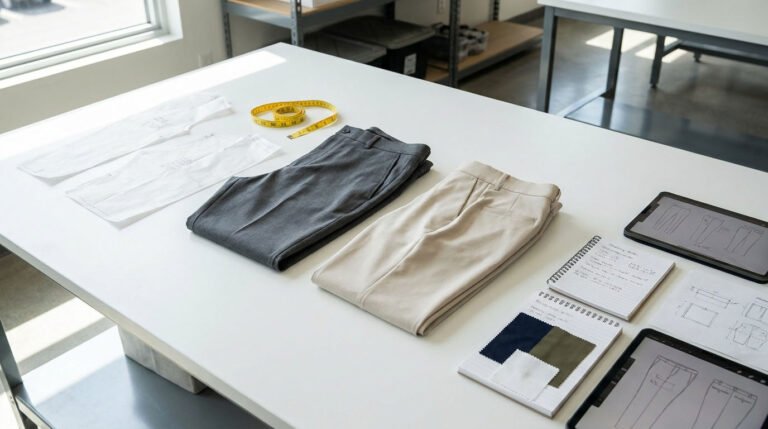
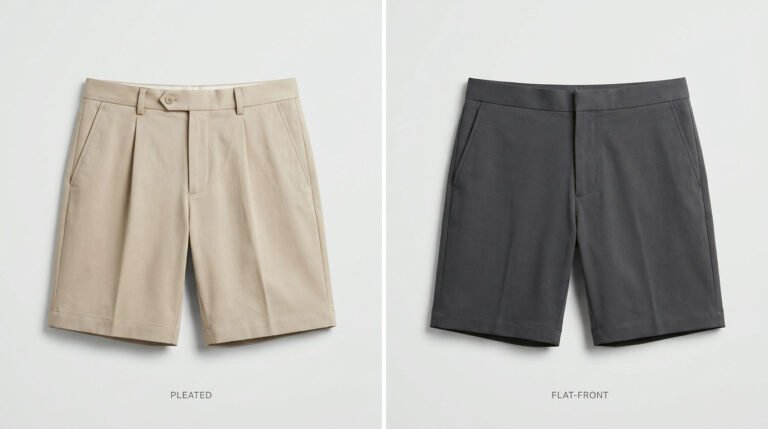
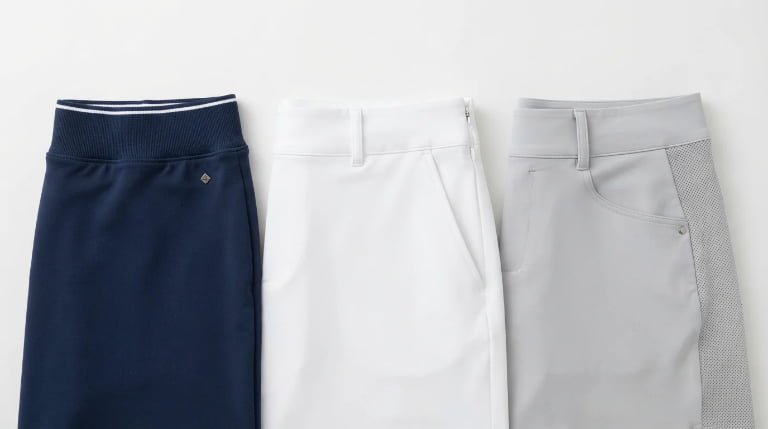
A golf pants pocket may look fine in a technical sketch but fail when a golfer carries a phone, bends to read a putt, or sits in a golf cart. These problems often begin with incomplete manufacturing specifications.
Effective golf pants pocket design requires buyers to define intended contents, measurable dimensions, construction details, and loaded movement tests before approving production.
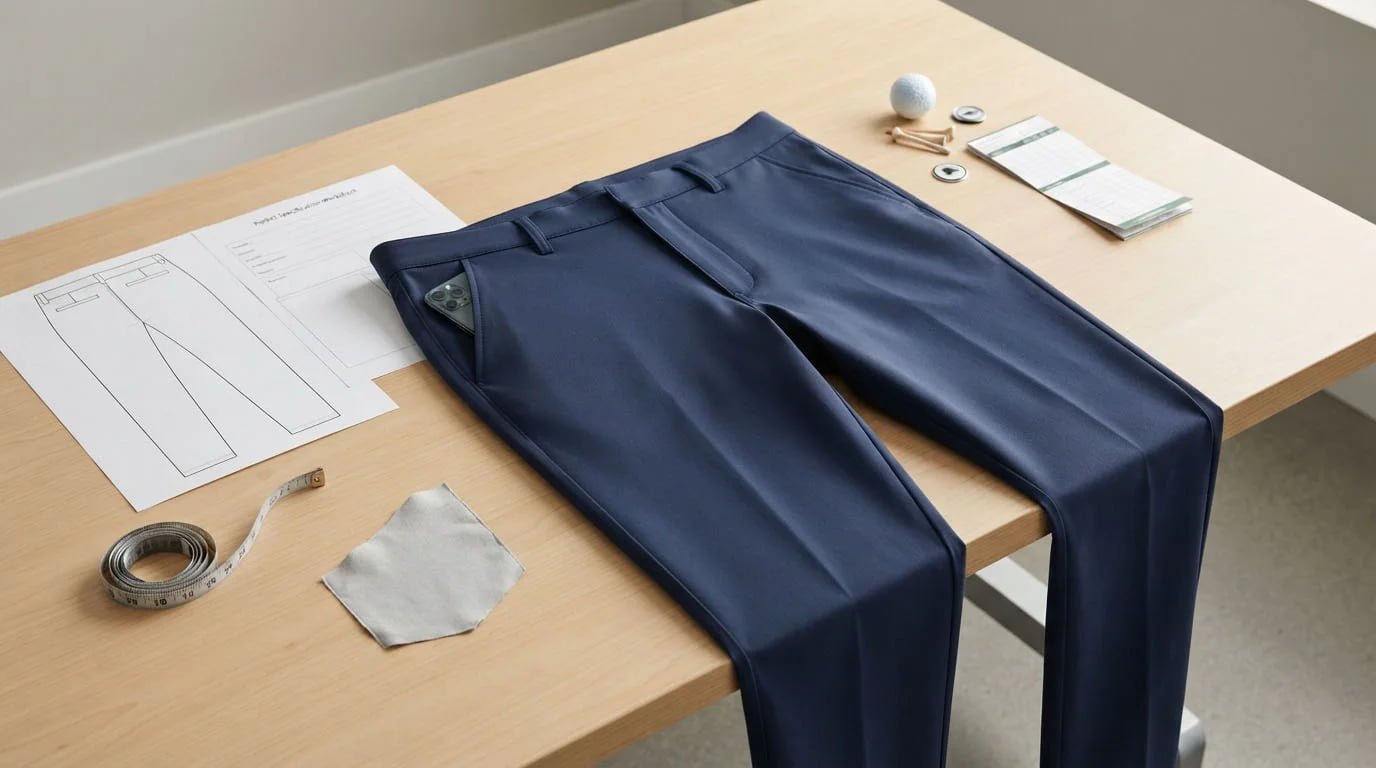
Clear specifications help golf apparel brands reduce sample revisions and maintain consistent production results.
This guide focuses on pocket engineering and approval. For broader decisions about silhouettes, waistbands, and product development, see our golf shorts and pants design guide.
Quick Answer: What Makes a Good Golf Pants Pocket Design?
A good pocket holds its intended contents securely without restricting movement, adding excessive bulk, or making access difficult.
Buyers should define five requirements:
| Requirement | What to Specify |
|---|---|
| Function | Intended contents and usage |
| Placement | Position and opening direction |
| Dimensions | Usable opening, bag depth, and width |
| Construction | Bag fabric, attachment, and reinforcement |
| Validation | Loaded appearance, security, and comfort |
There is no universal pocket depth or opening angle suitable for every golf trouser. Final specifications depend on the garment pattern, carried items, and intended wearer.
Step 1. Define What Each Golf Pants Pocket Needs to Carry
Start with the intended contents rather than copying another brand's pocket layout.
Golfers carry phones, tees, balls, markers, scorecards, gloves, and valuables. Each item creates different storage requirements.
Match Pocket Function to Golf Accessories
| Item | Main Requirement | Design Consideration |
|---|---|---|
| Smartphone | Stable, accessible storage | Prevent bouncing and pressure |
| Golf tees | Quick access | Reduce snagging and lining damage |
| Golf balls | Secure containment | Control movement and bulk |
| Ball marker | Easy retrieval | Consider a small compartment |
| Scorecard | Flat storage | Provide adequate usable space |
| Keys and cards | Security | Consider a zipper closure |
For example, instead of specifying "deep pocket for phone," define the reference phone size, including its case, and require secure retention during walking and sitting.
Buyer takeaway: Specify what each pocket must carry and how it should perform, not simply how it should look.
Step 2. Choose the Right Pocket Types and Placement
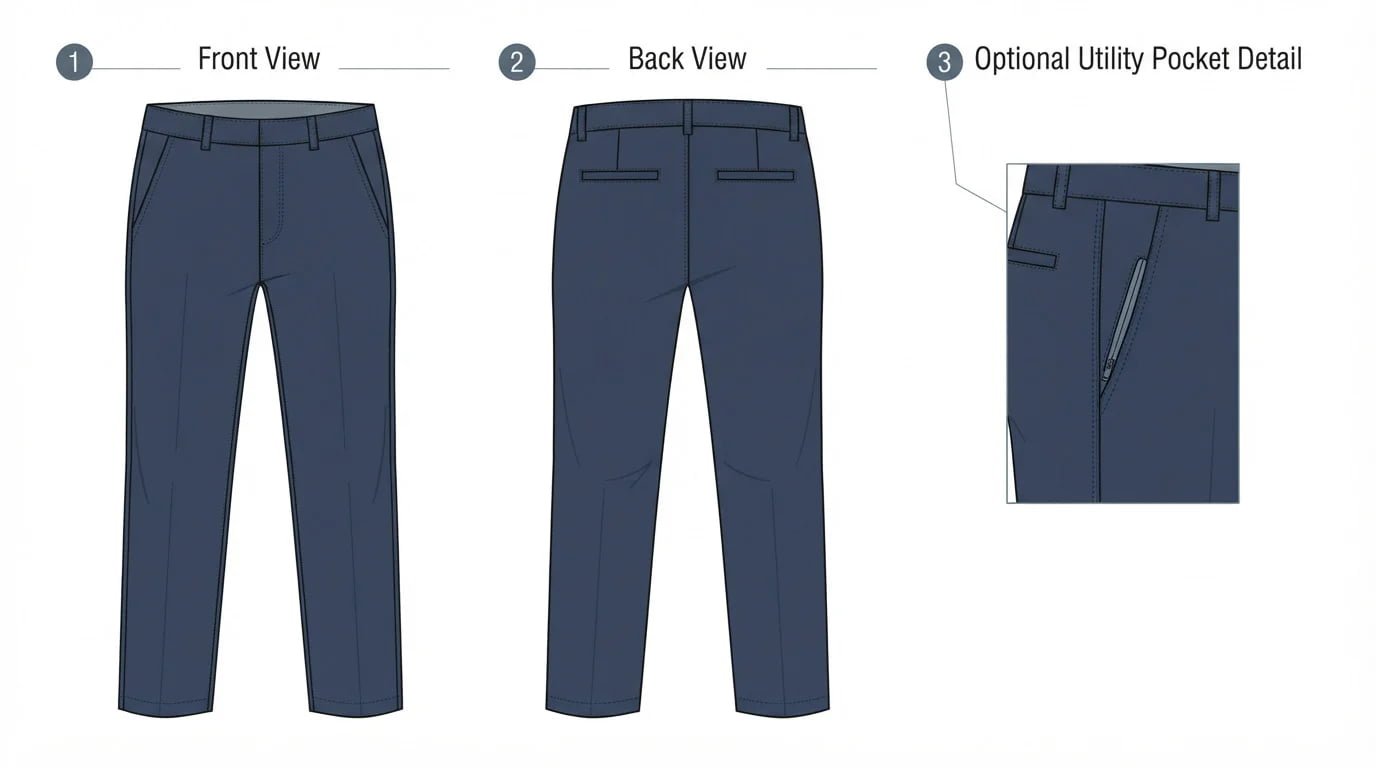
Most golf trousers combine front pockets, back pockets, and optional utility compartments. Each should have a clear purpose.
Front Slant and Side Pockets
Front pockets commonly hold phones, tees, balls, and everyday items.
Evaluate opening accessibility, internal bag positioning, stability under load, and comfort during walking or bending.
A more angled opening is not automatically better. Performance depends on the trouser pattern and intended contents.
Back Welt Pockets
Back pockets often accommodate scorecards, gloves, or small personal items.
Check usable space, closure requirements, and whether loaded contents create pressure while sitting.
Utility and Hidden Zipper Pockets
A small utility pocket may organize tees or markers. A concealed zipper pocket can improve security for valuables.
However, additional pockets increase construction complexity and potential quality-control requirements.
Include them only when their practical benefit justifies the added cost and bulk.
Step 3. Specify Pocket Dimensions and Measurement Methods
Incomplete pocket measurements are a common cause of avoidable sample revisions.
Terms such as "deep," "large," or "standard" leave too much room for interpretation.
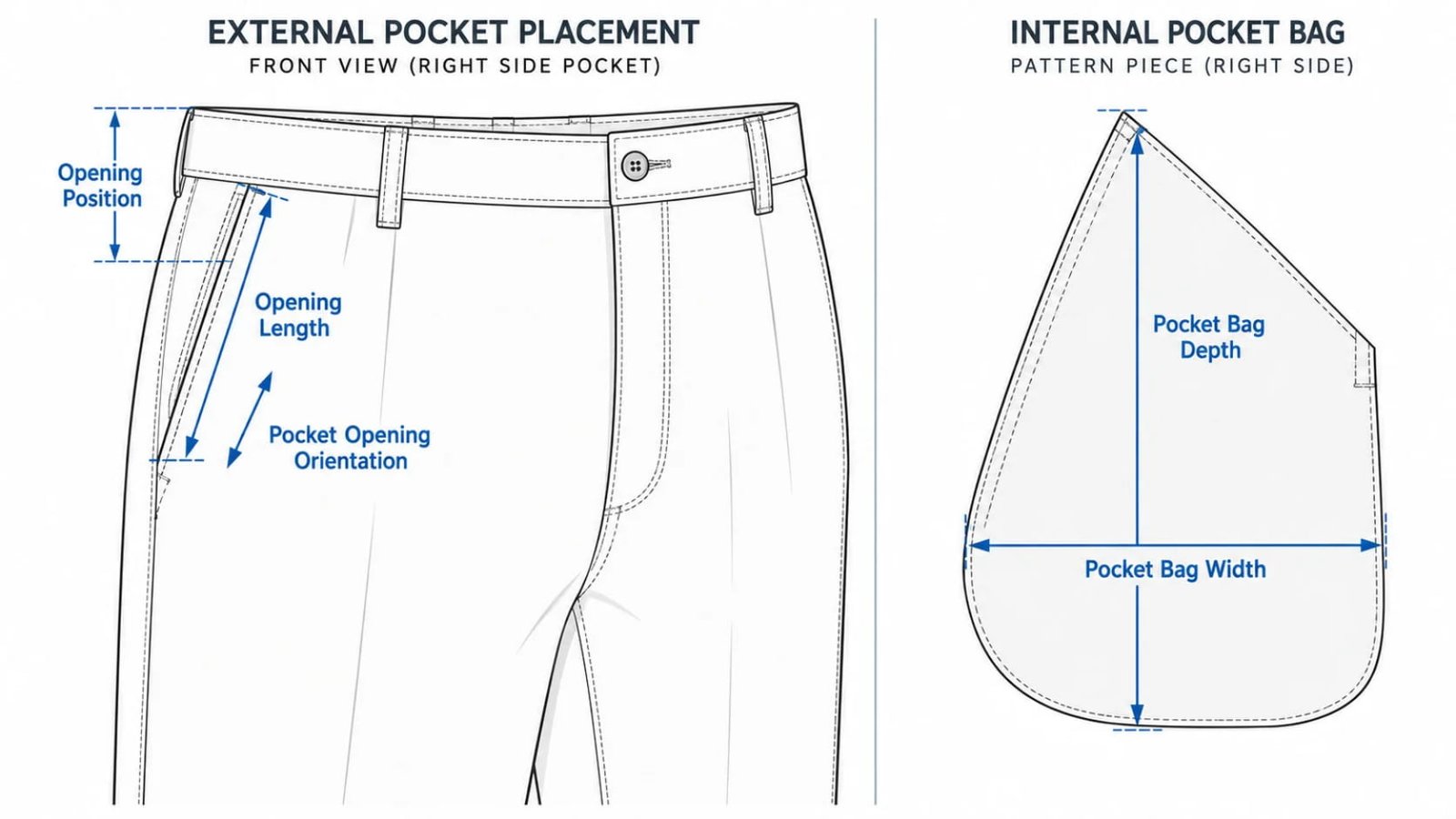
Essential Pocket Measurements
| Measurement | What to Specify |
|---|---|
| Usable opening | Accessible length and measurement endpoints |
| Opening position | Distance from defined waistband or seam references |
| Pocket bag depth | Usable internal depth and measurement method |
| Pocket bag width | Internal width at specified points |
| Opening direction | Orientation and reference axis |
| Attachment | Connection to waistband, seam, or structural support |
| Grading | Whether dimensions change across sizes |
External technical flats should identify pocket placement and appearance. Internal construction drawings should show pocket bag dimensions and attachment details.
Avoid Unverified Standard Dimensions
Published pocket sizes may provide starting references, but they should not automatically become production requirements.
A suitable depth for relaxed trousers may perform poorly in a narrow, tailored design.
Confirm dimensions against the approved pattern, actual contents, and physical sample.
Pocket Specification Checklist
Use the following table when preparing a production brief.
| Specification Field | Buyer Requirement |
|---|---|
| Style / Pocket ID | __ |
| Pocket type and position | __ |
| Intended carried item | __ |
| Usable opening and measurement method | __ |
| Pocket bag width and depth | __ |
| Bag fabric / BOM reference | __ |
| Reinforcement and attachment | __ |
| Closure type | __ |
| Size grading instructions | __ |
| Approval status | Pass / Revise / Retest |
Every measurement should include a defined reference point, unit, and agreed tolerance.
For complete garment specifications covering POM, BOM, grading, and revision control, refer to our golf apparel tech pack checklist.
Step 4. Select Pocket Bag Materials and Reinforcement
Pocket performance depends on both the outer fabric and internal construction.
A poorly supported pocket may sag under load, while a bulky or rigid bag can create discomfort or visible distortion.
Choose Pocket Bag Materials by Function
| Material | Potential Benefit | What to Check |
|---|---|---|
| Lightweight polyester woven | Stability and low bulk | Tear strength and comfort |
| Stretch woven pocketing | Flexibility | Recovery and distortion |
| Fine synthetic mesh | Breathability | Snagging and seam strength |
| Cotton-blend pocketing | Familiar hand feel | Moisture retention and shrinkage |
No material is universally superior.
For example, loose mesh can catch sharp accessories, while overly stretchy pocket bags may lose stability under load.
Material selection should consider the main garment fabric. Our golf pants fabric guide covers those broader fabric considerations.
Reinforce High-Stress Areas
Depending on the construction, reinforcement may include:
- Bar tacks at suitable pocket opening stress points.
- Reinforced attachment seams.
- Compatible interlining around welt openings.
- Pocket stays to improve internal stability.
A pocket stay can help control movement by connecting the bag to a stable garment structure. However, its suitability depends on the pattern and fabric.
Buyer takeaway: Choose materials and reinforcement according to pocket load, movement, and approved construction—not simply fabric weight or stitch count.
Step 5. Test Loaded Pockets During Golf Movements
An empty pocket may look acceptable but behave differently when carrying actual golf accessories.
Therefore, sample approval should include realistic loaded movement tests.
Practical Pocket Wear-Test Checklist
| Test | Action | Acceptance Criteria |
|---|---|---|
| Walking | Walk with intended contents | No unacceptable bouncing |
| Golf swing | Perform controlled practice swings | No restriction or item loss |
| Putting crouch | Bend or crouch | No painful pressure or distortion |
| Cart sitting | Sit and stand with loaded pockets | Adequate security and comfort |
| Retrieval | Repeatedly insert and remove items | Practical access without snagging |
| Appearance | Inspect loaded trousers | Acceptable silhouette and opening shape |
These are practical development checks, not standardized laboratory tests.
Record Test Conditions and Results
For each test, document the sample size and revision, pocket ID, reference item, movement, observed issue, and approval status.
For example:
Issue: A smartphone presses against the upper thigh when sitting.
Possible correction: Review pocket position, internal shape, and usable depth.
Verification: Retest the revised sample with the same phone and movement.
This provides the pattern maker with actionable feedback rather than a vague request to improve comfort.
Step 6. Identify Common Pocket Problems Before Production
Similar pocket defects can have different causes. Diagnose the problem before changing the pattern or material.
Common Problems and Corrective Actions
| Problem | Possible Cause | What to Review |
|---|---|---|
| Opening flares outward | Fit, geometry, or insufficient stabilization | Hip fit and opening construction |
| Pocket bag sags | Inadequate support | Bag material and attachment |
| Phone presses into thigh | Poor positioning | Bag shape and dimensions |
| Lining tears | Stress or material damage | Fabric strength and seams |
| Zipper feels uncomfortable | Hardware bulk or position | Zipper construction |
| Items fall out | Unsuitable opening or closure | Pocket geometry and security |
A pocket opening that pulls outward may also indicate insufficient room through the hips, rather than a pocket construction defect.
Evaluate the overall garment fit before deciding on corrections.
Final Pocket Approval Checklist
Before bulk production, confirm:
- [ ] Pocket functions and positions are documented.
- [ ] Dimensions and measurement methods are approved.
- [ ] Bag fabrics and reinforcement match the approved sample.
- [ ] Loaded movement tests meet acceptance criteria.
- [ ] Relevant size variations have been reviewed.
- [ ] Changes are reflected in the latest tech pack.
- [ ] The approved physical sample is retained as a reference.
For broader factory selection and production preparation, see our golf pants manufacturer sourcing guide.
Frequently Asked Questions
How Deep Should Golf Pants Pockets Be?
There is no universal depth. Buyers should define the intended items, specify usable dimensions, and verify security and comfort in physical samples. Excessive depth can create movement or retrieval problems.
What Is the Best Golf Pants Pocket Design for a Smartphone?
A suitable pocket accommodates the intended phone and case while minimizing bouncing, discomfort, and visible bulging. Opening geometry, bag shape, and placement should be tested together.
Should Golf Pants Have Zipper Pockets?
Zippers can improve security for valuables but add hardware and construction complexity. Use them when the security benefit justifies the additional requirements.
How Can Brands Reduce Pocket Sample Revisions?
Provide annotated drawings, measurable dimensions, construction details, and acceptance criteria before sampling. Test pockets with intended contents and document every required correction.
Conclusion
Good golf pants pocket design combines functional storage, measurable specifications, suitable construction, and realistic wear testing.
By defining these requirements before production, golf apparel brands can reduce avoidable revisions and improve consistency between approved samples and bulk garments.
FUWAY supports custom golf trouser development, sampling, and OEM/ODM manufacturing.
Developing a new golf pants collection? Contact FUWAY to discuss your pocket specifications and sampling requirements.