

Choosing the wrong golf shorts waistband can ruin an otherwise well-designed garment.
The shorts may look perfect in a product photo, but if the waistband twists, slips, digs into the waist, stretches out after washing, or feels restrictive during a golf swing, customers notice immediately.
Golf shorts waistbands generally fall into several functional categories: fixed, mechanical stretch, concealed elastic, expandable, full elastic, pull-on, gripper, adjustable, and hybrid constructions. The right choice depends on your target golfer, desired appearance, fit tolerance, activity level, and product positioning—not simply on which waistband offers the most stretch.
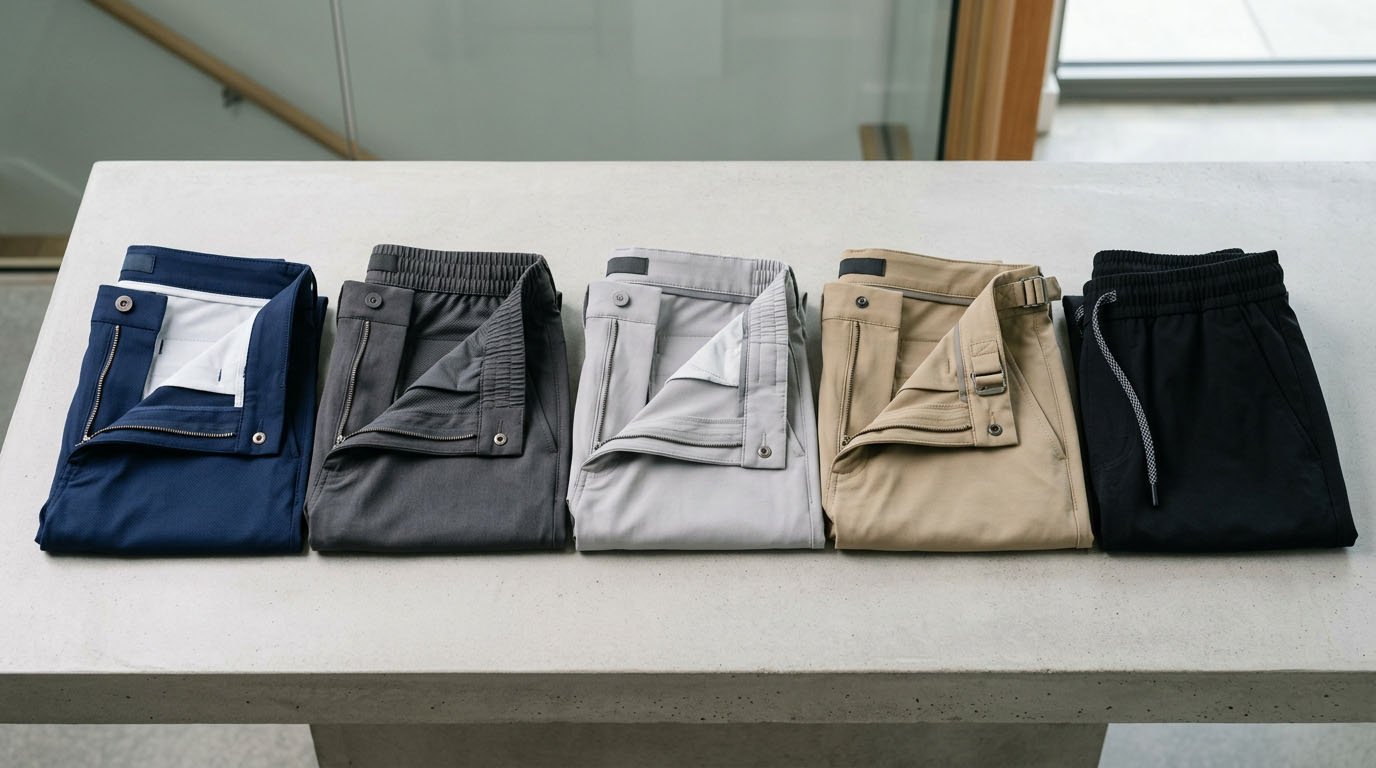
For golf brands developing new shorts, the important question is not simply:
Which waistband looks best?
A better question is:
Which waistband construction gives my target customer the right balance of comfort, stability, appearance, and fit forgiveness?
This guide explains how the main waistband types work, which products they suit, what to specify in your tech pack, and how to verify the construction before bulk production.
Quick Comparison: Which Golf Shorts Waistband Type Should You Choose?
| Waistband Type | Stretch | Structured Look | Fit Forgiveness | Stability | Development Complexity | Best For |
|---|---|---|---|---|---|---|
| Fixed Waistband | Low | Excellent | Low | Excellent | Low | Classic golf shorts |
| Mechanical Stretch | Medium | Excellent | Medium | High | Medium | Performance golf |
| Concealed Elastic | Medium–High | Excellent | High | High | Medium | DTC and performance brands |
| Expandable Waistband | Medium–High | Excellent | High | High | Medium–Higher | Classic look with hidden comfort |
| Full Elastic | High | Casual | High | Medium | Low–Medium | Casual and resort golf |
| Pull-On Waistband | High | Casual–Modern | High | Medium | Medium | Women's, casual and lifestyle golf |
| Gripper Waistband | Depends on base waistband | Excellent | Depends on base waistband | Excellent | Medium | Tucked-in golf polos |
| Adjustable Waistband | Variable | Medium–High | High | High | Medium | Flexible sizing |
| Hybrid Waistband | Variable | Excellent | High | High | Higher | Premium performance shorts |
There is no universally "best" waistband.
A traditional golf brand may prefer a structured fixed waistband, while a modern DTC brand may benefit more from concealed stretch or hybrid construction.
The waistband should follow the customer—not the trend.
Why Does Waistband Design Matter in Golf Shorts?
Golf places different demands on shorts than ordinary casual wear.
Players rotate through the hips and torso, bend to read putts, walk for long periods, sit in carts, and carry phones, balls, tees, and markers in their pockets.
The waistband needs to remain comfortable and stable through all of these movements.
A poorly developed waistband may cause:
- Rolling
- Twisting after washing
- Center-back gapping
- Excessive pressure
- Shorts slipping during movement
- Belt-loop distortion
- Front-waist wrinkling
- Uneven stretch
- Permanent loss of shape
- Sizing complaints
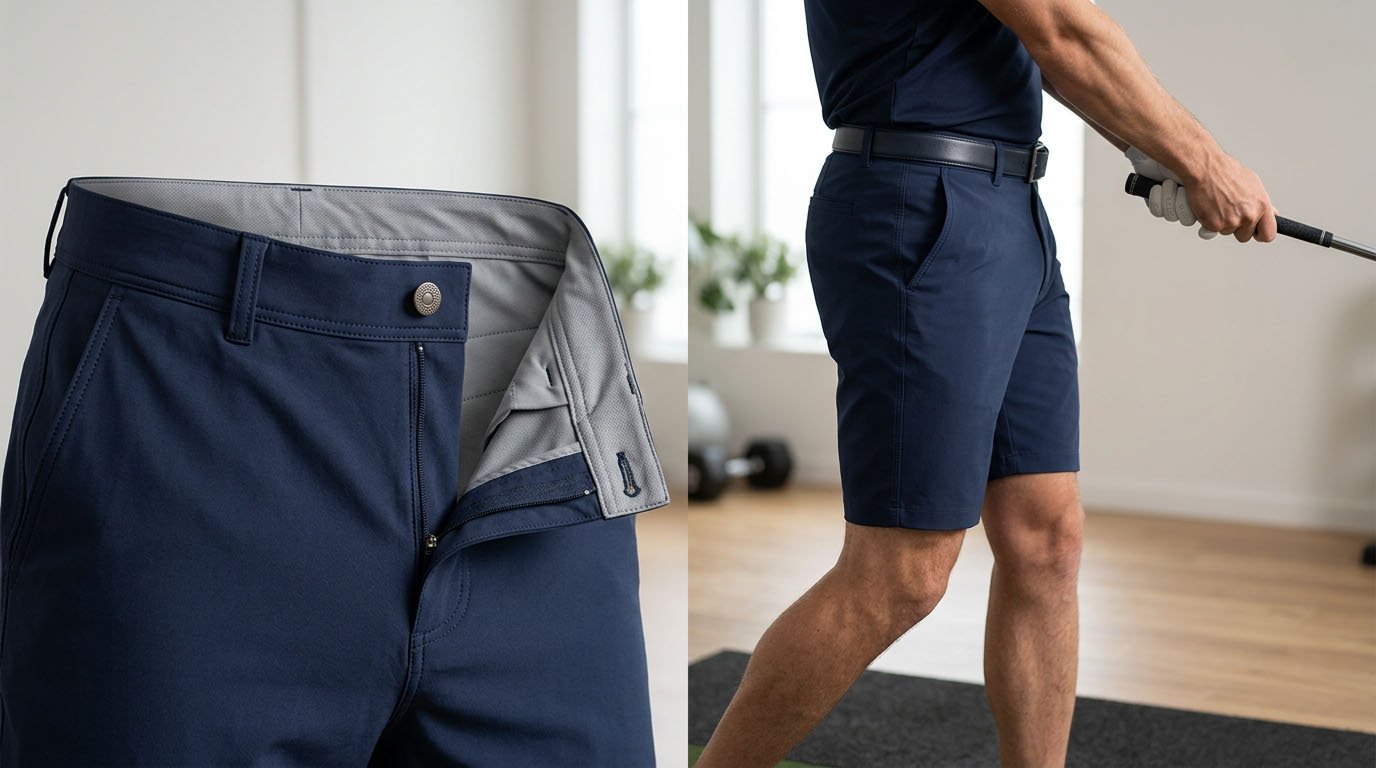
The waistband also affects how premium the garment feels.
A waistband that stays flat, holds its shape, and moves naturally with the golfer supports the quality of the whole garment.
That is why waistband construction should be considered during product development—not added as an afterthought.
What Are the Main Golf Shorts Waistband Types?
Terms such as "comfort waistband," "active waistband," and "flex waistband" can mean different things from one supplier to another.
For manufacturing, it is more useful to classify waistbands by how they create stretch, structure, and support.
1. Fixed Waistband
A fixed waistband has little or no intentional expansion.
It usually relies on shell fabric, interlining, waistband curtain, stitching, and belt loops to create structure.
Best For
Fixed waistbands work well for:
- Traditional golf styling
- Country-club collections
- Tailored silhouettes
- Premium lifestyle products
Main Advantage
They provide a clean and structured appearance.
Main Limitation
Fit tolerance is lower.
Customers need to choose their size more accurately because the waistband offers little forgiveness.
This matters especially for e-commerce brands.
2. Mechanical Stretch Waistband
Mechanical-stretch waistbands maintain a clean appearance while allowing controlled movement.
Stretch can come from:
- Stretch woven shell fabric
- Elastane-containing fabric
- Bias-oriented construction
- Flexible internal components
This construction is often a good middle ground between:
traditional tailoring
and
performance flexibility.
If your golf shorts already use performance woven fabrics, waistband behavior should be developed together with the shell fabric.
You can learn more about material development on our Fabric Sourcing page.
Best For
- Modern golf brands
- Performance lifestyle collections
- Athletic-fit golf shorts
- Premium stretch-woven bottoms
3. Concealed Elastic Waistband
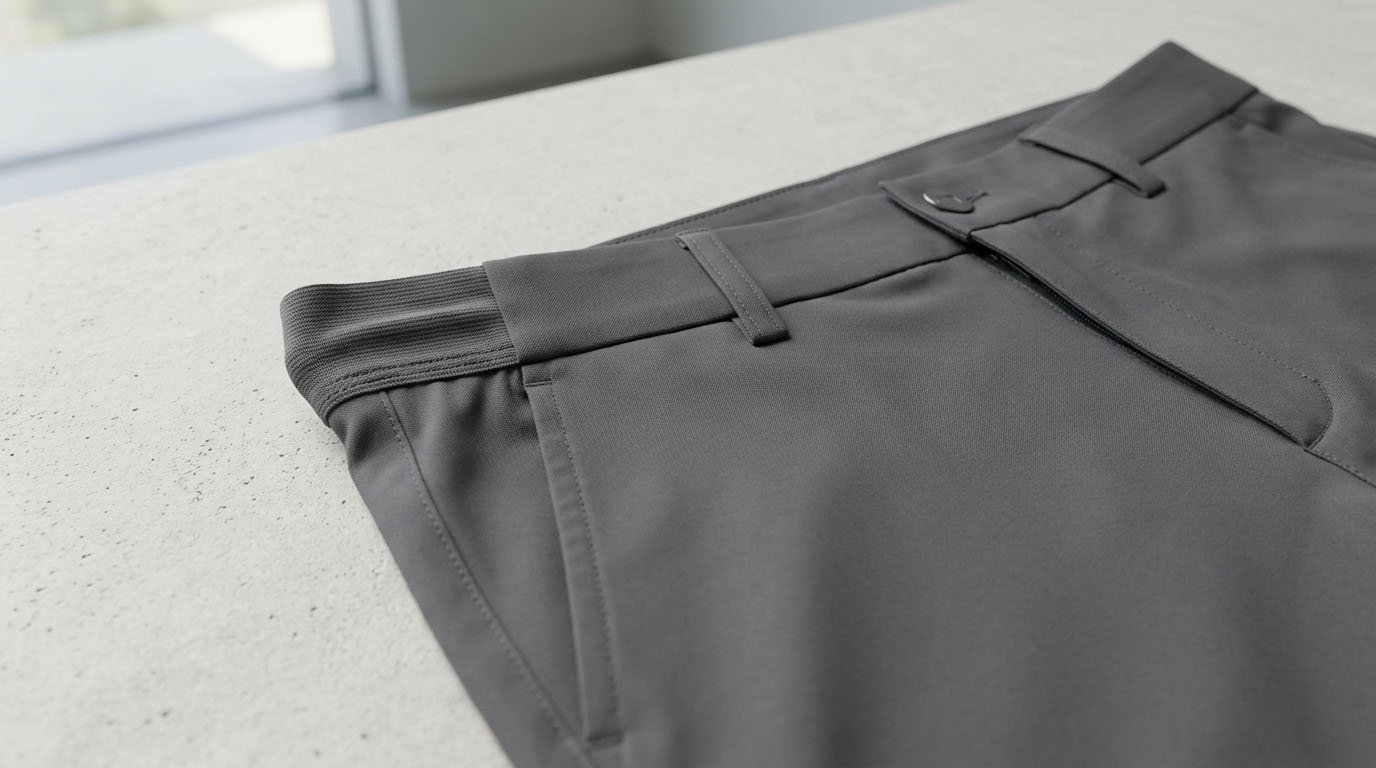
A concealed elastic waistband uses hidden elastic while keeping the exterior relatively clean.
The elastic may be placed:
- Around most of the waist
- At the sides
- At the back
- Inside the waistband curtain
- In selected stretch zones
Why Brands Use It
It combines:
tailored appearance + added fit flexibility
This makes it useful for performance and direct-to-consumer golf brands.
What Should Buyers Check?
Check whether:
- The waistband stretches evenly
- It returns to shape
- The outer fabric stays flat
- Elastic twists internally
- Seams pucker after washing
- Left and right stretch zones feel balanced
More elastic does not automatically mean better performance.
Controlled stretch and recovery matter more.
4. What Is an Expandable Golf Shorts Waistband?
An expandable golf shorts waistband is designed to provide hidden extra room without looking like a full elastic waistband.
The outside can still maintain a clean, flat-front appearance while internal or side-mounted stretch components allow the waist to expand during movement.
Common constructions include:
- Side elastic inserts
- Concealed elastic sections
- Hidden stretch panels
- Sliding or segmented waistband components
- Hybrid fixed-and-stretch constructions
This makes expandable waistbands useful for brands that want:
classic appearance + extra comfort
They are especially suitable for performance golf shorts where the customer expects a tailored look but still needs flexibility when sitting, bending, or swinging.
The key development point is balanced expansion.
During sampling, check whether the left and right sides expand evenly, whether the waistband returns to its original shape, and whether the front remains flat instead of pulling or puckering.
An expandable waistband should also be tested after washing because uneven elastic recovery can create asymmetry.
Unlike full elastic styles, the goal is not maximum stretch. The goal is to provide controlled hidden expansion while keeping the shorts looking structured.
5. Full Elastic Waistband
Full elastic waistbands prioritize comfort and fit flexibility.
They may include:
- Covered elastic
- Shirred elastic
- Drawcords
- Elasticized back sections
Best For
- Casual golf collections
- Resort golf
- Golf lifestyle apparel
- Travel shorts
- Younger golf audiences
The trade-off is appearance.
Full elastic normally looks less formal than a fixed, concealed, or expandable construction.
6. What Is a Pull-On Golf Shorts Waistband?
Pull-on golf shorts remove the traditional front opening or substantially simplify it.
Instead of relying on a zipper and conventional waistband opening, the waistband must stretch enough for the garment to pass over the hips before recovering comfortably around the waist.
This creates a different fit challenge from standard golf shorts.
Waist Fit Is Only Half the Job
A pull-on waistband has to work in two states:
- Relaxed comfortably around the waist
- Expanded enough to pass over the hips
A waistband can feel comfortable once worn but still be difficult to pull on.
The opposite can happen too.
It may stretch easily over the hips but then feel too loose at the waist.
That is why pull-on designs should not be approved only by checking relaxed waist measurements.
What Brands Should Evaluate
During sampling, check:
- Relaxed waist fit
- Usable opening width
- Ease of pulling over the hips
- Recovery after repeated dressing
- Center-back stability
- Waistband rolling
- Front-waist appearance
- Comfort when sitting and bending
Best For
Pull-on constructions can work particularly well for:
- Women's golf shorts
- Casual golf products
- Resort golf
- Golf lifestyle collections
- Travel apparel
- Younger performance brands
The goal is not maximum stretch.
It is:
enough opening stretch + reliable recovery
7. Gripper Waistband
A gripper waistband includes a grip component on the inside of the waistband.
Its main purpose is to help keep a golf polo tucked in during movement.
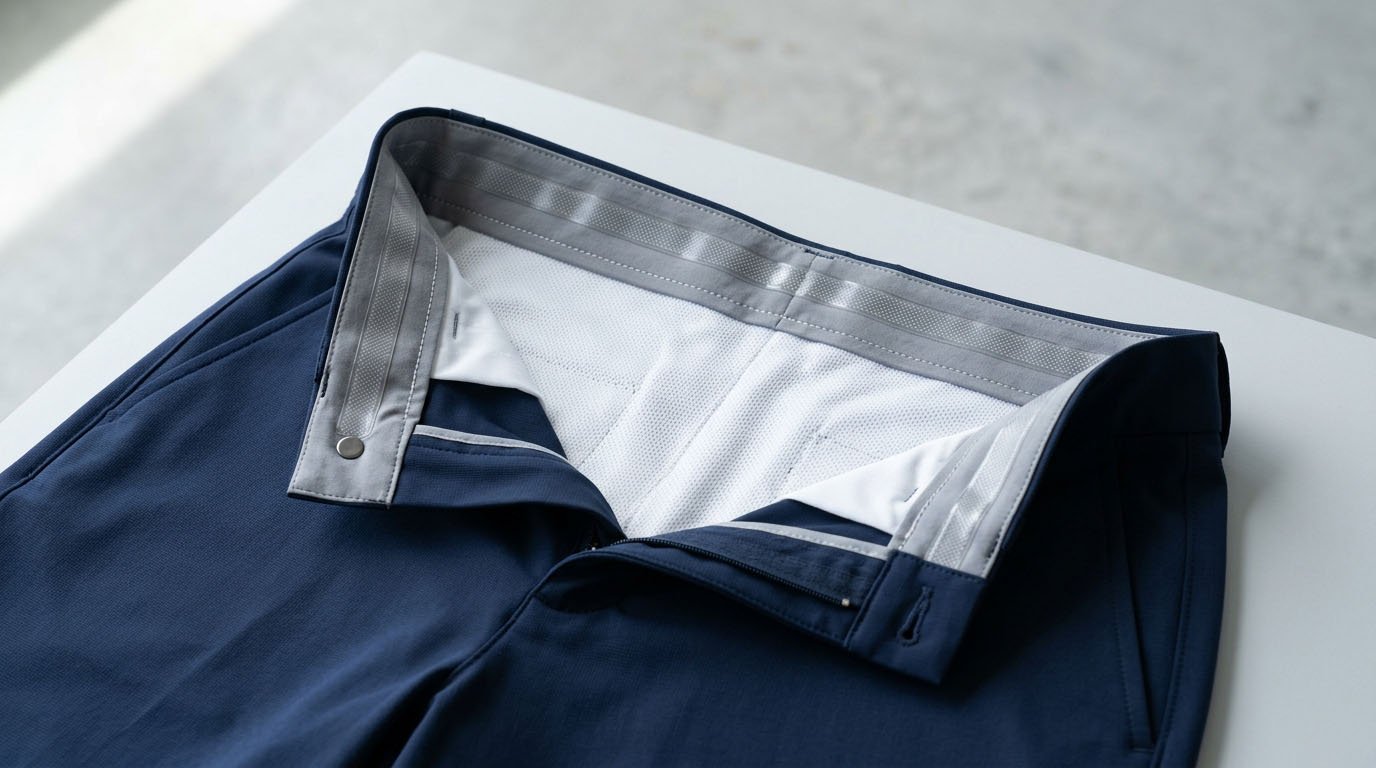
Common options include:
- Silicone print
- Grip tape
- Specialized elastic
- Textured internal material
What Should Be Checked?
The gripper should:
- Stay securely attached
- Feel comfortable
- Avoid excessive stiffness
- Remain stable after washing
- Avoid visible distortion on the outer waistband
A gripper should be tested on the actual garment, not selected only from a trim catalogue.
8. Adjustable Waistband
Adjustable waistbands allow customers to fine-tune their fit.
Common options include:
- Side tabs
- Internal adjustment
- Drawcords
- Button adjustment
- Hook-and-loop adjustment
These designs can increase fit flexibility, but every extra component adds development complexity.
They work especially well for:
- Broad customer groups
- Junior golf
- Travel
- Resort golf
- Casual styles
9. Hybrid Waistband
Hybrid waistbands combine two or more construction methods.
One common example is:
fixed front + stretch sides or back
Other combinations may include:
- Stretch fabric + hidden elastic
- Fixed waistband + gripper
- Concealed elastic + adjustable tabs
- Mechanical stretch + silicone grip
- Expandable side sections + structured front
Hybrid designs can balance tailored appearance with performance comfort.
The trade-off is greater development complexity, so they require careful sampling.
Golf Shorts Waistband Decision Tree
Use this decision tree to narrow down the best construction.
START
  │
  ▼
Do you want a traditional tailored golf look?
  │
  ├── YES
  │     │
  │     ▼
  │   Does the customer need extra waist flexibility?
  │     │
  │     ├── NO
  │     │     └── FIXED WAISTBAND
  │     │
  │     └── YES
  │           │
  │           ├── Small amount of controlled movement
  │           │       └── MECHANICAL STRETCH
  │           │
  │           └── Greater fit flexibility
  │                   │
  │                   ├── Hidden expansion + flat front
  │                   │       └── EXPANDABLE / CONCEALED ELASTIC
  │                   │
  │                   └── More complex performance build
  │                           └── HYBRID WAISTBAND
  │
  └── NO
        │
        ▼
      Is maximum comfort the main priority?
        │
        ├── YES
        │     │
        │     ├── Traditional opening wanted?
        │     │       └── FULL ELASTIC / DRAWCORD
        │     │
        │     └── Easy pull-on construction wanted?
        │             └── PULL-ON WAISTBAND
        │
        └── NO
              │
              ▼
            Need tailored appearance + flexible sizing?
              │
              └── HYBRID WAISTBAND
Then make a separate decision:
Will the golfer frequently wear a tucked-in polo?

YES → Consider an internal gripper.

NO → A standard internal waistband finish may be enough.
This is more useful than simply asking:
"Which waistband is best?"
The right answer depends on the full product concept.
How Should Golf Brands Choose the Right Waistband?
Different customer groups usually need different waistband priorities.
| Brand / Product Type | Good Starting Point | Main Priority |
|---|---|---|
| Traditional golf brand | Fixed / mechanical stretch | Tailored structure |
| Modern performance brand | Mechanical stretch / expandable / concealed elastic | Movement + clean appearance |
| DTC e-commerce brand | Concealed elastic / expandable / hybrid | Fit forgiveness |
| Casual or resort brand | Full elastic / pull-on | Comfort |
| Premium performance brand | Hybrid + optional gripper | Performance + refined look |
The most advanced construction is not automatically the best one.
A simpler waistband that fits the customer is often better than a complex design full of unnecessary features.
Why Can Too Much Stretch Become a Problem?
More stretch does not always mean more comfort.
The waistband supports:
- The garment itself
- Pocket contents
- Belt loops
- Front closure
- Phone
- Golf balls
- Tees and markers
If the waistband stretches too easily without enough recovery, several problems can appear.
Waistband Sagging
The shorts gradually move downward.
Center-Back Gapping
The waistband pulls away from the body.
Belt-Loop Distortion
The waistband stretches while the belt stays stable.
Waistband Rolling
Soft elastic folds during bending.
Poor Recovery
The waistband gradually becomes loose.
The better target is:
controlled elasticity + reliable recovery
rather than maximum stretch.
How Does Waistband Type Affect Online Sizing?
Waistband construction matters especially for e-commerce brands.
Customers often compare sizing across several companies, and one brand's Size 32 may not fit exactly like another brand's Size 32.
A fixed waistband offers little tolerance when the customer falls between sizes.
A concealed-stretch, expandable, or hybrid construction can add some fit forgiveness without changing the tailored appearance too much.
However, waistband construction cannot fix a poor size chart.
It should be considered together with:
- Size grading
- Fit model
- Fabric stretch
- Rise
- Seat width
- Thigh measurement
- Intended silhouette
How Do You Keep Waistband Performance Consistent Across Sizes?
Do not assume that a waistband approved in one base size will behave identically across the full size range.
This matters especially for:
- Pull-on designs
- Concealed elastic
- Expandable waistbands
- Side elastic
- Hybrid waistbands
- Adjustable constructions
Where practical, review:
one smaller size + base size + one larger size
Check:
- Relaxed waist measurement
- Stretch
- Opening width
- Recovery
- Gathering
- Front appearance
- Overall comfort
For pull-on and highly elasticated designs, extended sizes may need additional review rather than simply following the same grading formula.
What Should Be Included in a Golf Shorts Waistband Tech Pack?
A tech pack that simply says:
"Stretch waistband"
does not provide enough information for consistent manufacturing.
Your tech pack should explain how the waistband is supposed to work.
Golf Shorts Waistband Tech Pack Checklist
1. Waistband Construction
Specify:
- Fixed
- Mechanical stretch
- Concealed elastic
- Expandable
- Full elastic
- Pull-on
- Adjustable
- Hybrid
2. Finished Waistband Height
Define the finished height.
Do not rely only on photos.
3. Relaxed Waist Measurement
Define the finished measurement for each size.
4. Intended Stretch Range
Describe whether you need:
- Limited flexibility
- Moderate movement
- Significant adjustment
5. Stretch Location
Specify whether stretch appears:
- Around the whole waist
- At the sides
- At center back
- Internally
- In selected panels
6. Pull-On Opening Requirement
For pull-on designs, specify that the waistband must open sufficiently to pass over the intended hip range and then recover to the approved waist fit.
7. Elastic Type
Define:
- Width
- Position
- Construction
- Softness
- Required recovery behavior
8. Interlining
Specify whether the waistband needs:
- Soft interlining
- Structured interlining
- Fusible support
- Minimal support
9. Inner Gripper
Specify:
- Yes / No
- Material
- Width
- Placement
- Application method
10. Belt Loops
Include:
- Number
- Width
- Finished length
- Position
11. Closure
Specify:
- Button
- Snap
- Hook and bar
- Zipper
- Drawcord
- Combination
12. Topstitching
Define:
- Stitch position
- Visible appearance
- Thread requirement where relevant
13. Size-Set Requirements
If waistband behavior is critical, define which sizes require approval.
14. Wash Performance Requirements
The approved sample should remain free from unacceptable:
- Twisting
- Puckering
- Elastic migration
- Delamination
- Excessive deformation
- Uneven shrinkage
A detailed tech pack helps the factory reproduce the approved sample more consistently.
If your brand needs support turning a concept into production-ready specifications, FUWAY also provides Private Label golf apparel development.
Why Should Final Waistband Components Be Approved Before Bulk Production?
Two elastic tapes with the same width can still feel very different.
The same applies to:
- Interlining
- Gripper
- Waistband lining
- Closures
Before bulk production, confirm the final versions of critical components used in the approved sample.
Where practical, record:
- Material reference
- Supplier or internal code
- Approved sample reference
A simple rule is:
If a critical waistband component changes after approval, recheck the waistband before bulk production.
This is especially important for concealed elastic, expandable, pull-on, gripper, and hybrid constructions.
How Should You Test a Golf Shorts Waistband During Sampling?
Never approve a waistband from photos alone.
Two waistbands can look almost identical from the outside while using very different:
- Elastic
- Interlining
- Stitching
- Internal construction
The sample stage should test how the waistband behaves—not only how it looks.
1. Check the Relaxed Measurement
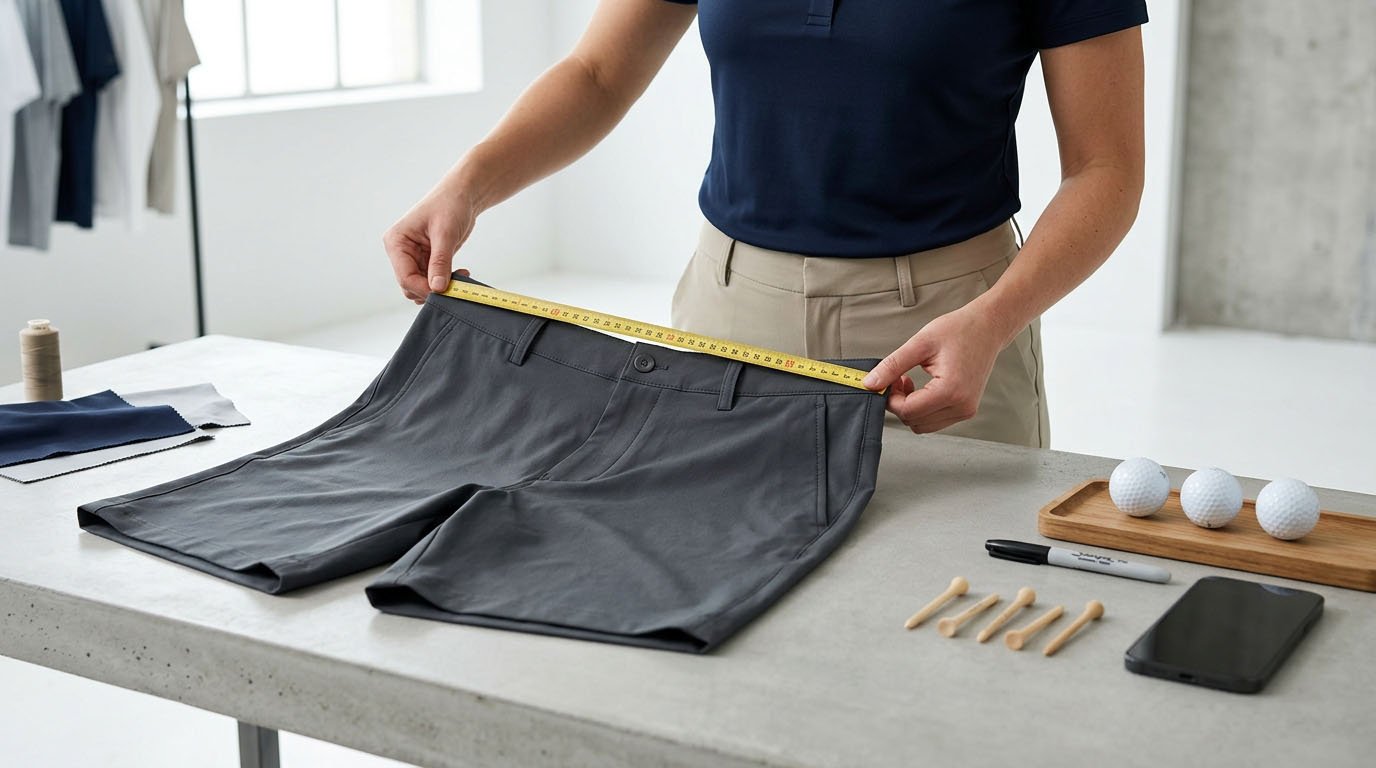
Lay the shorts flat.
Measure the waistband according to the agreed method.
Compare it with the tech pack.
2. Check Stretch and Recovery
Stretch the waistband through its intended working range.
Release it.
Check whether it returns close to its original shape without:
- Permanent distortion
- Excessive waviness
- Uneven recovery
For expandable constructions, also check that the left and right sides expand and recover evenly.
3. Check Pull-On Opening
For pull-on designs, test whether the waistband can comfortably pass over the intended hip range.
Repeat the action several times.
A pair of shorts can fit perfectly once worn and still fail because it is difficult to put on.
4. Check the Side Seams
Stretch the waistband while watching the side seams.
Look and listen for:
- Thread breakage
- Seam cracking
- Excessive tension
- Uneven gathering
5. Test the Shorts While Moving
Wear the sample.
Try:
- Walking
- Sitting
- Bending
- Squatting
- Golf-swing rotation
A waistband can pass a tabletop inspection and still feel uncomfortable on the body.
6. Add Normal Pocket Weight
Put typical golf items in the pockets.
For example:
- Phone
- Golf balls
- Tees
- Marker
Walk around and check whether the shorts remain stable.
7. Wash the Sample
After laundering, inspect:
- Waist measurement
- Elastic recovery
- Waistband shape
- Puckering
- Twisting
- Gripper adhesion
- Interlining behavior
- Left-right expansion balance where applicable
8. Compare Before and After
Photograph and measure the sample before and after washing.
This gives the brand and factory a clearer reference for bulk production.
You can also review FUWAY's Test Reports for more information about material and garment testing.
How Do You Maintain Waistband Consistency in Bulk Production?
The approved sample should become the physical reference for production.
During bulk manufacturing, compare key points such as:
- Waistband height
- Front appearance
- Stretch behavior
- Recovery
- Expansion balance
- Gathering
- Belt-loop placement
- Gripper positioning
- Closure alignment
QC should also check pieces across different sizes and production batches.
For complex concealed-elastic, expandable, pull-on, or hybrid constructions, this matters more than checking only one finished garment.
Common Golf Shorts Waistband Development Mistakes
Mistake 1: Choosing From Photos Only
Photos cannot show:
- Internal elastic
- Interlining firmness
- Recovery
- Seam flexibility
Always test the actual construction.
Mistake 2: Asking for Maximum Stretch
Maximum stretch may reduce stability.
Define how much functional flexibility the customer actually needs.
Mistake 3: Ignoring the Shell Fabric
The waistband and body fabric need to work together.
Very different stretch behavior can create puckering or tension problems.
Mistake 4: Forgetting Pocket Load
Golf shorts often carry phones, balls, tees, and other items.
The waistband should remain stable under normal use.
Mistake 5: Approving Only the Base Size
Stretch behavior may change across the size range.
Check multiple sizes where waistband performance is important.
Mistake 6: Ignoring Pull-On Opening
For pull-on shorts, relaxed waist fit is only half the equation.
The garment must also pass comfortably over the hips.
Mistake 7: Ignoring Expansion Balance
For expandable waistbands, uneven left-right expansion can create twisting, pulling, or visible asymmetry.
Check both sides during sampling.
Mistake 8: Approving an Unwashed Sample
Some waistband problems only appear after laundering.
Mistake 9: Changing Elastic After Approval
A visually similar elastic can still produce different:
- Stretch
- Pressure
- Recovery
- Fit
Recheck the garment if the critical elastic changes.
Should Golf Shorts Have a Silicone Shirt Gripper?
Not necessarily.
A gripper is useful when the target golfer frequently wears a tucked-in polo.
It can help keep the shirt stable during:
- Rotation
- Walking
- Bending
- Swinging
For casual and untucked golf apparel, it may add unnecessary cost and complexity.
If your shorts are designed as part of a full golf outfit, it makes sense to evaluate the waistband together with your custom golf shirts.
Which Waistband Is Best for a Startup Golf Brand?
For many startup brands, a relatively simple mechanical-stretch, expandable, or concealed-elastic waistband is easier to manage than a highly complicated design.
It provides useful performance benefits without adding too many components.
The final choice should still depend on:
- Customer profile
- Price positioning
- Style direction
- Fabric
- Distribution channel
If you are developing multiple golf-bottom styles, you can review FUWAY's Custom Golf Bottoms capabilities.
FAQ: Golf Shorts Waistband Types
Which golf shorts waistband type is best overall?
There is no single best type.
Fixed waistbands suit structured traditional styles, while mechanical stretch, concealed elastic, expandable, full elastic, pull-on, and hybrid constructions provide different levels of flexibility.
Match the waistband to the customer.
What is an expandable golf shorts waistband?
An expandable waistband uses hidden stretch components to provide extra waist flexibility while maintaining a relatively clean, tailored exterior.
It is different from a full elastic waistband because the stretch is usually concealed rather than visually dominant.
What is the difference between a pull-on waistband and a full elastic waistband?
Full elastic describes how the waistband creates stretch.
Pull-on describes how the garment is put on.
A pull-on design usually needs enough opening stretch to pass over the hips without a traditional zipper opening.
Should I approve only one sample size?
For simple fixed constructions, one base size may provide a useful starting point.
For pull-on, concealed-elastic, expandable, adjustable, or hybrid designs, reviewing multiple sizes is safer.
What should I test before bulk production?
At minimum, check:
- Finished waist measurement
- Stretch
- Recovery
- Expansion balance where applicable
- Pull-on opening where relevant
- Seam performance
- Comfort during movement
- Pocket-load stability
- Post-wash shape
- Size consistency
Final Thoughts
Choosing the right golf shorts waistband is not simply a decision between "elastic" and "non-elastic."
You need to balance:
appearance + movement + support + sizing tolerance + recovery + manufacturing complexity.
A traditional fixed waistband may be ideal for one brand and completely wrong for another.
For modern golf apparel, mechanical stretch, concealed elastic, expandable, pull-on, and hybrid constructions offer different ways to combine comfort with a clean appearance.
The important questions are:
- How much stretch is actually required?
- Where should the stretch be located?
- Does an expandable waistband move evenly on both sides?
- Can a pull-on waistband pass comfortably over the hips?
- Does the waistband behave consistently across key sizes?
- Are the final components approved?
- Does the waistband recover after movement and washing?
- Can bulk production reproduce the approved result?
Define the required behavior in your tech pack, develop it during sampling, test it on the body, wash it, review key sizes, and use the approved sample as the production reference.
If you are developing custom golf shorts or other golf apparel and need support with waistband construction, fabric sourcing, sampling, or OEM/ODM production, learn more about FUWAY or contact our team to discuss your project.