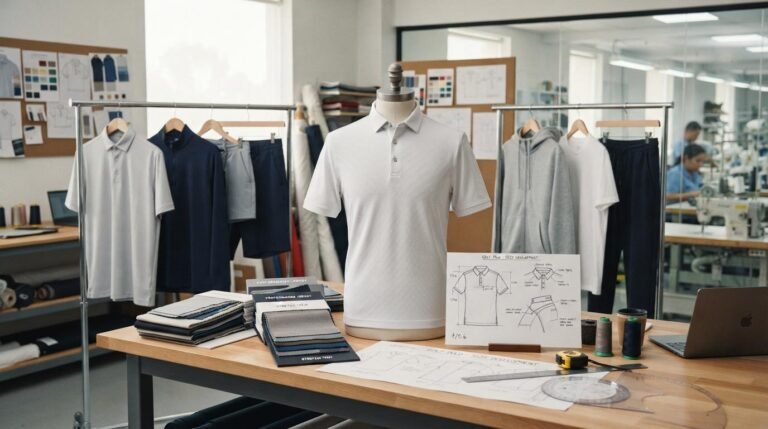
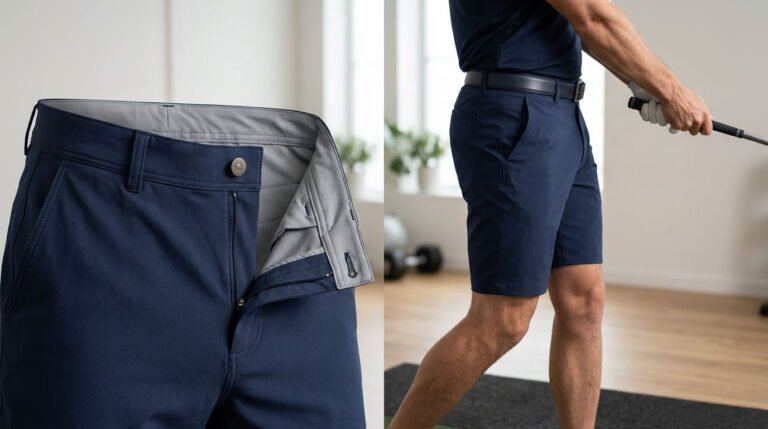
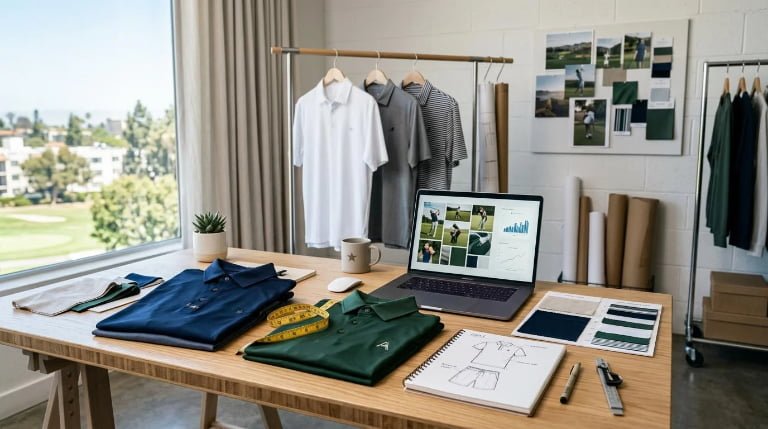
Choosing between sublimation and screen printing for golf shirts affects more than appearance. The printing method influences fabric compatibility, comfort, artwork quality, production costs, and how the finished polo performs on the course.
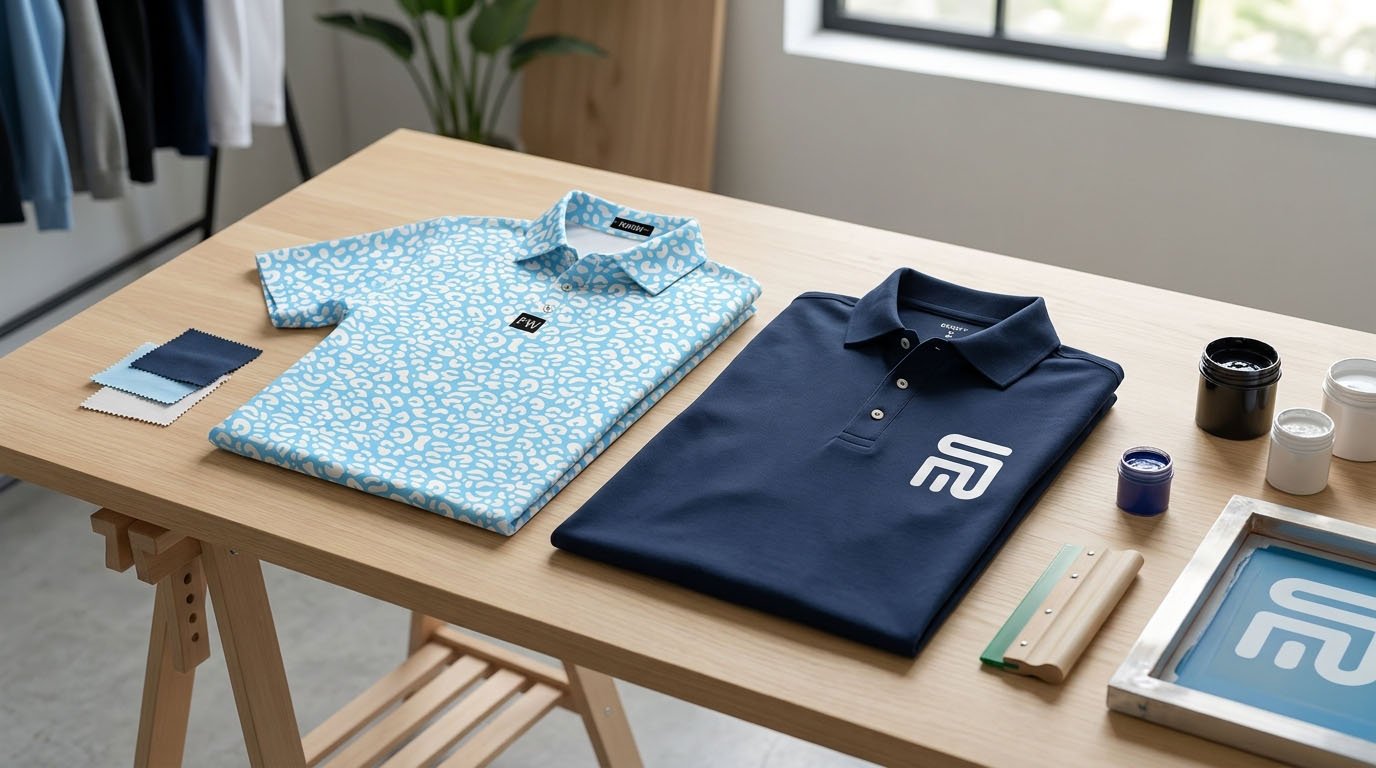
Sublimation is generally better for full-color or all-over designs on white or light-colored polyester golf shirts. Screen printing is usually better for simple logos and graphics on cotton, polyester blends, or dark-colored polos.
Neither method is universally better. The right choice depends on your fabric, artwork, print coverage, order quantity, and performance requirements.
Quick Answer: Sublimation vs Screen Printing for Golf Shirts
For most custom golf polo projects, start by comparing these factors:
| Factor | Sublimation | Screen Printing |
|---|---|---|
| Best fabric | Polyester or suitable high-polyester blends | Cotton, polyester, and compatible blends |
| Base fabric color | White or light colors | Light or dark colors |
| Ideal artwork | All-over patterns, gradients, photographs | Logos, text, solid-color graphics |
| Print feel | No raised ink layer | Depends on ink type and coverage |
| Breathability | Minimal added surface obstruction | Large ink areas may reduce airflow |
| Stretch | No surface film to crack; heat effects require testing | Stretch-compatible ink may be needed |
| Setup costs | No individual color screens | Screen preparation for each color |
| Best application | Full-color performance golf polos | Club logos, uniforms, promotional polos |
Our recommendation: Choose sublimation when the design covers much of the shirt and the fabric is suitable polyester. Choose screen printing for localized graphics, particularly on dark garments or mixed-fiber fabrics.
If you are also considering embroidery or heat transfer, see our Best Logo Methods for Golf Apparel guide.
Step 1: Compare Fabric Compatibility and Shirt Colors
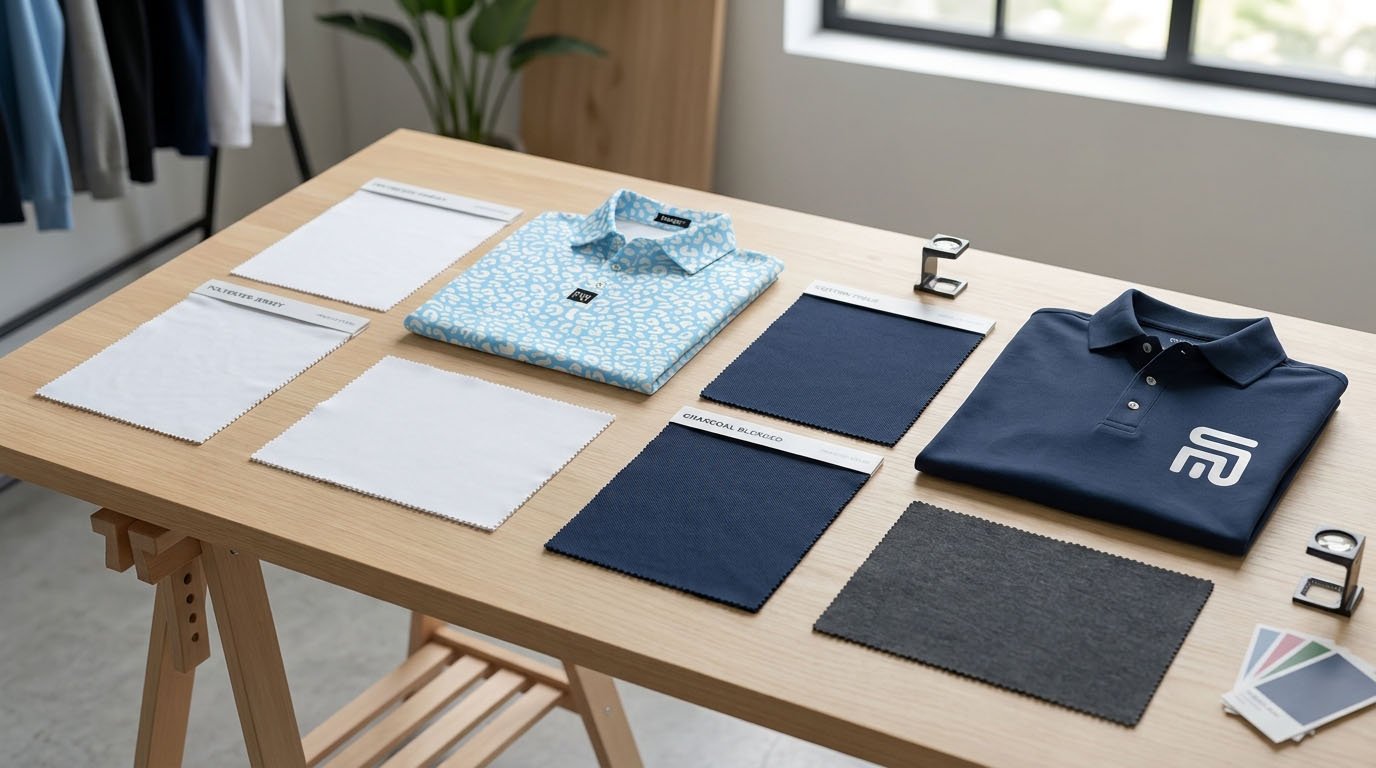
Fabric composition is usually the first factor that determines whether sublimation or screen printing is suitable.
When Is Sublimation Better?
Sublimation uses heat to transfer disperse dye into polyester fibers rather than depositing a conventional ink layer onto the fabric surface.
White 100% polyester is typically the most reliable starting point for vibrant, detailed sublimation prints.
High-polyester blends can also work, although results depend on fiber composition, fabric construction, and heat resistance.
The main considerations are:
- Polyester content: Higher polyester content generally supports stronger conventional sublimation color reproduction.
- Base color: White provides the most neutral background; light-colored fabrics may change the appearance of printed colors.
- Knit construction: Smooth jersey and interlock often reproduce intricate designs more clearly than heavily textured fabrics.
- Heat sensitivity: Polyester-spandex fabrics require verification of dimensional stability and stretch recovery.
Conventional sublimation is not recommended for 100% cotton golf polos.
However, a finished dark-colored sublimated golf shirt is possible. Manufacturers can print dark artwork onto white polyester panels before assembling the garment. The limitation is printing bright designs directly onto fabric that has already been dyed black or navy.
For detailed fabric selection, read our Best Golf Shirt Fabric for Sublimation guide.
When Is Screen Printing Better?
Screen printing uses a mesh stencil to deposit ink onto the fabric surface. With suitable ink selection and curing, it can work on a wider range of golf polo fabrics.
Common applications include:
- Cotton piqué golf polos
- Cotton-polyester blends
- Pre-dyed polyester performance shirts
- Dark navy, black, and burgundy uniforms
- Selected polyester-spandex fabrics using compatible inks
Printing on polyester requires additional attention to dye migration, ink adhesion, and curing temperature.
Similarly, stretch fabrics may need specialized flexible inks to prevent cracking during repeated movement.
Decision: If your collection uses white polyester and needs detailed full-color artwork, start with sublimation. If your shirts are cotton-based or already dyed dark colors, screen printing is usually more practical.
Step 2: Match the Printing Method to Your Golf Shirt Design
Artwork size, color complexity, and placement strongly influence the printing method.
Sublimation for All-Over Golf Polo Designs
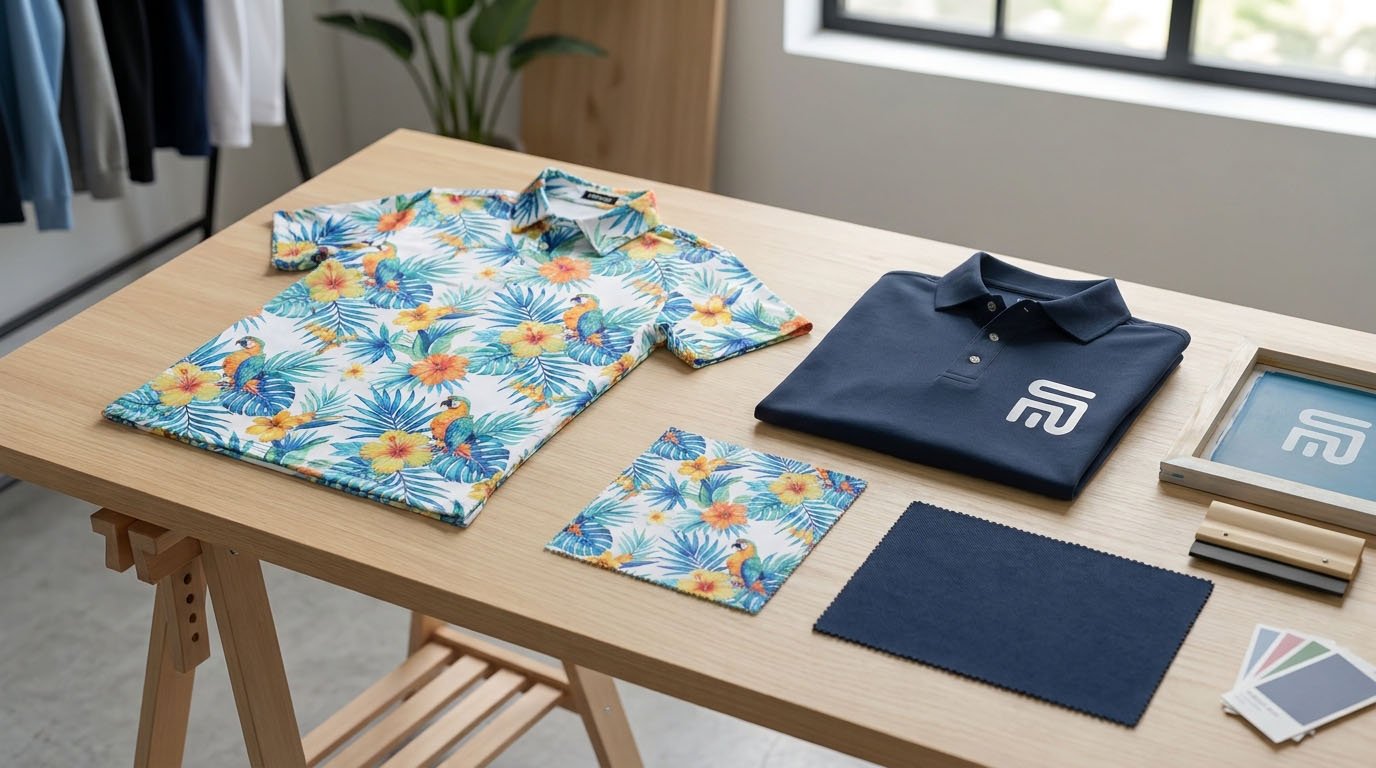
Sublimation is particularly suitable for golf polos featuring:
- Tropical or botanical patterns
- Repeating geometric prints
- Photographic artwork
- Gradients and ombré effects
- Large multi-color designs
For full-coverage designs, manufacturers can sublimate pre-cut fabric panels and then assemble the golf shirt.
This approach allows artwork to be planned across the front, back, sleeves, collar, and placket.
However, artwork continuity still requires careful pattern positioning. Designs crossing seams or plackets must account for cutting tolerances and garment construction.
For more information about the manufacturing process, explore FUWAY's Sublimation Printing service.
Screen Printing for Logos and Spot Graphics
Screen printing works particularly well for designs with limited colors and defined placement.
Examples include:
- A golf club logo on the chest
- A tournament sponsor graphic
- A corporate wordmark on the sleeve
- A simple graphic on the back
- Team or promotional artwork
Each spot color generally requires its own screen, although specialized multicolor and halftone processes are available.
This makes simple designs economical at suitable production quantities, while complex artwork requires more preparation and registration control.
Screen printing can also reproduce gradients using halftone techniques, but fine details may appear differently on textured piqué compared with smooth jersey.
Learn more about FUWAY's Screen Printing capabilities for custom golf apparel.
Decision: For full-body patterns, sublimation is usually the stronger option. For localized logos and bold graphics, screen printing is often more practical.
Step 3: Compare Breathability, Stretch, and Wash Durability
Golf shirts must remain comfortable during movement, perspiration, and repeated washing.
The printing method should support the garment's intended performance rather than create unnecessary restrictions.
Which Printing Method Feels Softer?
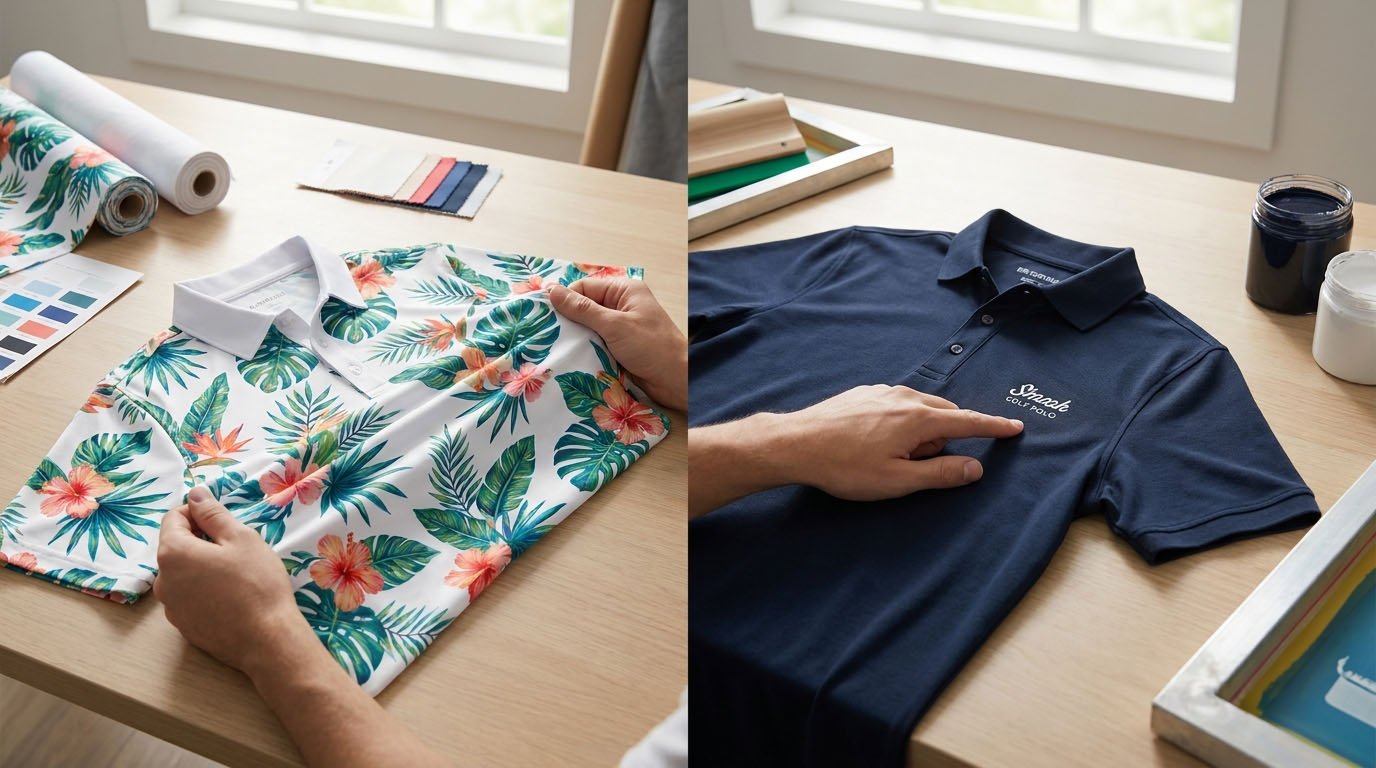
Sublimation generally offers the softer printed feel because the dye becomes part of the polyester fibers without adding a raised ink film.
This is valuable for lightweight performance golf polos with large printed areas.
Screen printing creates an ink deposit on the surface. Its feel depends on:
- Ink formulation
- Print thickness
- Artwork coverage
- Fabric construction
- Curing conditions
A small, thin screen-printed logo may have little noticeable impact on comfort. A large, heavily deposited print may feel warmer or stiffer.
Water-based or specialized stretch inks can help achieve a softer result, depending on the garment and artwork.
Does Printing Affect Stretch and Breathability?
Sublimation does not create a separate surface film, so it generally preserves more of the fabric's original surface characteristics.
However, sublimation heat can affect dimensions and stretch recovery, especially in elastane-containing blends.
Screen printing may restrict airflow or flexibility where large areas of ink cover the fabric.
For performance golf shirts, evaluate the print during realistic movements, including shoulder rotation and torso stretching.
Which Method Lasts Longer?
Both methods can deliver durable results when materials and processing conditions are suitable.
| Durability Factor | Sublimation | Screen Printing |
|---|---|---|
| Cracking | No surface ink film to crack | Possible if ink lacks flexibility or is improperly cured |
| Peeling | No applied surface film to peel | Poor adhesion may cause print damage |
| Color fading | Depends on dyes, fabric, light, and washing | Depends on ink, curing, light, and washing |
| Stretch performance | Depends on fabric behavior after heat | Depends on ink elasticity and print coverage |
| Wash durability | Requires colorfastness verification | Requires adhesion and wash verification |
Sublimation does not automatically guarantee that colors will never fade. Screen printing also should not be considered less durable simply because it deposits ink on the surface.
The correct comparison is between approved production samples—not generic claims about printing lifespan.
Step 4: Compare Sublimation vs Screen Printing Costs
Cost depends on more than the printing technique.
When requesting quotations, golf apparel brands should compare setup expenses, artwork complexity, print coverage, fabric costs, and order quantity.
Sublimation Cost Factors
Sublimation typically avoids individual screen-making costs for each artwork color.
However, production expenses may include:
- Digital artwork preparation and color profiling
- Transfer paper and dye
- Printing and heat-transfer operations
- Fabric consumption
- Cutting and sewing for all-over printed garments
- Sampling and color approval
For detailed patterns, sublimation can avoid the additional screens associated with numerous spot colors.
But full-body printing and cut-and-sew construction can increase total garment costs.
Screen Printing Cost Factors
Screen printing costs typically include:
- Artwork separation
- Screen preparation
- Ink mixing and setup
- Printing operations
- Curing
- Inspection
A two-color logo generally requires less setup than a six-color design using conventional spot-color screens.
As quantities increase, fixed setup expenses can be distributed across more garments.
This often improves screen printing economics for repeatable, limited-color artwork.
How Does Order Quantity Affect the Decision?
Consider how order size changes the comparison:
| Example Order | Sublimation Consideration | Screen Printing Consideration |
|---|---|---|
| 100 golf polos | Attractive for complex full-color designs | Setup can be significant for multiple colors |
| 300 golf polos | Suitable for repeated all-over artwork | Fixed setup spreads across more units |
| 500+ golf polos | Compare full printing and garment assembly costs | Often competitive for simple spot graphics |
These are illustrative quantities, not fixed pricing thresholds.
A 100-piece all-over sublimation order and a 500-piece two-color screen-print order have very different cost structures.
For accurate quotations, compare equivalent finished-garment specifications rather than decoration charges alone.
Important: A lower printing cost does not necessarily mean a lower total golf shirt manufacturing cost. Fabric quality, pattern complexity, trims, sewing, and packaging also matter.
Step 5: Choose the Right Method for Three Golf Polo Projects
The easiest way to choose is to compare your intended product with common golf apparel manufacturing scenarios.
Scenario A: A Full-Color Performance Golf Polo Collection
Project: A new golf brand wants lightweight polyester polos featuring tropical and geometric patterns across the body and sleeves.
Recommended method: Sublimation
Why?
- Supports detailed, multi-color artwork
- Suitable for all-over patterns
- Avoids a large surface ink layer
- Works with appropriate polyester performance fabrics
The brand should approve fabric composition, artwork positioning, color reproduction, and stretch performance before production.
Scenario B: A Corporate Golf Tournament Polo
Project: An event organizer needs dark navy polos featuring a two-color company logo on the chest and a sponsor graphic on the sleeve.
Recommended method: Screen printing
Why?
- Compatible with suitable pre-dyed dark fabrics
- Good for defined, limited-color artwork
- Can offer favorable economics at appropriate quantities
- Does not require converting the entire shirt into a sublimated design
Small or premium crests may also justify comparing embroidery or heat transfer before making the final decision.
Scenario C: A Premium Athletic Golf Polo With Large Graphics
Project: A performance golf brand wants a fitted, stretch polyester polo with a large gradient design across the front.
Recommended method: Sublimation, subject to fabric testing
Why?
A large screen-printed graphic may create an unwanted surface layer. Sublimation can provide a smoother finish and reproduce continuous-tone artwork.
However, the manufacturer must test the intended fabric after heat transfer to confirm acceptable stretch recovery, dimensions, and printed appearance.
| Project Priority | More Suitable Starting Option |
|---|---|
| All-over artwork on light polyester | Sublimation |
| Small logo on a dark polo | Screen printing or another compatible logo method |
| Full-color gradients | Sublimation |
| Limited-color graphics in larger runs | Screen printing |
| Large graphics on stretch performance fabric | Sublimation, if the fabric is compatible |
| Cotton piqué golf polo branding | Screen printing or another cotton-compatible method |
Brands planning multiple product styles should evaluate the printing method separately for each fabric and design combination.
At FUWAY, we develop custom golf shirts with fabric, fit, decoration, labels, and packaging specified around the brand's requirements.
Step 6: What Should You Confirm Before Bulk Production?
Selecting the printing method is only the first decision.
Before approving bulk production, ask your manufacturer to verify that the proposed process works with the final fabric, artwork, and garment construction.
Pre-Production Approval Checklist
| Checkpoint | What to Confirm |
|---|---|
| Fabric compatibility | Fiber composition, knit construction, and base color |
| Artwork approval | Final dimensions, colors, position, and print coverage |
| Print appearance | Clarity, registration, hand feel, and visible defects |
| Performance | Stretch, dimensional stability, and wash behavior |
| Garment construction | Artwork positioning around seams, collars, and plackets |
| Approved reference | Signed or documented sample for bulk production comparison |
What Information Should You Send Your Manufacturer?
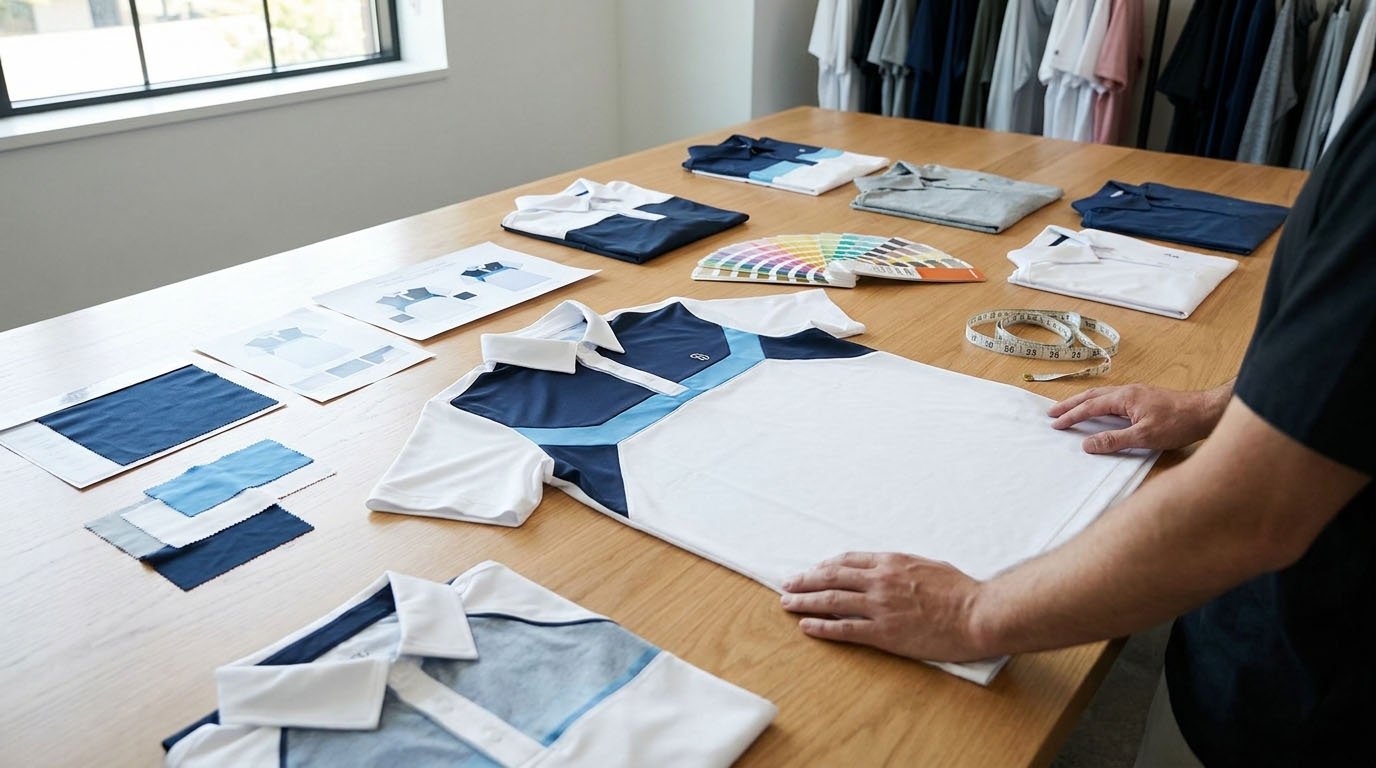
To compare sublimation and screen printing quotations, prepare:
- Fabric requirements: Composition, weight, knit type, and preferred color.
- Artwork files: Vector files or high-resolution artwork with intended dimensions.
- Print placement: Chest, sleeves, back, panels, or all-over coverage.
- Order details: Quantity per style, color, and size breakdown.
- Performance requirements: Stretch, moisture management, and intended use.
- Delivery requirements: Target market, packaging, and required schedule.
For custom development, FUWAY's typical starting MOQ is approximately 100 pieces per style, with flexibility depending on the design, fabric, and customization requirements.
Submitting complete specifications helps the manufacturer compare realistic production options and reduces unnecessary sample revisions.
Detailed print defect classifications and inspection procedures should be documented separately in the production quality control plan.
Frequently Asked Questions
Is Sublimation Better Than Screen Printing for Polyester Golf Shirts?
Not always. Sublimation is generally better for detailed all-over prints on suitable light-colored polyester. Screen printing may be better for small logos and defined graphics on pre-dyed polyester polos, provided compatible inks and curing conditions are used.
Can You Sublimate on Dark Golf Shirts?
Conventional sublimation does not reproduce bright artwork effectively on black or dark navy fabric because its dyes are transparent and do not include an opaque white ink layer.
However, manufacturers can create dark-colored sublimated golf shirts by printing dark artwork onto white polyester before garment assembly.
Is Screen Printing Cheaper Than Sublimation?
Screen printing can be more economical for limited-color designs at suitable quantities because setup costs are distributed across the order.
Sublimation may be more practical for detailed multi-color or all-over artwork because it does not require a separate screen for every color.
The total cost depends on fabric, production method, artwork coverage, and garment construction.
Which Printing Method Is Better for Small Golf Shirt Orders?
It depends on the design.
Sublimation can be attractive for small batches with complex artwork, while a simple logo may be better suited to screen printing or another decoration method.
Compare setup costs and minimum order requirements before deciding.
Does Screen Printing Affect Golf Shirt Breathability?
It can, particularly when thick ink covers a large area of a lightweight performance fabric.
Small graphics and appropriately selected inks generally create less noticeable effects.
Print placement, fabric construction, and ink coverage should be considered together.
Can Screen Printing Be Used on Polyester-Spandex Golf Polos?
Yes, with appropriate ink systems and process validation.
High-stretch fabrics may require flexible inks and careful curing conditions to maintain acceptable print durability and fabric performance.
Always test the finished print on the intended production fabric.
Conclusion: Which Printing Method Should Your Golf Brand Choose?
The best choice between sublimation and screen printing depends on the golf shirt you want to manufacture.
Choose sublimation for suitable light-colored polyester polos with all-over graphics, detailed patterns, or large full-color designs.
Choose screen printing for compatible fabrics requiring localized logos, simple graphics, and potentially cost-effective repeat production.
For performance golf apparel, the decision should also consider stretch, breathability, wash durability, and sample-to-bulk consistency.
At FUWAY, we support golf apparel brands with fabric sourcing, custom polo development, printing method selection, sampling, and OEM/ODM manufacturing.
Developing a custom golf polo collection?
Send us your artwork, fabric preferences, print locations, and estimated order quantity.
Contact FUWAY to discuss suitable printing methods and sample development for your next golf apparel collection.