Choosing between a golf-specific apparel manufacturer and a general sportswear factory can directly affect your product quality, development costs, and launch timeline.
A factory experienced in gym wear may produce excellent basic polos but struggle with golf-specific details such as swing mobility, collar stability, or tailored fit. Meanwhile, a golf specialist may offer valuable technical knowledge that your simpler products do not require.
The best choice depends on your product complexity, sampling requirements, MOQ, budget, and ability to maintain consistent quality from sample to bulk production.
This guide compares both factory types and explains how to evaluate their capabilities before committing to production.
Quick Comparison: Golf-Specific vs General Sportswear Factory
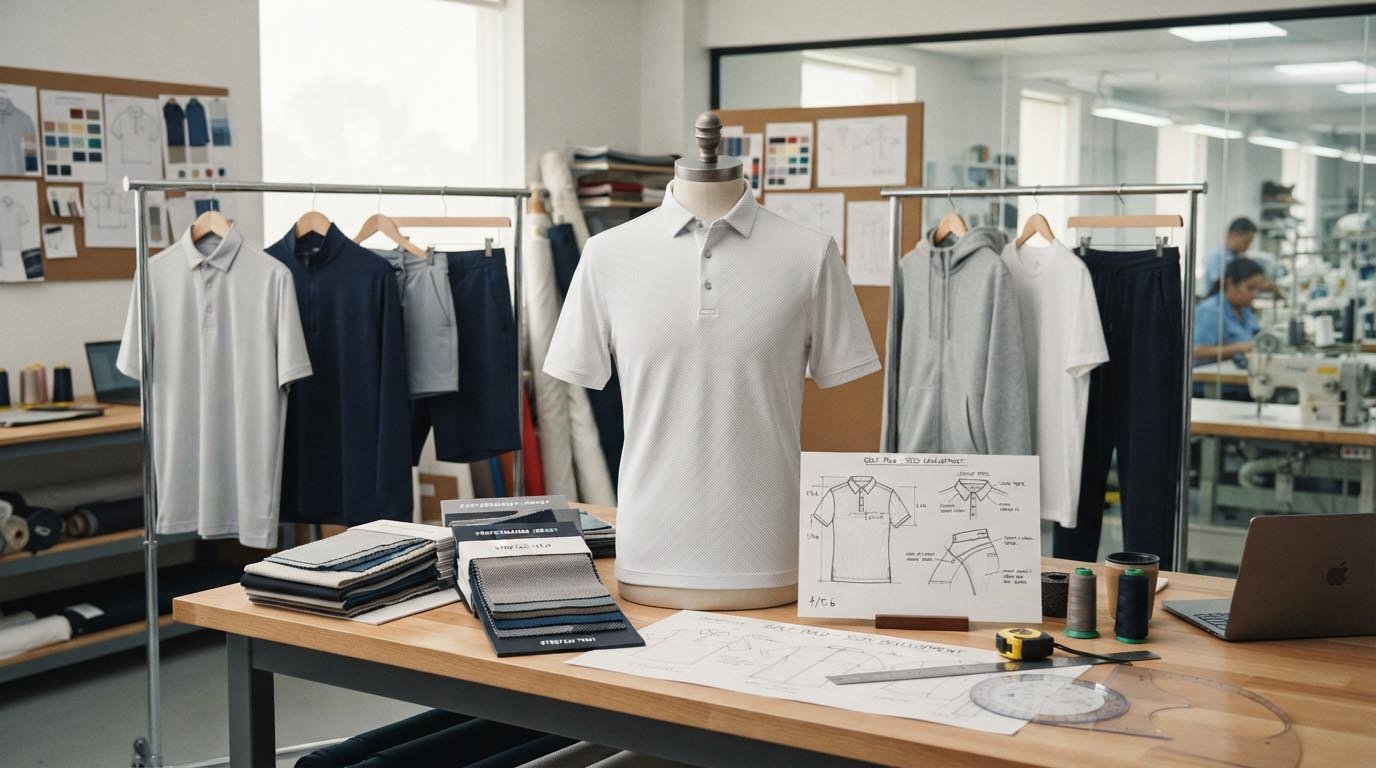
A golf-specific manufacturer focuses on golf apparel construction, fit, and performance requirements. A general sportswear factory works across multiple activewear categories and may offer greater flexibility for simpler products.
However, factory experience matters more than its label.
| Factor | Golf-Specific Manufacturer | General Sportswear Factory |
|---|---|---|
| Product expertise | Focused on golf apparel | Covers multiple sportswear categories |
| Golf fit development | Usually more experienced | Depends on previous golf projects |
| Collar construction | Familiar with golf polo requirements | Requires capability verification |
| Fabric sourcing | Golf-oriented performance options | Broad activewear material options |
| Product development | Strong for golf-specific designs | Suitable for basic or familiar styles |
| MOQ flexibility | Depends on fabrics and construction | May be flexible with existing materials |
| Sampling | Golf-specific technical feedback | Depends on patternmaking experience |
| Bulk consistency | Must be verified | Must be verified |
| Best for | Technical golf polos, pants, skorts, premium collections | Basic polos, casual activewear, simple promotional products |
Key takeaway: A specialist may reduce development uncertainty for technical golf apparel, while a capable general factory can be a practical choice for simpler products.
Neither factory type automatically guarantees better pricing, shorter lead times, or higher quality.
Key 1: What Makes a Golf-Specific Apparel Manufacturer Different?
A golf-specific manufacturer has experience translating the functional and appearance requirements of golf clothing into garment construction.
Golf apparel combines athletic movement with a more structured appearance than many casual sportswear products.
A good golf polo should allow comfortable rotation while maintaining its shape through repeated movement and washing.
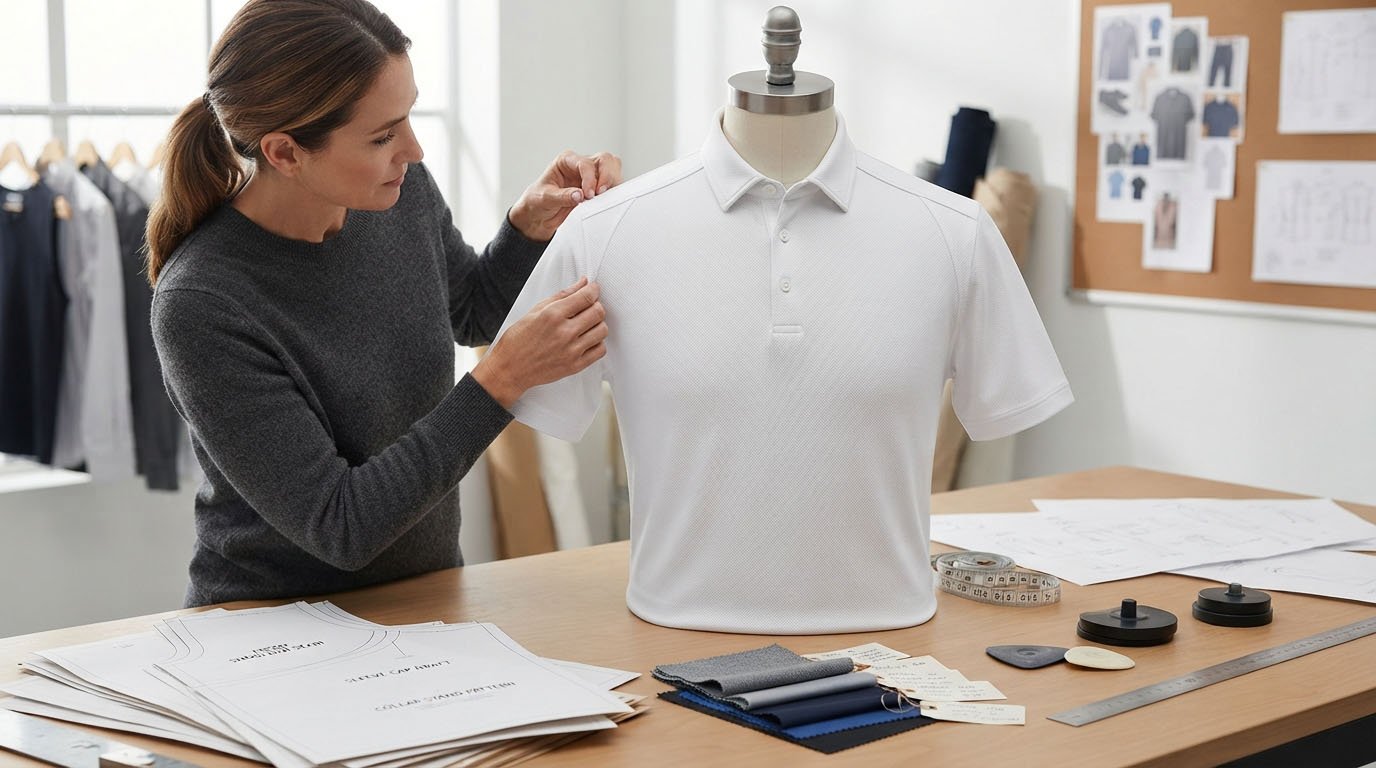
Golf Fit and Swing Mobility
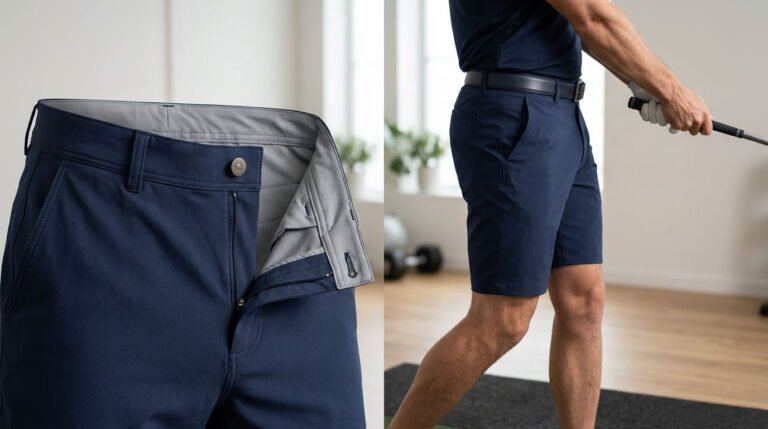
Golf garments must accommodate movement through the shoulders, upper back, arms, and torso.
Important pattern details include:
- Shoulder construction: Allows comfortable upper-body rotation.
- Armhole shape: Supports arm movement without excessive lifting of the garment.
- Sleeve pitch: Helps sleeves follow the intended arm position.
- Body length: Provides suitable coverage during bending and swinging.
- Fabric recovery: Helps the garment return to shape after stretching.
These requirements can be handled through pattern geometry, fabric selection, fit testing, or a combination of all three.
A golf specialist may recognize potential problems earlier because the team has encountered similar fit issues in previous projects.
Collar and Placket Construction
Collar stability is another important consideration for golf polos.
Common options include:
- Flat-knit rib collars
- Self-fabric collars
- Collars with appropriate interlining
- Structured collar and placket combinations
Each option behaves differently after washing and wearing.
For example, collar curling can result from differences in shrinkage, yarn behavior, knitting construction, or finishing.
A capable manufacturer should explain which construction suits your fabric and design rather than simply recommend the most expensive option.
Key 2: When Can a General Sportswear Factory Be a Good Choice?
A general sportswear factory manufactures multiple categories, such as running apparel, gym wear, casual activewear, and team uniforms.
Its wider product experience can be useful when your golf collection includes relatively simple garments.
Products That May Suit a General Factory
Examples include:
- Basic polyester golf polos
- Casual performance T-shirts
- Simple fleece hoodies
- Promotional tournament clothing
- Standard athletic shorts
If your product uses an existing fabric, familiar construction, and limited customization, a general factory may meet your requirements efficiently.
Some general sportswear manufacturers also operate dedicated golf apparel development teams.
Therefore, a general factory should not be rejected simply because golf clothing is not its only product category.
Where Additional Verification Matters
A general factory may need more technical guidance when your design includes:
- Golf-specific fit blocks
- Complex collar construction
- Tailored golf trousers
- Functional waistband systems
- Premium finishing requirements
The important question is whether the factory has successfully developed similar products, not how many sportswear categories appear in its catalog.
Key 3: How Do Golf Fabric, Fit, and Construction Requirements Differ?
The most meaningful difference between factory types often appears during product development.
Golf clothing requires a balance of movement, appearance, durability, and comfort.
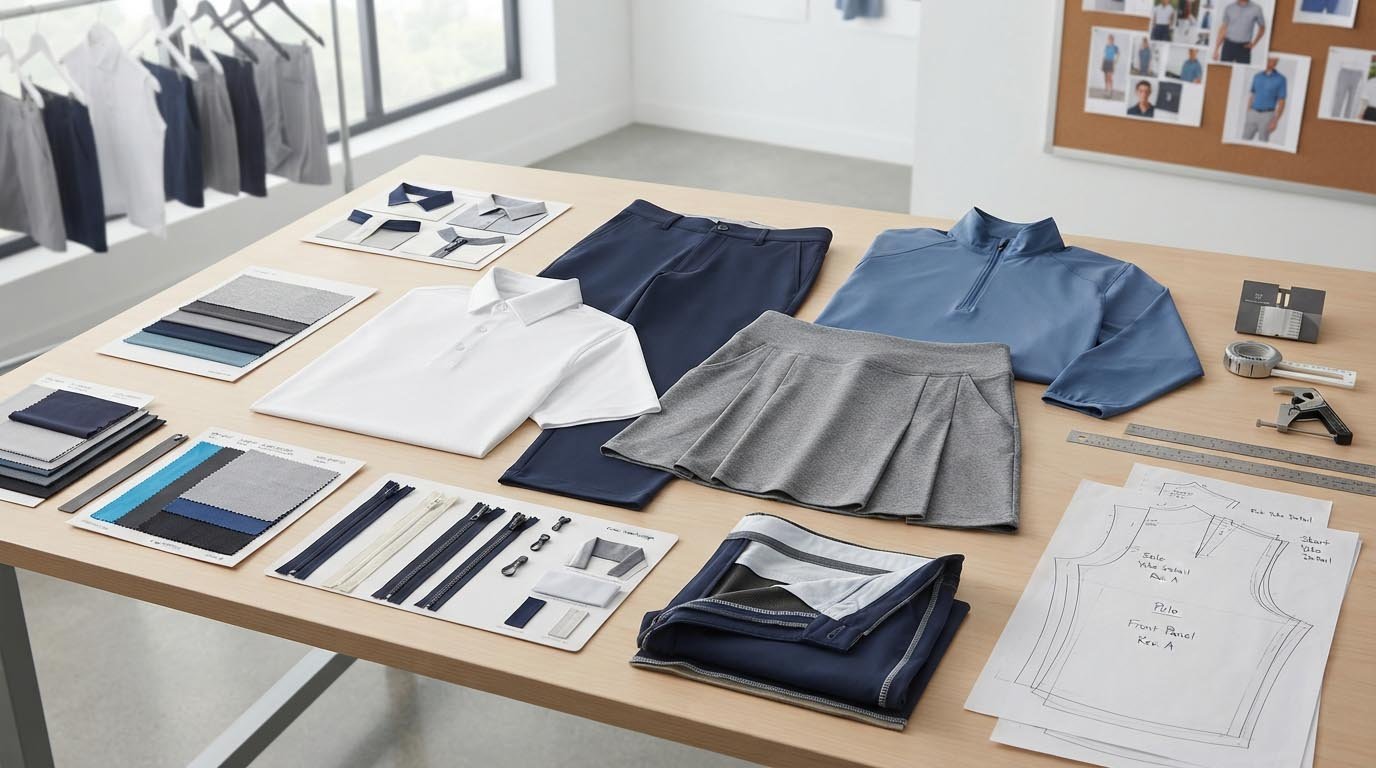
Fabric Performance and Drape
A suitable golf fabric should be evaluated for:
| Fabric Property | Why It Matters |
|---|---|
| Stretch and recovery | Supports movement without excessive deformation |
| Moisture management | Helps manage perspiration |
| Breathability | Supports comfort in warm conditions |
| Drape | Influences garment appearance and fit |
| Dimensional stability | Helps maintain measurements after washing |
| Colorfastness | Helps preserve appearance during use and laundering |
No single fabric specification works for every golf product.
A lightweight summer polo may prioritize airflow and moisture management, while premium golf trousers may require greater dimensional stability and shape retention.
For detailed fabric selection, see FUWAY's Fabric Sourcing capabilities.
Construction Requirements by Product
Different products create different manufacturing challenges.
Golf Polos
Focus on shoulder mobility, collar stability, placket alignment, sleeve fit, and appropriate body length.
Golf Pants and Shorts
Review waistband comfort, seat and thigh ease, pocket positioning, seam strength, and mobility during bending.
Golf Skorts
Evaluate skirt drape, inner-short comfort, waistband construction, and movement without excessive riding or restriction.
Quarter-Zips and Outer Layers
Check sleeve mobility, zipper alignment, layering ease, fabric recovery, and the intended weather-performance requirements.
A factory with experience across these categories may provide better development feedback, particularly when building a coordinated collection.
Key 4: How Does Sampling Reveal Real Manufacturing Capability?
Sampling is one of the most reliable ways to evaluate a factory's actual product development ability.
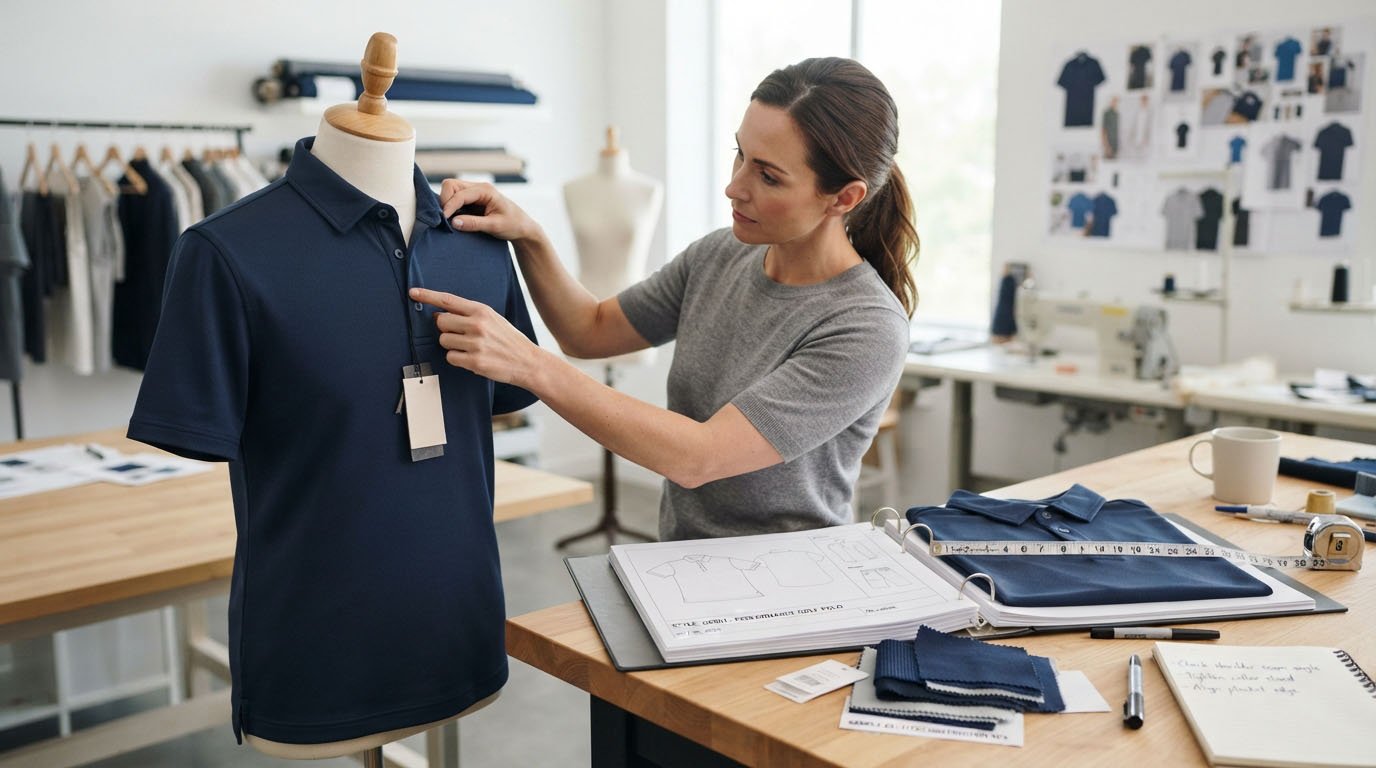
A supplier catalog shows available products, but a development sample reveals how well the factory understands your specifications.
What to Evaluate During Sampling
A capable manufacturer should be able to:
- Review your tech pack and identify unclear specifications.
- Recommend appropriate fabrics and construction options.
- Develop a sample matching your intended measurements.
- Explain technical problems rather than simply accepting every request.
- Document corrections before the next sample.
- Confirm which specifications will be used for bulk production.
The number of sample revisions alone does not determine factory quality. Complex original designs naturally require more development than adjustments to existing patterns.
Practical Golf Polo Sample Checklist
| Inspection Point | What to Check |
|---|---|
| Collar | Shape retention and curling after washing |
| Placket | Alignment, flatness, and stitching |
| Shoulder | Comfort during a full golf swing |
| Armhole | No excessive pulling or restriction |
| Body length | Suitable coverage during movement |
| Fabric | Stretch, recovery, and appearance |
| Measurements | Agreement with the approved size specification |
| Stitching | Seam consistency and workmanship |
Ask both factories to produce samples using the same specifications and comparable materials.
This makes the evaluation more meaningful than comparing unrelated catalog garments.
For brands developing original golf polos, FUWAY's Custom Golf Shirts service supports product customization and sample development.
Key 5: How Should You Compare MOQ, Pricing, and Lead Time?
A lower quoted unit price does not always mean a lower total project cost.
Buyers should compare the complete development and production requirements of each factory.
MOQ Depends on More Than Factory Type
MOQ is influenced by:
- Fabric availability
- Custom colors and dyeing requirements
- Printing or embroidery
- Garment complexity
- Number of styles and colorways
- Packaging requirements
- Production scheduling
For example, a general factory using stock fabrics may offer a small starting order.
However, a golf specialist with established fabric sourcing and production processes may also support smaller orders for selected styles.
FUWAY's typical MOQ starts around 100 pieces per style, subject to design, fabric, and customization requirements.
Always confirm whether an MOQ applies per style, color, size assortment, or total order.
Compare Total Project Cost
When comparing quotations, include:
| Cost Factor | Why It Matters |
|---|---|
| Sample development | Additional revisions may increase costs |
| Fabric and trims | Custom materials may require higher minimums |
| Unit production price | Depends on quantity and construction |
| Decoration | Embroidery, printing, and logo setup |
| Quality inspection | Helps detect defects before shipment |
| Rework or rejected goods | May increase overall project costs |
| Freight and duties | Affect landed cost |
| Production delays | May disrupt seasonal launches |
The better supplier is not necessarily the cheapest or the most specialized.
It is the one offering acceptable quality, commercial terms, and manageable production risk.
Key 6: How Can Buyers Verify Quality Control and Bulk Consistency?
An approved sample does not guarantee consistent bulk production.
Both specialist and general factories need reliable processes to ensure that finished garments match the approved specifications.
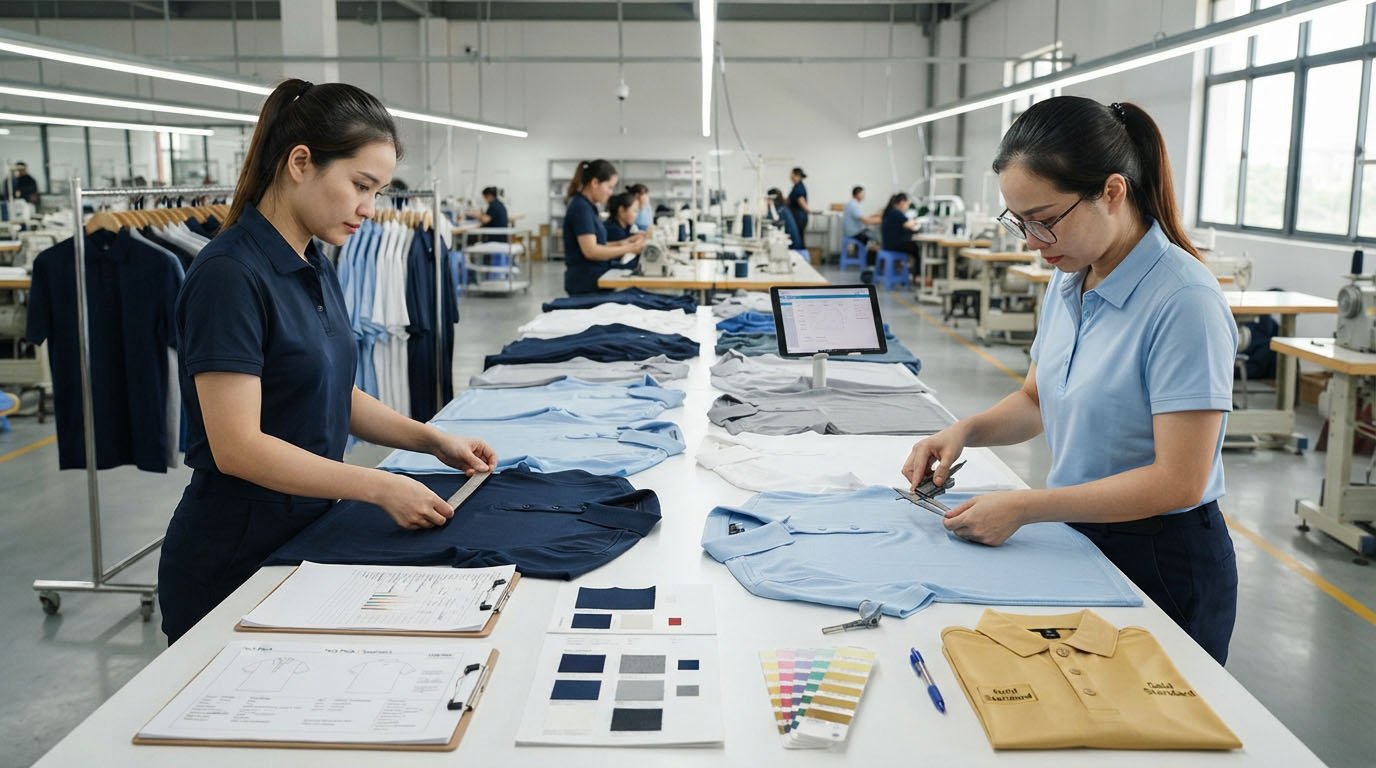
Three Important QC Stages
1. Incoming Material Inspection
Verify fabric identity, color, appearance, and relevant testing requirements before cutting.
2. In-Line Production Inspection
Check measurements, sewing workmanship, collar construction, and other critical details during production.
3. Final Inspection
Confirm finished garment measurements, appearance, labeling, packing, and agreed acceptance criteria before shipment.
What Evidence Should Buyers Request?
Ask prospective factories for:
- Relevant fabric test reports
- Sample measurement records
- Inspection procedures
- Defect-handling arrangements
- Evidence of similar completed products
- Confirmation of approved sample retention
Testing requirements should reflect the garment, intended market, and claims being made.
An independent laboratory report can support a particular material-performance claim, but it does not automatically certify the entire factory or guarantee bulk consistency.
FUWAY provides information about its available Test Reports for buyers reviewing material and product requirements.
Don't Forget Repeat Orders
A factory should also explain how it maintains consistency between:
Approved sample → First bulk order → Repeat production
Important controls include retained samples, material specifications, size charts, trim references, color approvals, and documented production changes.
This is particularly valuable for brands that expect repeat seasonal orders.
Key 7: Which Factory Is Right for Your Golf Apparel Brand?
Choosing a factory becomes easier when you match product complexity with demonstrated capability.
Factory Selection by Product Type
| Product Type | Recommended Starting Point | Main Verification |
|---|---|---|
| Basic promotional golf polo | Either factory type | Fabric, fit, and price |
| Premium performance golf polo | Golf specialist or proven generalist | Collar, mobility, and fabric recovery |
| Tailored golf pants | Factory with relevant bottoms experience | Waistband, fit, and movement |
| Women's golf skort | Factory with skort development experience | Inner shorts, fit, and construction |
| Basic tournament hoodie | General factory or specialist | Fabric and workmanship |
| Technical golf quarter-zip | Factory with relevant technical experience | Mobility, zipper, and layering fit |
| Multi-category premium golf collection | Golf specialist or experienced multi-category factory | Cross-product development and repeatability |
The table provides a starting point, not a fixed rule.
A general sportswear manufacturer with excellent golf samples may outperform a poorly managed specialist.
A Five-Question Factory Selection Framework
Before choosing your manufacturing partner, ask:
- Product experience: Can the factory show relevant examples of similar golf garments?
- Development ability: Can its team explain the construction and fit requirements?
- Sample accuracy: Does the prototype meet your approved specifications?
- Commercial suitability: Do MOQ, pricing, and lead time match your launch plan?
- Production consistency: How does the factory control quality during bulk and repeat orders?
Choose the supplier that demonstrates the strongest overall fit rather than relying on category specialization alone.
If you are still deciding between manufacturers, suppliers, and wholesalers, read our Golf Apparel Manufacturer vs Supplier vs Wholesaler comparison to understand how these sourcing models differ.
Frequently Asked Questions
Is a Golf-Specific Apparel Manufacturer Always Better?
No. A golf specialist may be more suitable for technical or fit-sensitive garments, but an experienced general sportswear factory can also produce high-quality golf apparel.
Evaluate samples, technical knowledge, and production controls before deciding.
Can a General Sportswear Factory Manufacture Premium Golf Polos?
Yes, if it has suitable patternmaking, fabric sourcing, collar construction, and quality-control capabilities.
Ask for relevant production examples and test a sample before placing a bulk order.
What Is the Typical MOQ for Custom Golf Apparel?
MOQ depends on fabric availability, garment complexity, customization, and production requirements.
Some manufacturers support orders starting around 100 pieces per style, while custom fabrics or complex designs may require higher quantities.
Which Factory Is Better for a Startup Golf Brand?
For simple designs using existing fabrics, either factory type may work.
For original designs requiring golf-specific fit and construction, a specialist or a general factory with proven golf development experience may reduce technical uncertainty.
How Can I Verify a Factory Before Paying a Deposit?
Request relevant samples, confirm production capabilities, review technical feedback, agree on written specifications, and clarify quality-control responsibilities.
A factory's ability to explain its production process is more meaningful than marketing claims alone.
Does a Golf-Specific Factory Guarantee Better Quality?
No. Specialization provides relevant experience, but actual quality depends on materials, production management, inspection systems, and consistent execution.
Conclusion: Choose Capability, Not Just Factory Type
The decision between a golf-specific apparel manufacturer and a general sportswear factory should depend on your product requirements rather than the supplier's marketing category.
A golf specialist may provide stronger development support for complex polos, tailored bottoms, skorts, and premium collections.
A capable general sportswear factory may be equally suitable for simpler garments, particularly when it can demonstrate relevant experience.
Before committing to bulk production, compare technical capability, sample accuracy, MOQ, total cost, and quality-control processes.
The right manufacturing partner is the one that can turn your design into a consistent, commercially viable golf apparel product.
Work With FUWAY
FUWAY supports OEM/ODM and private-label development for golf apparel brands, retailers, and distributors.
Our product range includes golf polos, pants, shorts, skorts, quarter-zips, and outerwear.
We support fabric sourcing, customization, sampling, bulk manufacturing, and quality inspection.
If you have a tech pack, reference garment, or product concept, contact FUWAY to discuss the manufacturing requirements of your next collection.