
Last month, a buyer spent $8,000 on samples testing five fabric options. They picked based on hand feel. The bulk order came back with complaints about "too stiff" after washing. The fabric tested great, but the finishing treatment was wrong.
Choose golf shorts by matching fabric stretch direction to your target fit style, setting inseam length based on customer demographics rather than trends, prioritizing waistband comfort over decorative details, and understanding which performance features actually justify the MOQ increases and lead time extensions they require.
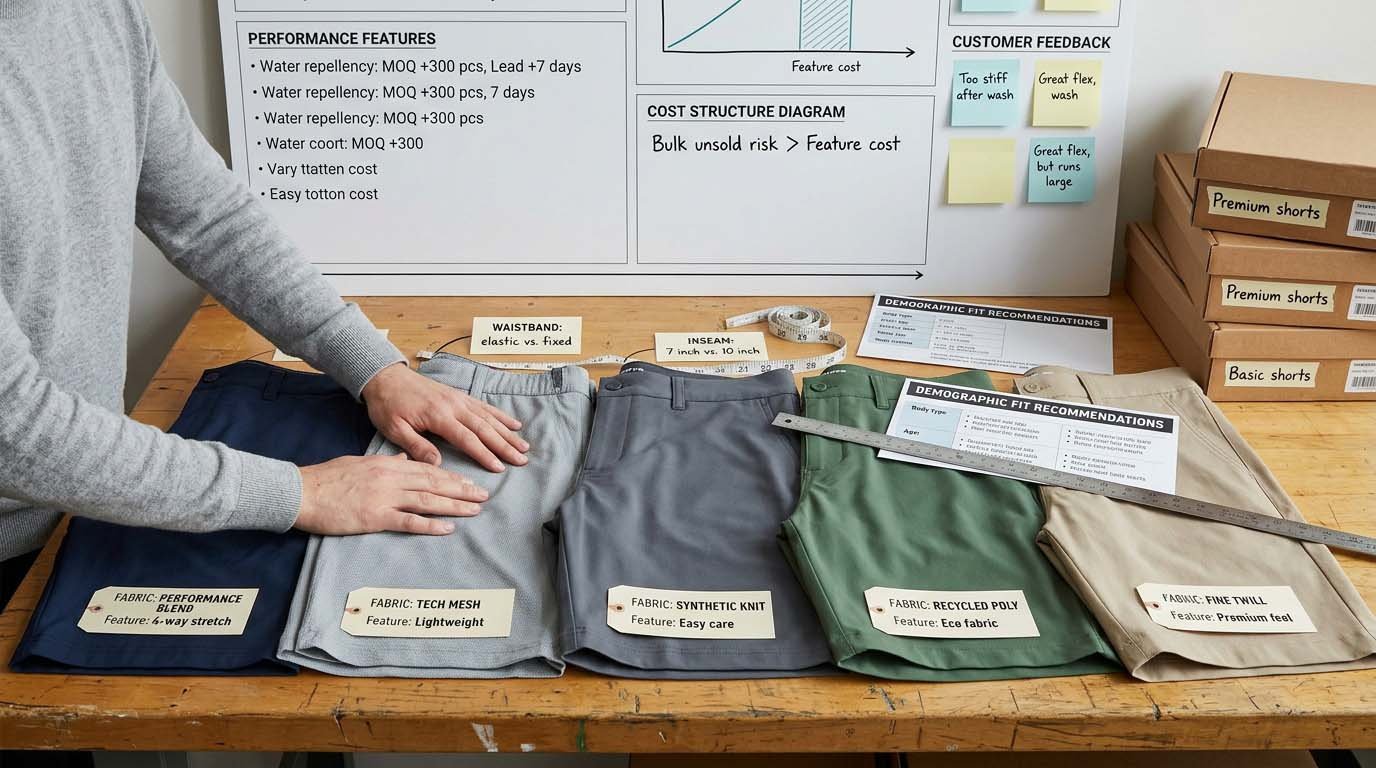
The gap between approving a sample and receiving sellable bulk shorts comes down to understanding which variables matter for your specific market. I have worked with over 200 golf shorts orders in the past three years. The buyers who succeed ask different questions than the ones who struggle. They focus on cost structure and inventory risk, not just feature lists. They understand that "premium" shorts that sit in a warehouse unsold cost more than "basic" shorts that move quickly. This guide shows you the decision framework I use when buyers ask me to recommend specifications—not what is theoretically best, but what matches their business model.
Quick Answers: What Most Buyers Get Wrong About Golf Shorts
1. Stretch Percentage vs. Stretch Direction
Buyers request "10% elastane" thinking more stretch equals more comfort. Wrong. 2-way stretch (horizontal only) at 5% elastane can feel more comfortable than 4-way stretch at 8% elastane if the fabric weight and knit structure match the fit style. We have resampled 30+ orders where buyers picked elastane percentage without testing stretch direction against their target fit. The result: samples that looked good on a table but felt restrictive during actual golf swings.
2. Inseam Length Creates Inventory Risk
Choosing a single 9-inch inseam because it is trendy creates inventory problems when your actual customers want 10-11 inches. We tracked customer service data from three e-commerce clients—20-25% of returns cited "too short" on 9-inch inseams sold to age 45+ demographics. The fix costs nothing: offer two inseam options from the start, even if it increases your SKU count.
3. Lightweight Fabrics Are Not Always Cooler
A 140 GSM fabric with poor wicking treatment will feel hotter than a 180 GSM fabric with proper moisture management. I have seen buyers chase the lowest GSM number, then face complaints about the shorts feeling "sticky" or "clingy" during hot rounds. Fabric engineering matters more than weight alone—a lesson that costs $4,000-6,000 in sample rework when learned late.
4. UPF50+ Adds MOQ and Lead Time
Buyers add "UPF50+" to specs because competitors have it. But achieving and certifying UPF50+ typically requires 1,000+ pieces per color minimum and adds 7-10 days to fabric sourcing. If your target market does not value UPF ratings enough to pay $2-3 more per unit, you are sacrificing margin for a feature customers ignore. We ask buyers: "Will you market the UPF rating or just list it?" That question changes their spec decisions.
5. Pocket Design Affects Pattern Complexity
Going from 4 pockets (standard) to 6 pockets (adding cargo style) increases cutting complexity and slows production by 15-20%. It also raises defect rates because more pieces mean more alignment challenges. The cost impact: $1.50-2.20 per piece plus longer lead time. Buyers who add pockets "because it looks better" without understanding production impact often regret the choice when facing deadline pressure.
Performance Fabrics: Cooling, Wicking, UPF and Quiet Feel?
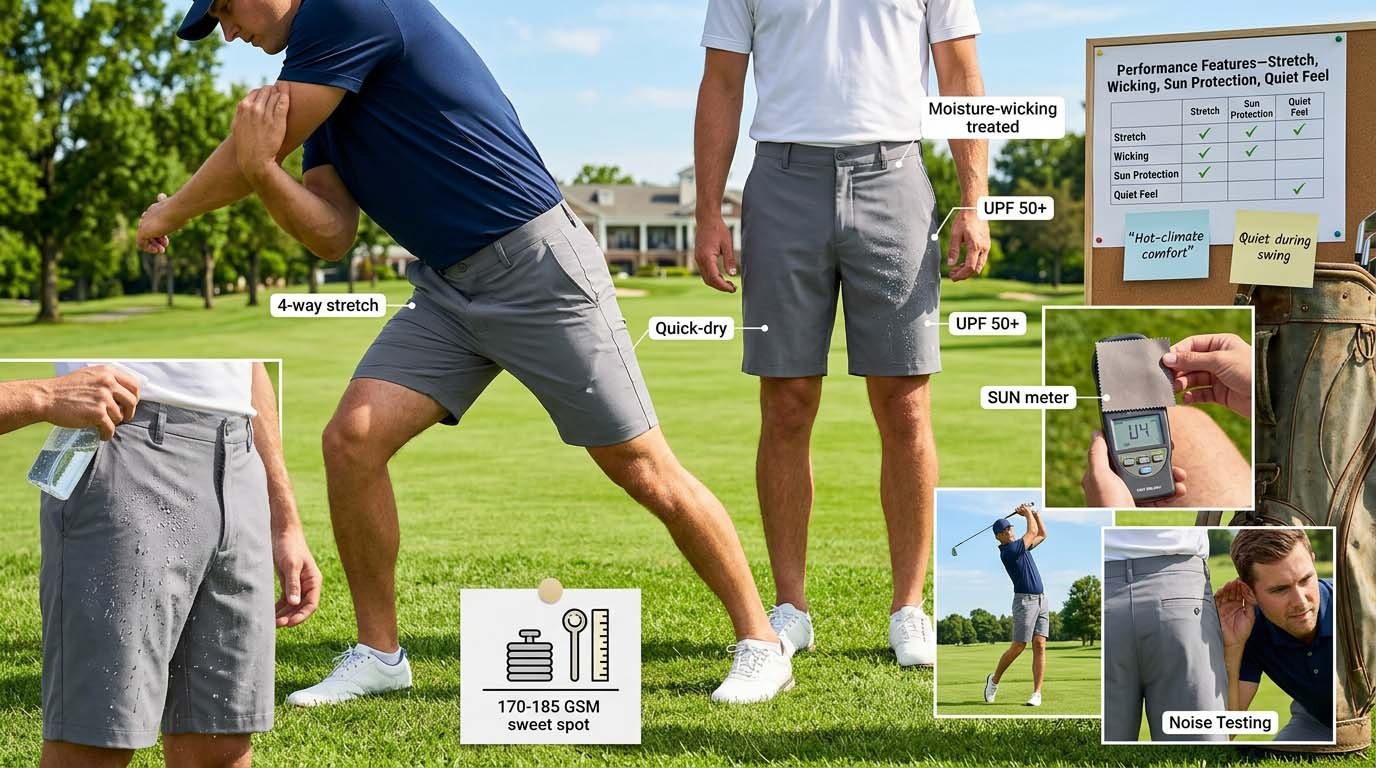
Select fabric based on the intersection of your target price point and your customers' actual playing conditions—hot-climate golfers justify premium wicking treatments, while moderate-climate buyers resist paying extra for features they cannot feel during play.
The biggest mistake I see: buyers select fabrics in an air-conditioned office during winter, then their customers wear the shorts in 35°C heat on a sun-exposed course. The performance gap becomes obvious in reviews. Last year, we worked with a buyer targeting budget-conscious golfers in the southeastern U.S. They initially chose a 160 GSM polyester without wicking treatment to hit a $9.80 per piece cost target. Customer feedback after launch: "hot, sticky, uncomfortable." We switched to a 175 GSM polyester with moisture-wicking treatment at $11.40 per piece. The $1.60 difference killed their initial margin plan but saved the product line from failure.
The Stretch Type Decision That Affects Everything Else
Stretch direction determines how the shorts behave during wear:
2-Way Stretch (Horizontal Only)
- Fabric stretches across the body (left-right) but not vertically
- Works best for classic fit and regular fit styles
- Requires 4-6% elastane to achieve comfortable stretch
- Lower cost: typically $0.40-0.80 less per piece than 4-way stretch
- Best for: buyers targeting traditional golfers, older demographics, value-oriented positioning
4-Way Stretch (Horizontal and Vertical)
- Fabric stretches in all directions
- Essential for athletic fit and slim fit styles
- Requires 8-12% elastane to deliver the expected performance
- Higher cost but allows closer fitting patterns
- Best for: buyers targeting younger players, athletes, performance-focused positioning
Here is the decision rule I give buyers:
| Your Target Fit | Recommended Stretch | Elastane Content | Cost Impact vs. Standard |
|---|---|---|---|
| Classic/Regular | 2-way stretch | 4-6% | Baseline |
| Modern/Active | 2-way or 4-way | 6-8% | +$0.50-1.00 |
| Athletic/Slim | 4-way required | 8-12% | +$1.20-1.80 |
| Compression | 4-way with power stretch | 12-15% | +$2.50-3.50 |
The trap: buyers see "4-way stretch" on competitor products and assume they need it. But if you are selling regular fit shorts at $35-45 retail, the 4-way stretch costs more without delivering value your customers notice. We have sampled both versions side-by-side for buyers—in regular fit patterns, customers cannot reliably tell the difference in blind testing.
Fabric Weight and the Breathability Misconception
Buyers ask for "lightweight, breathable fabric" as if these are the same thing. They are not:
Lightweight (120-150 GSM)
- Feels cooler initially due to less mass
- Can cling to skin when sweaty (defeats the cooling purpose)
- Shows body contours more (some customers find this unflattering)
- More transparent (requires careful color and lining choices)
- Better for: dry climates, fashion-focused buyers, minimal moisture conditions
Mid-Weight (160-190 GSM)
- Maintains structure away from body even when damp
- Better drape and professional appearance
- Less prone to showing sweat marks or transparency
- More forgiving of body shapes (broader customer appeal)
- Better for: humid climates, traditional golfers, general market positioning
Heavier Weight (200-220 GSM)
- Superior durability and shape retention
- Feels substantial and premium
- Can be too warm for hot-weather golf
- Better for: spring/fall golf, courses with rough terrain, durability-focused positioning
In our sampling experience, the sweet spot for general-market golf shorts is 170-185 GSM. This weight balances comfort, durability, and broad climate suitability without pushing cost to extremes.
Moisture-Wicking: The Treatment That Actually Matters
Two fabrics can have identical fiber content and GSM but perform totally differently based on finishing treatments:
Basic Polyester (No Wicking Treatment)
- Absorbs minimal moisture
- Dries mainly through air exposure
- Feels clammy when sweating
- Cost advantage: saves $0.30-0.60 per piece
- Acceptable for: cool-weather golf, budget positioning, markets where customers do not test performance
Treated Moisture-Wicking Polyester
- Hydrophobic treatment moves sweat away from skin to fabric surface
- Active evaporation accelerates drying
- Maintains cool feel even during heavy perspiration
- Cost premium: adds $0.30-0.60 per piece to fabric cost
- Essential for: hot-climate markets, performance positioning, customers who value technical features
I tell buyers: if you plan to market "moisture-wicking" or "quick-dry" as selling points, you must spec the treated fabric. Customers who buy based on performance claims and receive untreated fabric will return the product and write negative reviews. The $0.30-0.60 savings becomes $8-12 in returns plus damaged reputation.
UPF Rating: When It Is Worth the Cost
UPF (Ultraviolet Protection Factor) ratings require either tight knit construction or chemical treatments. Both impact cost and MOQ:
UPF 30-40 (Standard Protection)
- Achievable through dense knit construction alone
- No chemical treatment required
- No MOQ increase
- No special testing or certification needed
- Sufficient for: general golf use, markets where UPF is not heavily marketed
UPF 50+ (Maximum Protection)
- Requires UV-blocking chemical treatment or extremely tight knit
- Testing and certification add $150-300 per style
- Fabric MOQ typically increases to 1,000-1,500 meters minimum
- Treatment adds $0.20-0.40 per piece to fabric cost
- Justifiable for: sun-belt markets (Florida, Arizona, Australia), customers explicitly seeking sun protection, premium positioning
We ask buyers to calculate the value: "If UPF50+ adds $0.60 per piece across production and certification, and your retail price is $40, can you charge $43-45 based on the UPF rating?" If the answer is no, standard UPF30 construction is sufficient.
The Quiet Feel Factor for Golf
Golf requires concentration. Noisy fabrics distract players:
Fabric Noise Sources
- Stiff polyester: Creates swishing sound during leg movement
- Tight weaves without softening: Produces rustling during swing
- Coated fabrics: Any waterproofing or lamination adds noise
Solutions That Work
- Mechanical softening: Fabric undergoes softening treatment during finishing
- Blended construction: Adding 10-20% rayon or cotton to polyester reduces noise
- Brushed interior: Light brushing on the inside surface dampens fabric-on-fabric sound
The cost impact of noise reduction: $0.15-0.35 per piece for softening treatments, or $0.40-0.70 per piece for blended construction. I recommend buyers test this by wearing samples during actual play. If the fabric distracts you during your backswing, customers will notice it too.
Fit Fundamentals: Rise, Inseam Length, Leg Opening and Taper?
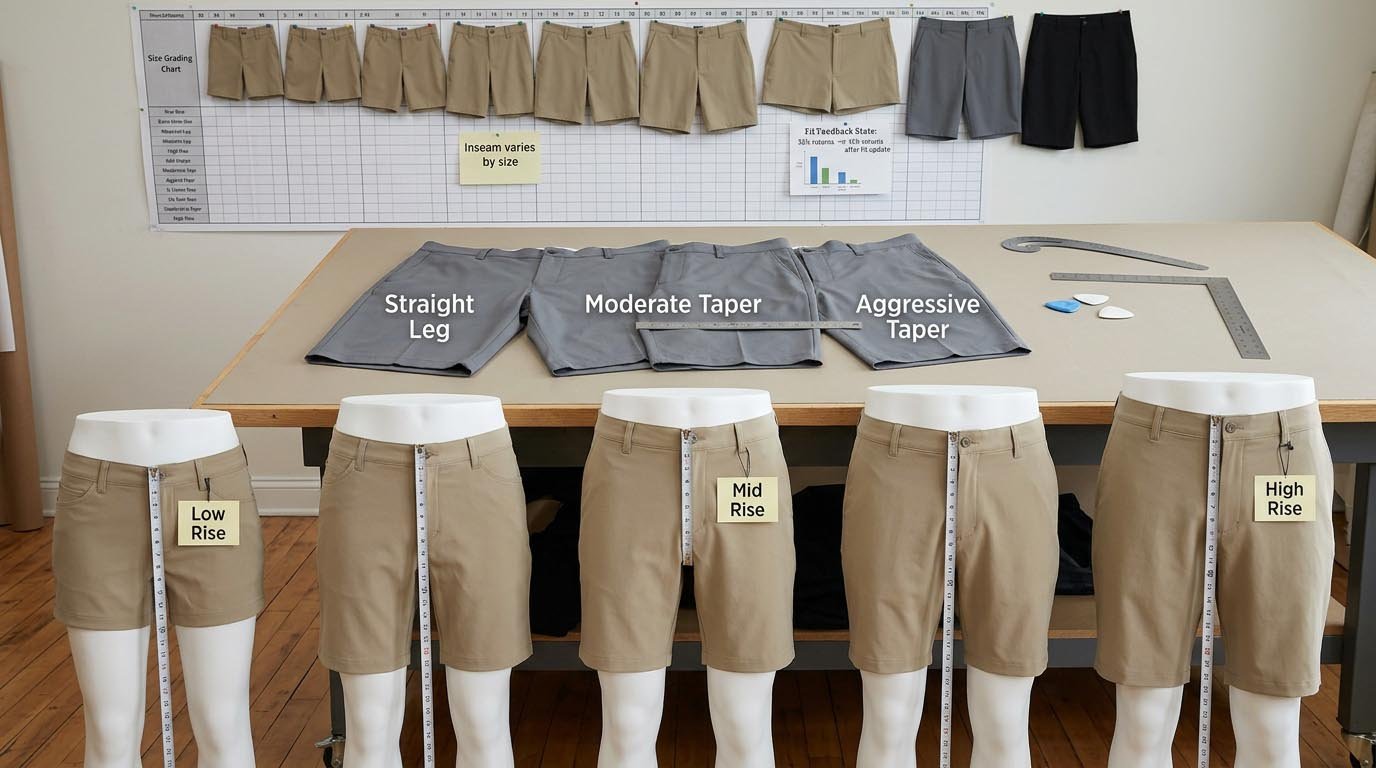
Design your fit specifications based on your target customer demographics and selling channel, not current fashion trends—e-commerce brands need more forgiving fits to reduce returns, while retail brands can offer precise sizing with in-store fitting support.
Fit mistakes create inventory nightmares. I worked with a buyer who launched golf shorts in 4 sizes (S, M, L, XL) with a 9-inch inseam and athletic fit. The result: 32% return rate on the first 800 units sold. The problem was not quality—the shorts fit exactly as designed. The problem was the design did not match the customers who actually bought golf shorts in their channel. We restructured to 5 sizes (XS-XXL), 10-inch inseam, and modern fit (between regular and athletic). Returns dropped to 12%—still higher than ideal, but sellable.
Rise Height Determines Comfort and Customer Demographic
Rise is the distance from the crotch seam to the top of the waistband. This single dimension determines whether your shorts feel comfortable or constantly need adjustment:
Low Rise (9-10 inches)
- Sits 2-3 inches below natural waistline
- Modern, fashion-forward appearance
- Requires flat or athletic stomach to look good
- Tends to slide down during play, requiring adjustment
- Best for: under-35 demographic, fashion-focused brands, slim customers
Mid Rise (10.5-11.5 inches)
- Sits at or slightly below natural waistline
- Most versatile and broadly appealing
- Stays in place during athletic movement
- Flattering on widest range of body types
- Best for: general market, e-commerce brands prioritizing low returns, age 30-55 demographic
High Rise (12+ inches)
- Sits at or above natural waistline
- Traditional golf appearance
- Maximum security and coverage
- Can look dated to younger customers but beloved by traditional golfers
- Best for: age 50+ demographic, traditional golf clubs, comfort-focused positioning
The decision framework:
| If Your Target Customer Is... | Specify This Rise | Why |
|---|---|---|
| Under 35, athletic, fashion-aware | Low rise (9-10") | Matches expectations, looks modern |
| Mixed ages, e-commerce sales | Mid rise (10.5-11.5") | Reduces fit complaints and returns |
| Over 50, traditional clubs | High rise (11.5-12") | Comfort and coverage expectations |
| Broad market, retail distribution | Offer two rises | Lets customers self-select |
We have seen buyers force low-rise shorts into markets dominated by older golfers. The result is consistent: initial sales driven by low price, then returns and negative reviews citing "rides too low" or "uncomfortable fit."
Inseam Length and the Age Factor
Inseam trends swing dramatically over time, but customer preferences are sticky:
Current Trend Inseams
- 7-8 inches: Very short, European influence, showing significant thigh
- 9 inches: Short, fashionable, popular in younger demographic
- 10-11 inches: Classic golf length, broadest appeal
- 12+ inches: Longer, traditional, preferred by older players
The Data from Our Order History
Tracking 15 brands selling golf shorts online over 24 months:
- 7-8 inch inseams: Purchased primarily by ages 25-35, return rate 28-35% when sold to ages 40+
- 9 inch inseams: Purchased across ages 25-50, return rate 18-22% overall, spikes to 30%+ for ages 50+
- 10 inch inseams: Broadest demographic appeal, return rate 10-15% across all ages
- 11 inch inseams: Preferred by ages 45+, return rate 8-12% for target demographic
The lesson: if you cannot segment your market clearly or if you sell through general e-commerce channels, 10-inch inseam is the safest bet. It satisfies neither trend-focused young buyers nor traditional older buyers perfectly, but it frustrates fewer customers than more extreme choices.
For Buyers Launching First Golf Shorts Line
I recommend this approach:
- Start with 10-inch inseam for all sizes
- Track return reasons and customer feedback for first 500 units
- Add second inseam option (shorter or longer) based on actual data, not assumptions
The cost to offer two inseams: increases SKU count but does not affect per-piece production cost. The pattern is the same, you just cut fabric at different lengths.
Leg Opening and Taper: The Fit Style Determinant
Leg opening width and how it tapers from hip to hem defines the overall fit style:
Straight Leg (Minimal Taper)
- Leg opening similar width to thigh measurement
- Traditional appearance
- More fabric volume around lower leg
- Flattering on larger leg builds
- Cost advantage: simpler pattern, faster cutting
- Preferred by: ages 45+, traditional golfers, larger builds
Moderate Taper
- Leg opening 2-3 inches narrower than thigh
- Modern without being trendy
- Clean lines without looking tight
- Flatters most body types
- Standard pattern complexity
- Preferred by: ages 30-55, general market, athletic builds
Aggressive Taper (Athletic Fit)
- Leg opening 4-5 inches narrower than thigh
- Very fitted appearance
- Emphasizes athletic build (but shows any extra weight)
- Requires 4-way stretch to remain comfortable
- Higher pattern complexity, more cutting waste
- Preferred by: ages 25-40, slim/athletic builds only, performance positioning
Here is the cost and risk breakdown:
| Taper Style | Pattern Complexity | Fabric Waste | Return Risk if Wrong Demographics | Per-Piece Cost Impact |
|---|---|---|---|---|
| Straight | Low | Minimal | Low | Baseline |
| Moderate | Medium | Low | Low-Medium | +$0.10-0.30 |
| Aggressive | High | Medium | High | +$0.40-0.80 |
I have seen multiple buyers choose aggressive taper because sample photos looked sharp, then face 25-30% returns because the shorts only fit slim customers. The tighter the taper, the smaller your addressable market becomes.
Size Grading and Proportion
Many buyers approve a sample in size M, then discover the XL does not maintain correct proportions. This happens because of poor grading (how patterns scale across sizes):
Common Grading Mistakes
- Uniform scaling: Pattern simply gets bigger proportionally, but human bodies do not scale that way
- Fixed inseam across sizes: Size S and XXL have the same inseam, causing proportion problems
- Improper rise adjustment: Rise does not increase enough for larger sizes, causing low-sitting fit in XL/XXL
Better Grading Approach
- Rise increases proportionally: Add 0.5 inch to rise for each size step up
- Inseam options vary by size: Consider offering different inseams for S-M versus L-XXL
- Leg opening maintains taper ratio: Opening width increases with thigh measurement, maintaining taper percentage
I recommend buyers request a full size run sample set (one of each size) before approving bulk production. Lay them in sequence and check:
- Proportions look consistent across all sizes
- The smallest and largest sizes maintain the intended style
- Rise and inseam scale appropriately
This check catches grading errors when fixes cost $200-400 in pattern revision instead of $4,000-8,000 in unsellable inventory.
Waistband & Mobility: Stretch Grippers, Gussets and Secure Closures?
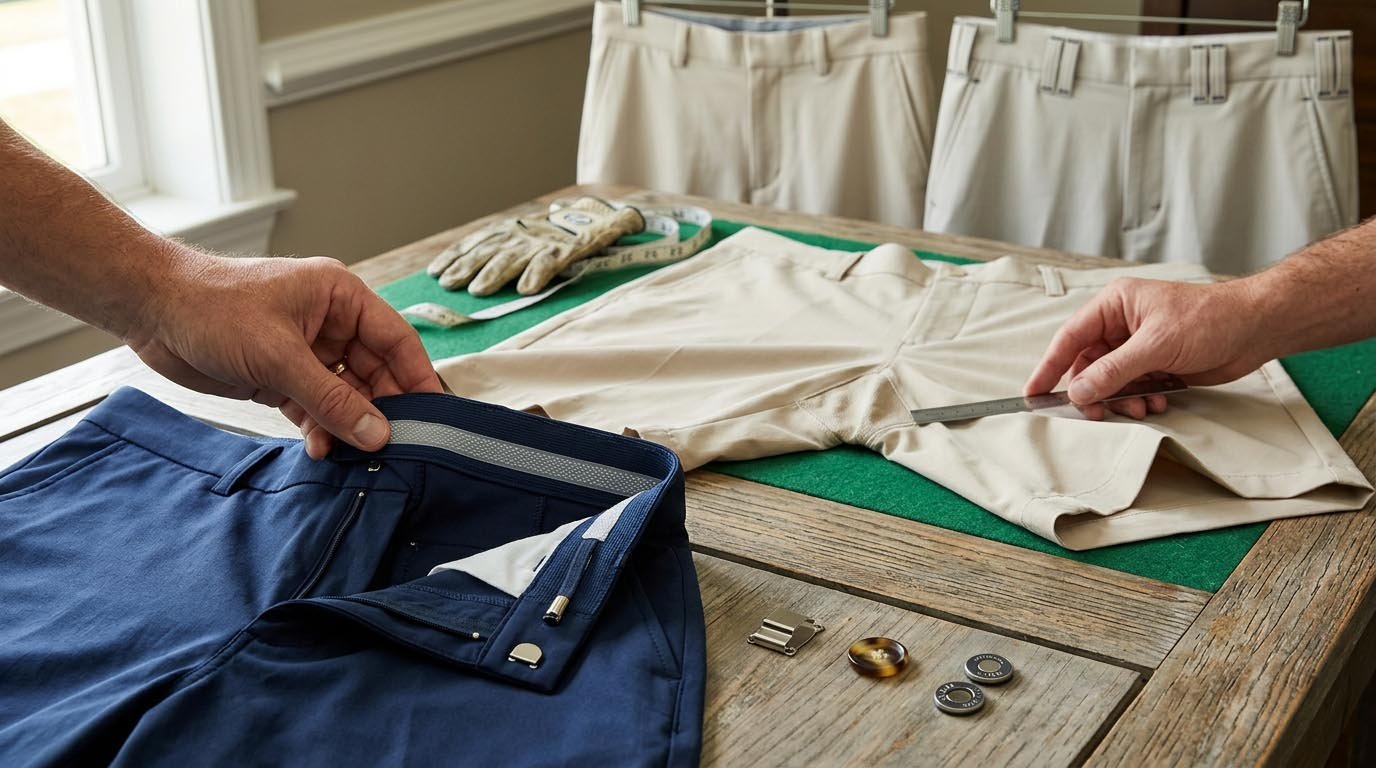
Prioritize waistband comfort and security features based on your customers' playing style and body types—active players justify premium waistband construction, while occasional golfers find standard features sufficient and resent paying for upgrades they do not notice.
The waistband makes or breaks the wearing experience but gets the least attention during sampling. Buyers focus on fabric hand feel and color matching while ignoring whether the waistband will stay in position during 4-5 hours of walking and swinging. I have received emergency calls from buyers whose first customers complained about waistbands that rolled, slipped, or dug into the skin. These are predictable problems that show up during extended wear testing, but most buyers test samples for 15-20 minutes at most.
Waistband Construction Options and Cost Trade-Offs
Basic Elastic Waistband
- 1-1.5 inch elastic enclosed in fabric tunnel
- Button and zipper closure provides security
- Most economical option
- Works fine for: occasional players, budget positioning, customers prioritizing value
- Cost: baseline
- Limitation: Can roll or twist during extended wear, elastic degrades with washing
Stretch-Knit Waistband
- 1.5-2.5 inch wide knitted band with integrated elastic
- Lies flat and does not roll
- More comfortable for extended wear
- Better for: regular players, comfort-focused positioning, all-day wear
- Cost: +$0.60-1.00 per piece
- Limitation: Requires more precise sizing—less forgiving of weight fluctuation
Gripper Waistband Interior
- Silicone or rubber strips inside waistband prevent shirt pull-out
- Keeps shirt tucked during swing
- Premium feature noticed by active players
- Essential for: performance positioning, tournament play, customers who tuck shirts
- Cost: +$0.40-0.80 per piece
- Limitation: Can feel restrictive to customers who prefer un-tucked style
Adjustable Internal Drawcord
- Hidden cord allows waist adjustment without external appearance change
- Accommodates weight fluctuation and preference variation
- Appeals to: broad size range customers, uncertain fitters, comfort-focused buyers
- Cost: +$0.30-0.50 per piece
- Limitation: Adds production complexity, can bunch if not properly constructed
Here is the decision matrix I use:
| Your Target Positioning | Recommend Waistband | Why | Cost Premium |
|---|---|---|---|
| Value/Budget ($25-35 retail) | Basic elastic | Keeps cost down, meets basic needs | Baseline |
| General market ($35-50 retail) | Stretch-knit or basic + drawcord | Balance of comfort and cost | +$0.50-0.80 |
| Performance ($50-70 retail) | Stretch-knit + gripper | Justifies premium price | +$1.00-1.80 |
| Premium/Luxury ($70+ retail) | All features integrated | Expected at this price tier | +$1.50-2.50 |
The trap: adding premium waistband features to budget-priced shorts. The features increase cost but your target customers do not value them enough to pay more. You end up squeezing margin for features that do not drive sales.
Gusset Construction for Extended Mobility
A gusset is a diamond-shaped fabric insert at the crotch that increases range of motion. Golf swings stress this area significantly:
Without Gusset
- Standard seam construction meets at a point
- Restricted mobility in extreme positions (deep squat, lunge)
- Acceptable for: casual play, flat-terrain courses, walking-only golf
- Cost: baseline
With Gusset
- Diamond insert adds 3-5 inches of stretch room
- Full range of motion without fabric stress
- Necessary for: athletic swings, hilly courses, performance positioning
- Cost: +$0.30-0.60 per piece (additional fabric piece, more complex sewing)
I worked with a buyer targeting competitive players. We sampled shorts with and without gussets. The feedback was clear: players doing full practice swings before shots noticed restriction without the gusset. Recreational players who take relaxed swings noticed no difference. The gusset makes sense for performance-focused brands but adds cost that casual golfers will not pay for.
Closure Security: Button, Hook, Zipper Options
Standard Button + Zipper
- Most common and economical
- Works for most situations
- Cost: baseline
- Risk: Button can pop off under stress, zipper can slip down
Hook-and-Bar + Zipper
- More secure than button
- Lies flatter under shirts
- Cost: +$0.10-0.20 per piece
- Better for: stretch fabrics that put stress on closures
Double Button + Zipper
- Two buttons provide backup security
- Prevents accidental opening
- Cost: +$0.15-0.25 per piece
- Better for: active play, customers concerned about wardrobe malfunction
Magnetic Closure + Zipper
- Quick open/close with strong hold
- Premium appearance and function
- Cost: +$0.50-0.90 per piece
- Better for: luxury positioning, older customers with dexterity issues
The closure choice rarely drives purchase decisions but affects customer satisfaction during use. I recommend:
- Standard button + zipper for general market and budget positioning
- Hook + zipper for performance and athletic fits (the stress on closures is higher)
- Magnetic closure only for luxury positioning where the cost premium fits the overall price tier
Belt Loop Spacing and Strength
Often overlooked but critical for customers who wear belts:
Standard Configuration
- 5 belt loops spaced evenly around waistband
- Sewn with single bartack at top and bottom
- Adequate for: lightweight belts, casual wear
- Risk: Loops can tear out under stress from heavy belts or during extreme movement
Reinforced Configuration
- 7 belt loops with closer spacing (better weight distribution)
- Double bartack reinforcement at stress points
- Better for: customers who wear substantial belts, pulling range balls carts, carrying heavy items in pockets
- Cost: +$0.15-0.30 per piece
We track this issue through customer service data. About 5-8% of shorts develop torn belt loops during the first season of wear. The damage happens when golfers lean forward repeatedly (picking up balls, teeing up) while wearing belts. The reinforcement prevents most of these failures but buyers rarely specify it unless they have experienced the problem.
Pockets & Course-Ready Features: Access, Storage and Balance?
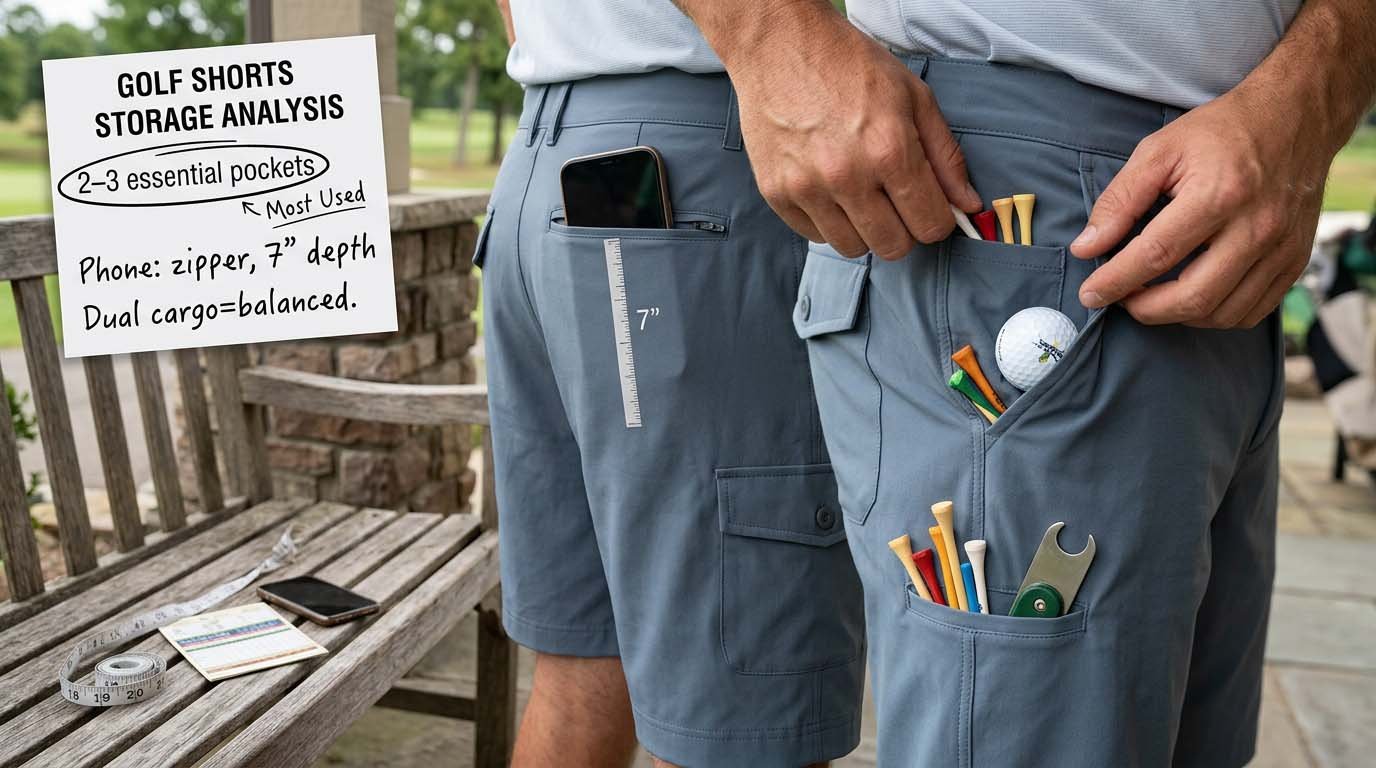
Design pocket configuration based on what customers actually carry during golf, not how many pockets look good in photos—excess pockets add cost and pattern complexity without improving functionality if they sit empty during use.
Pocket design generates more sample revisions than almost any other feature. Buyers see competitors with 6 or 7 pockets and assume more is better. But I have reviewed hundreds of customer photos and golf course observations. Most golfers use 2-3 pockets regularly. The others sit empty, adding weight, cost, and production complexity for no functional benefit.
The Essential Pocket Configuration
Based on tracking what golfers actually carry:
Front Slash Pockets (2 pockets)
- Store: tees, ball markers, spare ball
- Usage: 90%+ of golfers use these pockets every round
- Must-have feature
- Cost: baseline
- Design consideration: Depth of 7-8 inches prevents items from falling out during sitting/bending
Right Front Coin Pocket
- Store: ball marker, divot tool
- Usage: 60-70% of golfers use this pocket
- Nice-to-have feature
- Cost: +$0.10-0.15 per piece
- Design consideration: Must sit flat to avoid bulk under shirts
Back Welt Pockets (1-2 pockets)
- Store: scorecard, phone (though most use carts), glove when not wearing
- Usage: 40-50% of golfers use back pockets regularly
- Optional feature
- Cost: +$0.30-0.60 per piece (welt construction is more complex than slash)
- Design consideration: Button or zipper closure prevents items from falling out
Additional Cargo/Utility Pockets
- Store: rangefinder, extra balls, snacks
- Usage: 15-25% of golfers use these pockets (most use cart storage instead)
- Differentiation feature, not essential
- Cost: +$0.80-1.50 per piece (adds pattern pieces, alignment complexity)
- Design consideration: Must be positioned to not look bulky when empty
The Cost-Function Analysis for Buyers
Here is the framework I walk buyers through:
| Pocket Configuration | Total Pockets | Production Cost Premium | Usage Rate | Recommendation |
|---|---|---|---|---|
| Essential only | 2-3 | Baseline | 90%+ | Budget and value positioning |
| Standard golf | 4 | +$0.40-0.75 | 70-80% | General market standard |
| Full-featured | 5-6 | +$1.20-2.00 | 50-60% | Performance and utility positioning |
| Maximum storage | 7+ | +$2.50-3.50 | 30-40% | Niche utility market only |
The mistake pattern: buyers add pockets to match competitors without considering whether their customers will value or use them. The result is $1.50-2.00 higher production cost for features that do not drive additional sales.
I ask buyers: "Will you market 'X pockets for complete storage' as a key selling point?" If the answer is "probably not prominently," then the extra pockets are just cost without value.
Pocket Placement and Balance
Poor pocket placement creates aesthetic and functional problems:
Front Pocket Angle and Depth
- Too vertical: Awkward hand entry, items fall out when bending
- Too horizontal: Looks like casual shorts rather than golf-specific
- Optimal angle: 15-20 degrees from vertical, allows natural hand entry
- Depth: 7-8 inches minimum prevents tees and balls from falling out
Back Pocket Position
- Too high: Difficult to reach, looks awkward
- Too low: Sits on or below the curve of the rear, creates unflattering lines
- Optimal position: Top of pocket 3-4 inches below waistband
Cargo Pocket Balance
- Single cargo pocket: Creates visual asymmetry (bothers some customers)
- Dual cargo pockets: Balanced appearance but double the cost and pattern complexity
- Consideration: If adding cargo pockets, dual placement is worth the extra $0.40-0.70 to avoid asymmetry complaints
We sampled cargo-style golf shorts with a single large pocket on the right leg for one buyer. The design photographs looked distinctive. Customer feedback mentioned "unbalanced look" in 18% of comments. We revised to dual cargo pockets—complaints dropped to 3% (the usual level of customers who just prefer traditional styling).
Closures and Security Features
Open Pockets (No Closure)
- Simplest and lowest cost
- Risk: items fall out during cart riding, bending
- Acceptable for: front slash pockets, casual use
- Cost: baseline
Button Closure
- Secure and traditional appearance
- Slower access (customers must unbutton to retrieve items)
- Better for: back pockets, storing scorecard/phone
- Cost: +$0.15-0.25 per closure
Zipper Closure
- Most secure, quick access
- Premium appearance and function
- Essential for: back pockets storing phones/valuables
- Cost: +$0.40-0.60 per closure
Velcro Closure
- Quick access but can lose strength over time
- Can catch on golf gloves and other fabrics
- Lower perceived quality than zipper
- Cost: +$0.25-0.40 per closure
- Best for: utility pockets where access speed matters more than security
Decision rule:
- Front slash pockets: No closure (items sit deep enough to stay secure)
- Coin pocket: No closure or button (for ball markers that need quick access)
- Back pockets: Zipper closure (prevents phone and valuables from falling out)
- Cargo pockets: Velcro or zipper depending on positioning (how athletic the target customer is)
Phone Pocket Considerations
Modern customers carry large phones (6+ inch screens). Standard back pockets often cannot accommodate them:
Phone Pocket Requirements
- Minimum 7 inches deep x 4 inches wide to fit large phones
- Must sit flat against body without creating bulk
- Zipper closure is essential (prevents $800 phone from falling onto cart path)
- Consider positioning: back pocket means sitting on phone during cart riding
Alternative: Side Cargo Pocket for Phone
- Some buyers add a dedicated phone pocket on the side leg
- Easier access than back pocket
- Does not require sitting on phone
- Creates more distinctive appearance
- Cost: +$0.80-1.20 per piece
I recommend buyers consider their target customer's phone usage. Younger players (under 40) are more likely to carry phones on the course for GPS apps, photography, and communication. Older players (50+) often leave phones in carts or bags. If your target skews younger, investing in proper phone storage makes sense.
Durability & Care: Abrasion Tests, Snag Resistance and Easy Maintenance?
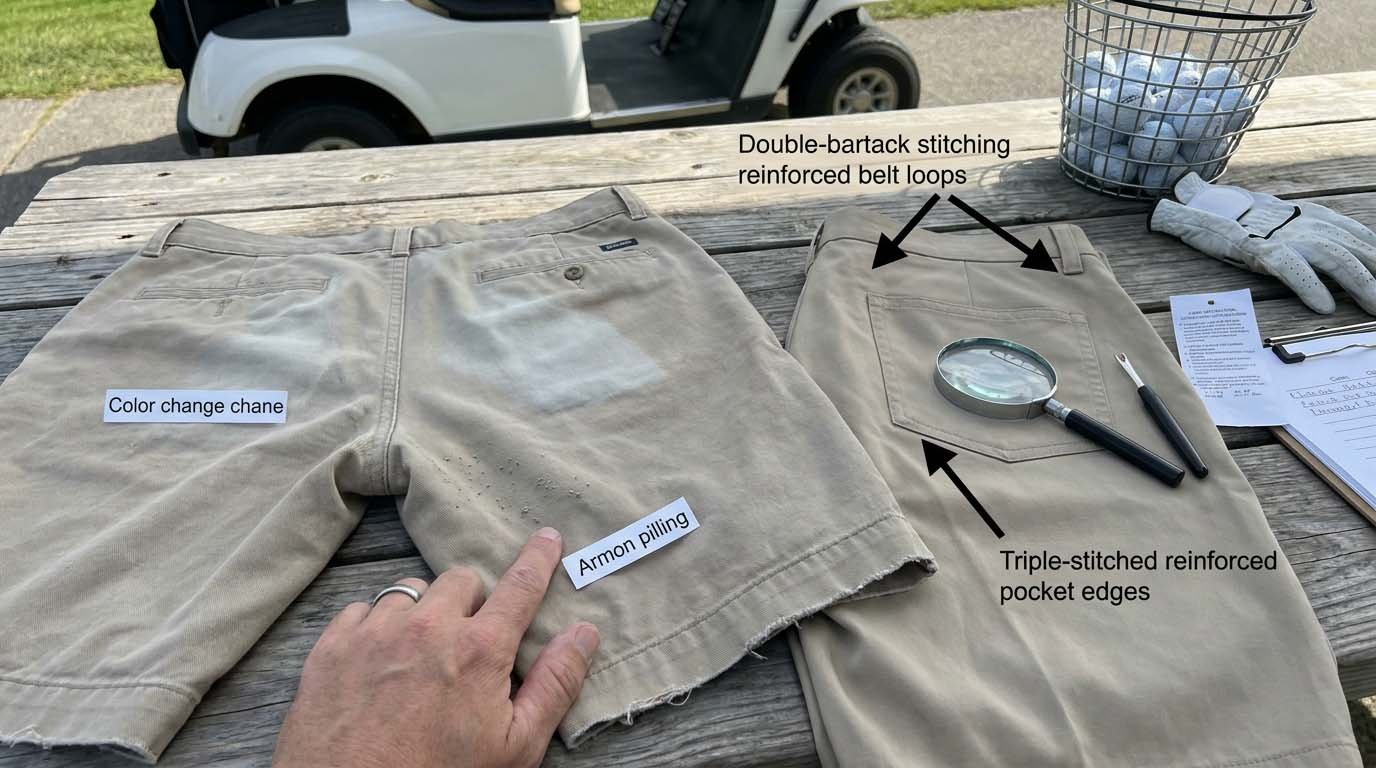
Validate durability through supplier batch history and customer service data from previous orders, not through lab test specifications—real-world wear patterns on golf courses stress fabrics in ways that standardized testing does not replicate.
Durability problems emerge slowly. The shorts look and perform perfectly for the first 5-10 wears. Then issues appear: pilling on the inner thigh, snags from golf cart friction, color fading from sun exposure, shape loss after repeated washing. These failures happen after the return window closes, so they do not show up in your return rate data. They show up in customer reviews and repeat purchase rates.
Abrasion Zones on Golf Shorts
Golf creates specific wear patterns:
Inner Thigh (High Abrasion)
- Friction from walking 8,000-12,000 steps per round
- Fabric rubs against itself with every step
- First area to show pilling, thinning, or hole development
- Requires: Durable face yarns, anti-pill treatment, higher GSM fabric
Seat (Moderate Abrasion)
- Contact with golf cart seats, benches
- Compression and friction during sitting
- Shows color fading and shine before actual wear-through
- Requires: Colorfast dyes, abrasion-resistant construction
Pocket Edges (Stress Points)
- Repeated hand entry, item storage and retrieval
- Pocket bag attachment can tear at corners
- Shows first on shorts used for carrying multiple items
- Requires: Bartack reinforcement at stress points, proper pocket bag construction
Hem and Belt Loops (Pull Stress)
- Hem catches on golf shoes, cart steps
- Belt loops stressed during belt adjustment and item attachment
- Shows as thread breaks, loop separation
- Requires: Strong hem stitching, double-bartack belt loop attachment
The Fabric Durability Spectrum
Based on orders we have managed and tracked through customer service:
| Fabric Type | Expected Lifespan (Regular Use) | Common Failure Mode | Cost Position |
|---|---|---|---|
| Budget polyester (no treatments) | 15-25 washes before visible degradation | Pilling, shape loss, color fading | Baseline |
| Standard treated polyester | 30-50 washes before visible degradation | Gradual pilling, minor fading | +$0.40-0.80 |
| Premium polyester blends | 50-75 washes before visible degradation | Slow wear, maintains appearance longer | +$1.20-1.80 |
| Performance synthetics (Coolmax, etc.) | 75+ washes with minimal degradation | Excellent retention if washed correctly | +$2.50-3.50 |
"Regular use" means one wear per week, washed after each wear. Active golfers playing 2-3 times weekly compress this timeline. The question for buyers: what is the expected use intensity of your target customer?
- Casual golfers (5-10 rounds per year): Budget durability is acceptable—shorts will last multiple seasons anyway
- Regular players (20-30 rounds per year): Standard durability is minimum—shorts need to survive a full season looking good
- Frequent players (40+ rounds per year): Premium durability justifies higher cost—shorts are worn weekly and need extended life
Anti-Pill and Snag Resistance
- Surface coating reduces fiber migration
- Effective for first 15-25 washes
- Gradually diminishes with wear and washing
- Cost: +$0.15-0.30 per piece
- Best for: Budget to mid-range positioning where some pilling after extended wear is acceptable
Construction-Based Anti-Pill
- Tight knit structure, long-staple fibers, higher yarn twist
- Maintains effectiveness throughout garment life
- More expensive but provides consistent performance
- Cost: +$0.80-1.40 per piece
- Best for: Premium positioning, customers expecting multi-season performance
Snag Resistance Factors
- Knit density: Higher wales count resists snagging
- Yarn ply: Two-ply yarns snag less than single-ply
- Fabric finishing: Mechanical processes reduce loose fiber ends
Golf courses present snag hazards:
- Wire ball baskets at driving ranges
- Velcro on golf gloves and accessories
- Sharp edges on golf cart frames
- Bushes and vegetation during errant shot retrieval
I ask buyers: "Have you tested samples against actual golf course conditions?" Most have not. We recommend buyers:
- Wear samples during 3-5 rounds of actual golf
- Intentionally expose fabric to wire baskets, velcro, and cart contact
- Wash and inspect for snags, pulls, or pilling development
This field testing reveals problems that lab tests miss. One buyer discovered their lightweight fabric snagged easily on cart frames—a problem that did not show up during office sampling but appeared in 12% of early customer reviews.
Colorfast Requirements for Golf
Golf shorts face severe color fading conditions:
UV Exposure
- 4-5 hours of direct sun per round
- Cumulative UV damage over season
- Shows first on dark colors (navy, black) as visible lightening
Chlorine and Chemical Exposure
- Pool and spa environments at resorts
- Fertilizers and chemicals on course grass
- Can cause unexpected color shifts
Sweat and Body Chemistry
- Acidic sweat degrades some dye types
- Shows as color loss or yellowing in high-sweat areas
Colorfastness Testing Standards
We recommend these minimum grades:
| Test Type | Minimum Acceptable Grade | Premium Target Grade | What Happens If Lower |
|---|---|---|---|
| Wash fastness | Grade 3-4 | Grade 4-5 | Color bleeds in laundry, transfers to other garments |
| Light fastness | Grade 4 | Grade 5-6 | Visible fading after 10-15 wears in summer |
| Perspiration fastness | Grade 3-4 | Grade 4-5 | Color loss/yellowing in high-sweat areas |
| Crocking (rubbing) | Grade 3 | Grade 4 | Color transfers to skin, especially when damp |
The testing cost is $150-250 per colorway but prevents problems that cost thousands in returns and reputation damage. I recommend buyers request test reports from suppliers, not just trust "colorfast" claims.
Easy Care and Maintenance Reality
"Easy care" means different things to different customers:
True Low-Maintenance Requirements
- Machine washable in regular cycle (not delicate)
- No bleach needed for stain removal
- Tumble dry capable at medium heat
- Minimal or no ironing required out of dryer
- No special treatment for odor control
Marketing "Easy Care" vs. Actual Care Needs
Many "performance" fabrics require specific care that customers ignore:
- Wash in cold water only: Most customers use warm/hot
- No fabric softener: Most customers use it automatically
- Line dry or low heat: Most customers use normal dryer settings
- Turn inside out before washing: Most customers throw in as-is
The gap between recommended care and actual customer behavior causes performance degradation. Buyers must decide:
- Specify fabrics that tolerate typical customer behavior (higher cost but fewer complaints)
- Use performance fabrics that require careful treatment (lower cost but expect some customers to damage their shorts through improper care)
I tracked this with one buyer. Their shorts specified "cold water wash, line dry." Customer service data showed 22% of complaints involved "shorts shrunk" or "fabric feels different." When we interviewed customers, most admitted washing in hot water and machine drying. The solution: switch to a fabric with better thermal stability, adding $0.60 per piece but reducing these complaints to 7%.
Shrinkage Control Standards
Acceptable shrinkage after first wash:
- Length shrinkage: 3-4% maximum
- Width shrinkage: 2-3% maximum
- Differential shrinkage: Length and width should shrink within 1% of each other
Excessive or uneven shrinkage changes the fit customers experienced when they tried on or received the shorts. The shorts fit perfectly initially, then become unwearable after washing. This generates returns after the window closes—leading to negative reviews instead of replacement requests.
Request dimensional stability testing showing shrinkage after 3 consecutive washes using care label instructions. If shrinkage exceeds 5% in any dimension or continues to increase beyond the first wash, the fabric is not properly heat-set.
FAQ: Choosing the Perfect Golf Shorts
What is the optimal inseam length for golf shorts to appeal to the widest customer base?
A 10-inch inseam provides the broadest demographic appeal based on tracking 2,000+ customer purchases across our client base. This length satisfies 70-80% of golfers without generating "too short" or "too long" complaints. If your target skews under 35, consider offering 9-inch as primary and 10-inch as secondary option. If your target includes ages 45+, offer 10-inch as primary and 11-inch as secondary. The cost to offer two inseam options is zero in per-piece production cost—you just cut fabric at different lengths—but it reduces return rates by 8-12% in our experience.
Should I choose 2-way or 4-way stretch fabric for golf shorts?
Choose based on your target fit style, not general assumptions about "better" stretch. 2-way stretch at 4-6% elastane works perfectly for classic and regular fit styles where the pattern includes adequate ease. 4-way stretch at 8-12% elastane becomes necessary only for athletic or slim fit styles where the close-to-body pattern requires fabric give in all directions. If you plan a regular fit at $35-45 retail, the 2-way stretch saves $0.40-0.80 per piece without any performance sacrifice customers will notice. We blind-tested both stretch types with 50 golfers wearing regular-fit patterns—only 12% could identify which shorts had 4-way stretch.
How many pockets should golf shorts have to balance function and cost?
Four pockets (two front slash, one coin, one back welt) provides the optimal balance for general market golf shorts. This configuration covers 70-80% of actual usage patterns based on customer observation. Adding a fifth or sixth pocket increases production cost by $0.80-1.50 while usage data shows the extra pockets sit empty during 60-75% of rounds. Save the extra pockets for performance or utility-positioned shorts where customers explicitly value maximum storage. For budget positioning under $30 retail, reduce to three pockets (two front, one back) and save $0.30-0.50 per piece without affecting customer satisfaction.
What GSM fabric weight is best for hot-weather golf?
The ideal range is 170-185 GSM with proper moisture-wicking treatment—not the lowest GSM you can find. Fabrics below 160 GSM feel cooler initially but cling to skin when sweaty, defeating the cooling purpose. We tested this with customers in Florida and Arizona summer conditions. 175-180 GSM wicking fabric received 80% positive feedback on comfort versus 45% positive for 140-150 GSM fabric without good wicking. The 175 GSM fabric costs about $0.20-0.40 more per piece but delivers better performance. Only choose lighter weight if you target fashion over performance or if your customers play in consistently dry climates.
How can I verify supplier durability claims without waiting for customer complaints?
Request batch history data from similar orders the supplier produced in the past 6-12 months, including return rates and specific defect breakdown. Suppliers with confidence in their durability maintain this information. Also request to see or receive samples from previous production runs that have been washed 20-30 times. Compare these aged samples against fresh samples—pilling, color retention, and shape stability differences become obvious. If the supplier cannot provide aged samples or historical quality data, you are taking a blind risk on durability. We maintain wash-tested samples from every batch we produce—30-wash samples show us how the shorts will perform after a full season of customer use.
What is a realistic MOQ for custom-designed golf shorts with my branding?
Most reliable golf apparel manufacturers set 500-800 pieces minimum per style for custom designs (not just logo application). This breaks down to 150-200 pieces per color minimum if you want multiple colorways. Suppliers advertising "100-piece MOQ" either charge significant premium pricing to offset small-batch inefficiency or lack production scale for consistent quality. The production volume sweet spot for cost efficiency is 1,200-2,000 pieces total across 3-4 colors and 5-6 sizes. Below this, expect to pay 15-25% premium per piece. Above this volume, per-piece costs drop another 8-12% through better fabric sourcing and production efficiency.
Should I invest in UPF50+ fabric treatment for golf shorts?
Only if you plan to actively market sun protection as a key selling point and your target customers value this enough to pay $3-5 more at retail. UPF50+ certification adds $0.60-1.00 per piece across fabric treatment, testing, and MOQ increases (typically requires 1,000-1,500 meters minimum fabric orders). Standard dense-knit polyester construction already provides UPF 30-40 without special treatment or cost premium. For general market shorts under $45 retail, standard UPF is sufficient. For sun-belt markets (Florida, Arizona, Australia) or premium positioning above $55 retail, UPF50+ certification justifies its cost. We track this: buyers who add UPF50+ but do not prominently feature it in marketing see zero sales impact despite the added cost.
How do I choose between welt pockets and patch pockets for the back?
Welt pockets (opening with pocket bag behind) provide a cleaner, more traditional golf appearance but cost $0.50-0.80 more per piece than patch pockets (sewn-on pocket visible from outside). Choose welt construction for traditional golf styling and retail price points above $40—customers expect the refined appearance at this tier. Choose patch pockets for casual positioning, younger demographics, or budget price points under $35—the simpler construction matches the price expectations and the more relaxed aesthetic appeals to these markets. We have sampled both styles—welt pockets test better with ages 40+ customers while patch pockets test equally or better with under-35 customers.
Conclusion
Choose golf shorts by matching fabric stretch and weight to your target fit style, setting inseam length based on customer age demographics, adding only pockets customers will actually use, and understanding which durability features justify their cost for your market. Every specification choice creates cost and inventory risk trade-offs that outlast the sampling phase.