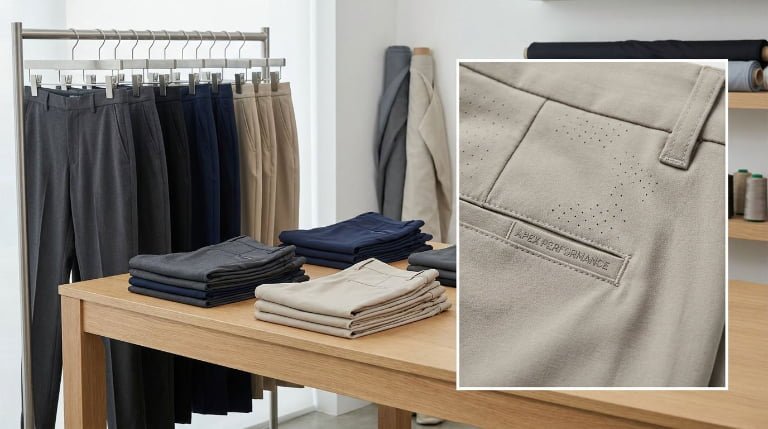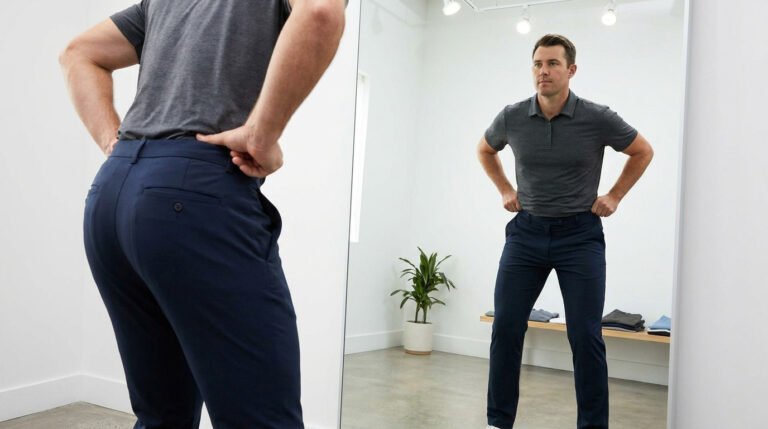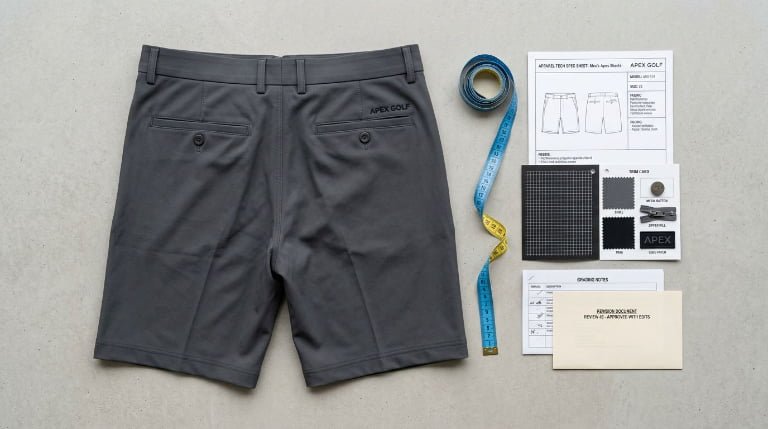
Sourcing custom golf shorts involves more than choosing a stretch fabric and adding your brand logo. A poor fabric choice, uncomfortable waistband, or unrealistic minimum order quantity (MOQ) can turn a promising design into an expensive inventory problem.
To source custom golf shorts successfully, define your target customer and product requirements first. Then evaluate fabric availability, fit, pocket functionality, customization options, and MOQ together. Before placing a bulk order, compare manufacturer quotations, test samples, and approve one final production specification.
At FUWAY, we help brands develop custom golf apparel through fabric sourcing, sampling, and OEM/ODM manufacturing. This guide focuses on the purchasing decisions brands should make before committing to production.
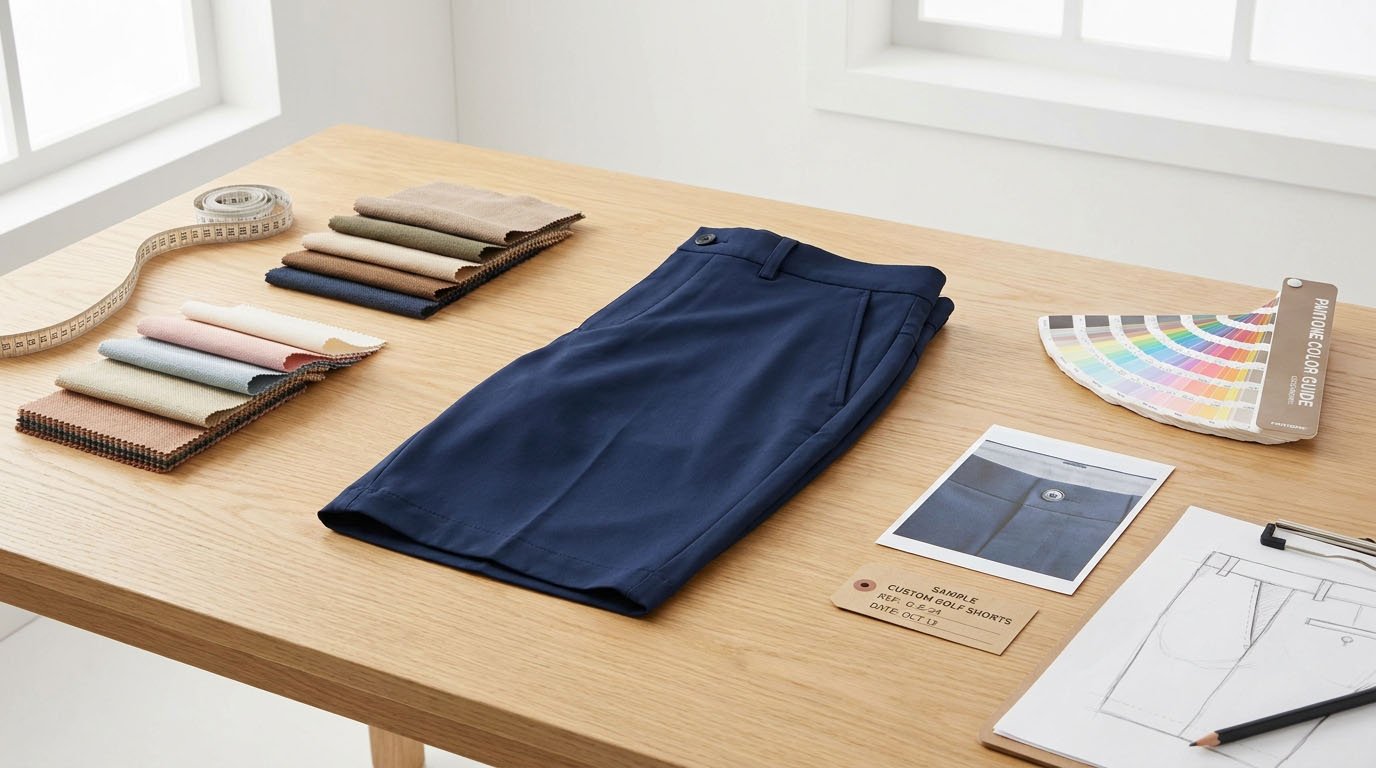
Quick Answer: How Do You Source Custom Golf Shorts?
Follow these seven steps:
- Define your product brief: Identify your customer, climate, retail price, and expected order quantity.
- Select suitable fabric: Compare performance, availability, consistency, and cost.
- Confirm fit and functional details: Align inseam, waistband, and pocket requirements with actual golf use.
- Evaluate MOQ and customization: Understand the minimum quantities for fabrics, colors, and trims.
- Compare manufacturers: Review relevant experience, technical communication, sampling capability, and quotations.
- Prepare an RFQ and request samples: Send clear specifications and test the proposed product.
- Approve before bulk production: Confirm materials, measurements, branding, and quality requirements.
The goal is not simply to find the cheapest factory. It is to develop golf shorts that meet your brand's requirements at a practical cost and order quantity.
Step 1: Define Your Golf Shorts Sourcing Requirements
Before contacting a manufacturer, prepare a short product brief.
This gives potential suppliers enough information to recommend suitable materials and provide meaningful quotations.
What Should Your Product Brief Include?
| Requirement | Questions to Answer |
|---|---|
| Target customer | Who will wear the shorts? |
| Climate | Hot and humid, mild, or cooler conditions? |
| Product positioning | Performance, lifestyle, or premium golfwear? |
| Target retail price | What price range are you developing for? |
| Fit | Slim, regular, or relaxed? |
| Customization | Logo, labels, unique colors, or custom construction? |
| Order plan | How many styles, colors, sizes, and units? |
| Launch timeline | When must finished inventory be available? |
For example, a startup selling lightweight golf shorts in Florida may prioritize breathability, easy-care fabrics, and accessible pricing.
A premium golf brand targeting country-club customers may place greater emphasis on fabric hand feel, structured appearance, and finishing details.
These brands should not necessarily source the same fabric or waistband construction.
Sourcing tip: Identify which requirements are essential and which are flexible. This allows manufacturers to suggest alternatives without changing your product's intended positioning.
Step 2: Select Fabric Based on Performance and Availability
Fabric selection affects comfort, appearance, cost, and production feasibility.
For custom golf shorts, the best sourcing decision is not necessarily the fabric with the highest stretch percentage or the most performance claims.
It is the material that meets your product requirements and can be supplied consistently.
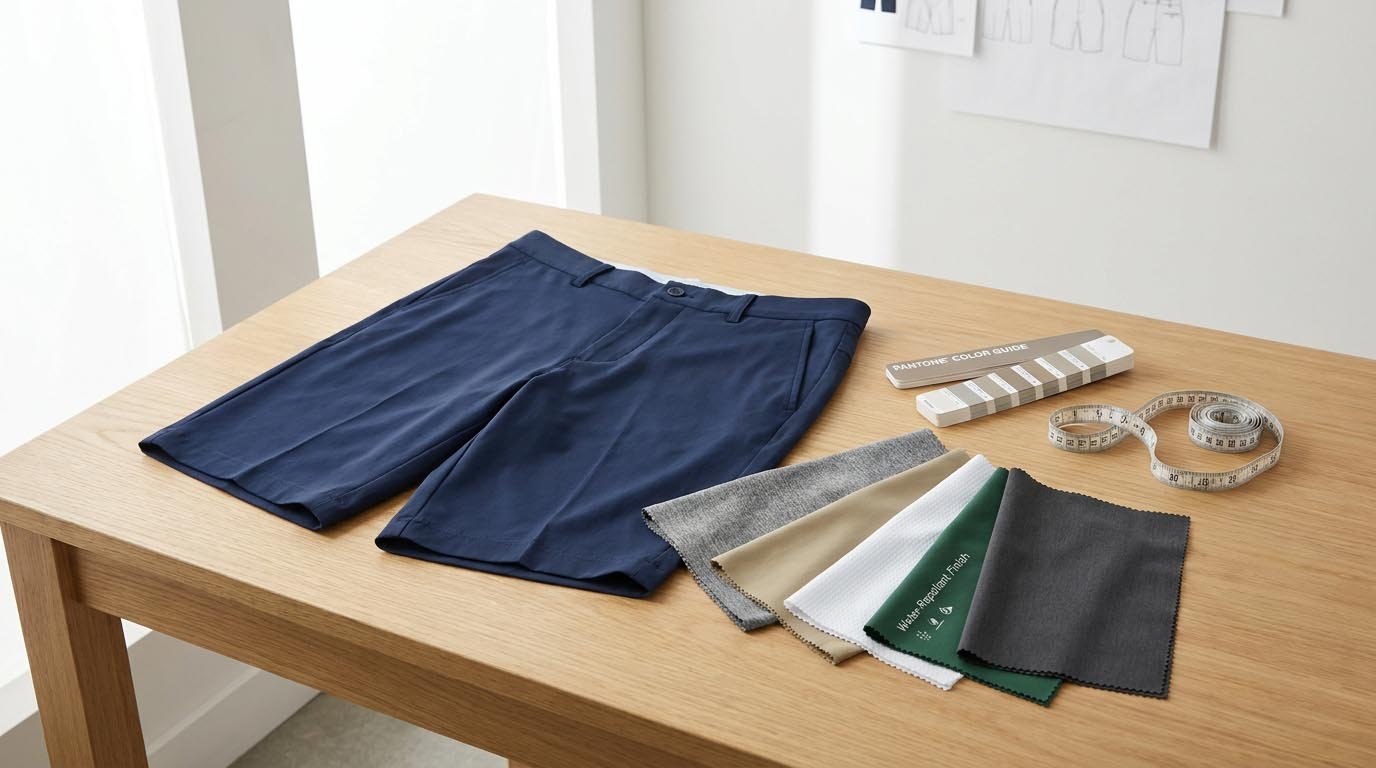
Compare Fabric Options
| Fabric Option | Main Advantage | Sourcing Consideration |
|---|---|---|
| Polyester | Durable, quick-drying, cost-effective | Compare weave, comfort, and finish |
| Polyester-Spandex | Added stretch and movement | Verify recovery and availability |
| Nylon-Spandex | Soft hand feel and premium positioning | Confirm cost and repeat availability |
| Lower-Stretch Woven Fabric | More structured appearance | Check mobility in the approved fit |
Fabric performance depends on more than fiber composition. Construction, weight, finishing, and garment design also influence the result.
For a deeper technical comparison, see our Best Fabric for Golf Shorts: Polyester vs Nylon vs Spandex Blends.
Stock Fabric vs Custom-Developed Fabric
This is an important sourcing decision, especially for smaller brands.
| Sourcing Option | Best For | Main Trade-Off |
|---|---|---|
| Available performance fabric | First launches and smaller orders | Limited colors or specifications |
| Custom-dyed fabric | Specific brand colors | Potential dyeing MOQ and longer lead time |
| Custom-developed fabric | Distinctive performance or appearance | Additional development, testing, and sourcing commitments |
An available fabric can simplify development, but it must still meet your requirements for stretch, recovery, opacity, comfort, and wash performance.
Before approving a fabric, ask the manufacturer:
- Is the fabric currently available?
- Which colors can be ordered?
- Is the material suitable for repeat production?
- What performance test information is available?
- Will a custom color or finish change the MOQ?
The most practical first-order fabric is often one that balances acceptable performance with reliable supply.
Step 3: Confirm Fit, Waistband and Pocket Requirements
Golf shorts should look appropriate off the course while allowing comfortable movement during play.
For sourcing purposes, focus on the product details that affect fabric consumption, construction complexity, and sample approval.
Confirm the Intended Fit
Your manufacturer should understand:
- Silhouette: Slim, regular, or relaxed.
- Rise: How the waistband sits on the body.
- Inseam: The intended finished length.
- Seat and thigh ease: Comfort during bending and rotation.
- Waistband type: Structured, elasticized, or hidden-stretch construction.
Do not assume that a waist measurement and inseam length fully describe the intended fit.
A golf short can meet its basic dimensions and still feel restrictive during a swing.
Choose Waistband Construction
Common options include:
| Waistband Type | Suitable Application |
|---|---|
| Structured waistband with belt loops | Classic tailored golf shorts |
| Hidden-stretch waistband | Clean appearance with additional flexibility |
| Elasticized waistband | Casual and relaxed golfwear |
| Waistband with internal gripper | Designs requiring additional shirt retention |
Each option affects material selection, pattern development, and manufacturing cost.
For an initial collection, avoid adding specialized components unless they provide a meaningful customer benefit.
Evaluate Pocket Functionality
Golfers may carry a phone, tees, ball marker, scorecard, or other small accessories.
The important questions are whether the pockets are accessible, comfortable, and secure during actual use.
| Pocket Feature | What to Evaluate |
|---|---|
| Front pockets | Entry angle, opening size, and usable depth |
| Rear pockets | Accessibility and closure requirements |
| Tee or accessory compartment | Convenience without unnecessary bulk |
| Pocket lining | Durability, breathability, and comfort |
| Pocket placement | Movement and appearance when carrying items |
Avoid specifying universal pocket dimensions before testing the intended contents and fit.
Instead, ask for a sample that can be evaluated while walking, bending, swinging, and sitting in a golf cart.
FUWAY's Custom Golf Bottoms page provides an overview of available golf bottoms manufacturing and customization capabilities.
Step 4: Compare MOQ, Customization and Pricing Options
MOQ is one of the most important commercial decisions when sourcing custom golf shorts.
However, a factory's minimum order quantity may depend on different factors.
What Influences Custom Golf Shorts MOQ?
| MOQ Factor | Why It Matters |
|---|---|
| Fabric availability | Custom materials may have independent minimums |
| Number of colors | Each color may require separate sourcing |
| Construction complexity | Specialized details may increase setup requirements |
| Custom trims | Buttons, grippers, labels, or packaging may have separate minimums |
| Order quantity | Smaller production runs spread fixed costs across fewer garments |
At FUWAY, MOQ generally starts at approximately 100 pieces per style for suitable projects. Specific golf shorts designs may require higher quantities depending on fabric, colors, construction, and customization.
Always confirm whether the quoted MOQ applies per style, per color, or per material configuration.
Request Alternative Quantity Quotations
Instead of asking only for the lowest MOQ, compare several realistic order quantities.
For example:
| Quotation Item | Option A | Option B | Option C |
|---|---|---|---|
| Quantity | 100 pcs | 200 pcs | 300 pcs |
| Fabric | Same specification | Same | Same |
| Colorways | Same | Same | Same |
| Branding | Same | Same | Same |
| Unit Price | To quote | To quote | To quote |
| Setup Charges | Confirm | Confirm | Confirm |
| Production Lead Time | Confirm | Confirm | Confirm |
These quantities are examples for comparing quotations, not guaranteed factory minimums.
The comparison helps you understand whether a larger order provides enough cost savings to justify the additional inventory.
Keep the First Order Manageable
For many startup brands, the most practical approach is to:
- Start with one well-developed silhouette.
- Limit initial colorways.
- Choose suitable available fabrics.
- Standardize essential trims where possible.
- Use a realistic size breakdown based on customer demand.
If your target quantity is below the factory's minimum, review our How to Negotiate MOQ With a Golf Apparel Manufacturer guide for practical negotiation options.
Step 5: Evaluate Golf Shorts Manufacturer Capabilities
Not every apparel factory has the same experience developing performance golf bottoms.
A suitable manufacturer should be able to explain how your material, fit, pocket, and branding requirements affect sampling and production.
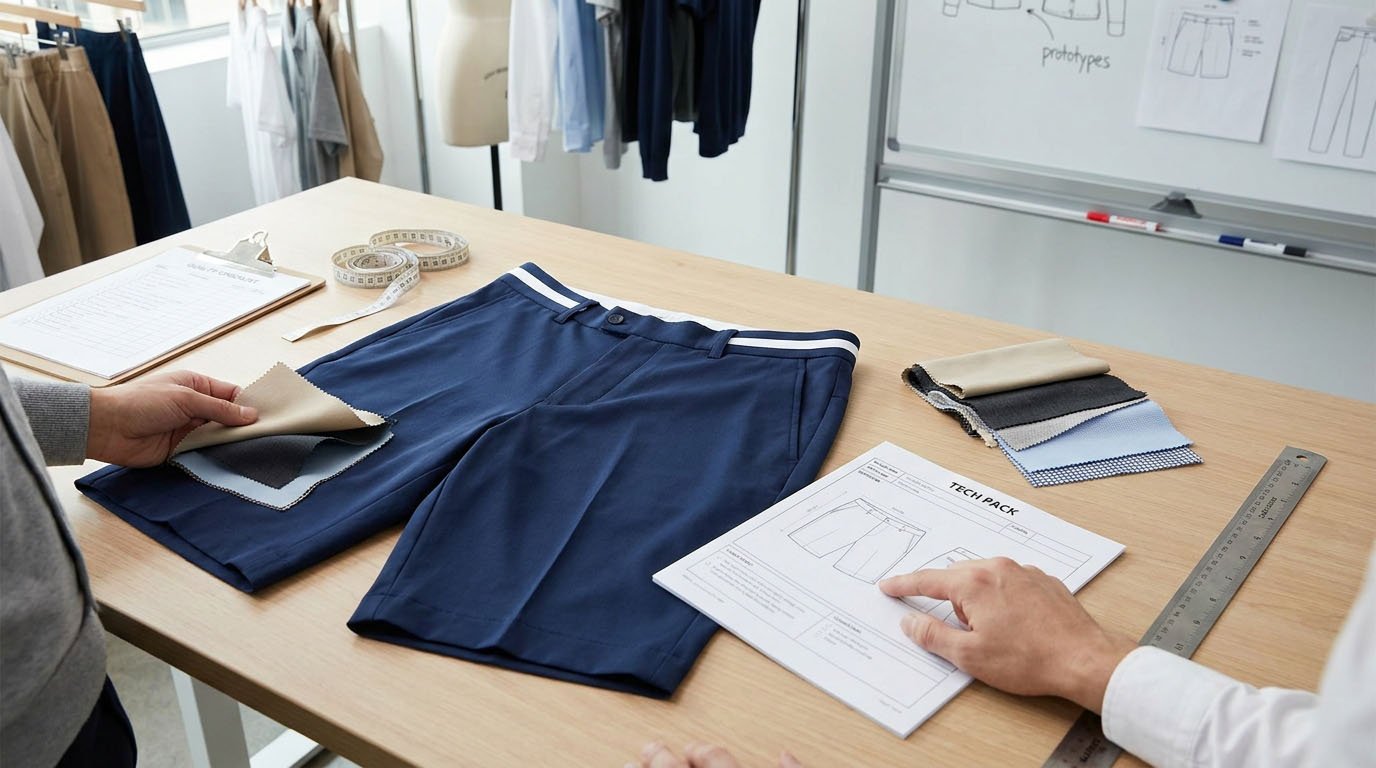
What Should You Ask a Potential Manufacturer?
| Evaluation Area | Question to Ask |
|---|---|
| Product experience | Have you manufactured comparable performance golf shorts? |
| Fabric sourcing | Can you provide suitable materials and confirm availability? |
| Pattern development | Can you develop or adjust the required fit? |
| Functional construction | Can you manufacture the specified waistband and pockets? |
| Sampling | How are sample revisions and approvals managed? |
| MOQ transparency | Which parts of the specification affect minimum quantities? |
| Quality control | What inspection evidence can you provide? |
| Repeat orders | How do you maintain material and fit consistency? |
Compare Evidence, Not Just Promises
A manufacturer that immediately agrees to every specification is not necessarily the best choice.
A stronger sourcing partner should be able to:
- Explain technical limitations.
- Identify missing information.
- Recommend appropriate alternatives.
- Clarify additional costs.
- Provide relevant product examples or sample evidence.
- State what must be confirmed before production.
When comparing suppliers, request quotations against the same specification. Otherwise, a lower price may simply reflect different materials, construction, or service assumptions.
The right manufacturing partner is one that can turn your approved requirements into a repeatable product—not simply offer the lowest initial quote.
Step 6: Prepare Your RFQ and Request Samples
Once you have shortlisted suitable factories, prepare a formal request for quotation (RFQ).
An incomplete inquiry may produce a preliminary estimate, but it rarely provides enough information for a dependable production decision.
What Information Should Your RFQ Include?
Use this checklist:
| RFQ Item | Information to Provide |
|---|---|
| Product | Men's or women's custom golf shorts |
| Design | Photos, sketches, or reference samples |
| Fabric | Composition, weight, stretch, preferred color |
| Fit | Size range, silhouette, inseam, waistband |
| Pockets | Type, quantity, placement, and closure |
| Branding | Logo artwork, decoration method, labels |
| Quantity | Estimated units per style and color |
| Packaging | Standard or private-label requirements |
| Timeline | Target sample approval and delivery dates |
| Destination | Shipping country and quotation terms |
For production development, these requirements should eventually be documented in a tech pack.
Our Golf Apparel Tech Pack Checklist explains the measurements, BOM, construction notes, and approval information required before sampling and bulk manufacturing.
Request Samples Against Clear Approval Criteria
Do not request a sample without defining what it needs to prove.
For custom golf shorts, the sample evaluation should cover three areas:
1. Fit and Movement
Check waist comfort, seat ease, thigh mobility, inseam appearance, and movement during golf-specific activities.
2. Fabric and Construction
Review fabric hand feel, recovery, waistband stability, pocket usability, and workmanship.
3. Branding and Appearance
Confirm logo placement, labels, colors, and overall product presentation.
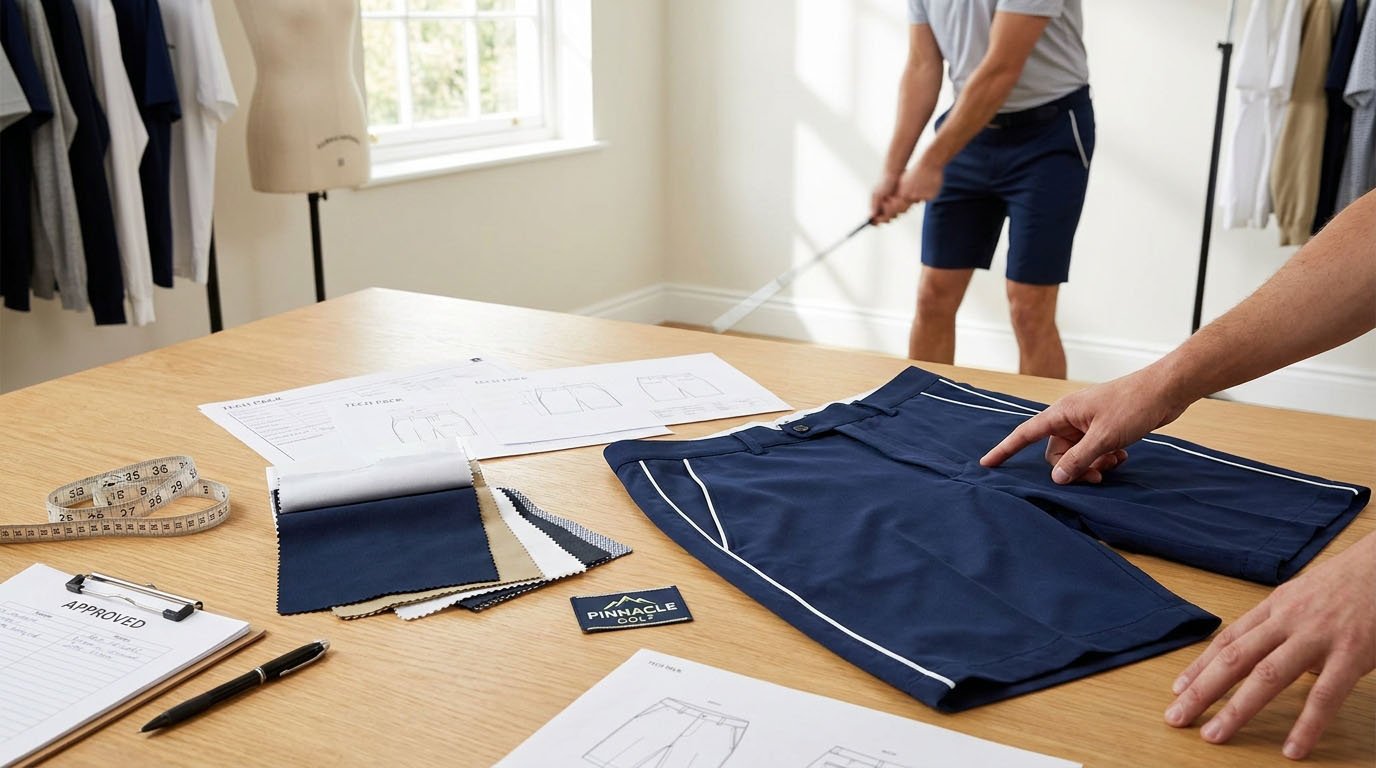
At FUWAY, initial sampling is generally around 7–10 working days for suitable projects after key requirements and materials are confirmed. Additional development, sourcing, or revisions can extend the timeline.
The initial sample should not automatically be treated as final bulk approval.
Record any changes, request revised samples where needed, and confirm the final specification before production.
Step 7: Approve Specifications Before Bulk Ordering
Sample approval is the point where your sourcing decisions become production requirements.
Before placing a bulk order, confirm that the manufacturer is working from the latest approved specifications.
Final Pre-Production Approval Checklist
| Approval Item | What to Confirm |
|---|---|
| Fabric | Approved material, color, and performance requirements |
| Fit | Final sample, size chart, and grading |
| Waistband | Construction, comfort, and recovery |
| Pockets | Placement, functionality, and workmanship |
| Branding | Approved logo artwork and placement |
| MOQ | Confirmed quantity by style and color |
| Pricing | Unit cost, additional charges, and payment terms |
| Timeline | Material readiness and production schedule |
| Quality | Measurement tolerances and inspection requirements |
| Packaging | Labels, folding, packing, and shipment details |
At FUWAY, finished garment measurements at specified measurement points must remain within ±1.0 cm of approved target dimensions, with tighter tolerances where agreed in the tech pack.
Do not accept unapproved material substitutions or construction changes simply to reduce production cost.
Confirm Repeat-Order Consistency
If the first golf shorts collection performs well, future orders should reproduce the approved product as closely as possible.
Ask the manufacturer to retain:
- Final approved tech pack and measurement chart.
- Fabric reference and color standards.
- Approved trims and branding specifications.
- Final sample approval records.
- Relevant inspection and test results.
Material availability and dye-lot differences may still require confirmation for a reorder.
For the manufacturing stages after approval, see our Golf Shorts OEM Process: From Design to Mass Production.
For detailed production inspection requirements, use the Golf Apparel Factory QC Checklist.
Custom Golf Shorts Sourcing Checklist
Before confirming your manufacturer, review these essential decisions.
| Sourcing Decision | Ready When |
|---|---|
| Product positioning | Customer, climate, and price target are clear |
| Fabric | Material and available color options are confirmed |
| Fit | Silhouette, sizing, and inseam are approved |
| Construction | Waistband and pocket requirements are documented |
| Branding | Logo, labels, and packaging are defined |
| MOQ | Minimums per style, color, and component are understood |
| Quotation | Comparable pricing and commercial terms are available |
| Sampling | Required sample evaluations are completed |
| Quality | Approved specifications and tolerances are documented |
| Production | Quantity, schedule, and approval responsibilities are confirmed |
If several items remain unresolved, request clarification before committing to bulk production. Fixing a specification during sourcing is usually simpler than correcting it after production begins.
Frequently Asked Questions About Sourcing Custom Golf Shorts
What Is the Best Fabric for Custom Golf Shorts?
Polyester-spandex and nylon-spandex are common options for performance-oriented golf shorts.
Polyester blends often provide practical cost and sourcing flexibility, while nylon blends can offer a softer hand feel.
The final choice should depend on climate, fit, stretch recovery, appearance, and material availability.
What Is the MOQ for Custom Golf Shorts?
MOQ depends on fabric sourcing, colorways, trims, and construction.
Some FUWAY projects can start at approximately 100 pieces per style, while other custom golf bottoms may require higher quantities.
Confirm the minimum for your exact design before preparing a purchase order.
Can I Customize Golf Shorts With My Own Logo?
Yes. Custom golf shorts can include embroidery, heat-transfer branding, woven labels, or other suitable decoration methods.
The best method depends on logo complexity, fabric compatibility, placement, durability, and quantity.
Do I Need a Tech Pack to Order Custom Golf Shorts?
A complete tech pack is strongly recommended for OEM development.
If you are starting with reference samples or photographs, your manufacturer may help translate them into technical specifications.
However, fabric, measurements, construction, branding, and approval requirements should be documented before production.
How Do I Compare Quotes From Different Golf Shorts Manufacturers?
Send each manufacturer the same product specification and quantity breakdown.
Compare material assumptions, unit prices, setup charges, sampling terms, MOQ, production lead times, inspection arrangements, and shipping terms.
A cheaper quotation is not necessarily a better sourcing option if essential requirements are excluded.
Should I Approve a Sample Before Bulk Production?
Yes. Sample approval helps verify fit, materials, construction, and branding.
For golf shorts, testing comfort during bending, walking, sitting, and swinging is particularly important.
Any required revisions should be documented and approved before bulk production begins.
Conclusion: Source Custom Golf Shorts With a Clear Plan
Successful custom golf shorts sourcing requires connecting product requirements with realistic manufacturing conditions.
Start with your target customer. Select suitable fabrics, confirm functional fit and pocket requirements, compare MOQ and pricing, and evaluate manufacturers against the same technical brief.
Most importantly, approve samples and specifications before committing to production.
At FUWAY, we support golf brands with OEM/ODM development, fabric sourcing, custom branding, sampling, and bulk production.
If you are planning a custom golf shorts collection, contact FUWAY to discuss your design, fabric requirements, order quantity, and sampling options.