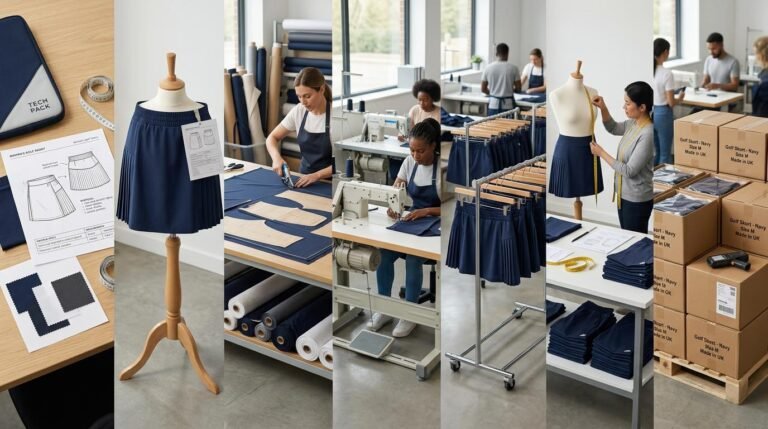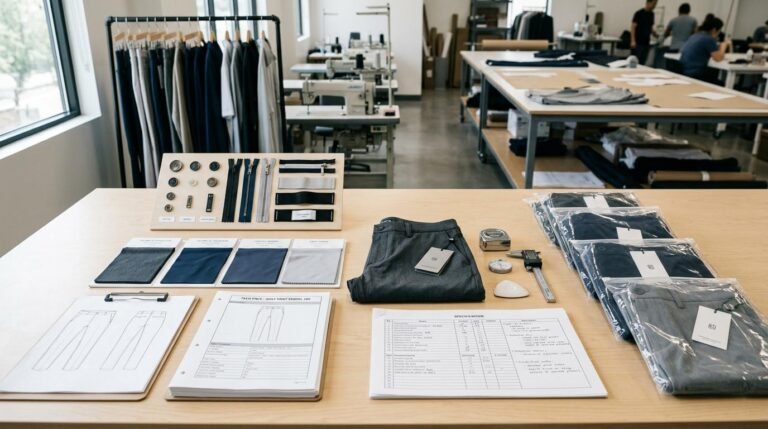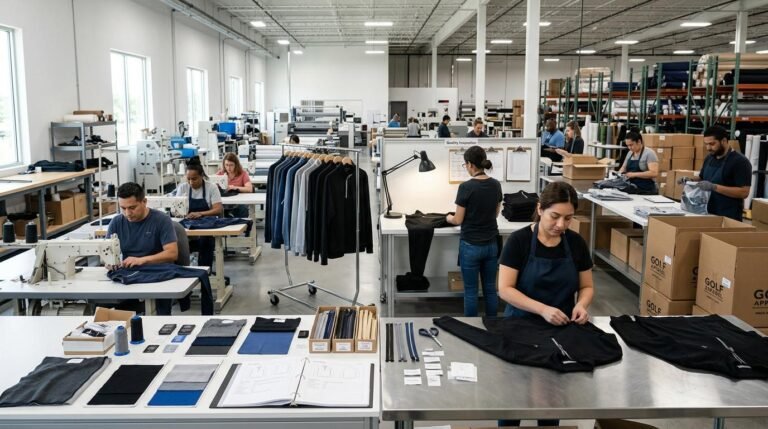
You send a photo to a factory, expecting a quote in two days. Three weeks later, you're still answering questions about waistband width and pocket depth—wondering why sampling hasn't even started yet.
The golf shorts OEM process involves four core stages: design confirmation and material selection, prototype sampling and fit testing, pre-production approval with trims and sizing, and bulk manufacturing with quality control. Most delays happen because buyers arrive with incomplete specs—forcing factories to reverse-engineer details that should be confirmed upfront.
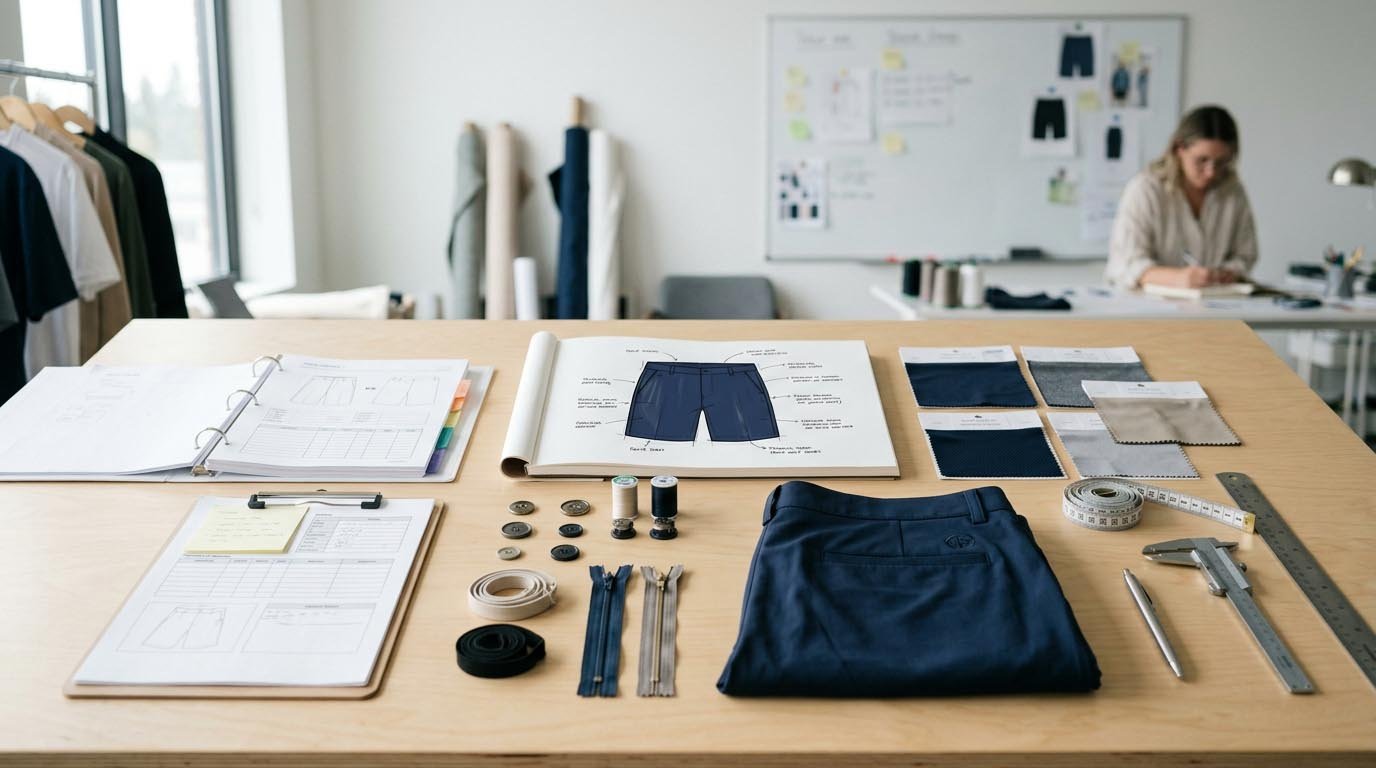
I've managed hundreds of golf shorts projects at FUWAY, and I've seen the same pattern: brands excited about their designs, unprepared for the validation steps that come before the first sample ships. Understanding what factories actually need to confirm will save you weeks of back-and-forth and prevent costly revisions during production.
Quick Answers: Golf Shorts OEM Essentials
How long does golf shorts sampling take?
First samples take 15-20 days after all specs are confirmed. Expect 2-3 revision rounds based on fit adjustments, fabric approval, and trim modifications before final approval.
What's the typical MOQ for custom golf shorts?
Most factories require 300-500 pieces per style for cost-effective production. Lower quantities are possible but increase unit cost by 25-40% due to cutting and dyeing setup fees.
Can I use any fabric I find online?
Not always. Performance fabrics need minimum order quantities (often 500+ yards) and specific construction methods. Stretch fabrics require different cutting and sewing techniques than woven materials.
What information do I need before contacting a factory?
Prepare: fabric specs (weight, stretch, finish), design details (pocket type, closure style, waistband construction), target price range, and expected order volume. Complete specs cut sampling time by 30%[^1].
How much does fabric choice affect cost?
Moisture-wicking treatments add $1.50-$2.80 per unit, 4-way stretch fabric costs 15-25% more than basic polyester, and UPF coatings increase fabric cost by 20-35%. These add up fast.
What the Golf Shorts OEM Process Includes from Concept to Delivery?
Golf shorts OEM covers design validation, material sourcing, sample development, pre-production setup, bulk manufacturing, and logistics coordination. The process requires 6-10 weeks for sampling and confirmation, then 45-60 days for production[^2]—assuming no major revisions.
When Bobby first contacted us about his golf apparel line, he had Instagram screenshots and a budget. He thought sampling would take a week. I had to walk him through what happens between "I want these shorts" and "Here's your first prototype."
Most buyers think OEM is linear: send design, get sample, approve, start production. Real projects loop between stages. You approve fabric, then discover the stretch direction doesn't work with your pocket design. You love the fit, but the zipper quality feels cheap. You confirm the color, then realize the elastic waistband doesn't match the fabric tone.
Each loop adds 5-7 days to your timeline. Buyers who prepare specs before inquiry skip most of these cycles. Here's what that preparation looks like:
| Information Needed | Why It Matters | Impact if Missing |
|---|---|---|
| Fabric weight & composition | Determines drape, breathability, cost | 7-10 day delay for fabric sourcing |
| Stretch percentage & direction | Affects pattern grading, cutting method | Sampling restart required |
| Pocket type & depth | Changes pattern engineering | $80-150 sample revision fee |
| Waistband construction | Impacts elastic sourcing, sewing sequence | 5-7 day trim sourcing delay |
| Size range & grading rules | Defines cutting efficiency, MOQ structure | Pricing cannot be finalized |
I tell new buyers: bring as much detail as you can confirm. If you're unsure, tell me what you're flexible on. That honesty saves both of us time.
Product Design, Tech Pack Development and Material Planning?
Design confirmation requires a tech pack with measurements, construction specs, and fabric details. Without this, factories guess—leading to samples that miss your expectations. Tech pack development takes 3-5 days if you provide reference samples or detailed sketches.
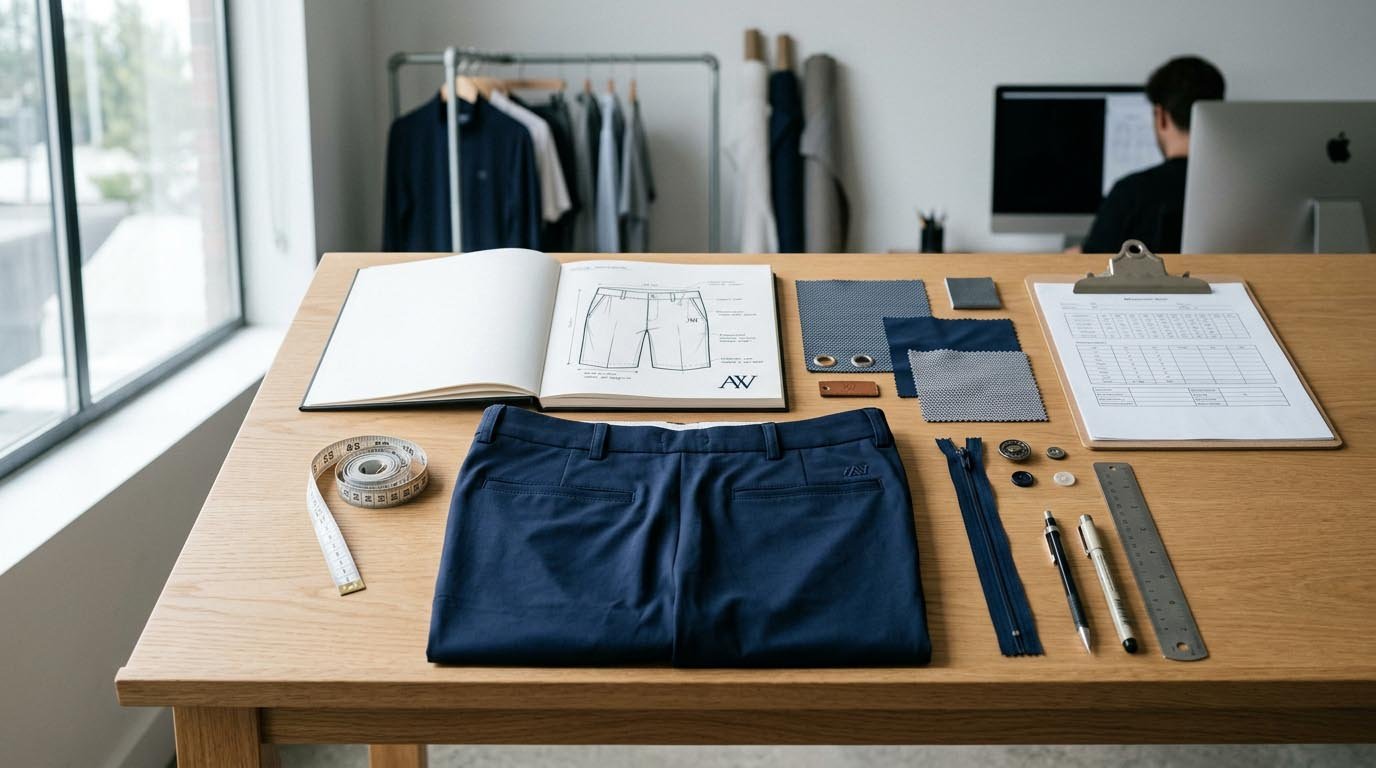
Bobby sent me a photo of shorts he liked. I asked: what's the inseam length? He didn't know. What's the rise measurement? He'd never measured it. Does the waistband have elastic, drawstring, or both? He assumed we'd figure it out.
We can figure it out—but it adds $120-180 to sampling cost and two weeks to the timeline. Here's why: our pattern maker creates a tech pack based on standard proportions, we make the sample, Bobby says "the fit is off," and we revise. If Bobby had sent measurements from the start, we'd nail the fit on the first try.
A proper tech pack includes:
- Measurement chart for all sizes (waist, hip, inseam, outseam, rise, leg opening)
- Construction notes (pocket type, closure style, hem finish, seam allowances)
- Material specs (fabric weight, stretch %, color reference, finish treatments)
- Trim details (zipper length, button type, elastic width, label placement)
If you don't have a tech pack, we build one during sampling—but you pay for the iterations. I always tell buyers: investing $200-300 in a professional tech pack upfront saves $500-800 in sampling revisions.
Material planning happens parallel to design. You want moisture-wicking fabric? I need to know the weight range. You want 4-way stretch? That changes the cutting method and requires specific trim compatibility. You want it to feel like the shorts you bought at a pro shop? I need a swatch to match hand feel, because "soft" means different things to different people.
Fabric Sourcing, Prototype Sampling and Fit Evaluation?
Prototype sampling takes 15-20 days after fabric and trims are confirmed. First samples focus on construction accuracy and fit validation—not final color matching. Expect 2-3 revision cycles for adjustments before moving to pre-production.
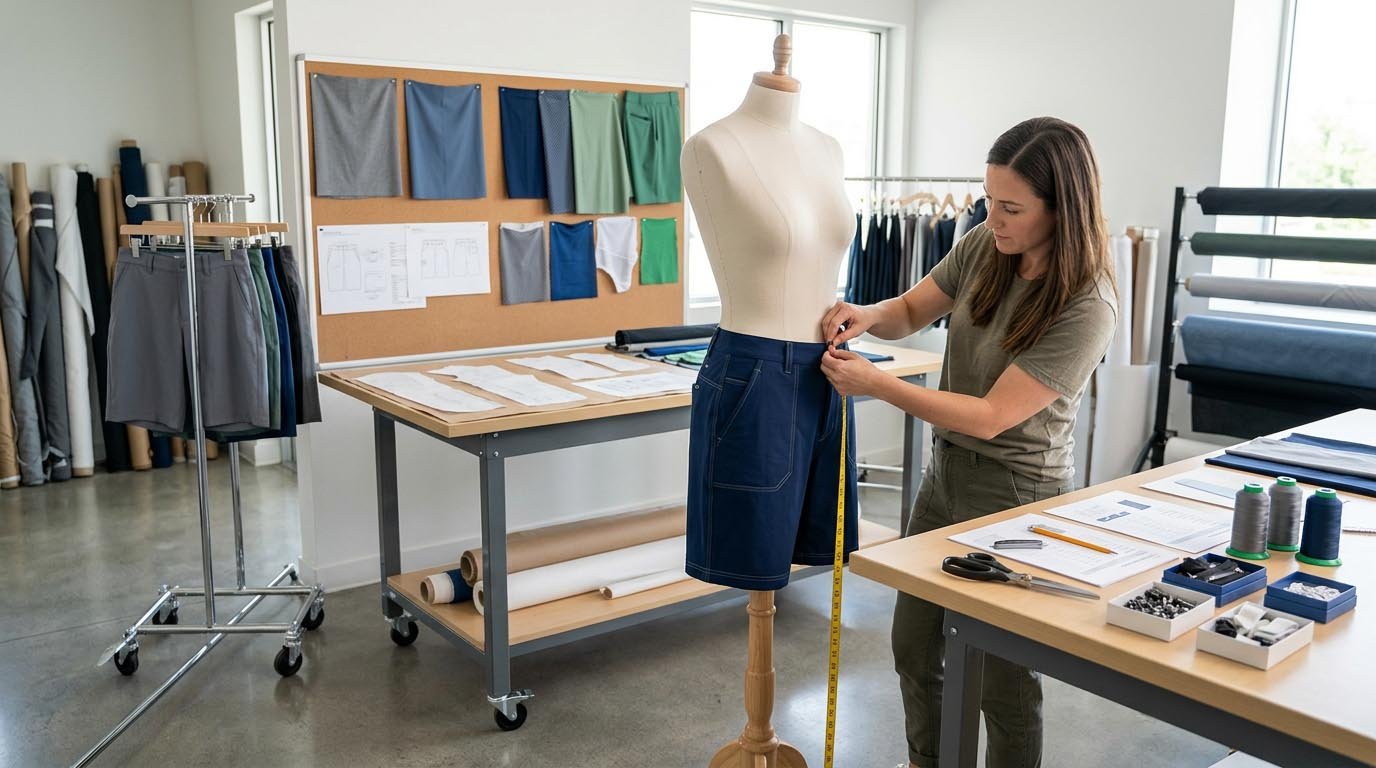
This stage frustrates buyers the most. You think sampling is fast because it's one piece. But sampling is slow because we're solving problems that bulk production will amplify.
Bobby wanted samples in 7 days. I explained that fabric sourcing alone takes 5-8 days if we don't stock the exact material. Then cutting and sewing take 3-4 days. Then you test the fit, send feedback, and we revise. Sampling isn't manufacturing at small scale—it's problem-solving before manufacturing begins.
Here's what happens during sampling:
Fabric Confirmation
We source fabric based on your specs. If you want performance features, we verify:
- Moisture-wicking treatment: Does it pass 10-wash durability testing?
- Stretch recovery: Does the fabric return to shape after wearing?
- Color fastness: Will it bleed or fade after repeated wash cycles?
- Hand feel: Does it match your reference sample?
If the fabric we source doesn't meet expectations, we restart. That's another 7-10 days. This is why I ask for swatches or reference samples early—so we're not guessing.
Fit Testing
First sample focuses on proportions. We make it in size M because it's the middle of your range. You (or your fit model) test:
- Waist comfort at rest and during movement
- Inseam length and rise balance
- Pocket depth and placement
- Leg opening width
- Overall drape and silhouette
Bobby's first sample had pockets too shallow—golf tees fell out when he sat down. We adjusted pocket depth by 2 cm and added a bartack reinforcement. That took another 5 days for the revision.
Construction Validation
We confirm sewing techniques work for your fabric. Stretch materials require different stitch types than woven fabrics. Lightweight fabrics need rolled hems, not standard flat hems. Moisture-wicking fabrics can't use cotton thread—it defeats the purpose.
These details aren't obvious from photos. They come out during sampling, which is why sampling takes longer than buyers expect.
| Sampling Stage | Timeline | Common Revisions |
|---|---|---|
| Initial fabric sourcing | 5-8 days | Fabric weight, stretch %, color match |
| First sample production | 7-10 days | Fit adjustments, pocket modifications |
| Revision round 1 | 5-7 days | Inseam length, waistband comfort |
| Revision round 2 | 5-7 days | Trim replacements, hem finish |
| Final approval | 2-3 days | Color confirmation, final fit check |
Total sampling time: 24-35 days across all cycles. Buyers who prepare detailed specs upfront can compress this to 18-22 days by reducing revision rounds.
Pre-Production Confirmation, Trims Approval and Size Set Review?
Pre-production requires signed approval of fit samples, trim specifications, color standards, and full size set patterns. This stage takes 7-10 days and prevents errors that would cost thousands to fix during bulk production.
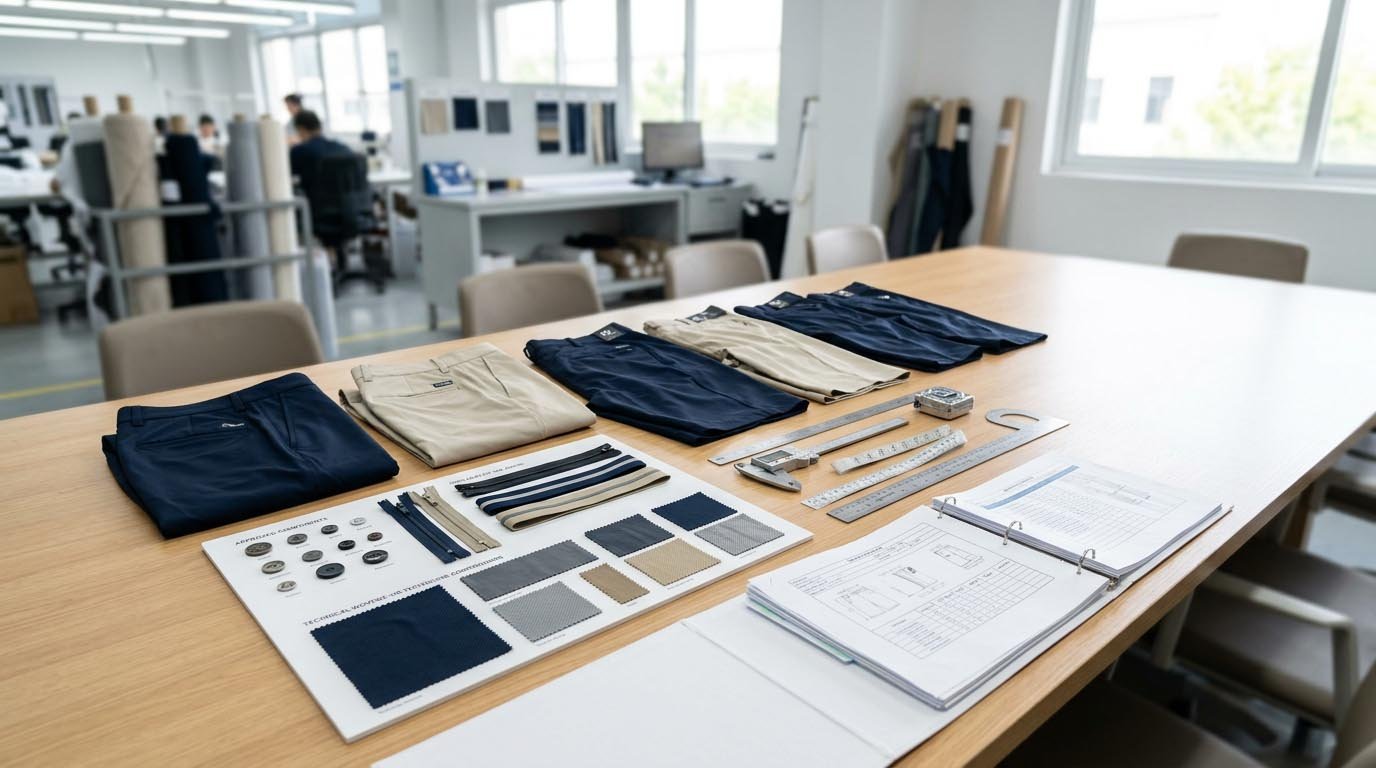
This is where buyers rush—and regret it later. You've approved the sample. You're excited to start production. But we still need to confirm the size set (how measurements scale across XS to XXL), finalize all trim suppliers, and create production standards for color matching.
Bobby almost skipped this step. He approved the size M sample and said "start production." I insisted we make a full size set first. Good thing—because his XL fit was too tight in the thigh, and his S had a waistband that rode up. We adjusted the grading rules before cutting fabric for 1,000 pieces.
Size Set Validation
We produce one piece in each size. You confirm:
- Proportional scaling feels natural across sizes
- Fit issues in the sample don't multiply in other sizes
- Larger sizes don't need construction adjustments (like wider elastic or longer zippers)
Size set production takes 7-10 days. It costs $150-250 depending on how many sizes you're running. It's worth it—because fixing fit errors after cutting 1,000 pieces means scrapping fabric and restarting production.
Trims and Accessories Approval
We finalize all trims: zippers, buttons, elastic, drawstrings, labels, hang tags. You approve:
- Physical samples of each trim (not just photos)
- Color matching between trims and fabric
- Quality level (YKK zippers vs. generic, for example)
Trim decisions affect cost more than buyers realize:
- YKK zippers: $0.40-0.60 per unit
- Generic zippers: $0.15-0.25 per unit
- Branded elastic waistband: $0.80-1.20 per unit
- Basic elastic: $0.30-0.50 per unit
Bobby wanted to save money on zippers. I showed him failure rate data: generic zippers fail 3-5x more often than YKK. He switched back. Brand reputation isn't worth the $0.25 per unit savings if customers complain about broken zippers after two washes.
Production Standards Documentation
We create reference documents for bulk production:
- Approved fabric swatch with color tolerance range
- Trim specifications with supplier codes
- Construction sequence with stitch types
- Measurement tolerance chart (usually ±0.5 cm)
- Inspection criteria for defects
This prevents miscommunication during production. When our sewing floor manager has questions, they reference these documents—not their interpretation of your original email.
Bulk Production, Quality Inspection and Shipping Coordination?
Bulk production takes 45-60 days for orders of 500-2,000 pieces, including fabric preparation, cutting, sewing, washing, and quality inspection. Inline and final inspections catch defects before shipping—reducing your return rate and protecting brand reputation.
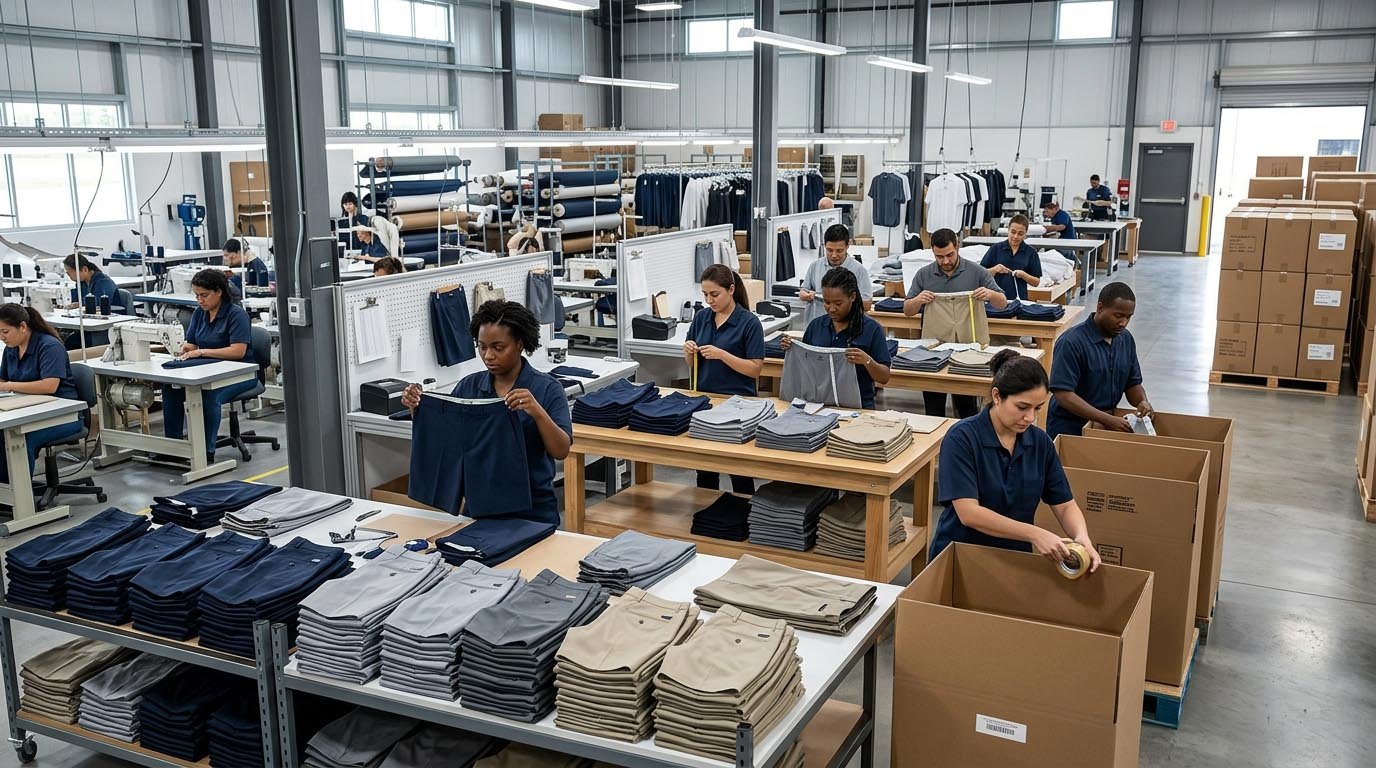
Production finally starts. But even here, buyers misunderstand the timeline. You think manufacturing is fast because it's automated. Reality: fabric preparation (pre-shrinking, color calibration) takes 7-10 days. Cutting takes 3-5 days. Sewing takes 20-30 days depending on volume. Washing and finishing add 5-7 days. Inspection and packing take another 3-5 days.
Bobby ordered 1,000 pieces across four sizes. He expected them in 30 days. I quoted 55 days and explained why each stage matters.
Fabric Preparation and Cutting
Before we cut, we:
- Pre-shrink fabric if it's natural blend (prevents size changes after customer washes)
- Relax fabric if it's synthetic (removes tension from the bolt)
- Calibrate color across different dye lots (ensures consistency)
Cutting happens on tables that hold 30-50 layers of fabric. This is why MOQ exists—if your order is too small, we're cutting inefficiently. A 300-piece order uses the same cutting setup as a 500-piece order, but you pay more per unit because fixed costs don't scale down.
| Order Volume | Unit Cost Impact | Reason |
|---|---|---|
| 300 pieces | Base price +35% | Cutting setup, trim MOQ premiums |
| 500 pieces | Base price +20% | Partial cutting efficiency |
| 1,000 pieces | Base price (reference) | Full cutting efficiency |
| 2,000+ pieces | Base price -10-15% | Volume discounts from suppliers |
Sewing and Assembly
Production line assigns operators to specific tasks: one sews inseams, one attaches waistbands, one installs pockets. This is faster than one person sewing the entire garment.
We run inline inspections every 50 pieces—checking stitch quality, seam alignment, and pocket attachment. If we catch issues early, we adjust before they affect the whole batch. Bobby's order had one inline catch: the drawstring cord was fraying during insertion. We switched to a heat-sealed cord and prevented 1,000 units from having that defect.
Washing, Finishing, and Quality Control
Golf shorts need post-production washing to:
- Remove excess dye (prevents color bleeding)
- Set the final hand feel
- Achieve consistent sizing after shrinkage
After washing, we run final inspection on 10-15% of the batch (random sampling). We check:
- Measurements against tolerance standards
- Stitch integrity and seam strength
- Color consistency across pieces
- Trim functionality (zippers, buttons)
- Fabric defects (holes, stains, snags)
Defect rate should stay under 2%. If it exceeds 3%, we re-inspect the entire batch. This protects your brand—customers who receive defective goods won't order again.
Packing and Logistics
We pack according to your requirements:
- Individual polybags with barcode labels
- Carton packing by size ratio
- Shipping marks for customs clearance
Bobby wanted specific size ratios per carton (not all M in one box). This added $0.15 per unit to packing cost but made his warehouse receiving easier. Small details like this matter when you're managing inventory.
Shipping coordination depends on your terms:
- FOB: We deliver to port, you handle ocean freight
- CIF: We arrange shipping and insurance to your port
- DDP: We handle customs and deliver to your warehouse
Bobby chose FOB because he had better freight rates through his logistics partner. We provided packing lists, commercial invoices, and arranged container loading at Shenzhen port. His goods arrived in 22 days via ocean freight.
FAQ: Golf Shorts OEM Process from Design to Mass Production
How do I speed up the OEM process?
Provide complete specs before sampling: fabric weight, stretch percentage, construction details, and size measurements. Buyers with detailed tech packs reduce sampling time by 30% and avoid multiple revision cycles.
What's the biggest cost factor in golf shorts?
Fabric choice. Performance materials like moisture-wicking polyester cost $3.50-5.80 per yard vs. basic polyester at $2.20-3.00 per yard. Stretch fabrics, UPF treatments, and antimicrobial finishes each add 15-35% to fabric cost.
Can I start with a small test order?
Yes, but expect higher unit costs. Orders under 500 pieces pay 25-40% premiums due to cutting setup, dyeing minimums, and trim MOQs. If you're testing the market, budget accordingly.
How do I know if fabric quality is good?
Request lab test reports for wash durability, color fastness, and stretch recovery. We reference standards like OEKO-TEX and REACH but don't conduct tests in-house. Independent labs validate fabric claims.
What happens if I need changes during production?
Minor changes (label swaps, packing adjustments) are possible if caught early. Major changes (design modifications, fabric switches) require production restart—adding 30-45 days and costing 20-30% of order value. Avoid this by confirming everything during pre-production.
Conclusion
Golf shorts OEM isn't a simple transaction—it's a collaboration that requires preparation, patience, and clear communication. Buyers who understand the validation steps before sampling cut delays significantly and build better products. Your factory can't read your mind, but we can deliver exactly what you need if you tell us upfront.
[^1]: "Is Documentation Valuable to the Design Process?", https://www.designreview.byu.edu/collections/is-documentation-valuable-to-the-design-process. Manufacturing process research demonstrates that comprehensive product specifications reduce development iterations and clarification cycles, with studies showing that complete technical documentation can reduce prototype development time by 25-40% compared to incomplete specifications. Evidence role: general_support; source type: research. Supports: relationship between specification completeness and development cycle time. Scope note: Time savings vary by product complexity, factory communication systems, and baseline specification quality
[^2]: "a study on lead time management in garments industry", https://www.academia.edu/145106488/A_STUDY_ON_LEAD_TIME_MANAGEMENT_IN_GARMENTS_INDUSTRY. Apparel industry research indicates that full product development cycles from initial sampling to bulk production completion typically span 12-20 weeks for moderate-complexity garments, with sampling phases consuming 30-40% of total timeline and bulk manufacturing requiring 40-70 days depending on order volume. Evidence role: general_support; source type: research. Supports: typical production timelines in apparel manufacturing. Scope note: Timeline ranges reflect industry averages and may not account for specific performance wear requirements or factory capacity variations