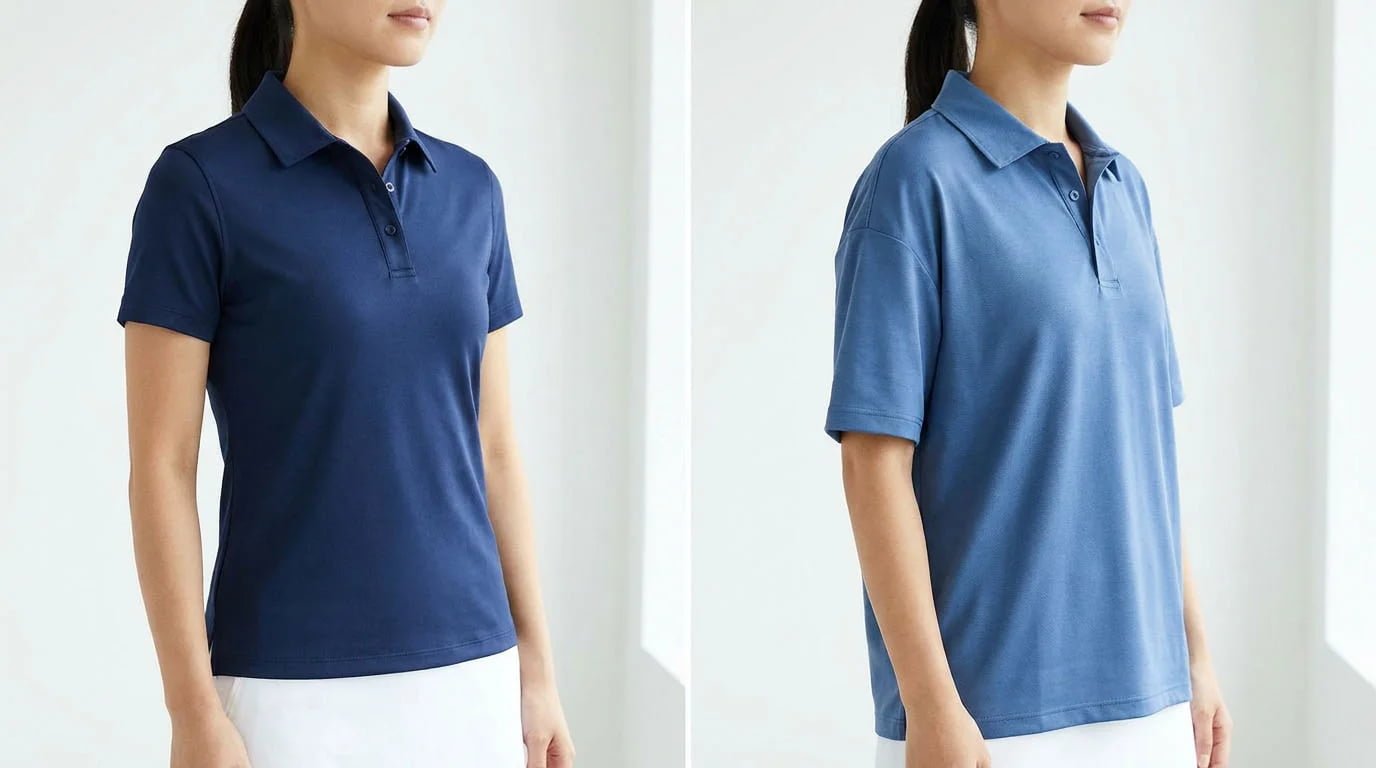
A women's golf polo can fit comfortably across the bust but still look oversized. The hem falls too low, the shoulder seams extend beyond the shoulders, or the sleeves reach farther down the arms than intended.
For petite golfers, these problems often come from garment proportions rather than the size label.
To check the fit of petite women's golf shirts, compare body length, shoulder width, armhole position, and sleeve placement with a shirt that already fits you well. A smaller regular size does not necessarily provide the shorter vertical proportions needed for a petite fit.
This guide explains how to measure these areas, recognize common fit problems, and evaluate petite golf polos before buying or approving a production sample.
Quick Answer: How Should Petite Women's Golf Shirts Fit?
A well-fitting petite golf shirt should have balanced proportions through the shoulders, torso, and sleeves while allowing comfortable movement during a golf swing.
| Fit Area | What to Check | Common Problem |
|---|---|---|
| Body length | Where the front and back hems fall | Excess fabric or insufficient tuck-in length |
| Shoulder width | Position of the shoulder seam | Seams extend too far down the arms |
| Armhole | Shape, depth, and clearance | Bunching or restricted movement |
| Sleeve length | Where the sleeve opening sits | Sleeves appear disproportionately long |
| Bust and waist | Garment ease and shaping | Tight chest or misplaced waist shaping |
| Hem opening | Width relative to the hips | Hem catches or rides upward |
The simplest starting point is to measure a golf shirt you already like wearing. Use it as your reference rather than relying only on Small, XS, or Petite labels.
Key 1. Petite vs. Regular Golf Shirts: What Actually Changes?
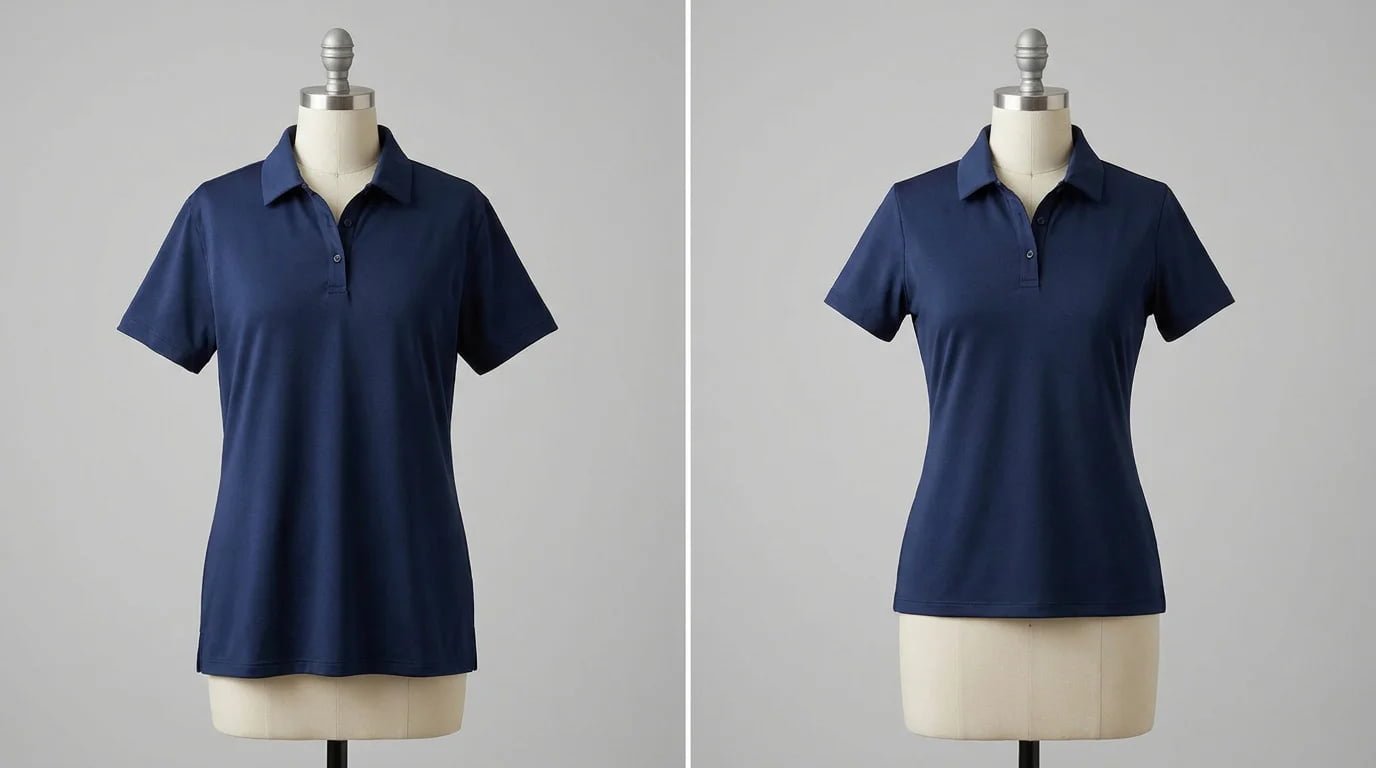
Petite sizing addresses body proportions, particularly vertical measurements. It is not simply another name for Extra Small.
A petite golf polo may need a shorter torso, adjusted shoulder placement, repositioned waist shaping, and corresponding sleeve changes.
However, petite sizing is not standardized. Some brands modify several pattern dimensions, while others make more limited adjustments.
Why Sizing Down Does Not Always Work
Suppose a golfer wears a regular Medium that fits across the bust but has excessive body length and low sleeve placement.
Choosing a regular Small may shorten the shirt slightly, but it also reduces the bust and sleeve opening. The garment can become tighter without solving the proportional problem.
| Pattern Area | Regular Size Down | Petite Pattern |
|---|---|---|
| Bust width | Usually becomes smaller | Adjusted for the target body |
| Body length | Follows regular grading | Shortened where appropriate |
| Shoulder width | Follows regular grading | Evaluated for petite proportions |
| Armhole | Changes with regular grading | Rebalanced with bodice and sleeve |
| Waist shaping | Follows regular pattern | May be repositioned higher |
| Sleeve placement | Depends on regular dimensions | Adjusted with shoulder and armhole |
These are possible pattern differences, not universal measurement rules.
Why Proportions Matter During a Golf Swing
An overly long torso can create excess material around the waistband. An incorrectly positioned armhole can pull the shirt upward when the arms rise.
But simply shortening the body or raising the armhole is not always the solution.
The pattern must balance appearance, movement, and whether the shirt is intended for tucked or untucked wear.
Key 2. How to Measure Body Length: HPS vs. Center Back
Body length is one of the most useful measurements when comparing petite golf shirts, but the starting and ending points must be consistent.
Different measurement methods can produce different figures for the same garment.
High Point Shoulder (HPS) Length
HPS stands for High Point Shoulder, typically located near the highest shoulder point beside the neckline.
To measure front body length:
- Lay the shirt flat on a smooth surface.
- Locate the HPS beside the neckline.
- Smooth the fabric without stretching it.
- Measure from HPS to the front hem using the specified measurement path.
- Record the result in centimeters or inches.
Some specifications use a straight vertical measurement, while others define a particular path. Always follow the brand's stated method.
Center Back (CB) Length
Center Back length is measured from a defined point at the back neckline to the center of the back hem.
To check it:
- Lay the shirt flat with the back facing upward.
- Identify the specified center-back neckline point.
- Measure to the center of the back hem.
- Record the result separately from HPS length.
HPS and CB measurements are not interchangeable. Neckline construction, measurement paths, and hem design affect their values.
For example, a golf polo with a drop-tail hem may have a longer back than front.
How to Compare Two Golf Shirts
Choose a polo that already fits well and measure its HPS and, if relevant, CB length.
Compare the same measurement points with the prospective shirt.
| Comparison | What It Indicates |
|---|---|
| Similar HPS length | Front body lengths may be comparable |
| Different HPS length | Front hem positions may differ |
| Same front length, different CB | Back coverage may differ |
| Same length, different hem width | Shirts may hang differently around the hips |
Fabric behavior also matters. Two polos with identical flat measurements may fit differently if one uses structured piqué and the other uses stretch jersey.
Tucked vs. Untucked Length
For untucked wear, the hem should create a balanced proportion without extending farther down the hips than desired.
For tucked wear, sufficient body length is needed to keep the shirt reasonably secure during bending and rotation.
A longer shirt is not automatically a poor petite fit. The appropriate length depends on body proportions and intended styling.
Key 3. How Shoulder Width, Armholes and Sleeves Affect Petite Fit
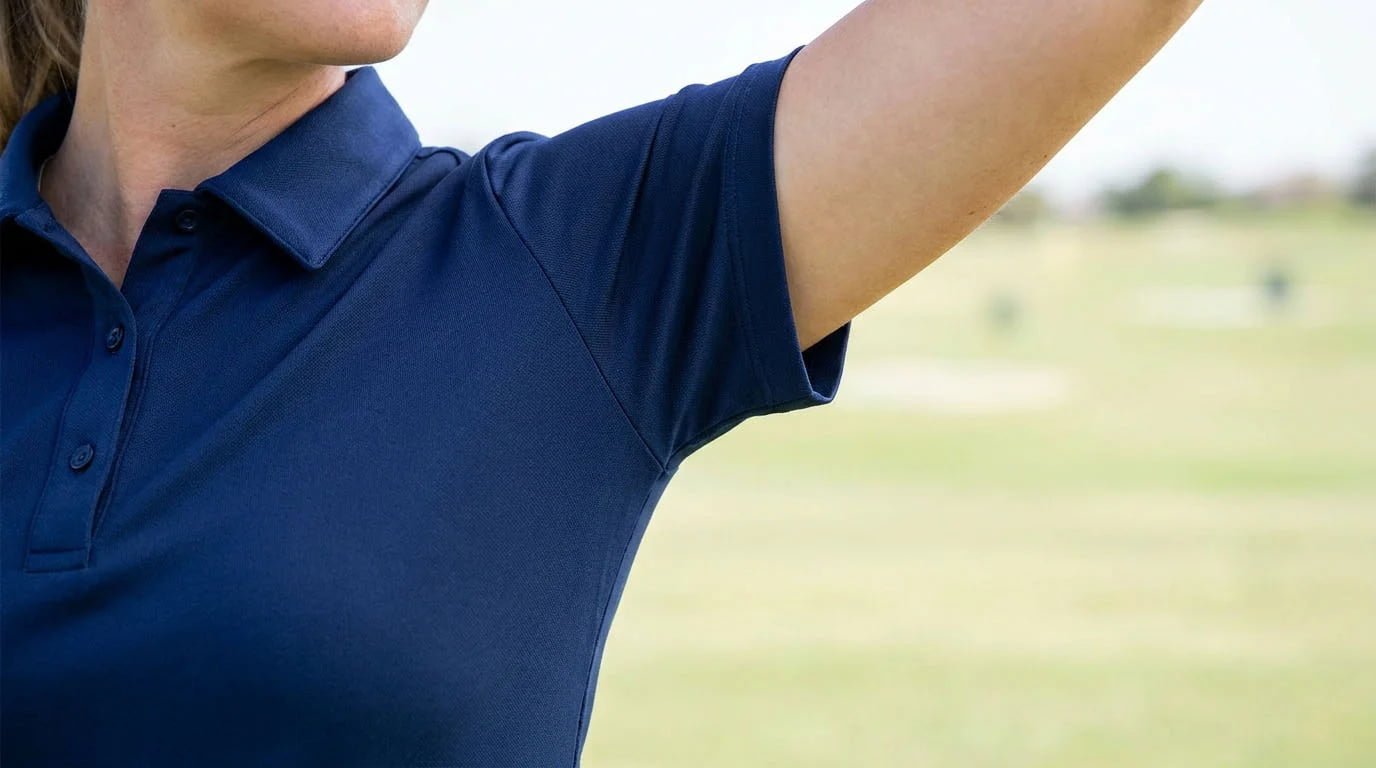
Sleeve length should be evaluated together with shoulder width and armhole position.
Even a correctly measured sleeve can appear too long when the shoulder seam sits farther down the arm than intended.
Check Shoulder Width First
For a conventional set-in sleeve polo, examine where the shoulder seam sits when worn naturally.
A seam extending too far down the upper arm may indicate excessive shoulder width.
However, relaxed and dropped-shoulder designs intentionally use different seam positions.
For a classic fitted golf polo, check whether the shoulder line matches the intended silhouette without pulling or excess fabric.
When comparing flat measurements, verify whether shoulder width is measured between seam intersections and whether the path is straight or follows the garment contour.
Check Armhole Shape and Depth
Armhole geometry affects how the sleeve and body move together.
A poorly balanced armhole may cause:
- Bunching beneath the underarm.
- Pulling when the arms rise.
- Sleeve twisting.
- Unwanted shirt movement during rotation.
A regular pattern may position the underarm area too low for some petite wearers.
However, raising the armhole without adjusting the sleeve cap, chest width, and curve can also restrict movement.
For custom petite development, these adjustments should be evaluated on an actual fit sample rather than based on a fixed centimeter rule.
Check Sleeve Placement and Opening
After evaluating the shoulder, check where the sleeve ends on the upper arm.
The ideal position depends on the intended style, from shorter athletic sleeves to traditional mid-upper-arm polo sleeves.
Ask four questions:
- Does the sleeve end at the intended position?
- Does the opening follow the arm without excessive flaring?
- Is it comfortable when the elbow bends?
- Does it remain balanced during movement?
A sleeve that appears too long may require a shoulder adjustment, sleeve-length adjustment, or both.
Test Mobility During a Golf Swing
Wear the polo in your normal golf stance and perform three movements:
- Arms forward: Check for pulling across the upper back.
- Arms overhead: Observe whether the body lifts excessively.
- Practice swing: Check for restriction, twisting, or uncomfortable tension.
Movement should feel comfortable without excessive looseness.
For general golf apparel sizing and swing mobility, see FUWAY's Golf Apparel Fit Guide.
Key 4. How to Check Bust, Waist and Hem Proportions
Petite fit also depends on garment width and shaping.
A shirt can have the correct body length but still fit poorly if its waist shaping or hem opening does not match the wearer's proportions.
Bust Fit and Garment Ease
Garment ease is the difference between garment and body measurements.
Garment Bust Circumference − Body Bust Circumference = Bust Ease
However, dimensional ease alone does not determine comfort.
Stretch, fabric construction, and intended fit also matter.
When checking bust fit, look for:
- Unwanted tension across the chest.
- Placket gaping.
- Excess material near the underarm.
- Comfortable movement without excessive pulling.
There is no universal bust-ease allowance suitable for every petite golf polo.
Waist Shaping Position
Some women's polos use shaped side seams to create a defined waist.
On a shorter torso, regular-pattern shaping may sit too low, causing tightness around the upper hips while leaving excess fabric around the waist.
Check whether the narrowest point aligns with the intended body proportions.
Straight-cut and relaxed polos may intentionally have minimal waist shaping.
Hem Opening and Hip Fit
A narrow hem may catch on the hips and ride upward, while an excessively wide opening may create a boxy silhouette.
For untucked wear, check the hem while standing, walking, and rotating.
For tucked wear, confirm that the shirt remains comfortable and reasonably secure during movement.
Key 5. Petite Golf Shirt Fit Checklist: Before Buying or Approving a Sample
The most reliable evaluation combines defined measurements with actual wear testing.
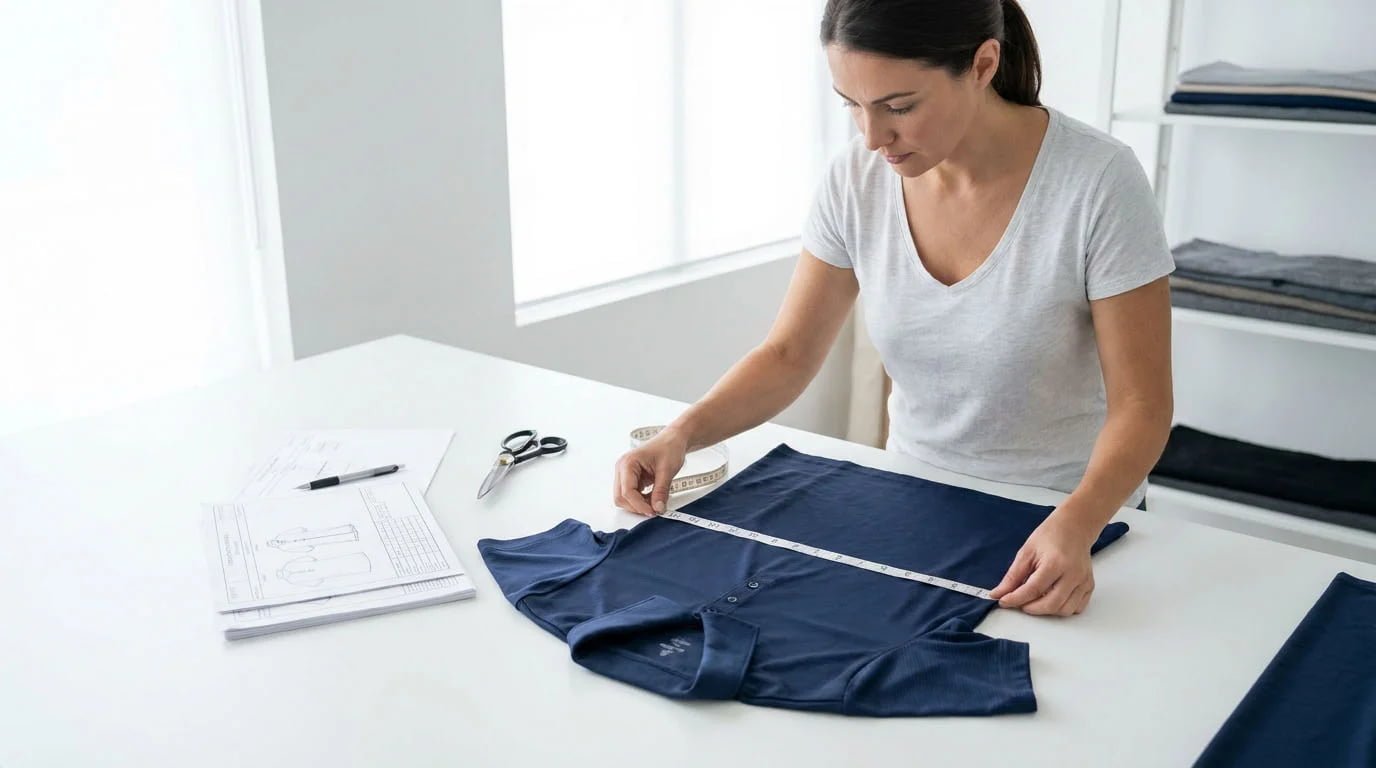
Step 1: Select a Reference Garment
Choose a golf polo with a fit you already like.
Ideally, its construction and fabric behavior should be similar to the shirt being evaluated.
Step 2: Compare Key Measurements
| Checkpoint | What to Record | Decision Question |
|---|---|---|
| Front length | HPS to front hem | Will the hem fall correctly? |
| Back length | CB to back hem | Is back coverage suitable? |
| Shoulder width | Defined shoulder POM | Is shoulder placement balanced? |
| Bust width | Flat chest width | Is there appropriate room? |
| Waist width | Defined waist POM | Does shaping align with the body? |
| Hem width | Bottom opening | Will the hem hang comfortably? |
| Sleeve length | Shoulder to sleeve hem | Does the sleeve end correctly? |
| Sleeve opening | Flat opening width | Is there comfortable upper-arm room? |
For circumference comparisons, double the relevant flat width when the specification requires a full circumference.
Do not double body or sleeve length.
Step 3: Test Fit in Motion
Check the shirt during:
- Standing and walking.
- Golf address posture.
- Shoulder rotation.
- Backswing and follow-through.
- Bending and reaching.
Watch for fabric tension, twisting seams, excessive hem movement, and sleeve displacement.
Step 4: Identify the Cause Before Adjusting
| Fit Problem | Possible Cause | What to Review |
|---|---|---|
| Shirt looks too long | Excess body length | HPS and CB |
| Sleeves hang too low | Shoulder width or sleeve length | Both measurements |
| Underarm bunching | Armhole geometry or excess width | Armhole and chest |
| Waist shaping sits too low | Proportional mismatch | Vertical waist position |
| Hem rides up | Hem width, body length, or fabric behavior | All three |
| Restricted swing | Insufficient functional mobility | Shoulder, armhole, back, and fabric |
These are diagnostic starting points, not automatic pattern corrections.
Step 5: Confirm Approved Specifications
For brands developing petite golf shirts, each Point of Measure (POM) should have a defined measurement location and method.
The final specification should be based on an approved fit sample.
At FUWAY, our standard finished-garment measurement tolerance is ±1.0 cm for specified POMs, unless stricter requirements are agreed in the technical specifications.
This manufacturing tolerance is not a recommended amount of petite pattern adjustment.
A garment may fall within measurement tolerance yet still require a fit review.
Brands developing custom petite golf polos can explore FUWAY's Custom Golf Shirts services.
Key 6. How Fabric Stretch, Washing and Tolerances Affect Petite Fit
Correct measurements matter, but fabric behavior influences how a garment fits during wear and after laundering.
Stretch and Recovery
Stretch allows fabric to extend during movement, while recovery describes how well it returns toward its original dimensions.
These properties depend on fiber composition, knit structure, finishing, and repeated use.
For example:
- Polyester-elastane jersey may provide substantial stretch.
- Structured piqué may create a firmer silhouette.
- Cotton blends may respond differently to washing and drying.
Stretch does not automatically correct poor pattern proportions.
Brands developing petite performance polos should evaluate the selected fabric's stretch and recovery rather than relying only on its fiber composition.
FUWAY's Fabric Sourcing service supports fabric selection for custom golf apparel.
Washing and Dimensional Stability
Laundering can affect body length, width, seam alignment, and fabric recovery.
The extent depends on fabric construction, finishing, and care conditions.
There is no universal shrinkage percentage for all petite golf shirts.
When sourcing in bulk, request dimensional-stability test results using a defined washing and drying method.
Manufacturing Tolerance vs. Shrinkage
These are different measurements:
- Manufacturing tolerance: Permitted difference between finished-garment measurements and approved specifications.
- Dimensional change after laundering: Change in garment dimensions following a specified washing procedure.
Passing one requirement does not guarantee passing the other.
Both should be considered when developing petite sizing.
Key 7. Common Petite Golf Shirt Fit Mistakes
| Mistake | Why It Causes Problems | Better Approach |
|---|---|---|
| Choosing XS instead of Petite | Reduces width without necessarily correcting proportions | Compare actual garment measurements |
| Checking sleeve length alone | Shoulder position also affects sleeve placement | Evaluate both together |
| Shortening only the hem | Does not correct armholes or waist shaping | Review overall pattern proportions |
| Assuming all Petite sizes are identical | Brands use different fit blocks | Check each brand's specifications |
| Ignoring movement | Static fit may not reflect golf-swing comfort | Perform realistic movement checks |
A well-fitting petite golf shirt should combine balanced proportions, suitable fabric behavior, and comfortable mobility.
Frequently Asked Questions
Is Petite the Same as Extra Small in Women's Golf Shirts?
No. Extra Small usually identifies a size within a regular size range, while Petite generally refers to proportions intended for a shorter frame.
They may overlap in some measurements but are not interchangeable.
What Height Is Considered Petite for Women's Golf Clothing?
Many clothing brands use approximately 5'4" (163 cm) or below as a petite shopping reference.
However, height alone does not determine fit. Torso length, shoulder proportions, and garment measurements are more useful when choosing a golf polo.
How Long Should a Petite Women's Golf Polo Be?
There is no universal length.
The appropriate measurement depends on torso proportions, garment size, fabric, hem construction, and whether the shirt is worn tucked or untucked.
Compare the same HPS or CB measurement with a reference shirt that fits well.
Can I Shorten a Regular Golf Polo to Make It Petite?
Shortening the hem can help when excessive body length is the only issue.
However, hemming does not correct shoulder width, armhole depth, sleeve placement, or waist shaping.
If several proportions are incorrect, a petite-specific pattern may provide a better fit.
Can Golf Apparel Brands Develop Custom Petite Size Ranges?
Yes. Brands can create petite fit blocks based on their target customers, approved measurements, intended fabrics, and fit-testing results.
A reliable development process should confirm base-size proportions and grading rules before bulk production.
For brands planning custom petite golf polo collections with their own labels and branding, FUWAY offers Private Label development services.
Conclusion
Finding well-fitting petite women's golf shirts requires more than choosing a smaller size.
The most important measurements are body length, shoulder width, armhole position, and sleeve placement. These should be evaluated together with bust and hem proportions, fabric behavior, and movement comfort.
For individual golfers, comparing a new polo with an existing well-fitting shirt provides a practical starting point.
For golf apparel brands, a successful petite collection begins with clearly defined measurements, an appropriate pattern, and fit testing on the intended customer body proportions.
FUWAY supports OEM/ODM golf polo development, including custom sizing, fabrics, pattern adjustments, and private-label production. If your brand is planning a petite women's golf shirt collection, contact FUWAY to discuss your target fit, reference samples, specifications, and development requirements.