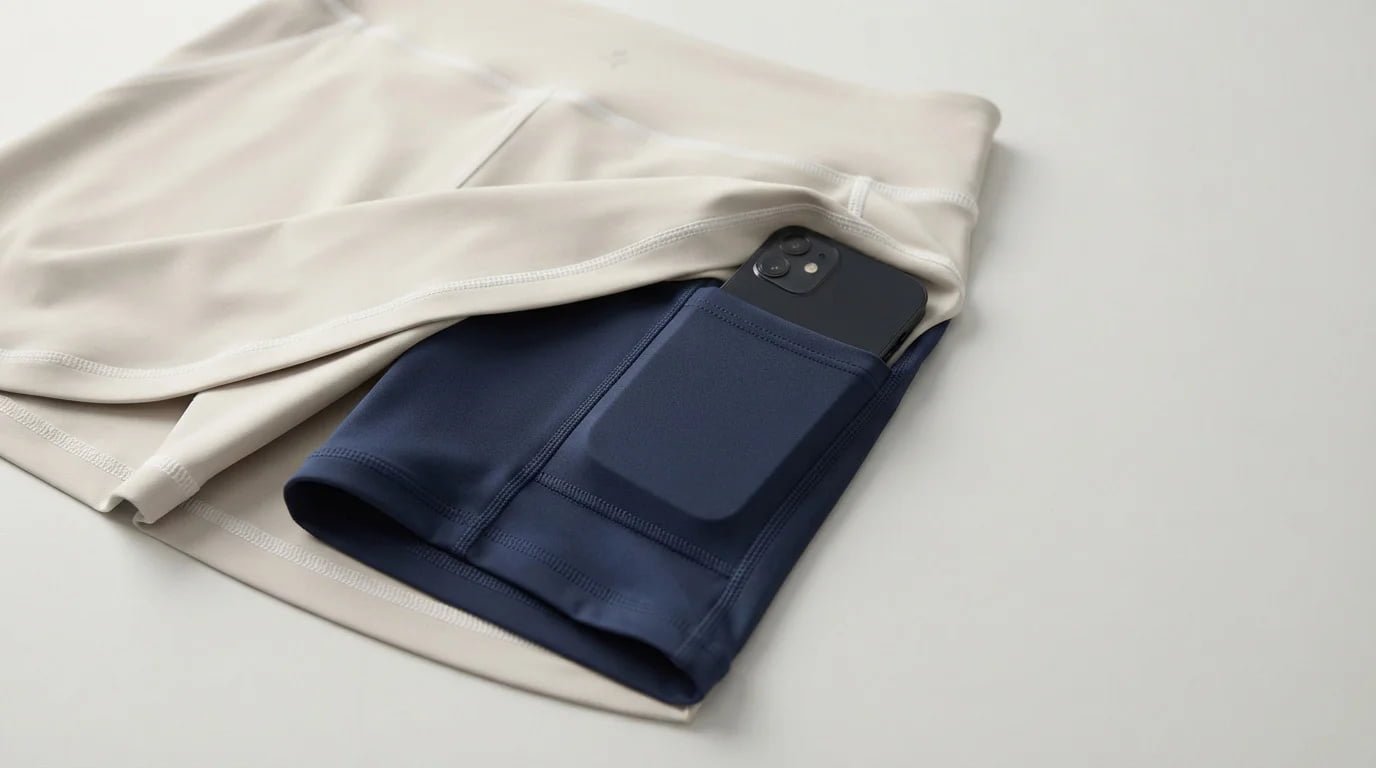
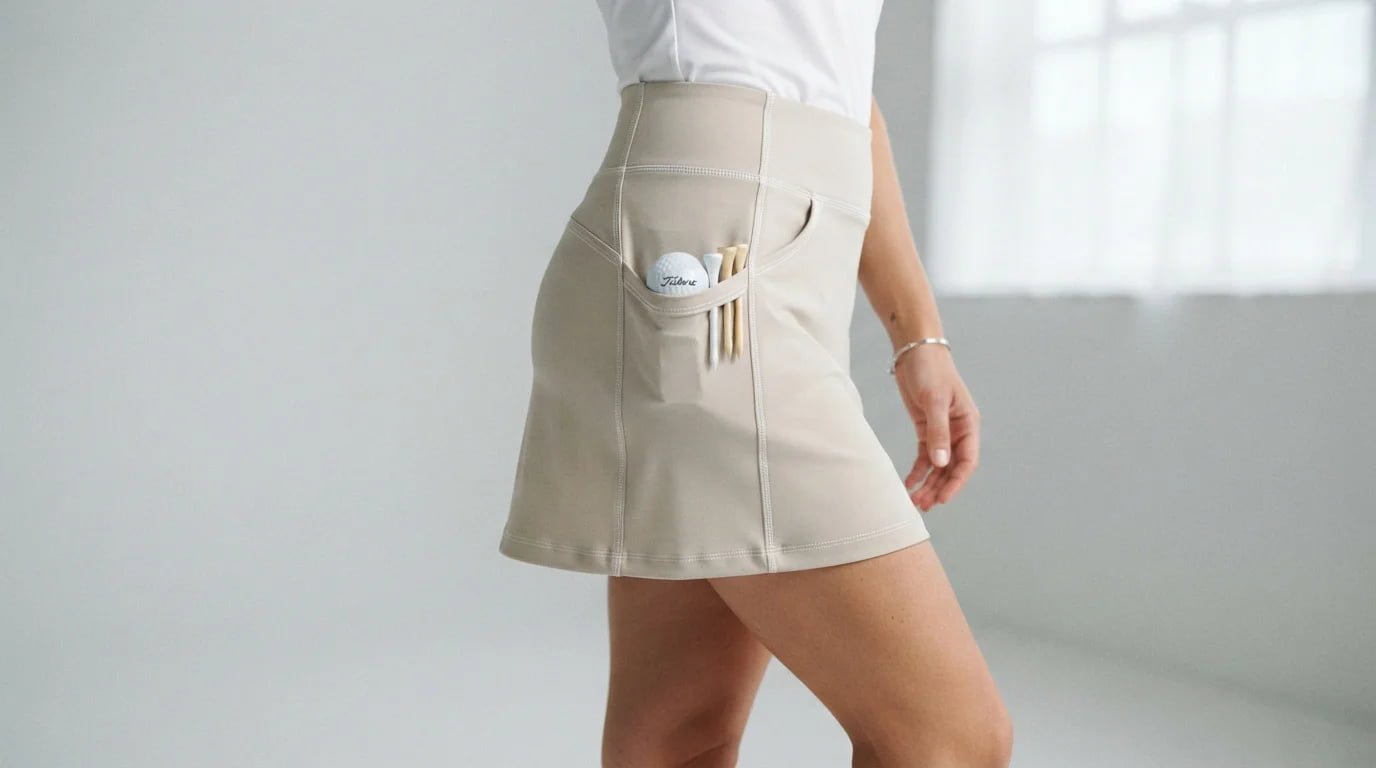
For golf skort pocket design, an inner-short phone pocket is a useful starting point when close-to-body carry and a clean outer skirt matter most. An outer side pocket suits easier access, provided its construction supports the intended contents. A combined layout can serve both needs, but it adds seams, bulk and cost.
A phone pocket describes its purpose; a side pocket describes its location. One pocket can be both. For brands developing a golf skort, the practical decision is which garment layer should carry each item—and how that choice behaves on a moving wearer.
This guide focuses on that decision, the specifications it requires and the checks needed before approval. For the wider product brief, see our women’s golf skort development checklist.
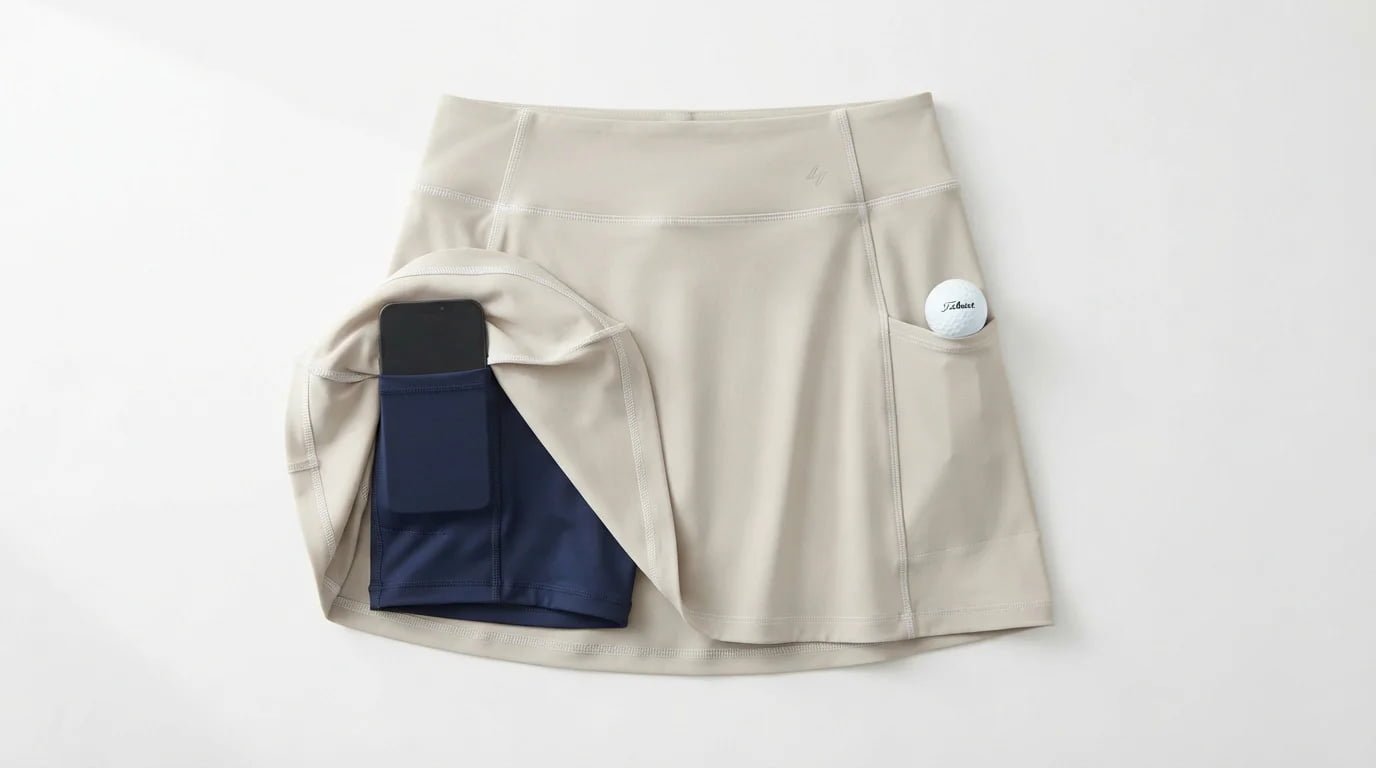
Inner-Short Phone Pockets vs Outer Side Pockets
The comparison below describes development trade-offs, rather than guaranteed performance. Fit, material recovery, opening construction and attachment all affect the result.
| Decision factor | Phone pocket on inner shorts | Side pocket on outer skirt |
|---|---|---|
| Carry position | Holds the item closer to the thigh | Carries the item within the outer skirt structure |
| Access | May require lifting or reaching beneath the shell | Usually accessible directly from outside |
| Movement | Can reduce independent phone movement if the liner supports it | Requires control of pocket-bag movement and shell distortion |
| Appearance | Conceals the opening; a loaded pocket may still show through | Opening is part of the styling; loading may alter the drape |
| Comfort risk | Phone edges, seam pressure and liner displacement | Hardware contact, a swinging bag or local pulling |
| Main approval check | Retention and access without uncomfortable compression | Access and support without unacceptable gape or distortion |
Neither location guarantees secure storage. A loose liner pocket can sag, while a well-supported outer pocket may carry a phone successfully.
When to Start With an Inner-Short Phone Pocket
Consider this option when the wearer carries a phone for longer periods and the outer skirt needs a simple silhouette.
Check whether she can reach the opening comfortably beneath the intended shell. A pocket that is easy to use under a short, flared skirt may be awkward beneath a longer or narrower design.
The liner must carry the phone without pulling down, twisting or riding up. Increasing tightness alone may create pressure without solving the underlying fit problem.
When to Start With an Outer Side Pocket
Consider an outer pocket when frequent retrieval matters—for example, when the wearer checks a phone for yardages or repeatedly reaches for small accessories.
For phone storage, review the pocket bag and its attachments together with the waistband and shell. Depending on the pattern, support may come from a controlled pocket bag, a connection to an appropriate seam, local reinforcement or a revised pocket position.
A zipper can help retain an item, but it does not solve bounce, pressure or sagging by itself. Check that the closed pocket still accommodates the intended device comfortably.
When a Combined Layout Is Worth Sampling
A liner phone pocket plus an outer accessory pocket can separate a rigid device from balls, tees and markers. It is useful only if both compartments have a clear task.
Do not add pockets simply to increase the count. Each additional compartment affects construction time, local thickness and the finished appearance. Ask the factory to quote the proposed layout and a simpler alternative if the brief is still open.
Define What Each Pocket Must Carry
Start the specification with actual objects. A screen diagonal does not describe a phone’s overall width, thickness or case profile.
| Carry item | Define before sampling | Check on the loaded garment |
|---|---|---|
| Phone | Device and case dimensions, weight and insertion direction | Retrieval, retention, pressure and garment movement |
| Golf ball | Intended quantity and pocket entry | Local bulk and whether the ball remains accessible |
| Tees or repair tool | Shape, length and exposed points | Snagging, penetration and contact with the body |
| Ball marker or keys | Smallest intended object and closure needs | Escape through the opening or pocket material |
| Scorecard | Actual card dimensions and preferred carry position | Folding, access and sitting comfort |
Small items are not automatically safer in mesh. The mesh aperture, pocket opening and object shape all matter. Avoid placing a phone and pointed accessories together where they can rub against each other or the wearer.
Load the planned pockets simultaneously during fitting. Testing each one separately can miss the combined effect on waistband position and skirt balance.
Specify Phone Pocket Size and Placement Clearly
There is no universal golf skort phone-pocket dimension. Develop the pattern around the intended cased device, the pocket fabric and the wearer’s access needs.
Measure the finished usable space, not just the cut pattern. Seams, binding and closures can reduce capacity. A stretch pocket may also behave differently flat and on-body.
| Specification | What the tech pack should identify |
|---|---|
| Clear opening | Usable entry length and measurement condition, including zipper opening if applicable |
| Usable width | Internal width at an agreed level, excluding seam allowances |
| Usable depth | Defined entry reference to the inside bottom; illustrate angled openings |
| Placement | Position from fixed garment references, such as waistband seam and side seam |
| Device position | Intended orientation and acceptable exposure above the opening |
| Construction | Pocket material, stretch direction, edge finish, attachment and reinforcement |
| Size range | Dimensions held constant and positions adjusted by size |
| Acceptance | Agreed dimensional tolerances and functional checks |
Avoid locating a rigid device where it presses into the hip crease during bending or interferes with sitting. Confirm the position on the intended wearer rather than adopting a fixed distance below an anatomical landmark.
Keep the intended phone capacity explicit across sizes. A smaller garment does not necessarily need a proportionally smaller pocket, but its placement and liner support still require review.
FUWAY’s general finished-garment POM tolerance is ±1.0 cm unless the approved tech pack specifies a tighter requirement. Agree any tighter pocket-opening or placement tolerance before sample approval; do not assume the general limit is suitable for every functional detail. Our golf apparel tech pack checklist covers the wider documentation requirements.
Choose Materials and Construction Around the Load
Fabric weight and elastane percentage alone do not establish whether a pocket will work. Evaluate the material’s stretch, recovery, surface feel and behavior within the complete garment.
For a liner pocket, inspect the opening after repeated insertion and removal. Check whether the pocket fabric and liner move together without the opening becoming distorted or the seams restricting stretch.
For an outer pocket, inspect the loaded shell from the front, side and back. Look for waistband tilt, an uneven hem, pocket-bag outlines and an opening that pulls away from the body. Light colors deserve their own appearance check.
Folded edges, binding, stitching and bonded finishes each create different thickness and stretch behavior. Specify the selected finish and review it on the sample. A bonded edge still needs evaluation for durability and comfort.
For broader pocket types and pocket-bag construction, see our golf shorts pocket design guide. The additional skort checks concern interaction between the outer shell, inner shorts and loaded pocket.
Test the Loaded Skort Before Production Approval
Use production-intent materials for final approval. An early prototype can compare layouts, but substitute fabric may conceal problems with recovery, bulk or drape.

The following is a practical development checklist, not a standardized laboratory method. Agree the movement sequence, duration, laundering conditions and acceptance criteria for the project, and record them so revised samples can be compared consistently.
| Review stage | What to do | What requires revision |
|---|---|---|
| Baseline | Measure the empty garment and photograph its fit | Measurements or construction differ from the approved brief |
| Load and retrieve | Insert the named cased phone and other intended items | Forced entry, difficult retrieval, snagging or excessive exposure |
| Golf movement | Walk, take an address position, swing and bend to place a tee | Item escapes, uncomfortable movement or pocket-mouth distortion |
| Sit and reach | Sit as in a golf cart and retrieve the phone | Device presses into the body, closure digs in or access is obstructed |
| Compare loaded and empty fit | Review waistband, liner hem and shell drape | Unacceptable tilt, twisting, ride-up or visible distortion |
| Care and repeat | Launder under agreed care conditions, then repeat the checks | Loss of retention, seam damage, finish failure or changed fit |
Ask the wearer where pressure occurs and when she needs to adjust the garment. Photos and short videos should identify the sample size, device, loading arrangement and observed problem.
If the liner rides up only when loaded, investigate pocket position and attachment alongside liner fit, rise, inseam and leg opening. Avoid assuming that stronger leg grippers will resolve every cause.
Golf Skort Pocket Design FAQs
Should the phone pocket be on the right or left?
Confirm the wearer’s preferred retrieval hand and the rest of the pocket layout. A side choice should follow user feedback and sampling; golfing handedness alone does not establish a universal position.
Does a phone pocket need a zipper?
It depends on the required retention and access. An open pocket may work with appropriate depth, fit and recovery. A zipper provides a closed opening, but adds hardware and can reduce usable entry space. Evaluate either construction with the intended phone.
Can one pocket hold both a phone and a golf ball?
It may have enough capacity, but the combination needs its own loaded test. A ball can change the phone’s position and increase local bulk. Separate compartments are worth considering when carrying both is a regular requirement.
Develop Your Pocket Layout With FUWAY
For a custom golf skort, send your preferred silhouette, target size range, intended phone with case dimensions and proposed carry items. Include reference sketches showing which pockets belong to the outer skirt and which belong to the inner shorts.
Use those details to agree the first sample’s pocket layout, construction and review criteria. Approve the final arrangement after checking access, comfort, retention and loaded appearance together.