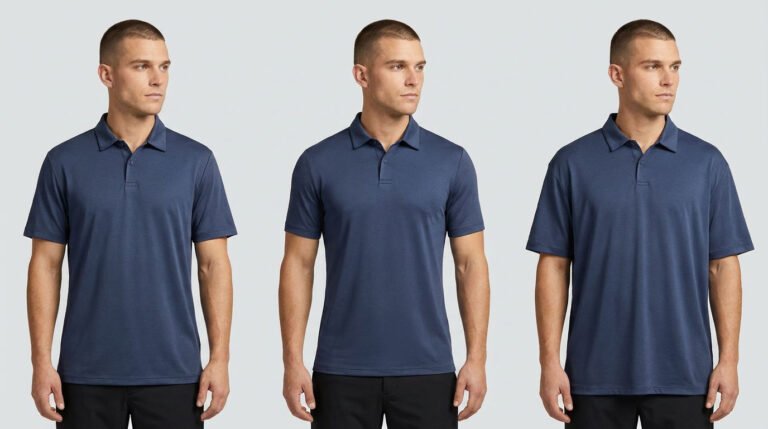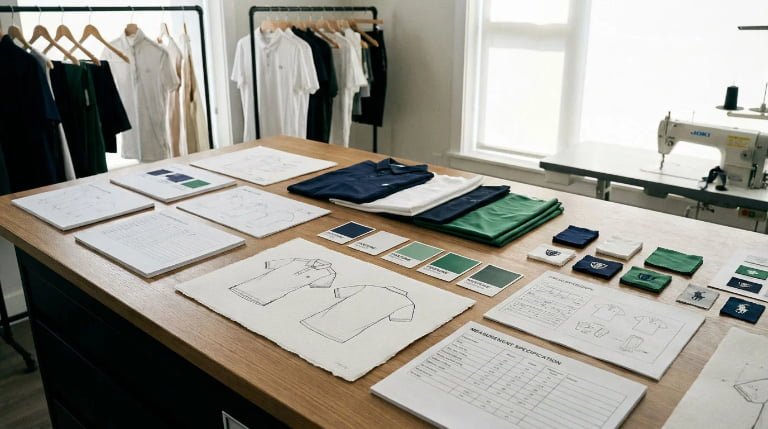
A golf apparel design may look complete but still leave critical manufacturing requirements unclear. Missing measurement methods, incomplete fabric specifications, or outdated artwork can lead to incorrect samples, repeated revisions, and production delays.
A golf apparel tech pack checklist helps buyers verify 13 essential specification areas before sampling or bulk production: style information, technical flats, fabrics, colors, BOM, measurements, grading, construction, decoration, testing, sampling, packaging, and revision control.
At FUWAY, finished-garment measurement deviations must remain within ±1.0 cm of approved target measurements, with tighter tolerances where specified in the approved tech pack.
This guide focuses on reviewing an existing tech pack. If you need to develop one from scratch, see our How to Prepare a Solid Tech Pack for Golf Apparel guide.
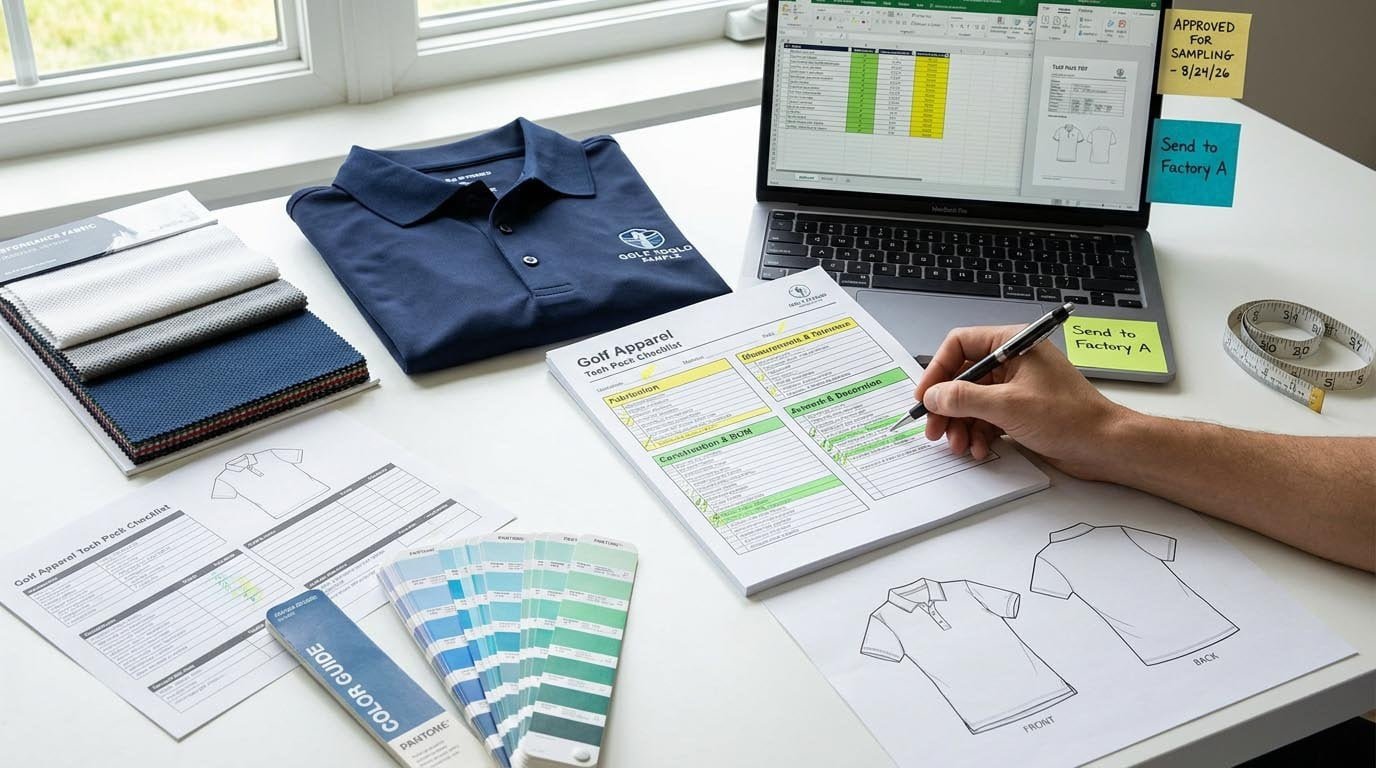
Quick Answer: What Should a Golf Apparel Tech Pack Include?
Before sending your tech pack to a manufacturer, review these 13 essential areas.
| No. | Checklist Item | What Buyers Should Verify |
|---|---|---|
| 1 | Style information | Style ID, fit, sizes, and revision |
| 2 | Technical flats | Front/back drawings and construction details |
| 3 | Fabric specifications | Composition, GSM, structure, and performance |
| 4 | Color standards | Approved color references and lab dips |
| 5 | Bill of Materials (BOM) | Components, material specifications, and suppliers |
| 6 | POM measurements | Target dimensions, methods, and tolerances |
| 7 | Size grading | Measurements or grading rules across sizes |
| 8 | Construction | Seams, collars, pockets, and finishing |
| 9 | Logo and decoration | Artwork, method, size, and placement |
| 10 | Performance testing | Test methods, targets, and approval requirements |
| 11 | Sampling requirements | Sample purpose and approval criteria |
| 12 | Labels and packaging | Label artwork, packaging, and carton details |
| 13 | Revision control | Current document version and approval status |
The objective is not to create the longest possible tech pack. It is to ensure the manufacturer has enough approved information to complete the next development or production stage without making critical assumptions.
What Must Be Included Before Quotation, Sampling, and Bulk Production?
Not every specification must be finalized before requesting a quotation. However, the amount of detail required increases as a project moves toward production.
| Requirement | Initial Quotation | Prototype Sampling | Bulk Production |
|---|---|---|---|
| Design | Basic drawings or reference | Technical flats | Final approved design |
| Fabric | Proposed material | Defined sample fabric | Approved production fabric |
| Measurements | Key dimensions | Base-size POM chart | Approved full-size specifications |
| Grading | Intended size range | Proposed rules if needed | Approved grading |
| BOM | Major components | Required sample components | Final approved BOM |
| Decoration | General requirements | Sample artwork | Final artwork and placement |
| Approval | Pricing assumptions identified | Sampling criteria defined | Required approvals completed |
A preliminary quotation may contain material or construction assumptions. These should be documented and resolved before the relevant purchasing or production decisions.
Buyer takeaway: A tech pack can be ready for prototype sampling without being ready for bulk production.
The 13-Point Golf Apparel Tech Pack Checklist
Key 1: Verify Product and Style Information
Every garment should have a unique identity.
Check that the tech pack includes:
- Style name and reference number
- Garment category and intended fit
- Base sample size and planned size range
- Colorway identification
- Target market
- Document version and revision date
For example, "Men's Regular-Fit Golf Polo — GP001" provides clearer identification than "Performance Golf Shirt."
Buyer Check: Can the manufacturer identify the correct style, sample size, and current specifications without confusion?
Key 2: Review Technical Flats and Construction Callouts
Technical flats communicate construction requirements more precisely than lifestyle photographs.
Verify that the drawings include front and back views, plus detailed views where necessary.
For golf polos, important details include collar shape, placket construction, sleeve openings, and side vents.
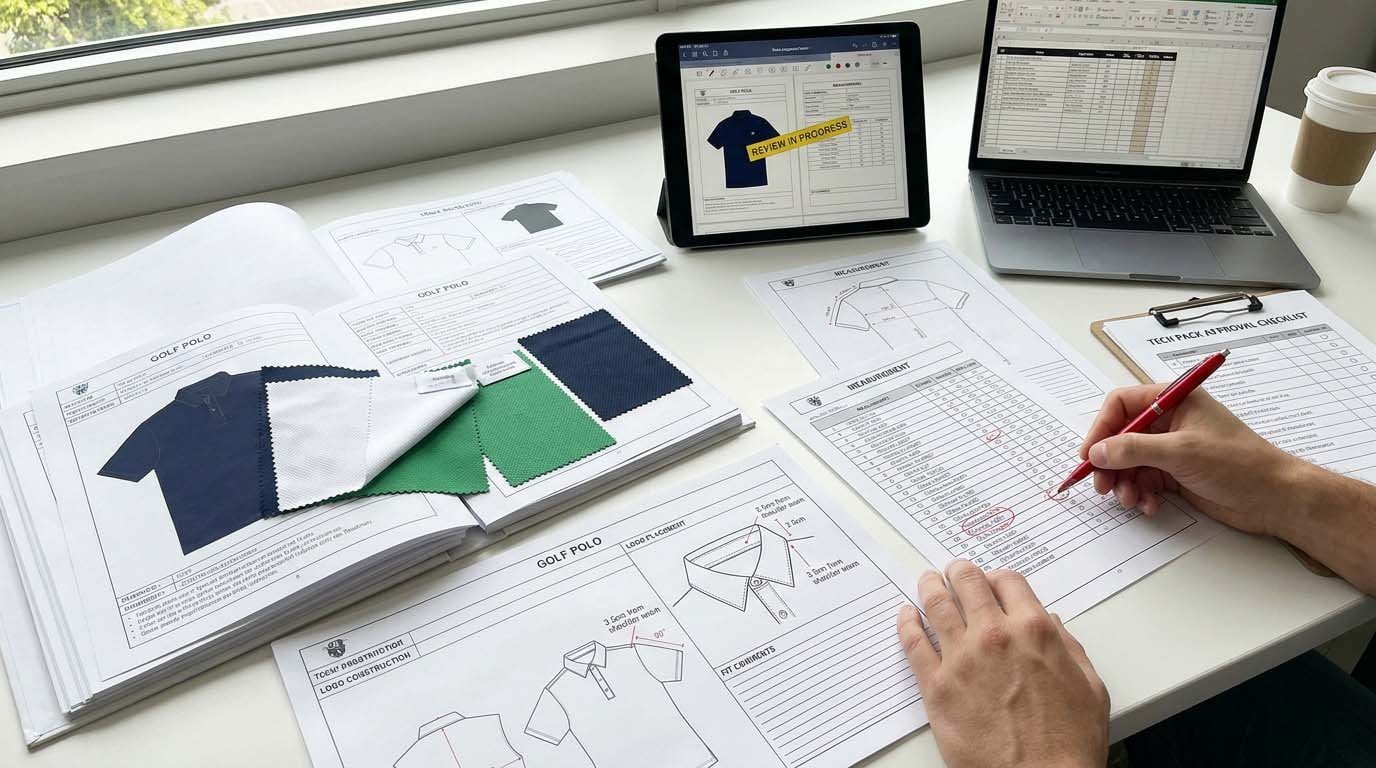
A reference garment or photograph can supplement technical drawings, but it should not replace measurable construction instructions.
Buyer Check: Are critical garment details clearly illustrated or supported by construction callouts?
For a product-specific example, read How to Create a Golf Polo Tech Pack.
Key 3: Confirm Fabric Specifications
Descriptions such as "premium performance polyester" are insufficient for controlled manufacturing.
Confirm the following:
- Fiber composition
- Knit or woven structure
- Target fabric weight (GSM)
- Stretch direction and recovery requirements
- Relevant finishes and performance properties
- Approved fabric swatch or material reference
- Supplier or fabric article number, where applicable
Two polyester-spandex fabrics may have similar compositions and weights but different hand feel, stretch recovery, drape, and appearance.
Buyer Check: Can the factory identify or source the required fabric and verify it against the approved reference?
If materials are not finalized, record the required properties and mark the fabric as pending approval.
Learn more about FUWAY's Fabric Sourcing service.
Key 4: Verify Color Standards
Color names alone are not reliable manufacturing references.
Check that the tech pack identifies:
- Colorway name and code
- Pantone or agreed physical color reference
- Fabric and trim color requirements
- Lab dip, knitdown, or strike-off requirements where applicable
- Color approval status
Fabric composition, structure, dyeing method, and surface texture can influence the final appearance.
Buyer Check: What approved reference will be used to judge color consistency during production?
Key 5: Check the Bill of Materials (BOM)
The BOM identifies the materials and components required to manufacture each garment.
Typical items include shell fabric, collar fabric, thread, buttons, zippers, elastic, labels, decoration materials, and packaging components.
| BOM Field | Required Information |
|---|---|
| Component | Item name and description |
| Specification | Material, dimensions, or finish |
| Color | Approved color reference |
| Supplier / Code | Identifiable source where applicable |
| Approval Status | Proposed, pending, or approved |
Buyer Check: Are critical components identified, and are substitutions subject to the agreed approval procedure?
Key 6: Verify POM Measurements and Tolerances
Points of Measurement (POMs) define the dimensions of a finished garment and how those dimensions should be measured.
Each required POM should contain:
- Measurement name or code
- Target dimension and unit
- Measurement method
- Diagram or reference point
- Approved tolerance
- Applicable size
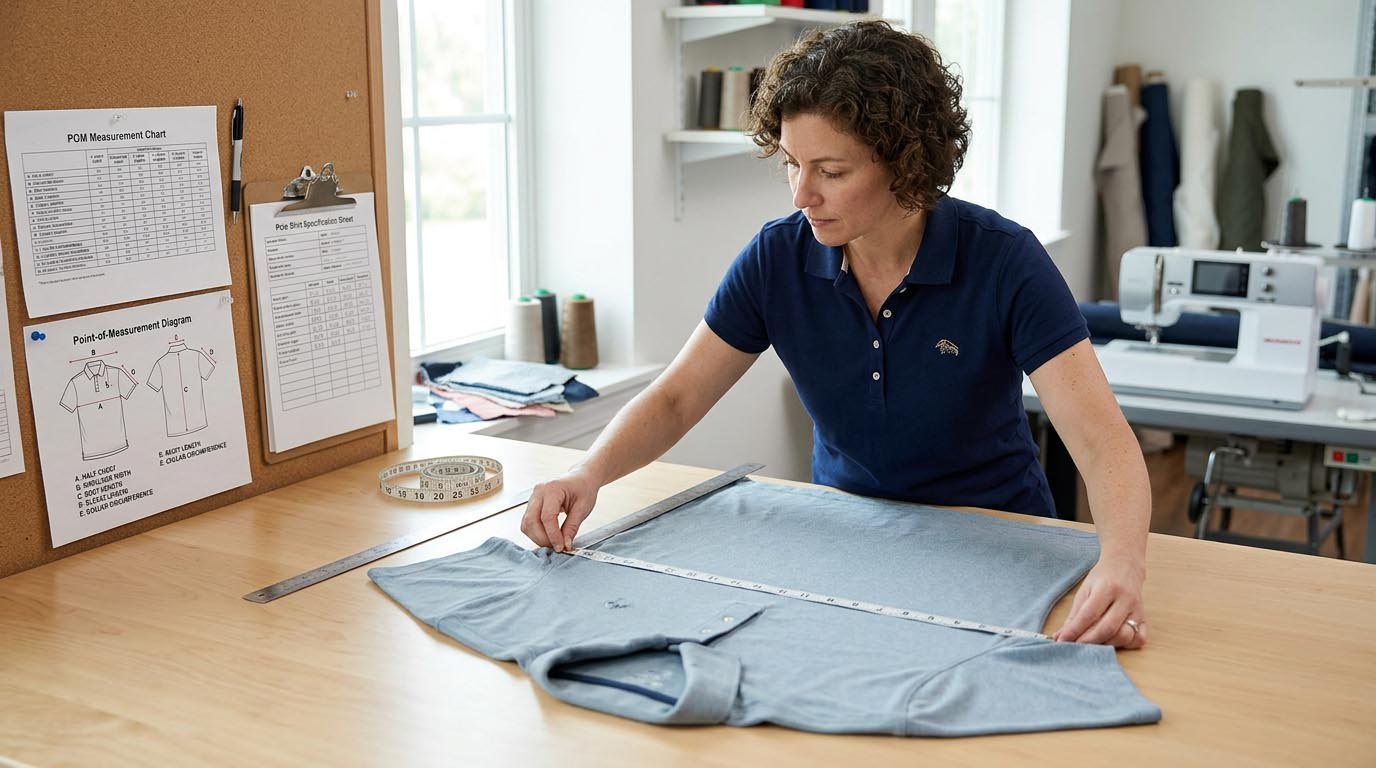
FUWAY's Measurement Tolerance Standard
FUWAY's standard finished-garment dimensional tolerance is ±1.0 cm for all specified POMs. Tighter tolerances can be agreed upon where required by the approved Tech Pack.
The following measurements are illustrative, not fixed specifications for every FUWAY garment.
| Point of Measurement | Example Target | Tolerance | Acceptable Range |
|---|---|---|---|
| Polo 1/2 chest width | 54.0 cm | ±1.0 cm | 53.0–55.0 cm |
| Polo body length | 72.0 cm | ±1.0 cm | 71.0–73.0 cm |
| Polo collar height | 4.0 cm | ±1.0 cm | 3.0–5.0 cm |
For fit-sensitive dimensions, the buyer may specify a tighter limit during development. Such limits must be documented and approved before the relevant production stage.
Size grading increments and fabric shrinkage limits are separate from finished-garment measurement tolerances.
Buyer Check: Can the buyer and manufacturer measure the same garment consistently using the approved method and tolerance?
For further guidance, see our Golf Apparel Measurement Tolerance Guide.
Key 7: Check Size Grading Rules
Approving one medium-size sample does not automatically establish correct measurements for the entire size range.
The tech pack should include either an approved measurement chart for every required size or grading rules that define size-to-size changes.
For golf apparel, pay particular attention to:
- Chest and shoulder proportions
- Sleeve length and opening
- Body length
- Waist and hip measurements
- Rise, inseam, and leg opening
Buyer Check: Are the intended dimensions clearly defined across all selling sizes?
Key 8: Confirm Construction Requirements
Construction details influence appearance, fit, comfort, and durability.
Depending on the garment, specifications may include:
- Seam and stitch types
- Seam allowances
- Collar and placket assembly
- Pocket construction
- Waistband and elastic attachment
- Reinforcement points
- Hem finishing
- Bonding or taping requirements
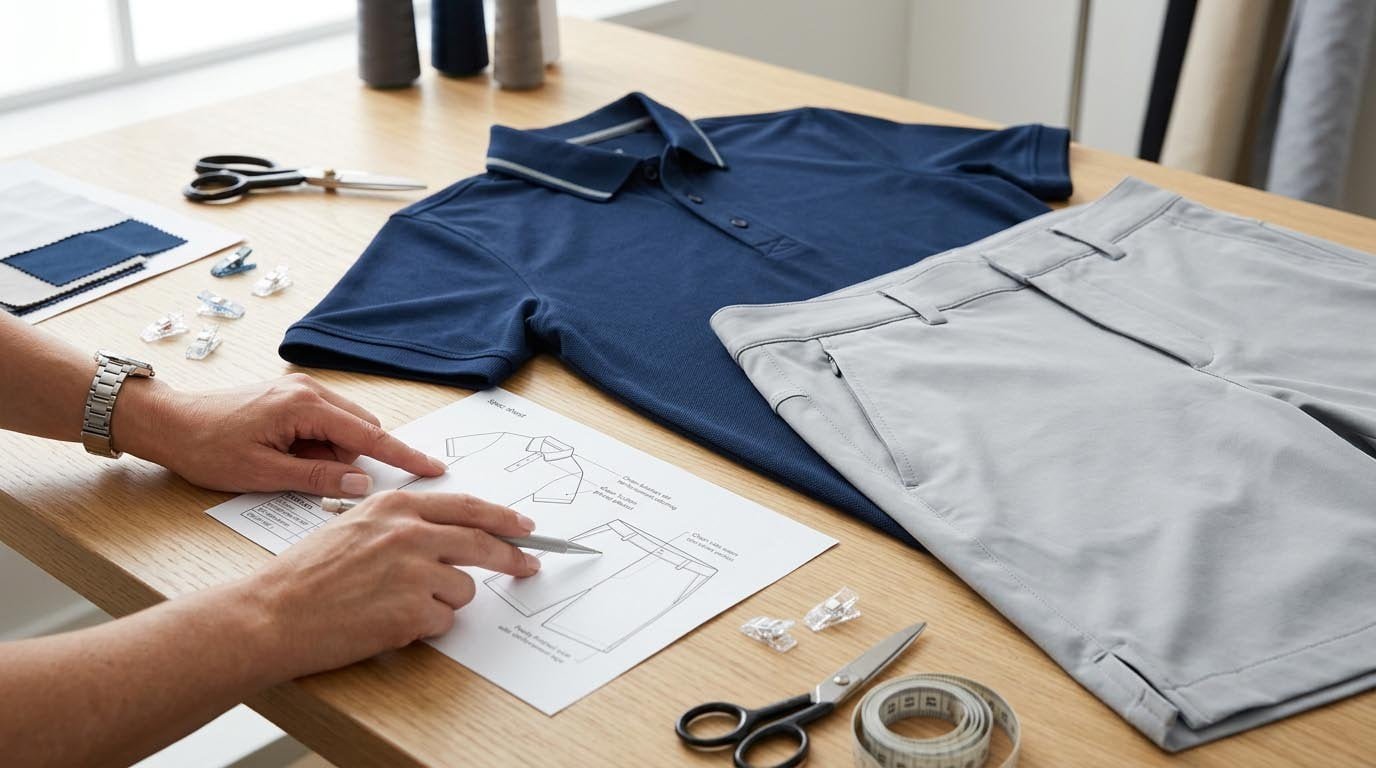
For example, "reinforced side vent" should be supported by a construction reference showing the required reinforcement method.
Buyer Check: Can critical construction details be reproduced without relying on undocumented factory assumptions?
Key 9: Verify Logo Artwork and Placement
Instructions such as "logo on left chest" are not precise enough for consistent manufacturing.
Verify:
- Approved artwork file and revision
- Decoration method
- Finished logo dimensions
- Placement reference points
- Orientation
- Color requirements
- Method-specific construction details
For example, a chest logo may use agreed measurements from the high point shoulder and center-front reference.
Embroidery, screen printing, sublimation, and heat transfer may require different technical specifications.
Buyer Check: Can the manufacturer reproduce the logo's approved size, position, color, and appearance?
Key 10: Confirm Performance and Testing Requirements
Golf apparel may require measurable performance characteristics such as moisture management, stretch recovery, UV protection, colorfastness, pilling resistance, and dimensional stability.
For applicable requirements, specify:
| Item | What to Document |
|---|---|
| Property | What must be verified |
| Test Method | Agreed method or standard |
| Performance Target | Required acceptance criterion |
| Testing Stage | When verification is required |
| Approval Responsibility | Who reviews the result |
Claims such as UPF 50+ or antimicrobial performance require appropriate supporting evidence before marketing use.
Buyer Check: Are required product-performance claims supported by measurable criteria and an appropriate verification plan?
Key 11: Review Sampling and Approval Requirements
Different sample stages serve different purposes.
Common stages may include:
- Prototype sample
- Fit or development sample
- Size-set sample
- Pre-production (PP) sample
- Top-of-production (TOP) sample
Not every project requires every stage.
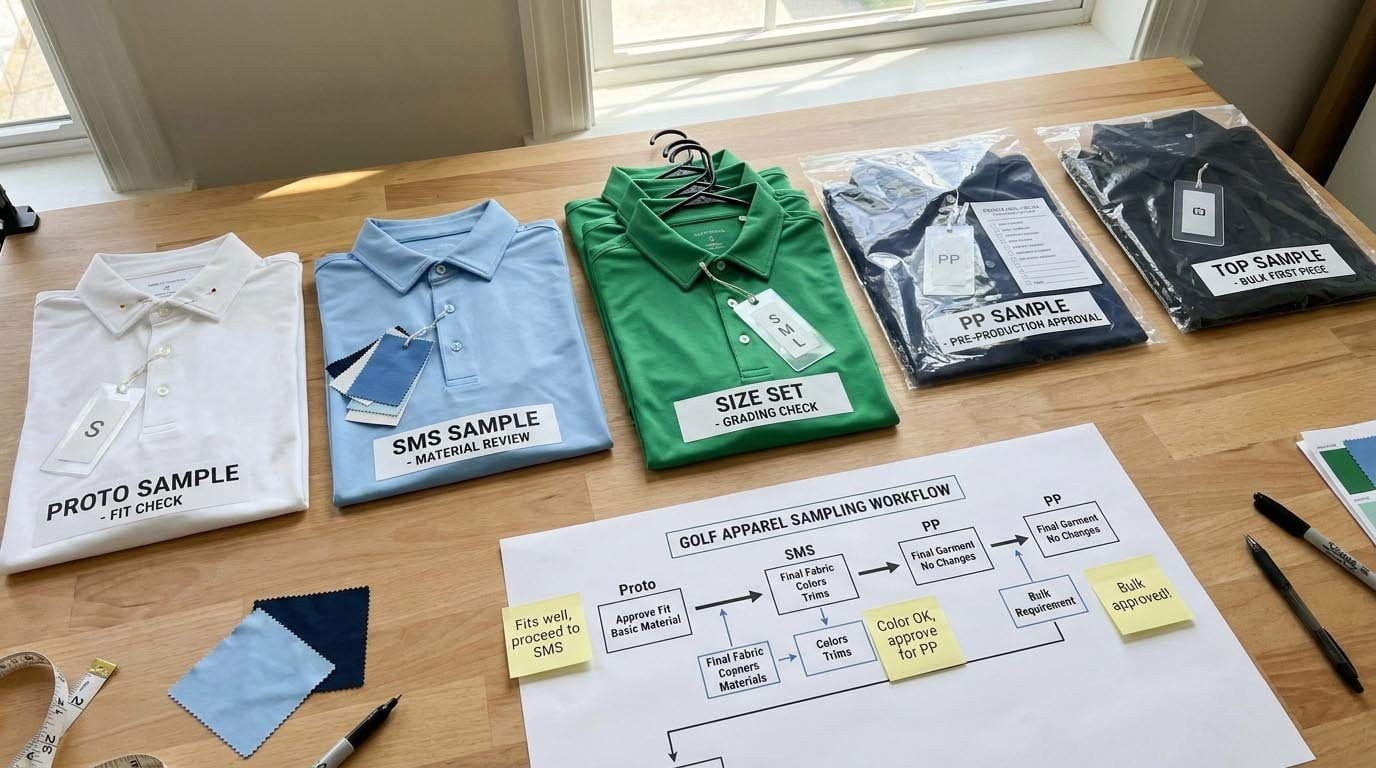
Each requested sample should have a defined purpose, material requirement, size, quantity, review criteria, and responsible approver.
Buyer Check: Do both parties understand what the sample must demonstrate before approval?
The detailed evaluation of fit and physical samples is covered separately in our Garment Fit Approval Checklist.
Key 12: Check Labels and Packaging
Labeling and packaging instructions should be finalized before the relevant production or purchasing decisions.
Verify the applicable requirements for:
- Main brand and size labels
- Fiber-content and care labels
- Country-of-origin marking
- Hangtags and barcodes
- Folding and individual packaging
- Carton quantities and markings
Exact labeling obligations depend on the destination market and applicable regulations.
Buyer Check: Are the required label artwork, specifications, and packaging instructions available and approved at the appropriate stage?
Key 13: Verify Revision Control and Approval Status
A technically complete tech pack can still cause manufacturing mistakes if the factory uses an outdated revision.
Every revision should identify what changed and which specifications are approved.
| Version | Main Change | Status |
|---|---|---|
| V1.0 | Initial specification issue | Under Review |
| V1.1 | POM and grading revised | Pending Approval |
| V1.2 | Prototype requirements approved | Sample Release |
| V2.0 | Final production specifications | Bulk Release |
Illustrative revision history.
Buyer Check: Are the buyer and manufacturer using the same current document, with unresolved specifications clearly identified?
Approval for prototype development does not automatically authorize bulk production.
Golf-Specific Tech Pack Checks by Product Type
Different golf garments require additional specifications beyond a general apparel template.
| Product | Additional Specifications to Verify |
|---|---|
| Golf Polo | Collar, placket, sleeve opening, side vents |
| Golf Shorts | Waistband, pockets, rise, inseam, leg opening |
| Golf Pants | Front/back rise, thigh, waistband, pocket construction |
| Golf Skort | Outer skirt, inner liner, waistband, coverage |
| Quarter-Zip | Collar, zipper, guard, layering allowance |
| Golf Jacket | Lining, cuffs, closures, seam finishing |
For golf skorts, the tech pack should distinguish outer-skirt dimensions from inner-liner measurements.
For quarter-zips, buyers should clarify whether the garment is designed to be worn over a polo or another base layer.
Buyer Check: Does the tech pack document the important functional requirements of the specific golf garment?
Common Missing Specifications That Delay Sampling
Even when a tech pack appears complete, a few missing details can prevent accurate development.
| Common Problem | Potential Consequence | Recommended Action |
|---|---|---|
| Missing measurement method | Inconsistent sample measurements | Add a POM diagram |
| Unconfirmed fabric reference | Different hand feel or stretch | Approve fabric specifications and reference |
| Unclear collar construction | Incorrect collar shape | Provide a construction detail |
| Outdated logo artwork | Incorrect branding | Confirm current artwork revision |
| Incomplete grading | Inconsistent sizing | Finalize required size specifications |
| Conflicting document versions | Production follows wrong instructions | Release one controlled version |
The goal is to resolve critical gaps before they become repeated sample revisions.
Golf Apparel Tech Pack Buyer Review Worksheet
Use the following worksheet before submitting a tech pack for sampling or production.
Record the approval status and supporting evidence for each requirement.
| Review Item | Required Evidence | Status |
|---|---|---|
| Style information | Current style sheet | Pending |
| Technical flats | Annotated drawings | Pending |
| Fabric | Approved specifications or swatch | Pending |
| Color | Agreed color reference | Pending |
| BOM | Component list | Pending |
| POM | Measurements and methods | Pending |
| Grading | Size chart or grading rules | Pending |
| Construction | Technical callouts | Pending |
| Logo | Artwork and placement specifications | Pending |
| Testing | Required methods and targets | Pending |
| Sampling | Sample requirements | Pending |
| Packaging | Applicable instructions | Pending |
| Revision control | Latest version and approval record | Pending |
How to Assign Review Status
Use four statuses:
- Approved: The requirement has been confirmed for the relevant manufacturing stage.
- Pending: Information or approval is still required.
- Needs Revision: Existing specifications are incomplete or inconsistent.
- Not Applicable: The requirement does not apply to the current style or stage.
For every unresolved item, record the responsible person, required action, and target completion date.
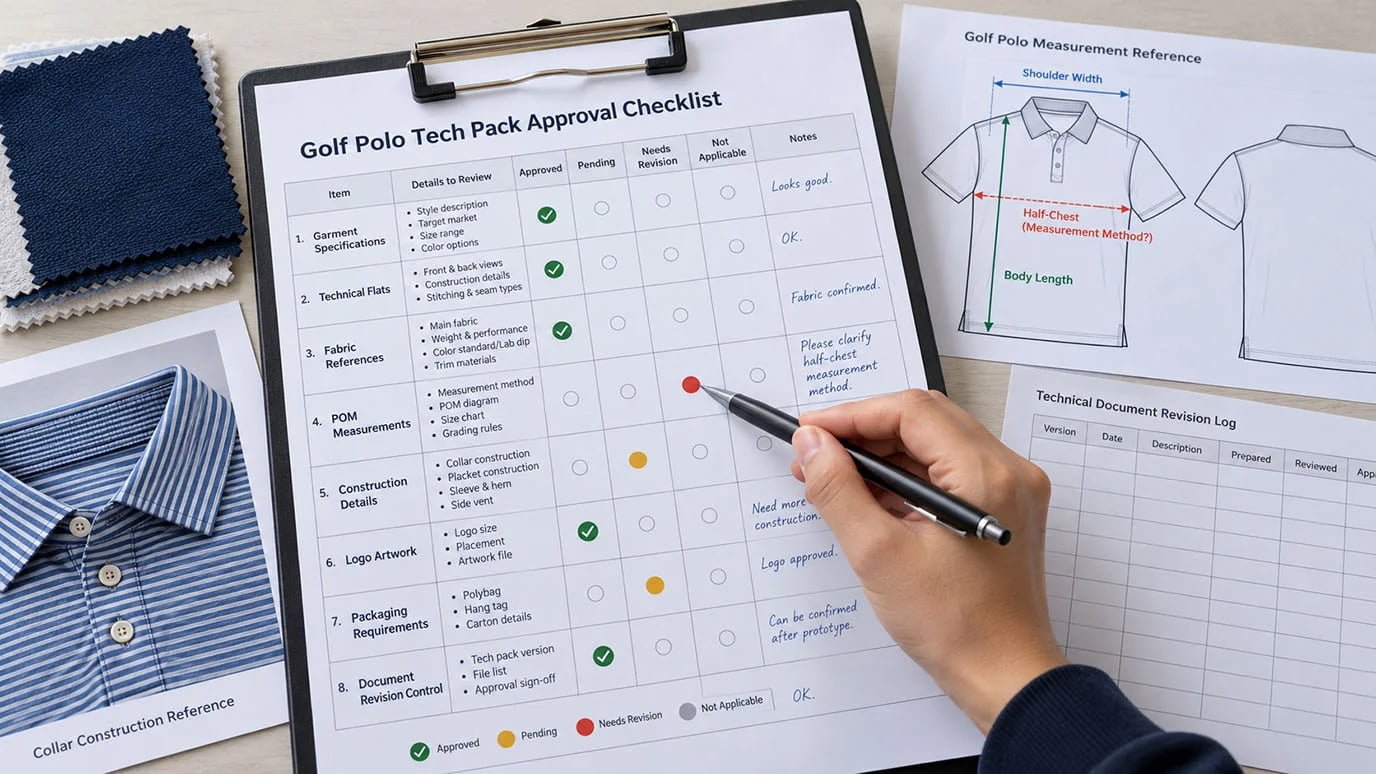
Example: Reviewing an Incomplete Golf Polo Tech Pack
Consider a buyer preparing a regular-fit golf polo for initial sampling.
| Finding | Status | Required Action |
|---|---|---|
| Fabric reference confirmed | Approved | None |
| Chest measurement method missing | Needs Revision | Add POM diagram |
| Collar construction unclear | Pending | Confirm construction reference |
| Logo artwork approved | Approved | None |
| Packaging artwork unfinished | Pending | Finalize before packaging production |
In this example, the missing chest measurement method and unclear collar construction may prevent meaningful prototype development.
However, final packaging artwork may remain pending if it is not required for the current sampling stage.
The important distinction is whether an unresolved item prevents the next manufacturing stage—not simply whether the worksheet is completely filled.
When Is a Tech Pack Ready for Sampling or Production?
Use three practical release decisions.
| Decision | Conditions | Next Action |
|---|---|---|
| Ready for Sampling | Critical prototype requirements are defined | Proceed with sampling |
| Needs Clarification | Important specifications are missing or conflicting | Resolve gaps before proceeding |
| Ready for Bulk | Final specifications, materials, and required approvals are complete | Authorize production under agreed conditions |
Before bulk production, the manufacturer and buyer should verify the approved physical garment against the final specifications.
A signed sample alone does not replace an updated tech pack, and an approved tech pack does not eliminate the need for physical sample review.
The document and approved reference garment should support the same manufacturing requirements.
Frequently Asked Questions
Do I Need a Complete Tech Pack Before Requesting a Quote?
Not necessarily. A manufacturer may provide a preliminary quotation based on drawings, reference garments, estimated quantities, and proposed materials.
However, incomplete information may require pricing assumptions that must be clarified before production.
Can a Manufacturer Help Complete My Tech Pack?
Yes. A manufacturer may assist with measurements, fabric selection, construction details, and sample development.
Buyers should review and approve the resulting specifications before the relevant manufacturing stage.
What Measurement Tolerance Should FUWAY Tech Packs Specify?
FUWAY's standard finished-garment dimensional tolerance is ±1.0 cm for all specified POMs.
Tighter tolerances may be agreed upon for particular measurements and documented in the approved tech pack.
Is ±1.0 cm Also the Grading or Fabric Shrinkage Standard?
No.
Measurement tolerance controls deviations from approved garment dimensions.
Grading defines planned size-to-size measurement differences, while fabric shrinkage is evaluated separately under agreed testing conditions.
Can a Reference Sample Replace a Tech Pack?
A reference garment helps communicate fit, construction, and material appearance, but it should not replace written measurements, material specifications, grading requirements, and approval records.
What Is the Most Important Check Before Bulk Production?
Confirm that the buyer and manufacturer are using the same approved specification revision and that all critical production requirements have been resolved.
Conclusion: Review Your Tech Pack Before Sampling
A useful golf apparel tech pack checklist identifies missing specifications before they cause manufacturing problems.
Before submitting your files, verify that design, fabric, measurements, grading, construction, decoration, testing, and approval requirements are sufficiently defined for the next production stage.
The goal is not the longest tech pack. It is a clear, controlled document that helps buyers and manufacturers make consistent production decisions.
If your brand needs assistance reviewing a golf polo, shorts, skort, quarter-zip, or other golf apparel tech pack, contact FUWAY to discuss your specifications and sampling requirements.