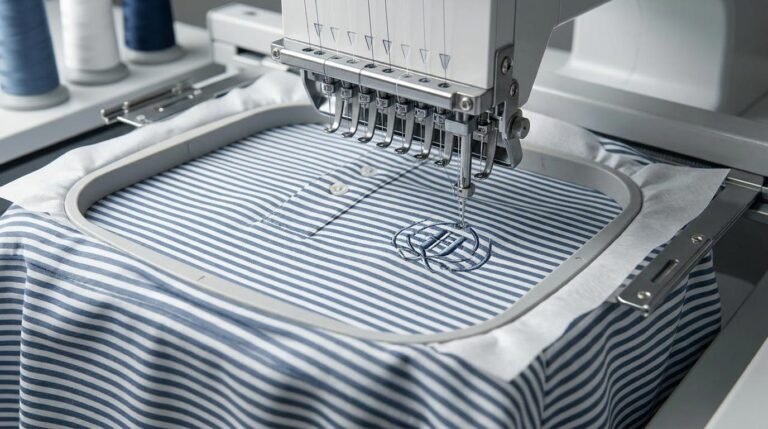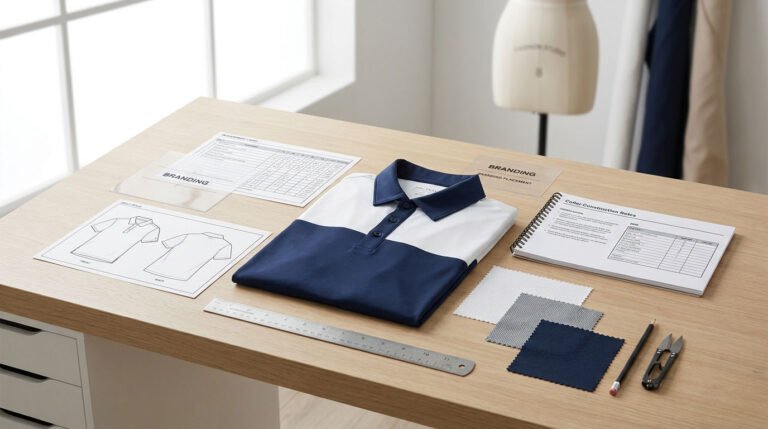
A golf polo can look excellent in a product photo and still fail after washing or repeated wear.
Common problems such as:
- collar curling,
- twisted plackets,
- puckered seams,
- restricted shoulder movement,
- uneven hems
often come from construction decisions made long before bulk production.
Golf polo construction quality depends on five connected elements:
Fabric → Pattern → Collar → Placket → Seam Construction
For buyers, the objective is not to understand every sewing operation performed inside a factory.
It is to know which construction details should be specified and checked in samples before bulk production begins.
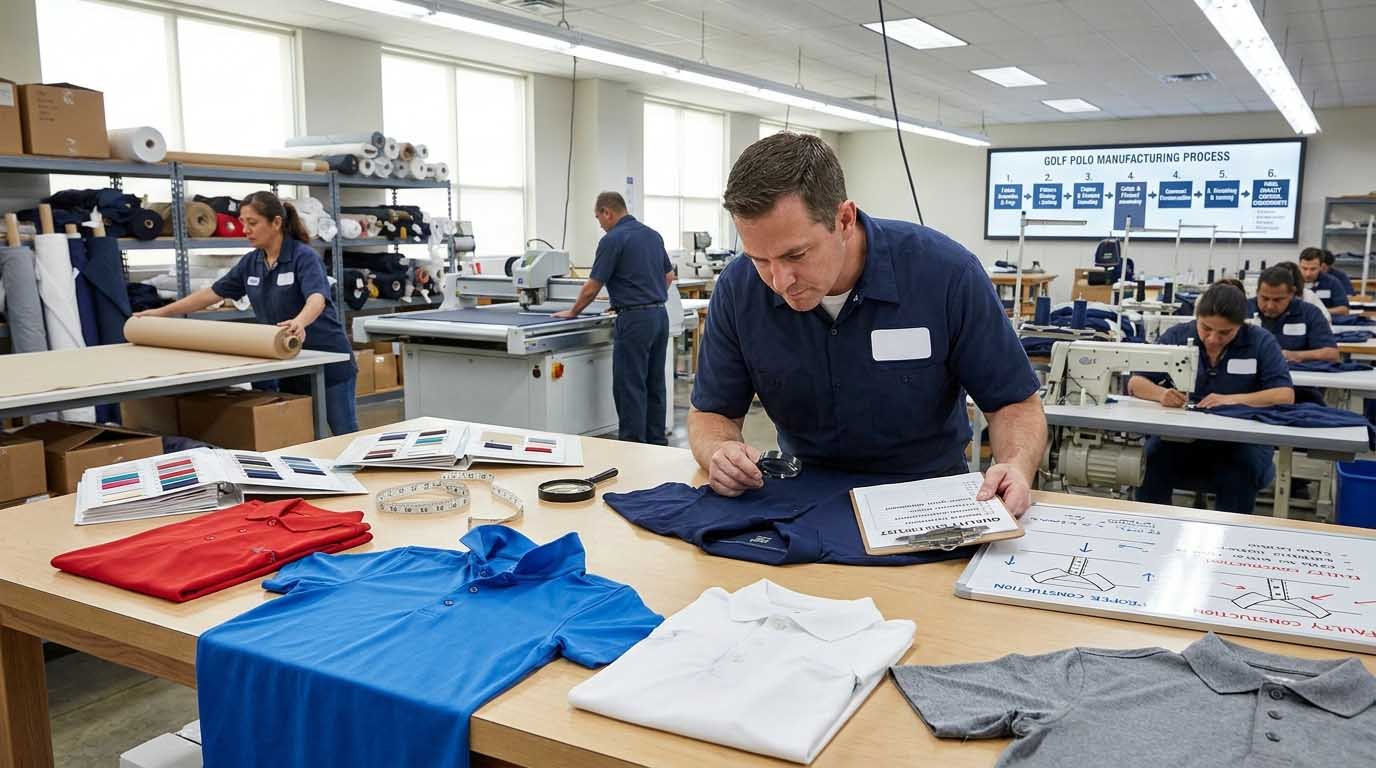
This guide focuses specifically on golf polo construction engineering.
If you want to see how an approved golf polo moves through the factory from tech pack and material sourcing to cutting, sewing, quality inspection, packing, and shipment, read our Golf Polo Shirts Production Process Guide.
Quick Answer: What Determines Golf Polo Construction Quality?
Five areas have the greatest influence on how a golf polo fits, performs, and maintains its appearance.
| Construction Area | Main Buyer Question |
|---|---|
| Fabric | Does it have the right weight, stretch, stability, and performance? |
| Pattern | Does the fit support golf movement and remain consistent across sizes? |
| Collar | Will it maintain shape without curling, twisting, or bubbling? |
| Placket | Will it remain flat, aligned, and stable after washing? |
| Seams | Are the stitch and seam constructions compatible with the fabric? |
A good golf polo should be evaluated as one construction system.
For example:
- changing the fabric can change the fit,
- changing stretch can require pattern adjustments,
- an unstable fabric can cause placket puckering,
- an unsuitable collar construction can curl after washing,
- incorrect seam tension can distort stretch fabric.
That is why construction decisions should be approved together rather than independently.
How Should You Choose Fabric for a Golf Polo?
Fabric affects nearly every other construction decision.
Important variables include:
- fiber composition,
- knit structure,
- GSM,
- stretch,
- recovery,
- hand feel,
- moisture management,
- dimensional stability,
- pilling resistance,
- snag resistance.
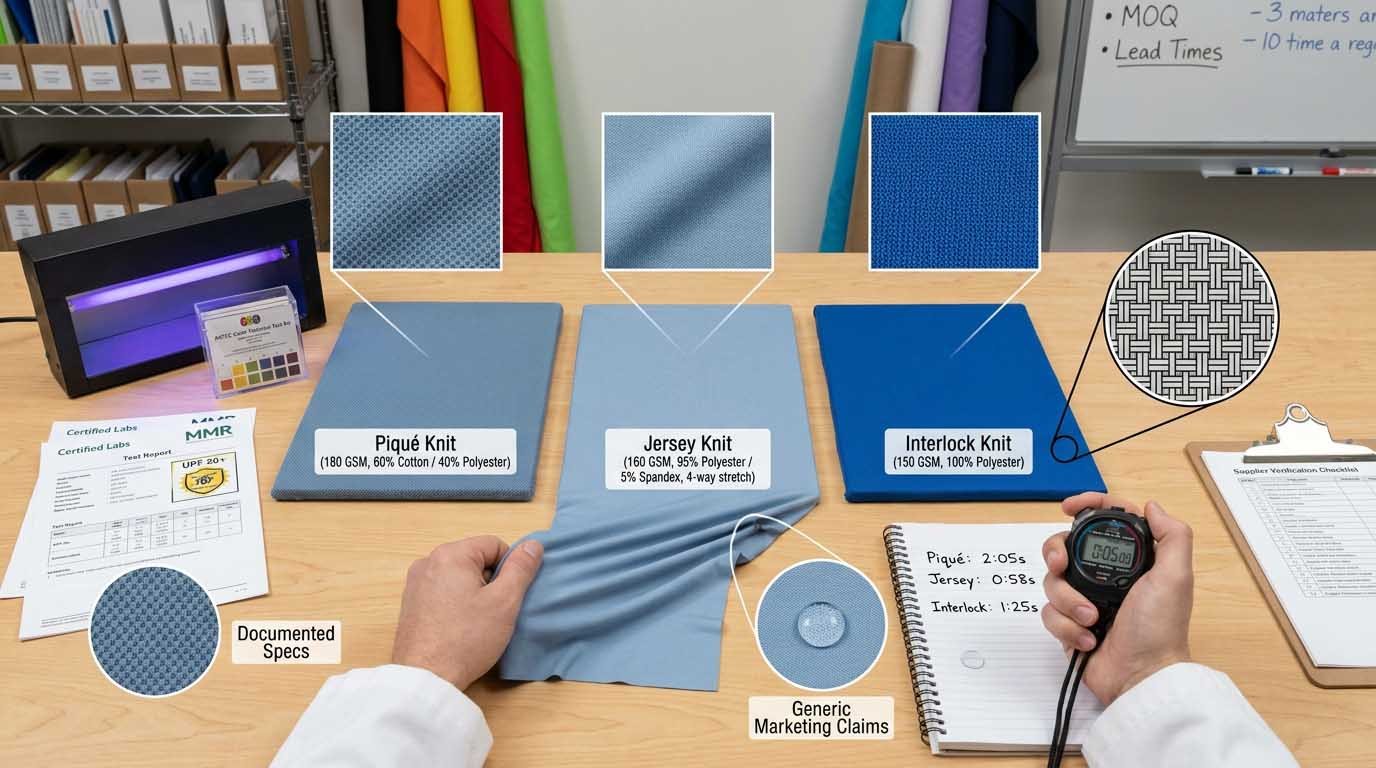
Piqué
Piqué has a textured knit surface and is strongly associated with traditional polo styling.
It can provide:
- structured appearance,
- classic hand feel,
- good body,
- compatibility with rib or structured collars.
Piqué can be made from:
- polyester,
- cotton,
- cotton/polyester blends,
- stretch blends.
Do not assume all piqué fabrics behave the same. GSM, yarn quality, knit density, and finishing can change performance significantly.
Jersey
Jersey generally provides:
- smoother surface,
- softer drape,
- lighter athletic appearance,
- good mobility when engineered with stretch.
It is commonly used for modern performance golf polos.
Interlock
Interlock is a double-knit construction that tends to provide:
- greater stability,
- smoother appearance,
- stronger opacity,
- more structured drape.
It can work well for premium performance polos where buyers want a clean surface with more body than lightweight jersey.
Does Spandex Percentage Tell You Whether Fabric Is 4-Way Stretch?
No.
A common sourcing mistake is assuming:
more spandex = better 4-way stretch.
Stretch behavior depends on more than fiber composition.
It is affected by:
- elastane content,
- yarn arrangement,
- knit construction,
- fabric density,
- mechanical stretch,
- finishing.
Two fabrics with the same polyester/spandex composition can behave very differently.
Instead of specifying only:
88% polyester / 12% spandex
buyers should also define the required fabric behavior.
For example:
Polyester/spandex performance knit with useful stretch in both lengthwise and crosswise directions, suitable recovery, and approved wash stability.
For a deeper explanation of stretch testing and sourcing, see our 4-Way Stretch Fabric for Golf Shirts Guide.
What Fabric Weight Works for Golf Polos?
There is no single GSM that is correct for every polo.
The appropriate range depends on:
- climate,
- knit structure,
- opacity,
- fit,
- drape,
- durability,
- target customer.
Lighter fabrics can improve warm-weather comfort but may require more attention to:
- opacity,
- collar support,
- embroidery stability.
Heavier fabrics may provide:
- more structure,
- greater coverage,
- substantial hand feel,
but can reduce the lightweight performance feel some golfers prefer.
The correct approach is:
Select GSM according to product use—not according to one universal “best” number.
What Fabric Performance Claims Should Buyers Verify?
If you intend to market measurable performance, request supporting information for claims such as:
- moisture management,
- quick dry,
- UPF,
- stretch,
- recovery,
- shrinkage,
- pilling resistance.
A physical swatch should also be reviewed before garment sampling whenever possible.
Ask the supplier:
- What is the exact composition and construction?
- What is the GSM?
- Is this fabric available or custom-developed?
- What performance data is available?
- What shrinkage or dimensional change should be expected?
- Can I approve a physical swatch before sampling?
FUWAY also provides Fabric Sourcing support for custom golf apparel projects.
Fabric decisions should also reflect changing market expectations. Brands are increasingly looking for softer hand feel, cleaner surface appearance, cooling comfort, and fabrics that work both on and off the course. See our golf apparel trends guide for the broader fashion, performance, and product-development direction.
How Does Pattern Engineering Affect Golf Polo Fit?
Pattern engineering converts the product concept into garment proportions.
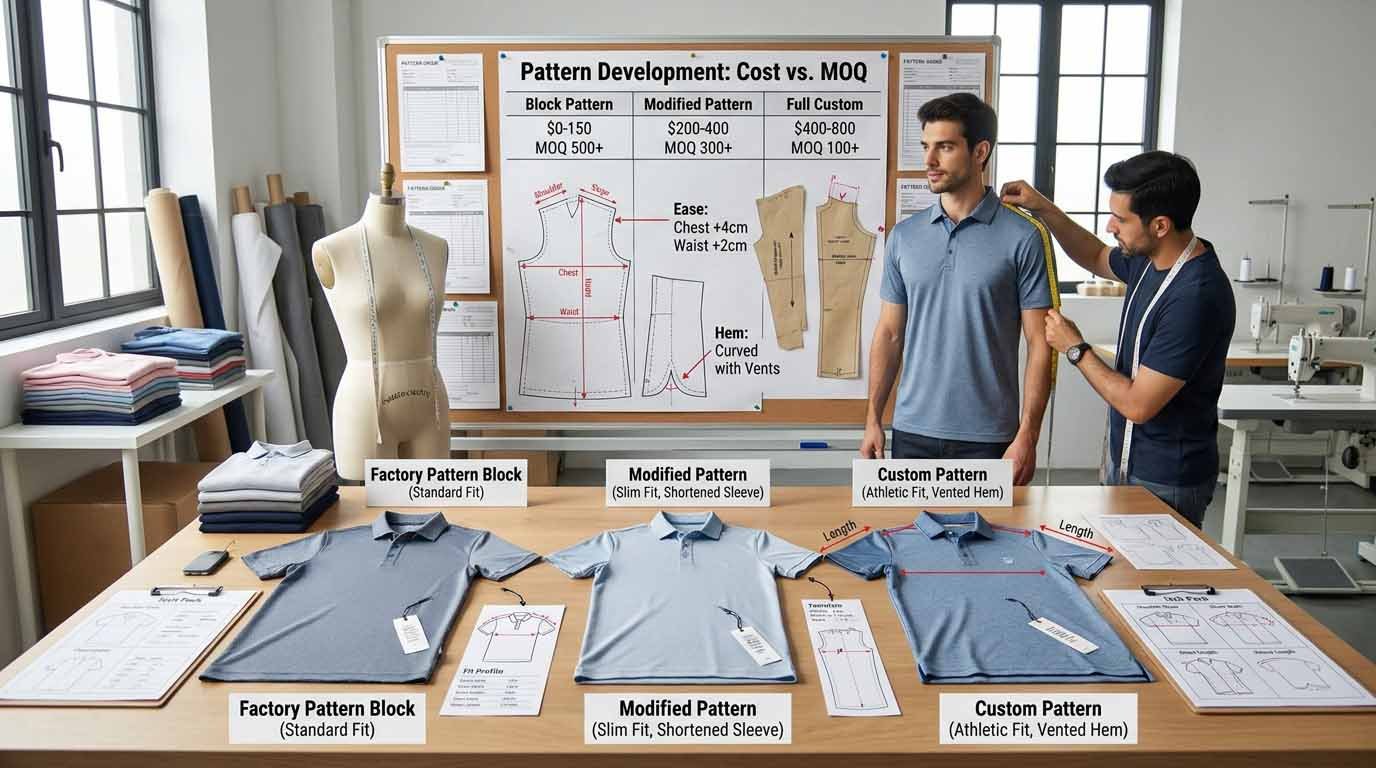
A pattern controls:
- chest width,
- shoulder width,
- armhole,
- sleeve shape,
- torso taper,
- body length,
- neckline,
- hem shape.
A visually attractive polo can still perform poorly if the pattern restricts golf movement.
Existing Pattern Block
Using an existing factory block can be efficient when the buyer already likes the basic:
- chest fit,
- shoulder,
- length,
- proportions.
Adjustments can then focus on:
- collar,
- sleeve length,
- hem,
- branding,
- trims.
This can reduce development complexity.
Modified Pattern
A modified block may be appropriate when the brand needs changes to:
- shoulder slope,
- chest ease,
- torso taper,
- armhole depth,
- sleeve shape.
This allows more fit differentiation without developing every element from zero.
Fully Custom Pattern
A fully custom pattern provides greater control when the brand has a specific fit identity or detailed measurement specification.
It may be appropriate for:
- proprietary fit systems,
- athletic body profiles,
- women's golf fits,
- distinctive silhouettes.
Custom pattern development may require more sampling, but it does not automatically require a universal high MOQ.
At FUWAY, typical custom projects start around 100 pieces per style, while actual requirements depend on fabrics, colors, trims, and construction.
What Should a Golf Polo Measurement Specification Include?
Instead of writing:
“Slim fit”
or:
“Athletic fit,”
define measurable dimensions.
Important points of measurement can include:
- half chest,
- shoulder width,
- body length,
- sleeve length,
- sleeve opening,
- waist,
- bottom opening,
- armhole,
- neck opening,
- collar dimensions,
- placket length.
Each important measurement should also have an agreed tolerance.
For example:
| Measurement | Spec | Tolerance |
|---|---|---|
| Half Chest | Buyer-defined | Buyer-defined |
| Body Length | Buyer-defined | Buyer-defined |
| Sleeve Length | Buyer-defined | Buyer-defined |
| Collar Height | Buyer-defined | Buyer-defined |
The exact tolerance should depend on the garment and construction.
How Should Golf Polo Fit Be Tested?
A golf polo should not be judged only while standing still.
During sampling, test:
- address position,
- backswing,
- follow-through,
- reaching,
- bending,
- walking.
Check whether the polo:
- pulls across the upper back,
- restricts shoulder rotation,
- rides up excessively,
- binds at the armhole,
- feels too tight through the torso.
Photos alone are not enough.
Use the actual sample on a wearer who represents the target size and body type.
What Determines Golf Polo Collar Quality?
Collar quality is one of the most visible indicators of polo construction.
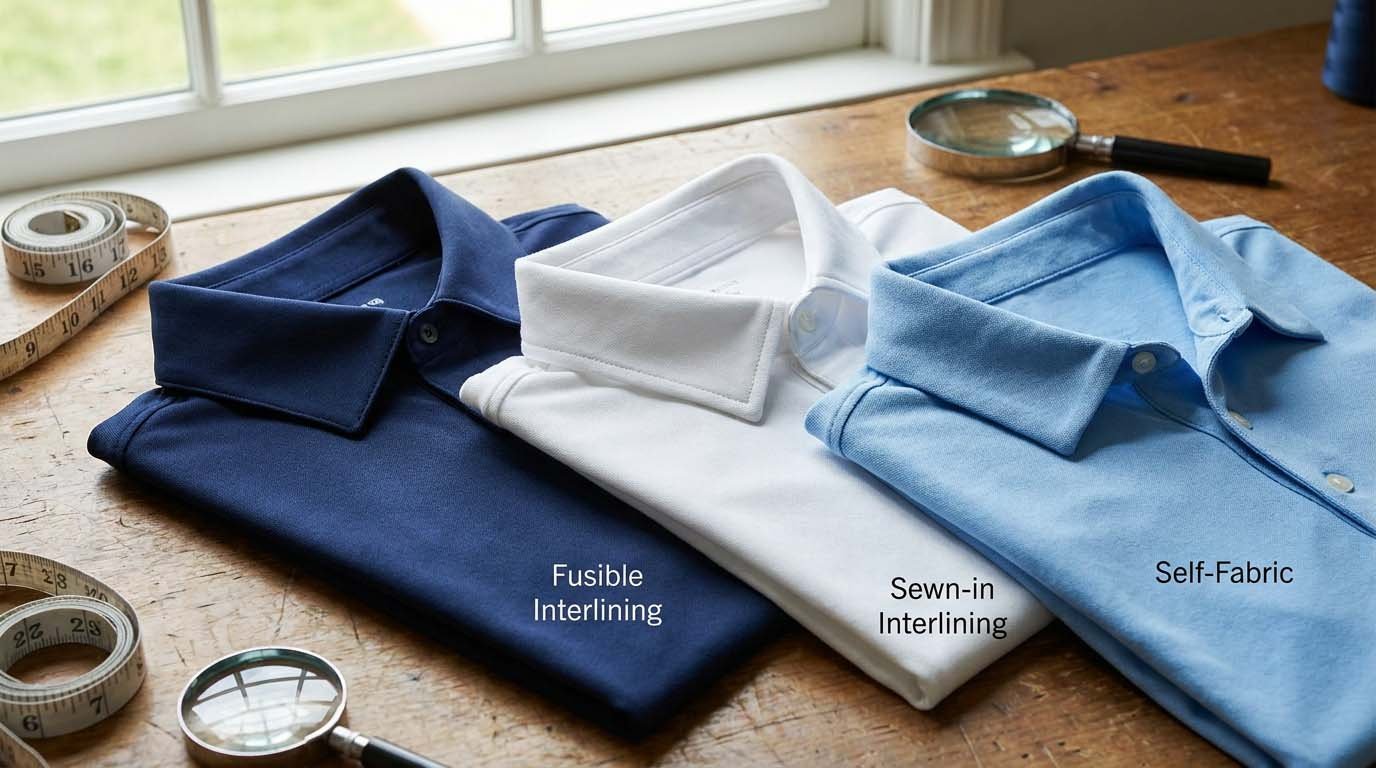
Common collar problems include:
- curling,
- twisting,
- bubbling,
- uneven points,
- poor collar roll,
- weak shape retention.
These problems can come from:
- unsuitable material,
- poor grain alignment,
- incompatible interlining,
- incorrect pressing,
- inconsistent stitching.
Fusible Interlining vs Sewn-In Support
Fusible Interlining
Fusible material uses heat-activated adhesive to stabilize the collar.
Advantages can include:
- clean appearance,
- controlled shape,
- efficient production.
Important variables include:
- adhesive quality,
- pressure,
- temperature,
- compatibility with the outer fabric.
Poor bonding can eventually cause:
- bubbling,
- separation,
- distortion.
Sewn-In Support
Sewn-in interlining is mechanically secured rather than fused.
It can provide strong structure where long-term collar stability is important.
However, it may also create:
- greater thickness,
- firmer hand feel.
The best construction depends on the design.
Self-Fabric / Soft Collar
Some modern performance polos intentionally use softer collar constructions with minimal internal structure.
This can support:
- lightweight feel,
- casual appearance,
- softer drape.
It should not automatically be treated as lower quality.
The key is whether the final result matches the intended design.
How Should You Check a Collar Sample?
Before approval, check four areas.
1. Symmetry
Compare:
- left and right collar points,
- collar height,
- neckline attachment.
2. Grain and Knit Direction
Misaligned fabric direction can increase the risk of twisting.
3. Stitching
Look for:
- even topstitching,
- no skipped stitches,
- no pulling,
- no puckering.
4. Wash Stability
Wash the sample according to the intended care instructions.
Then check:
- curl,
- twist,
- bubbling,
- symmetry,
- collar roll.
For a deeper explanation of collar failures, see our guide on Why Golf Polo Collars Curl After Washing.
What Determines Placket Quality?
A placket is small, but it sits directly at the visual center of the polo.
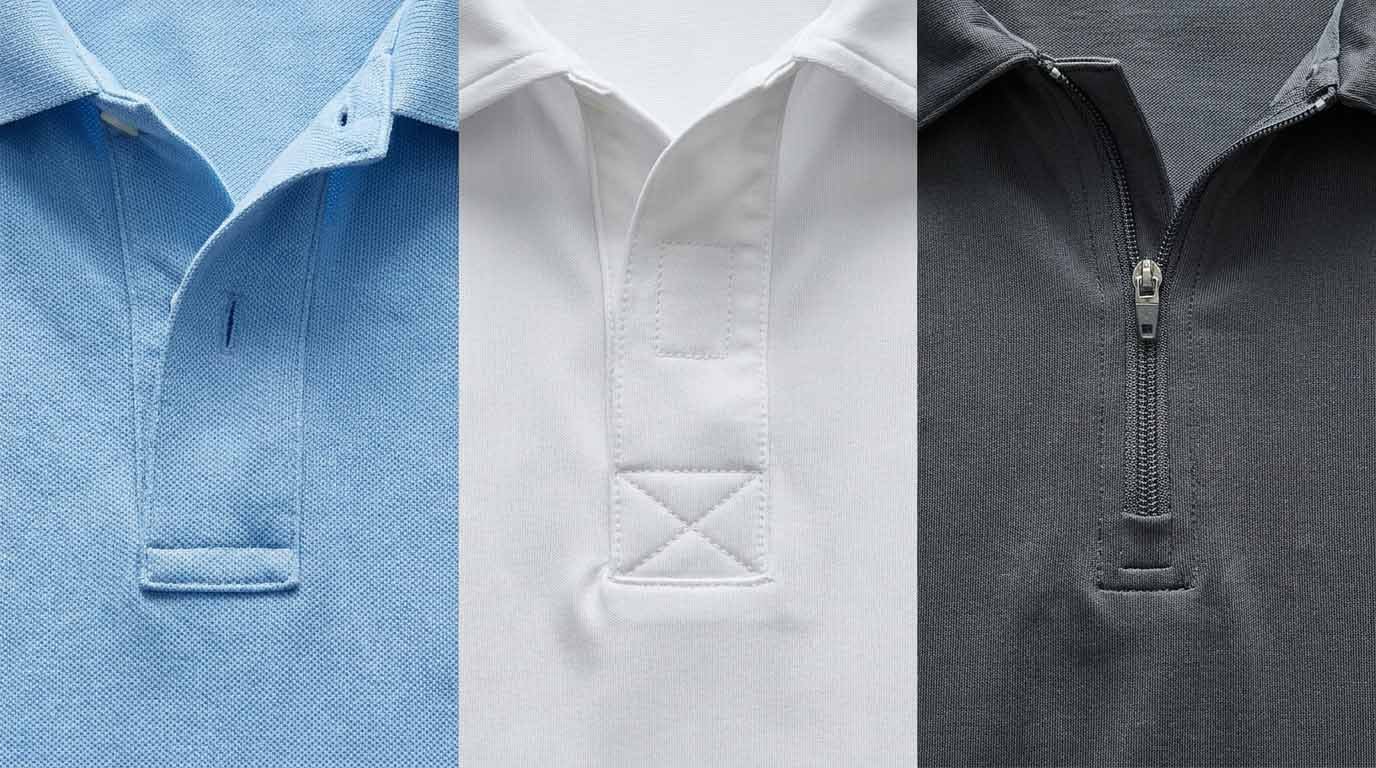
Common defects include:
- puckering,
- twisting,
- uneven button spacing,
- stretched buttonholes,
- poor reinforcement,
- misalignment.
Common Placket Constructions
Folded / Two-Piece Style
A common construction for performance polos.
The placket needs sufficient stability so the fabric remains flat after:
- sewing,
- buttoning,
- washing.
Box or Reinforced Placket
A more structured construction can be used when greater reinforcement or a traditional appearance is required.
Zipper Placket
Zipper openings are common in:
- performance tops,
- golf pullovers,
- quarter-zips.
They require careful stabilization because zipper tape and stretch fabric can respond differently during sewing.
What Should You Check in a Placket Sample?
Alignment
Button the polo and lay it flat.
The center front should remain straight.
Stitch Tension
Topstitching should look:
- even,
- flat,
- smooth.
The correct stitch density depends on:
- fabric,
- thread,
- construction.
Avoid treating one stitches-per-inch number as universal.
Reinforcement
Check stress areas near:
- placket bottom,
- buttonholes,
- top opening.
Buttonholes
They should be:
- clean,
- stable,
- appropriately sized.
Wash Stability
After washing, check for:
- puckering,
- rippling,
- shifting,
- distorted buttonholes.
If these appear during sampling, correct the construction before bulk production.
How Does Seam Construction Affect Golf Polo Quality?
Seams connect the pattern and fabric into a functional garment.
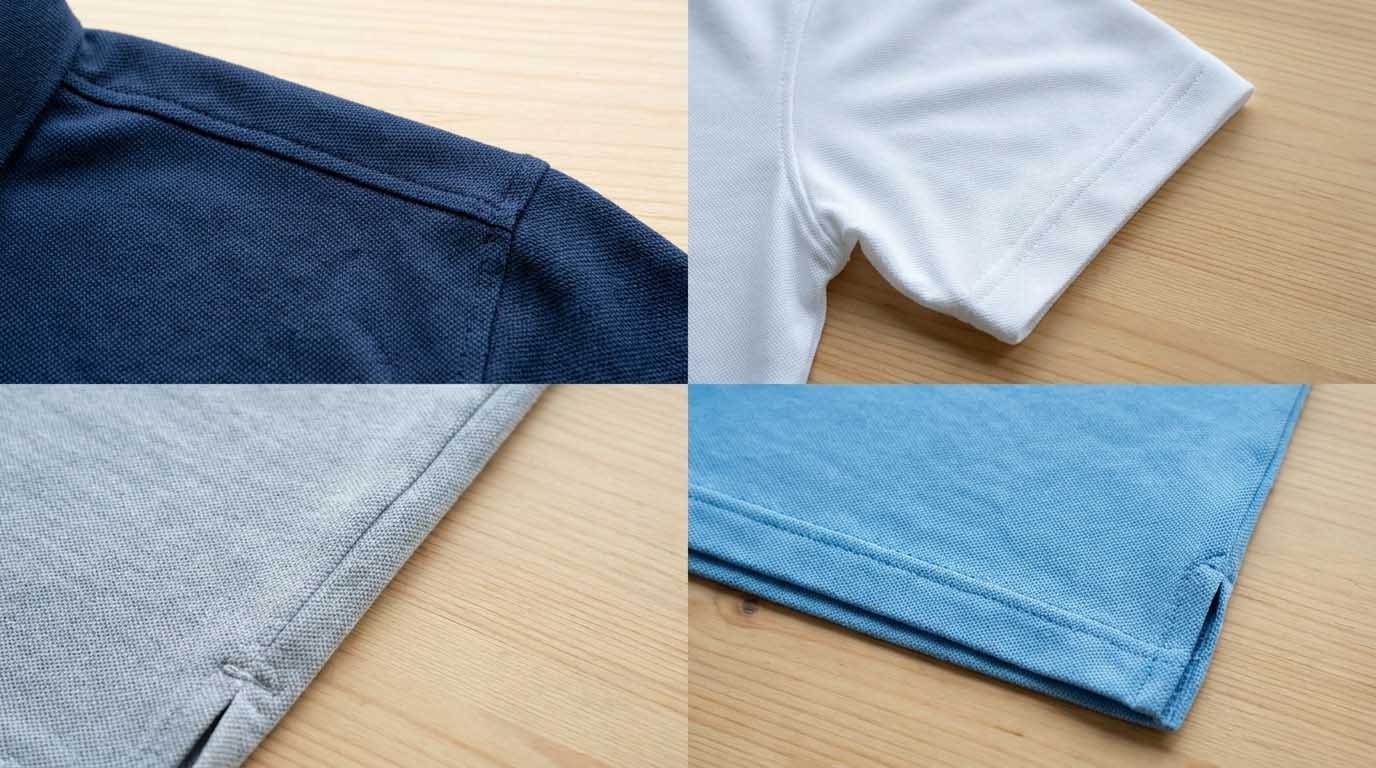
The correct seam depends on:
- fabric stretch,
- garment location,
- load,
- desired appearance.
Shoulder Seams
Shoulders experience repeated movement and need sufficient stability.
Check for:
- seam stretching,
- thread stress,
- uneven shoulder lengths.
Side Seams
Side seams should work with the stretch characteristics of the fabric.
When gently stretching the garment, stitching should not:
- break,
- restrict the fabric excessively,
- create permanent puckering.
Sleeve Attachment
Poor sleeve setting can create:
- puckering,
- twisting,
- uneven armholes.
Inspect the inside and outside of the sample.
Hem
The hem should remain:
- flat,
- even,
- balanced.
A wavy hem can indicate:
- excessive fabric feeding,
- unsuitable stitch tension,
- stretch distortion.
Four Common Seam Defects to Catch in Samples
Puckering
A seam appears wavy or gathered.
Possible causes include:
- stitch tension,
- thread mismatch,
- fabric instability,
- feeding problems.
Skipped Stitches
Missing stitches create weak points and an unfinished appearance.
Uneven Seam Allowance
Inconsistent allowance can create asymmetry and make bulk consistency harder to control.
Poor Edge Finishing
Exposed or poorly secured edges may affect durability and appearance.
The construction method should suit the knit fabric and intended product quality.
Pre-Production Construction Checklist
Before approving a golf polo for bulk production, confirm:
Fabric
- [ ] Composition approved
- [ ] Knit structure approved
- [ ] GSM approved
- [ ] Stretch behavior approved
- [ ] Wash behavior checked
- [ ] Performance claims supported where required
Pattern
- [ ] Base size fit approved
- [ ] Measurement chart confirmed
- [ ] Tolerances confirmed
- [ ] Golf movement tested
- [ ] Grading reviewed where required
Collar
- [ ] Collar shape approved
- [ ] Left/right symmetry checked
- [ ] Interlining/support confirmed
- [ ] No bubbling or twisting
- [ ] Wash behavior approved
Placket
- [ ] Center front aligned
- [ ] Stitching flat
- [ ] Buttonholes clean
- [ ] Stress points reinforced
- [ ] Wash stability approved
Seams
- [ ] Shoulder seams stable
- [ ] Side seams flat
- [ ] Sleeve attachment smooth
- [ ] Hem flat
- [ ] No skipped stitches or visible puckering
How Long Does Golf Polo Sampling Take?
At FUWAY, a typical initial sample takes around:
7–10 business days
depending on:
- fabric availability,
- trims,
- construction,
- artwork.
The full sampling cycle can take longer if the project requires:
- fit revisions,
- custom fabric,
- new colors,
- size-set samples,
- additional approvals.
The important distinction is:
Initial Sample Lead Time ≠ Complete Sampling Cycle
Frequently Asked Questions
What Is the Best Fabric for a Golf Polo?
There is no single best fabric.
The right material depends on:
- climate,
- fit,
- appearance,
- stretch,
- performance requirements.
Polyester, polyester/spandex, piqué, jersey, and interlock can all work depending on the design.
Does More Spandex Mean Better Stretch?
Not automatically.
Stretch depends on fiber content plus:
- yarn arrangement,
- knit structure,
- density,
- finishing.
Why Do Polo Collars Curl?
Common causes include:
- material instability,
- grain misalignment,
- poor interlining,
- pressing problems,
- construction imbalance.
What Is FUWAY's MOQ for Custom Golf Polos?
Typical FUWAY custom projects start around 100 pieces per style.
Custom-developed fabrics, special trims, or custom dyeing may have separate material minimums.
How Long Does Sampling Take?
A typical initial sample takes around 7–10 business days.
The complete development cycle may take longer if revisions or custom materials are required.
Should I Approve a Golf Polo Based on Photos?
No.
A physical sample allows you to evaluate:
- fabric,
- fit,
- collar,
- placket,
- seams,
- wash behavior.
Conclusion
Golf polo construction should be evaluated as one connected system:
Fabric → Pattern → Collar → Placket → Seams
A good-looking sample is not enough if the garment:
- restricts movement,
- curls after washing,
- develops a puckered placket,
- loses shape,
- has unstable seams.
For buyers, the most important step is to define measurable construction requirements before bulk production and verify them in physical samples.
At FUWAY, we support brands through Custom Golf Shirts, Fabric Sourcing, Embroidery, Screen Printing, Sublimation Printing, sampling, construction development, and bulk manufacturing.
For the complete factory workflow after construction approval, including tech pack control, bulk material preparation, cutting, decoration, sewing, QC, packing, and shipment, see our golf polo production process guide.
If you already have a golf polo reference sample, tech pack, fabric requirement, or target quantity, contact FUWAY to discuss your project.