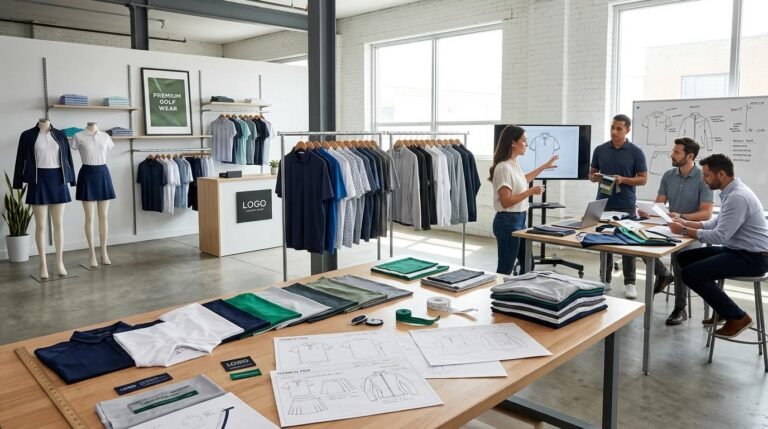
I've spent 15 years watching brands burn through sampling budgets because they treated golf polo design like picking colors from a mood board. The truth is simpler and harder: every design choice is a trade-off between what your golfer needs, what production can deliver, and what your budget allows.
A well-designed golf polo balances stretch recovery, collar durability, and cost reality—not just aesthetics. The brands that get this right avoid 3-4 sampling rounds and launch 6-8 weeks faster, while those who don't end up with expensive inventory they can't sell.
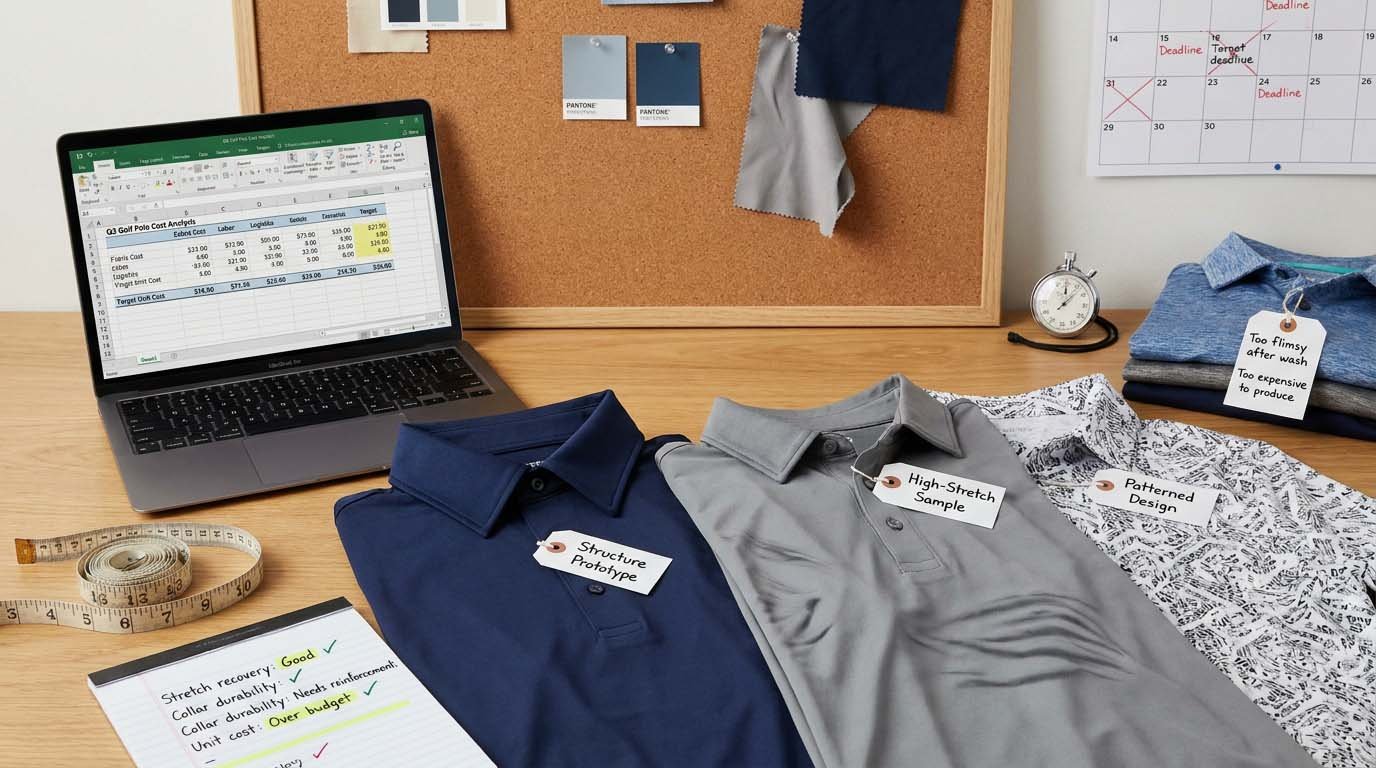
Most new brands ask me "what's trending" before they ask "what fits my customer." I get it—you want your polo to look premium. But here's what I've learned from hundreds of sampling revisions: the polo that sells isn't the one with the coolest details. It's the one where you made the right trade-offs between performance, production constraints, and price point from the start.
If you're mapping your overall launch strategy before finalizing polo details, start with how to start a golf apparel line.
Quick Answers: What You Need to Know About Golf Polo Design?
Before we go deep, here are five things I tell every client when they send their first design brief:
- Fit matters more than fabric – A $12 polyester polo with correct armhole depth will outsell a $28 merino blend with generic sizing
- Collar choice impacts unit cost by 15-30% – Traditional collars add interlining and stitching time, knit collars save cost but need higher MOQ
- Stretch direction beats stretch percentage – 5% elastane with four-way construction outperforms 10% single-direction stretch for golf swings
- Placket design changes lead time by 7-10 days – Hidden plackets require more sampling adjustments than ribbed or zipper options
- Most design failures come from unclear specs – Missing armhole depth, hem curve, or collar stand height causes 60% of revision requests we handle
Why Is the Polo the Anchor of Most Golf Brands?
The polo is the highest-volume, fastest-turning SKU in golf apparel—it defines your brand identity, tests your price positioning, and funds your expansion into other categories.
I've worked with brands that launched with full collections and brands that started with just two polo colorways. The ones who started small and got their polo right always scaled faster.
Here's why the polo matters so much:
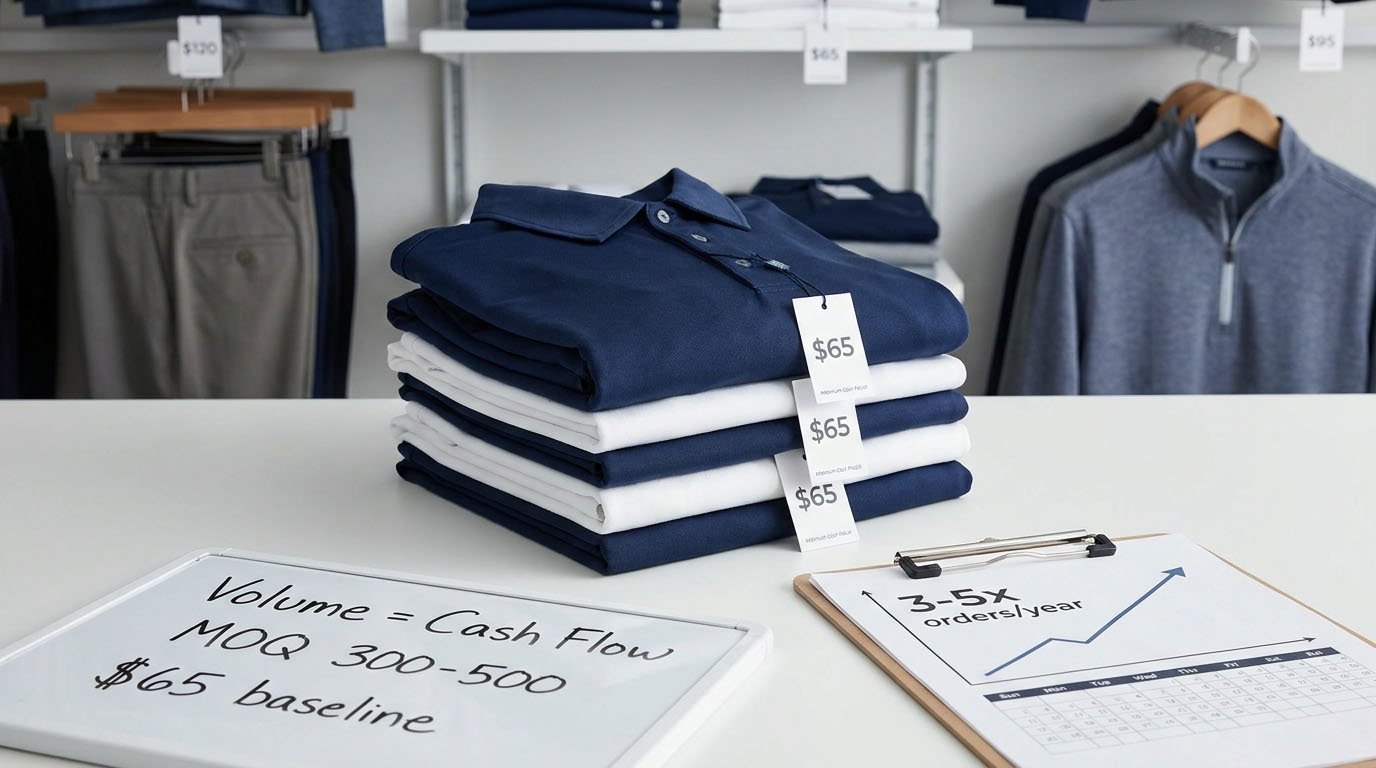
Volume and reorder frequency drive cash flow. A golfer who likes your polo will buy 3-5 pieces per year. Compare that to pants (1-2 pieces) or outerwear (maybe one). Your polo is your repeat-purchase engine.
Production flexibility keeps you competitive. Polos have lower MOQ thresholds than technical pieces. We can run 100-300 pieces per colorway for most constructions, which means you can test markets without overcommitting inventory. Try doing that with a bonded jacket.
Price perception sets brand positioning. If your polo retails at $65, customers expect your shorts at $75-85 and your quarter-zips at $95-110. Get your polo pricing wrong and your entire catalog feels off.
| Garment Type | Typical MOQ | Reorder Frequency | Price Multiplier vs Polo |
|---|---|---|---|
| Golf Polo | 100-300 pcs | 3-5x per year | 1.0x (baseline) |
| Golf Pants | 300-500 pcs | 1-2x per year | 1.15-1.30x |
| Quarter-Zip | 200-300 pcs | 1-2x per year | 1.45-1.70x |
| Outerwear | 300-500 pcs | 0.5-1x per year | 2.0-3.0x |
The brands I respect most spend 80% of their first year perfecting their polo. They test fabrics, refine sizing, and gather customer feedback before they add complexity. That patience pays off when they launch product line two—they already know their customer and their production rhythm.
How to Choose the Right Fit for Your Target Golfer?
Fit isn't about following trends—it's about matching your target customer's body type, swing style, and wearing preferences to avoid returns and negative reviews that kill conversion rates.
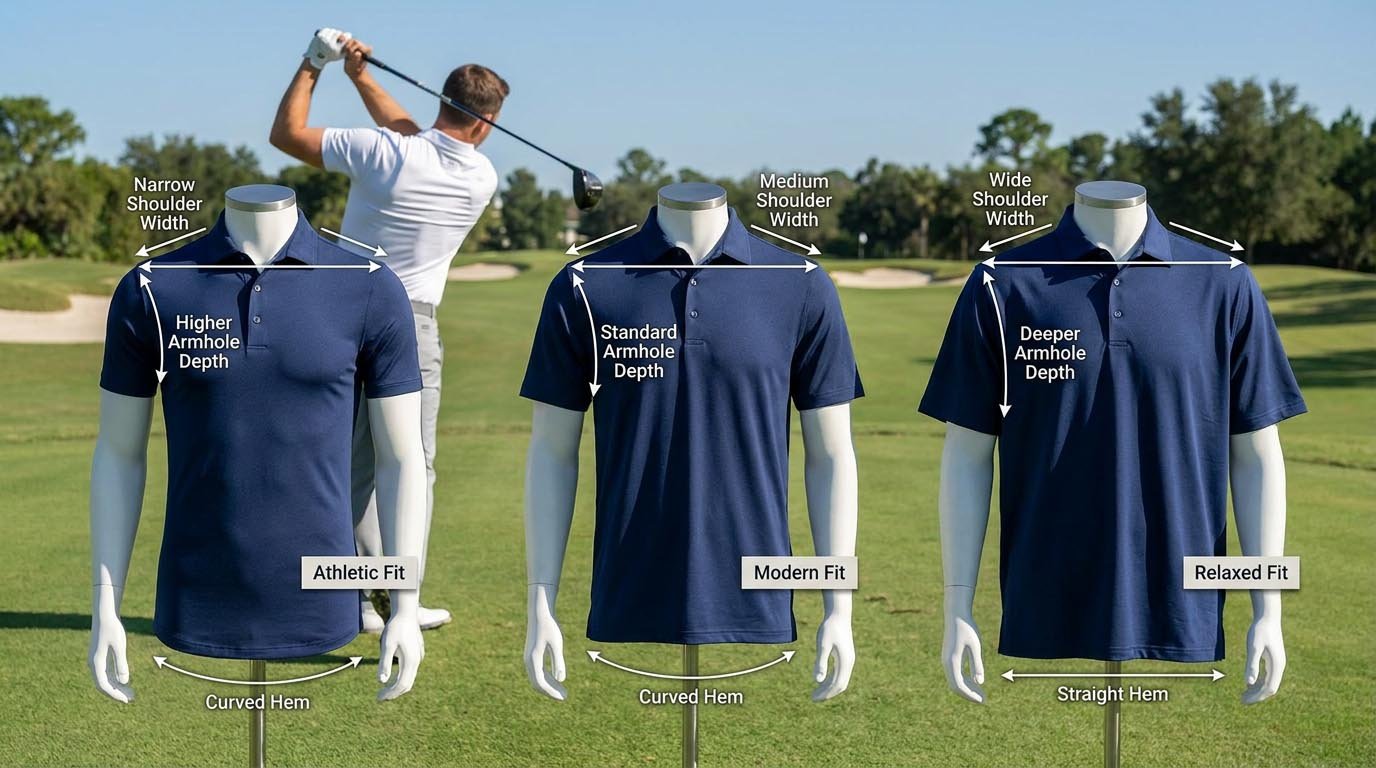
Here's where most brands waste their first sampling round: they send us "athletic fit" or "modern fit" without defining what that means in measurements. I've seen "slim fit" specs from three different brands with 4cm difference in chest width for the same size large.
Your fit decision breaks down into three questions:
What's your customer's torso shape? A 35-year-old golfer who lifts weights needs different shoulder and chest proportions than a 55-year-old with the same waist size. We've found that shoulder-to-chest ratio matters more than overall width—too tight in the shoulders creates pulling during backswing, too loose in the chest looks sloppy at address.
How much mobility do they need? Recreational golfers (85% of the market) tolerate less stretch if the fit is slightly relaxed. Competitive players and younger athletes expect full shoulder rotation without fabric pulling. Test this by having your sample wearer cross their arms and twist—the polo should move with them, not against them.
What's their wearing context? Some customers wear polos tucked on-course and untucked off-course. That changes your hem curve and side vent requirements. Others only play in hot climates and want looser fits for airflow. Ask yourself: is my customer wearing this for 18 holes in 32°C heat or for a quick 9 holes in the morning?
Key measurements that prevent fit revisions:
- Armhole depth: Most problems happen here. Start 2-2.5cm lower than fashion polos to allow backswing clearance
- Shoulder width: Match to natural shoulder point, don't extend for "broader" look—that restricts motion
- Hem curve: For untucked wear, front hem should sit 2-3cm higher than back hem for modern proportion
- Sleeve length: Should end mid-bicep (tucked wear) or slightly longer (untucked preference)
I always recommend brands create fit samples in three sizes (S/M/L or M/L/XL) before confirming grading. The $180-240 you spend on extra samples saves you from discovering fit issues after you've committed to 1,000+ pieces at $14-18 per unit.
What Collar and Placket Options Work Best?
Collar and placket construction directly impact comfort, durability, and unit cost—choosing wrong means customer complaints about curling collars or production delays from complex stitching requirements.
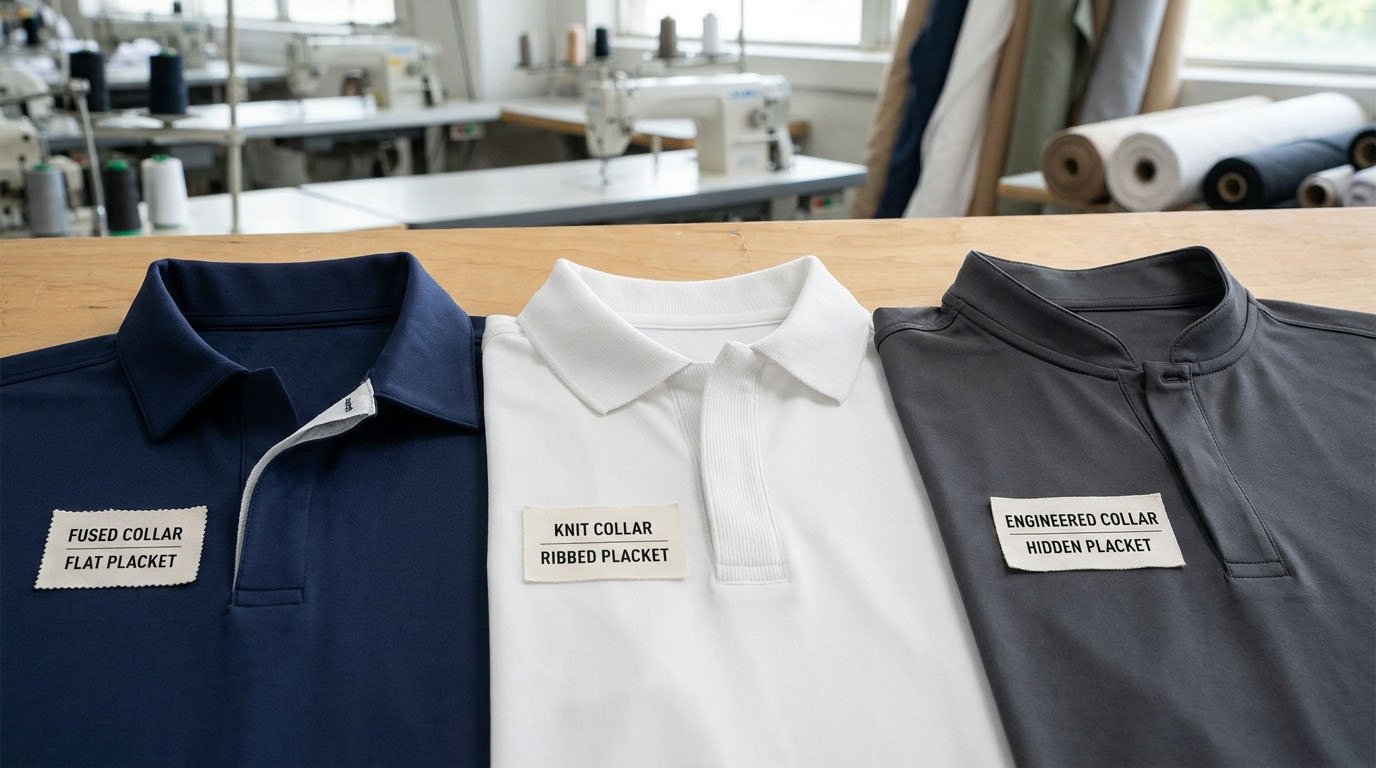
Let me share what we see in production. A brand sends a tech pack with "classic polo collar" and "standard placket." Then we ask: do you want fused interlining or unfused? Two-piece or three-piece collar? Ribbed placket or flat with interlining? They don't know, because no one told them these choices have real consequences.
Collar construction reality:
Traditional fused collars (two layers with interlining) give that stiff, formal look. They hold shape through 25-30 washes but add $0.80-1.20 to unit cost due to interlining material and extra stitching time. We see curling issues when customers use high-heat drying—the interlining shrinks differently than the outer fabric.
Knit collars (ribbed or engineered fabric) cost less and resist curling because they're single-layer and stretch with the garment. The trade-off? They require higher MOQ (500-800 pieces) because we need to knit custom collar fabric. They also look more casual, which might not fit your brand.
Engineered collar bands (like the newer athletic golf brands use) eliminate interlining by using textured or structured knit fabric. These are my favorite for new brands—they balance cost, comfort, and modern aesthetics. But they need proper collar stand height (4-4.5cm) or they flop.
| Collar Type | Unit Cost Impact | Durability (Washes) | MOQ Requirement | Best For |
|---|---|---|---|---|
| Traditional Fused | +$0.80-1.20 | 25-30 washes | 300-500 pcs | Premium/classic brands |
| Knit Ribbed | +$0.30-0.50 | 30-40 washes | 500-800 pcs | Athletic/casual brands |
| Engineered Band | +$0.50-0.80 | 30-35 washes | 300-500 pcs | Modern/performance brands |
Placket decisions that affect production:
Ribbed placket (knit fabric with button holes) is fastest to produce and lowest cost. No interlining, no fusing, just stitch and button. We can turn samples in 7-9 days. The downside? Limited premium perception—great for value brands, harder to justify $70+ retail.
Flat placket with interlining looks cleaner and more tailored. But it adds 2-3 days to sampling because we need to test interlining tension and button placement more carefully. If the interlining is too stiff, the placket ripples. Too soft, it looks cheap.
Hidden placket (buttons concealed under fabric panel) is trending with modern golf brands. It's sleek, but it's the highest complexity option—expect 10-12 days for first sample and potential fit adjustments. We've had brands approve this design, then switch back to standard after seeing the $1.50-2.00 unit cost increase.
My recommendation: match collar and placket to your price point. If you're selling at $55-70, go with knit collar and ribbed placket. At $70-90, traditional fused collar with flat placket. Above $90, you can justify engineered collars and hidden plackets if your customer values premium details.
How Do Hem, Sleeves and Mobility Details Affect Performance?
Hem construction, sleeve length, and mobility features separate polos that perform during golf swings from ones that just look athletic—small details here prevent restriction complaints and return rates.
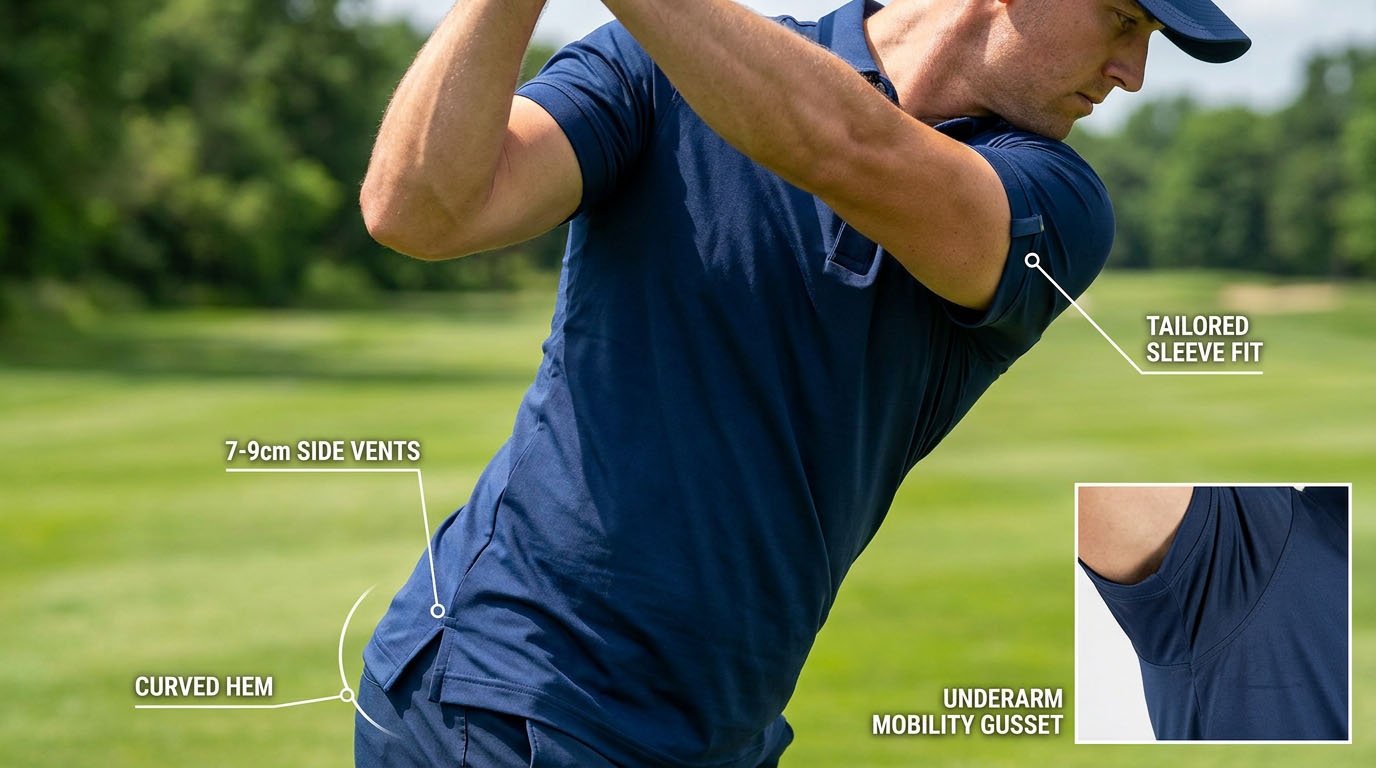
Most brands focus on big decisions like fabric and fit, then treat hem and sleeves as afterthoughts. That's a mistake. I've seen customers reject entire production runs because sleeve binding cut into their arms mid-swing or because side vents were too short and the hem rode up during rotation.
Hem details that matter:
Hem curve for untucked wear needs to be right. If your customer wears the polo untucked, the front hem should sit 2-3cm higher than the back hem. Too flat and it looks like they forgot to tuck it in. Too aggressive and it looks like a fashion tee, not a golf polo.
Side vents aren't optional for golf. Even if your polo is meant for tucked wear, vents provide hip mobility during address position and prevent fabric pulling. Standard vents run 5-7cm, but we recommend 7-9cm for plus-size ranges or relaxed fits.
Hem binding vs. turned hem is a cost decision. Turned hem (folded and stitched) is standard and clean. Binding (separate fabric strip sewn to raw edge) adds $0.20-0.30 but gives a sportier look and prevents hem stretching over time.
Sleeve length and construction:
Here's what we've learned from fit complaints: sleeve length variation by size matters more than absolute length. A medium polo with 22cm sleeve works great, but if your XXL has the same 22cm, it looks weirdly short on broader shoulders.
- Standard golf sleeve: 20-22cm (size M), graded up 0.8-1cm per size
- Athletic cut sleeve: 22-24cm for more coverage
- Sleeveless option: Requires armhole binding which adds $0.40-0.60 per unit
Sleeve hem can be turned, banded, or ribbed. Turned hem is cleanest. Banded (contrast fabric strip) adds visual interest but increases cost by $0.15-0.25. Ribbed cuffs (like casual polos) aren't common in golf but work for brands targeting the athleisure crossover market.
Mobility features worth considering:
- Raglan sleeves (diagonal shoulder seam) give maximum shoulder rotation but look more athletic—best for performance-focused brands
- Underarm gussets (small fabric panel) add rotation without changing silhouette, cost $0.30-0.50 per unit
- Stretch side panels (contrast fabric at sides) are trending but require pattern engineering and add $1.20-1.80 per unit
The brands that succeed here do motion testing with actual golfers before confirming patterns. Have your fit sample wearer do 10 full swings and 5 practice putts (bending forward). If anything pulls, rides up, or restricts movement, adjust before you approve production.
Which Fabrics Actually Work for Golf Polos?
Fabric choice isn't about finding the softest hand feel—it's about matching moisture management, stretch recovery, and durability to your price point while avoiding sampling loops from incorrect specs.
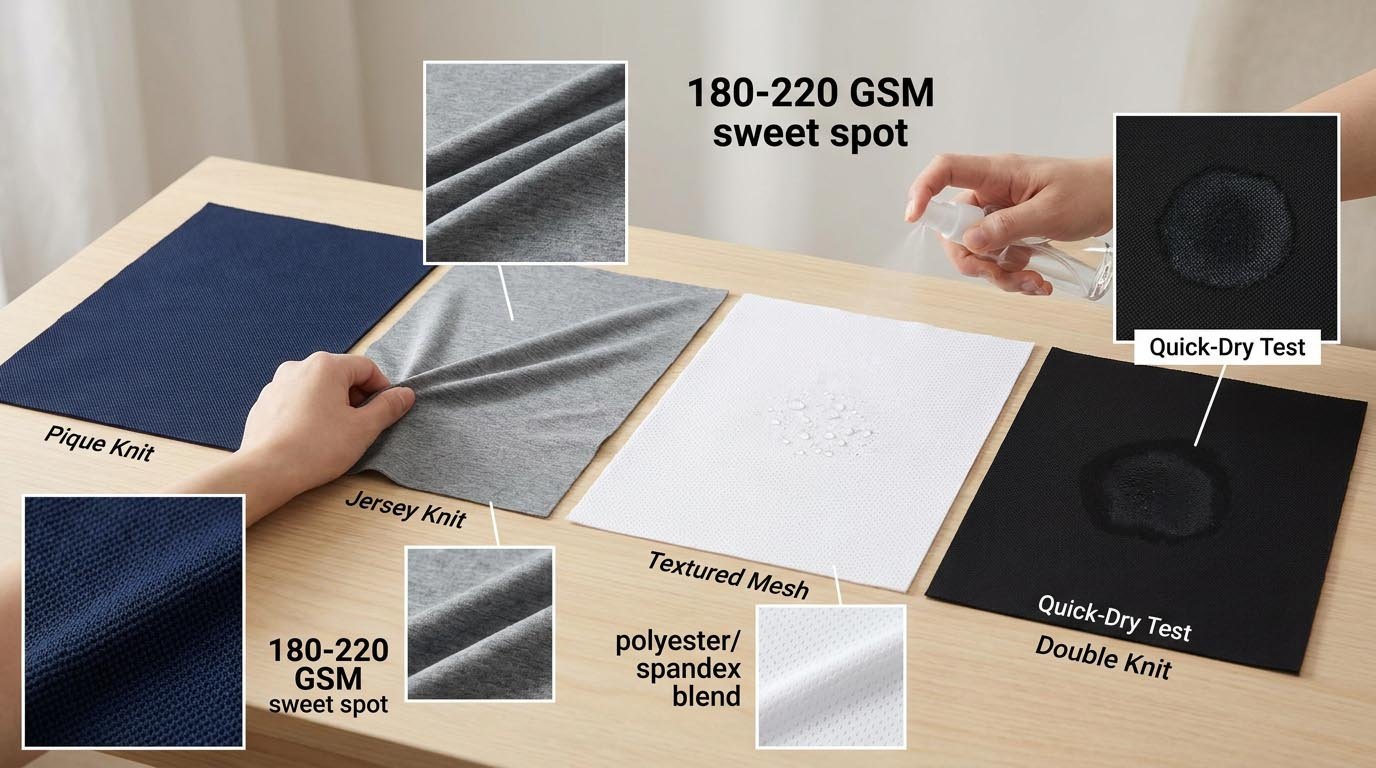
Every brand brief I receive mentions "moisture-wicking" and "four-way stretch" like they're magic words. But here's the reality: all polyester wicks moisture to some degree, and not all stretch fabrics recover well after a golf swing.
The fabric questions that actually matter:
Does the stretch work in the right direction? I've tested polos with 10% elastane that restricted shoulder rotation because the stretch was vertical (warp direction) instead of horizontal (weft direction). For golf, you need horizontal stretch for torso rotation and vertical stretch for arm raising. Four-way stretch isn't required, but two-way must be in the right direction.
Test this yourself: hold a fabric swatch vertically and pull horizontally. It should stretch 20-30% and snap back quickly. If it stays stretched, the recovery speed is too slow—that polo will bag out after 3-4 wears.
Does the fabric dry fast enough for hot climates? Your customer might play 18 holes in 35°C heat. A thick pique knit (240-280 GSM) looks premium but holds sweat. A lightweight mesh (140-180 GSM) dries faster but can look cheap if the knit structure is too open.
| Fabric Type | GSM Range | Elastane % | Unit Cost Impact | Best Use Case |
|---|---|---|---|---|
| Pique Knit | 200-240 | 3-5% | Baseline | All-weather, classic brands |
| Jersey Knit | 160-200 | 5-8% | -$0.40 to -0.60 | Budget/casual lines |
| Textured Mesh | 140-180 | 5-10% | +$0.60 to +1.00 | Hot climate, performance |
| Double Knit | 240-280 | 3-5% | +$0.80 to +1.40 | Premium, cool weather |
Does the fabric pill after washing? We recommend brands order 3-meter fabric swatches before committing to sampling. Wash them 5 times on normal cycle, tumble dry on medium heat. If you see pilling or color fading, that fabric won't last in customer hands. Some polyester blends pill within 10-15 washes—those complaints destroy your reviews.
Fabric specs I always lock down before sampling:
- GSM (grams per square meter): Affects drape, durability, and cost. Sweet spot for golf is 180-220 GSM
- Composition: 100% polyester is standard. Poly-spandex blends (92/8 or 95/5) add stretch. Cotton blends (35% cotton) add softness but reduce wicking
- Knit structure: Pique (raised texture) vs. jersey (smooth) vs. interlock (double-layer smoothness)
- Finish treatment: Some fabrics need anti-microbial or UV treatment—adds $0.50-0.90 per unit
The biggest fabric mistake I see: brands pick fabric based on how it feels in their hands, not how it performs on a golfer's body. A butter-soft jersey knit feels amazing but might cling to sweat. A slightly rougher pique texture feels less premium but dries faster and hides moisture marks.
I always tell clients: order lab dips and strike-offs (color samples on actual fabric) before bulk production. The $80-120 you spend confirms that your chosen fabric takes dye evenly and matches your color expectations. We've had brands approve fabric in white, then discover the dye lot shifted when produced in navy—that's a $4,000-6,000 mistake on a 500-piece order.
What Are the Most Common Golf Polo Design Mistakes?
Most golf polo failures come from unclear specs, unrealistic production expectations, and designing for trends instead of customer needs—here's how to avoid the mistakes that cost brands 4-6 weeks and $2,000-4,000 in sampling.
I keep a folder of design revisions we've handled. Some patterns repeat every season, especially with new brands who are designing their first golf line.
Mistake 1: Treating "athletic fit" like a standard spec
A brand sends a tech pack that says "athletic fit, modern cut" with no measurements. We ask for chest, waist, and hem width. They send fashion polo measurements. We sample it. The fit is too tight in the shoulders for a golf swing.
Fix: Provide actual garment measurements for every size, not body measurements. Specify chest width, shoulder width, armhole depth, and hem width. If you don't have measurements, ask us for baseline specs in your preferred fit category, then adjust from there.
Mistake 2: Choosing fabric based on competitor teardown without testing
A brand reverse-engineers a major golf brand's polo, identifies the fabric as "200 GSM poly pique with 5% spandex," and requests the same. We sample it. The hand feel is completely different because major brands use custom-developed fabrics with proprietary finishes.
Fix: Order fabric swatches from 3-4 suppliers before sampling. Test them for stretch, recovery, and wash durability. Accept that you might not match the exact hand feel of a brand spending $18-22 per unit on fabric when your target is $12-16 all-in cost.
Mistake 3: Ignoring production lead time in timeline planning
A brand wants to launch for spring golf season (March-April). They send design brief in January, expecting production by February. That timeline doesn't account for sampling (2-3 weeks), revisions (1-2 weeks), fabric sourcing for bulk (3-4 weeks), and production (4-5 weeks).
Fix: Work backwards from your launch date. For a March launch, your design brief should be locked by early October at the latest. Budget 12-16 weeks total from first brief to finished goods.
| Design Timeline Phase | Typical Duration | Common Delay Factors |
|---|---|---|
| Design Brief Finalization | 1-2 weeks | Unclear specs, missing measurements |
| First Sampling | 10-14 days | Custom fabric delays, complex construction |
| Sample Revision | 7-10 days per round | Fit changes, color adjustments |
| Pre-production Approval | 3-5 days | Client review delays |
| Bulk Fabric Sourcing | 20-30 days | Dye lot matching, custom orders |
| Bulk Production | 30-40 days | Order size, factory scheduling |
Mistake 4: Overcomplicating first designs to "stand out"
A new brand wants contrast piping, sublimated panels, custom collar construction, and laser-cut vents on their first polo. The unit cost comes in at $22-26, which forces a retail price of $85-100. Their target market is recreational golfers expecting $60-75 polos.
Fix: Start simple. Nail your fit, fabric, and color palette on a clean design. Add complexity in season two after you've validated demand. We've seen brands succeed with 3 solid colors and 2 stripes as their entire launch lineup—then expand to 12 SKUs once they understood their customer.
Mistake 5: Skipping pre-production samples to save time
A brand approves a sample, then asks us to go straight to bulk production. Midway through production, they realize the size run grading isn't quite right, or the fabric color shifted slightly in bulk dyeing. It's too late to fix without canceling the order and starting over.
Fix: Always request pre-production samples (samples from actual bulk fabric in your size range). This costs $80-150 depending on size run but catches issues before you've committed to 500-1,000+ units. The brands I respect most do this even when it delays launch by 10-14 days.
Mistake 6: Not specifying collar and placket construction clearly
A brand says "traditional collar" without specifying fused vs. unfused interlining. We choose fused (our standard for traditional collars). They receive samples and say it's too stiff. We remake with lighter interlining. They approve. In bulk production, the collar curls after washing because the interlining-to-fabric ratio wasn't tested properly.
Fix: Ask your manufacturer to provide collar construction options with photos and cost impacts before sampling. Specify whether you want stiff/medium/soft hand feel and whether wash durability or premium appearance is more important.
Better fit becomes even more valuable when it is built into a realistic first collection plan, which we outline in how to start a golf apparel line.
Conclusion
Designing a golf polo that actually sells means making informed trade-offs between performance, production constraints, and cost reality. Lock down your fit measurements, test fabric swatches before sampling, and match your design complexity to your price point—because the polo that succeeds isn't the one with the most features, it's the one where you avoided costly mistakes from the start.