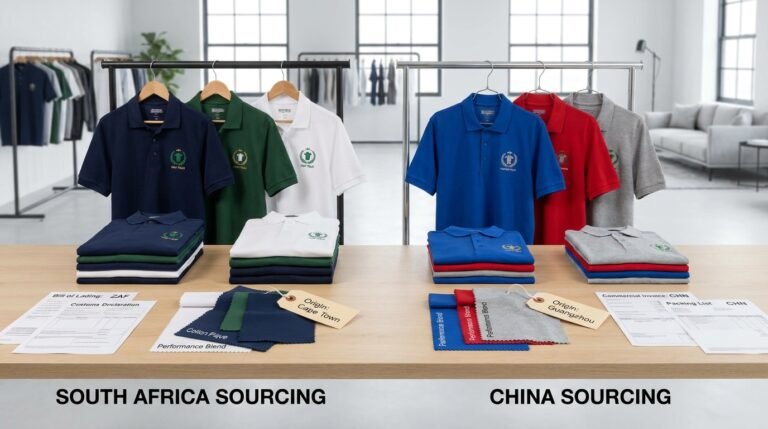
You have shortlisted several golf apparel factories. Their quotations look competitive, samples appear acceptable, and each supplier promises reliable delivery. But which one should you choose?
To compare 3–5 golf apparel factories, standardize your product requirements, eliminate suppliers that fail essential conditions, and use a weighted scorecard to evaluate quality control, manufacturing capability, communication, lead time, and total cost. Base your decision on verified evidence—not just price or sample appearance.

This guide provides a practical scoring framework, a worked factory comparison, and an Excel template for documenting your final sourcing decision.
If you are still building your shortlist, start with our guide to choosing wholesale golf apparel suppliers.
Quick Answer: How Do You Compare Golf Apparel Factories?
An effective supplier comparison follows seven steps:
- Standardize the RFQ: Send identical specifications to every factory.
- Apply pass/fail gates: Exclude suppliers that cannot meet essential requirements.
- Set scoring weights: Prioritize quality, capability, communication, delivery, and cost.
- Score the evidence: Evaluate qualified factories using a consistent 1–5 rating scale.
- Check golf-specific capability: Review relevant fabric, fit, and construction requirements.
- Make the final decision: Compare total cost, unresolved risks, and production reliability.
- Review actual performance: Update the scorecard after the first order.
Recommended Scoring Weights
| Evaluation Category | Weight |
|---|---|
| Quality Control & Bulk Consistency | 35% |
| Factory–Project Fit | 20% |
| Communication & Problem Solving | 20% |
| Lead Time & Capacity | 15% |
| Cost & Commercial Terms | 10% |
| Total | 100% |
These are example weights for a performance golf apparel project, not an industry standard. Adjust them to your product and sourcing priorities.
Step 1: Standardize Your RFQ Before Comparing Factories
A supplier scorecard only works when factories quote comparable products.
For example, one supplier may quote a basic polyester piqué polo while another includes a stretch interlock fabric, custom collar, and embroidery. Comparing those quotations directly would be misleading.
What Should Your RFQ Include?
| Requirement | What to Specify |
|---|---|
| Product | Polo, shorts, pants, skort, or quarter-zip |
| Fabric | Composition, GSM, construction, and performance |
| Construction | Fit, seams, collar, waistband, and trims |
| Customization | Logo method, labels, and packaging |
| Order Quantity | Units per style, color, and size |
| Quality | Measurements, tolerances, tests, and inspection requirements |
| Delivery | Required shipment window and destination |
| Commercial Terms | Currency, Incoterms, sample costs, and payment terms |
For unfinished designs, prepare a consistent specification package before requesting final quotations.
Our Golf Apparel Tech Pack Checklist explains the documents manufacturers need before sampling.
Scoring rule: Do not award cost points until all quotations reflect comparable materials, customization, quantities, and delivery terms.
Step 2: Apply Pass/Fail Gates Before Weighted Scoring
A low-priced supplier should not qualify simply because its commercial score compensates for unacceptable production risks.
Use pass/fail gates to eliminate suppliers that cannot meet non-negotiable project requirements.
Factory Qualification Checklist
| Qualification Gate | Evidence to Check |
|---|---|
| Legal & Commercial Transparency | Contracting entity and payment arrangements |
| Manufacturing Capability | Relevant products, samples, and processes |
| MOQ & Fabric Availability | Confirmed quantities and material access |
| Production Capacity | Realistic production and delivery schedule |
| Required Compliance | Applicable product and market documentation |
| Bulk Quality Controls | Sample approval and inspection procedures |
Record each gate as Pass, Fail, or Pending.
Reject a supplier when it cannot satisfy an essential requirement. If evidence is missing, mark the item Pending and investigate before making a final selection.
Do not impose arbitrary requirements, such as mandatory automated machinery or a fixed capacity multiple, unless your project genuinely requires them.
For deeper legal, production, and pre-deposit checks, see How to Verify a Golf Apparel Factory in China.
The purpose of this scorecard is to compare qualified candidates—not repeat the complete factory verification process.
Step 3: Set Evaluation Criteria and Scoring Weights
After qualification, score each supplier using the same five categories.
Supplier Evaluation Criteria
| Category | Weight | What to Evaluate |
|---|---|---|
| Quality Process | 35% | Fabric checks, sample-to-bulk controls, inspection records |
| Factory–Project Fit | 20% | Relevant garment experience and technical capability |
| Communication | 20% | Technical clarity, transparency, problem resolution |
| Lead Time | 15% | Capacity confirmation and realistic scheduling |
| Total Cost | 10% | Comparable quotations, extra charges, commercial terms |
Avoid double-counting the same evidence across different categories.
For example, a well-made sample may demonstrate technical capability, but it does not independently prove that the factory has strong bulk-production quality controls.
Use a Consistent 1–5 Scoring Scale
| Score | Meaning |
|---|---|
| 1 | Unverified or substantially below requirements |
| 2 | Weak evidence or major concerns |
| 3 | Acceptable evidence and basic requirements |
| 4 | Strong capability supported by credible evidence |
| 5 | Thoroughly verified capability with relevant records |
A factory should not receive a high score merely because its sales representative makes confident promises.
Look for relevant samples, measurement records, material test results, inspection documents, and clear corrective-action procedures.
Important: Set the weighting before evaluating final quotations. Otherwise, buyers may unconsciously adjust the model to favor a preferred supplier.
Step 4: Compare 3–5 Factories Using a Weighted Scorecard
This is the most important stage.
After every factory passes the mandatory gates, assign a 1–5 rating for each evaluation category and calculate the weighted total.

Example: Three-Factory Comparison
Assume a brand is sourcing custom performance golf polos.
All three shortlisted factories have passed the qualification gates.
The following scores are hypothetical examples, not real factory audit results.
| Evaluation Category | Weight | Factory A | Factory B | Factory C |
|---|---|---|---|---|
| Quality Process | 35% | 4 | 3 | 5 |
| Factory–Project Fit | 20% | 4 | 5 | 4 |
| Communication | 20% | 4 | 3 | 4 |
| Lead Time | 15% | 3 | 5 | 3 |
| Total Cost | 10% | 5 | 4 | 3 |
| Weighted Total / 100 | 100% | 79 | 76 | 82 |
How to Calculate the Score
Multiply each category rating by its percentage weight, add the results, and divide by five.
Formula:
Weighted Score = SUM(Rating × Weight) ÷ 5
For Factory C:
(5 × 35 + 4 × 20 + 4 × 20 + 3 × 15 + 3 × 10) ÷ 5 = 82/100
Factory C receives the highest score, followed by Factory A and Factory B.
Does the Highest-Scoring Factory Automatically Win?
No.
Factory C leads because of its quality-process score, but its delivery and cost ratings are weaker.
If the buyer has a fixed tournament launch deadline, Factory A may be more suitable once schedule risks are reviewed.
The scorecard supports the decision. It does not replace commercial judgment or verification.
When comparing four or five factories, extend the scoring columns while keeping the criteria and weighting consistent.
Do not assign a final ranking to suppliers with unresolved mandatory requirements.
Step 5: Evaluate Golf-Specific Manufacturing Risks
A general apparel factory may manufacture excellent golf clothing, but its capability should be verified against the products you actually intend to order.
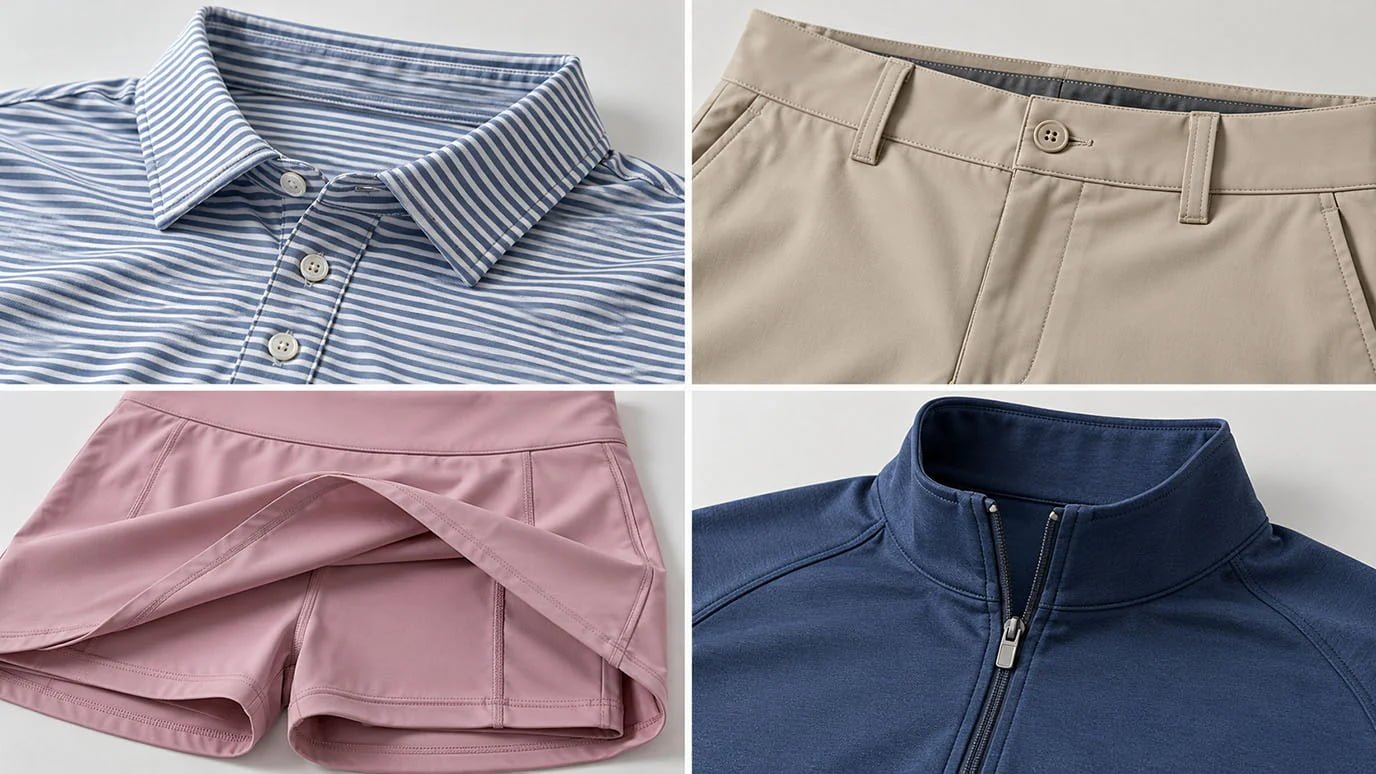
Golf polos, bottoms, skorts, and quarter-zips require different construction and performance controls.
Golf Apparel Technical Evaluation Matrix
| Product | Key Risks | Evidence to Request |
|---|---|---|
| Golf Polo | Collar curling, placket alignment, stretch recovery | Approved sample, measurements, wash-test records |
| Golf Shorts & Pants | Waistband fit, seam strength, mobility | Fit sample, construction details |
| Golf Skort | Inner-short comfort, waistband stability, skirt length | Fit review, measurement chart |
| Quarter-Zip | Zipper alignment, sleeve mobility, layering fit | Construction sample, technical review |
| Branded Golfwear | Logo placement and decoration consistency | Approved artwork, decorated sample |
Evaluate Experience, Not Just Factory Labels
A factory specializing in golf apparel may identify technical problems earlier. However, a general sportswear manufacturer with relevant production experience can also be suitable.
Our Golf-Specific vs General Sportswear Factory Guide explains these differences in more detail.
Check Sample-to-Bulk Consistency
Ask each supplier three questions:
- How are approved materials, measurements, and trims transferred into bulk production?
- How are production defects identified and corrected?
- How are finished garments inspected before shipment?
Use supporting records to evaluate the quality-process score.
For detailed inspection methods and AQL considerations, refer to FUWAY's Golf Apparel Quality Control Guide.
Step 6: Make the Final Supplier Decision Beyond Unit Price
A low quoted price does not automatically mean a low total sourcing cost.
Two factories may offer different prices because they include different fabrics, decoration methods, packaging, quality requirements, or shipping arrangements.
Compare Total Commercial Exposure
| Decision Factor | What to Confirm |
|---|---|
| Unit Price | Same specifications and order quantities |
| Development Cost | Sample fees and revision charges |
| Materials | Approved fabrics, trims, and availability |
| Inspection | Agreed inspection standards and responsibilities |
| Logistics | Incoterms, freight responsibilities, and timing |
| Production Risk | Evidence of consistency and corrective-action capability |
Avoid inventing defect rates or financial penalties when no historical records support those assumptions.
Final Decision Checklist
Before placing a bulk order, confirm:
- The selected factory has passed all mandatory gates.
- The score is supported by relevant evidence.
- The approved sample represents the intended bulk specifications.
- Measurement tolerances and inspection requirements are agreed in writing.
- The production schedule and commercial terms are confirmed.
- Material substitutions and production changes require approval.
A controlled first order can help validate the supplier's ability to reproduce the approved product.
Keep a qualified second-choice supplier as a backup when practical.
Step 7: Download and Reuse the Supplier Scorecard
A supplier scorecard should remain useful beyond the first sourcing decision.
Download the Golf Apparel Supplier Scorecard Excel Template
The template is designed to compare up to five candidate factories using:
- Pass/fail qualification gates
- Adjustable category weights
- Consistent 1–5 scoring
- Automatic weighted totals
- Supplier evidence and decision records
Update the Scorecard After Bulk Delivery
The initial score reflects expected performance. After delivery, evaluate what actually happened.
| Performance Area | What to Review |
|---|---|
| Product Quality | Did bulk match the approved sample? |
| Delivery | Was the agreed schedule achieved? |
| Communication | Were changes and problems reported promptly? |
| Corrective Action | Were production issues resolved effectively? |
| Repeatability | Can the supplier maintain the approved specifications? |

Retain the original scores and record actual performance separately.
This helps buyers distinguish a factory that makes a convincing sales presentation from one that consistently delivers acceptable products.
Frequently Asked Questions
How Many Golf Apparel Factories Should I Compare?
Three to five is a practical shortlist for many sourcing projects. It allows meaningful comparison without making sampling and evaluation unnecessarily complicated.
Is a Supplier Scorecard Better Than a Factory Audit?
They serve different purposes. A factory audit verifies capabilities and operating conditions, while a scorecard compares candidates using consistent evaluation criteria. Higher-risk projects may require both.
Should Sample Quality Matter More Than Price?
Sample quality matters, but a single sample does not prove bulk consistency. Evaluate the sample alongside the factory's production controls, material management, and inspection records.
What If Two Factories Receive Similar Scores?
Review the evidence behind each rating and focus on the risks most relevant to your order. A small numerical difference should not automatically determine the winner.
Conclusion: Choose the Best Factory for Your Project
Comparing golf apparel manufacturers requires more than collecting quotations and reviewing samples.
A structured supplier scorecard helps buyers standardize requirements, exclude unsuitable candidates, evaluate manufacturing evidence, and document sourcing decisions.
The process is straightforward:
Standardize → Qualify → Score → Compare → Decide → Review
The best supplier is not necessarily the cheapest or highest-scoring factory. It is the manufacturer that demonstrates the strongest fit for your product requirements, commercial priorities, and production expectations.
At FUWAY, we support brands developing custom golf polos, shorts, pants, skorts, and performance layers through OEM/ODM manufacturing.
If you are comparing manufacturing partners, contact FUWAY with your tech pack, target quantities, customization requirements, and expected delivery window. Our team can provide relevant manufacturing information to support your supplier evaluation.