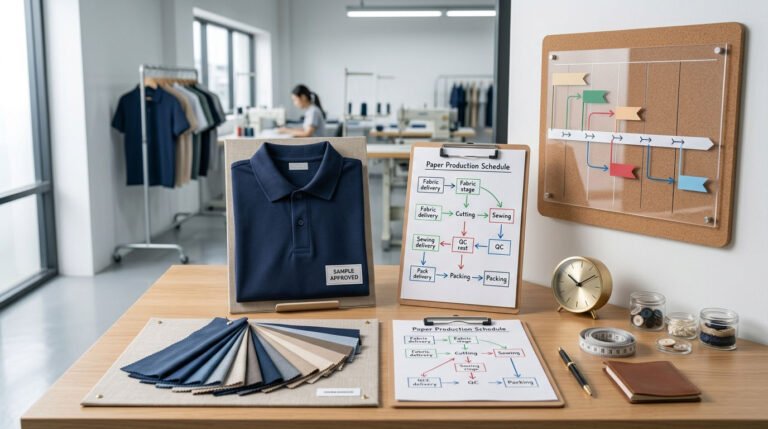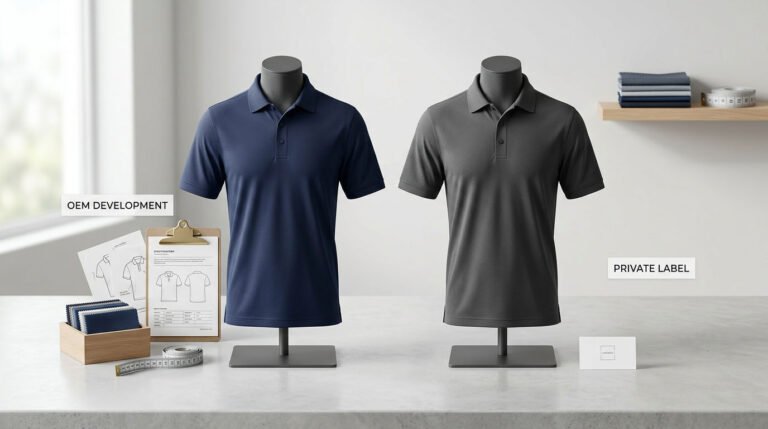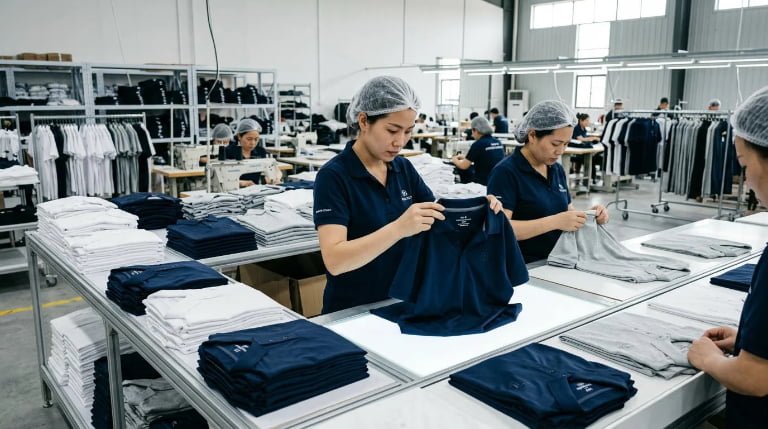
You found a golf apparel factory in China. The price looks reasonable, the samples look good, and communication has been smooth.
Now comes the uncomfortable part: sending the deposit.
Before you transfer money, you need to verify more than whether the company exists. You need to know whether the factory can actually produce your golf apparel at the quality, price, quantity, and timeline you agreed on.
To verify a golf apparel factory in China before paying a deposit, check its legal identity and payment details, confirm its golf apparel production experience, review samples and bulk-production evidence, verify QC procedures, and put specifications, costs, timelines, and payment terms in writing.

This guide walks through the practical checks a golf brand should complete before committing to bulk production.
If you are still comparing potential suppliers, you can also review how an experienced golf apparel manufacturer presents its products, customization capabilities, sourcing process, quality controls, and communication before you make a final decision.
Quick Factory Verification Checklist
Before paying a deposit, confirm these 10 points:
| Check | What You Should Verify | Possible Red Flag |
|---|---|---|
| Business identity | Legal company name and registration | Refuses to provide documents |
| Payment details | Beneficiary matches contracting company | Requests payment to a personal account |
| Factory activity | Real cutting, sewing, finishing or QC operations | Only showroom photos |
| Golf apparel experience | Relevant golf polos, bottoms, jackets or performance wear | Only general promotional clothing |
| Fabric knowledge | GSM, stretch, shrinkage, finishing and performance | Very vague answers |
| Sample process | Sample matches agreed specifications | Sample materials differ from bulk |
| Bulk-production evidence | Previous bulk orders or production records | Only perfect showroom samples |
| QC process | Measurement, workmanship and final inspection procedures | No written QC standards |
| Quotation | Clear product, materials, trims and packaging scope | Very low one-line quotation |
| Payment terms | Clear deposit and balance milestones | Demands full payment before production |
A supplier does not need to be perfect in every area.
What matters is whether the evidence is consistent.
Why Should You Verify a Golf Apparel Factory Before Paying a Deposit?
Paying a deposit changes your position.
Before payment, you can still compare factories, adjust specifications, negotiate details, or walk away.
After payment, changing suppliers becomes much more expensive.
The biggest sourcing problems are often not outright scams. They are more ordinary operational problems such as:
- fabric that does not match the approved sample
- collar shape changing after washing
- incorrect measurements
- unexpected trim or packaging costs
- bulk color differences
- production delays
- poor communication after the order is confirmed
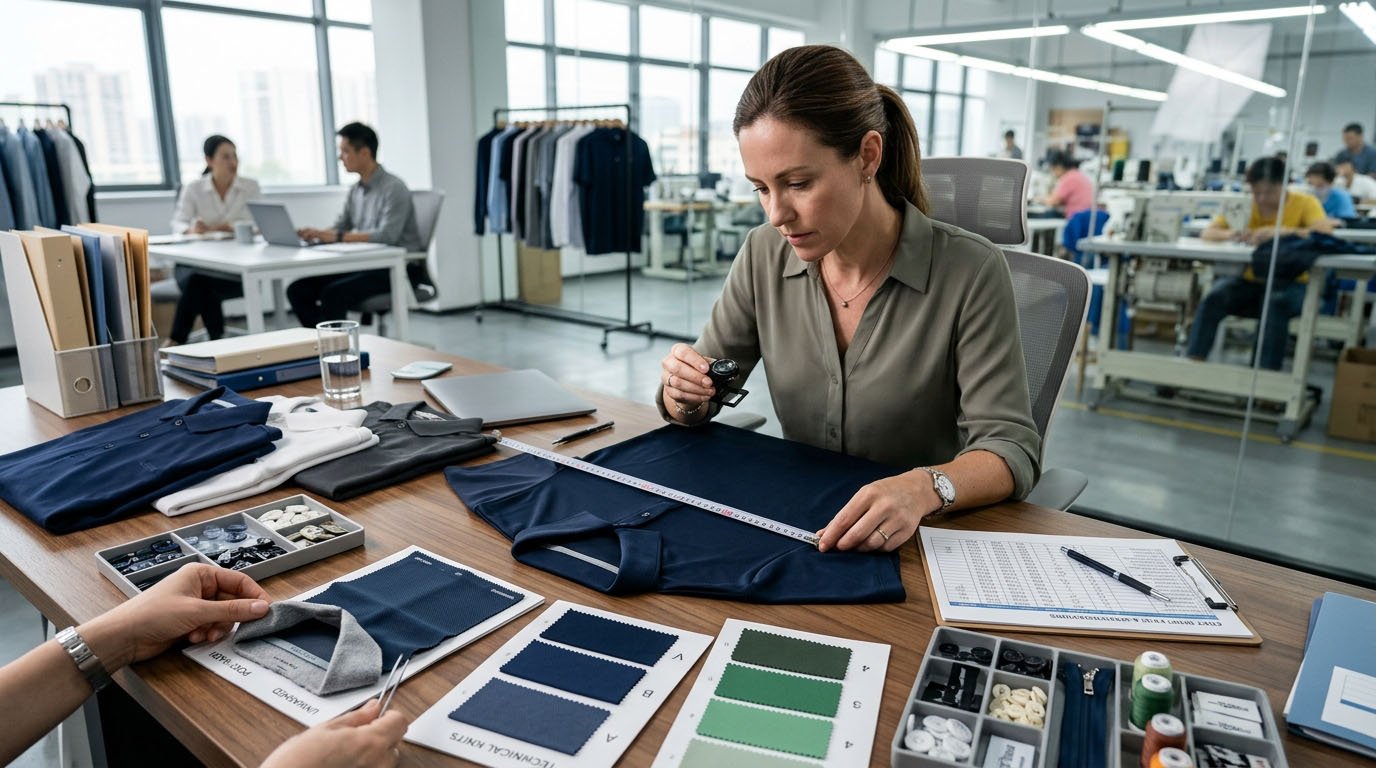
The goal of factory verification is therefore not only to answer:
Is this company real?
It should also answer:
Can this company reliably produce my specific golf apparel order?
Step 1: Check the Company's Business Identity
Start with the basic legal information.
Ask the supplier for its registered company name and business registration information.
Do not rely only on the English company name shown on a website.
Chinese companies may use an English trading name internationally while contracts, licenses, and bank accounts use the official registered entity.
What should you check?
At minimum, compare:
- company name on the business registration
- company name on the quotation or proforma invoice
- bank beneficiary name
- factory or office address
- contact information
The names may not always be identical for legitimate reasons. For example, a manufacturer may export through an affiliated trading company.
But any difference should have a clear explanation.
What is a red flag?
Be more cautious when:
- the supplier refuses to provide company information
- payment suddenly changes to a different company
- you are asked to transfer a large deposit to an individual
- the company cannot explain the relationship between the factory and payment entity
A mismatch does not automatically mean fraud.
It means you should verify the relationship before paying.
Step 2: Confirm That the Supplier Actually Handles Production

A professional website does not prove that a company owns or operates a factory.
Some suppliers are manufacturers.
Some are trading companies.
Some are manufacturers with trading operations.
None of these models is automatically good or bad.
The important question is whether the supplier has enough control over production to meet your requirements.
Ask for a live factory walkthrough
A simple video call can tell you a lot.
Ask the salesperson to show:
- fabric storage
- cutting area
- sewing lines
- embroidery or printing area if applicable
- ironing and finishing
- QC area
- packing area
A live walkthrough is more useful than a collection of edited factory photos.
However, even a video call should be only one part of your verification.
For larger orders, third-party factory audits may provide another layer of assurance.
Step 3: Test Their Golf Apparel Knowledge
A general clothing factory may be able to sew a polo shirt.
That does not automatically mean it understands golf apparel.
Golf clothing often requires more attention to:
- stretch
- recovery
- moisture management
- UV protection
- collar stability
- lightweight construction
- fit during movement
- colorfastness
- shrinkage
- printing or embroidery on performance fabrics
Instead of asking:
Can you manufacture golf polos?
Ask more specific questions.
Good technical questions include:
- What fabric weight would you recommend for a lightweight golf polo?
- How do you reduce collar curling after repeated washing?
- How do you test shrinkage before bulk production?
- What tolerance do you normally use for garment measurements?
- How do you control color differences between dye lots?
- Can you source polyester-spandex or nylon-spandex fabrics?
- How do you handle heat-transfer logos on stretch fabrics?
- Can you provide test reports for performance claims when required?
If you are developing performance polos, reviewing a supplier's custom golf shirts capabilities can also help you understand whether they offer the fabric, fit, branding, and construction options your project requires.
A capable supplier should be able to explain the options and trade-offs.
Be cautious when every answer is simply:
No problem. We can do it.
Step 4: Check Whether the Factory Fits Your MOQ
The biggest factory is not always the best factory for your brand.
A factory designed around very large production runs may not prioritize a 100-piece startup order.
At the same time, a very small workshop may struggle when your brand grows from a few hundred pieces to several thousand.
Ask about MOQ early.
MOQ can depend on:
- fabric availability
- custom dyeing
- number of colors
- garment design
- printing method
- embroidery
- labels
- trims
- packaging
For custom golf apparel, MOQ varies significantly between suppliers and projects.
Some factories can support relatively small runs using available fabrics, while custom-developed fabrics or colors may require higher quantities.
The important question is not:
Does this factory have the lowest MOQ?
It is:
Does this MOQ fit the stage of my brand and the type of product I am developing?
If your project includes custom labels, packaging, and brand presentation, you should also ask whether the supplier offers a complete private label golf apparel service rather than only basic garment production.
Step 5: Review a Real Sample Before Bulk Production
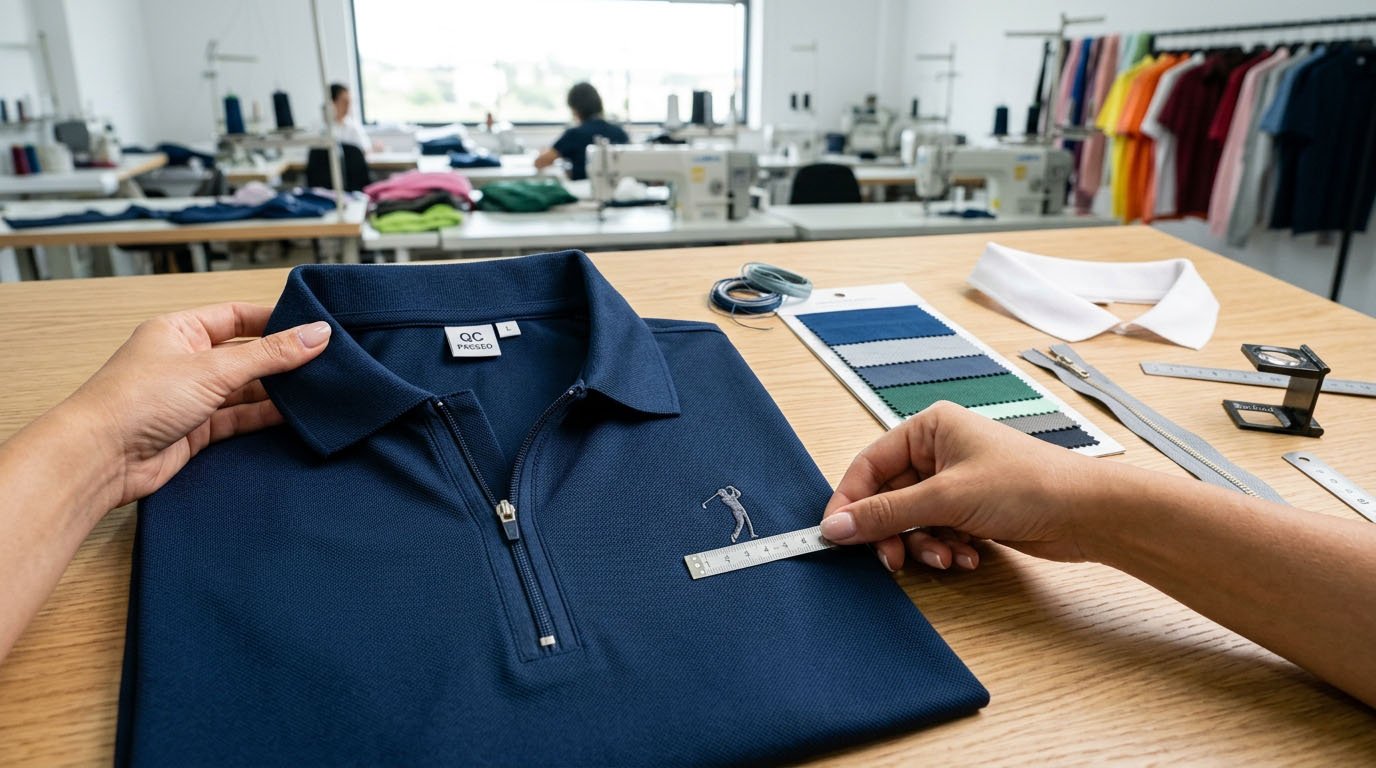
Never judge a factory only from website photographs.
Develop or order a physical sample.
For golf apparel, inspect:
- fabric hand feel
- stretch and recovery
- fit
- measurements
- stitching
- collar shape
- placket construction
- zipper quality
- printing
- embroidery
- labels
- trims
- overall finishing
But remember:
A good sample proves that the factory can make one good garment.
It does not automatically prove that the factory can make 500 or 2,000 identical garments.
That is why the next step matters.
Step 6: Create a Golden Sample Before Bulk Production
One of the best ways to reduce misunderstandings is to create an approved pre-production benchmark.
This is often called a Golden Sample, PPS, or approved production sample.
The exact terminology varies between factories.
The principle is simple:
Both buyer and factory should agree on what the finished product is supposed to look like before bulk production starts.
Your approved sample should represent, as closely as practical:
- approved fabric
- approved color
- correct measurements
- correct logo size and position
- approved labels
- approved trims
- approved stitching
- approved packaging where relevant
Also create a written specification
Do not rely only on the physical garment.
Document:
- fabric composition
- fabric weight
- color reference
- measurement chart
- measurement tolerances
- logo specifications
- trim specifications
- packing requirements
If something changes later, you have a clear reference.
Step 7: Verify the Fabric Before Bulk Production
Fabric is one of the biggest variables in golf apparel manufacturing.
A factory may produce excellent sewing, but if the wrong fabric is selected, the finished garment can still fail.
Before approving bulk production, confirm:
- fiber composition
- GSM or fabric weight
- stretch direction
- recovery
- shrinkage
- color
- hand feel
- finishing
- performance requirements
For golf clothing, common requirements may include moisture management, stretch, soft hand feel, UV protection, breathability, or quick drying.
Do not accept a vague description such as:
Premium performance polyester.
Ask for the actual specification.
If fabric selection is an important part of your project, review the supplier's fabric sourcing service and ask how they source, test, approve, and replace fabrics before production.
Ask for swatches first
For new fabric developments, approve swatches before ordering large quantities.
Your approval records can include:
- physical swatch
- fabric code
- composition
- GSM
- color reference
- supplier or mill reference
- performance requirements
This makes substitutions easier to detect later.
Step 8: Ask How They Control Bulk Consistency
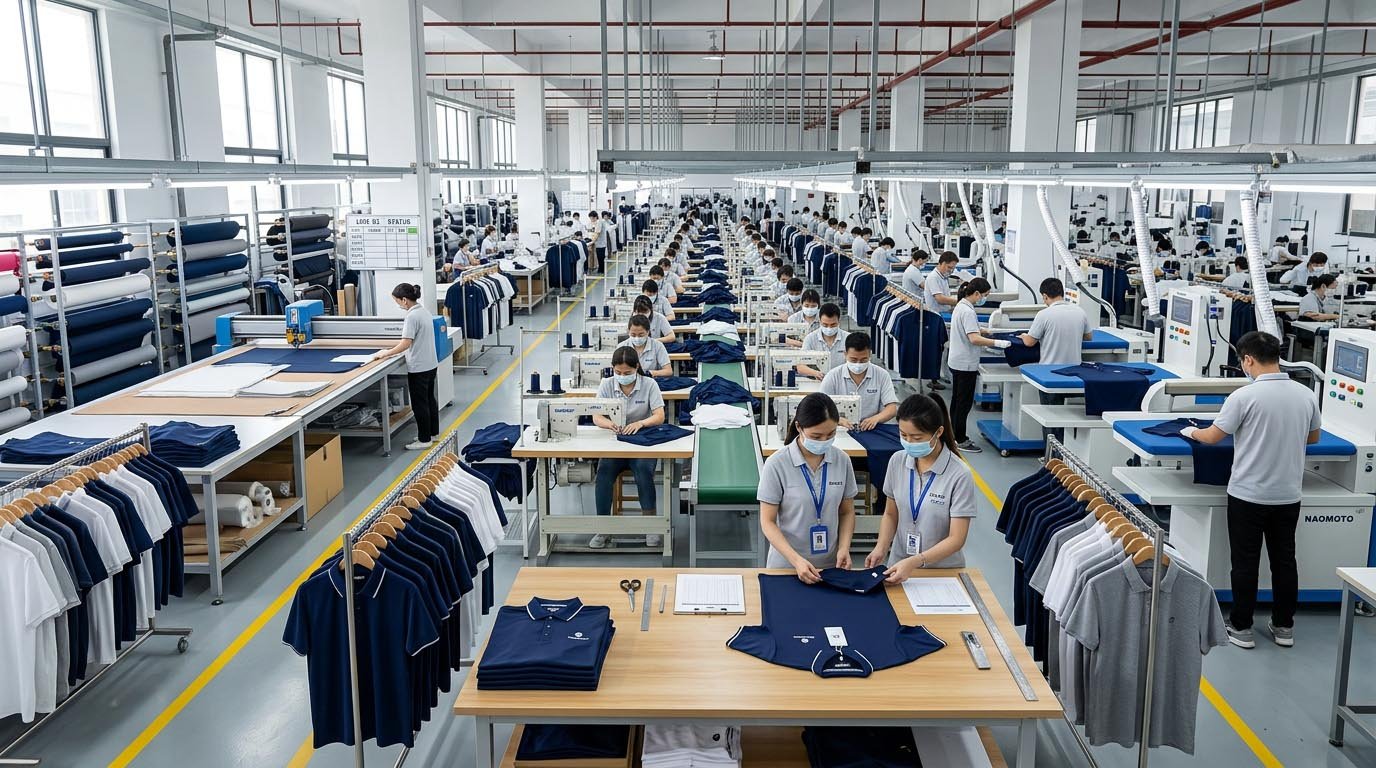
Sample production and bulk production are different environments.
A sample may be made slowly by an experienced sample maker.
Bulk production involves:
- multiple operators
- large cutting quantities
- different fabric rolls
- faster sewing speeds
- repeated pressing and finishing
- hundreds or thousands of garments
This introduces variation.
Ask the supplier:
How do you make sure bulk production matches the approved sample?
A structured factory should be able to explain its process.
Typical controls may include:
Incoming fabric inspection
↓
Fabric relaxation or preparation where required
↓
Cutting inspection
↓
Printing / embroidery inspection
↓
In-line sewing QC
↓
Measurement inspection
↓
Final appearance check
↓
Packing inspection
The exact process varies by factory and product.
You are looking for evidence that quality is controlled during production rather than only checked at the end.
Step 9: Confirm How Fabric and Trim Substitutions Are Handled
This is an underrated sourcing question.
Ask:
What happens if the approved fabric becomes unavailable during production?
The correct answer should involve buyer approval.
The factory should not silently replace:
- fabric
- rib
- buttons
- zippers
- labels
- interlining
- thread
- packaging
with alternatives simply because the original material is unavailable.
Put this in writing:
No material substitutions without buyer approval.
That one sentence can prevent many quality disputes.
Step 10: Verify Embroidery and Printing Capabilities
Decoration quality matters especially for golf brands.
A perfectly made golf polo can still look cheap if the embroidery is distorted or a printed logo cracks after washing.
Before production, confirm which decoration method is best for your design.
Common options include:
- embroidery
- screen printing
- heat transfer
- sublimation
For embroidered logos, ask about:
- stitch density
- backing
- logo size
- placement
- distortion on stretch fabric
- sample approval
You can review more details about golf polo embroidery when comparing embroidery options for polos, jackets, caps, or other golf apparel.
For printed artwork, also ask whether the supplier has experience printing on performance fabrics. Different fabrics and graphics may require different methods.
For example, screen printing can work well for many logo and graphic applications, while sublimation printing is often used when designs require extensive all-over graphics on suitable polyester fabrics.
The decoration method should be chosen based on the garment, fabric, design, quantity, and desired appearance.
Step 11: Review the Factory's QC Standards
Do not accept:
Don't worry. We check everything.
Ask what they actually check.
For golf apparel, QC may cover:
Fabric
- composition
- GSM or weight
- color
- shrinkage
- stretch
- surface defects
Garment measurements
- chest
- body length
- sleeve length
- shoulder width
- waist
- hip
- inseam
- other points of measure
Workmanship
- open seams
- skipped stitches
- puckering
- loose threads
- uneven collars
- incorrect logo placement
- damaged trims
Appearance
- stains
- shade variation
- pressing
- symmetry
- packaging
For larger orders, buyers may also choose third-party inspections based on agreed sampling plans.
The inspection level and acceptance limits should be agreed between buyer, supplier, and inspection company rather than assumed to be universal.
Step 12: Check Certifications and Test Reports Carefully

Certifications can add confidence.
They should not replace factory verification.
Depending on your market and product, you may ask about:
- material safety testing
- colorfastness testing
- shrinkage
- UPF testing
- restricted substance requirements
- customer-specific compliance requirements
If a factory claims:
This fabric is UPF 50+.
Ask:
Do you have a test report for this exact fabric or an equivalent production lot?
Do not assume a certificate displayed on a website applies to every fabric the supplier offers.
If testing and compliance are important for your project, review available fabric and apparel test reports and ask the supplier which reports apply specifically to the material or product you intend to purchase.
Likewise, when certifications matter to your order, check:
- issuing organization
- certificate holder
- scope
- validity period
- applicable product or facility
A certificate is useful evidence.
It is not proof of every claim a supplier makes.
Step 13: Audit the Quotation Before Paying
Many production disputes start with a vague quotation.
For example:
Custom Golf Polo
1,000 PCS
US$XX/PC
That is not enough information for a complicated custom order.
Your quotation or purchase documentation should make clear what is included.
Check:
- fabric
- composition
- garment construction
- printing
- embroidery
- labels
- hangtags
- special trims
- packaging
- sample charges
- testing charges where applicable
- shipping terms
- tooling or mold costs where relevant
Also clarify whether pricing changes when:
- quantities decrease
- additional colors are added
- fabric changes
- packaging changes
- artwork becomes more complicated
The goal is not necessarily to receive the cheapest quote.
The goal is to understand exactly what you are paying for.
Step 14: Confirm the Production Timeline
Do not ask only:
What's your production lead time?
Break it down.
Ask how much time is needed for:
- fabric sourcing
- lab dips or color approval
- printing or embroidery setup
- pre-production sample
- cutting
- sewing
- finishing
- QC
- packing
Custom golf apparel lead times vary significantly depending on material availability, design complexity, quantity, and season.
A realistic production schedule is more valuable than an unusually fast promise.
Example
A factory might tell you:
Fabric sourcing: 10–20 days
Bulk production: 20–30 days
QC and packing: several additional days
Another project using available stock fabric may move much faster.
The important point is to understand the critical path.
Step 15: Agree on Payment Terms Before Sending Money
Payment terms vary between factories and order sizes.
A common structure in apparel manufacturing is:
- deposit before production
- remaining balance before shipment or after agreed inspection
The percentages can vary.
Rather than focusing only on the percentage, focus on the conditions tied to each payment milestone.
For example:
Deposit
Released after:
- specifications are agreed
- quotation is confirmed
- payment entity is verified
- approved sample or production details are finalized
Balance
Released after:
- bulk production is complete
- agreed QC is completed
- quantities are confirmed
- shipping documents are prepared
Be cautious with large full prepayments when you have no established relationship with the supplier.
Step 16: Put Important Agreements in Writing
A WeChat message or phone call is easy to forget.
Before paying, make sure your critical production requirements appear in written documentation.
At minimum, document:
- product description
- quantity
- colors
- sizes
- material
- approved sample
- measurement chart
- tolerances
- logo specifications
- packing requirements
- agreed price
- production timing
- payment terms
- inspection requirements
- procedure for defects or shortages
- approval requirements for substitutions
For high-value orders or legally sensitive agreements, consider obtaining qualified legal advice appropriate to your jurisdiction and China-related transactions.
Step 17: Watch for Red Flags Before Paying a Deposit
One red flag does not always mean you should reject a supplier.
Several together should make you slow down.
Payment suddenly changes
You have been speaking with Company A for weeks, but the supplier suddenly asks you to pay Company B or an individual.
Ask why.
They refuse live factory verification
A legitimate supplier may have confidentiality restrictions in some areas, but completely refusing to show any production activity deserves further investigation.
The price is much lower than every competitor
There may be a valid reason.
But check whether the quotation is missing:
- labels
- packaging
- performance fabric
- printing
- testing
- freight
- development costs
Every technical answer is vague
If the salesperson cannot answer, ask to speak with the merchandiser, product developer, or technical team.
A real manufacturing operation should have people who understand production.
They refuse to put specifications in writing
This is one of the biggest warning signs.
If the supplier says:
Don't worry. We know what you want.
Ask them to write it down anyway.
Golf Apparel Factory Verification Scorecard
You can use this simple scorecard when comparing two or three factories.
Give each category:
0 = Weak / no evidence
1 = Partially verified
2 = Clearly verified
| Verification Area | Score |
|---|---|
| Business identity | /2 |
| Payment entity | /2 |
| Golf apparel experience | /2 |
| Fabric knowledge | /2 |
| Sample quality | /2 |
| Bulk-production evidence | /2 |
| QC process | /2 |
| Quotation transparency | /2 |
| Lead-time planning | /2 |
| Communication quality | /2 |
| Total | /20 |
How to use the score
This is a practical buyer screening tool, not an industry certification.
As a general internal guide:
15–20
The supplier has provided strong evidence across most critical areas.
10–14
Several areas still need clarification or verification.
Below 10
Too many important points remain unclear. Do more due diligence before committing funds.
The score should support your judgment, not replace it.
Factory Verification Questions You Can Send to a Supplier
You can copy these questions directly into an email or WhatsApp message:
- Can you provide your registered company name and business registration information?
- Which company name will appear on the invoice and bank account?
- Can we arrange a live video walkthrough of your production area?
- What percentage of your production is golf or performance apparel?
- What MOQ do you require for this fabric, style, and color?
- Can you recommend suitable fabric options based on our design?
- How do you control shrinkage and measurement consistency?
- How do you prevent collar curling on golf polos?
- Can you make a pre-production sample using the actual bulk fabric?
- What happens if an approved material becomes unavailable?
- What QC inspections do you conduct during production?
- Can third-party inspection be arranged before shipment?
- Is the quotation inclusive of labels, trims, packaging, and decoration?
- What is the estimated fabric lead time?
- What is the estimated bulk-production lead time?
- What payment terms do you require?
- What happens if bulk production does not match the approved sample?
A professional supplier should not be offended by these questions.
Experienced manufacturers hear them regularly.
FAQ
Is a factory website enough to prove a supplier is legitimate?
No.
A professional website is useful, but it should be combined with business information, payment verification, product samples, factory evidence, and written commercial terms.
Should I avoid trading companies?
Not automatically.
Some trading companies provide excellent sourcing and quality-management services.
Some direct factories are poor exporters.
Judge the supplier by its ability to control your order, communicate clearly, and provide evidence.
What MOQ should I expect from a golf apparel factory in China?
There is no single standard MOQ.
MOQ depends on the fabric, design, color, decoration method, and factory.
Using available fabric usually allows more flexibility than developing completely custom fabrics or dye colors.
Is an approved sample enough before paying for bulk production?
It is important, but not enough by itself.
You should also confirm written specifications, bulk materials, QC standards, production timelines, and payment terms.
Should I hire a third-party inspection company?
For larger or higher-risk orders, third-party inspection can add another layer of control.
The inspection company can check quantities, measurements, workmanship, packaging, and other agreed requirements before shipment.
Should the bank account name match the factory name?
Ideally, the relationship between the contracting company and beneficiary should be clear.
If the names differ, ask the supplier to explain and document why.
Do not simply assume that a different payment entity is legitimate.
How can I protect my golf apparel designs?
Control who receives your complete tech packs and production files, use written confidentiality and ownership terms where appropriate, and seek qualified legal advice for valuable proprietary designs or China-specific contractual protections.
If your brand also requires custom woven labels, neck labels, hangtags, packaging, and brand-specific garment finishing, a structured private label service can simplify the process by keeping these requirements within one development workflow.
Final Checklist Before You Pay
Before releasing your deposit, ask yourself:
- Do I know who I am paying?
- Have I verified the supplier's company information?
- Have I seen real production activity?
- Does the supplier understand golf apparel?
- Have I approved the materials?
- Have I approved the sample?
- Are measurements documented?
- Are substitutions controlled?
- Is the quotation complete?
- Is the timeline realistic?
- Is the QC process clear?
- Are payment milestones written down?
If several answers are still “no,” continue verifying before transferring money.
Conclusion
Verifying a golf apparel factory in China is not about finding one perfect certificate or one perfect sample.
It is about connecting the evidence.
The company identity should match the commercial documents. The factory should understand golf apparel. The sample should match written specifications. The bulk process should include quality controls. And the quotation, timeline, and payment terms should be clear before production begins.
Do those checks before paying your deposit, and you reduce the chances of hidden costs, quality disputes, production delays, and uncomfortable surprises later.
For golf brands developing custom polos, bottoms, jackets, skorts, and other performance apparel, the strongest supplier relationship normally starts with clear specifications and transparent verification—not just a low quotation.
At FUWAY, we work with golf brands on OEM/ODM product development, fabric sourcing, sampling, private labeling, customization, bulk production, and quality control.
If you already have a tech pack, reference sample, or product concept, you can contact our team to discuss your project, MOQ, fabric requirements, sampling, and bulk-production plan.