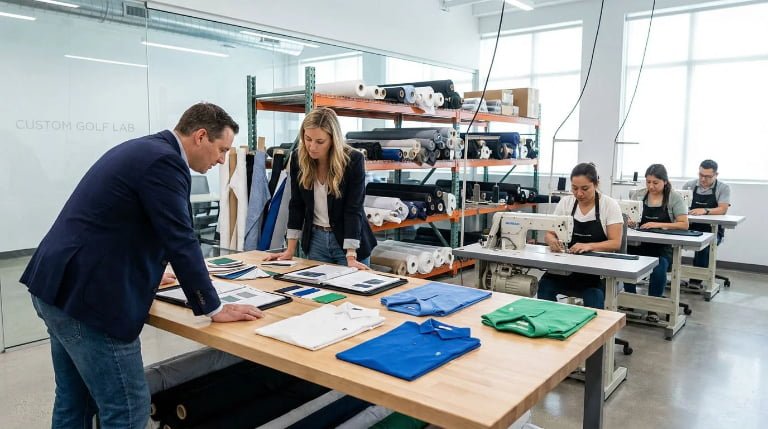
Choosing between China and Vietnam for golf apparel manufacturing is not simply a question of labor cost.
For most golf brands, the better sourcing hub depends on:
- product complexity,
- order volume,
- development and replenishment speed,
- and total landed cost.
China often has an advantage when a program requires technical fabrics, custom trims, frequent sampling, multiple SKUs, or flexible production.
Vietnam can be highly competitive for stable, repeatable products with larger order volumes and well-defined specifications.
The most important rule is simple:
Choose the factory and supply chain that fit your product—not the country with the lowest headline quote.

Quick Answer: China vs Vietnam for Golf Apparel Manufacturing
| Sourcing Priority | China | Vietnam |
|---|---|---|
| Technical performance golf apparel | Often stronger | Capable, but material sourcing should be checked |
| Fast product development | Often stronger | Depends on material availability |
| Small-to-medium initial programs | Often more flexible | Factory-dependent |
| Complex fabrics and trims | Strong supply-chain depth | Some materials may require regional sourcing |
| Stable high-volume programs | Strong | Often highly competitive |
| Frequent design changes | Often easier | Better when specifications are stable |
| Seasonal replenishment | Often more agile | Depends on production planning |
| Trade advantages | Market-dependent | Can be attractive in some destinations |
| Overall quality | Factory-dependent | Factory-dependent |
There is no universal winner.
A technical golf polo with custom collars, four-way-stretch fabric, embroidery, heat transfers, and multiple colorways has very different sourcing needs from a stable repeat order of a basic polo.
If your program centers on technical polos or branded tops, reviewing how custom golf shirts are developed can help you understand how fabric, fit, trims, and decoration interact before comparing countries.
That difference should drive your decision.
How Should You Decide Between China and Vietnam?
Start with your product specification rather than the country.
Ask:
- How technical is the garment?
- How many fabrics and trims are involved?
- Is the design already finalized?
- How many sample revisions are likely?
- How large is the first order?
- How quickly will you need repeat orders?
- Which market will the goods enter?
The more development-heavy the project, the more important supply-chain coordination becomes.
The more stable and repetitive the program, the more important production scale and execution become.
Sourcing Decision Matrix
| Your Situation | Better Starting Point | Why |
|---|---|---|
| Startup testing a first collection | China often fits better | Development and quantity flexibility |
| Technical performance polo | China often fits better | Fabric and trim ecosystem |
| Many SKUs with smaller quantities | China often fits better | Flexible sourcing |
| Frequent design changes | China often fits better | Faster iteration |
| Complex decoration requirements | China often fits better | Dense supplier network |
| Stable core style with large repeats | Compare both | Vietnam may be highly competitive |
| Locked tech pack and predictable demand | Vietnam worth evaluating | Strong production execution |
| Duty-sensitive program | Compare both carefully | Origin rules may affect landed cost |
Use this as a starting point—not as a substitute for evaluating the actual factory.
For startup brands that also need labels, packaging, trims, and brand customization, a private label golf apparel program can help clarify how much supplier coordination is actually required beyond basic cut-and-sew manufacturing.
How Does Product Complexity Affect the Decision?
Product complexity is one of the biggest differences between sourcing basic apparel and sourcing technical golf apparel.
A technical golf polo may require:
- moisture-management fabric,
- polyester-spandex or nylon-spandex blends,
- stretch and recovery,
- UV-performance requirements,
- custom collar construction,
- specialized plackets,
- branded buttons,
- embroidery,
- heat transfer,
- mesh panels,
- or bonded components.
Golf bottoms and skorts can add further complexity through stretch-woven recovery, waistband construction, pocket engineering, liner integration, inseam control, and fit consistency across sizes.
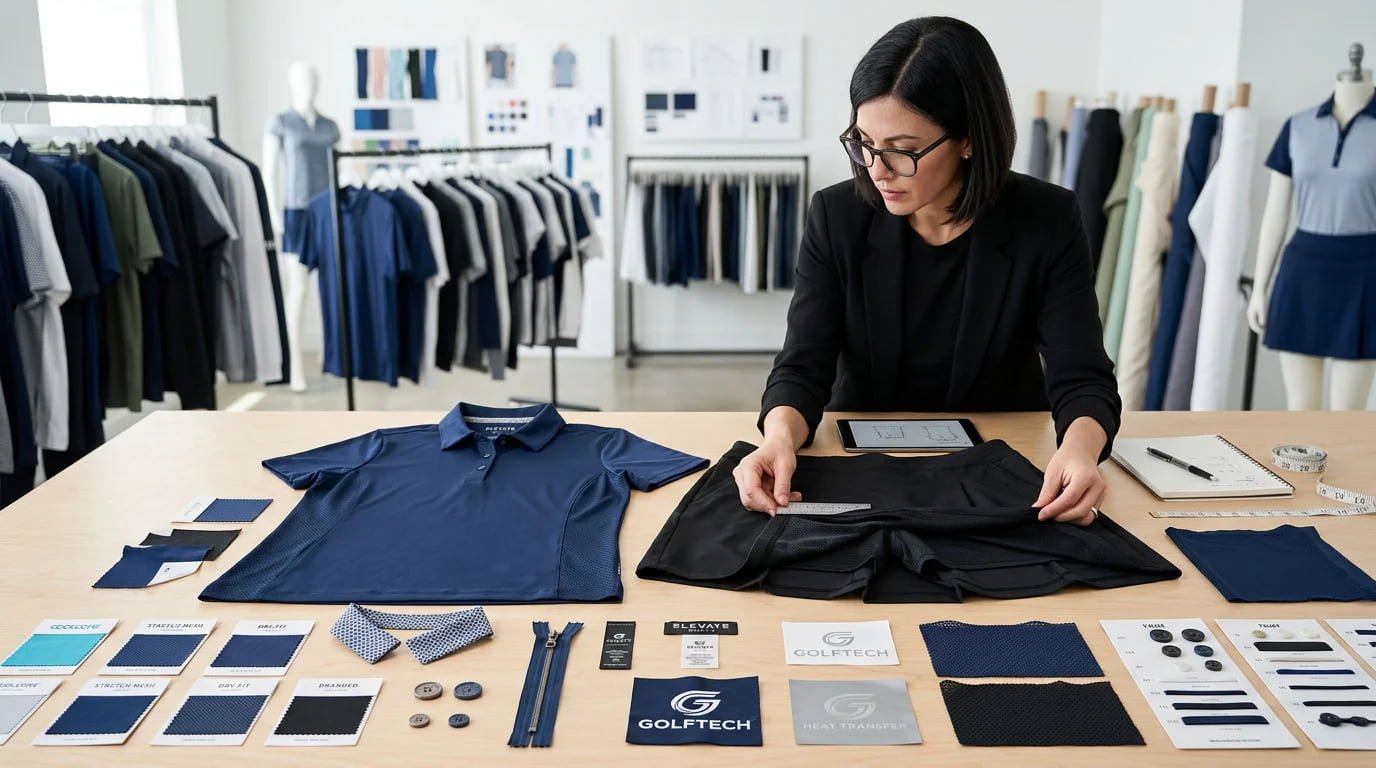
China: Supply-Chain Density
China's advantage is not only garment sewing.
It is the depth of the surrounding ecosystem for:
- fabrics,
- trims,
- collars,
- labels,
- zippers,
- printing,
- embroidery,
- packaging,
- and testing.
For development-heavy programs, this can make fabric, trim, artwork, and construction revisions easier to coordinate.
Decoration also matters. A program using detailed chest logos, sleeve logos, or structured branding may require experienced golf polo embroidery suppliers that can maintain stitch density, placement, and appearance from sample through bulk production.
Vietnam: Strong When the Product Is Stable
Vietnam has strong apparel manufacturing capability.
It can be highly competitive when:
- specifications are finalized,
- material sources are confirmed,
- order volumes are predictable,
- and development changes are limited.
The right question is not:
Is Vietnam capable of technical apparel?
It is.
The better question is:
Can the selected factory manage your exact fabric, trim, decoration, and development requirements efficiently?
How Do Fabric and Trim Supply Chains Compare?
Golf apparel performance begins with materials.
Performance requirements may include:
- moisture management,
- breathability,
- stretch and recovery,
- UV protection,
- dimensional stability,
- colorfastness,
- and compatibility with decoration.
China's deep textile ecosystem can reduce friction during sampling and production because many material and trim suppliers are located within the same broader manufacturing network.
For buyers developing technical polos, shorts, pants, or skorts, a structured performance fabric sourcing process can help compare fabric composition, stretch, weight, hand feel, colorfastness, and finishing before bulk production.
Vietnam also has a strong and expanding apparel supply chain, but buyers should verify where specialized performance fabrics and trims are actually sourced.
Some programs may still rely on materials from China, Taiwan, South Korea, or other regional suppliers.
When fabric and garment assembly are located in different countries, this may affect:
- sampling,
- replacement materials,
- dye-lot corrections,
- production scheduling,
- and total landed cost.
Why Does Sampling Speed Matter?
Sampling is where sourcing problems usually appear first.
A typical development cycle may include:
- tech pack review,
- fabric selection,
- first prototype,
- fit correction,
- artwork adjustment,
- trim changes,
- size-set review,
- pre-production approval.
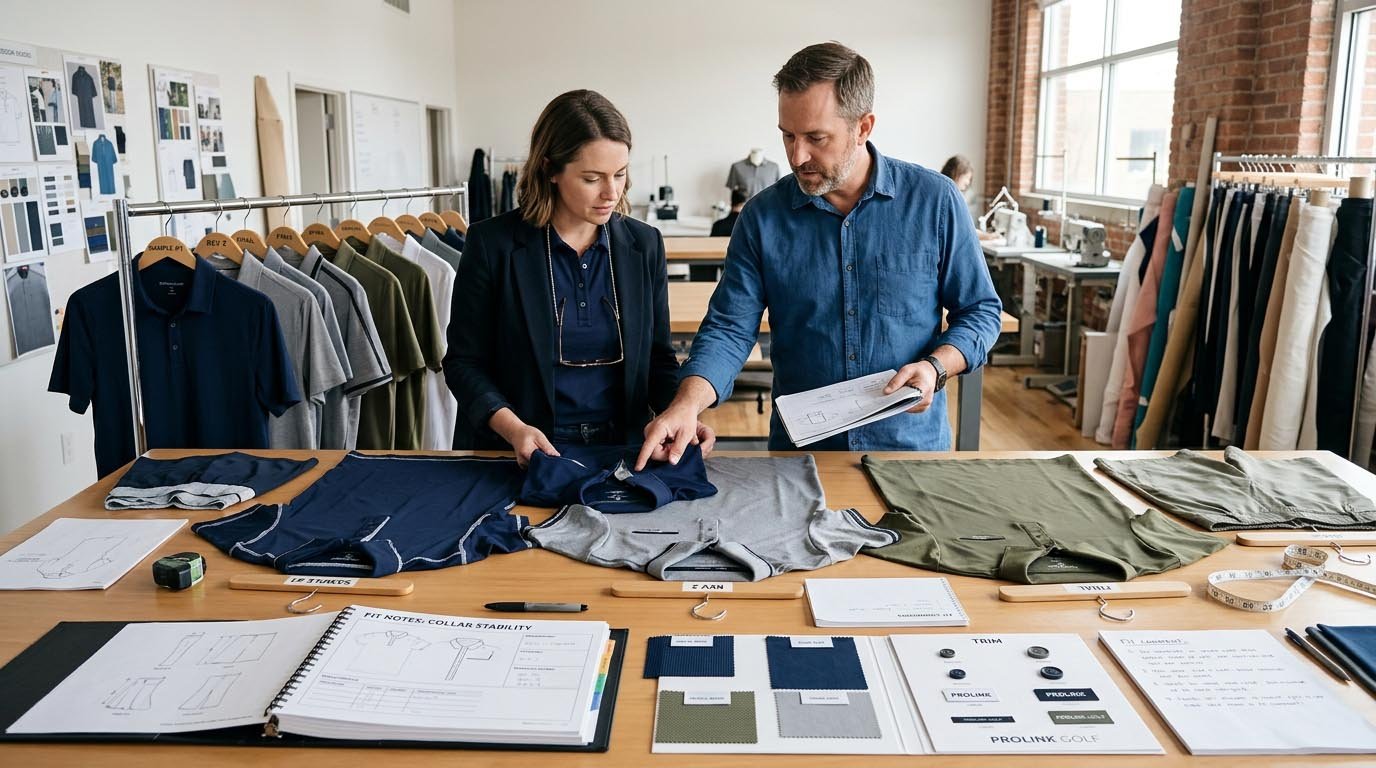
When a brand is still developing fit, fabric, or decoration, the ability to make changes quickly can matter more than a small difference in labor cost.
China often performs well when:
- the tech pack is still evolving,
- multiple fabrics are being tested,
- fit revisions are expected,
- or custom trims are being developed.
Vietnam becomes more attractive when the specification, fabric, and trim package are already locked.
What About MOQ and First-Order Risk?
MOQ matters because new brands rarely know which styles, colors, or sizes will sell best.
Do not ask only:
What is your MOQ?
Also ask:
- Is MOQ per style?
- Is it per color?
- Does fabric MOQ apply separately?
- Does custom dyeing change the MOQ?
- Do trims have separate minimums?
- What happens on repeat orders?
Think in Total Inventory Commitment
A collection with several polos, multiple colors, and a few bottoms can create a large total inventory commitment even when the quoted MOQ looks reasonable.
China's broad supplier base often gives smaller and growing brands more options for structuring initial production.
Vietnam may become more attractive as order volume grows and styles become more stable.
Compare total inventory commitment—not one isolated MOQ number.
How Do Replenishment and Repeat Orders Compare?
The first order gets most of the attention.
But the second, third, and fourth orders often matter more commercially.
A supplier should be able to reproduce:
- the same fabric hand feel,
- color,
- fit,
- measurements,
- logo placement,
- trims,
- and packaging.
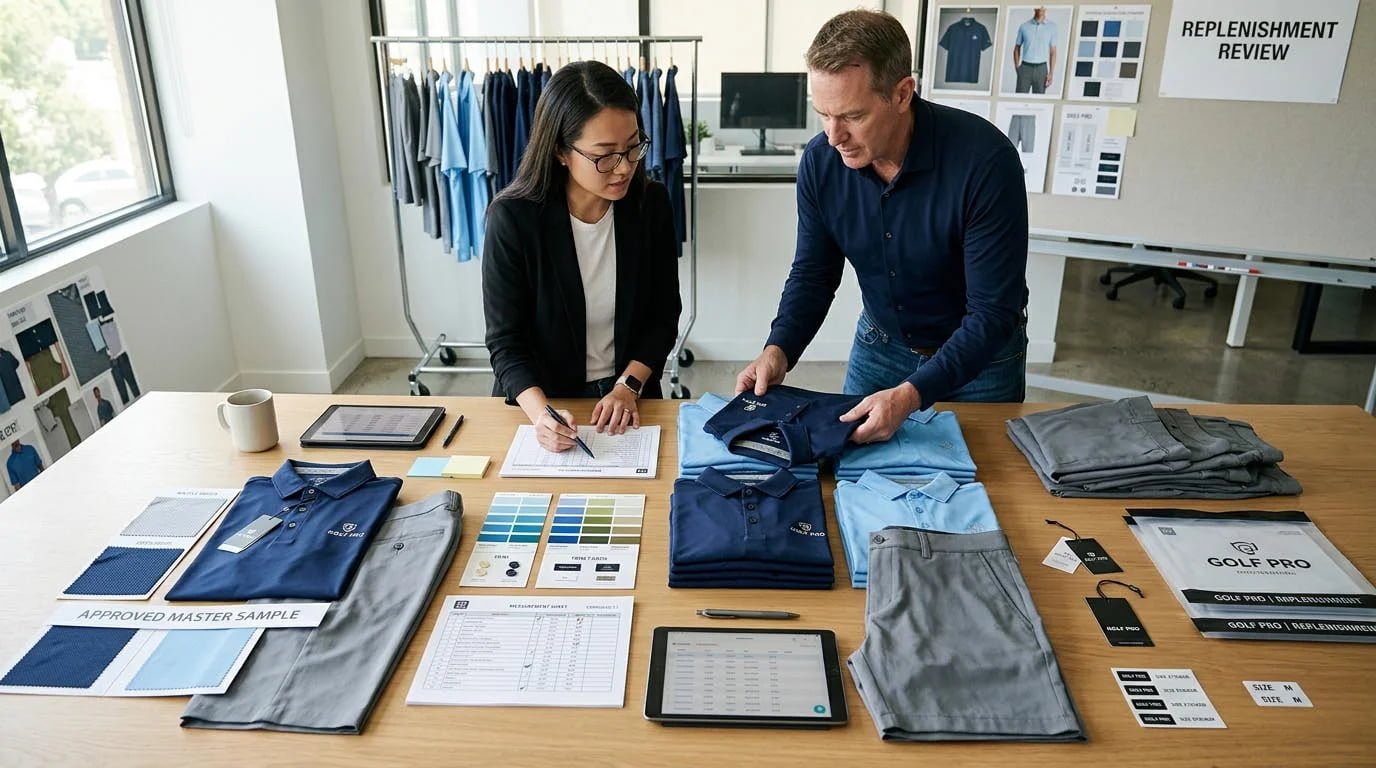
Sample → Bulk → Reorder
A strong sourcing partner should maintain consistency across three stages:
Sample → Bulk Production → Reorder
The sample proves the factory can make the product once.
Bulk production proves it can repeat the product across a production run.
The reorder proves it can reproduce the same approved product months later.
The best sourcing hub is not the one that makes the best first sample. It is the one that can reproduce the approved product consistently from sample to bulk and again on the next order.
Before placing the first order, verify:
- fabric specifications,
- approved trims,
- pattern version control,
- color standards,
- decoration specifications,
- and pre-production samples.
For bottoms and skorts, also control waistband structure, pocket placement, zipper specifications, liners, and finished measurements.
China's integrated supplier network can help brands that replenish several styles in smaller-to-medium quantities.
Vietnam can also perform strongly on large, predictable repeat programs.
The real goal is:
fast replenishment without product drift.
Why Compare Total Landed Cost Instead of Unit Price?
The lowest FOB quote does not always produce the lowest real cost.
Total landed cost may include:
- sampling,
- development,
- fabric and trims,
- packaging,
- inspection,
- freight,
- duties,
- customs,
- rework,
- delays,
- and inventory carrying cost.

A cheaper garment can become more expensive if it requires:
- longer material sourcing,
- higher minimum commitments,
- slower revisions,
- or more safety stock.
That is why sourcing managers should compare:
Landed Cost + Inventory Risk + Development Cost + Replenishment Risk
rather than:
FOB Price Only
Which Country Offers Better Quality?
Neither country automatically offers better quality.
Quality depends on the individual factory and its process control.
The real question is whether the supplier can reproduce the approved standard consistently during bulk production.
Buyers should verify:
- fabric batch consistency,
- shrinkage,
- color consistency,
- measurement tolerances,
- seams,
- logo placement,
- embroidery,
- print adhesion,
- labeling,
- and final inspection.
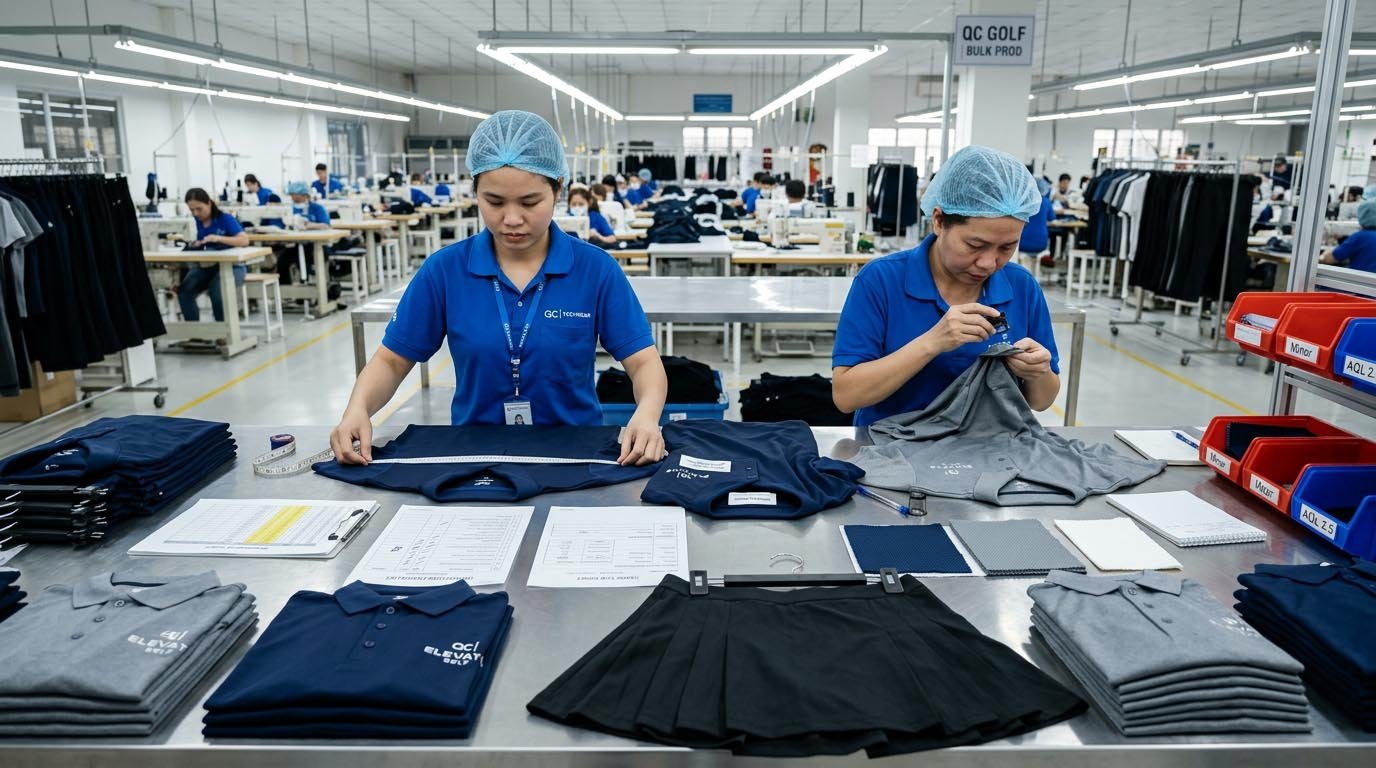
For performance claims and material consistency, buyers should also review available golf apparel testing and test reports rather than relying only on supplier descriptions.
Ask These Questions Before Paying a Deposit
- How is incoming fabric inspected?
- How are measurements controlled?
- Is there a pre-production sample?
- How are bulk colors approved?
- How are embroidery and prints inspected?
- What happens when defects are found?
- Is final inspection completed before packing?
- Can third-party inspection be arranged?
These questions tell you more than the factory's country.
How Do Lead Time and Capacity Affect the Decision?
Country-level lead-time claims can be misleading.
Actual timelines depend on:
- material availability,
- sample revisions,
- fabric dyeing,
- decoration,
- factory load,
- order quantity,
- and shipping method.
Ask each supplier:
What is the complete timeline from approved specification to shipment for my exact program?
Request separate estimates for:
- sampling,
- material sourcing,
- pre-production approval,
- bulk manufacturing,
- final inspection,
- and shipment preparation.
This creates a much more useful comparison.
What About Tariffs and Rules of Origin?
Trade policy can affect total landed cost.
Vietnam may offer trade advantages for some destination markets, while China may face different tariff treatment depending on product classification, fiber content, garment type, and destination.
However, preferential tariff treatment can depend on rules of origin.
A garment assembled in Vietnam does not automatically qualify for every trade preference if its yarn or fabric does not meet the relevant origin requirements.
Verify current HS classifications, duty rates, and origin requirements with a qualified customs broker before making a sourcing decision.
Trade rules change, so avoid making a long-term sourcing choice based on outdated tariff assumptions.
When Does China Make More Sense?
China is often worth prioritizing when your program involves:
- performance fabrics,
- custom trims,
- complex decoration,
- multiple fabric options,
- frequent product development,
- smaller-to-medium initial runs,
- multiple SKUs,
- or seasonal replenishment.
Its key advantage is the ability to coordinate:
fabric + trims + sampling + decoration + manufacturing + QC
within a mature supplier ecosystem.
If China looks like the better fit for your program, the next step is to learn how to find a golf clothing manufacturer in China and compare factories based on golf specialization, sampling, QC, and repeat-order capability.
When Does Vietnam Make More Sense?
Vietnam deserves serious consideration when:
- product specifications are already stable,
- fabrics are confirmed,
- order volumes are larger,
- the style will repeat,
- development changes are limited,
- and the supply chain can plan further ahead.
In these programs, production efficiency may matter more than development flexibility.
How Should You Evaluate Individual Factories?
Country comparison should create your shortlist.
Factory evaluation should determine the final supplier.
| Evaluation Area | What to Check |
|---|---|
| Golf apparel experience | Similar products and customers |
| Fabric capability | Performance knit sourcing |
| Product development | Tech pack and sampling support |
| MOQ structure | Style, color and material minimums |
| Decoration | Embroidery, printing, heat transfer |
| Quality system | Incoming, inline and final QC |
| Repeatability | Pattern, color and material controls |
| Capacity | Initial and repeat-order capability |
| Compliance | Required audits and testing |
| Communication | Response speed and technical clarity |
| Logistics | Export and shipping experience |
Score the factory, not the country.
Once China is on your shortlist, the next step is to verify a golf apparel factory in China before paying a deposit by checking its legal identity, production capability, sample controls, QC process, quotation, and payment terms.
China vs Vietnam: Final Buyer Checklist
Before choosing either sourcing hub, confirm:
Product
- Is the garment basic or technical?
- Is the tech pack finalized?
- Are special trims or performance claims required?
Materials
- Where are fabrics and trims produced?
- Are substitutes available?
- How fast can materials be replenished?
Commercial Terms
- What is the MOQ per style and color?
- Are material MOQs separate?
- What are the payment terms?
Development
- How are samples and revisions controlled?
- Who manages patterns and grading?
- What is the bulk approval process?
Quality
- How are fabric, measurements, color, and decoration inspected?
- Is pre-shipment inspection available?
Supply Chain
- How are sample, bulk, and reorder specifications kept consistent?
- Can the factory support seasonal repeat orders?
Landed Cost
Compare:
- garment price,
- development,
- materials,
- inspection,
- freight,
- duty,
- customs,
- inventory carrying cost,
- and delay risk.
The lowest quotation should not automatically win.
FAQ: China vs Vietnam for Golf Apparel Manufacturing
Is Vietnam cheaper than China for golf apparel?
Vietnam may offer lower labor costs or attractive economics for some high-volume programs.
However, final cost depends on fabrics, trims, logistics, duties, development time, MOQ, and inventory requirements.
Compare total landed cost rather than labor cost alone.
Which country is better for startup golf brands?
China often provides more flexibility for brands developing new products, testing fabrics, managing multiple SKUs, or placing smaller initial programs.
The individual factory still matters more than the country.
Is China or Vietnam Better for Small-Batch Golf Apparel Manufacturing?
China often has an advantage for small-batch programs because its supplier ecosystem provides more options for fabrics, trims, decoration, sampling, and flexible production.
However, MOQ policies vary widely by factory.
Compare MOQ by:
- style,
- color,
- fabric,
- and customization level.
Which country is better for technical golf polos?
China often has an advantage because of its deep supply chain for performance fabrics, trims, decoration, and product development.
Vietnam can also manufacture technical golf apparel, but buyers should verify where the required materials will come from.
Can Vietnam handle small golf apparel orders?
Some factories can.
MOQ varies by factory, fabric, style, color, and production setup.
Avoid using one MOQ figure to represent an entire country.
Which country has better golf apparel quality?
Neither country automatically has better quality.
Quality depends on factory specialization, material control, sample approval, production processes, QC, and repeatability.
Is China faster than Vietnam for sampling?
China can have an advantage when multiple fabrics, trims, and decoration suppliers are locally available.
Actual sampling time still depends on the factory and project.
Should I Choose a China Golf Apparel Manufacturer or a Vietnam Golf Shirt Manufacturer?
Choose based on your product and operating model rather than country reputation.
A China golf apparel manufacturer may be a better fit when you need:
- technical fabrics,
- custom trims,
- multiple SKUs,
- frequent sampling,
- flexible initial quantities,
- or faster seasonal replenishment.
A Vietnam golf shirt manufacturer may be worth evaluating when:
- the specification is locked,
- the fabric supply is confirmed,
- order volume is larger,
- and repeat production is predictable.
In either case, verify golf apparel experience, QC, material sourcing, and repeat-order capability before placing a deposit.
Should tariffs determine whether I choose China or Vietnam?
No.
Tariffs belong in the landed-cost calculation, but they should not be the only sourcing criterion.
Verify current duties and rules of origin before placing an order.
Conclusion: Which Sourcing Hub Fits Your Golf Brand?
China and Vietnam are both major apparel manufacturing hubs.
China often fits brands developing:
- technical performance garments,
- custom trims,
- multiple SKUs,
- smaller initial programs,
- or frequently changing seasonal products.
Vietnam may deserve stronger consideration when you already have:
- stable specifications,
- confirmed materials,
- predictable forecasts,
- and larger repeat orders.
But the final sourcing decision should not be:
China vs Vietnam: Which country is better?
It should be:
Which factory and supply chain can reproduce my product consistently from sample to bulk to reorder, at the right volume, with acceptable risk and total landed cost?
That is the decision that protects your brand.
If you are comparing sourcing options for a new golf apparel line and want to evaluate fabrics, customization, MOQ, sampling, and bulk production requirements, you can contact FUWAY to discuss your project specifications.
Disclosure: FUWAY is a China-based golf apparel manufacturer and does not operate a factory in Vietnam. Observations about Vietnam are based on buyer feedback, supplier comparisons, and general sourcing experience rather than direct operation of a Vietnamese manufacturing facility. Buyers should independently verify factory capability, current duty rates, trade rules, and rules of origin before making sourcing decisions.