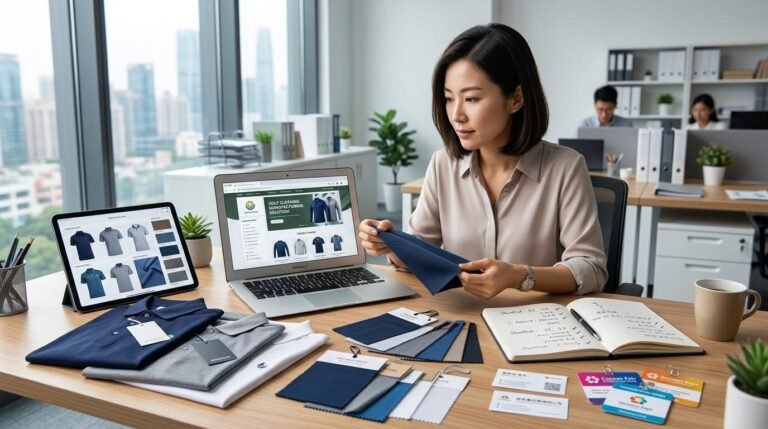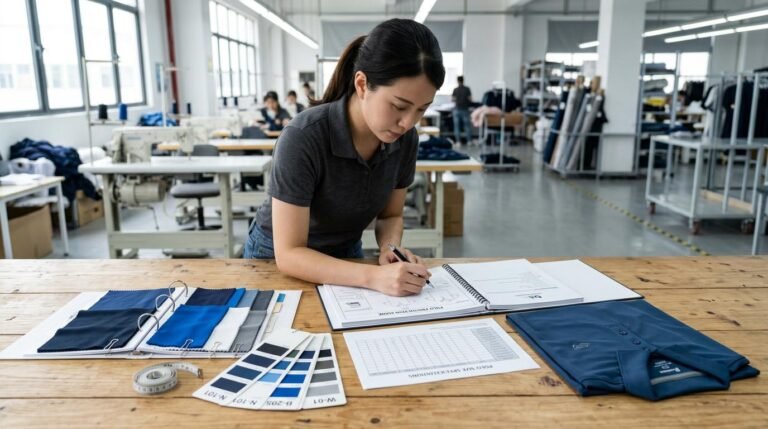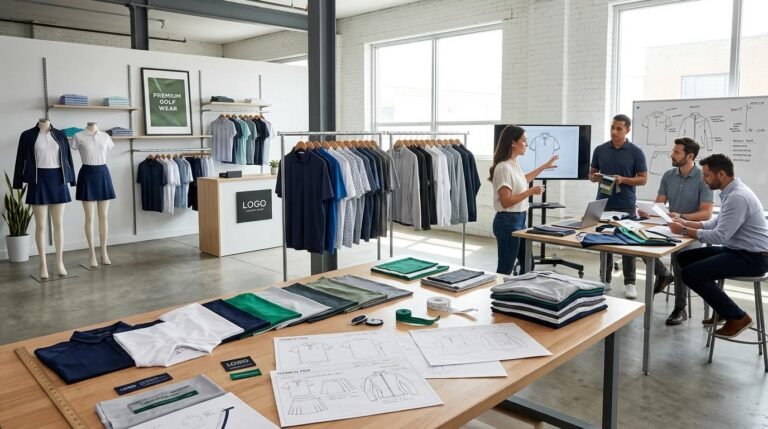
Custom golf tournament apparel is not a simple product order. It is a deadline-driven branding project that involves sponsor approvals, logo execution, sizing accuracy, production lead times, and day-of event logistics.
That is why many tournament apparel orders fail even when the supplier is fully capable of making good products. In most cases, the biggest problems come from:
- late sponsor approvals
- poor logo files
- skipped sample rounds
- unrealistic lead-time expectations
- ordering exact player count with no extra inventory
For most events, organizers should start planning 90-120 days before the tournament date. That timeline gives enough room for:
- sponsor agreement finalization
- logo file collection and artwork preparation
- sampling and revision rounds
- bulk production
- shipping and customs clearance
- delivery buffer before event day
In this guide, I explain what organizers and sponsors should look for in custom golf tournament apparel, including:
- how early to start
- how to manage sponsor logo approvals
- whether to use embroidery or screen printing
- how many extra polos to order
- what sizing data to collect
- how to estimate total landed cost
- how to evaluate suppliers and timelines
I am Will from FUWAY. Over the past 15 years, I have worked with 200+ tournament organizers on custom golf apparel projects ranging from small club events to large corporate championships. The main lesson I have learned is simple:
Tournament apparel projects usually fail because of approval-chain delays and coordination mistakes, not because factories cannot sew polos fast enough.
Quick Answer: What Organizers Need to Know About Custom Golf Tournament Apparel
If you are ordering custom golf tournament polos or event apparel, the safest approach is:
- start 90-120 days before the event
- finalize sponsor agreements before sampling
- collect vector logo files early
- plan for at least one revision round
- use embroidery for player polos in most cases
- order 10-15% extra pieces
- collect more detailed sizing data than just S/M/L
- compare suppliers on total landed cost, not only base garment price
If you have less than 60 days, you should seriously consider:
- reducing logo complexity
- using stock garments instead of full custom
- limiting decoration locations
- switching to a simpler logo program
- or delaying customization to reduce delivery risk
The biggest mistake is treating tournament apparel like a catalog purchase. It is really a custom branded event project with hard deadlines and multiple stakeholders.
How Far in Advance Should You Order Custom Golf Tournament Apparel?
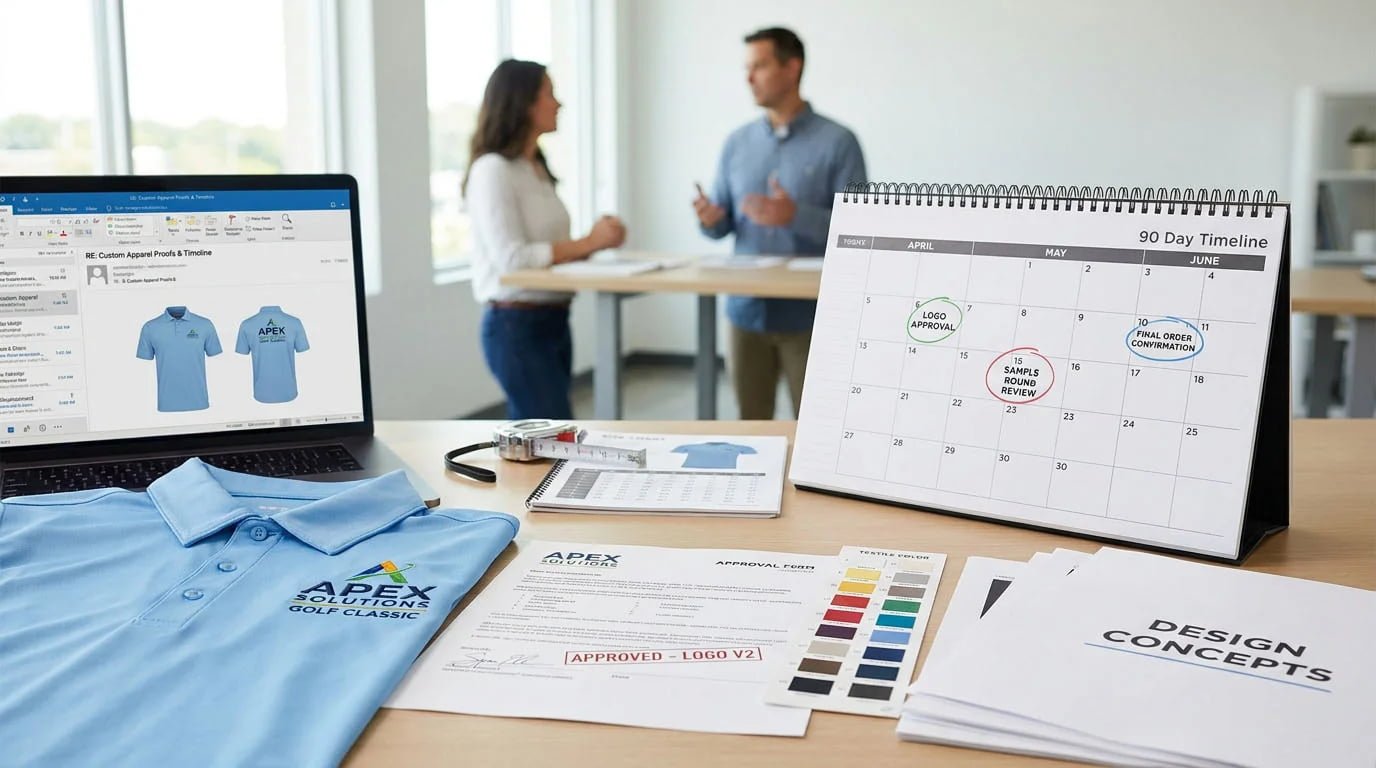
You should usually start 90-120 days before the event date.
Why 90-120 days is the realistic window
Most organizers think in terms of production time only. But tournament apparel timelines are longer because they include:
- sponsor agreement finalization
- logo file collection
- digitization
- physical samples
- sponsor review
- revisions
- bulk production
- shipping
- contingency time
A factory may be able to make polos in a few weeks. That does not mean a fully approved, sponsor-vetted, correctly branded tournament order can be delivered in the same timeframe.
A practical timeline for a tournament apparel order
A typical first-time custom order often looks like this:
Days 1-30: sponsor and artwork preparation
- finalize sponsor agreements
- confirm logo hierarchy and placements
- collect proper logo files
- review artwork suitability for embroidery or print
Days 31-60: sampling and approvals
- digitize logos
- produce first physical samples
- send samples for organizer and sponsor review
- adjust size, placement, or thread colors if needed
Days 61-90: production and quality control
- start bulk production only after written approval
- inspect logo placement and quality during production
- complete final inspection and packing
Days 91-120: shipping and buffer
- ship internationally or domestically
- allow for customs if needed
- receive goods before event week, not on event day
Timeline overview table
| Project Phase | Typical Activities | Main Risk if Delayed |
|---|---|---|
| 1-30 days | sponsor finalization, logo collection, artwork review | design resets and approval conflict |
| 31-60 days | digitization, sampling, sponsor review, revisions | no time to correct logo or placement issues |
| 61-90 days | production, inline QC, final inspection | rushed manufacturing and higher error exposure |
| 91-120 days | shipping, customs, delivery buffer, sorting | late arrival and event-day disruption |
What happens when organizers start too late
Shorter timelines usually force bad decisions:
- skipping sample rounds
- rushing approvals
- paying rush fees
- using air freight
- accepting higher defect risk
- falling back on generic or retail replacement shirts
A real pattern we see in rushed orders
A common situation looks like this:
- the organizer says the event is only 5-6 weeks away
- the sponsor logos are “almost finalized”
- everyone assumes production is the only thing that matters
- then the title sponsor asks for a logo size change after seeing the first sample
- the presenting sponsor wants equal visibility
- and suddenly the project loses another 7-10 days
This is why rushed tournament orders often become stressful even when the factory is responsive.
Recommended planning rule
- 90 days minimum for first-time custom orders
- 120 days preferred for multi-sponsor events, international shipping, or complex customization
- under 60 days means you should simplify aggressively
The real bottleneck is rarely factory capacity. It is usually the sponsor approval chain.
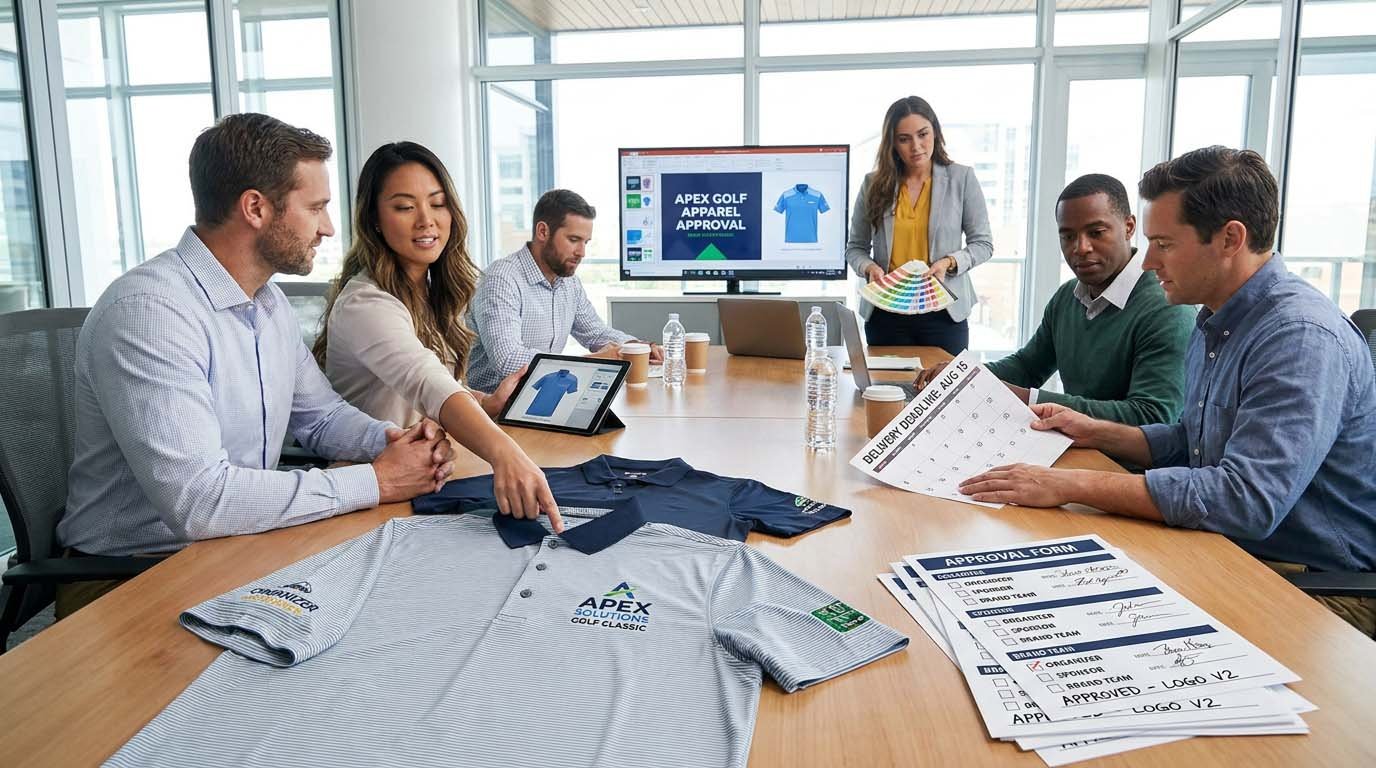
What Organizers and Sponsors Actually Care About
Organizers and sponsors look at the same apparel order from different angles.
What organizers care about
Tournament organizers usually prioritize:
- on-time delivery
- clean event presentation
- size accuracy
- cost control
- smooth day-of distribution
Their biggest fear is simple: apparel arriving late or creating check-in problems.
What sponsors care about
Sponsors usually prioritize:
- logo visibility
- logo placement
- correct brand colors
- hierarchy relative to sponsorship tier
- professional execution in photos and in-person interactions
Their concern is not just “is my logo on the shirt?”
It is “does my branding look important, correct, and worth what we paid?”
Why these priorities sometimes conflict
A title sponsor may want:
- the largest logo
- the left-chest position
- exact brand color matching
At the same time, organizers may need:
- a wearable garment that players actually like
- reasonable lead times
- a design that does not look overloaded
That is why successful custom golf tournament apparel projects need early alignment between event operations and sponsor expectations.
Typical organizer vs sponsor priorities
| Stakeholder | Main Priority | Typical Concern |
|---|---|---|
| organizer | delivery, sizing, budget, logistics | “Will this arrive on time and work on event day?” |
| title sponsor | visibility and hierarchy | “Is our logo prominent enough?” |
| presenting sponsor | fairness and brand quality | “Does our logo look secondary in the wrong way?” |
| legal or brand team | compliance | “Does this follow our brand rules?” |
Best practice
Before requesting final samples or production pricing, confirm:
- who has final approval authority
- whether sponsors have contractual logo requirements
- how logo hierarchy will reflect sponsorship tiers
- whether legal or brand teams also need to review samples
Practical experience note
One of the most common mistakes I see is when an organizer says, “I can approve the shirt myself,” but later a sponsor reviews the sample and requests changes that should have been identified much earlier. Once that happens, the project is no longer about production efficiency. It becomes a race against the calendar.
Tournament apparel is not a single-buyer decision. It is a multi-stakeholder approval project.
Embroidery vs Screen Printing for Golf Tournament Polos
For most player polos, embroidery is the better choice.
Why embroidery is usually best
Embroidery is the standard choice for tournament polos because it offers:
- a more professional look
- strong durability
- better sponsor presentation
- broad compatibility with polos, outerwear, and hats
This matters because player polos are usually:
- worn during the event
- photographed
- seen by sponsors and guests
- worn again after the tournament
When screen printing makes sense
Screen printing is often better for:
- large back graphics
- volunteer shirts
- towels
- tote bags
- lower-cost giveaway items
It can also be a good choice when:
- the design includes gradients
- the artwork is large-format
- budget is more important than long-term durability
A simple decision framework
Use embroidery for:
- player polos
- quarter-zips
- jackets
- sponsor-facing garments
- chest or sleeve logos
Use screen print for:
- giveaways
- large graphics
- volunteer shirts
- lower-frequency-use items
Decoration method comparison
| Method | Best For | Main Strength | Main Limitation |
|---|---|---|---|
| Embroidery | player polos, quarter-zips, jackets, caps | premium look and strong durability | limited with fine detail and gradients |
| Screen printing | volunteer shirts, towels, tote bags, large graphics | cost-effective for large artwork | less premium on polos and not ideal for every fabric |
Important embroidery limitation
Not every sponsor logo works perfectly in embroidery. Problems often come from:
- thin lines
- tiny text
- gradients
- too many colors
- photographic or highly detailed artwork
That is why suppliers should review logo files early and produce a physical embroidery sample, not just a digital mockup.
What real projects often reveal
Many sponsors approve a digital proof quickly because the logo looks fine on screen. Then the first physical sample arrives and they realize:
- the text is too small to read clearly
- the thread color looks different than expected
- the right-chest logo feels too large
- the combined logo layout makes the shirt look crowded
That is exactly why first samples matter so much.
Recommended approach
For most tournament programs:
- embroider player polos
- screen print secondary giveaway items
- use a hybrid method only when it clearly improves cost or visibility
Embroidery is usually the safest and most professional default for custom golf tournament polos.
How Many Extra Tournament Polos Should You Order?
Most tournaments should order 10-15% overage.
Why exact counts create risk
Ordering exactly one polo per player sounds efficient, but it usually fails because events often face:
- day-of size exchanges
- last-minute registrations
- committee or sponsor additions
- damaged garments
- unexpected VIP attendance
What overage protects you from
Extra pieces help cover:
- players who need to size up or down
- sponsor reps who attend late
- check-in exchange requests
- replacements for stains or defects
- small registration changes close to event day
Which sizes should get the extra pieces
Overage should usually be focused on:
- Medium
- Large
- XL
These are the sizes most likely to be requested and exchanged.
Example overage strategy
| Event Size | Base Player Count | Suggested Overage | Safer Total |
|---|---|---|---|
| small club event | 72 | 8-10% | 78-80 |
| standard tournament | 120 | 10-15% | 132-138 |
| larger sponsor-facing event | 144 | 10-15% | 160-165 |
| uncertain or walk-up event | 144 | 15-20% | 165-172 |
Why extra inventory is worth the cost
A few extra custom polos cost far less than:
- emergency retail purchases
- inconsistent tournament photos
- sponsor disappointment
- participants wearing non-matching shirts
- staff chaos at check-in
A real event-day scenario
We have seen tournaments order exact count to save budget, only to run into predictable problems:
- several players request size exchanges
- a sponsor executive attends unexpectedly
- a few walk-up participants appear
- one or two pieces are unusable because of stains or handling damage
At that point, the savings from not ordering overage disappear quickly.
Recommended ordering rule
- 10-15% extra for most standard events
- 15-20% extra for charity tournaments with walk-up registration, executive guests, or high uncertainty
Ordering extra inventory is a risk-management decision, not waste.
What Sizing Information Should You Collect From Players?
Do not rely only on a simple S/M/L/XL question.
Why generic sizing causes problems
When you ask a participant, “What size polo do you wear?” the answer may depend on:
- brand
- fit preference
- casual vs golf apparel
- athletic vs relaxed cut
- whether they prefer loose or fitted styles
That is why many tournament orders see avoidable exchange volume on event day.
Better sizing data to collect
A stronger sizing form should include:
1. Usual golf polo size
Ask what size they normally wear in golf polos specifically.
2. Fit preference
Let them choose:
- fitted
- standard
- relaxed
3. Verification information
Ask for one of the following:
- chest measurement
- reference brand and size, such as Nike Golf L or Adidas Golf M
This gives you a way to validate suspicious responses.
Why validation matters
After collecting responses, review the overall size curve.
If one size is unusually high or low, confirm it before ordering.
For example, if “Large” is dramatically overrepresented, some participants may actually be choosing based on:
- casual t-shirt fit
- preference for looser wear
- misunderstanding of the garment cut
Recommended sizing form structure
| Field | Purpose |
|---|---|
| usual golf polo size | gives baseline size preference |
| fit preference | explains why someone may size up or down |
| chest measurement or brand reference | helps verify unusual responses |
| open notes field | catches tall fit, broad shoulders, or special requests |
Example of why this matters
We once reviewed a size list where “Large” was far higher than expected relative to Medium. That does not always mean the data is wrong, but it is a warning sign. In that case, some participants were choosing based on relaxed casual wear, not golf polo fit. Because the size curve was reviewed before production, the organizer adjusted the order mix and kept enough extra Mediums for exchanges.
Without that correction, check-in would likely have been much more difficult.
When to collect size data
Collect player sizing 30-45 days before final order placement so you have time to:
- chase non-responders
- verify outliers
- correct obvious mistakes
- build extra inventory into the right sizes
Best practice
Use a hybrid form:
- usual size
- fit preference
- chest measurement or reference brand
Tournament apparel sizing should be treated as a data-cleaning process, not just a registration question.
How to Choose the Right Golf Tournament Apparel for Weather and Format
The right polo for one tournament may be the wrong polo for another.
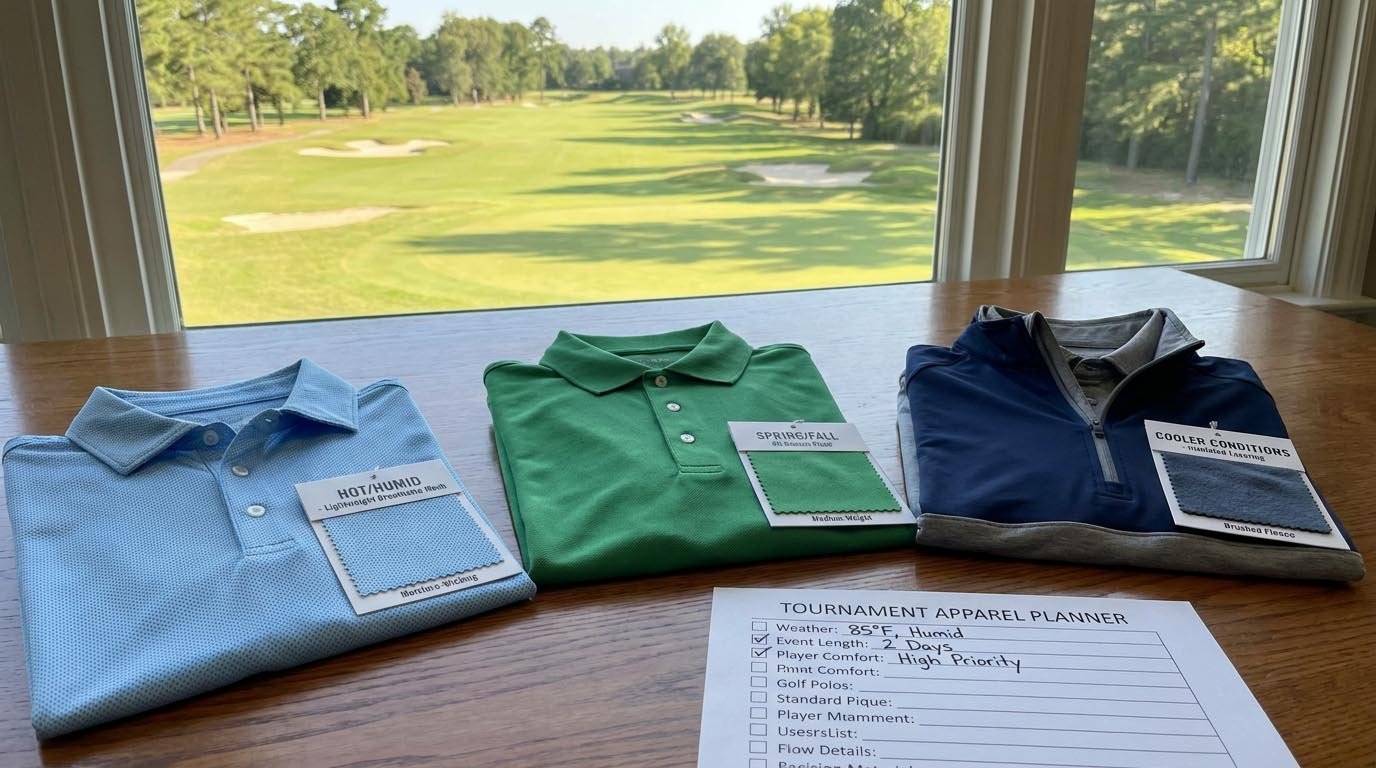
Why product selection should be event-specific
The best custom golf tournament apparel depends on:
- climate
- humidity
- season
- whether players walk or ride
- event length
- whether the tournament is single-day or multi-day
A product that feels great in spring in the Northeast may be too heavy for a summer event in Florida.
For hot and humid tournaments
Prioritize:
- lighter fabric weights
- better breathability
- moisture management
- player comfort over structure
Heavy polos in hot, humid conditions often create complaints even if the branding looks good.
For moderate spring and fall tournaments
Standard golf polo constructions often work well because they offer:
- balanced comfort
- enough structure for embroidery
- broad player acceptance
- flexibility across changing temperatures
For cool-weather or multi-day events
Consider adding:
- quarter-zips
- vests
- layering pieces
- heavier polos if climate justifies it
Climate and format guide
| Event Condition | Better Apparel Direction |
|---|---|
| hot and humid summer event | lightweight breathable performance polos |
| moderate spring or fall event | standard golf polos with balanced fabric weight |
| cool-weather event | polos plus quarter-zips or light layers |
| single-day scramble | polos first, optional hats or towels second |
| multi-day tournament | multiple polos or polos plus layering pieces |
Match apparel to the event format
Single-day scramble
Best focus:
- polos first
- optional hats or towels second
Multi-day tournament
Consider:
- more than one polo
- additional layering pieces
- different colors for different days
Corporate outing
A mixed gift package may make sense:
- polos
- hats
- towels
- simple welcome kits
Practical experience note
One organizer once asked for a heavier standard golf polo for a summer tournament in a hot, humid region because they liked the structure and feel. The problem was that the players would be on course for hours in high heat. In that situation, shirt comfort matters more than the organizer’s personal preference. The right fabric choice can prevent a lot of avoidable complaints.
Players remember whether the shirt felt right on the course, not just whether the logo looked good in a mockup.
How to Manage Sponsor Logo Files, Placement, and Approvals
Sponsor branding is one of the most important and most underestimated parts of tournament apparel planning.
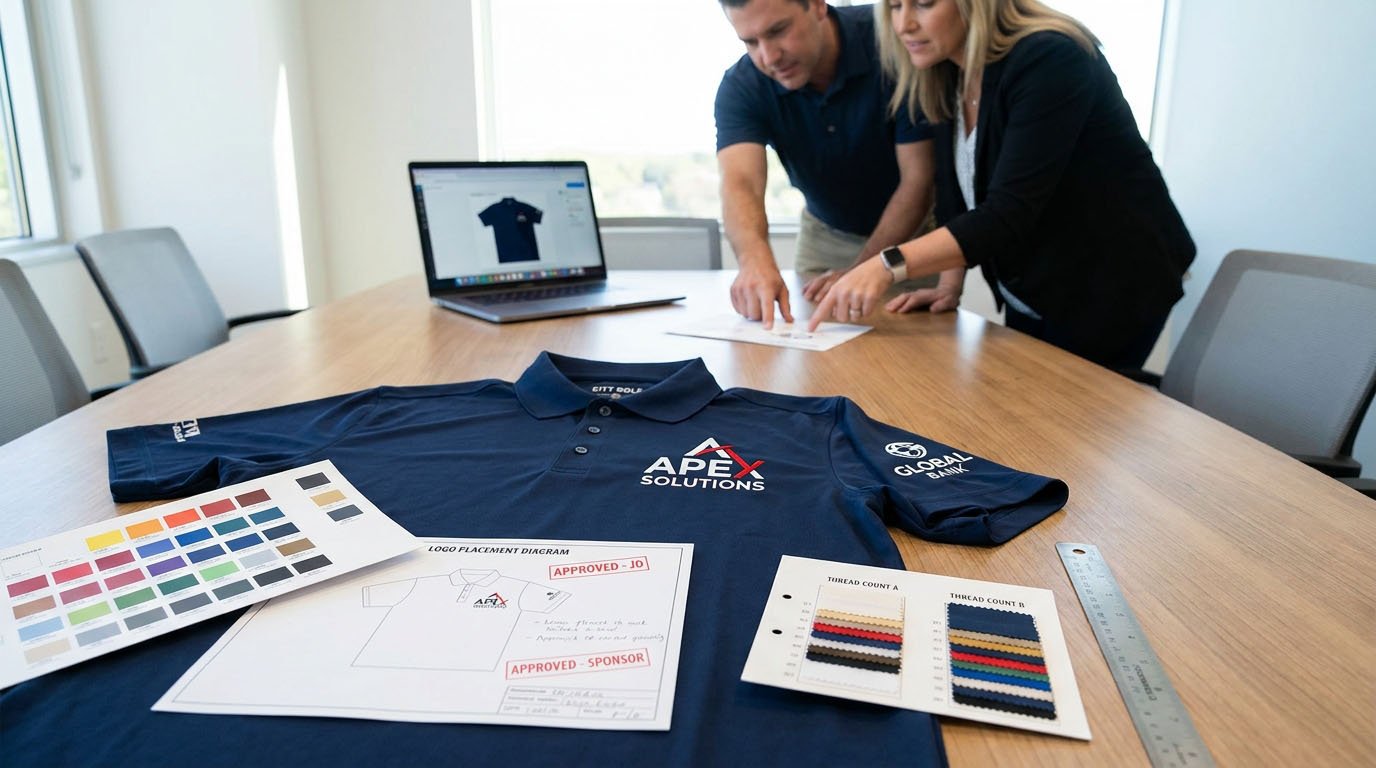
Finalize sponsor structure before production planning
Before you lock in design or pricing, confirm:
- title sponsor
- presenting sponsor
- supporting sponsors
- logo hierarchy
- placement expectations
- any contractual visibility requirements
If you quote and sample too early, sponsor agreements may later force redesigns.
Ask for the right logo files
The best formats are:
- AI
- EPS
- vector PDF
If sponsors send:
- low-resolution JPEGs
- screenshots
- website images
- flattened files with backgrounds
you may lose time recreating artwork or requesting new assets.
Why embroidery-friendly logo versions are often necessary
Many logos are built for web or print, not embroidery. They often need adjustment because:
- small text becomes unreadable
- thin lines disappear
- gradients cannot sew cleanly
- too many colors increase stitch count and stiffness
A good supplier should explain this clearly and produce an embroidery-optimized version when needed.
Use physical samples, not just digital proofs
Digital mockups do not show:
- thread texture
- density
- puckering risk
- real logo scale on the garment
- how multiple sponsor logos balance together
A physical sample helps sponsors approve what they will actually receive.
Keep sponsor hierarchy professional and wearable
In most cases:
- title sponsor gets the strongest position
- presenting sponsor gets strong but slightly secondary visibility
- supporting sponsors should still be visible without overcrowding the garment
Too many large logos make the shirt look overloaded and reduce post-event wearability.
Typical file and approval workflow
| Step | What Should Happen |
|---|---|
| 1 | finalize sponsor hierarchy and placement rules |
| 2 | collect vector logo files and brand guidelines |
| 3 | review embroidery or print suitability |
| 4 | create sample with real placements |
| 5 | secure written approval before production |
Real-world sponsor issue
A common problem in sponsor-heavy events is that everyone wants maximum visibility. But a polo has limited branding space before it starts looking overloaded. The job is not just to “fit all logos.” It is to make the shirt wearable while still reflecting sponsorship hierarchy.
That balance is one of the most important reasons to review physical samples early.
Best practice for multi-sponsor events
Before approving production:
- confirm final placement map
- confirm logo sizes
- review contrast against garment color
- make sure all stakeholders see the same sample version
- get written approval
Good tournament branding is not about putting every sponsor logo as large as possible. It is about balancing visibility, hierarchy, and manufacturability.
What Does Custom Golf Tournament Apparel Really Cost?
The quoted per-piece garment price is rarely the full project cost.
What many buyers misunderstand
A buyer may receive a polo quote and assume:
- unit price × quantity = total project cost
For custom golf tournament apparel, that is usually incomplete.
What total landed cost may include
A realistic project budget may include:
- garment cost
- embroidery or printing per location
- logo digitization
- sample development
- revision samples
- shipping
- duties and taxes
- packaging
- kitting
Why multi-logo tournament orders cost more
A three-logo polo is more expensive because it requires:
- multiple decoration placements
- more setup time
- more approval complexity
- more sampling risk
- more production handling
Cost breakdown framework
| Cost Category | What It Usually Covers |
|---|---|
| garment | polo, quarter-zip, or other base item |
| decoration | embroidery or print per logo location |
| setup | digitization, programming, screens, or artwork prep |
| samples | first sample and revision sample if needed |
| shipping and duties | freight, customs, domestic delivery |
| finishing | packing, labeling, kitting, sorting |
How to compare suppliers properly
Always request a total landed cost estimate that shows:
- base garment price
- decoration cost
- setup fees
- sample costs
- freight estimate
- duties if applicable
- packaging choices
Better budgeting rule
For many tournament orders, final landed cost can be significantly above the base garment quote, especially when:
- multiple sponsor logos are involved
- there are several sample rounds
- the event needs custom packing or kitting
- international shipping is required
Experience-based warning
One of the most common buyer misunderstandings is assuming that a base polo quote already includes full decoration, artwork setup, freight, and packaging. That is often not the case. A low garment quote can still turn into a more expensive project if the decoration program is complex.
Do not compare tournament apparel suppliers on FOB price alone. Compare the total project cost.
Kitting, Personalization, and Day-of Distribution
Production is only part of success. Distribution planning matters too.
What kitting means
Kitting usually means packing each player’s items together before the event, such as:
- polo
- name tag
- welcome note
- sponsor items
- hat or towel if included
Why kitting helps larger tournaments
For larger events, kitting improves:
- check-in speed
- presentation quality
- organization
- sponsor perception
- participant experience
When bulk distribution still works
Bulk distribution can still be fine for:
- smaller club events
- low-complexity programs
- tight budgets
- events with fewer participants and simple apparel packages
Should you personalize polos?
Personalization such as names can make sense for:
- corporate teams
- donor recognition
- VIP participants
But it also adds:
- more cost
- more spelling risk
- more lead time
- more approval work
For many public or standard tournaments, full participant personalization is unnecessary.
Distribution options table
| Distribution Method | Best For | Main Benefit | Main Tradeoff |
|---|---|---|---|
| bulk by size | smaller events | lower prep cost | slower check-in and more sorting |
| pre-kitted packages | larger or sponsor-facing events | faster check-in and stronger presentation | more labor and planning |
| personalized garments | VIP or recognition programs | stronger perceived value | higher complexity and longer lead time |
Plan for day-of exchanges
Even with good data, some players will still ask to swap sizes.
Prepare:
- a dedicated exchange table
- clearly sorted extra sizes
- staff who know the inventory plan
- a simple logging process
Practical experience note
A well-made polo program can still feel disorganized if distribution is poorly planned. We have seen events where the garments arrived on time and looked good, but check-in became chaotic because:
- extras were not separated by size
- VIP kits were mixed in with general inventory
- staff did not know which pieces were reserved
- no exchange process was set up
That is why distribution planning should start before event day, not on event day.
A professional tournament apparel program includes a distribution plan, not just a production plan.
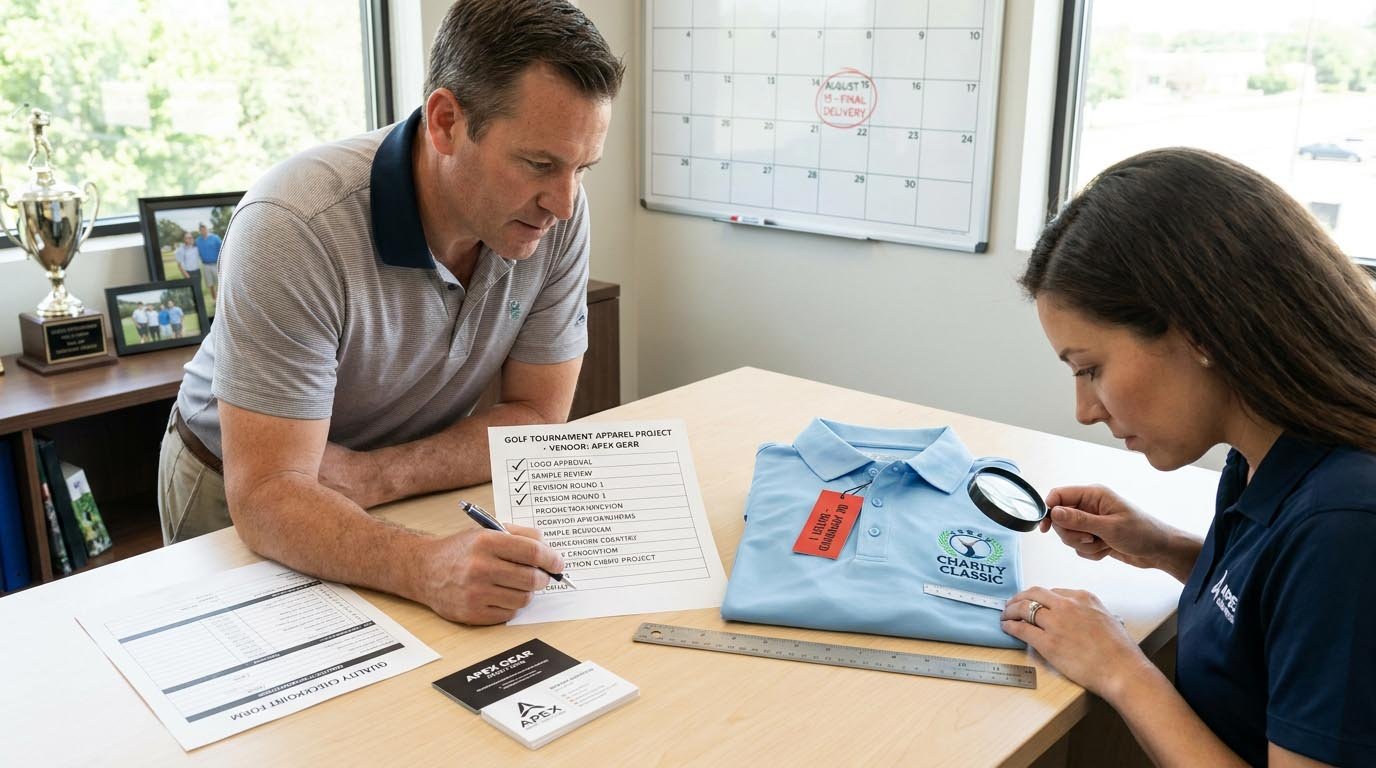
How to Evaluate Vendors, Lead Times, MOQ, and Quality Control
The right supplier should help you manage both production and project risk.
Ask suppliers about tournament-specific experience
A strong supplier should understand:
- sponsor approval chains
- multi-logo embroidery
- sampling revisions
- size overage strategy
- tournament deadlines
- contingency planning
A factory that only talks about production speed may not understand event risk.
Ask what their timeline actually includes
When a supplier gives a lead time, ask whether it includes:
- logo digitization
- sample production
- revision rounds
- bulk production
- freight
- customs clearance if relevant
A production timeline is not the same as a full project timeline.
Understand MOQ realistically
MOQ matters because there are fixed costs in:
- setup
- digitization
- line planning
- QC
- sample handling
Smaller orders are often possible, but they usually cost more per piece.
Ask about quality checkpoints
Good suppliers should be able to explain:
- pre-production sample approval
- inline inspection
- final inspection
- packing verification before shipment
These checkpoints reduce the chance of finding critical mistakes too late.
Ask how they handle problems
A supplier should be able to answer:
- what happens if a sponsor requests revisions
- what happens if a file is unusable
- what happens if a shipment is delayed
- what happens if a defect is found during inspection
Vendor evaluation checklist
| Question | Why It Matters |
|---|---|
| Have you handled golf tournament apparel projects before? | shows whether they understand event-specific risk |
| Does your lead time include samples and revisions? | avoids confusion between production time and full project time |
| What logo files do you require? | reduces artwork delays |
| What quality checkpoints do you use? | lowers the risk of bulk errors |
| How do you handle last-minute issues? | reveals whether they can protect the event, not just the order |
Practical supplier lesson
In tournament apparel, the cheapest quote is not always the safest choice. A supplier who helps identify problems early can save more money overall than a supplier who only offers a low base price and leaves the organizer to manage all the risk alone.
Best vendor-selection principle
Do not choose only on lowest price.
Choose the supplier who can best protect:
- timing
- quality
- sponsor satisfaction
- event-day execution
For golf tournament apparel, reliability and project management matter as much as garment quality.
FAQ: Custom Golf Tournament Apparel
How far in advance should I order custom golf tournament apparel?
Most organizers should start 90-120 days before the event. This allows enough time for sponsor approvals, sample rounds, production, shipping, and buffer.
Is embroidery better than screen printing for golf tournament polos?
Yes, in most cases. Embroidery is usually better for player polos because it looks more professional and lasts longer. Screen printing works better for large graphics and giveaway items.
How many extra polos should I order for a tournament?
A good rule is 10-15% extra pieces, with most extras concentrated in Medium, Large, and XL sizes.
What sizing data should I collect from players?
Collect:
- usual golf polo size
- fit preference
- chest measurement or reference brand and size
Do not rely only on basic S/M/L responses.
What is the best logo file format for sponsor embroidery?
Vector files such as AI, EPS, or vector PDF are best. Low-resolution JPEGs and screenshots often delay projects.
Why do sponsor logo approvals delay tournament apparel orders?
Because sponsors often need to review:
- logo size
- placement
- hierarchy
- color accuracy
- brand compliance
Some events also require legal or executive approval.
What does the total cost of custom golf tournament apparel include?
It may include:
- garment cost
- embroidery or printing
- setup fees
- samples
- freight
- duties
- packaging
- kitting
Can I order exact player count and skip extra inventory?
You can, but it is risky. Most events should order extra pieces for exchanges, late additions, and replacements.
What type of polo is best for a summer tournament?
For hot and humid events, lightweight and breathable performance polos are usually the best choice.
Can I provide my own polos and only pay for decoration?
Yes, but it often creates more cost, more logistics, and more quality risk than organizers expect. In many cases, buying fully decorated polos from one supplier is simpler.
Why are physical samples so important for sponsor-heavy orders?
Because digital mockups do not show actual embroidery quality, logo balance, texture, or scale on the garment. Physical samples help prevent expensive approval mistakes before production.
What makes a good golf tournament apparel supplier?
A good supplier understands sponsor approvals, logo execution, sizing, overage planning, QC, realistic timelines, and day-of event risk — not just garment production.
Final Takeaway
Custom golf tournament apparel projects succeed when organizers understand that the biggest risks are not just product quality or price. The biggest risks are usually:
- underestimating approval timelines
- delaying sponsor alignment
- using the wrong logo files
- skipping samples
- collecting poor sizing data
- ordering too close to event day
- failing to build in extra inventory
The most successful organizers usually do five things well:
- start early
- finalize sponsor requirements before sampling
- review real physical samples
- order extra pieces
- choose suppliers based on reliability, not just quote price
If you treat tournament apparel like a simple catalog purchase, you increase the chance of delays, rework, and sponsor dissatisfaction.
If you treat it like a custom branded event project, you improve:
- delivery reliability
- sponsor confidence
- participant comfort
- event presentation
- overall execution quality
The safest tournament apparel program is usually the one that solves coordination risk before it turns into production risk.
Need Help With Custom Golf Tournament Apparel?
We support tournament organizers, sponsors, clubs, and corporate event teams with:
- custom golf tournament polos
- sponsor logo embroidery and printing
- sample development and logo review
- size planning and order breakdowns
- kitting and individual packing
- MOQ and lead-time planning
- quality control and shipment coordination
If you already know your:
- event date
- player count
- sponsor structure
- target budget
- product type
send us your project brief and we can help you build a more realistic custom golf tournament apparel plan.