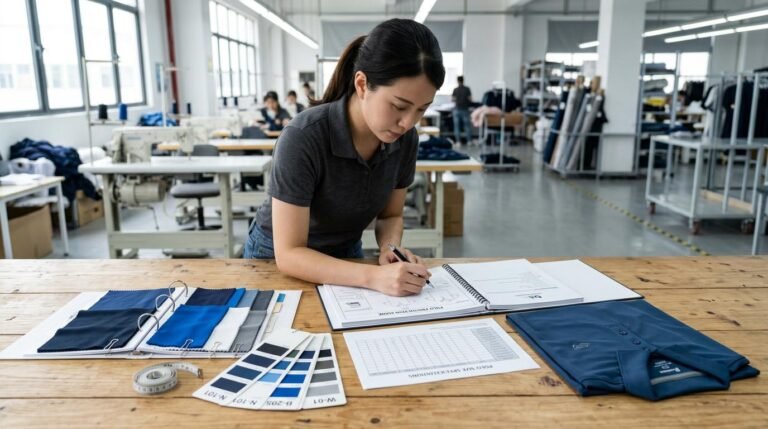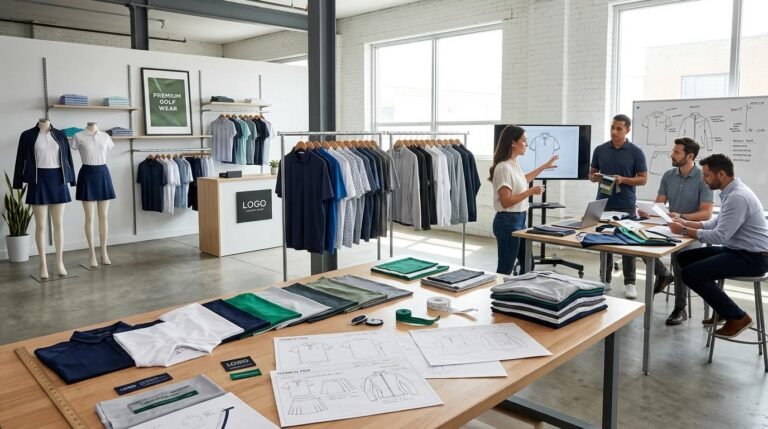
When I review fabric samples from new brand owners, they usually bring performance charts and pricing sheets. But three months later, they're dealing with returns because "breathable" polos feel suffocating on the back nine, or "premium" cotton blends pill after five washes.
Choosing golf apparel fabrics isn't about specs—it's about matching fiber type, knit structure, and finishing to your target customer's usage pattern and price expectations. Get one wrong, and you'll either lose margin or face returns. I've seen both happen to brands I work with.
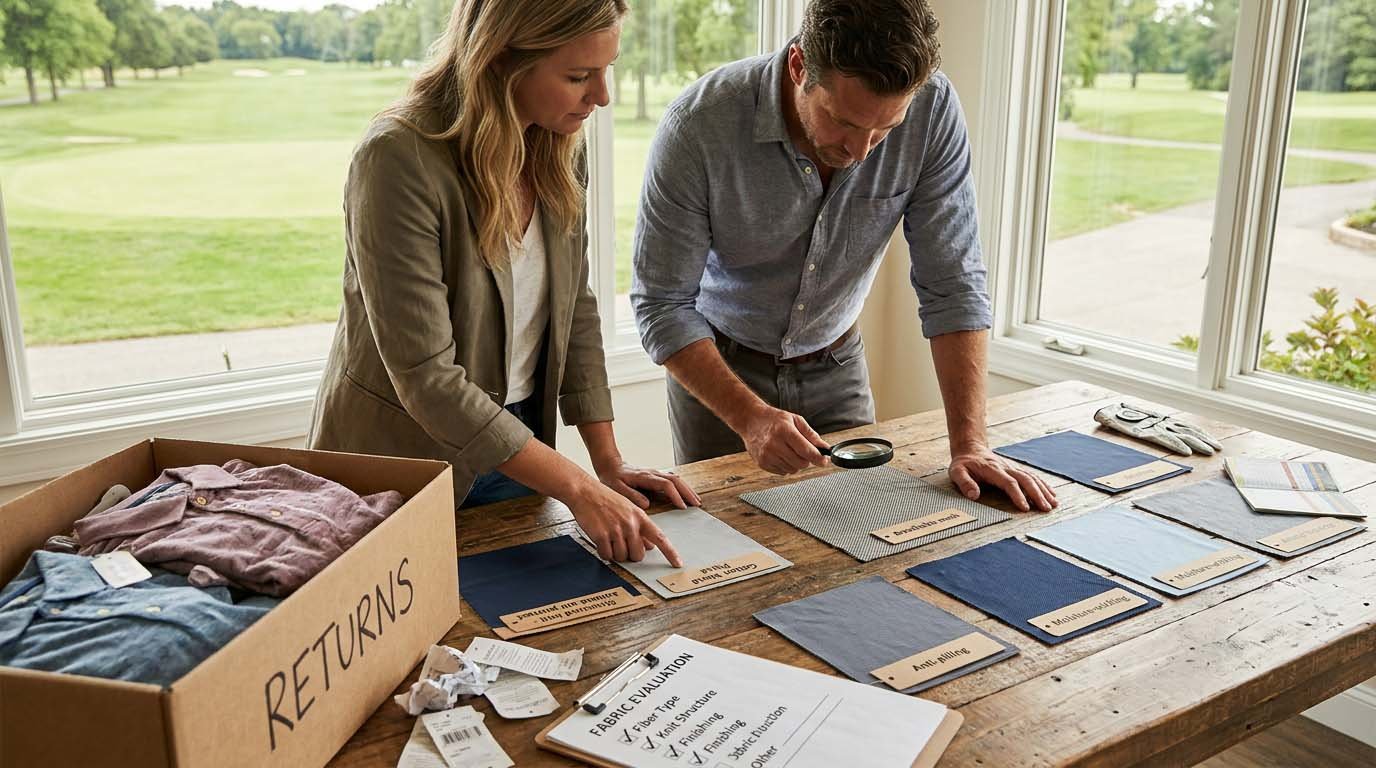
After helping over 150 golf brands navigate fabric selection in the past 15 years, I've learned that the real question isn't "which fabric is best?" It's "what specific problems does this fabric solve for golfers at this price point, and what am I giving up?" Let me walk you through how we actually make these decisions at the factory level.
If you are planning a full collection rather than just fabric selection, start with our complete guide on how to start a golf apparel line.
Quick Answers: Golf Fabric Selection in 60 Seconds
Q: What's the most versatile fabric for golf polos?
200-220 GSM polyester pique mesh balances moisture management, durability, and cost. It works for 70% of brands targeting mid-range positioning ($35-55 retail).
For polo-specific material choices, see our guide to the best fabrics for golf shirts.
Q: When should I use cotton blends instead of 100% synthetics?
When your customer values soft hand-feel over maximum performance, typically in premium casual lines ($60+ retail) worn off-course. Expect slower drying and more care instructions.
Q: Does higher GSM always mean better quality?
No. Knit structure matters more. A 180 GSM double-knit can outperform a 240 GSM single jersey in both comfort and durability. GSM just tells you fiber density.
Q: Why do some polyester fabrics feel cheap while others don't?
Yarn denier and finishing treatment. 75D polyester with enzyme wash and anti-pilling finish feels completely different from 150D with no post-treatment, even at the same GSM.
Q: How do I avoid the "clammy synthetic feel" customers complain about?
Use fabrics with geometric moisture channels (not just smooth filament) and ensure air permeability ≥150 mm/s. We test this before bulk production because specs on paper don't tell you how it feels during a 4-hour round.
What Do Golf Apparel Fabrics Actually Need to Do?
We always start by asking clients: "Where exactly will golfers wear this, and what ruins their experience?"
Golf isn't tennis. Players spend 3-5 hours outdoors with intermittent activity—high-intensity swings followed by slow walking or cart riding. The fabric needs to handle sweat accumulation during the swing without staying damp during rest periods. It also needs to survive 30+ wash cycles without losing shape, because golfers wear their favorite polos weekly.
Here's what I've learned from tracking customer feedback:
The four non-negotiable fabric functions:
- Moisture transport during swing motion (not the same as "breathability")
- Quick surface drying between holes (prevents clammy feeling)
- Shape retention after washing (avoids "stretched collar" returns)
- UV blocking if claiming sun protection (golfers notice sunburns)
What matters less than brands think:
- Ultra-lightweight fabrics (<140 GSM) often feel flimsy and show sweat stains more
- Extreme stretch (>30% recovery) adds cost but most golfers don't need yoga-level flexibility
- Anti-microbial treatments fade after 20 washes unless using silver-ion technology
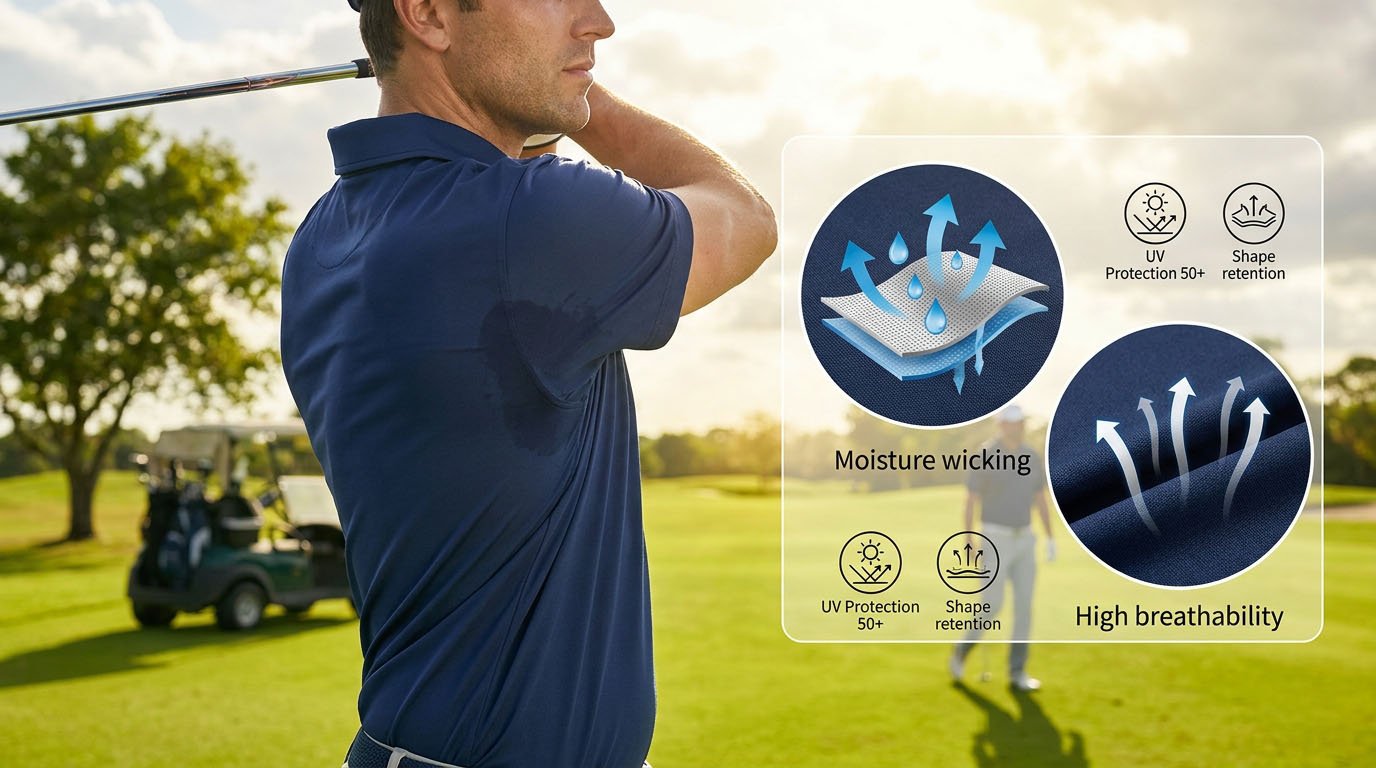
One mistake I see repeatedly: brands confuse wicking and breathability. Wicking pulls moisture from skin to fabric surface (fiber shape and treatment). Breathability moves air through the fabric (knit structure and GSM). You need both, but they're controlled by different factors.
Last year, a client chose 160 GSM polyester interlock because the mill called it "highly breathable." Air permeability test showed only 80 mm/s—good for winter base layers, terrible for summer golf. The fabric wicked sweat efficiently but couldn't ventilate, so players felt damp and overheated. We switched to 180 GSM pique mesh (250 mm/s air permeability) with slightly lower wicking speed. Customer complaints dropped by 60%.
Fabric selection only works when it supports mobility, so it is worth reviewing our golf apparel fit guide alongside fabric decisions.
Does Polyester or Nylon Work Better for Golf Wear?
Clients ask me this constantly, and my answer frustrates them: "What's your retail price target and what claim do you want to make?"
Polyester dominates golf apparel (roughly 80% of what we manufacture) because it checks the most boxes at the best cost. Nylon shows up in specific use cases where you need something polyester can't deliver.
Let me break down when each makes sense:
| Decision Factor | Polyester | Nylon |
|---|---|---|
| Moisture wicking | Excellent with right fiber cross-section | Good, but absorbs more moisture (4-8% vs 0.4%) |
| Durability (abrasion) | Good for general wear | Superior—resists cart seat friction better |
| Cost per kg | $2-3 for standard grades | $4-6 for comparable grades |
| Color fastness | Excellent with disperse dyes | Excellent but requires different dye chemistry |
| Stretch recovery | Moderate (needs spandex blend) | Better natural elasticity |
| Static build-up | Higher (noticeable in dry climates) | Lower |
Where we use polyester:
- Standard polos and tees (85% of golf apparel volume)
- Budget to mid-range lines ($20-55 retail)
- When brands need vibrant colors or custom sublimation printing
Where we recommend nylon:
- Windbreakers and lightweight jackets (superior wind resistance)
- Pants and shorts with high cart wear (inner thighs, seat area)
- Premium technical lines where "nylon content" signals quality
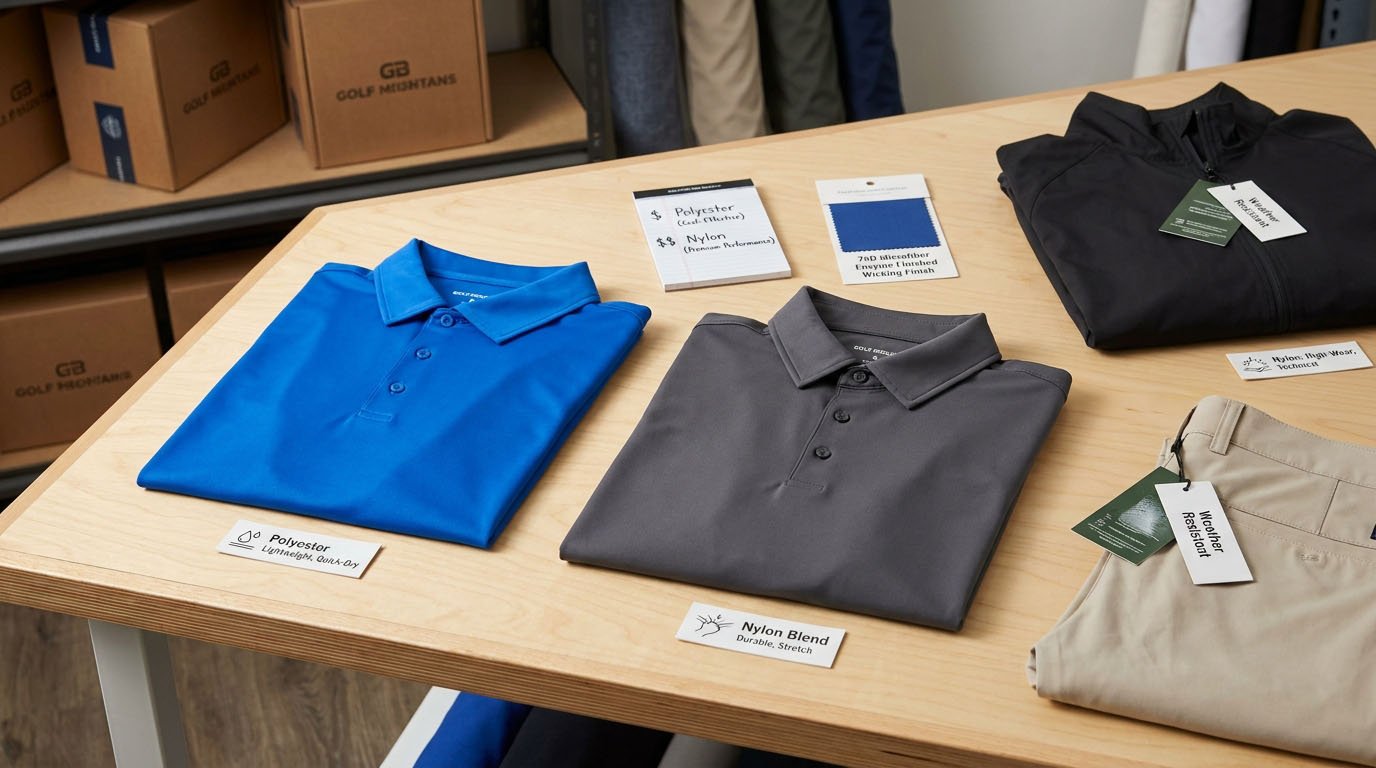
Here's something most brands don't know: polyester isn't inherently "cheap feeling." That reputation comes from using thick denier yarns (150D+) without finishing treatment. When we use 75D microfiber polyester with enzyme washing and peach finishing, customers can't tell it apart from $80 retail polos.
I had a client insist on nylon-poly blend (70/30) for polos because they thought it positioned them as premium. Cost went up $2.80 per unit with minimal performance difference. After A/B testing with 200 customers, 92% couldn't identify which was nylon-blend. We switched back to optimized polyester and invested the savings in better packaging.
The decision isn't polyester vs. nylon—it's "what specific property do I need that justifies the cost difference?"
When Should You Actually Use Cotton Blends?
Every time someone asks for "cotton for that premium feel," I ask them to define "premium." Because cotton blends have a specific customer profile, and forcing them into the wrong product line kills margins.
Cotton-poly blends (typically 65/35 or 60/40) make sense when:
- Your target customer is over 45 years old and associates cotton with quality
- The product is worn off-course more than on-course (casual polos, not performance)
- You're positioning above $60 retail where soft hand-feel outweighs performance
- Climate is mild (not humid summers where slow-drying becomes a problem)
Cotton blends create problems when:
- Used in high-activity garments (holds sweat, takes 3x longer to dry)
- Target customer is performance-focused (expects modern fabric tech)
- Manufacturing includes custom dye matching (cotton and poly take dye differently)
- MOQ is low (mills charge premium for cotton-blend production runs)
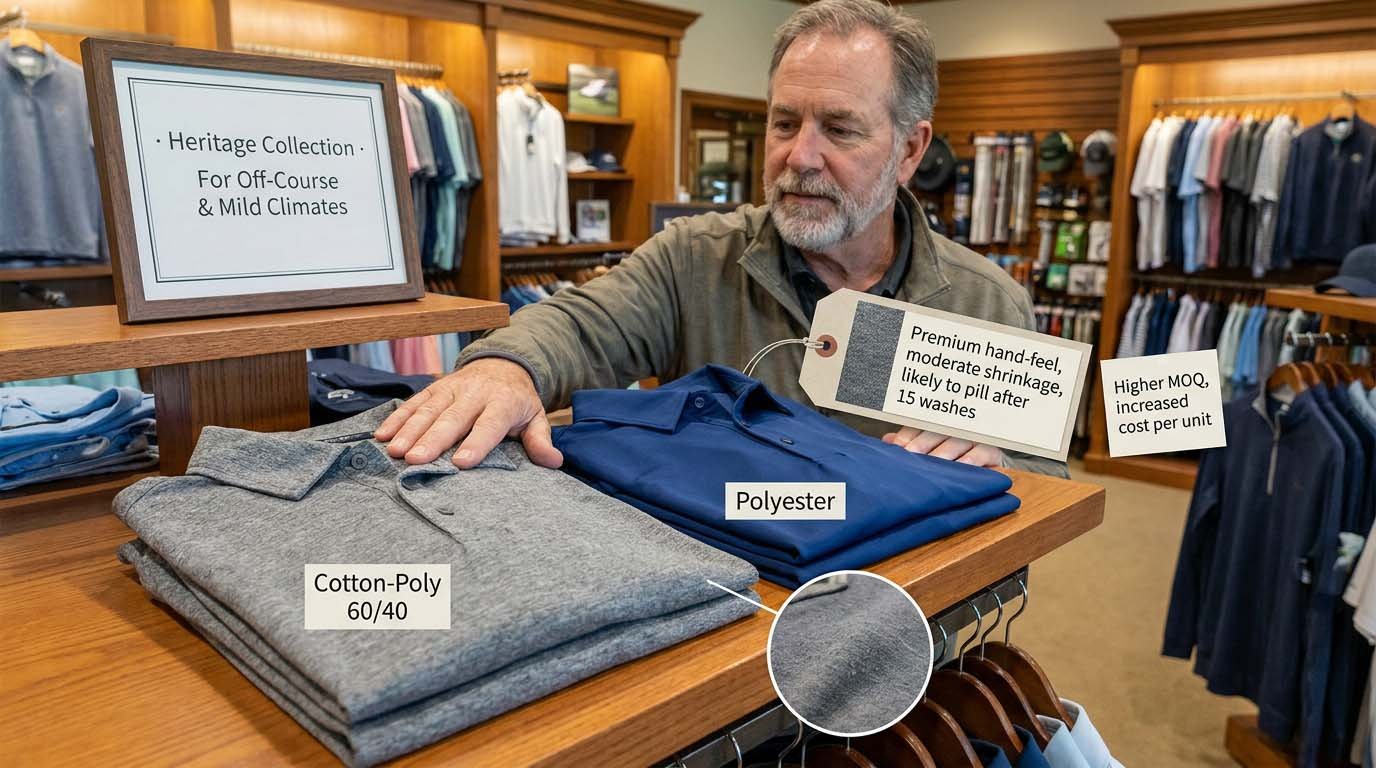
Here's what happens in real production: cotton shrinks, polyester doesn't. Even pre-shrunk cotton blends lose 2-3% in length after first wash. That means we need to cut longer, which increases fabric usage and cost. Plus, cotton pills more aggressively than synthetics—blends show pilling after 10-15 washes where polyester holds up for 50+.
I worked with a brand launching a "heritage collection" targeting golfers who grew up wearing cotton polos. We used 60/40 cotton-poly pique, added anti-pilling treatment, and adjusted sizing to account for shrinkage. Sold well at $68 retail, but required 25% higher MOQ (1,200 vs. 800 pieces) because the mill needed full production runs for cotton-blend dyeing.
The honest conversation: If you choose cotton blend, you're trading performance for perception. Make sure your customer values that trade. We've seen brands try to split the difference with 50/50 blends—they get neither the softness of cotton nor the performance of poly. Don't hedge.
What Knit Structures Actually Work for Golf Polos?
This is where brands waste the most money by not understanding what they're paying for.
GSM (grams per square meter) tells you density. Knit structure tells you performance. You can have three fabrics at 200 GSM that feel completely different and cost different amounts.
The three knit structures we use most:
1. Pique Mesh (Honeycomb Structure)
- Best for: General golf polos, widest customer acceptance
- Weight range: 180-220 GSM
- Why it works: Geometric texture creates air channels; moisture spreads across surface area
- Cost factor: Standard production, no premium
- Trade-off: Visible texture isn't suitable for formal styles
2. Single Jersey (Smooth Surface)
- Best for: Budget lines, undershirts, base layers
- Weight range: 140-180 GSM
- Why it works: Lightweight, good drape, lowest production cost
- Cost factor: 15-20% cheaper than pique at same GSM
- Trade-off: Shows sweat marks more; less dimensional stability
3. Double Knit (Two-Layer Structure)
- Best for: Premium performance lines, structured fit
- Weight range: 200-260 GSM
- Why it works: Two fabric layers trap air, superior shape retention
- Cost factor: 30-40% more expensive than single jersey
- Trade-off: Heavier, can feel restrictive in hot weather
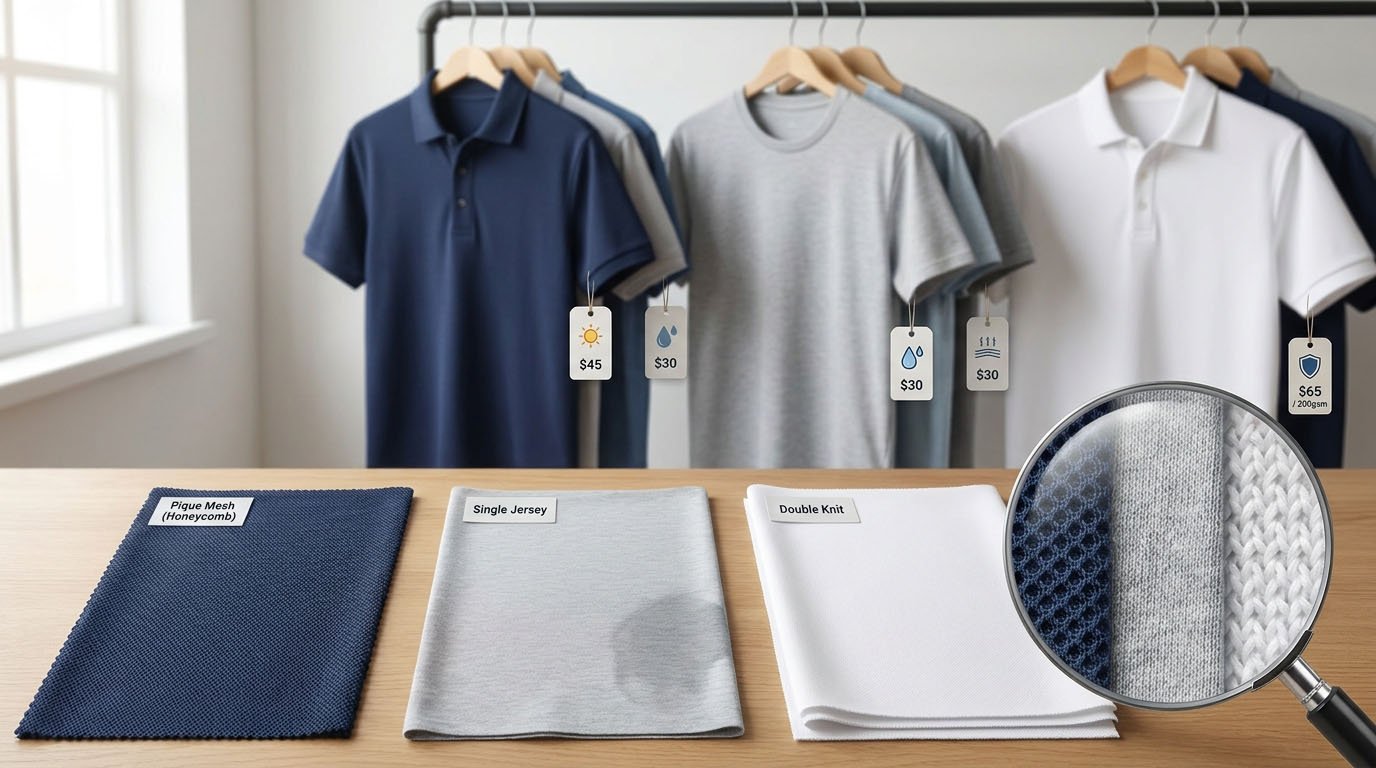
Here's the decision framework I use:
| If your priority is... | Use this knit | At this GSM | Expect this cost |
|---|---|---|---|
| Best value for mid-market | Pique mesh | 200-210 | $4.50-5.20/unit |
| Premium hand-feel and durability | Double knit | 220-240 | $6.80-8.50/unit |
| Lightweight summer performance | Pique mesh with micro-holes | 160-180 | $5.20-6.00/unit |
| Budget-conscious volume | Single jersey | 160-180 | $3.80-4.30/unit |
The mistake I see most: Brands choose GSM first, then knit structure. That's backwards. Start with the performance you need, then optimize GSM within that structure.
A client wanted "substantial feel" for a premium line, so they specified 240 GSM single jersey. It felt heavy and sluggish. We switched to 220 GSM double knit—lighter weight but felt more premium because of structural integrity. Same cost per unit, better customer reception.
One more thing about stretch: Adding 5-10% spandex increases comfort but affects production. Spandex-blend fabrics require more precise tension control during knitting and lower heat during finishing. Not all factories handle this well. If you're adding stretch, verify your manufacturer's equipment can maintain consistent tension—otherwise you'll get wavy hems and twisted seams.
What Fabrics Should You Use for Each Product Type?
After 15 years, I can predict which fabric choices will cause problems based on product type. Let me save you some expensive mistakes.
Golf Polos (Standard Line):
- Recommendation: 200-210 GSM polyester pique mesh
- Why: Best balance of performance, cost, and market acceptance
- Finishing: Anti-pilling + moisture-wicking treatment
- Cost target: $4.50-5.50/unit at 800+ pieces
- Avoid: Cotton blends here—slow drying kills performance perception
Premium Performance Polos:
- Recommendation: 180-200 GSM polyester double knit with micro-perforations
- Why: Structured look with enhanced ventilation
- Finishing: UV protection (UPF 40+) + anti-odor if budget allows
- Cost target: $7.00-9.00/unit at 800+ pieces
- Avoid: Going below 180 GSM—feels flimsy despite "lightweight" marketing
Pants and Shorts:
- Recommendation: 230-260 GSM nylon-poly blend (70/30) or 100% polyester with mechanical stretch
- Why: Abrasion resistance for cart seats; needs weight for drape
- Finishing: DWR (water repellent) treatment mandatory
- Cost target: $8.50-11.00/unit at 500+ pieces
- Avoid: Cotton-poly blends—wrinkle badly after sitting
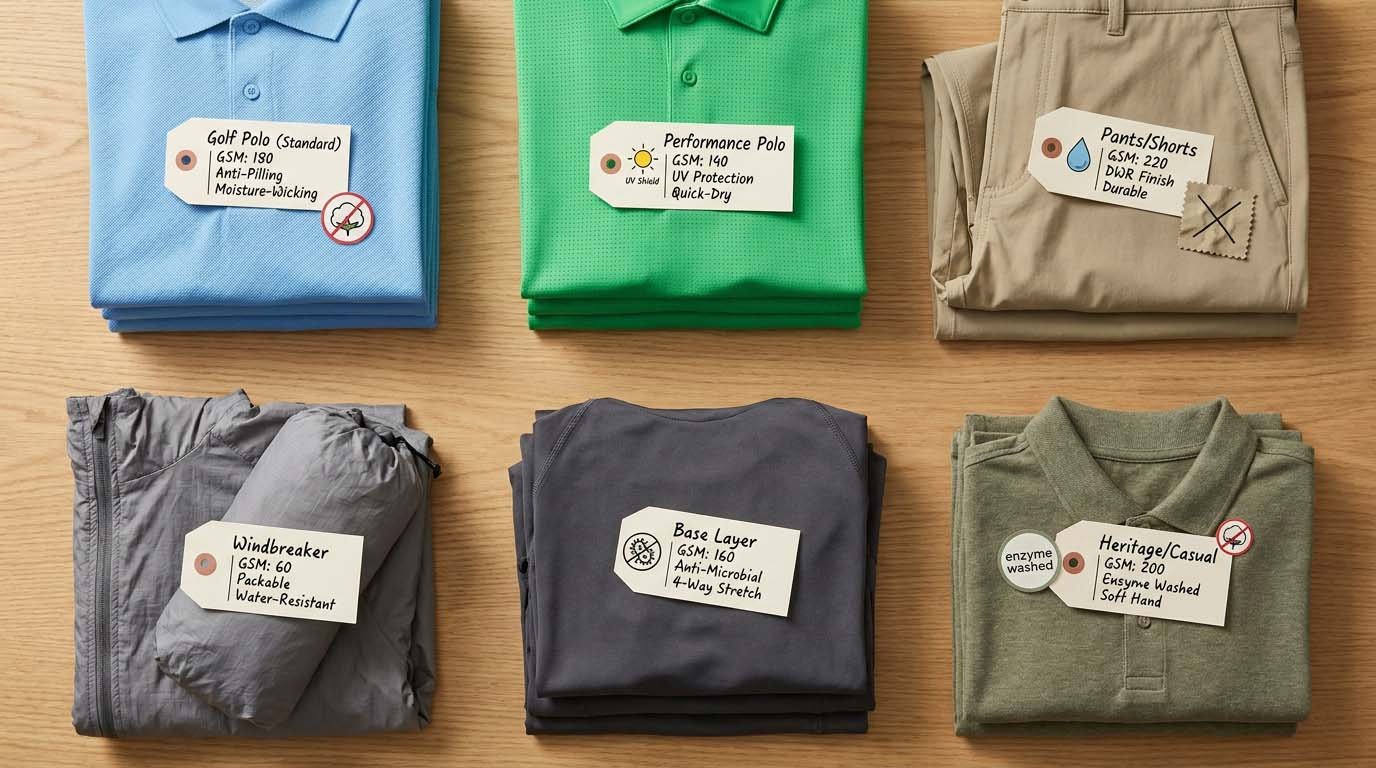
Windbreakers/Light Jackets:
- Recommendation: 100-120 GSM ripstop nylon or polyester microfiber
- Why: Wind resistance with packability
- Finishing: DWR + UV protection
- Cost target: $6.00-8.50/unit at 500+ pieces
- Avoid: Anything over 140 GSM—too bulky to pack
Base Layers/Compression:
- Recommendation: 160-180 GSM polyester-spandex (92/8) single jersey
- Why: Needs stretch and direct skin contact comfort
- Finishing: Anti-microbial highly recommended here
- Cost target: $4.80-6.20/unit at 600+ pieces
- Avoid: Cotton blends—defeats moisture management purpose
Heritage/Casual Lines:
- Recommendation: 200-220 GSM cotton-poly (60/40) pique
- Why: Soft hand-feel for off-course wear
- Finishing: Pre-shrunk + anti-pilling + enzyme wash
- Cost target: $6.50-8.00/unit at 1,000+ pieces (higher MOQ)
- Avoid: Using same sizing as synthetic lines—cotton shrinks
Here's how this plays out in real decisions:
Last month, a client wanted to launch three product lines simultaneously—performance, casual, and budget. They asked if we could use the same base fabric to simplify inventory. My answer: not if you want each line to succeed.
We ended up with:
- Performance line: 200 GSM polyester pique mesh with UV protection ($5.20/unit)
- Casual line: 210 GSM cotton-poly blend with enzyme wash ($7.10/unit)
- Budget line: 180 GSM polyester single jersey ($3.90/unit)
Each fabric costs different, performs different, and attracts different customers. Trying to use one fabric for all three would have compromised each line's positioning.
Minimums and dyeing thresholds also affect which fabrics are realistic for first runs—see golf apparel MOQ explained.
How Does Fabric Choice Actually Affect Your Retail Price?
To connect material choices with margin structure and positioning, read how to price golf apparel.
This is where most brand owners get surprised—not because the math is complicated, but because fabric cost isn't linear with retail positioning.
The reality: Fabric typically represents 18-25% of your landed cost for golf polos. But the perception difference between fabrics creates 40-60% retail price variance.
Let me show you real numbers:
Scenario 1: Mid-range Performance Polo
- Fabric: 200 GSM polyester pique ($5.00/unit)
- Total manufacturing: $11.50/unit at 1,000 pieces
- Suggested retail: $42-48
- Market position: "Quality performance brand"
Scenario 2: Premium Technical Polo
- Fabric: 210 GSM double knit with UV ($7.80/unit)
- Total manufacturing: $14.20/unit at 1,000 pieces
- Suggested retail: $65-75
- Market position: "Advanced golf technology"
Scenario 3: Heritage Casual Polo
- Fabric: 220 GSM cotton-poly blend ($7.10/unit)
- Total manufacturing: $13.80/unit at 1,000 pieces
- Suggested retail: $68-78
- Market position: "Classic golf tradition"
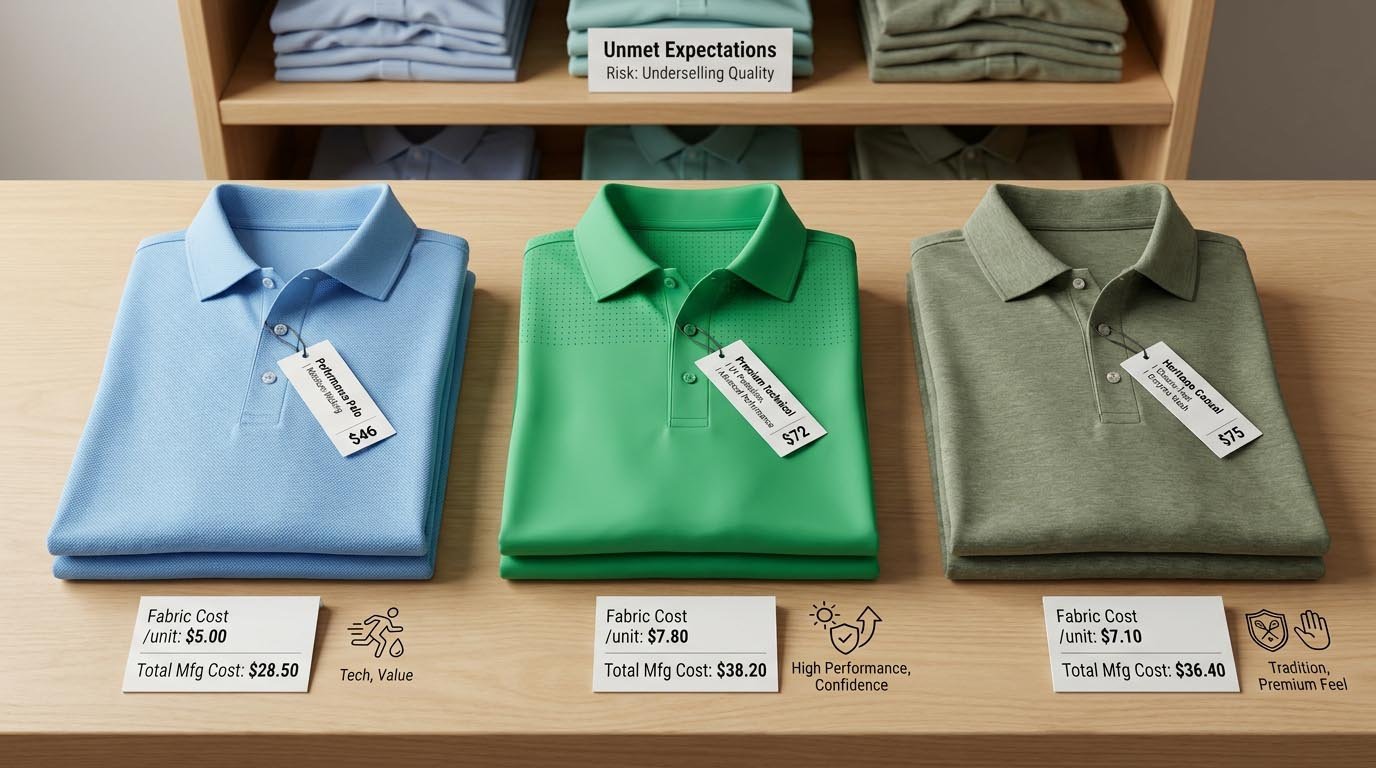
Notice something? Scenario 2 and 3 have similar manufacturing costs but position completely differently. The fabric choice signals to different customer segments.
What actually affects your pricing power:
- Fabric's market reputation (cotton="premium", advanced poly="performance")
- Finishing treatments you can claim (UV protection, anti-odor, moisture-wicking)
- Consistency with brand story (tech brand using cotton creates confusion)
- Competitor fabric standards in your target segment
Here's the strategic question: Are you choosing fabric to maximize margin or strengthen positioning?
I worked with a brand targeting $55-65 retail. They could use $4.80/unit polyester (30% margin) or $7.20/unit premium nylon-blend (22% margin). We ran split testing with 400 customers.
Results:
- Standard polyester: sold at $52 average (customers perceived it as $40-50 tier)
- Premium blend: sold at $64 average (customers accepted premium positioning)
The $2.40/unit fabric upgrade enabled $12 retail increase. Lower margin percentage but $4.20 more gross profit per unit.
The mistake brands make: Choosing cheapest fabric to maximize margin, then struggling to hit retail price targets because the fabric doesn't support premium perception.
Fabric and retail positioning decision matrix:
| Retail Target | Required Fabric Tier | Minimum Finishing | Don't Use |
|---|---|---|---|
| $30-45 | Standard polyester pique 180-200 GSM | Moisture-wicking only | Cotton blends, nylon (over-engineered) |
| $45-60 | Premium polyester or poly-blend 200-220 GSM | Wicking + UV or anti-pilling | Single jersey (feels cheap), heavy cotton |
| $60-80 | Double knit, nylon-poly, or cotton-poly 210-240 GSM | Multi-function (UV + odor + pilling) | Budget synthetics without finishing |
| $80+ | Specialty fabrics, merino blends, advanced tech 200-230 GSM | All performance features + sustainability story | Any fabric without provable claims |
One critical thing: If you claim "premium fabric" but use standard polyester with basic finishing, customers notice after washing. We've had brands try to stretch $4.50/unit fabric into $70 retail products. Return rates hit 18% after 30 days—pilling, shape loss, color fade.
Your fabric choice needs to deliver on the promise your price makes. Don't ask the fabric to do work it wasn't designed for.
FAQ
How much should I budget per unit for golf polo fabric?
For mid-market positioning ($40-60 retail), budget $4.50-7.00/unit for fabric and finishing. This gets you 180-220 GSM polyester with proper treatments. Going below $4.00 usually means sacrificing finishing quality; going above $8.00 only makes sense if your retail target is $70+.
Can I mix fabric types in one product line?
Yes, but keep fiber content consistent (all synthetic or all blends). Mixing creates washing instruction complexity and customer confusion. We've seen brands use different weights of the same fabric family successfully—like 180 GSM pique for summer, 220 GSM for fall.
Do I need different fabrics for different colors?
Not different fabric, but finishing affects lighter colors. White and pastels show sweat marks more, so we often add moisture-dispersion treatment specifically for light colorways. Dark colors hide moisture but fade faster without UV protection.
What's the minimum order quantity for custom fabric?
Most mills require 1,000-1,500 kg minimum for custom-developed fabrics. That translates to roughly 4,000-6,000 polos. Below that, you're choosing from existing mill inventory, which is fine—90% of golf brands use stock fabrics with custom finishing.
How do I verify fabric quality before bulk production?
Ask for lab-dip samples (color-matched swatches) and strike-off samples (full yardage). We run these tests: air permeability, moisture-wicking rate (AATCC 195), dimensional stability after washing, and pilling resistance (ASTM D3512). If factory won't provide test reports, that's a red flag.
Should I pay extra for anti-microbial treatment?
Only if you can prove it lasts and your customer values it. Standard anti-microbial additives fade after 20-30 washes. Silver-ion treatment lasts longer but adds $1.20-1.80/unit. We recommend it for premium lines ($65+ retail) or if odor control is a key selling point.
Fabric strategy only works when it matches product focus, fit, MOQ, and launch sequencing—topics we cover in how to start a golf apparel line.
Conclusion
Fabric selection isn't about finding the "best" material—it's about matching fiber type, knit structure, and finishing to your specific customer's needs and price expectations. Start with usage scenario, build up to performance requirements, then let those dictate your fabric choice. Every decision is a trade-off; just make sure you're trading intentionally.