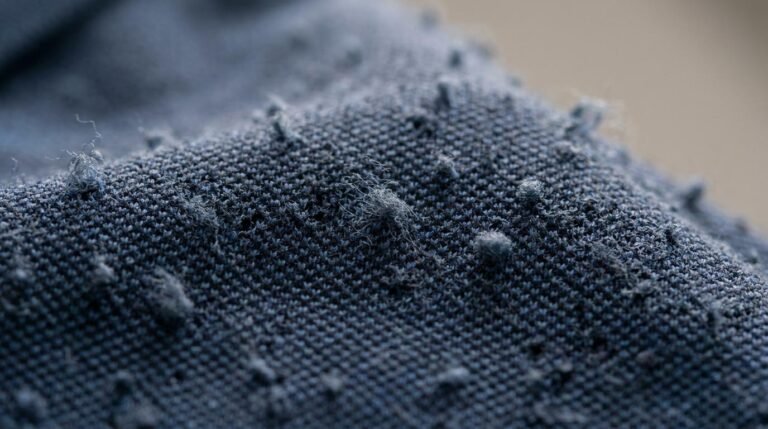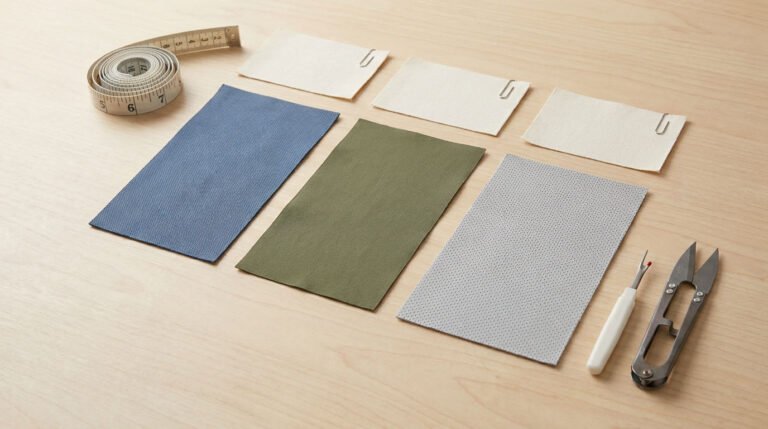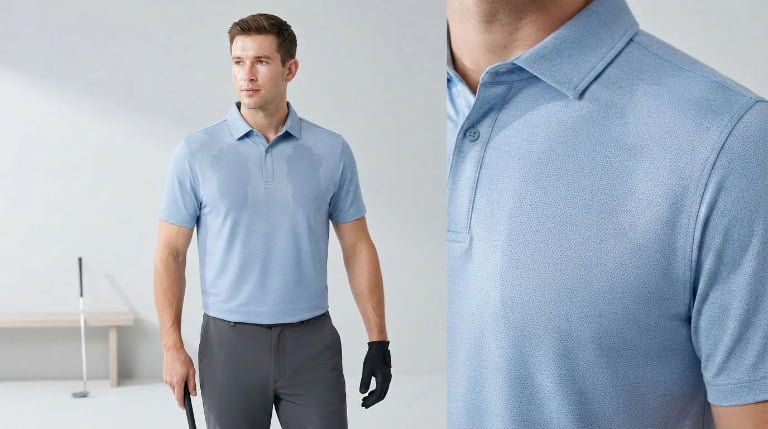
Mesh panels can improve ventilation in golf apparel, but placing them in the wrong areas may introduce new problems: uncomfortable seams, fabric distortion, unwanted transparency, or reduced sun protection.
For golf apparel brands, the question is not simply whether mesh is breathable. It is where to position mesh panels, which fabrics to combine, and how to verify the finished garment before bulk production.
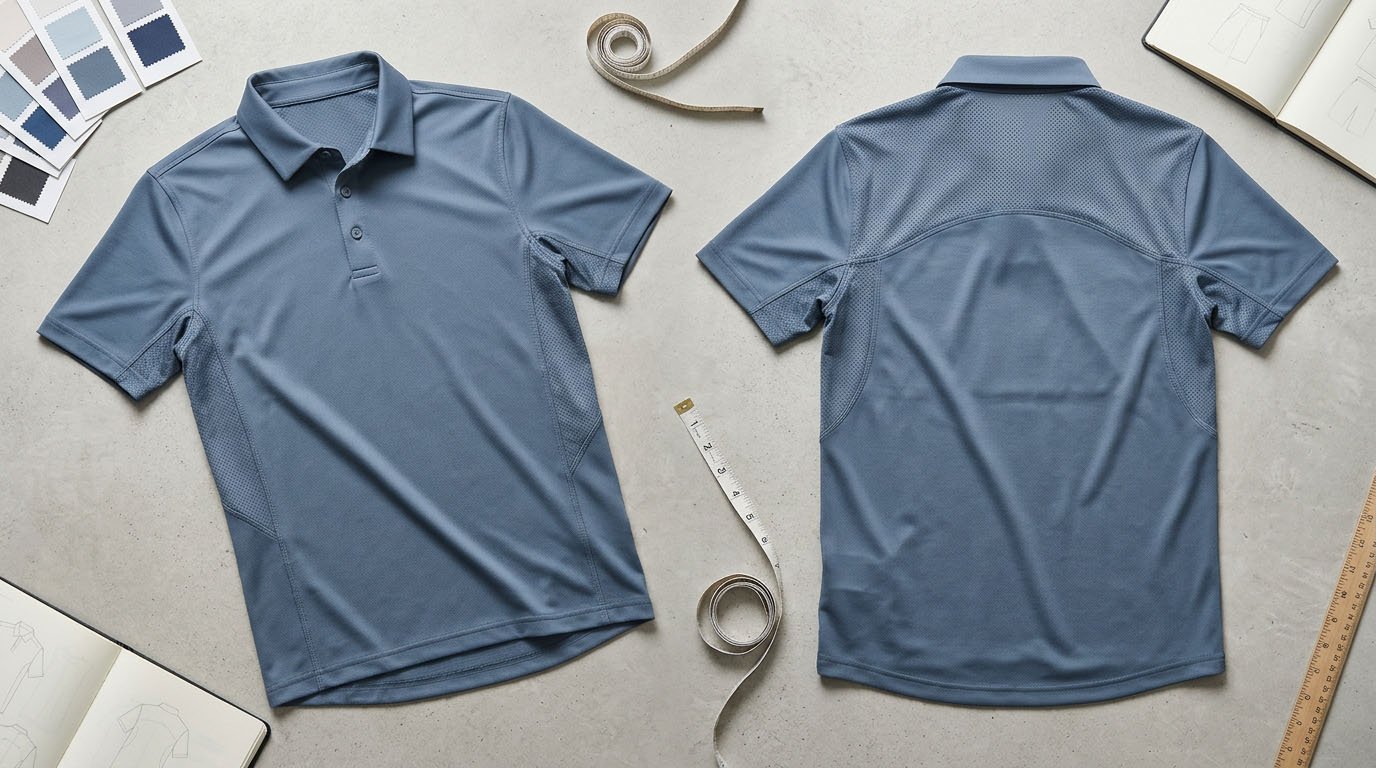
The most common candidate areas include underarm gussets, side torso panels, and selected back panels. However, the right choice depends on garment construction, fit, wearing conditions, and the performance requirements of the finished product.
Quick Answer: Where Should You Use Mesh Panels in Golf Apparel?
Mesh panels are most useful when they address a specific ventilation or comfort problem that the main fabric cannot adequately solve.
| Garment | Candidate Mesh Location | Main Purpose | Important Risk |
|---|---|---|---|
| Golf Polo | Underarm gusset | Targeted ventilation | Skin friction and limited airflow when arms are lowered |
| Golf Polo | Side torso | Ventilation and design flexibility | Stretch mismatch and seam distortion |
| Golf Polo | Upper back | Potential ventilation in selected designs | UV exposure and golf bag abrasion |
| Golf Skort | Inner waistband facing | Skin comfort and moisture management | Limited ventilation if covered by outer fabric |
| Quarter-Zip | Side panels or back vent | Manage ventilation during active wear | Reduced wind protection |
| Golf Shorts | Pocket bag or inner waistband | Reduce bulk and improve local comfort | Insufficient durability or excessive transparency |
The best placement is not necessarily the area with the most sweat. An underarm panel may seem logical, but if the arm covers it during wear, it adds seams without adding meaningful airflow.
The mesh must allow useful airflow, remain comfortable during a golf swing, and meet the garment's durability and appearance requirements.
Before approving a design, evaluate the fabric pairing, panel construction, and actual sample performance.
Key 1: What Do Mesh Panels Do in Golf Apparel?
Mesh panels are sections of relatively open fabric incorporated into a garment. They may be cut and sewn into specific areas, while some garments use engineered knit ventilation zones as an alternative.
Their main purpose is to allow air to pass through selected parts of the garment.
However, air permeability, moisture management, and thermal comfort are related but different properties.
A mesh insert with high air permeability does not automatically guarantee that a golfer will feel cooler. Cooling is influenced by airflow, humidity, garment fit, and the body's own thermoregulation. A ventilated panel that sits flat against the skin or under another layer may move less air than expected.
How Mesh Panels Differ From Breathable Main Fabrics
A breathable pique or jersey fabric provides its performance across the garment body. A separate mesh panel creates a localized area with different structural properties.
This distinction matters because a mesh insert introduces additional construction considerations:
- A joining seam between the mesh and main fabric
- Possible differences in stretch and recovery
- Different washing and dimensional-change behavior
- Additional transparency and UV considerations
- Potential changes to the garment's appearance
Design Rule: Before specifying a mesh panel, ask: What problem does this solve that the main fabric cannot? If the answer is unclear, start with a simpler construction and test first.
If the main fabric already meets the brand's ventilation and comfort targets, a separate mesh insert may not be necessary.
For a broader explanation of fabric performance and garment structure, see our guide to balancing breathability, structure, and comfort in golf apparel.
This article focuses specifically on mesh placement and production decisions.
Key 2: Where Should Mesh Panels Be Placed in Golf Apparel?
There is no universal ventilation map that works for every golf garment.
The appropriate position depends on the fit block, main fabric, intended climate, and the movements or contact conditions the garment must accommodate.
Underarm Mesh Panels: A Candidate for Golf Polos
Underarm gussets are a common area to consider because the underarm experiences perspiration and repeated movement.
Potential advantages:
- Mesh can be relatively discreet.
- The insert can be integrated into an existing gusset or side-panel construction.
- It may provide localized ventilation when the area is exposed to airflow.
Design risks:
- The arm may cover or compress the panel during normal wear.
- Poorly positioned seams can rub against the skin.
- A mesh insert with insufficient stretch may restrict movement.
- Excessive seam bulk can reduce comfort.
For an underarm design, check the sample with the arms naturally lowered, raised, and moving through a golf swing.
Approval gate for underarm mesh: The sample passes only when the wearer can complete a full swing without seam irritation, the panel does not visibly pull or restrict movement, and the mesh remains flat after washing.
A mesh gusset should not be approved based on its appearance alone.
Side Torso Mesh Panels: Ventilation and Design Flexibility
Side torso panels can provide a relatively discreet design feature while preserving space for chest logos and other branding.
They may also help create visual contrast between the front and back body panels.
However, the side torso experiences movement and fabric tension during rotation.
If the mesh and main fabric have substantially different stretch or recovery behavior, the garment may develop:
- Wavy joining seams
- Diagonal pulling
- Side-panel twisting
- Excessive local stretching
- Distortion after washing
Quick check: Lay the washed sample flat. Run your hand along the joining seam. Any waviness, puckering, or twisting that wasn't present before washing indicates a compatibility problem that needs investigation.
Check the garment while standing, bending, and rotating. The mesh should not pull the hem or change the intended silhouette.
Upper Back Mesh Panels: Ventilation With Additional Risks
Upper back panels can be considered when designing a garment with a dedicated ventilation feature.
Their performance depends on panel placement, exposure to airflow, and whether the design includes a protective outer layer or vent construction.
Two risks deserve particular attention.
UV exposure: Open mesh can allow more ultraviolet radiation to reach the skin. Do not assume that an adjacent UPF-rated main fabric provides the same protection over the mesh area.
Abrasion: Golfers who carry bags may expose shoulder and upper-back materials to repeated friction from straps and contact surfaces.
Before using upper-back mesh, determine whether the ventilation benefit justifies these risks.
For sun-protective golfwear, consider alternatives such as a double-layer vented back yoke (where the outer layer shields UV while the inner layer manages airflow), or a main fabric with engineered micro-ventilation that maintains consistent UPF coverage.
Mesh in Golf Skorts, Shorts, and Quarter-Zips
Mesh does not always need to be visible on the outside of a garment.
For golf skorts and shorts, suitable applications may include pocket bags and selected inner waistband components.
In these applications, mesh may help reduce bulk or change the feel of a layer against the skin. However, a mesh lining covered by an impermeable or tightly constructed outer fabric should not automatically be described as an effective ventilation opening.
For quarter-zips, mesh side inserts or protected back vents may be considered. The construction must account for layering, wind exposure, and the garment's intended thermal function.
Buyer takeaway: Select the mesh location only after defining what problem it is expected to solve.
Key 3: How Should You Match Mesh Fabric With the Main Fabric?
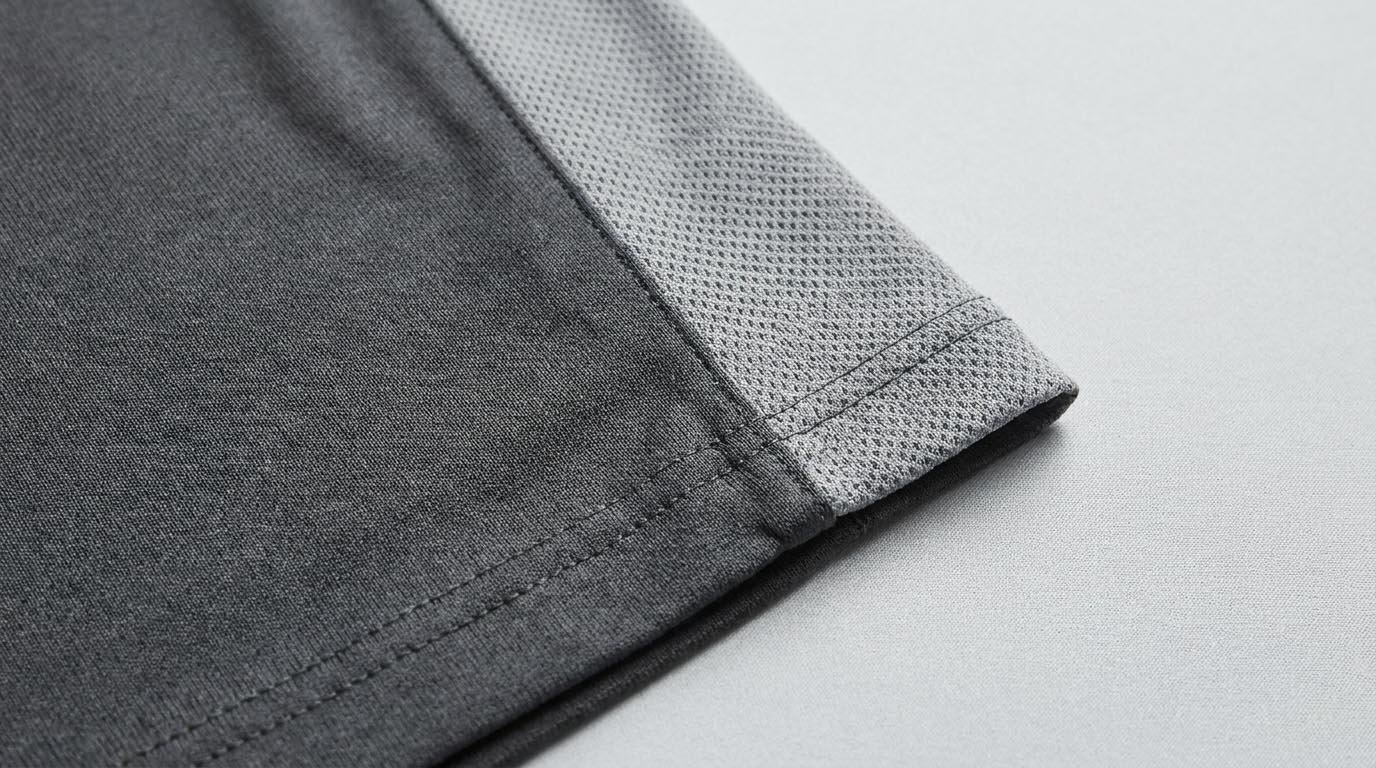
Mesh and main-body fabric should be treated as one garment construction system.
It is not enough to choose two fabrics that look compatible in a swatch book.
The combination must also work when stretched, sewn, washed, and worn.
Compare These Five Material Properties
| Property | What to Evaluate | Potential Problem |
|---|---|---|
| Stretch and recovery | Extension and return in relevant directions | Restricted motion or permanently stretched panels |
| Fabric weight and drape | Behavior of both fabrics when joined | Sagging, pulling, or uneven appearance |
| Dimensional stability | Lengthwise and widthwise change after washing | Puckering or twisting |
| Surface and hand feel | Texture against the skin and other garments | Irritation or friction |
| Color and opacity | Appearance under intended lighting and wear conditions | Visible mismatch or unwanted transparency |
Stretch Compatibility Matters More Than Matching Fiber Percentages
Two fabrics with the same polyester and spandex content can still behave differently because of knit structure, yarn construction, finishing, and other factors.
Similarly, fabrics with different fiber compositions may be compatible for a particular application.
The meaningful question is whether the selected materials perform acceptably together in the finished garment.
When communicating with your supplier, replace the question "Do these fabrics have the same stretch?" with "Please test these two fabrics joined along the proposed seam. How do they behave after 5 wash cycles?"
Ask your supplier to compare stretch direction, recovery behavior, and seam performance rather than relying only on fiber percentages.
Should Mesh and Main Fabric Have the Same GSM?
Not necessarily.
A mesh panel may be lighter than the main fabric, but there is no universal GSM ratio that guarantees a good result.
Compatibility depends on panel size, location, fabric construction, and the intended silhouette.
A small insert and a full-length side panel create different demands.
Instead of setting an arbitrary weight difference, inspect the joined fabrics for pulling, sagging, and distortion.
Consider the Mesh Construction
Different mesh constructions have different properties.
| Mesh Construction | Typical Application | Key Consideration |
|---|---|---|
| Open-knit stretch mesh | Underarm or side inserts on performance polos | Opacity, snagging risk, seam stability at high-stretch zones |
| Fine-hole mesh | Visible back panels or lined vent constructions | Actual airflow (hole size ≠ air permeability); stretch recovery |
| Stable warp-knit mesh | Pocket bags, inner waistbands, internal linings | Drape, hand feel against skin, compatibility with outer fabric |
| Engineered knit ventilation | Integrated zones in premium cut-and-sew or seamless garments | Feasibility at required order quantity; development lead time |
These are material categories, not universal recommendations. Their suitability depends on the actual specification and sample.
Key 4: When Should You Avoid Mesh Panels? A Decision Framework
Mesh adds complexity. Before committing, run through these four questions:
1. Is there a UV exposure requirement?
If yes → Can the mesh meet the same UPF standard as the main fabric? If not, either choose a different mesh, move the panel to a lower-UV-risk area, or switch to an alternative ventilation construction.
2. Will the panel face repeated friction?
If yes (shoulders for bag carriers, sides for glove contact) → Test the actual mesh for snagging and abrasion. Delicate open-knit structures may fail earlier than expected.
3. Does the design require a clean, opaque exterior?
If yes → Check samples in the intended lighting and on-body. Light-colored garments especially can reveal mesh contrast. A fine-hole mesh may work; a large-hole mesh may not.
4. Can the same result be achieved without mesh?
If maybe → Compare a mesh sample against a non-mesh alternative (e.g., a lighter-weight main fabric, a vented construction, or a different fiber blend). Approve the mesh version only when it demonstrates a clear performance or design advantage.
The principle: Mesh should solve a specific, verifiable problem. If it's added only because competitors use it, the incremental complexity may not be justified.
Key 5: How Should You Specify Mesh Panels in a Tech Pack?
A technical drawing showing the position of a mesh insert is not enough for reliable production.
The factory also needs to know exactly which material to use, where the panel starts and ends, how it joins the main fabric, and how the finished result will be approved.
Mesh Panel Tech Pack Specification Table
Use the following as a specification template. The entries marked To be confirmed must be completed for the actual style.
| Specification | Required Information |
|---|---|
| Panel ID | Unique identification, such as MP-01 |
| Garment and fit | Polo, skort, quarter-zip; approved fit block |
| Panel location | Front/back technical drawing with reference points |
| Panel dimensions | Length, width, shape and measurement points |
| Mesh material | Composition, knit structure, GSM, color and approved swatch |
| Main fabric | Approved material reference |
| Construction | Joining seam, seam allowance, stitch and edge finish |
| Stretch requirement | Required movement and recovery behavior |
| Dimensional stability | Test conditions and agreed acceptance limits |
| Appearance | Opacity, color match and approved panel shape |
| Performance | Air permeability or UV requirements, where applicable |
| Sample approval | Test records, sample version and approval status |
Panel dimensions should be defined on the technical drawing, not described only as "small underarm mesh" or "breathable side insert."
For example, specify where an underarm insert begins relative to the armhole and side seam, and how its dimensions are measured.
Common Tech Pack Omissions for Mesh Panels
- Specifying the mesh material as "breathable mesh" without a swatch reference or composition
- Showing the panel on a flat sketch but omitting seam construction details
- Defining panel position but not panel dimensions or measurement tolerance
- Failing to note whether the mesh stretches in the same direction as the adjacent main fabric
- Omitting the required wash-test procedure and acceptance criteria for the joined construction
Each of these gaps can lead to a sample that looks correct but performs poorly after washing or wear.
Control Panel Dimensions and Construction
FUWAY's general finished-garment measurement tolerance is ±1.0 cm unless a customer's approved Tech Pack specifies a tighter requirement.
That general garment tolerance should not automatically be applied to every small mesh component. Panel dimensions, seam locations, symmetry, and any critical measurements should have separately agreed acceptance criteria where needed.
The complete document should also identify the approved sample version and any construction changes.
For the full document preparation process, use FUWAY's Golf Apparel Tech Pack Checklist for Buyers.
Key 6: How Do You Test Mesh Panels Before Bulk Production?
A mesh-panel design should be reviewed on a physical sample before it is approved for production.
The purpose is not simply to confirm that the mesh has been sewn into the correct location.
The sample must demonstrate that the chosen material, panel geometry, and joining construction are suitable for the actual garment.
Step 1: Check Panel Position and Appearance
Lay the garment flat and compare it with the approved technical drawing.
Verify:
- Panel shape and placement
- Left/right symmetry where applicable
- Seam alignment
- Visible puckering or twisting
- Color and opacity
- Edge finishing
Record any discrepancy before proceeding to wear evaluation.
Step 2: Conduct Golf-Specific Wear Checks
Test the garment on an appropriate wearer in its intended size.
For a polo or quarter-zip, evaluate:
- Normal standing posture
- Address position
- Backswing and follow-through
- Arm raising
- Torso rotation
- Intended layering conditions, if relevant
Pro tip: During the wear test, ask the fit model to hold the finish position for 5 seconds. Seams that feel acceptable during a quick swing may cause discomfort when held under tension.
Pay particular attention to seams near the underarm, shoulder, and side torso.
A mesh panel that looks correct on a table may still restrict movement or irritate the skin.
Step 3: Review Washing and Dimensional Stability
Wash and dry the sample according to the agreed test procedure and intended care instructions.
After testing, examine whether the mesh and main fabric have changed differently.
Check for:
- Panel puckering
- Twisting or uneven shrinkage
- Changes in seam appearance
- Distortion of the garment silhouette
- Loss of stretch recovery
The buyer and manufacturer should define the applicable test conditions, wash cycles, and acceptance criteria before testing.
For detailed dimensional-change methods, see FUWAY's Golf Apparel Fabric Shrinkage Testing Guide.
Step 4: Request Performance Testing Where Needed
Physical wear checks are useful, but they do not provide standardized air-permeability or UV-protection values.
Where measurable performance is part of the product specification, appropriate laboratory testing may be needed.
Two relevant references are:
- ASTM D737 — Air Permeability of Textile Fabrics, which describes a method for measuring air permeability.
- AATCC TM183 — UV Radiation Transmission or Blocking, which addresses ultraviolet radiation transmission through textile fabrics.
The test method, tested material, conditions, result, and acceptance criteria should be documented.
A test report for one mesh sample should not be treated as evidence for every mesh option or a different finished garment.
Step 5: Approve or Revise the Sample
Use a dedicated mesh-panel approval record to distinguish cosmetic issues from problems that affect comfort or performance.
| Review Item | Evidence to Record | Common Failure Mode | Status |
|---|---|---|---|
| Panel location | Approved drawing and sample photos | Asymmetry, deviation from spec | Pass / Revise |
| Seam construction | Seam inspection and construction reference | Puckering, incorrect stitch type | Pass / Revise |
| Stretch and movement | Wear-test observations | Restricted backswing, panel overstretch | Pass / Revise |
| Skin comfort | Fit-test feedback | Seam abrasion, mesh roughness | Pass / Revise |
| Opacity and appearance | Inspection under agreed conditions | Excessive transparency, color mismatch | Pass / Revise |
| Washing stability | Recorded wash-test results | Differential shrinkage, seam twisting | Pass / Revise |
| UV or air permeability | Test report, if required | Results below claimed specification | Pass / Revise / N/A |
| Production readiness | Approved final sample and revision | Unresolved issues from prior review | Approved / Hold |
Do not release a mesh-panel construction for bulk production solely because the first sample looks visually acceptable.
Any unresolved problem that affects the approved specifications should be corrected and re-evaluated.
For general sizing and garment fit approval beyond the mesh-panel construction, refer to the Garment Fit Approval Checklist for Golf Apparel.
FAQ: Mesh Panels in Golf Apparel
Do Mesh Panels Always Make Golf Shirts More Breathable?
No. Mesh may provide higher local air permeability, but the overall effect depends on placement, fabric structure, coverage, garment fit, and the actual wearing environment.
Is Underarm Mesh Better Than Side-Panel Mesh?
Neither is universally better. Underarm inserts can be discreet but may be covered or compressed by the arm. Side panels can provide a different ventilation area but must accommodate torso movement and maintain shape. Compare the options through samples.
Can Mesh Panels Be Used in UPF-Rated Golf Apparel?
Yes, but the protection of the mesh area must be considered separately. An open mesh panel may have different UV performance from the main fabric. Any applicable UV claim should be supported by appropriate testing.
Is Engineered Mesh Better Than Sewn Mesh Panels?
Not necessarily. Engineered knit ventilation can reduce the need for some joining seams, but it may require different fabric development and sourcing arrangements. Cut-and-sew panels offer another way to position contrasting materials. Choose based on the actual design, order requirements, and sample performance.
What Causes Puckering Around Mesh Panels?
Possible causes include differences in fabric stretch, sewing feed or thread tension, seam construction, and dimensional changes after washing. The exact cause should be identified through sample inspection rather than assuming it is always a fabric-shrinkage problem.
Should Startups Add Mesh Panels to Their First Golf Polo?
Only when mesh addresses a defined product requirement. A startup's first polo benefits from simplicity: a well-chosen main fabric, a clean construction, and a validated fit.
Adding mesh introduces additional sourcing, seam engineering, wash-testing, and approval steps. If the main fabric is already breathable and the design doesn't require visible ventilation zones, consider deferring mesh to a later collection when you have established baseline quality standards.
If you decide to proceed, limit mesh to one area (e.g., a small underarm gusset) and test thoroughly before expanding to larger or more visible panels.
Conclusion: Design Mesh Panels Around the Garment, Not a Generic Placement Map
Before you specify a mesh panel, remember:
- Mesh is a solution to a specific problem, not a default feature
- Placement matters more than fabric specs — test on a real garment, not just a swatch
- The joining seam is as important as the panel itself
- Wash-test the complete garment, not just the mesh component
- If a non-mesh alternative performs equally well, prefer simplicity
These principles help ensure that mesh panels improve the finished product rather than creating new quality risks.
Mesh panels can be useful in golf polos, skorts, shorts, and performance layers, but successful integration requires more than selecting an open-knit fabric.
The critical decisions are where the panel belongs, how it works with the main material, whether its construction affects comfort or durability, and how the finished sample will be evaluated.
For golf apparel brands, the most practical development sequence is:
Define the wearing requirement → Select candidate zones → Compare fabrics → Specify construction → Review samples → Approve before bulk production.
At FUWAY, we support golf apparel brands developing custom polos and other golfwear through OEM/ODM production, fabric selection, pattern development, and sampling.
Our standard golf polo programs start from approximately 100 pieces per style, with eligible orders allowing two colors at 50 pieces each. Sampling typically takes 7–10 working days, depending on project requirements and material availability.
If you are developing a polo with mesh inserts or comparing mesh and non-mesh constructions, share your technical drawings, fabric preferences, target quantity, and intended market with our team.
Explore FUWAY's Custom Golf Shirts Manufacturing Service to discuss your project and sample requirements.