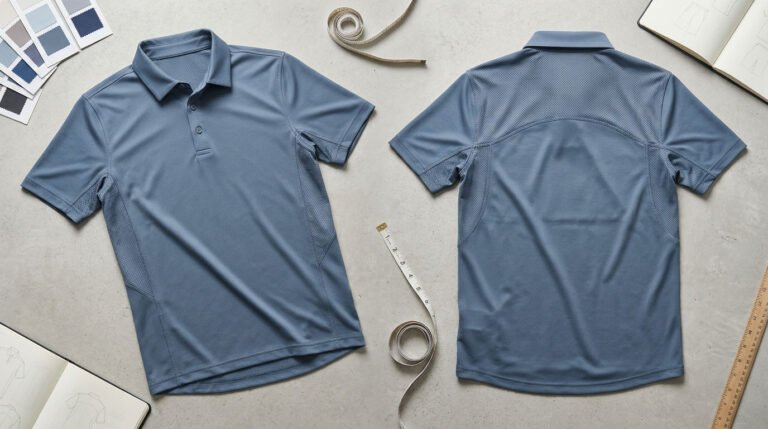
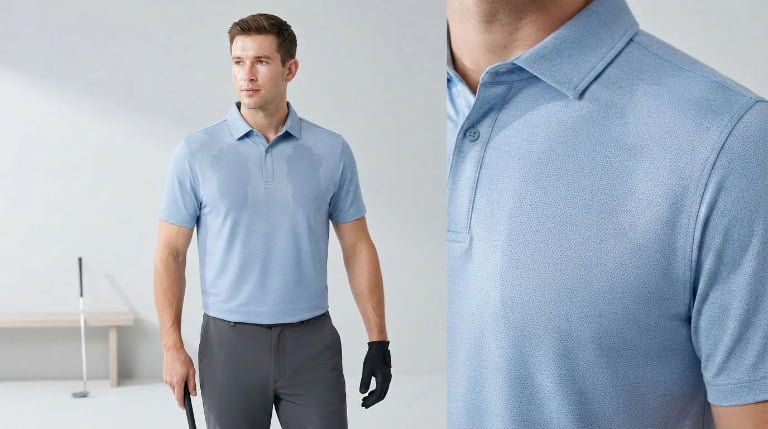
A golf polo can look excellent when delivered but develop small fiber balls after repeated wear or washing. For apparel brands, this can lead to customer complaints, returns, and hard questions about product durability.
However, not every rough fabric surface is caused by pilling. Some problems are actually snagging, fuzzing, or abrasion—and each requires a different solution. Following this guide, you can establish a reliable quality control process to intercept problematic fabrics at the sampling stage, long before customer complaints arrive.
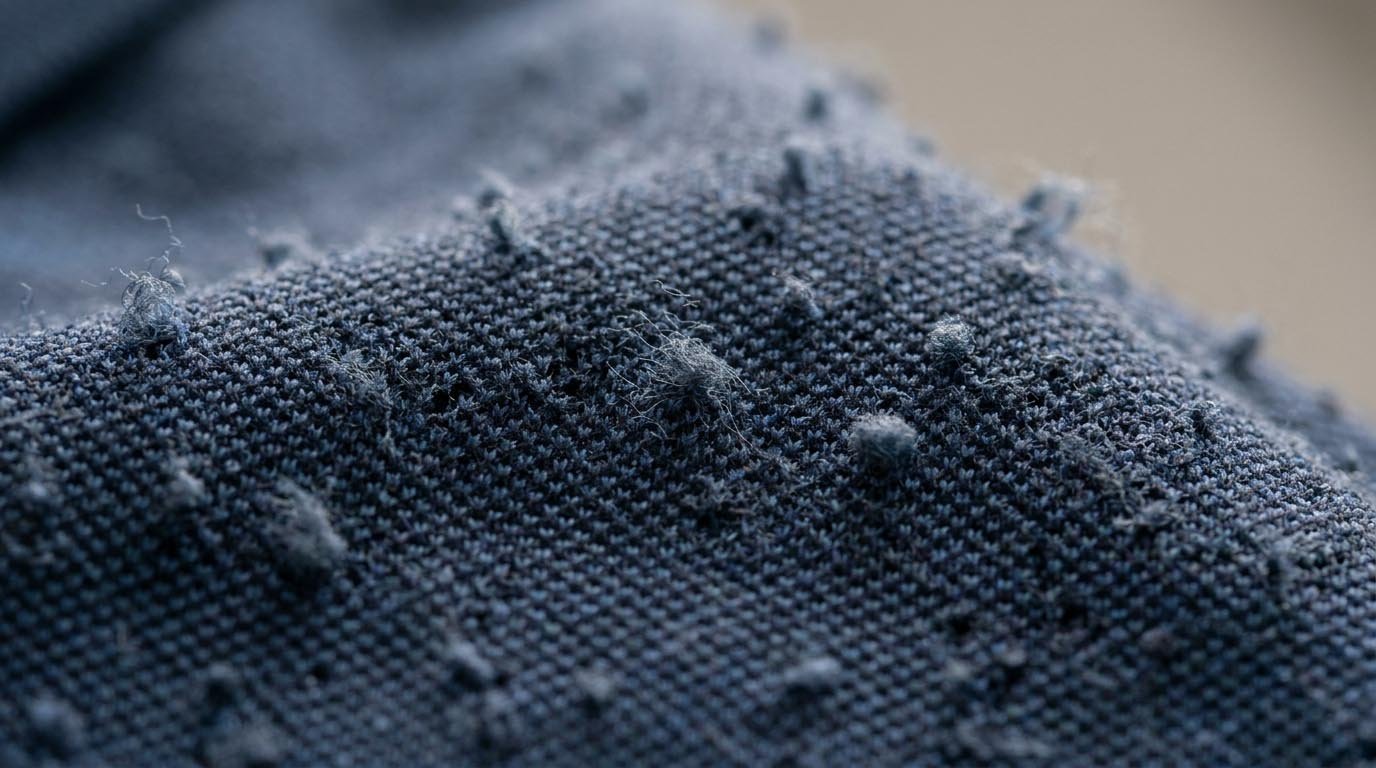
Golf polo pilling occurs when surface fibers become entangled through friction and form small balls called pills. Its severity depends on fiber characteristics, yarn construction, knit structure, finishing, and wear conditions. No fabric can be guaranteed permanently pill-free under every condition.
In this article, you will learn:
- How to distinguish pilling, snagging, and abrasion at a glance.
- The 5 hidden factors that cause golf polo shirts to pill.
- A clear comparison of the 5 most common pilling test methods.
- How to write an airtight anti-pilling clause in your purchase order (with a copyable template).
- 5 critical checkpoints for interpreting your supplier's test report.
- A step-by-step prevention process to implement before bulk production.
Quick Answer: Why Do Golf Polo Shirts Pill?
Golf polo shirts pill when repeated friction causes fibers to emerge from the fabric surface and become entangled.
Five factors influence the process:
- Fiber properties: Fiber length and strength affect pill formation and retention.
- Yarn structure: Twist, spinning method, and yarn hairiness influence loose surface fibers.
- Fabric construction: Knit density and structure affect yarn movement and friction.
- Finishing: Surface treatments can change pilling behavior.
- Wear and washing: Bag straps, clothing layers, and laundering introduce mechanical contact.
| Common Question | Short Answer |
|---|---|
| Does polyester golf fabric pill? | Yes, depending on its yarn and fabric construction. |
| Is expensive fabric always more resistant? | No. Price does not establish pilling performance. |
| Is pilling the same as snagging? | No. They require different corrective actions. |
| Can finishing eliminate pilling? | No. Some treatments may reduce it, but cannot guarantee permanent prevention. |
| What pilling grade is acceptable? | Buyers should define a target using a specified test method; there is no universal rule. |
Key 1: How to Identify Pilling, Fuzzing, Snagging and Abrasion
Correct diagnosis must come before changing fabric specifications.
Golf polos experience friction from bag straps, golf gloves, belts, outerwear, and repeated movement. But the resulting damage is not always pilling.
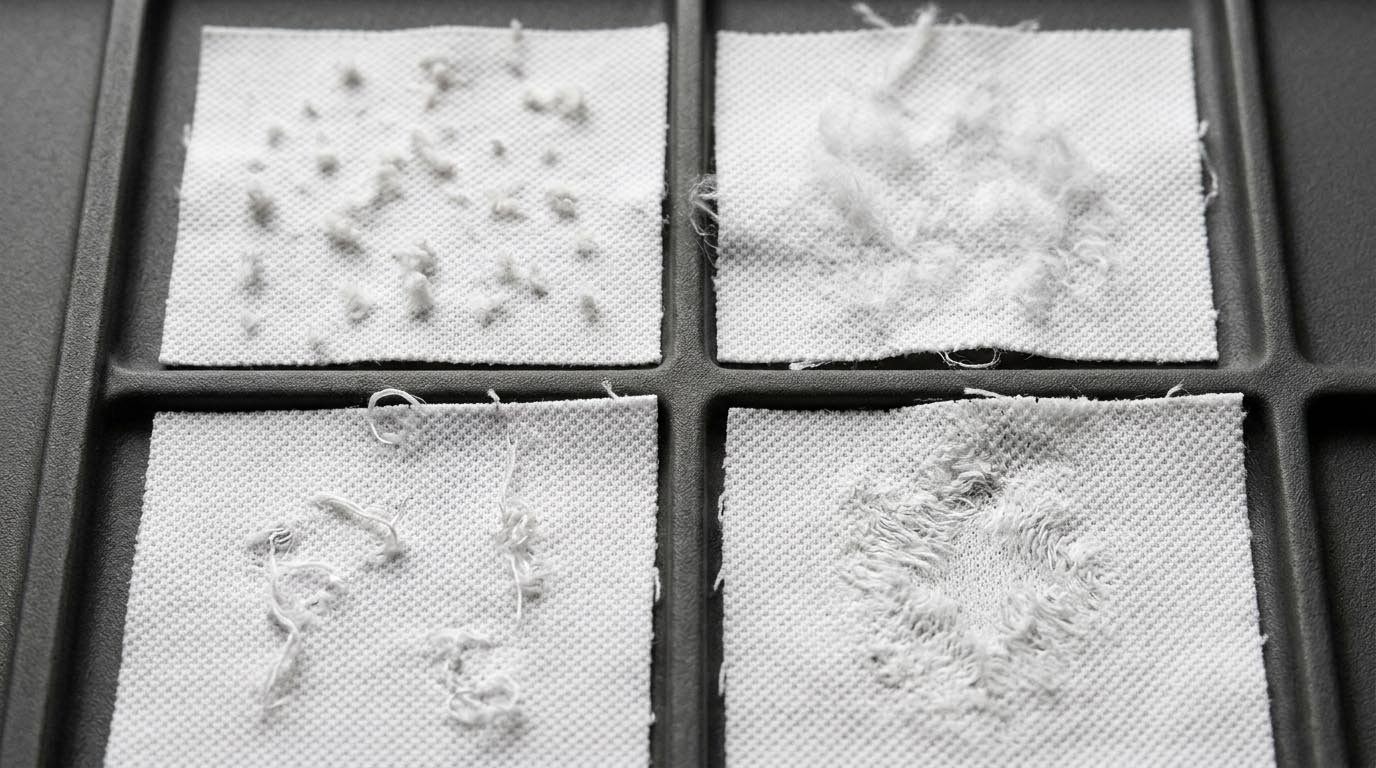
1.1 Four Common Fabric Surface Problems
| Problem | Appearance | Typical Mechanism |
|---|---|---|
| Pilling | Small fiber balls attached to the surface | Loose fibers become entangled |
| Fuzzing | Raised fibers creating a hairy appearance | Surface fibers protrude |
| Snagging | Pulled loops or filaments | Contact catches yarn or filaments |
| Abrasion | Thinning or worn fabric surface | Repeated mechanical wear |
For example, a golf glove's hook-and-loop closure may catch a knitted polo and pull out loops. This is snagging, not necessarily pilling.
An anti-pilling treatment would not automatically solve that problem. For difficult cases that are hard to judge with the naked eye, a laboratory can use digital microscopy for cross-sectional analysis to determine whether the fiber breakage stems from repetitive abrasion (pilling/fuzzing) or a single, sharp force (snagging).
1.2 Where Does Pilling Commonly Develop?
Potential high-contact areas include:
- Shoulders: Repeated contact with golf bag straps.
- Underarms: Fabric-to-fabric friction during movement.
- Lower front: Contact with belts, glove closures, or equipment.
- Lower back: Rubbing against outerwear, bag components, or seating surfaces.
The actual damage depends on the fabric and how the garment is used.
1.3 How to Investigate a Complaint
When a customer reports pilling:
- Request clear photographs of the affected area.
- Identify pills, loose fibers, pulled loops, or surface wear.
- Record the approximate wearing and washing history.
- Check whether the area contacts golf equipment.
- Compare the garment with an approved reference sample.
- Arrange further examination if the cause remains uncertain.
Buyer takeaway: Identify the correct defect before changing materials, finishing processes, or suppliers.
Key 2: What Causes Pilling in Golf Polo Fabrics?
Two golf polos with identical fiber compositions can have very different pilling performance.
The difference may come from yarn construction, knit density, surface finishing, or other material characteristics.
2.1 Fiber Type and Pill Retention
Polyester
Polyester can retain pills because its relatively strong fibers may keep the entangled balls attached to the fabric. However, this does not mean every polyester fabric pills heavily. Continuous-filament and spun-polyester constructions can behave very differently.
Note: A supplier may promote “anti-pilling polyester” or other engineered fibers. These are useful tools, but brands should treat them as a claim to be verified and request test reports based on the final finished fabric, not just the raw fiber.
Cotton
Cotton can also pill, particularly when shorter fibers or surface hairiness contribute to entanglement. Longer-staple cotton and suitable yarn preparation may help control loose fibers, but they do not guarantee a pill-free surface.
Polyester-Cotton Blends
Blended fabrics require individual evaluation. Their behavior depends on the blend ratio, fiber characteristics, yarn, and fabric construction. Fiber composition alone is not sufficient evidence of pilling resistance.
2.2 Spun Yarn vs Continuous-Filament Yarn
| Characteristic | Spun Yarn | Continuous-Filament Yarn |
|---|---|---|
| Construction | Short fibers assembled into yarn | Continuous filaments assembled into yarn |
| Surface Fiber Ends | Generally more exposed ends | Generally fewer exposed ends |
| Appearance | Can create a soft, cotton-like surface | Can create a smoother performance surface |
| Main Consideration | Fiber migration and yarn hairiness | Fabric construction, finishing, and snagging risk |
Combing, suitable yarn twist, and compact spinning may help control fiber hairiness in appropriate yarn systems.
However, higher twist can also affect softness and drape. Brands should balance appearance, comfort, and durability rather than optimize one property in isolation.
2.3 Does Piqué, Jersey or Interlock Pill Less?
There is no universal winner.
Piqué, jersey, and interlock describe knit constructions, not guaranteed durability levels.
A tightly constructed jersey may outperform a loosely constructed piqué, while another piqué fabric may perform better because of its yarn and finishing.
Buyers should compare actual fabric samples under equivalent test conditions.
For a broader comparison of fabric choices, see our Best Fabric for Golf Polo Shirts guide.
2.4 Can Anti-Pilling Finishing Help?
Some finishing processes may reduce pilling risk:
- Bio-polishing: Enzyme treatments can remove protruding fibers from suitable cellulosic fabrics.
- Surface treatments: Certain mechanical processes can help control yarn or fabric hairiness.
- Anti-pilling finishes: Appropriate chemical treatments may reduce fiber movement or pill formation.
Their effectiveness depends on the material, treatment, and laundering conditions.
Buyer takeaway: Evaluate the finished fabric, not just the fiber composition or a supplier's "anti-pilling" description.
Key 3: Which Pilling Test Methods Should Golf Apparel Brands Use?
Standardized testing provides a structured way to compare fabric surface performance.
However, different tests apply different mechanical actions. Their results should not be treated as interchangeable.
3.1 Common Fabric Pilling Tests
| Test Method | Standard | Basic Principle |
|---|---|---|
| ICI Pilling Box | ISO 12945-1:2020 | Specimens undergo mechanical action in a rotating box |
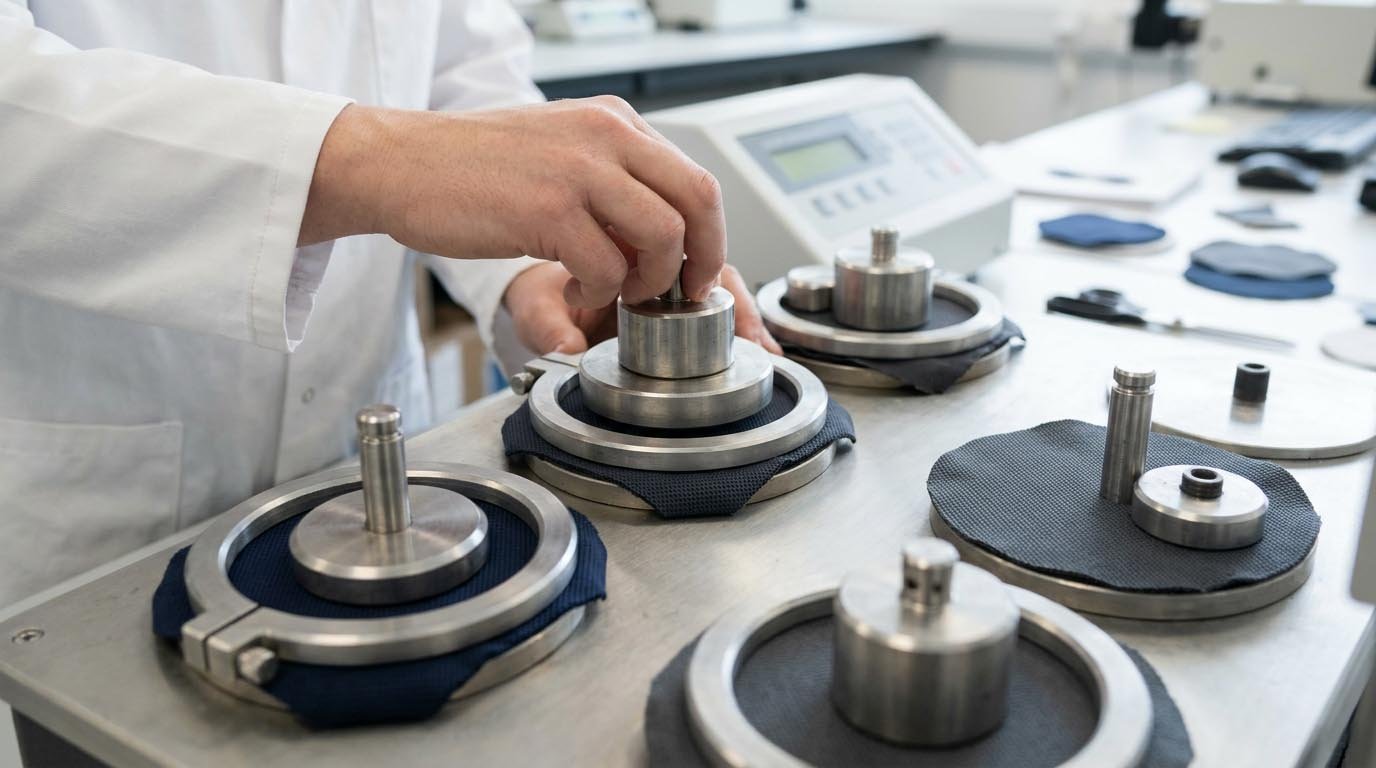
| Modified Martindale | ISO 12945-2:2020 | Fabric specimens undergo controlled rubbing |
| Random Tumble | ISO 12945-3:2020 | Specimens undergo random tumbling |
| ASTM Martindale | ASTM D4970/D4970M-22(2026) | Evaluates pilling and related surface changes using a Martindale tester |
| ASTM Random Tumble | ASTM D3512/D3512M-22(2026) | Evaluates surface changes using random tumbling |
The official ISO 12945-2:2020 standard describes the modified Martindale method.
The ASTM D4970/D4970M-22(2026) standard covers the Martindale tester method, and ASTM cautions against relying on it as a routine commercial acceptance test without interlaboratory data.
3.2 How to Choose the Right Test Method
This is not about finding the single "best" test, but about aligning it with your market and consistent application.
- If your primary market is Asia or Europe: It is common practice to first refer to the ISO 12945-2 (Modified Martindale) method.
- If your primary market is North America: You may negotiate with your client to use ASTM D4970 or D3512.
- The most critical step: Agree with your supplier on one specific method and write that method into your product specification sheet. Using different methods will lead to non-comparable results and disputes.
3.3 What Should Buyers Check in a Test?
A meaningful test report should identify:
- Test method and standard edition.
- Tested specimen and preparation.
- Test duration, cycles, or prescribed stages.
- Assessment procedure and reported grade.
- Whether washing or other pretreatment was performed.
Results from different methods or preparation conditions should not be compared as though they measure exactly the same performance.
3.4 Is Pilling Testing the Same as Abrasion Testing?
No.
Pilling testing evaluates changes such as pill formation, fuzzing, or matting.
Abrasion testing evaluates resistance to mechanical wear under its specified method and endpoint.
A good abrasion resistance result does not automatically prove that a fabric has a high pilling grade.
Buyer takeaway: Use the appropriate test method, document the conditions, and never combine pilling and abrasion resistance into one assumption.
Key 4: What Pilling Grade Is Acceptable for Golf Polos?
Pilling performance is commonly assessed using a five-point visual grading scale.
Higher grades generally indicate less visible surface deterioration under the stated assessment conditions.
4.1 Understanding Pilling Grades
| Grade | General Interpretation |
|---|---|
| 5 | No visible change |
| 4 | Slight surface change |
| 3 | Moderate surface change |
| 2 | Distinct surface change |
| 1 | Severe surface change |
Intermediate grades, such as 3–4, may also be reported where permitted by the relevant procedure.
4.2 Is Grade 3 or Grade 4 a Universal Requirement?
No single pilling grade automatically applies to every golf polo.
Acceptance requirements depend on the product, testing method, intended use, and agreement between buyer and supplier.
As a general practical guide, we often suggest clients consider the following positioning based on market tier:
- Premium Retail Brand: 4 or above
- Corporate or Tournament Uniform: 3-4
- Fast Fashion or Promotional Goods: 3
This is just a reference point, and the final grade must always be a negotiated specification based on your brand positioning and cost structure.
4.3 Should Brands Test Before and After Washing?
Where wash durability matters, both unwashed and prewashed specimens may be evaluated.
The buyer should define the laundering procedure and number of cycles before testing.
This helps reveal whether washing changes surface performance, but the results still cannot directly predict the number of golf rounds a polo will withstand.
Buyer takeaway: Anchor the acceptable grade to a specific test method and a clear market segment, rather than chasing a meaningless “pass.”
Key 5: How to Read a Real Golf Polo Pilling Test Report
A test report is useful only when buyers understand what was tested and under which conditions.
A result such as "PASS" or "Grade 4" should not be interpreted without its supporting information. Be especially wary of reports that only state "PASS" without naming a test method or rating scale, or reports using Mill A's fabric data to vouch for Mill B's fabric. A valid report must trace its tested sample back to the same lot as your approved swatch.
5.1 FUWAY's Published Pilling Test Reports
FUWAY maintains a public Golf Shirts Test Reports directory.
It includes the following relevant reports:
| Published Report | Standard Listed |
|---|---|
| Pilling Resistance Test | ASTM D4970 |
| Fuzzing and Pilling Test Report | ISO 12945-2 |
These are publicly available FUWAY test report entries. Their results apply to the tested samples and documented conditions, not as a blanket guarantee for every FUWAY golf polo. For any new project, buyers should verify that the tested material corresponds to their proposed fabric or arrange suitable project-specific testing.

5.2 What Should Buyers Check?
| Report Field | Why It Matters |
|---|---|
| Sample Identification | Confirms which material was tested |
| Fabric Description | Identifies the relevant construction or composition |
| Test Standard | Defines the assessment method |
| Test Conditions | Explains how the specimen was evaluated |
| Sample Preparation | Indicates washing or other pretreatment |
| Reported Result | Shows the measured or assessed outcome |
| Report Identification | Supports document traceability |
A laboratory report can support a claim about an identified material under stated conditions. It cannot automatically prove that future fabric lots or all finished garments will perform identically.
Buyer takeaway: Match the report to the actual fabric specification before using its result to support a purchasing decision.
Key 6: How Can Brands Reduce Pilling Before Bulk Production?
Prevention should begin during material development, rather than waiting for finished-garment inspection.
A practical process involves six steps.
Step 1: Define Expected Use
Identify whether the polo is intended for retail, club uniforms, tournaments, or lifestyle wear. Consider the expected frequency of wear, laundering, and contact with golf equipment.
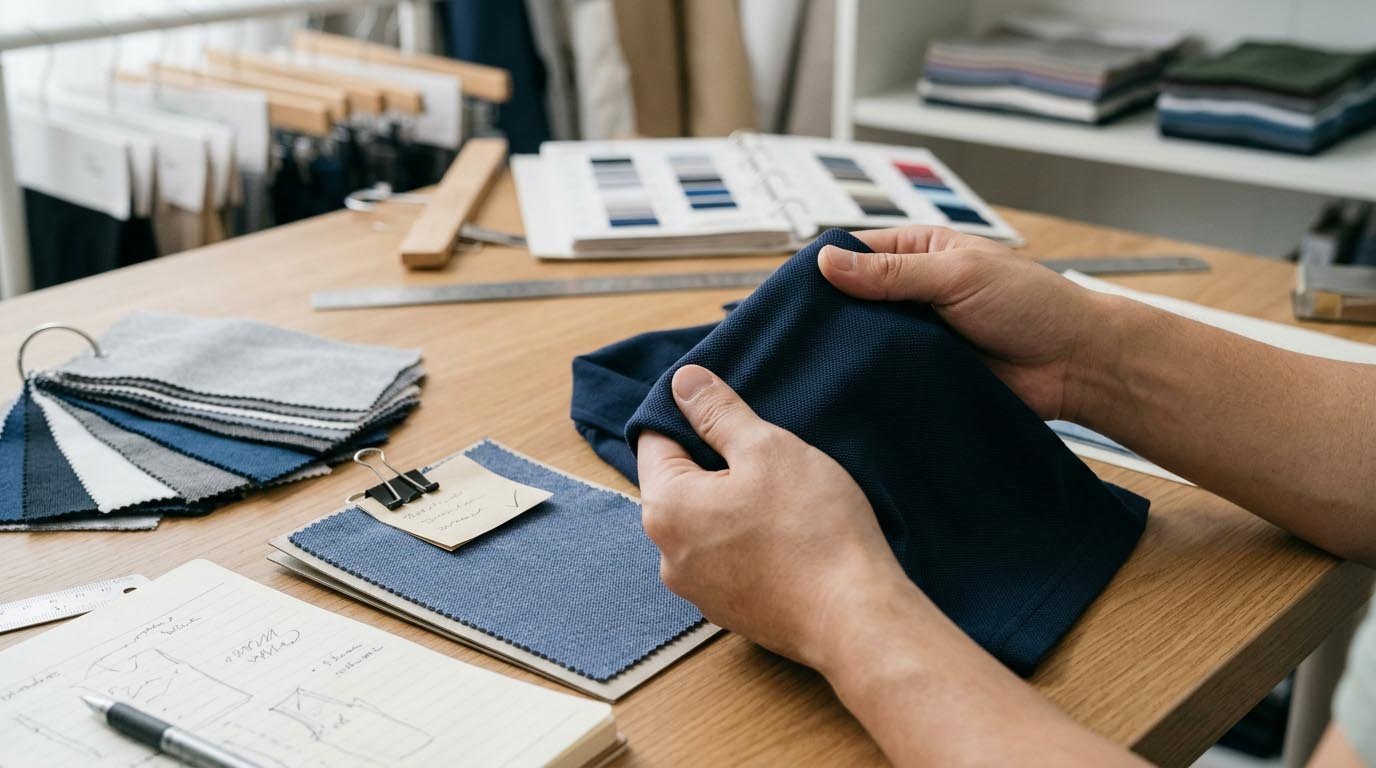
Step 2: Compare Material Specifications
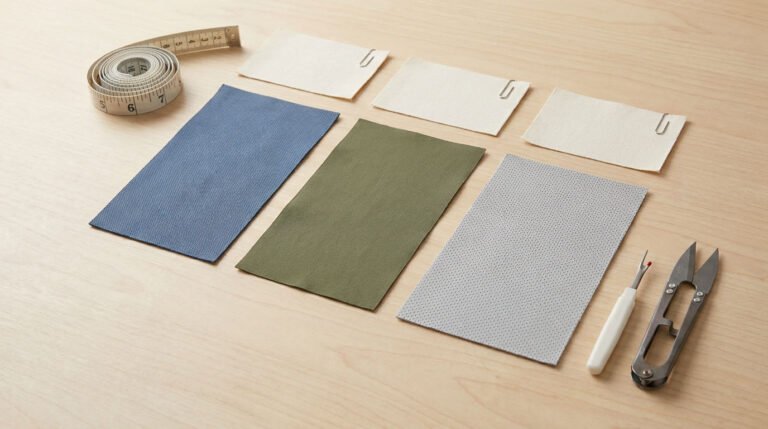
Request the proposed fabric's fiber composition, yarn type, knit structure, fabric weight, finishing information, and relevant test documentation. Evaluate competing fabrics under comparable conditions.
Step 3: Test the Development Material
Where required, assess the proposed material through laboratory pilling tests, agreed laundering evaluations, or suitable wear trials. FUWAY's typical sampling lead time is approximately 7–10 days, depending on project requirements.
Step 4: Keep an Approved Fabric Reference
Record the agreed material specification and retain an approved swatch or other suitable reference to identify unwanted changes between development and production.
Step 5: Verify Bulk Material
Where the project requires pilling verification, establish a sampling and testing plan for representative production material. Do not assume that an earlier development report automatically covers every future fabric lot. For a broader factory inspection process, see our Golf Apparel Quality Control Checklist.
Step 6: Provide Appropriate Care Instructions
Subject to the approved garment care label, recommendations may include turning the polo inside out, avoiding contact with abrasive laundry items, separating hook-and-loop closures, and avoiding excessive drying heat.
Key 7: How to Specify Pilling Requirements in a Purchase Order
A purchasing specification must be measurable. Writing "the fabric must be anti-pilling" is unenforceable, as it identifies no test method, required performance, or acceptance conditions.
Instead, establish an agreed testing protocol before sample approval.
7.1 Editable Example: Pilling Testing Specification
| Specification Item | Example Requirement |
|---|---|
| Product | Men's Custom Golf Polo |
| Material | Approved fabric reference |
| Test Property | Fabric pilling resistance |
| Test Method | ISO 12945-2:2020 |
| Assessment | Applicable agreed grading procedure |
| Test Conditions | According to the agreed laboratory test plan |
| Sample Preparation | Define whether unwashed or prewashed |
| Acceptance Grade | Agreed before sample approval |
| Production Verification | As defined in the sampling plan |
| Required Evidence | Report identifying the specimen, conditions, and result |
| Failed Result | Investigate and agree on corrective action or retesting |
Where necessary, buyers and suppliers should also agree on how testing disputes will be resolved.
7.2 Pre-Production Buyer Checklist
Before approving a golf polo fabric, confirm:
- [ ] The proposed material and construction are documented.
- [ ] The pilling test method is identified.
- [ ] The report corresponds to the relevant material.
- [ ] Sample preparation and test conditions are clear.
- [ ] The acceptance requirement has been agreed in writing.
- [ ] An approved material reference is retained.
- [ ] Any production-lot verification requirements are defined.
For other purchasing requirements, including garment construction, fit, measurements, and branding, see our Golf Polo Sourcing Specifications Checklist.
Ready to put this into practice? Copy this checklist into your communication with your supplier. If you need a manufacturing partner who can execute these standards rigorously, contact FUWAY today to request a customized quality specification sheet built around your exact design.
Frequently Asked Questions About Golf Polo Pilling
Does 100% polyester golf fabric pill?
Yes, some polyester fabrics can develop pills. However, continuous-filament and spun-polyester constructions may behave differently. Yarn structure, knitting, finishing, and wear conditions all influence the result.
Does adding spandex prevent pilling?
Not automatically. A polyester-spandex blend is not necessarily more resistant than a 100% polyester fabric. The complete material construction must be evaluated.
Can golf bag straps cause pilling?
Repeated strap contact can contribute to surface damage. Depending on the fabric, the result may be pilling, fuzzing, snagging, or abrasion. Correct diagnosis is important.
Can a fabric pass a pilling test and still pill during wear?
Yes. Laboratory tests measure performance under defined conditions, while actual wear introduces additional variables. A test result cannot guarantee permanent resistance.
Should I test the development sample or bulk fabric?
Development testing helps evaluate fabric options before approval. When production consistency is important, representative bulk material may also require verification under an agreed sampling plan.
Can pilling be completely prevented?
No fabric can be guaranteed permanently pill-free under every wear and care condition. Appropriate material selection, finishing, testing, and consumer care can help reduce the risk.
Conclusion: Better Pilling Control Starts With Clear Specifications
Golf polo pilling depends on fiber, yarn, fabric construction, finishing, and real-world friction—not simply the material label or price.
For apparel brands, the most practical approach is to diagnose surface damage correctly, compare fabrics under suitable test conditions, review the evidence, and agree on performance requirements before bulk production.
At FUWAY, we provide OEM/ODM golf apparel manufacturing services, including custom fabric selection, sample development, private labeling, and production quality control.
If you are developing a golf polo collection and need to evaluate fabric choices or establish pilling-resistance requirements, explore our Custom Golf Shirts Manufacturing services.
Share your fabric requirements, design, target market, and planned order quantity so our team can discuss suitable development and verification options.
Reliable golf apparel quality begins with measurable specifications—not unsupported anti-pilling promises.