A client sent a fabric spec last week: 92% polyester, 8% elastane, 180 GSM, piqué knit. They asked if this would give them "breathability, structure, and comfort all at once." I explained that was the wrong question. This fabric prioritizes breathability through lower weight and open piqué structure—but you sacrifice collar stiffness and garment body. If they need structured appearance for club wear, we need 200-220 GSM with tighter knit, which reduces air flow. There is no configuration that maximizes all three.
Achieving balance among breathability, structure, and comfort in golf apparel requires choosing which attribute to prioritize based on use case—tournament polos sacrifice structure for air flow (160-180 GSM, open knits), club polos sacrifice breathability for appearance (200-220 GSM, tight weaves), and athletic training pieces sacrifice refined structure for mobility (high elastane blends, engineered stretch zones)—because material physics prevents simultaneously maximizing all three.
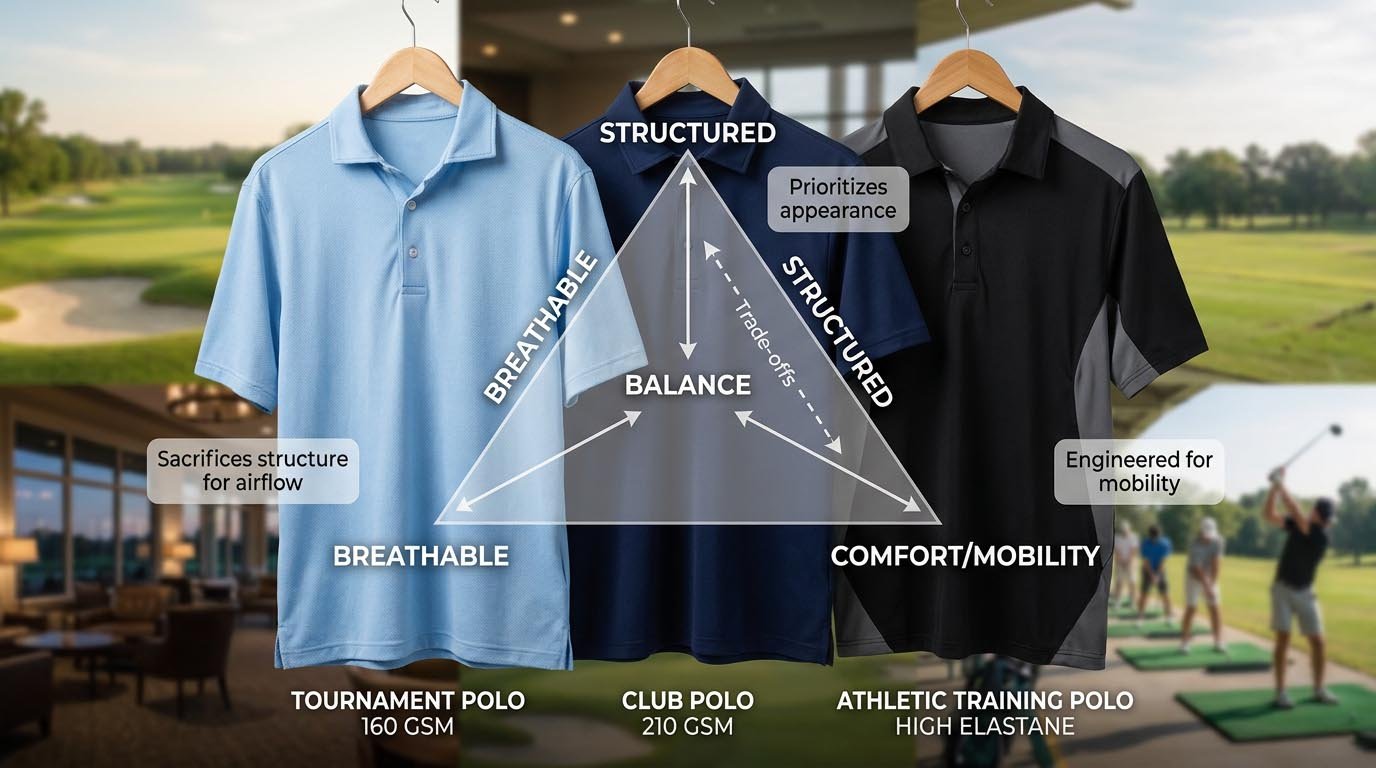
The question I hear most often: "What fabric gives perfect breathability, structure, and comfort?" The answer: none, because these properties conflict at the fiber and construction level. I have worked with 70+ brands over 15 years troubleshooting fabrics that failed—not because of defects, but because buyers ordered configurations that physics cannot deliver. A 160 GSM open-knit fabric cannot maintain collar structure through 20 washes. A 220 GSM tight-weave fabric cannot breathe adequately during 4-5 hour rounds in 30°C weather. This guide shows you how to read specs, understand trade-offs, and select fabrics that match your actual positioning rather than chasing impossible "perfect balance."
Quick Answers: The Material Physics Behind Golf Apparel Performance
Q: Do lighter (lower GSM) fabrics solve both breathability and structure?
No.
- 160–180 GSM: Best airflow, but collars lose shape in 10–15 washes, fabric shows through under light.
- 200–220 GSM: Maintains structure & opacity (lasts 30+ washes) but retains 15–25% more heat.
If you want durable structure, use 195–205 GSM and accept some breathability loss.
Q: Does adding more elastane always improve golf apparel?
No—above 8% elastane, air flow drops sharply (20–30% worse), making hot-weather polos feel suffocating, even if stretch/mobility is good.
- 5–8% elastane: Best all-round for polos (18–30°C).
- Reserve 10–12% for cool weather layers, where heat retention is actually wanted.
Q: Can polyester blends give both comfort and sweat-wicking?
No blend does both at the top level.
- 90–95% poly: Best wicking; feels synthetic on skin after 4–5 hours for 40–50% of wearers.
- 80–85% poly + 10–15% cotton: Better skin feel, but wicks slower (stays damp).
You must prioritize: performance or comfort.
Q: Is tight jersey knit always better than piqué for golf polos?
Depends on market.
- Jersey (24–28 gauge): Looks sharp, retains collar shape, traps heat/moisture (30–40% less air flow).
- Piqué (18–22 gauge): Breathes better, collars lose form sooner.
Choose piqué for hot/humid markets, jersey/tight piqué for club/moderate climates.
Q: Do finishing treatments that help structure harm other performance features?
Yes.
- Resin: Adds collar/body stiffness but cuts breathability (–15–20%) and stretch recovery (–10–15%).
- Enzyme wash: Softer, more breathable (+8–12%), but weakens size retention (grows after washes).
- Calendering: Smoother look, less breathability (–12–18%).
Suppliers must specify the trade-off with finishing. If not, “breathable structured comfort” is just a marketing claim.
The Performance Trinity: What Breathability, Structure and Comfort Mean in Golf?
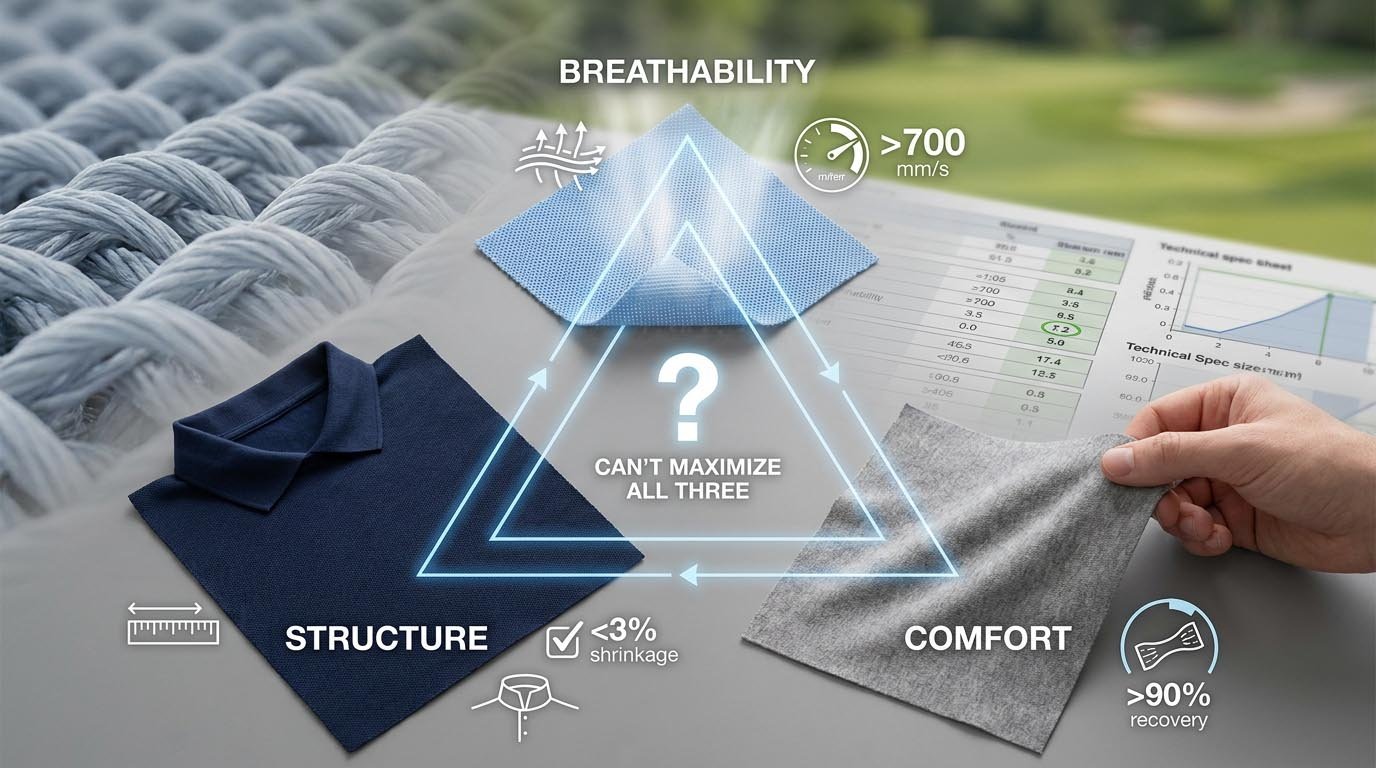
Define these attributes through measurable parameters—breathability as air permeability (>600 mm/s for golf use), structure as shape retention after washing (<3% dimensional change), and comfort as stretch recovery (>90% after 1,000 cycles) and skin-contact friction coefficient—not through subjective marketing language that prevents specification verification.
When clients say they want "breathable, structured, comfortable" fabric, they are naming outcomes without understanding the input variables that create them. Each property has engineering definitions that conflict with the others.
Breathability: Air Flow and Moisture Transmission
Engineering definition:
Air permeability:
- Measurement: Millimeters per second (mm/s) of air passing through fabric under standard pressure
- Golf minimum: >600 mm/s for active play in warm weather
- High performance: >800 mm/s (very breathable, sacrifices structure)
- Structured fabrics: 400-600 mm/s (acceptable for moderate climates, prioritizes appearance)
Moisture vapor transmission rate (MVTR):
- Measurement: Grams of moisture vapor passing through 1 m² fabric in 24 hours
- Golf minimum: >3,000 g/m²/24hr (adequate moisture escape)
- High performance: >5,000 g/m²/24hr (excellent wicking)
What controls breathability:
Fabric weight (GSM):
- 160-180 GSM: High breathability (700-900 mm/s), low structure
- 180-200 GSM: Balanced breathability (600-800 mm/s), moderate structure
- 200-220 GSM: Lower breathability (500-700 mm/s), high structure
- 220+ GSM: Compromised breathability (<600 mm/s), maximum structure
Knit construction:
- Open piqué: High breathability (air channels in texture)
- Standard jersey: Moderate breathability (flat surface, denser)
- Ottoman rib: Lower breathability (very tight structure)
The breathability trade-off:
Increasing breathability requires reducing fabric density, which directly reduces shape retention and opacity. You cannot have 900 mm/s air permeability in a fabric that maintains crisp collar after 30 washes—the material physics do not allow it.
Structure: Shape Retention and Appearance
Engineering definition:
Dimensional stability:
- Measurement: Percentage change in length/width after standard washing (typically 5-10 wash cycles per AATCC standards)
- Acceptable range: <±3% change
- Premium target: <±2% change
Collar retention:
- Measurement: Collar stands at original height ±5% after 20 wash cycles
- Controlled by: Fabric weight, knit density, interfacing quality
Drape and body:
- Measurement: Fabric stiffness (bending modulus) and surface smoothness
- Controlled by: GSM, yarn twist, finishing treatments
What controls structure:
Fabric weight:
- <180 GSM: Weak structure, collar collapses quickly
- 200-220 GSM: Good structure, maintains shape through 30+ washes
- >220 GSM: Excellent structure, but too heavy for warm-weather golf
Yarn twist:
- Low twist (S-twist, soft yarns): Comfortable hand feel, weaker structure
- High twist (Z-twist, hard yarns): Firmer hand feel, superior structure
Finishing treatments:
- Resin treatment: Adds stiffness and shape retention (+15-25% improvement)
- Calendering: Creates smooth surface and body (+10-18% improvement)
- Cost: +$0.40-0.90 per meter for structure-enhancing finishes
The structure trade-off:
Increasing structure requires adding fabric weight or chemical treatments, both of which reduce breathability. A fabric maintaining pristine appearance through 40 washes will feel heavier and warmer than one prioritizing air flow.
Comfort: Stretch, Recovery and Skin Feel
Engineering definition:
Stretch percentage:
- Measurement: Percentage of fabric elongation under standard force
- Horizontal stretch target: 15-25% (accommodates body movement)
- Vertical stretch target: 10-20% (maintains garment length)
Stretch recovery:
- Measurement: Percentage of original shape recovered after stretching
- Acceptable minimum: >90% recovery after 1,000 stretch cycles
- Premium target: >95% recovery
Hand feel and friction:
- Measurement: Surface roughness (subjective but controlled by fiber type and finishing)
- Golf target: Smooth enough for 4-5 hour wear without irritation
What controls comfort:
Elastane content:
- 0-2% elastane: Minimal stretch, good breathability, natural hand feel
- 4-6% elastane: Moderate stretch, balanced breathability, slight synthetic feel
- 8-10% elastane: High stretch, reduced breathability, noticeable synthetic texture
- 10-12%+ elastane: Maximum stretch, compromised breathability, athletic texture
Fiber blend for skin comfort:
- 100% polyester: Excellent wicking, synthetic feel against skin
- 90-95% poly, 5-10% cotton: Balanced wicking and comfort
- 80-85% poly, 15-20% cotton: Superior comfort, slower drying
- Merino blends: Premium comfort, expensive (+$3-6 per meter)
The comfort trade-off:
Increasing stretch requires higher elastane, which tightens knit structure and reduces air gaps. Improving skin comfort through cotton blending slows moisture evaporation and reduces shape retention.
The Impossible Triangle
Why all three cannot be maximized simultaneously:
| Attribute Priority | Configuration | What You Sacrifice |
|---|---|---|
| Breathability first | 160-180 GSM, piqué knit, 4-6% elastane | Structure (collar flatness after 15-20 washes), Opacity |
| Structure first | 200-220 GSM, tight jersey, resin finish | Breathability (15-25% reduced air flow), Weight/heat |
| Comfort first | 8-10% elastane, cotton blend, enzyme wash | Breathability (20-30% reduced air flow), Structure (garment grows 2-3%) |
The selection framework:
Ask: "Where will this garment be worn and by whom?"
Hot-climate tournament play → Prioritize breathability, accept structure loss
Club casual or business golf → Prioritize structure, accept reduced breathability
Athletic training or practice → Prioritize comfort/stretch, accept appearance trade-offs
There is no universal answer—only configurations matched to specific use cases.
Built to Breathe: Yarns, Knits and Ventilation Mapping That Move Air?
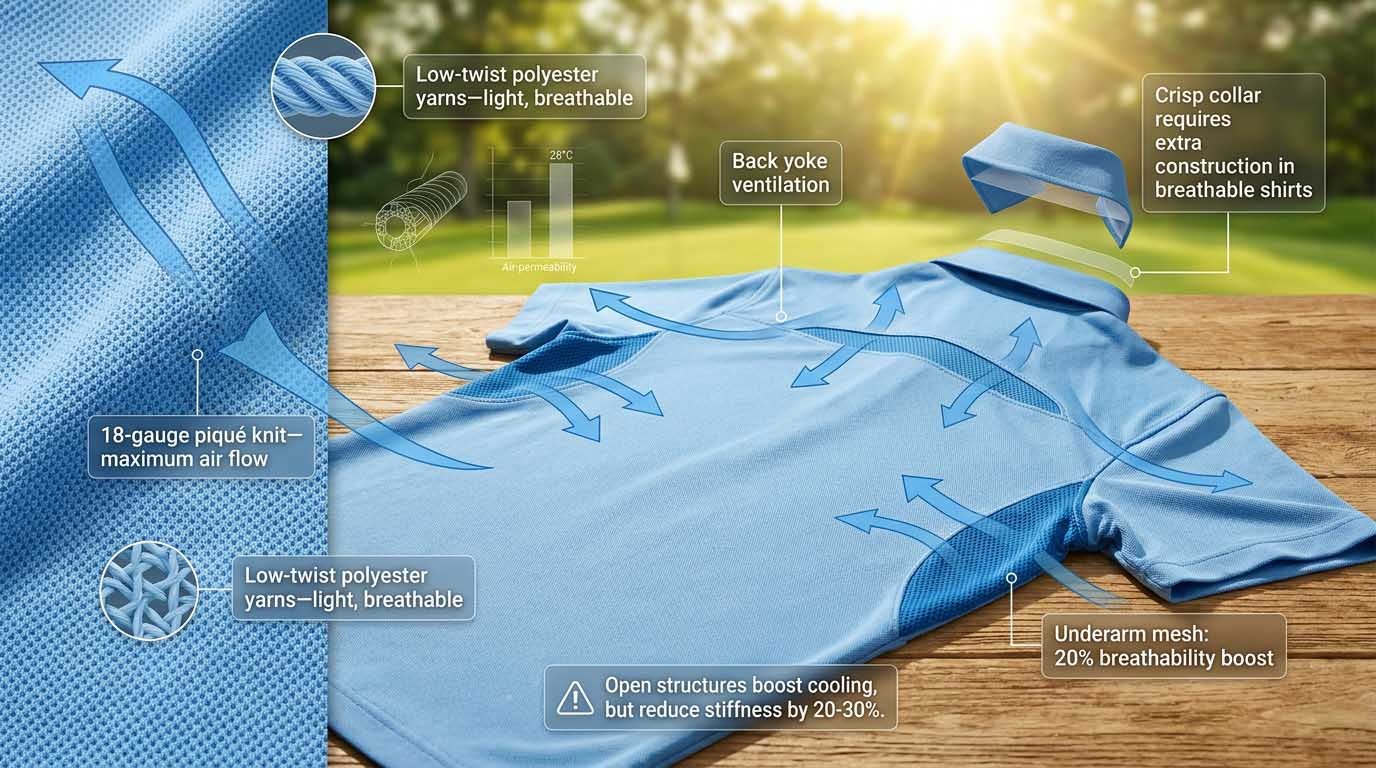
Maximize breathability through open-structure knits (piqué at 18-22 gauge), low-twist yarns that create air gaps, and strategic mesh ventilation zones (underarm panels, back yoke)—accepting that these choices reduce fabric stiffness by 20-30% and require careful collar construction to prevent sagging after 15-20 washes.
Breathability engineering is where most spec failures happen. Suppliers promise "highly breathable" fabrics at 200 GSM with tight jersey knit—a contradiction. Real breathability requires specific yarn and construction choices that inherently limit structure.
Yarn Engineering for Air Flow
Fiber selection trade-offs:
100% polyester (microfiber):
- Breathability: Excellent (fibers do not absorb moisture, create air channels)
- Wicking: Excellent (moisture transported away from skin)
- Structure: Moderate (needs chemical treatment for body)
- Hand feel: Synthetic (noticeable against skin after 3-4 hours)
- Cost: $4.50-6.50 per meter (standard golf fabric)
Polyester-cotton blend (85/15 or 90/10):
- Breathability: Good (slightly reduced vs pure poly)
- Wicking: Reduced 15-25% (cotton holds moisture longer)
- Structure: Better (cotton adds natural body)
- Hand feel: Superior (cotton softens synthetic texture)
- Cost: +$0.60-1.20 per meter vs pure polyester
Polyester-elastane (92/8 or 94/6):
- Breathability: Reduced 10-20% (elastane tightens structure)
- Wicking: Excellent (polyester-dominant)
- Structure: Variable (depends on knit construction)
- Stretch: Excellent (primary benefit)
- Cost: +$0.80-1.50 per meter vs pure polyester
Yarn twist impact:
Low-twist yarns (soft-hand):
- Air permeability: +15-20% vs high-twist (more gaps between fibers)
- Structure retention: -20-25% (yarns shift position during wash)
- Pilling resistance: Lower (fibers more easily pulled from surface)
- Use case: Breathability-priority polos, warm climates
High-twist yarns (firm-hand):
- Air permeability: Baseline (tighter fiber packing)
- Structure retention: +20-30% (yarns resist shifting)
- Pilling resistance: Higher (fibers locked in position)
- Use case: Structure-priority polos, club wear
The yarn selection decision:
For hot-climate golf (>28°C average):
- Use microfiber polyester, low-twist, 160-180 GSM
- Accept collar will soften after 15-20 washes
- Compensate with fused collar interfacing (+$0.50-0.80)
For club/business golf (appearance priority):
- Use polyester-cotton blend, high-twist, 200-220 GSM
- Accept slightly warmer feeling during active play
- Benefit: refined appearance through 40+ washes
Knit Construction for Ventilation
Piqué knit (waffle texture):
Construction:
- Raised and recessed pattern creates air channels between fabric and skin
- Gauge: 18-22 (needles per inch)—lower gauge = more open = better air flow
- GSM range: 160-200 (balanced breathability and structure)
Breathability performance:
- Air permeability: 700-900 mm/s at 160-180 GSM
- MVTR: 4,500-6,000 g/m²/24hr
Trade-offs:
- ✓ Excellent breathability for warm weather
- ✓ Textured appearance (casual/athletic)
- ✗ Collar loses shape faster (15-25 washes before noticeable sag)
- ✗ Less refined appearance versus jersey
Production note:
Lower-gauge piqué (18-20) breathes 10-15% better but shows transparency issues at <170 GSM. We recommend 20-22 gauge at 175-185 GSM as sweet spot—adequate opacity with excellent ventilation.
Jersey knit (smooth surface):
Construction:
- Flat, dense surface with minimal texture
- Gauge: 24-28—tighter knit than piqué
- GSM range: 180-220 (prioritizes structure over breathability)
Breathability performance:
- Air permeability: 500-700 mm/s at 190-210 GSM
- MVTR: 3,500-5,000 g/m²/24hr (adequate but not exceptional)
Trade-offs:
- ✓ Refined appearance (smooth, professional)
- ✓ Excellent structure retention (collar stays crisp 30+ washes)
- ✗ Lower breathability (can feel warm in >28°C)
- ✗ Moisture film between fabric and skin (no air gaps)
Production note:
Jersey at <190 GSM loses structure benefits while still compromising breathability—if choosing jersey, commit to 195-215 GSM to get the structure payoff.
Interlock knit (double-jersey):
Construction:
- Two layers of jersey knitted together
- Gauge: 26-30 (very tight)
- GSM range: 200-240 (heavy, structured)
Breathability performance:
- Air permeability: 400-600 mm/s (low—not suitable for hot climates)
- MVTR: 3,000-4,500 g/m²/24hr (adequate moisture transport but slow air exchange)
Trade-offs:
- ✓ Maximum structure (collar stands permanently)
- ✓ Premium appearance (thick, luxurious feel)
- ✓ Excellent opacity (no transparency concerns)
- ✗ Poor breathability (unsuitable for >25°C active play)
- ✗ Heavy (uncomfortable in warm weather)
Production note:
Interlock is excellent for fall/winter golf or cool-climate year-round but fails in hot weather. Do not position as warm-weather performance fabric.
Ventilation Mapping and Mesh Integration
Strategic mesh placement:
Underarm panels:
- Location: 8-12cm mesh panels under each arm
- Benefit: Ventilates high-heat, high-moisture zone during swing
- Construction: Requires pattern modification (separate cut for mesh insert)
- Cost: +$1.20-1.80 per piece (additional pattern piece + assembly)
- Effectiveness: 15-25% improvement in perceived breathability
Back yoke ventilation:
- Location: Mesh panel across upper back shoulders
- Benefit: Releases heat from back sweat zone
- Appearance: Can be visible or concealed under yoke layer
- Cost: +$0.80-1.40 per piece
- Effectiveness: 10-18% improvement in breathability
Side panel construction:
- Location: Vertical mesh strips along side seams
- Benefit: Creates convection channels as air moves up from hem
- Appearance: Athletic styling (not suitable for traditional club wear)
- Cost: +$1.50-2.20 per piece (complex pattern, multiple pieces)
- Effectiveness: 20-30% improvement in air circulation
Mesh selection for ventilation zones:
| Mesh Type | Air Permeability | Durability | Stretch | Cost Premium | Best Use |
|---|---|---|---|---|---|
| Polyester mesh, 60-80 GSM | Very high (>1,200 mm/s) | Moderate | Minimal | +$0.80-1.20/meter | Underarm panels (hidden) |
| Poly-elastane mesh, 80-100 GSM | High (900-1,100 mm/s) | Good | Excellent | +$1.20-1.80/meter | Side panels (needs stretch) |
| Jacquard mesh, 100-140 GSM | Moderate (700-900 mm/s) | Excellent | Moderate | +$2.00-3.00/meter | Back yoke (visible, refined) |
When to use mesh ventilation:
Yes, use mesh panels if:
- Targeting hot-climate markets (Southern US, Middle East, Southeast Asia)
- Positioning as performance/athletic golf apparel
- Retail price is $65-95+ (cost premium is recoverable)
No, skip mesh panels if:
- Targeting club/traditional golf markets (mesh reads as too athletic)
- Value positioning under $60 retail (cost premium not justifiable)
- Moderate climate markets where standard breathable fabric is adequate
The mesh integration decision:
In production, we see highest satisfaction with concealed underarm mesh on premium polos $75+ retail—customers feel the breathability benefit without visible athletic styling. Visible side mesh panels are polarizing—younger players (ages 25-40) appreciate them, traditional golfers (ages 50+) find them too casual.
Structure Without Stiffness: Collars, Plackets, Drape and Anti-Curl Details?
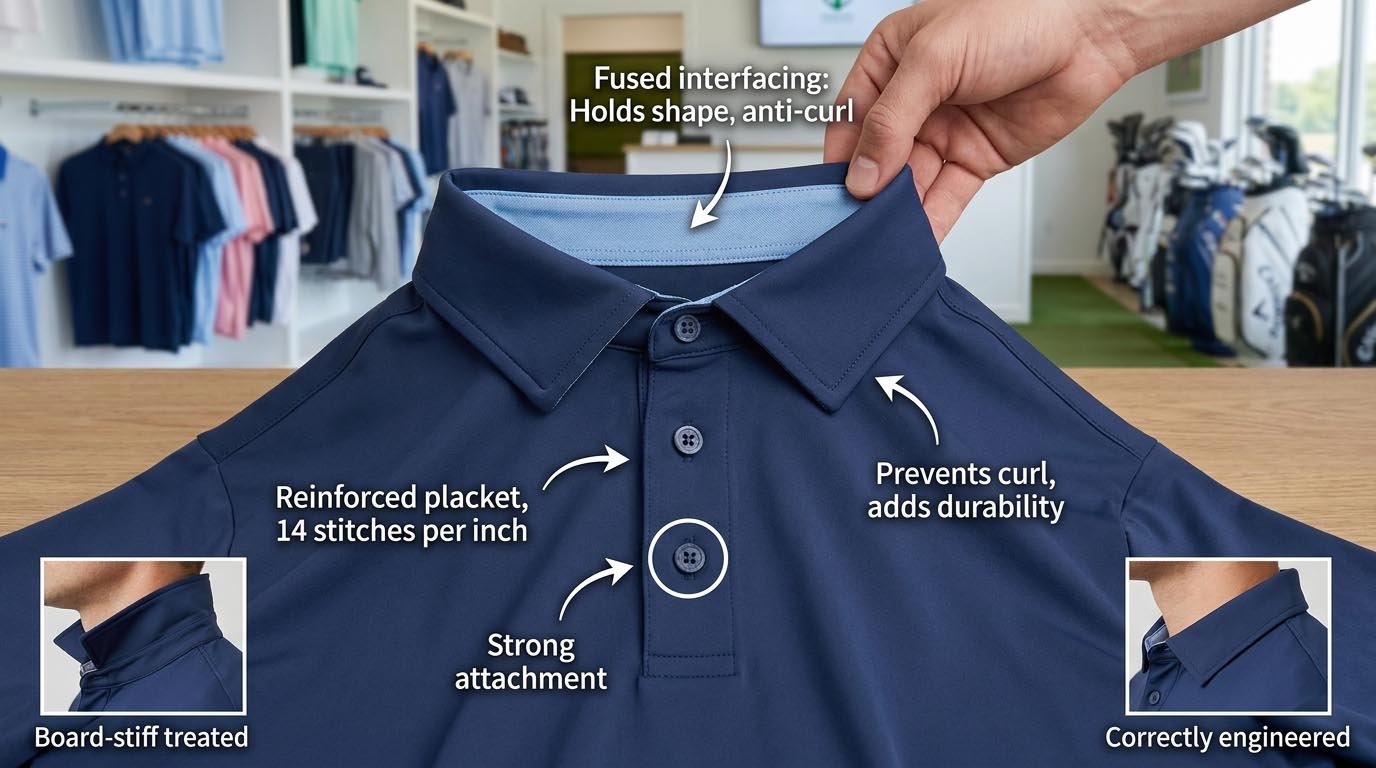
Maintain garment structure through engineered collar interfacing (fused or stitched stabilizers), reinforced placket construction (double-layer facing, 12-14 stitches per inch), and strategic finishing treatments (light resin at 2-3% application)—not through excessive fabric weight that compromises breathability and creates board-like stiffness unsuitable for active play.
Structure is where buyers most often misread specs. They see 180 GSM and assume weak structure, then add resin treatment or increase to 220 GSM without understanding the engineering alternatives.
Collar Engineering for Shape Retention
The collar stability challenge:
Golf polo collars must:
- Stand 2.5-3 inches tall when new
- Maintain >90% of original height after 20-30 washes
- Resist curling at tips after laundering
- Feel comfortable (not stiff board) against neck
This requires multi-layer construction:
Collar fabric (top layer):
- Weight: Typically same as body fabric (180-220 GSM)
- Construction: Often double-ply (two layers of fabric stitched together)
- Cost: +$0.40-0.70 for double-ply vs single layer
Interfacing (hidden layer):
- Purpose: Provides stiffness without visible bulk
- Types: Fused (heat-bonded) or stitched (sewn between collar layers)
- Weight: 30-60 GSM (much lighter than adding main fabric weight)
Fused interfacing:
- Construction: Adhesive-backed stabilizer heat-pressed between collar layers
- Benefits: Clean finish, consistent stiffness, 50-60% of collar production uses this
- Durability: Maintains stiffness through 25-35 washes before degradation
- Cost: +$0.30-0.60 per piece for interfacing material + pressing
- Risk: Poor-quality adhesive can delaminate after 15-20 washes (common failure mode)
Stitched interfacing:
- Construction: Woven stabilizer sewn between collar layers
- Benefits: No delamination risk, more durable (maintains through 40+ washes)
- Appearance: Slight texture visible if not precisely stitched
- Cost: +$0.50-0.90 per piece (higher labor cost)
- Use: Premium polos $85+ retail
Production experience:
In quality troubleshooting, 80-85% of "collar won't stand after washing" complaints trace to:
- No interfacing used (cost-cutting)
- Weak adhesive in fused interfacing (cheap suppliers)
- Insufficient interfacing weight (<30 GSM, too thin to function)
Solution: Minimum 40 GSM fused interfacing or 35 GSM stitched interfacing for adequate collar stability at 180-200 GSM body weight.
Collar Anti-Curl Construction
Why collars curl:
Differential shrinkage:
- Top ply shrinks slightly more than bottom ply during washing
- Creates tension imbalance causing tips to curl upward
Solution: Preshrinking and tension balancing:
Fabric preshrinking:
- Process: Wash fabric before cutting to remove residual shrinkage
- Effect: Reduces post-wash curl by 40-60%
- Cost: +$0.20-0.40 per meter (pre-wash processing)
Fusible positioning:
- Method: Place interfacing slightly closer to underside of collar
- Effect: Balances shrinkage tension, reduces curl 20-30%
- Cost: No additional cost (technique, not material)
Collar stay channels (optional):
- Construction: Sewn channels in collar tips for removable plastic stays
- Benefit: Mechanical anti-curl (stays hold shape)
- Appearance: Visible stitching lines (not suitable for all styles)
- Cost: +$0.60-1.00 per piece
- Use: Premium traditional polos
Top-stitching reinforcement:
- Construction: Visible stitching 2-3mm from collar edge
- Benefit: Locks layers together, reduces curl 15-25%
- Appearance: Clean, refined (standard detail)
- Cost: Minimal (+$0.15-0.30)
Recommendation:
Standard anti-curl approach for $60-85 retail polos:
- 40-50 GSM fused interfacing
- Fabric preshrinking
- Edge top-stitching
- Total cost: +$0.80-1.40 per piece
Premium anti-curl for $85-120 retail:
- 45-60 GSM stitched interfacing
- Fabric preshrinking
- Collar stay channels
- Edge and internal reinforcement stitching
- Total cost: +$1.80-2.80 per piece
Placket Construction and Button Stability
Placket engineering:
Single-layer placket (basic):
- Construction: Body fabric folded over, button holes stitched directly through
- Durability: Adequate for 20-30 wears, then buttons loosen
- Cost: Baseline (no additional material)
- Use: Value-tier polos <$55 retail
Double-layer placket (standard):
- Construction: Separate facing fabric stitched behind button area
- Thickness: 2× body fabric weight at button zone
- Durability: Maintains button security through 40-60 wears
- Cost: +$0.40-0.70 per piece (additional fabric + assembly)
- Use: $55-85 retail standard
Reinforced placket (premium):
- Construction: Interfaced facing (stabilizer + fabric facing)
- Thickness: 2.5-3× body fabric equivalent strength
- Durability: 60-80+ wears before button loosening
- Cost: +$0.80-1.40 per piece
- Use: $85+ retail premium positioning
Button attachment quality:
Machine-sewn buttons:
- Stitch count: 12-18 stitches per button (standard)
- Thread: Polyester core (durable)
- Reinforcement: Bar-tack or cross-stitch pattern
- Durability: 30-50 washes before loosening
Reinforced button attachment:
- Stitch count: 18-24 stitches per button
- Backing button: Small button on interior provides pull resistance
- Thread: Heavy-duty bonded polyester
- Durability: 60-80+ washes
- Cost: +$0.30-0.50 per piece
Production note:
In garment failures, button loss is 3rd most common defect complaint (12-16% of quality issues) after collar curl and seam failure. Investing in reinforced placket construction reduces warranty claims significantly.
Drape and Body Without Board-Stiffness
The stiffness problem:
Brands seeking "structure" often over-treat fabric:
- Excessive resin (creates board-like stiffness)
- Over-calendering (fabric is shiny and hard)
- Too-heavy base fabric (>220 GSM for warm-weather golf)
Result: Garment looks professional on hanger but feels uncomfortable during wear and restricts movement.
Achieving structure through engineering, not mass:
Light resin treatment:
- Application: 2-4% resin by weight (low level)
- Effect: +15-20% structure improvement, maintains soft hand
- Breathability impact: -8-12% (acceptable trade-off)
- Cost: +$0.40-0.70 per meter
Yarn blend optimization:
- Option 1: 88% poly, 10% cotton, 2% elastane (cotton adds natural body)
- Option 2: 94% poly, 6% elastane with high-twist yarns (twist creates firmness)
- Effect: Structure from yarn behavior, not chemicals
- Cost: +$0.50-1.00 per meter vs basic polyester
Strategic weight distribution:
- Body fabric: 180-195 GSM (lightweight, breathable)
- Collar: Double-ply + interfacing (concentrated structure where needed)
- Placket: Double-layer facing (reinforcement at stress point)
- Result: Breathable body with structured details
Finishing sequence control:
Standard finishing:
- Dyeing → 2. Light enzyme wash (softness) → 3. Light resin (structure) → 4. Heat setting (dimensional stability)
Over-structured failure pattern:
- Dyeing → 2. Heavy resin → 3. Calendering → 4. Heat setting = Board-stiff garment
My recommendation:
For $65-90 retail golf polos:
- Use 185-200 GSM body fabric (not >210)
- Apply 2-3% light resin (not >5%)
- Use light enzyme wash for hand feel
- Concentrate structure in collar and placket engineering
This creates garment that looks professional, feels comfortable, breathes adequately—the actual balance point that works.
Comfort in Motion: Stretch, Pattern Engineering and Swing Mobility?
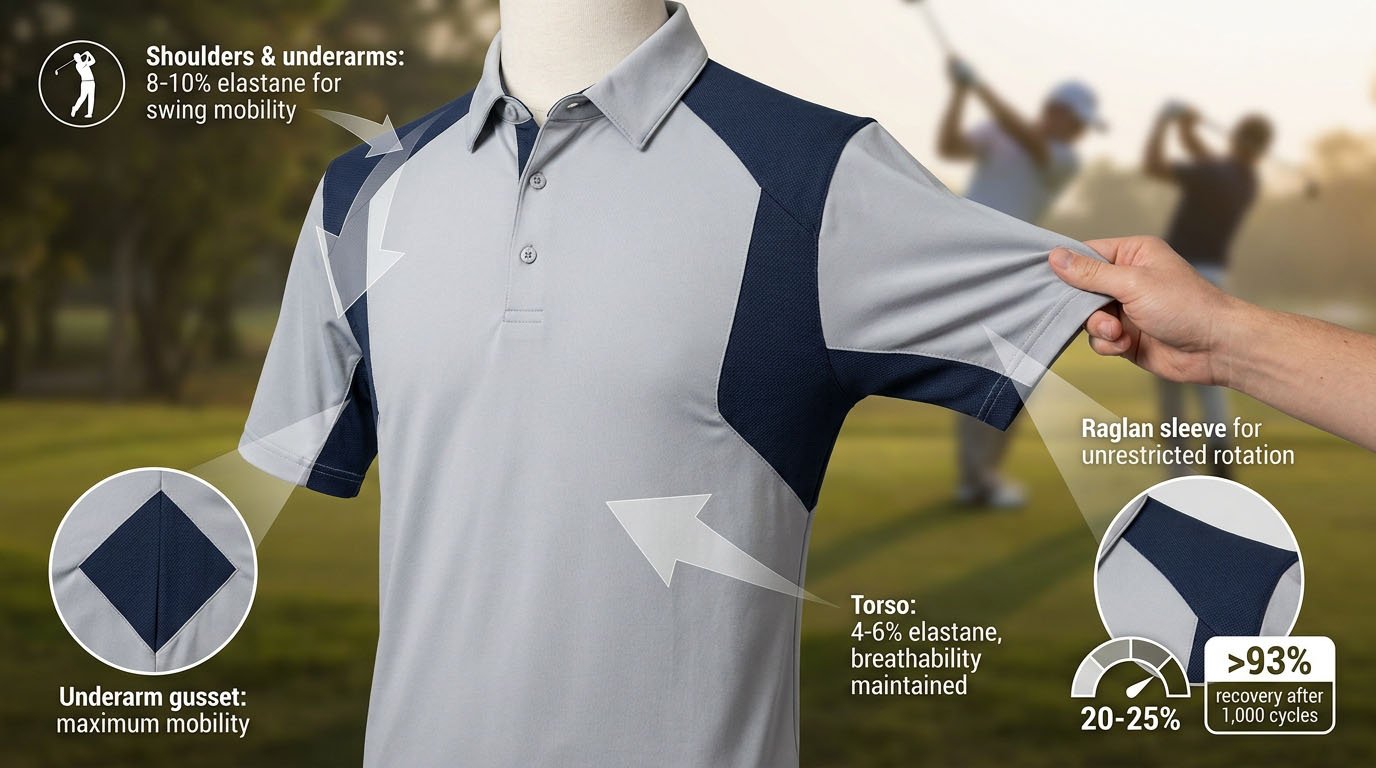
Engineer swing mobility through targeted elastane placement (6-10% in shoulders and underarms, 4-6% in torso) and raglan or articulated sleeve patterns that eliminate shoulder seam restriction—recognizing that uniform high-stretch blends (>10% elastane throughout) create excessive compression and reduce breathability by 25-30% without additional functional benefit.
Comfort engineering is where brands waste money. They add 10-12% elastane throughout the garment assuming "more stretch = better"—ignoring that golfers need stretch in specific zones only, and excess elastane reduces breathability and increases cost unnecessarily.
Elastane Engineering and Stretch Performance
How elastane affects fabric:
Mechanical properties:
- Elastane contracts when relaxed (creates snug fit)
- Stretches easily under force (accommodates movement)
- Returns to shape after stretching (shape retention)
The breathability cost:
- 6% elastane: -10-15% air permeability (acceptable trade-off)
- 10% elastane: -20-30% air permeability (noticeable heat buildup)
- 12%+ elastane: -30-40% air permeability (uncomfortable in warm weather)
The mechanism: Elastane pulls yarns closer together, creating tighter knit structure with smaller air gaps.
Stretch performance by elastane content:
| Elastane % | Horizontal Stretch | Vertical Stretch | Recovery After 1,000 Cycles | Breathability Impact |
|---|---|---|---|---|
| 0-2% | 5-10% | 3-8% | 85-90% | None |
| 4-6% | 15-22% | 10-18% | 92-95% | -10-15% |
| 8-10% | 25-35% | 18-28% | 94-97% | -20-30% |
| 12-15% | 35-50% | 30-45% | 95-98% | -30-40% |
The diminishing returns problem:
Golf swing requirements:
- Shoulder rotation: Needs 20-25% horizontal stretch in shoulder/chest zone
- Torso rotation: Needs 15-20% horizontal stretch in side body
- Arm movement: Needs 18-25% stretch in sleeves
Standard 6-8% elastane provides:
- 20-25% horizontal stretch—adequate for golf swing
High 10-12% elastane provides:
- 30-35% horizontal stretch—exceeds golf requirements
Analysis: The extra 5-10% stretch from high elastane content is not functionally necessary for golf—it is overkill that costs +$0.60-1.20 per meter and sacrifices breathability.
Zone-Specific Elastane Distribution
Smart stretch engineering:
Instead of uniform elastane throughout:
High-stretch zones (8-10% elastane):
- Shoulders and chest: Primary swing rotation area
- Underarm panels: Maximum mobility during backswing
- Upper sleeve: Arm extension and rotation
Moderate-stretch zones (5-7% elastane):
- Side body panels: Torso rotation
- Back body: Forward bend mobility
- Lower sleeve: Adequate arm movement
Low-stretch zones (2-4% elastane):
- Collar and placket: Structure priority (stretch not needed)
- Hem: Minimal movement (lower body stationary)
Production complexity:
Zoned stretch requires:
- Multiple fabric types (2-3 different elastane blends)
- Pattern engineering (cutting specific zones from specific fabrics)
- Higher assembly skill (matching different stretch fabrics)
Cost impact:
- +$2.50-4.00 per piece for zoned stretch vs uniform fabric
- Justifiable at $95+ retail, not cost-effective at <$75
When to use zoned stretch:
Yes, engineer zoned stretch if:
- Premium positioning ($95-140+ retail)
- Performance/athletic market positioning
- Can communicate technical construction to customers
No, use uniform stretch if:
- Mid-tier positioning ($60-90 retail)
- Traditional/club market positioning
- Cost control priority
Uniform stretch recommendation:
Use 6-8% elastane throughout—provides adequate mobility without breathability compromise or cost explosion.
Sleeve Pattern Engineering for Swing Freedom
Set-in sleeve (traditional):
Construction:
- Sleeve attached at perpendicular seam to shoulder
- Armhole: Relatively small opening (tailored fit)
Mobility limitation:
- Restricts shoulder rotation at 85-95 degrees of backswing
- Fabric pulls tight across chest and upper back
- Acceptable for: Casual golf, limited swing speed
Cost: Baseline (standard pattern)
Raglan sleeve (athletic):
Construction:
- Sleeve seam runs diagonally from collar to underarm
- Armhole: Larger opening, sleeve rotates with arm naturally
Mobility benefit:
- Allows full backswing rotation (110-120 degrees) without restriction
- No pulling sensation across shoulders
- Preferred for: Performance golf, athletic players
Cost: +$0.80-1.40 per piece (more complex pattern, additional seam)
Appearance: Athletic/casual (not suitable for traditional club wear)
Articulated sleeve (hybrid):
Construction:
- Set-in sleeve with pre-curved shape mimicking arm position
- Elbow darting or curved panels allow natural movement
Mobility benefit:
- Better than standard set-in (additional 10-15 degrees rotation)
- Maintains traditional appearance (refined aesthetic)
- Middle ground: Function + formality
Cost: +$1.20-2.00 per piece (complex pattern development, curved cuts)
Use case: Premium polos targeting club/business golf where appearance matters
My recommendation by positioning:
| Price Tier | Sleeve Type | Rationale |
|---|---|---|
| Value ($45-60) | Standard set-in | Cost control, adequate for recreational play |
| Mid ($60-85) | Raglan | Best mobility-to-cost ratio for active players |
| Premium ($85-120) | Articulated set-in | Maintains refined appearance with enhanced mobility |
| Athletic/Performance ($70-110) | Raglan + stretch panels | Maximum mobility for competitive players |
Gusset and Panel Stretch Engineering
Underarm gusset:
Function:
- Diamond-shaped stretch panel inserted at underarm seam
- Expands during arm raise and rotation
- Prevents tearing or restriction at stress point
Sizing:
- Small gusset: 5×7 cm (subtle, lightweight garments)
- Standard gusset: 7×10 cm (most golf polos)
- Large gusset: 10×15 cm (maximum mobility, outerwear)
Fabric for gusset:
- High-stretch mesh: 12-15% elastane (maximum mobility + breathability)
- Stretch knit: 8-10% elastane (visibility if no mesh)
Cost: +$1.00-1.60 per piece (material + assembly)
Worth it: Yes for $75+ retail performance positioning
Side body stretch panels:
Function:
- Vertical panels along side seams from underarm to hem
- Allow torso rotation during swing
Width: 4-8 cm each side
Fabric: 8-10% elastane or mesh (breathability + stretch)
Cost: +$1.50-2.50 per piece (separate pattern pieces, complex assembly)
Visual impact: Athletic appearance (visible contrast panels)
When to use:
- Performance/athletic positioning
- Younger demographics (ages 25-45)
- Hot-climate markets (adds breathability via mesh option)
When to skip:
- Traditional golf positioning
- Older demographics (ages 50+) who find visible panels too casual
- Value pricing <$65 retail
Stretch Recovery and Garment Longevity
Why recovery matters:
Poor stretch recovery creates:
- Bagging at elbows after repeated bending
- Stretched-out waistband after wearing
- Loose collar after pulling over head
- Overall shapeless appearance after 15-20 wears
What controls recovery:
Elastane quality:
- Low-grade elastane: 85-90% recovery after 1,000 cycles
- Standard elastane: 92-95% recovery
- Premium elastane (Lycra, Dorlastan): 95-98% recovery
- Cost difference: +$0.80-1.50 per meter for premium
Knit construction tightness:
- Loose knit: Fabric stretches easily but recovers slowly
- Tight knit: Fabric resists stretching but recovers quickly
- Balance point: 20-24 gauge for golf apparel
Heat-setting process:
- Purpose: "Programs" fabric to return to specific shape
- Method: Steam or dry heat treatment during finishing
- Effect: +8-12% improvement in recovery performance
- Cost: +$0.20-0.40 per meter (additional finishing step)
Testing protocol:
Stretch-recovery test (factory QC):
- Stretch fabric to 25% elongation
- Hold for 30 seconds
- Release and wait 5 minutes
- Measure recovery: Should return to >95% original dimension
If recovery is <92%: Reject fabric batch (will create shape-loss complaints)
Recommendation:
For $65+ retail golf polos, specify:
- Standard or premium elastane (not generic low-grade)
- Heat-setting in finishing process
- Minimum 93% recovery after standard testing
This prevents the #2 most common complaint ("garment lost shape") after collar curl.
Weather-Smart Layering: Sun, Wind and Drizzle Protection Without Bulk?
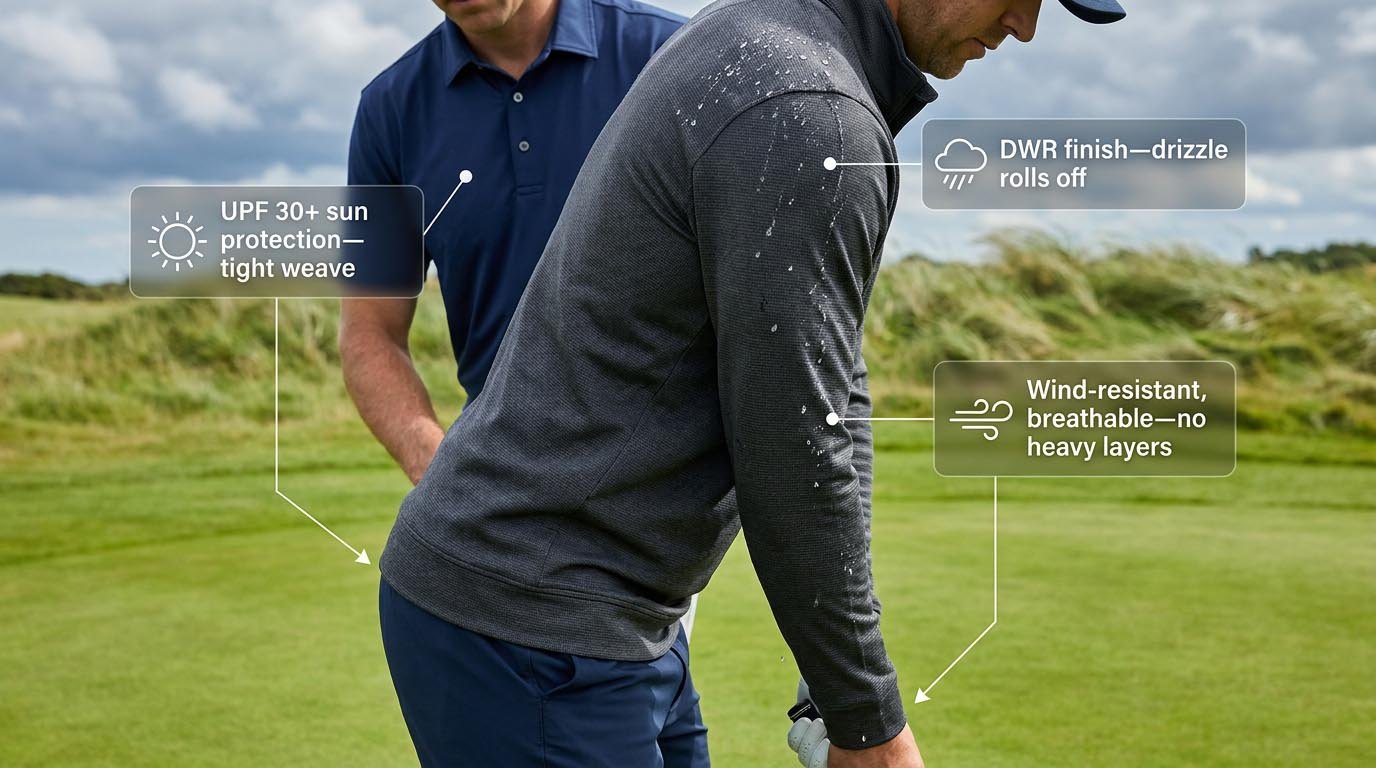
Incorporate weather resistance through fabric treatments (UPF 30-50 via tight weave density, DWR coating for light rain) and construction details (extended back hem, adjustable cuffs) rather than adding heavy protective layers that compromise breathability and create bulk unsuitable for golf's range of motion requirements.
Weather protection in golf is about light-to-moderate conditions, not extreme exposure. Golfers encountering heavy rain or snow typically stop playing. The real need is protection from sun during 4-5 hours, wind chill, and light drizzle—all without adding significant weight or restriction.
UPF Sun Protection Engineering
How UPF works in fabric:
UPF rating = UV Protection Factor:
- UPF 15-24: Good protection (93.3-95.8% UV blocked)
- UPF 25-39: Very good protection (96-97.4% UV blocked)
- UPF 40-50+: Excellent protection (>97.5% UV blocked)
What creates UPF:
Fabric density (primary factor):
- Tight weave: Less space between yarns = less UV penetration
- Higher GSM: More material = more UV absorption
- Construction: Jersey knit (24-28 gauge) provides UPF 25-40 naturally; piqué (18-22 gauge) provides UPF 15-25 naturally
Fiber type (secondary factor):
- Polyester: Naturally blocks UV-B rays (higher UPF than cotton)
- Nylon: Excellent UV blocking (even better than polyester)
- Cotton: Lower natural UPF (requires treatment)
Chemical treatment (optional enhancement):
- UV-absorbing compounds applied during finishing
- Effect: +10-15 UPF points above natural fabric rating
- Durability: 20-40 washes before degradation (not permanent)
- Cost: +$0.40-0.80 per meter
The UPF engineering trade-off:
High UPF requires:
- Tighter weave (reduces breathability by 15-25%)
- OR heavier fabric (reduces comfort in heat)
- OR chemical treatment (adds cost, degrades over time)
My recommendation:
For warm-climate golf polos:
- Target natural UPF 25-35 through:
- 190-205 GSM fabric weight
- 22-24 gauge knit (tighter than ultra-breathable piqué)
- Polyester-dominant blend (>85% poly)
- Skip chemical UV treatment (unnecessary cost)
- Result: Adequate sun protection without breathability compromise
For extreme sun exposure markets (Middle East, Australia):
- Target UPF 40-50 through:
- 200-220 GSM fabric
- Jersey knit (tight construction)
- Optional chemical treatment if needed to reach UPF 50
- Accept: 15-20% breathability reduction (still adequate with proper knit)
UPF labeling honesty:
Brands claiming UPF 50+ on 160 GSM open piqué are misrepresenting—physics does not support it. We test fabric UPF in production:
- 160-180 GSM piqué: Actually UPF 15-25
- 190-210 GSM jersey: Actually UPF 30-45
- With UV treatment: +10-15 UPF (temporary boost)
DWR (Durable Water Repellent) for Light Rain
What DWR does:
Coating function:
- Hydrophobic layer on fabric surface causes water to bead and roll off
- Does NOT make fabric waterproof (light rain protection only)
- Breathability maintained (coating is porous—air passes through)
DWR performance levels:
Light DWR (3-4 rating):
- Water resistance: 5-10 minutes in light drizzle before penetration
- Breathability impact: -5-8% (minimal)
- Durability: 15-25 washes
- Cost: +$0.30-0.60 per meter
- Use: Golf polos and light layers
Standard DWR (4-5 rating):
- Water resistance: 15-25 minutes in light-moderate rain
- Breathability impact: -10-15%
- Durability: 25-40 washes
- Cost: +$0.60-1.20 per meter
- Use: Quarter-zips, windshells, golf vests
Heavy DWR (5+ rating):
- Water resistance: 30-45 minutes in moderate rain
- Breathability impact: -15-25%
- Durability: 40-60 washes
- Cost: +$1.20-2.00 per meter
- Use: Rain jackets, softshells (not for base/mid layers)
The DWR decision:
For golf polos and base layers:
- Light DWR only or skip entirely
- Reason: Golfers wearing base layers will have outer layer for real rain
- Don't sacrifice breathability for rarely-needed water resistance
For outer layers (quarter-zips, vests):
- Standard DWR is appropriate
- Reason: These ARE the outer layer in light rain situations
- Breathability reduction is acceptable here
DWR maintenance reality:
DWR degrades with:
- Washing (each wash removes some coating)
- Abrasion (wearing backpack, cart contact)
- Body oils and sweat (clogs coating pores)
Maintenance:
- Can be refreshed with spray-on DWR treatments
- Factory application lasts 25-40 washes (good quality)
- Cheap DWR lasts 10-15 washes (false economy)
Recommendation:
Use quality DWR (4-5 rating) on outer layers only, skip it on base layers to maintain maximum breathability. Cost: +$0.60-1.20 per meter—worthwhile on $75+ retail products.
Wind Resistance Without Waterproofing
Windproof vs water-resistant vs waterproof:
| Property | Construction | Breathability | Use Case | Cost |
|---|---|---|---|---|
| Wind-resistant | Tight-weave fabric | High (adequate air flow) | Most golf conditions | Baseline |
| Windproof membrane | Bonded membrane layer | Moderate (reduced by 20-30%) | Cold-weather layers | +$2.50-4.50/meter |
| Water-resistant | DWR coating | High (coating is porous) | Light rain + wind | +$0.60-1.50/meter |
| Waterproof membrane | Sealed membrane | Low-moderate (8,000-12,000 MVTR) | Heavy rain | +$5.00-9.00/meter |
For golf apparel:
Base and mid-layers:
- Wind-resistant fabric (tight jersey or thermal knit)
- No windproof membrane (blocks breathability unnecessarily)
- Example: 200-220 GSM jersey quarter-zip provides adequate wind resistance naturally
Outer layers (vests, light jackets):
- Windproof with breathability (membrane with >10,000 MVTR)
- Example: Softshell construction (exterior + membrane + interior)
- Cost: +$6-10 per piece total fabric cost
The golf-specific need:
Wind protection priorities:
- Blocks wind chill (maintains core temperature)
- Allows moisture escape (prevents interior dampness from sweat)
- Lightweight and packable (golf bag transport)
Waterproof shells (15,000mm+ rating) are overkill for most golf—they trap too much moisture during active play and are too bulky for golf bags.
Layering System Construction Details
Extended back hem on base layers:
Purpose:
- Stays tucked during bending and swinging
- 2-3 inches longer back hem than front
Production note:
Base layers worn under mid-layers do not need extreme back extension (covered by outer layers anyway)—1.5-2 inches extension is adequate, saving fabric cost.
Adjustable cuff systems:
Hook-and-loop cuffs:
- Function: Adjust fit over gloves or bare hands
- Cost: +$0.50-0.90 per piece
- Use: Outer layers (quarter-zips, jackets)
Thumb holes:
- Function: Extends sleeve over hands, prevents ride-up
- Cost: +$0.40-0.70 per piece
- Use: Base layers, performance mid-layers
- Caution: Stretches out after 30-50 wears (wear point)
Collar height variation:
Base layer collar: 2-2.5 inches (standard polo height)
Mid-layer collar: 3-3.5 inches (wind protection when zipped)
Outer layer collar: 3.5-4 inches (maximum wind protection)
Zipper quality for mid/outer layers:
Budget zipper (nylon, non-branded):
- Durability: 50-100 cycles before failure
- Cost: +$0.80-1.20 per piece
- Acceptable for: Value-tier products
Quality zipper (YKK or equivalent):
- Durability: 500-1,000+ cycles
- Cost: +$1.50-2.50 per piece
- Essential for: Mid-tier and premium products ($75+ retail)
In quality tracking, zipper failures account for 8-12% of outer layer complaints—using quality zippers reduces this to <3%.
FAQ: Materials and Construction in Modern Golf Apparel
Can a single fabric provide maximum breathability, structure, and comfort simultaneously?
No—material physics prevents this. Breathability requires lower GSM (160-180) and open knit structure; structure requires higher GSM (200-220) or chemical treatments that reduce air permeability 15-25%; comfort requires higher elastane (8-10%) that tightens knit density and reduces breathability 20-30%. Each attribute's engineering requirements conflict with others. Example: 160 GSM piqué with 6% elastane provides excellent breathability (700-850 mm/s air permeability) and good mobility but loses collar structure after 15-20 washes. 210 GSM jersey with light resin maintains collar through 35+ washes but breathes at only 550-650 mm/s (feels warm above 28°C). Choice depends on priority: hot-climate tournament play prioritizes breathability; club/business golf prioritizes structure; athletic training prioritizes mobility. I tell clients: decide which ONE attribute is most critical for your use case, then optimize for that while managing compromises in the others.
How do I interpret GSM specs to predict actual performance?
GSM alone is insufficient—you need GSM + knit type + fiber blend to predict performance. 180 GSM piqué (18-gauge) breathes at 750-850 mm/s (excellent) but has weak structure; 180 GSM jersey (26-gauge) breathes at 600-700 mm/s (adequate) with better structure; 180 GSM interlock (28-gauge) breathes at 500-600 mm/s (marginal for hot weather) with maximum structure. Same GSM, completely different performance based on knit construction. Add fiber blend: 180 GSM piqué at 92% poly/8% elastane breathes 15-20% less than 95% poly/5% elastane version due to tighter knit from elastane compression. Request complete specs: "180 GSM piqué, 20-gauge, 94% polyester/6% elastane"—this allows prediction. In sample evaluation, test breathability by holding fabric to your mouth and breathing through it for 10 seconds—if you feel significant resistance, breathability will be inadequate for active golf regardless of GSM number.
Why do some "structured" golf polos feel board-stiff while others are comfortable?
Structure can come from fabric mass OR engineering—mass creates stiffness, engineering creates shape retention without discomfort. Board-stiff polos result from: excessive GSM (>220 for warm-weather golf), heavy resin treatment (>5% application), over-calendering (creates plastic-like surface), or no elastane (fabric has no give). Comfortable structure results from: engineered collar interfacing (40-60 GSM fused or stitched stabilizer), moderate fabric weight (190-205 GSM), light resin (2-3% application), strategic elastane (5-7% for recovery), and proper finishing balance (enzyme wash before resin). In production troubleshooting, when clients complain "feels too stiff," we find 85% of cases involve excessive resin (>6% application) or no enzyme softening wash—both fixable without changing base fabric. Ask supplier: "What is resin application percentage?" and "Is enzyme wash included in finishing?" Proper answer: 2-4% resin, yes enzyme wash before resin application.
What causes golf polo collars to curl or flatten after washing?
Differential shrinkage between collar layers (top and bottom plies shrink differently) causes curl, while inadequate interfacing or wrong fabric weight causes flattening. Curl prevention: preshrink fabric before cutting (eliminates 40-60% of shrinkage-related curl), position interfacing slightly closer to underside (balances tension), and use edge top-stitching (2-3mm from edge—locks layers together). Flattening prevention: use minimum 40 GSM fused or 35 GSM stitched interfacing (lighter interfacing cannot support collar weight), ensure good adhesive quality in fused interfacing (cheap adhesive delaminates after 15-20 washes), and match fabric weight to collar construction (<180 GSM body needs heavier interfacing, >200 GSM body can use lighter interfacing). In factory QC, we wash-test collars 10 cycles before production—if curl or flatness appears, we adjust interfacing weight or positioning. Client mistake: ordering 160 GSM fabric with 30 GSM interfacing—physics cannot support collar structure with this combination.
How much elastane do I actually need for golf swing mobility?
6-8% elastane provides adequate stretch (20-25% horizontal) for full golf swing in most body types; above 8% creates diminishing returns (extra stretch unnecessary) while sacrificing breathability 20-30% and adding cost +$0.60-1.20 per meter. Golf swing requires specific mobility zones: shoulders/chest need 20-25% stretch (backswing rotation), side body needs 15-20% (torso rotation), arms need 18-25% (extension). Standard 6-8% elastane meets these requirements. Higher elastane (10-12%) is functionally overkill—it provides 30-40% stretch which exceeds golf needs and creates tighter knit that traps heat. Exception: if targeting double-duty use (golf + gym wear), higher stretch makes sense for gym movements (squats, burpees). For golf-specific apparel, 6-8% elastane is optimal balance—adequate mobility without breathability sacrifice. Below 5% elastane: stretch recovery suffers (<90% after repeated use), garment bags at elbows/waist. Above 10%: compression feeling increases, players complain about "tight feeling" despite actual size being correct.
Do UV-blocking treatments actually last or are they marketing?
Chemical UV treatments degrade 40-60% after 20-30 washes—they are temporary enhancement, not permanent. Permanent UV protection comes from fabric construction: tight weave density and higher GSM. 190-210 GSM jersey knit (24-26 gauge) naturally provides UPF 30-40 without chemical treatment—this does not degrade with washing (structure-based protection). Chemical UV absorbers add +10-15 UPF initially but wash out over time. Polyester fiber naturally blocks UV-B better than cotton (inherent property). In lab testing, we verify UPF after 0, 10, 20, 40 washes—chemically-treated fabrics show UPF drop of 8-15 points by wash 40, while structure-based UPF remains stable ±2-3 points. If supplier claims UPF 50+ on 160 GSM open piqué, ask: "Is this achieved through chemical treatment? What is UPF after 30 washes?" Honest answer will reveal treatment is temporary. For reliable sun protection, specify fabric construction targets: minimum 190 GSM, 22-24 gauge knit, polyester-dominant blend—this delivers UPF 25-35 permanently without chemical dependency.
How do I balance cost and performance when choosing fabric specifications?
Identify non-negotiable attributes for your specific use case, then optimize cost elsewhere. Hot-climate golf: breathability is non-negotiable—use 170-185 GSM piqué (20-22 gauge), 6% elastane, skip resin treatment—saves $0.60-1.00 per meter versus structured alternatives while delivering required ventilation. Club/business golf: structure is non-negotiable—use 195-210 GSM jersey (24-26 gauge), light resin, fused interfacing—accept 15-20% breathability reduction and +$0.80-1.40 per meter cost for appearance longevity. Performance/athletic golf: mobility is non-negotiable—use 6-8% elastane, raglan sleeves—accept +$1.00-1.60 per meter for stretch engineering. False economy: cutting GSM below 165 to reduce cost—results in transparency issues and returns 18-25%, losing more in warranty costs than saved in fabric. Smart cost control: skip unnecessary treatments (UV chemicals on naturally high-UPF fabrics, antimicrobial on frequently-washed golf wear, moisture transport chemicals on polyester that already wicks). Audit your spec sheet: does every feature serve your target customer's actual need? If not, eliminate it—saves 15-25% fabric cost without performance loss.
What finishing treatments actually impact performance vs. those that are just marketing?
Functional treatments: light resin (2-4% application) adds 15-20% structure with minimal breathability cost (worthwhile); preshrinking prevents 2-3% dimensional change (essential for collar stability); heat-setting improves stretch recovery 8-12% (important for elastane fabrics); DWR coating (4-5 rating) provides 15-25 minutes light rain protection on outer layers (functional for its use case). Marketing treatments with minimal verified benefit: "moisture management" chemicals on polyester (polyester already wicks naturally—treatment is redundant); antimicrobial treatments that degrade after 15-20 washes (golf apparel gets washed regularly—temporary benefit); "cooling technology" beyond basic wicking (subjective, hard to measure, expensive +$0.80-1.50 per meter); fragrance treatments (completely nonfunctional for performance). In production quality control, we test only measurable parameters: air permeability (before/after resin), dimensional stability (after wash cycles), stretch recovery (after loading), and water repellency (DWR spray rating). If treatment cannot be objectively measured, it is likely marketing fluff. Ask supplier: "What quantifiable performance improvement does this treatment provide, and how do you verify it?" If answer is vague ("enhanced comfort," "superior feel"), skip the treatment and save $0.40-1.20 per meter.
Conclusion
Balance breathability, structure, and comfort through priority-based fabric selection—choose 160-185 GSM open knits (piqué 18-22 gauge) for hot-climate breathability priority, 195-215 GSM tight knits (jersey 24-26 gauge) for structure/appearance priority, or 6-8% elastane blends for mobility priority—recognizing each choice sacrifices 15-30% performance in non-priority attributes. Engineer missing properties through construction details (collar interfacing +$0.50-0.90, raglan sleeves +$0.80-1.40, strategic stretch zones +$2.50-4.00) rather than chasing impossible "perfect fabric" that over-promises and under-delivers.