That crisp golf polo collar looked perfect when the sample arrived. Then, after one or two washes, the edges became wavy, the collar tips started lifting, or the whole collar developed a “bacon curl.”
For a golf brand, this is more than a small appearance problem. Curling collars can lead to customer complaints, negative reviews, returns, and questions about product quality.
Golf polo collars usually curl after washing because different parts of the collar shrink, stretch, or move at different rates. The collar fabric, interlining, stitching, and construction all work together as one system. When they are poorly matched, washing and drying expose the imbalance.
If you are developing new golf polos, collar stability should be evaluated as part of the complete custom golf shirts development process, not treated as a small finishing detail.
The good news is that collar curling can often be reduced significantly through better material matching, construction control, wash testing, and bulk-production consistency.
Quick Answers: Why Do Golf Polo Collars Curl?
Here are the short answers before we go deeper.
- What is the main cause? Different collar layers shrink or move differently after washing.
- Is cheap fabric always the problem? No. The body fabric may be perfectly fine while the collar construction fails.
- Can interlining cause curling? Yes. An interlining that does not match the outer collar fabric can create tension and distortion.
- Can sewing cause a collar to curl? Yes. Excessive thread tension, uneven feeding, or stretching during sewing can create hidden stress.
- Does washing temperature matter? Yes. Heat can expose shrinkage differences between materials.
- Can tumble drying make it worse? Yes. High heat and rough tumbling can increase distortion.
- Do rib-knit and self-fabric collars behave the same way? No. They have different structures and different failure risks.
- Can an already curled collar be fixed? Sometimes temporarily, but permanent prevention should start during product development.
- How should brands prevent it? Wash-test the actual finished collar before approving bulk production.
Why Do Golf Polo Collars Curl After Washing?
A polo collar may look simple, but it is often made from several components working together.
Depending on the collar design, these can include:
- outer collar fabric
- under-collar fabric
- internal interlining
- adhesive or fusing
- sewing thread
- edge stitching
- neckline attachment seams
When these components react differently to water, heat, agitation, and drying, tension develops inside the collar.
For example, if the inner layer shrinks more than the outer fabric, it may pull the collar inward.
If the outer layer moves more than the inner layer, the excess fabric can ripple or roll outward.
The result is the familiar wavy or curled edge.
The Collar Is a System, Not Just One Piece of Fabric
Many buyers immediately blame the main polo fabric.
That can be a mistake.
| Collar Component | Main Function | Possible Curling Risk |
|---|---|---|
| Collar shell | Visible outer surface | Shrinkage or poor dimensional stability |
| Interlining | Adds shape and structure | Shrinks differently from shell fabric |
| Fusing | Bonds layers together | Weak or uneven bonding |
| Stitching | Holds collar structure | Excess tension can pull edges |
| Neckline seam | Connects collar to shirt | Stretching or uneven feeding can distort collar |
This is why a golf polo can use a good-quality body fabric and still develop a poor-looking collar after washing.
Is Fabric the Main Reason Polo Collars Curl?
Sometimes, but not always.
The fabric itself can contribute to curling if it has poor dimensional stability or changes significantly during washing.
However, collar curling is often caused by material incompatibility, rather than one material simply being “bad.”
For example, a lightweight polyester-spandex outer fabric may behave differently from a rigid internal support layer.
Both materials may be acceptable individually.
The problem begins when they are combined without considering:
- shrinkage
- stretch
- recovery
- thickness
- heat sensitivity
- washing behavior
For golf brands developing performance polos, proper fabric sourcing should consider not only moisture-wicking, stretch, hand feel, and appearance, but also dimensional stability and compatibility with the collar construction.
That is why collar materials should be evaluated together instead of judging only the body fabric.
How Does Interlining Affect Golf Polo Collar Curling?
The interlining is one of the most important hidden parts of many self-fabric polo collars.
It gives the collar structure and helps it maintain its shape.
But choosing the thickest interlining available does not automatically produce a better collar.
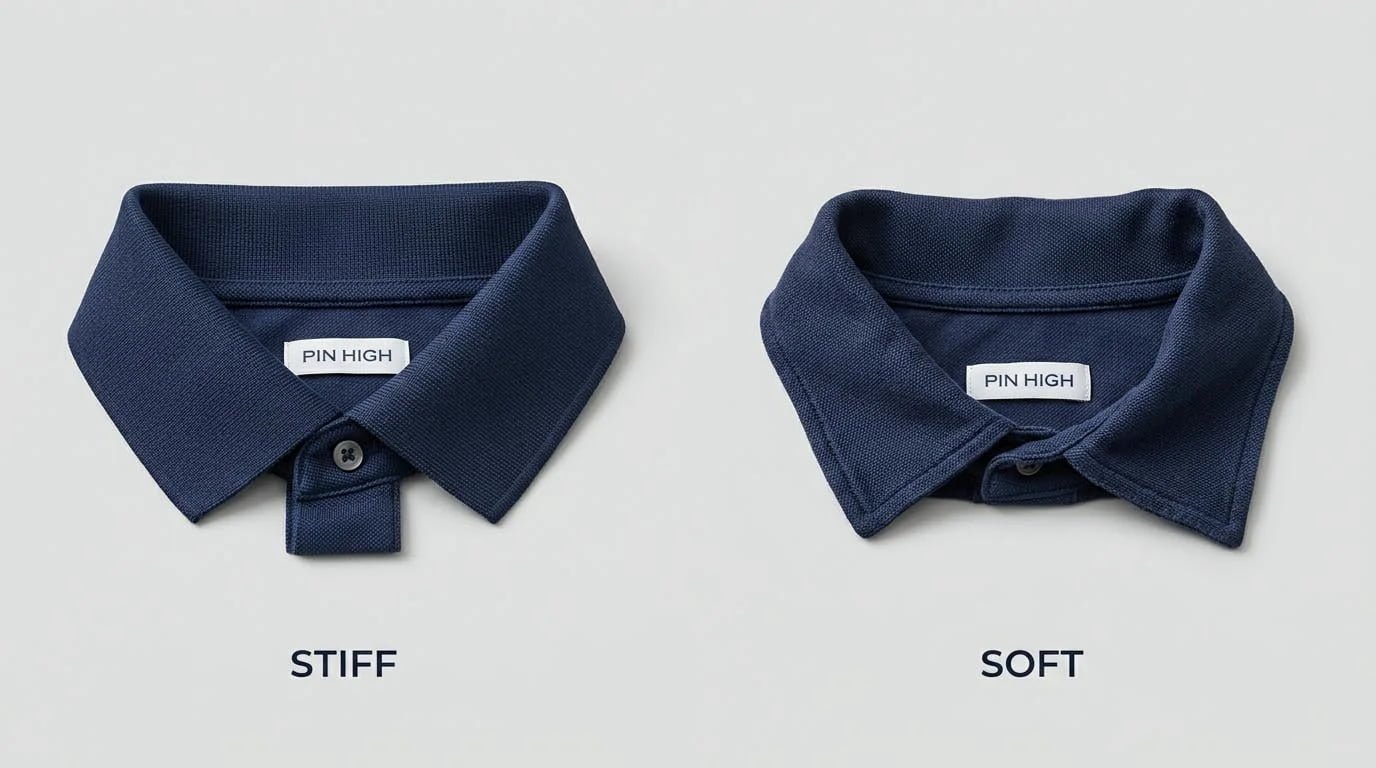
What Happens If the Interlining Is Too Heavy?
A very heavy interlining can make the collar:
- stiff
- uncomfortable
- unnatural
- difficult to fold
- inconsistent with a lightweight performance polo
A stiff collar may look sharp when freshly pressed but still develop problems after repeated washing if the materials are not properly matched.
What Happens If the Interlining Is Too Light?
An overly soft or weak interlining may not provide enough support.
The collar can:
- collapse
- wrinkle
- lose its shape
- curl along the edge
- develop soft, uneven collar tips
The Goal Is Compatibility, Not Thickness
There is no universal “best” interlining for every golf polo.
The correct choice depends on the outer collar fabric.
A good combination should have compatible:
- stretch behavior
- recovery
- dimensional stability
- weight
- flexibility
- heat response
This is why the same interlining should not automatically be reused across every polo fabric.
Can Sewing Tension Make a Polo Collar Curl?
Yes.
This is one of the less visible causes of collar distortion.
Even when the fabric and interlining are suitable, the sewing process can introduce hidden tension.
The polo may look fine immediately after production because pressing temporarily keeps the collar flat.
After washing, that stored tension is released.
Common Sewing Problems That Can Cause Curling
1. Excessive Thread Tension
If stitching is too tight around the collar edge, it can behave like a small drawstring.
The fabric around it may then ripple or curl.
2. Uneven Feeding
During sewing, the upper and lower collar layers should move through the machine evenly.
If one layer stretches more than the other, tension can become trapped inside the finished collar.
3. Stretching the Collar During Attachment
The collar should match the neckline correctly.
If operators stretch the collar excessively while attaching it to the shirt, the collar may try to recover to its original dimensions after washing.
That can distort the neckline and collar shape.
4. Incorrect Stitch Density
Too many stitches can make an edge rigid.
Too few may allow the collar layers to shift.
The sewing method needs to match the fabric and collar construction.
Rib-Knit vs Self-Fabric Golf Polo Collars: Which Is More Likely to Curl?
Not all polo collars are constructed the same way.
Two common types are:
- Rib-knit collars
- Self-fabric collars
Their curling problems can come from different sources.
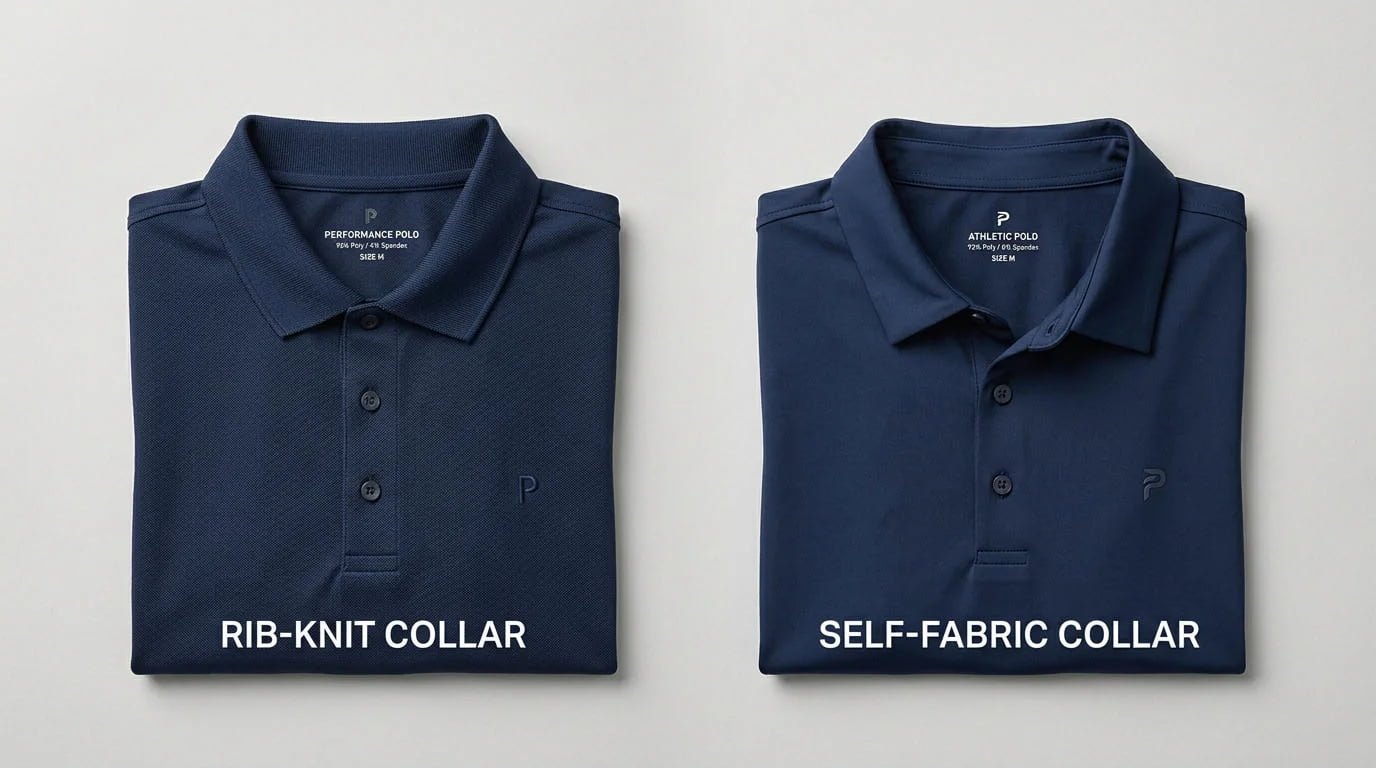
Rib-Knit Collars
Traditional rib-knit or flat-knit polo collars are usually knitted separately and attached to the shirt neckline.
Their shape depends heavily on:
- yarn structure
- knitting tension
- edge construction
- yarn recovery
- collar-to-neckline sizing
Because many rib-knit collars do not use the same internal interlining system as tailored self-fabric collars, their curling problem may be related more to the knit construction itself.
Poor edge stability or uneven yarn tension can make the collar tips roll or flare after washing.
Self-Fabric Collars
Self-fabric collars use fabric similar to, or the same as, the polo body.
They are popular on modern performance golf shirts because they give a clean, athletic appearance.
However, lightweight performance fabrics often need extra internal support.
Self-fabric collar performance therefore depends heavily on:
- interlining
- fusing
- grain direction
- edge stitching
- accurate cutting
If the internal support does not reach the collar edge correctly, the unsupported outer area may curl after washing.
Which One Is Better?
Neither construction is automatically better.
A well-developed rib-knit collar can remain stable through repeated washing.
A well-developed self-fabric collar can also maintain excellent shape.
When creating a private label golf apparel collection, the collar style should therefore be selected together with the fabric, brand positioning, desired hand feel, and expected care conditions.
Can Poor Fusing Cause a Polo Collar to Curl?
Yes.
For collars that use fusible interlining, bonding quality matters.
Fusing normally depends on a combination of:
- temperature
- pressure
- contact time
- interlining type
- outer fabric type
If bonding is incomplete, sections of the collar may separate internally.
This can create:
- bubbles
- ripples
- uneven surfaces
- loose sections
- curled edges
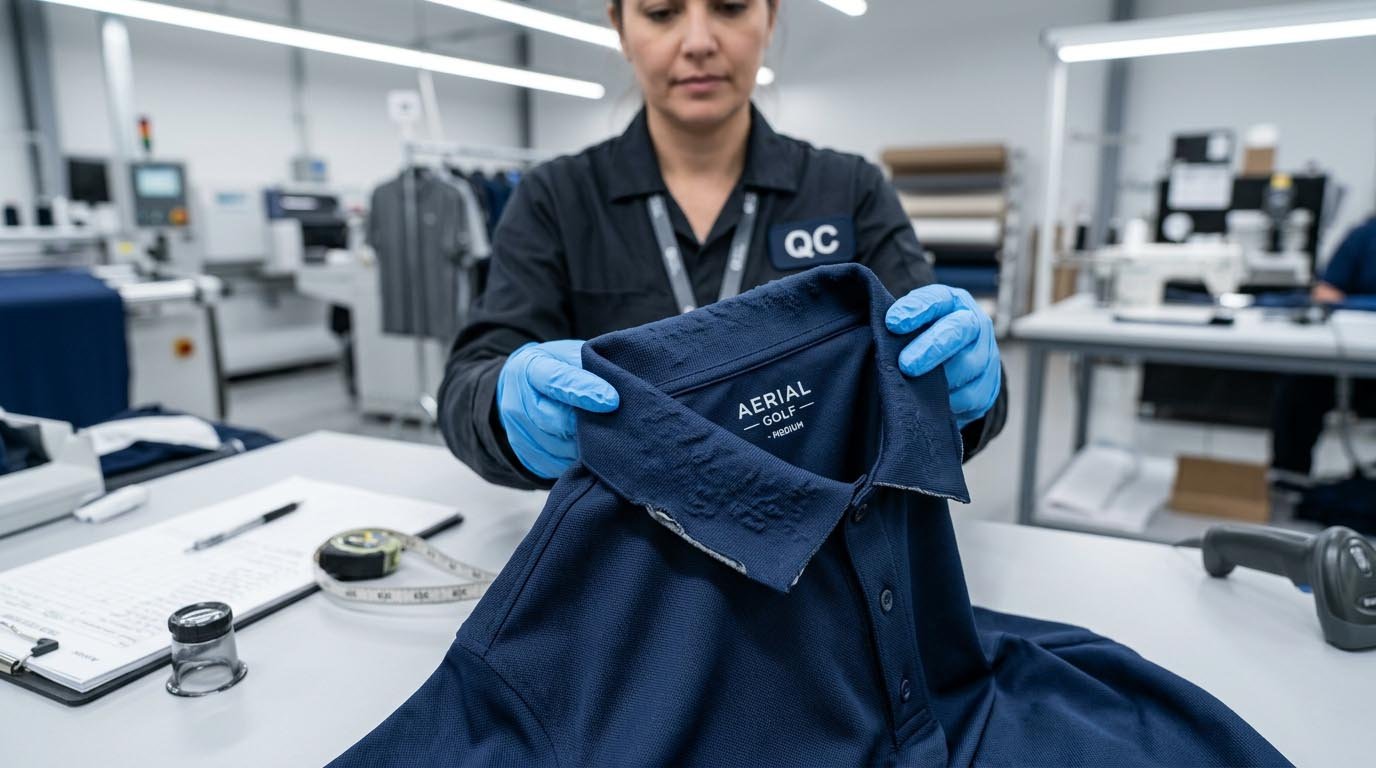
The difficult part is that poor bonding may not always be obvious on a freshly pressed sample.
The problem can appear only after laundering.
That is another reason wash testing is more valuable than judging an unwashed sample alone.
How Does Washing Temperature Affect Golf Polo Collars?
Washing does not always create the original problem.
Often, it reveals an existing construction weakness.
Hot water can make different materials move or shrink at different rates.
If the collar materials are already poorly matched, heat increases the stress between them.
Washing Factors That Can Affect Collar Shape
| Washing Factor | Possible Effect |
|---|---|
| Hot water | May increase differential shrinkage |
| Long wash cycles | Increase mechanical stress |
| Strong agitation | Can distort unsupported areas |
| Aggressive detergent | May increase fiber stress over repeated washes |
| Repeated laundering | Gradually exposes construction weaknesses |
A properly developed polo collar should still handle normal consumer washing.
Care labels are important, but the garment should not depend on unrealistic washing conditions just to maintain its shape.
Does Tumble Drying Make Collar Curling Worse?
It can.
High dryer temperatures can create additional shrinkage and stress.
Rough tumbling can also twist or fold the collar while it is warm.
Common drying problems include:
- excessive dryer heat
- over-drying
- leaving the collar folded or twisted inside the dryer
- repeated high-temperature drying
Air drying or low-temperature drying can reduce the risk.
However, good consumer care cannot completely fix poor collar engineering.
If a collar repeatedly fails during normal home laundering, the product construction should be investigated.
How Can You Fix an Already Curled Golf Polo Collar?
If a collar has already started curling, you may sometimes improve its appearance.
However, the solution depends on whether the problem is temporary surface distortion or a permanent structural mismatch.
Try Reshaping the Collar While Damp
After washing:
- Remove the shirt promptly.
- Lay the collar flat.
- Gently reshape the collar edge and tips.
- Allow it to air dry in the correct position.
This may help with mild curling.
Use Gentle Steam or Low Heat
Light steaming or careful pressing can temporarily flatten the collar.
Always follow the garment's care instructions, especially with synthetic performance fabrics.
Avoid excessive heat because it may damage the fabric or make bonding problems worse.
Understand the Limitation
If the collar curl is caused by:
- mismatched shrinkage
- damaged fusing
- poor interlining
- incorrect sewing tension
home ironing usually does not solve the root cause.
The collar may become flat temporarily and curl again after the next wash.
For golf brands, prevention during product development is therefore much more important than consumer repair.
Quick Fixes vs Permanent Collar Curl Prevention
A useful way to think about collar curling is to separate consumer fixes from production fixes.
A customer who already owns a curled polo wants to improve its appearance.
A golf brand developing its next collection should focus on preventing the problem before bulk production.
| Situation | Best Action | Expected Result |
|---|---|---|
| Existing mildly curled shirt | Reshape while damp and air dry flat | Temporary improvement |
| Collar curls after tumble drying | Reduce drying temperature | May reduce future distortion |
| Collar tips keep lifting | Improve edge stability and construction | Better long-term shape retention |
| Shell and interlining shrink differently | Match materials more carefully | Lower repeat curling risk |
| Sewing creates hidden tension | Correct feeding and attachment technique | Reduces structural stress |
| Sample looks good but bulk fails | Lock approved materials and processes | Better production consistency |
| New bulk production | PP sample wash test before approval | Helps prevent unstable collar construction |
The key difference is simple:
Reshaping and steaming treat the visible symptom. Material matching, construction control, and wash testing address the root cause.
How Can Golf Brands Prevent Polo Collar Curling?
The most effective approach is to treat collar performance as a product-development checkpoint.
Do not approve a collar only because the freshly finished sample looks good.
1. Match the Collar Materials
Evaluate the collar shell and internal support materials together.
Check whether they have compatible:
- shrinkage
- stretch
- recovery
- thickness
- heat response
2. Test the Actual Finished Collar
Do not test only a loose fabric swatch.
The finished collar assembly is what the customer will wash.
Testing should therefore include the real:
- outer fabric
- interlining
- fusing
- stitching
- neckline construction
For buyers who want to understand how product quality can be verified, reviewing a manufacturer's available test reports and quality documentation can also help support the supplier-evaluation process.
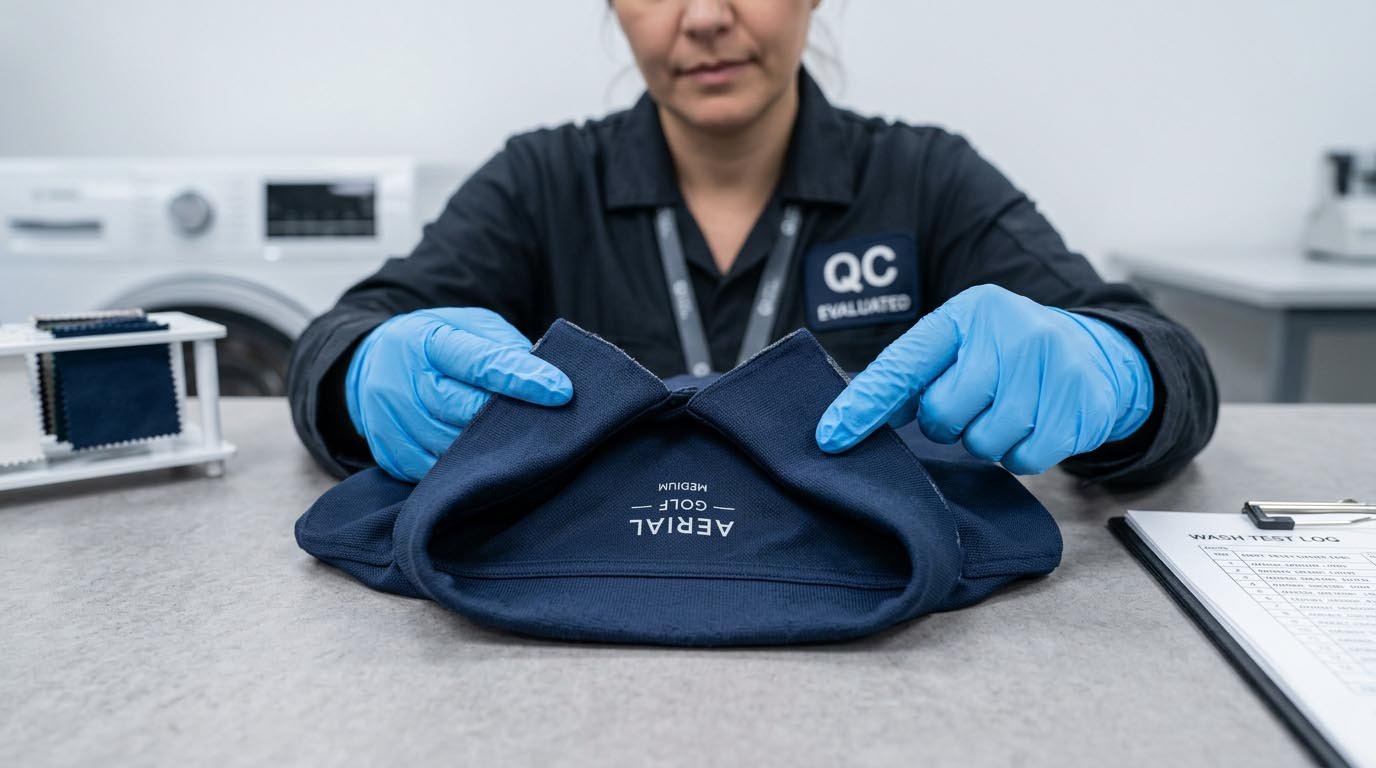
3. Wash the Sample Before Approval
A newly pressed sample can hide problems.
Wash and dry the sample under realistic conditions before final approval.
Then inspect:
- edge curling
- collar-tip lifting
- bubbling
- twisting
- shrinkage
- loss of shape
4. Check Sewing and Fusing
If curling appears, do not immediately change the body fabric.
First investigate:
- interlining
- fusing
- thread tension
- feeding
- collar attachment
- cutting direction
5. Approve the Construction, Not Just the Appearance
The approved sample should represent more than a visual standard.
It should also define the important materials and production methods used to create the collar.
What Is a Simple Golf Polo Collar Wash-Test Procedure?
A wash test does not need to be complicated to provide useful information.
What matters is testing the finished garment under agreed care conditions and comparing the collar before and after washing.
Step 1: Photograph the Collar Before Washing
Take clear photos of:
- the complete collar
- collar tips
- front neckline
- placket area
- collar edge
Lay the garment naturally instead of forcing the collar flat.
Step 2: Wash the Finished Garment
Use the washing conditions expected for the final product.
The goal is to test the complete construction, including:
- shell fabric
- collar
- interlining
- stitching
- neckline seam
- placket
Step 3: Dry the Garment
Dry it according to the planned care instructions.
Do not manually reshape the collar during testing unless that is part of the normal care process.
Step 4: Lay the Polo Flat
After drying, lay the garment on a flat surface.
Allow the collar to sit naturally.
Do not pull, stretch, or press the collar flat before evaluation.
Step 5: Check the Main Failure Points
Look for:
- collar edge roll
- collar-tip lift
- rippling
- bubbling
- twisting
- neckline distortion
- placket distortion
- overall shape loss
Step 6: Compare Before-and-After Photos
Side-by-side photos make small changes easier to identify.
This is especially useful when more than one collar construction or interlining option is being evaluated.
Step 7: Approve or Adjust
If the collar performs well, the tested construction can move toward approval.
If it fails, investigate the cause before bulk production.
Possible adjustments may include:
- changing interlining
- adjusting collar dimensions
- correcting sewing tension
- improving fusing
- revising material combinations
The purpose of wash testing is not simply to say that a sample was “washed.”
It should help the buyer and manufacturer decide whether the collar construction is stable enough for production.
Why Can a Sample Pass but Bulk Production Still Develop Curling?
This is an important issue for golf brands.
Sometimes the development sample looks good and passes washing, but customers later report curling on bulk-production garments.
Why?
Because the bulk collar may not be exactly the same as the approved sample.
Sample-to-Bulk Drift Can Include:
- a different interlining
- a different interlining weight
- different adhesive or bonding behavior
- different fusing settings
- different sewing tension
- different cutting direction
- substituted trims
- inconsistent operator techniques
This is why approving one perfect sample is not enough.
The important question is:
Can the factory reproduce the approved collar consistently in bulk production?
For brands working with an OEM/ODM partner, this is one reason manufacturing consistency matters just as much as a good-looking first sample. You can learn more about FUWAY's golf apparel manufacturing services if you are comparing suppliers for an upcoming collection.
Golf Polo Collar Quality-Control Checklist
For buyers and golf apparel brands, a simple checklist can help reduce risk.
| Stage | What to Check | Why It Matters |
|---|---|---|
| Fabric selection | Dimensional stability | Reduces shrinkage risk |
| Collar development | Shell + interlining compatibility | Prevents material conflict |
| Sewing | Thread tension and feeding | Reduces hidden stress |
| Fusing | Consistent bonding | Reduces bubbling and delamination |
| Sampling | Finished-garment wash test | Reveals hidden problems |
| Approval | Check shape after washing | Avoids approving pressed-only samples |
| Bulk production | Match approved materials | Prevents sample-to-bulk drift |
| Final QC | Inspect collar shape | Catches visible problems before shipment |
What Should Brands Add to a No-Curl Collar Tech Pack?
A tech pack should describe more than the collar's dimensions, shape, and appearance.
For a performance polo, it is useful to include a basic post-wash performance requirement as well.
This gives the factory a clearer target during sampling and reduces subjective discussions such as:
“The collar does not look good after washing.”
Instead, both sides can agree in advance on what acceptable performance should look like.
Example No-Curl Collar Requirement
A practical specification might read:
Collar Performance Requirement:
The finished collar should maintain a clean, natural lay-flat appearance after normal laundering according to the approved care instructions. Collar edges should not show obvious rolling or excessive waviness, collar tips should remain stable, and the neckline should not show visible distortion caused by excessive stretching during sewing. The final pre-production sample should be wash-tested before bulk approval.
This type of wording creates a performance expectation without relying on vague terms such as:
- premium collar
- strong collar
- thick collar
- high-quality collar
Other Details Worth Adding to the Tech Pack
Brands can also specify:
- collar construction type
- rib-knit or self-fabric
- approved collar fabric
- approved interlining, where applicable
- collar dimensions
- collar-tip shape
- neckline dimensions
- stitch construction
- care instructions
- wash-test requirement
- approved pre-production sample reference
The goal is not to make the tech pack unnecessarily complicated.
It is to make sure the factory understands that post-wash collar stability is part of the product specification, not just an optional quality preference.
What Should Golf Brands Ask Their Manufacturer?
If you are developing a new golf polo, consider asking:
- What type of collar construction are you recommending?
- Is this a rib-knit or self-fabric collar?
- Does the collar require interlining?
- How is the interlining selected for this fabric?
- Will the finished sample be wash-tested?
- How do you check collar shape after washing?
- Will bulk production use the same collar materials as the approved sample?
- How do you control sewing tension?
- How do you control the fusing process?
- What happens if the collar fails the wash test?
These questions help move the conversation away from:
“Can you make this collar thicker?”
and toward:
“Can you make this collar stable after repeated washing?”
That is a much better quality question.
If you are developing a new polo and want to discuss collar structure, fabric, MOQ, sampling, or production requirements, you can also contact FUWAY with your design or tech pack.
Frequently Asked Questions About Golf Polo Collar Curling
Is collar curling always caused by cheap fabric?
No.
High-quality body fabric can still be paired with an unsuitable interlining or poor collar construction.
The entire collar system needs to work together.
Does a thicker collar prevent curling?
Not necessarily.
A very thick interlining can make the collar stiff without solving shrinkage or bonding problems.
Material compatibility matters more than thickness alone.
Can washing at home cause collar curling?
Hot water, strong agitation, and high dryer heat can make curling more visible.
However, normal washing should not cause serious distortion in a properly developed collar.
Can ironing permanently fix a curled polo collar?
Usually not if the problem is structural.
Ironing or steaming may temporarily flatten the collar, but curling can return after the next wash.
Do collar stays prevent golf polo collars from curling?
Not necessarily.
Collar stays can help support the shape of certain collar designs, but they do not correct underlying problems such as:
- uneven shrinkage
- poor interlining compatibility
- incorrect sewing tension
- weak rib recovery
- poor fusing
They can be a useful design feature, but they should not replace proper collar engineering and wash testing.
Are self-fabric collars more difficult to manufacture?
They can require more careful control because lightweight performance fabrics often depend on internal support, accurate cutting, fusing, and stitching.
Do rib-knit collars need interlining?
Many traditional rib-knit polo collars rely primarily on the knitted structure itself rather than the same fused interlining system commonly used in self-fabric collars.
Their performance therefore depends more heavily on knit construction, yarn recovery, and attachment.
Should golf brands wash-test samples before bulk production?
Yes.
The finished garment should be tested rather than relying only on an unwashed, freshly pressed sample.
Why did my sample look good but my bulk order developed curling?
The production process may have changed.
Check whether bulk manufacturing used the same:
- collar fabric
- interlining
- fusing method
- stitching setup
- construction details
as the approved sample.
Conclusion
Golf polo collar curling is usually not caused by one simple problem.
It often comes from different materials and construction elements behaving differently after washing.
The most common areas to investigate are:
- collar fabric
- interlining
- fusing
- stitching tension
- collar attachment
- rib-knit construction
- washing and drying conditions
- sample-to-bulk consistency
For golf brands, the best solution is not to wait for customer complaints.
Treat the collar as its own development project. Match the materials carefully, test the actual finished collar after washing, include post-wash performance requirements in your tech pack, approve the construction only after it performs well, and make sure bulk production follows the approved sample.
If you are developing a new golf polo collection, you can explore FUWAY's custom golf shirts manufacturing service or contact our team to discuss your fabric, collar construction, sampling, and bulk-production requirements.