I watch brand owners choose golf fabrics based on stretch percentage alone. They miss the bigger picture. The wrong stretch fabric ruins a golf shirt faster than bad stitching ever could.
Stretch fabric in golf apparel controls two things: how freely a player swings and how long the garment keeps its shape. Real performance comes from matching stretch direction and recovery rate to swing mechanics—not just picking the highest elastane percentage on a spec sheet.
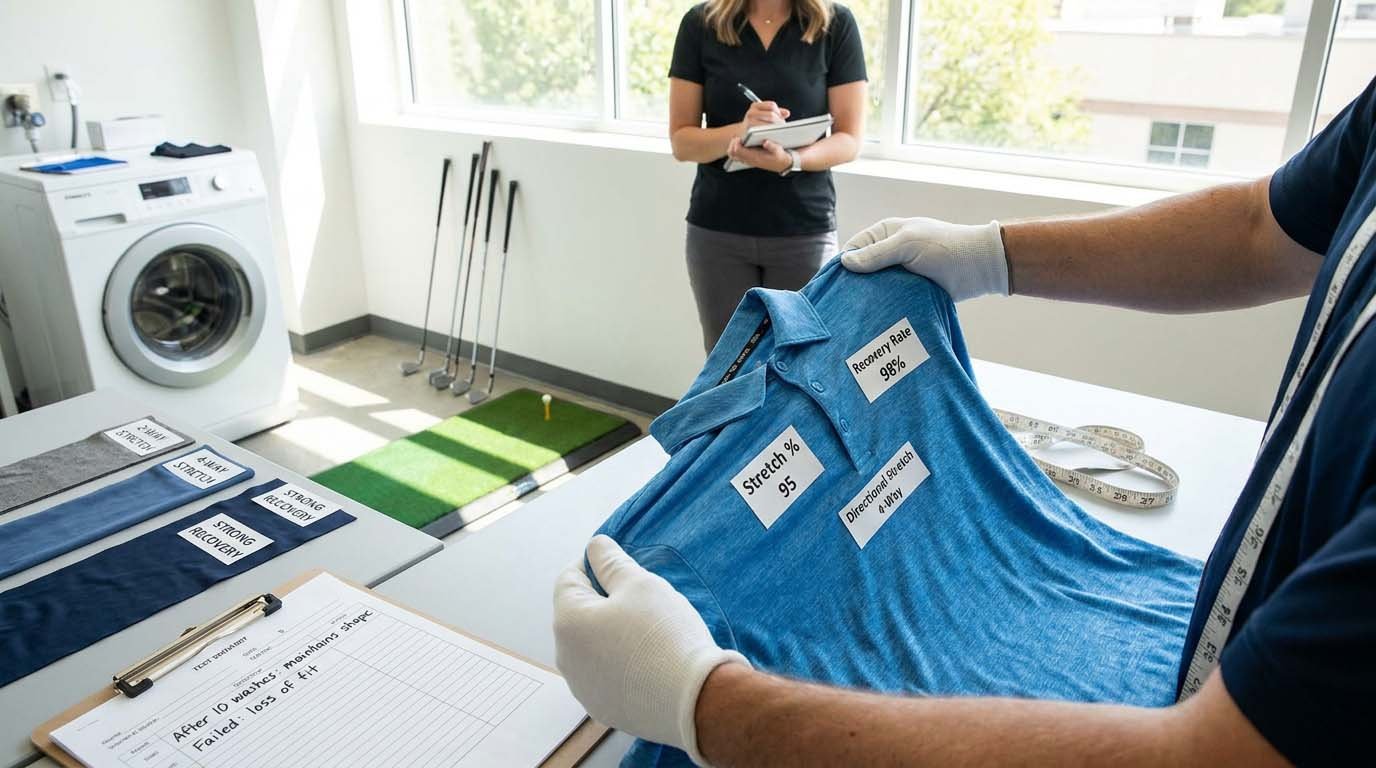
I've tested dozens of stretch fabrics for golf clients over the past eight years. The results surprised me. High stretch numbers look great on paper, but they often fail after ten washes. Let me walk you through what actually matters.
Quick Answers: Stretch Fabric in Golf Apparel
What type of stretch do golfers need most?
Golf swings need lateral stretch for torso rotation (side-to-side) and longitudinal stretch for arm extension (up-down). Four-way stretch sounds premium but often loses shape faster than targeted two-way stretch.
How much elastane should golf fabric contain?
3-5% spandex works for most golf apparel. Higher percentages (8-10%) add cost without improving performance if the knit structure and yarn denier aren't optimized for recovery.
Does stretch fabric reduce breathability?
No. Knit architecture controls airflow, not stretch itself. A well-designed mesh knit with 4% elastane breathes better than a tight plain weave with no stretch.
How long should stretch fabric maintain recovery?
Quality golf apparel should retain at least 85% elastic recovery after 20 wash cycles. Anything less means the garment will sag and lose fit within one season.
Can you test stretch performance before bulk production?
Yes. Request stretch percentage testing, recovery rate analysis, and pilling resistance reports from your fabric supplier. We run these tests on every new fabric we develop for golf clients.
The Biomechanics of a Golf Swing: Why Mobility Is Non‑Negotiable?
A golf swing moves through 100+ degrees of shoulder rotation and demands full hip turn. Any fabric that restricts this movement throws off the entire motion.
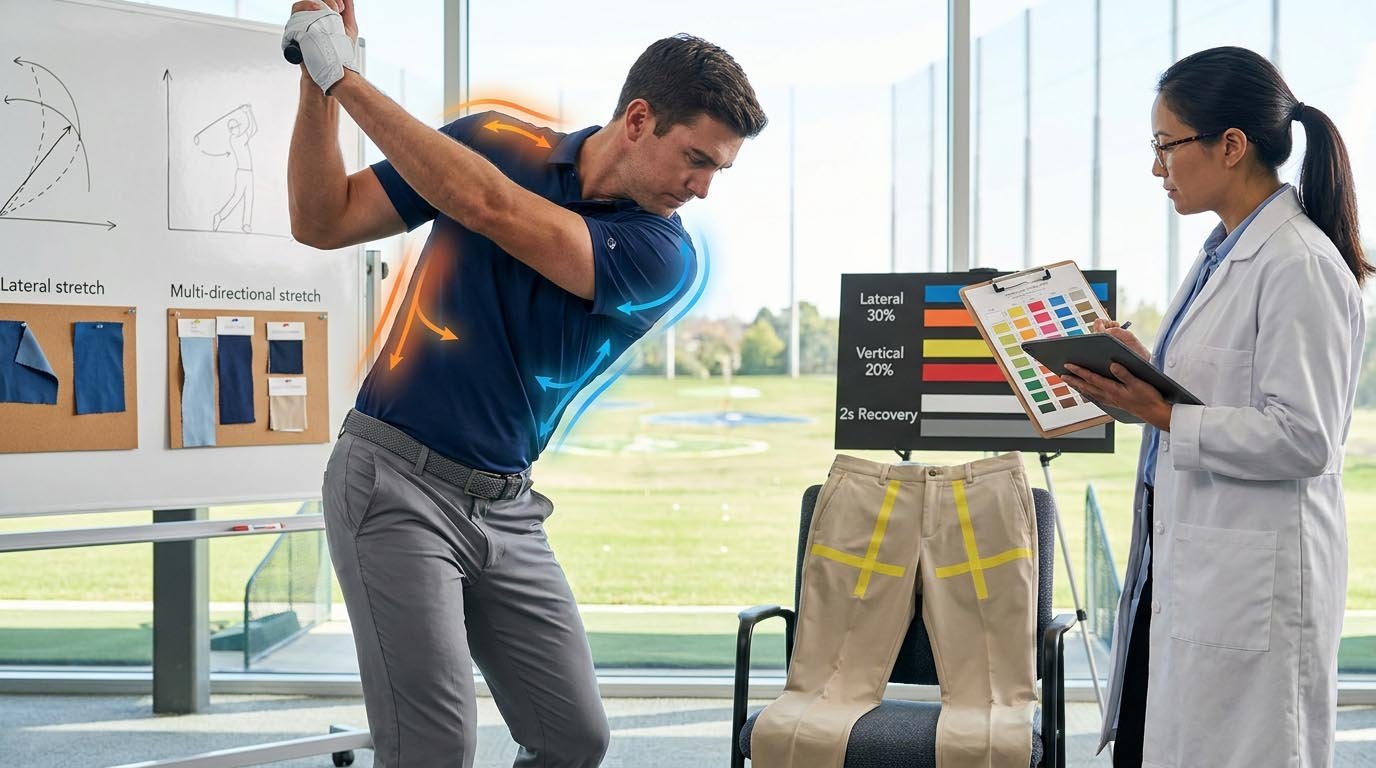
I learned this lesson early in my career. A client insisted on a classic woven cotton blend for polos because "that's what premium brands use." We made 500 units. The feedback came back harsh: players felt restricted at the top of their backswing. The fabric looked sharp but pulled across the shoulders during rotation.
Here's what I discovered testing fabrics against swing mechanics:
| Movement Phase | Stretch Direction Needed | Fabric Requirement |
|---|---|---|
| Backswing rotation | Lateral (side-to-side) | 25-30% stretch across chest/back |
| Downswing acceleration | Longitudinal (shoulder to hem) | 15-20% vertical stretch |
| Follow-through | Multi-directional | Recovery to original shape within 2 seconds |
| Walking/bending | Longitudinal in legs | 30-35% stretch in trouser thighs/knees |
The key insight? Golf demands different stretch in different garment zones. A polo needs maximum lateral stretch across the upper back. Trousers need it through the seat and thighs. You can't treat all golf apparel the same way.
We now map stretch requirements to specific swing phases before we choose fabrics. This simple step eliminates most fit complaints before production even starts.
Comfort Over 18 Holes: Fit Retention, Breathability and Skin Feel?
A golf round lasts 4-5 hours. Stretch fabric must maintain its shape through sweat, movement, and UV exposure without turning clammy or baggy.
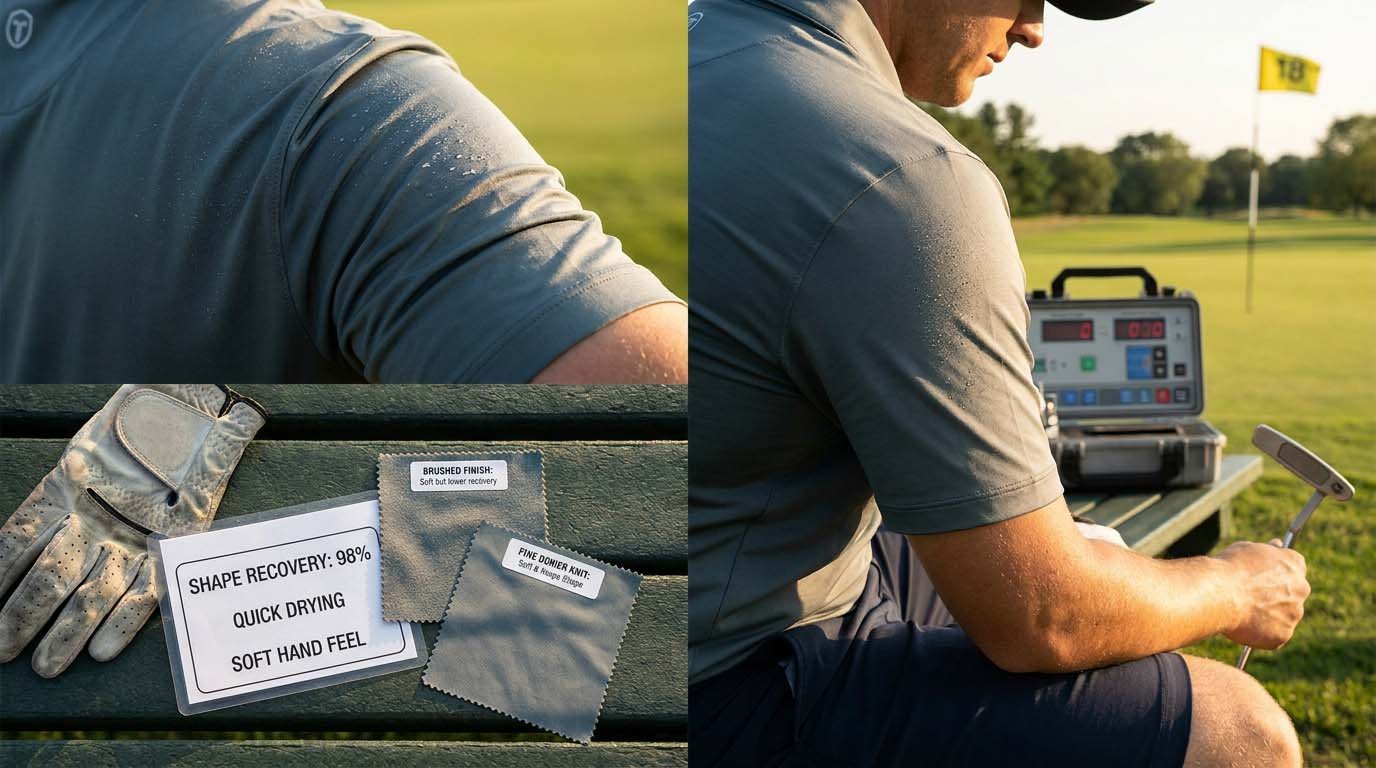
I've seen too many brands focus on initial comfort and ignore what happens after hole nine. The fabric feels great in the fitting room. By the back nine, it's sagging at the elbows and knees.
Three comfort factors matter most over a full round:
Fit retention under stress:
- Fabric must return to original dimensions after every swing
- Poor recovery creates permanent bagging at stress points
- We test recovery by stretching fabric samples to 30% extension, releasing, and measuring shape return after 5 seconds
- Quality fabrics recover to within 2% of original length; cheap alternatives stay stretched 8-10%
Moisture management with stretch:
- Adding elastane doesn't block moisture transfer if you choose the right knit structure
- Open-knit patterns with 4% spandex wick faster than tight knits with 2%
- The yarn denier matters more than the spandex percentage for breathability
Surface texture and hand feel:
- Mechanical stretch (weave-based) often feels rougher than spandex stretch
- Brushed finishes improve skin contact but may reduce stretch recovery
- We balance these by using finer denier yarns (75D vs 150D) to soften hand feel without sacrificing performance
I once worked with a client who demanded ultra-soft fabric for a premium line. We achieved it by reducing yarn denier and adding a light peach finish. The fabric felt luxurious in samples. After three washes, it pilled badly and lost 40% of its stretch recovery. We had to reformulate with slightly coarser yarns and a different finishing process. The lesson: extreme softness and long-term stretch performance rarely coexist.
Fabric Choices That Stretch: Knits vs Wovens, Elastane% and Mechanical Stretch?
Most buyers think all stretch comes from spandex. It doesn't. Knit structure creates mechanical stretch even without elastane, and that stretch behaves very differently.
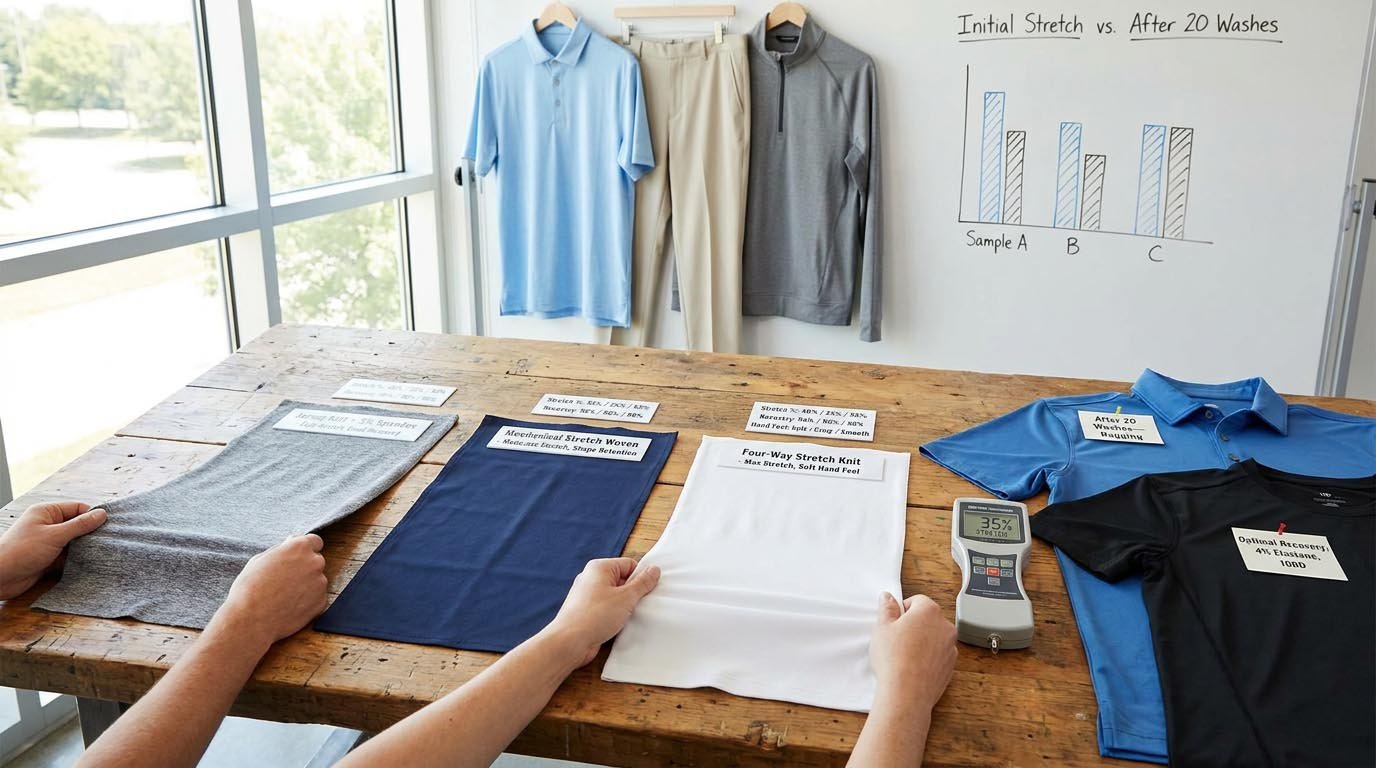
Here's a comparison I show every new client:
| Fabric Type | Stretch Source | Typical Stretch % | Recovery Speed | Best Golf Use |
|---|---|---|---|---|
| Jersey knit + 3% spandex | Knit + elastane | 35-40% bi-directional | Fast (1-2 sec) | Polos, base layers |
| Pique knit + 4% spandex | Knit + elastane | 30-35% bi-directional | Medium (2-3 sec) | Polos (textured) |
| Mechanical stretch woven | Weave structure only | 15-20% one-direction | Slow (4-5 sec) | Trousers (traditional look) |
| Four-way stretch knit | Knit + 5-8% spandex | 40-50% all directions | Fast but degrades faster | Performance polos, athletic fit |
| Twill + 2% spandex | Weave + elastane | 20-25% limited direction | Medium | Trousers (casual) |
I tested this last year with three polo samples:
- Sample A: 95% polyester / 5% spandex, four-way stretch
- Sample B: 96% polyester / 4% spandex, two-way stretch (lateral priority)
- Sample C: 100% polyester mechanical stretch knit, no spandex
All three measured similar initial stretch. After 20 wash cycles:
- Sample A lost 35% of its recovery and developed permanent shoulder bagging
- Sample B maintained 90% recovery and held its shape
- Sample C felt stiff and restricted movement at high-speed swings
The takeaway: more spandex creates more initial stretch but often worse long-term stability. We now recommend 3-4% elastane with optimized knit architecture for most golf apparel.
One more critical point buyers miss: elastane content and yarn denier must match. High spandex with thick yarns (150D+) creates stiff fabric. Low spandex with fine yarns (75D) gives better hand feel but weaker durability. We typically use:
- 4% spandex + 100D polyester for polos
- 3% spandex + 120D polyester for trousers
- 5% spandex + 75D polyester for lightweight performance layers
Design That Works With Stretch: Sleeves, Gussets, Knees and Waistbands?
Choosing stretch fabric is only half the work. Design details must work with the fabric's stretch properties, or you waste the performance completely.
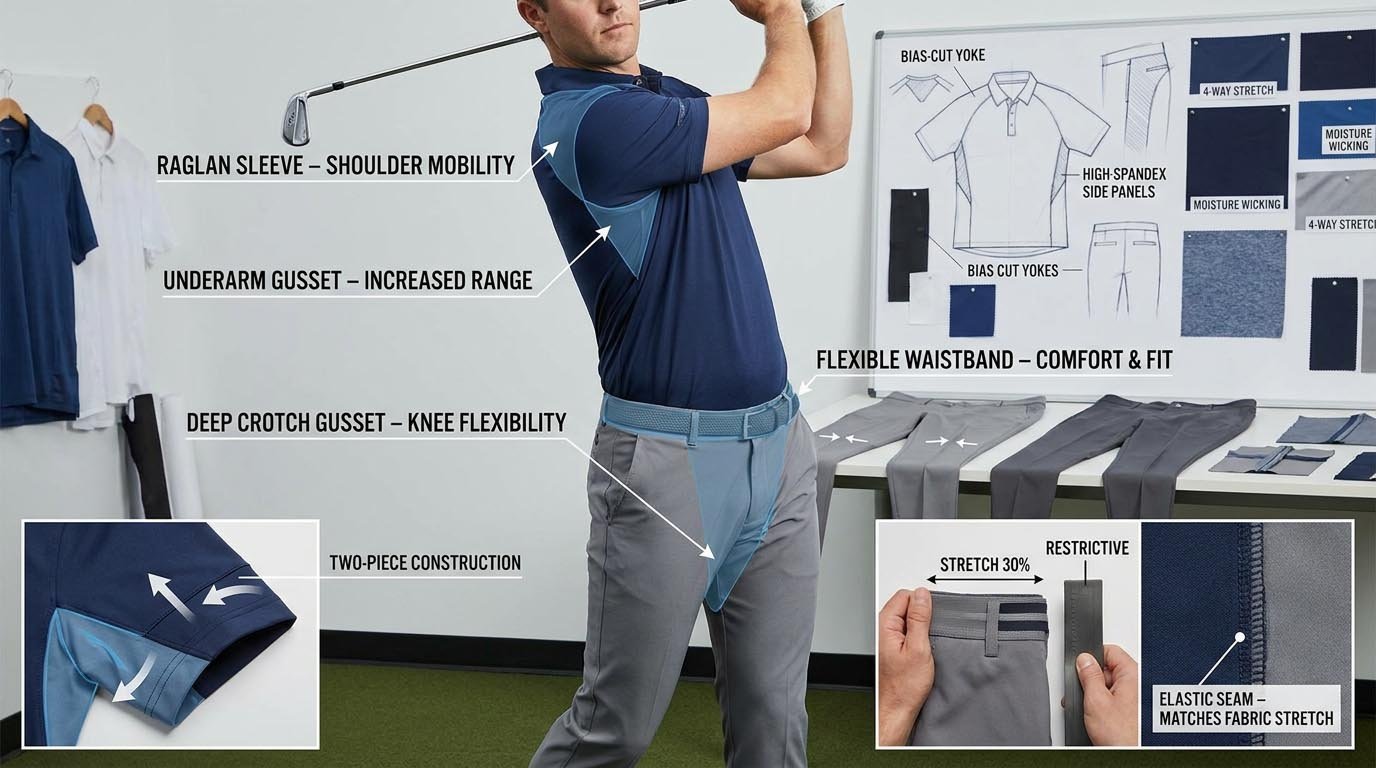
I see this mistake constantly: brands select premium stretch fabric, then use design patterns that fight against the stretch. Tight sleeve hems restrict arm movement. Narrow crotch gussets cancel out fabric stretch. Elastic waistbands compress instead of support.
Here's what works based on hundreds of prototypes:
Sleeve construction:
- Raglan sleeves utilize fabric stretch better than set-in sleeves for full range of motion
- Cuff width should be 10-12% wider than bicep measurement to avoid restriction
- Two-piece sleeve construction with stretch fabric allows better shaping than one-piece
Torso zones:
- Add 20-30% extra stretch in underarm gussets even if the main fabric stretches well
- Back yoke should use fabric cut on the bias (45° angle) to maximize lateral stretch
- Side panels with higher spandex content (6% vs 4% in main body) improve rotation freedom
Trouser details:
- Deep crotch gussets (8-10cm) prevent fabric from maxing out stretch during deep squats
- Knee darts placed 2cm higher than standard allow flex without bunching
- Waistbands should stretch 30% more than the main fabric to move with hip rotation
Reinforcement strategy:
- High-stress seams (shoulder, side seams) need stretch thread to match fabric elasticity
- If main fabric stretches 40% but thread only stretches 15%, seams rupture
- We use textured polyester thread or covered elastane thread for all stretch garments
I made a critical error two years ago with a trouser order. We used excellent stretch fabric (30% lateral, 25% longitudinal) but standard waistband construction. The waistband had only 10% stretch. Players complained the pants felt restrictive during their swing even though the fabric moved perfectly. We redesigned with a stretch waistband insert and eliminated the complaints entirely.
The principle: every design element must stretch at least as much as the fabric, or that element becomes the restriction point.
Prove It Performs: Stretch %, Recovery, Pilling and Durability Tests?
Numbers on a spec sheet mean nothing without testing. I run five tests on every stretch fabric before I approve it for golf apparel production.
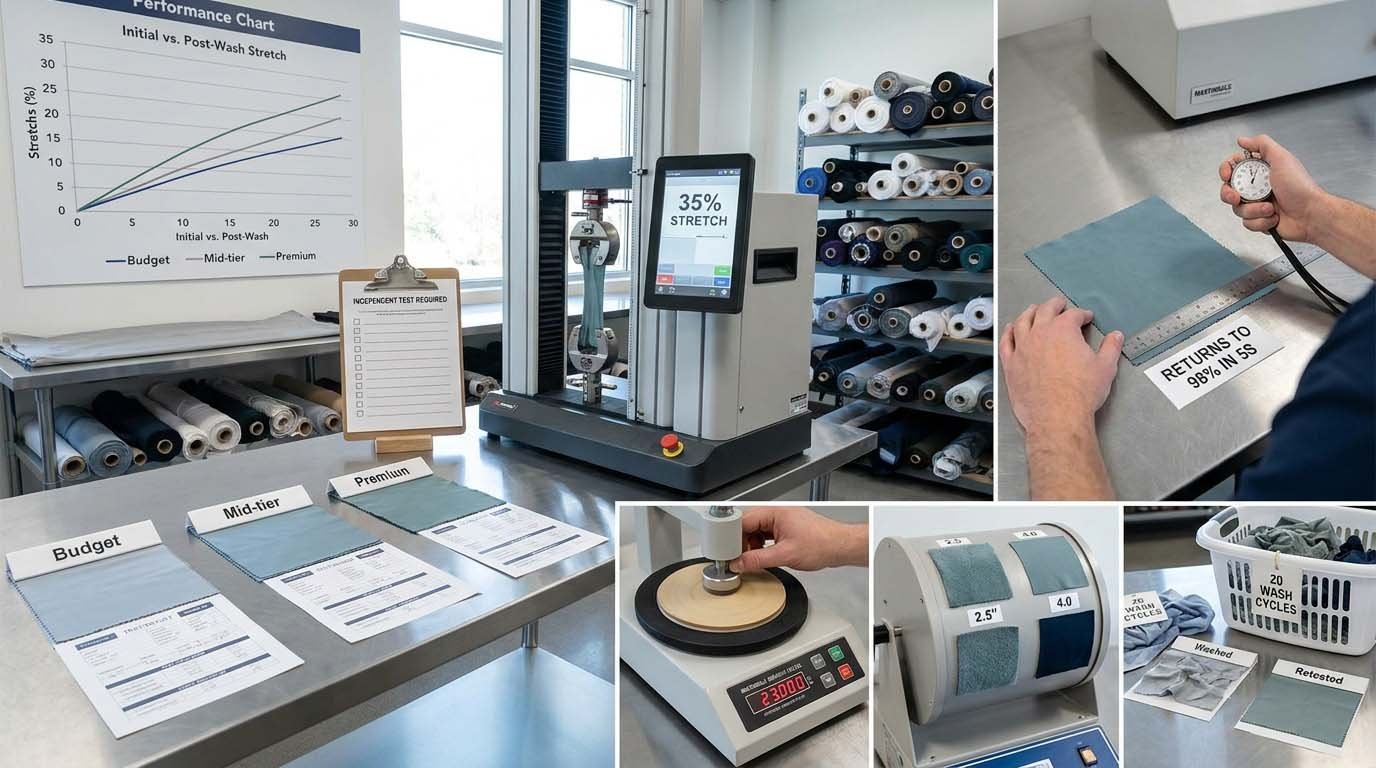
Stretch percentage (ASTM D2594):
- Measures maximum stretch before fabric distorts
- Golf apparel should hit 30-35% lateral stretch minimum
- We clamp fabric samples and apply controlled tension, measuring extension
Recovery rate:
- The test spec sheets skip but buyers need most
- Stretch fabric to 30%, hold for 30 seconds, release, measure return to original length
- Quality fabrics return to within 2% of original dimension within 5 seconds
- Budget fabrics stay stretched at 8-12% permanently
Wash cycle retention:
- Run fabric through 20 wash cycles (40°C, normal detergent)
- Re-test stretch and recovery
- Acceptable fabrics maintain 85%+ of original performance
- I've seen cheap stretch fabrics lose 50% recovery after just 10 washes
Pilling resistance (ICI Pilling Test):
- Four hours of tumbling in pilling tester
- Grade results on 1-5 scale (5 = no pilling)
- Golf apparel needs minimum grade 3.5 because players carry bags and wear seat belts
- Higher spandex content often increases pilling unless yarn quality is premium
Abrasion durability (Martindale Test):
- Measures cycles until fabric shows wear
- Golf trousers should withstand 20,000+ cycles
- Polos need 15,000+ cycles for underarm areas
- Stretch fabrics with poor knit density fail at 8,000-10,000 cycles
Here's actual test data from three fabrics we evaluated last quarter:
| Fabric Sample | Spandex % | Initial Stretch | Recovery (5 sec) | Post-20 Washes Stretch | Pilling Grade | Martindale Cycles |
|---|---|---|---|---|---|---|
| Budget option | 8% | 45% | 88% (5% permanent stretch) | 32% (lost 29%) | 2.5 | 9,500 |
| Mid-tier option | 4% | 35% | 96% (1.5% permanent) | 32% (lost 9%) | 3.5 | 17,000 |
| Premium option | 5% | 38% | 98% (0.8% permanent) | 36% (lost 5%) | 4.0 | 23,000 |
The numbers tell a clear story. Budget fabric had the highest initial stretch but worst long-term performance. The premium option cost 18% more per meter but delivered over twice the durability.
I show buyers this data and ask: would you rather replace garments after one season or maintain quality through multiple seasons? Most choose performance once they see real test results.
One more insight: don't trust supplier claims without requesting test reports. I've received fabrics labeled "high recovery" that failed our basic tests. We now require independent lab reports for any fabric over 500 meters purchase quantity.
FAQ: Stretch Fabrics in Golf Apparel?
What's the difference between two-way and four-way stretch?
Two-way stretch extends in one direction (usually lateral or longitudinal). Four-way stretch extends equally in all directions. Golf apparel performs better with optimized two-way stretch because it maintains shape longer. Four-way stretch sounds premium but often sags faster.
Does more spandex always mean better performance?
No. Spandex content above 5-6% adds cost without improving golf-specific performance if the knit structure isn't optimized. We've tested fabrics with 3% spandex that outperformed 8% alternatives in recovery tests.
How do I know if a fabric will keep its stretch?
Request recovery testing after 20 wash cycles. Quality stretch fabric maintains 85%+ of original stretch and returns to shape within 5 seconds after stretching. Ask suppliers for Martindale abrasion scores above 15,000 cycles for polos and 20,000+ for trousers.
Can stretch fabric work for traditional-looking golf apparel?
Yes. Mechanical stretch wovens and low-elastane pique knits (2-3% spandex) provide traditional appearance with modern comfort. The key is balancing visible texture with hidden stretch performance.
What causes stretch fabric to lose recovery?
Three main factors: poor quality elastane yarn, excessive spandex percentage that degrades faster, and inadequate knit density. High heat during finishing also damages elastane. We test all fabrics at production temperatures before approval.
Should polo and trouser fabrics have the same stretch properties?
No. Polos need maximum lateral stretch (30-35%) for torso rotation. Trousers need balanced lateral and longitudinal stretch (25-30% each) for hip movement and knee flex. Using the same fabric for both compromises performance.
Conclusion
Stretch fabric in golf apparel is about matching fabric science to swing mechanics. Test recovery and durability before you commit. Focus on long-term performance, not impressive spec sheet numbers.