
A buyer contacted me requesting 220 GSM fabric for their golf polo line. They said heavier fabric meant better quality. I asked where they planned to sell. They said Dubai and Singapore—two of the hottest, most humid markets for golf. I explained that 220 GSM polos in 40°C heat would feel like wearing a blanket. Golfers would be soaked and overheated by hole 5. The buyer was confused—they had always heard that heavier equals premium. I showed them how top resort courses in Dubai stock 160-180 GSM performance polos, not heavyweight traditional styles. The "premium" signal in hot climates is moisture management and lightness, not weight. They had conflated weight with quality without considering their actual market.
Fabric weight in golf polos is not a quality indicator but a climate-fit parameter—where the right GSM depends on whether your customers play in humid tropics requiring 160-180 GSM quick-dry fabrics, temperate climates accepting 200-220 GSM traditional weights, or seasonal markets needing different weights for summer versus spring/fall, making "what's the best weight?" an unanswerable question without first specifying target region, play season, customer price sensitivity and brand positioning between performance-athletic versus traditional-classic aesthetics.
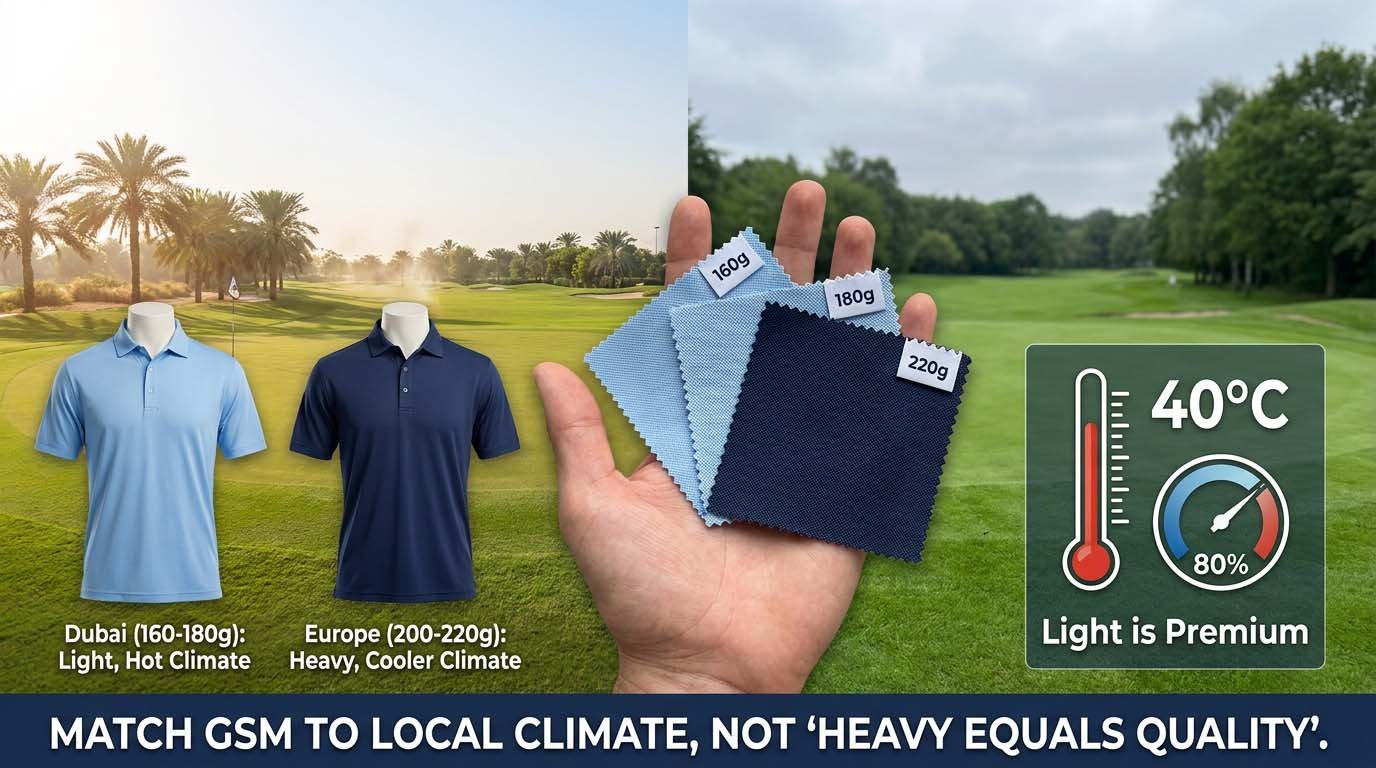
I am Will from FUWAY. Over the past 15 years, I have handled 800+ fabric weight inquiries from golf apparel buyers. Most arrive asking "What GSM is standard?" or "Should I go 200 or 220?" without first telling me where their customers play golf. This guide helps you translate your market conditions—climate intensity, seasonal timing, customer expectations, price positioning—into actionable fabric weight specifications rather than chasing an imaginary "standard" or "premium" GSM that does not exist outside specific contexts.
Quick Answers: Choosing Golf Polo Fabric Weight
Q: What GSM is right for my golf polo market?
Hot/humid (SEA, Gulf Coast): 150–180 GSM
Hot/dry (SW US, Middle East): 160–190 GSM
Temperate (Europe, N US): 180–220 GSM
Cool (Scand, Highlands): 220–240 GSM
Indoor: 180–200 GSM
Climate matters more than brand tradition—wrong GSM triggers high returns!
Q: Does heavier fabric always mean better quality?
No—“heavier = premium” only holds for traditional clubs/older golfers. Light, technical fabrics (microfiber, mesh) can be higher quality and cost more. Quality > Weight!
Q: What's the practical difference between 180 and 200 GSM?
Mostly opacity and drape; 200 GSM shows less see-through, holds collar shape better. Performance and durability nearly identical.
Q: How does climate affect fabric weight choice?
Hot/humid: lowest GSM for breathability; hot/dry: medium weight for sun/UV; temperate/cool: higher GSM for warmth and traditional hand feel. Don't ignore local weather!
Q: What GSM do major brands use?
Nike/Adidas/UA: 160–180 GSM (poly)
Peter Millar/Johnnie-O: 200–220 GSM (cotton/modal)
US: 190–210 GSM; Europe: 180–200 GSM; Asia: 160–180 GSM
Brands adapt GSM by region and climate.
Q: Does heavier fabric cost more?
Minimal effect—160 GSM can be pricier than 220 GSM if high-tech. Price depends most on fiber type, finishes, and knit complexity.
Why Fabric Weight Matters: Comfort, Performance and Brand Positioning
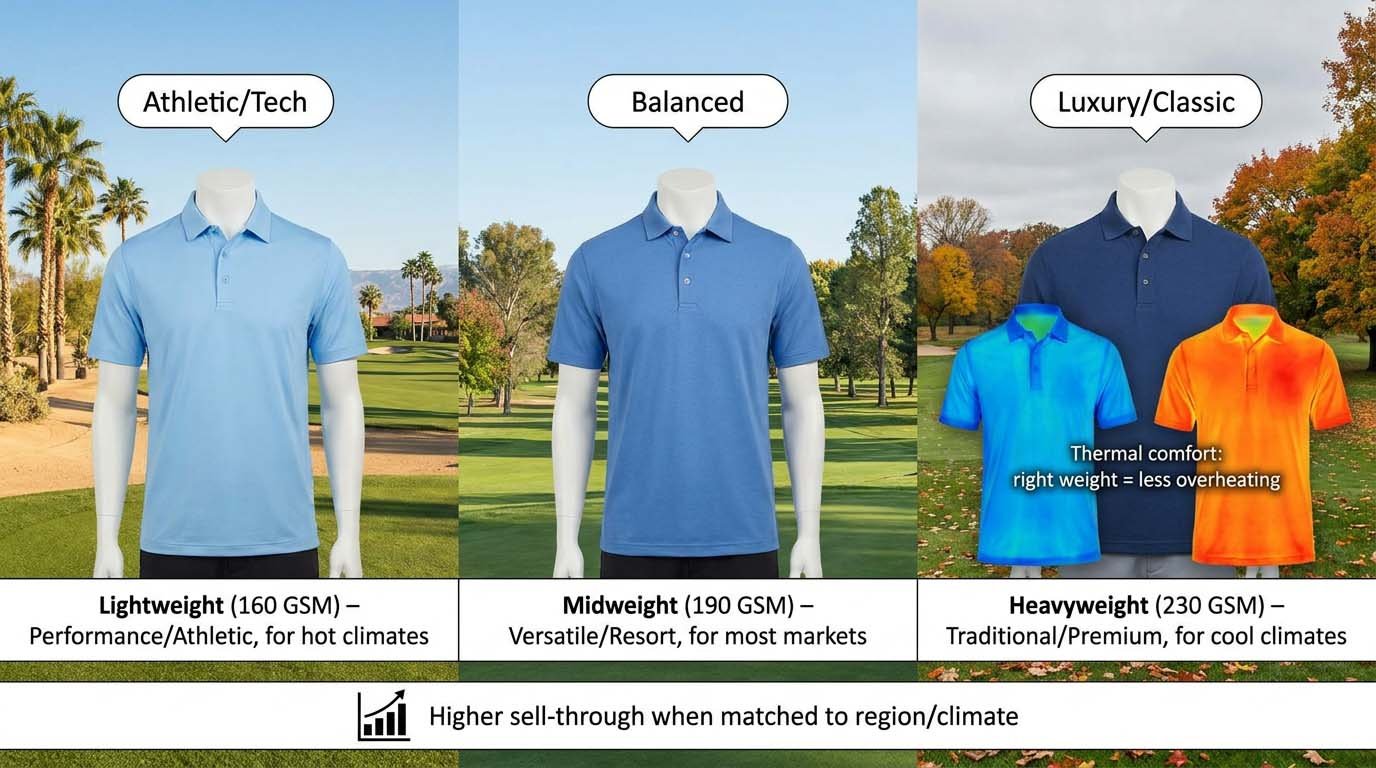
Fabric weight determines thermal comfort during play, affects brand positioning signals to customers, and influences inventory success across regional climates—where weight choice is not a technical parameter to optimize but a strategic decision that communicates whether your brand prioritizes performance-athletic function, traditional-classic prestige, or budget-conscious versatility, with mismatches between weight and market climate causing returns and slow inventory turns that exceed any raw material cost savings.
Thermal Comfort: The Primary Function
How weight affects body temperature regulation:
Heavier fabrics (220-260 GSM):
- Trap more heat (more material between skin and air)
- Slower moisture evaporation (denser knit structure)
- Better wind protection (beneficial in cool climates)
- Risk in hot weather: Overheating, excessive sweating
Lighter fabrics (150-180 GSM):
- Better airflow (less material barrier)
- Faster moisture evaporation (thinner fabric dries faster)
- Less heat retention
- Risk in cool weather: Insufficient warmth
Weight must match activity intensity:
- Walking 18 holes in heat: Generates significant body heat → lighter weight essential
- Cart golf in temperate conditions: Less exertion → heavier weight acceptable
- Winter golf: Environmental cold overrides activity heat → heavier weight needed
I have observed: Buyers who ignore thermal comfort face 25-40% return rates from hot-climate markets when shipping traditional-weight polos.
Brand Positioning Signals
Weight communicates brand values (intentionally or not):
Heavyweight (220-260 GSM) signals:
- Traditional quality (substance, durability)
- Premium materials (luxury hand feel)
- Conservative styling (country club, dress-casual)
- Older demographic appeal
Best for brands targeting:
- Private country clubs
- Corporate/business golf wear
- Heritage/traditional positioning
- Price points: $70-150 retail
Midweight (180-200 GSM) signals:
- Versatility (multiple seasons/climates)
- Balanced performance-comfort (not extreme either direction)
- Broad appeal (largest addressable market)
- Safe choice (rarely completely wrong)
Best for brands targeting:
- General recreational golfers
- Resort courses
- E-commerce (diverse customer base)
- Price points: $45-80 retail
Lightweight (150-180 GSM) signals:
- Performance focus (technical, athletic)
- Innovation (modern materials, engineered)
- Active lifestyle (younger demographic)
- Functional priority (comfort over tradition)
Best for brands targeting:
- Competitive/serious golfers
- Hot climate markets
- Athletic-casual crossover
- Price points: $50-100 retail (technical features justify premium)
Weight mismatch destroys positioning:
- Performance brand using 220 GSM: Customers question "performance" claim
- Premium brand using 160 GSM: May feel insubstantial, "cheap"
- Value brand using 240 GSM: Exceeds customer expectations (good) but kills margins (bad)
Inventory and Market Fit
Regional weight preferences affect sell-through rates:
Example: 1,000-unit order distributed nationally (US market)
Scenario A: Single weight (200 GSM) across all regions
- Southeast (hot/humid): 40% sell-through (too heavy, slow sales)
- Northeast (temperate): 80% sell-through (appropriate weight)
- Southwest (hot/dry): 55% sell-through (moderate mismatch)
- Overall: 58% sell-through average
Scenario B: Regionally optimized weights
- Southeast: 170 GSM → 75% sell-through
- Northeast: 200 GSM → 80% sell-through
- Southwest: 180 GSM → 70% sell-through
- Overall: 75% sell-through average
Financial impact:
- Scenario A: 580 units sold, 420 unsold (clearance at 40% loss)
- Scenario B: 750 units sold, 250 unsold
- Net improvement: 170 additional units at full price
Added complexity cost:
- Multiple SKUs (inventory management)
- Higher MOQs per variant
- More complex forecasting
Decision framework:
- Direct-to-consumer/E-commerce: Can manage multiple weights economically (made-to-order models)
- Wholesale/Retail: Prefer single versatile weight (inventory burden on partners)
- Large brands: Justify regional variants with volume
- Small/new brands: Start with single weight, optimize later with data
GSM Demystified: Piqué, Jersey, Double-Knit and Mesh Constructions
Fabric weight alone does not predict drape, breathability, stretch or hand feel—because identical GSM measurements can represent tight-knit jersey with dense coverage and minimal airflow, textured pique with raised patterns creating air pockets, mesh constructions with maximum ventilation through open knit structures, or double-knit fabrics combining two layers for warmth, making construction type and knit architecture as important as weight for determining whether fabric suits your climate, fit style and customer expectations.
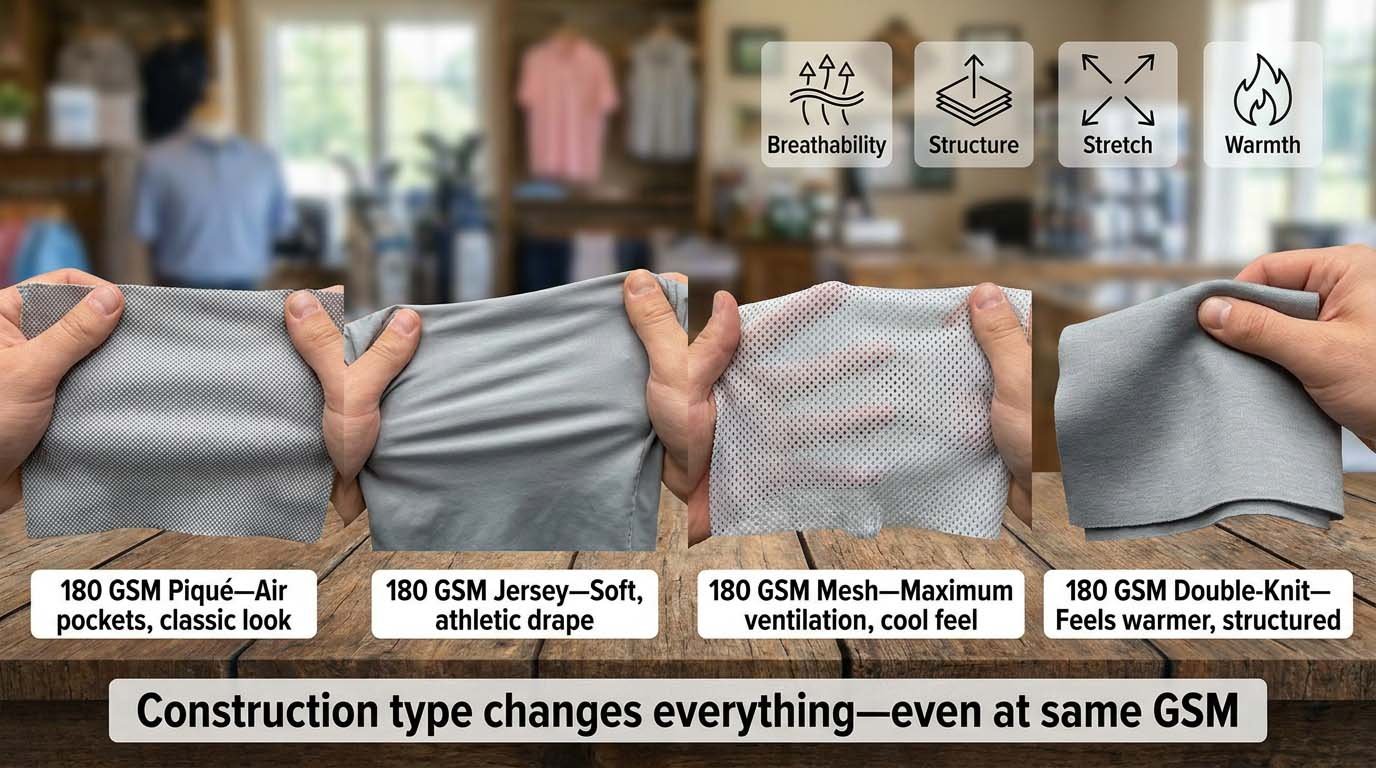
Piqué Knit: The Golf Polo Standard
Construction:
- Textured knit with raised geometric pattern (wales and courses)
- Creates small air pockets between skin and fabric
- Classic golf polo appearance (traditional aesthetic)
How GSM affects pique performance:
Lightweight pique (150-170 GSM):
- More breathable (less material, larger air pockets relatively)
- Less structured (collar may soften faster)
- Better for hot weather
- Risk: Light colors may show through
Medium-weight pique (180-200 GSM):
- Balanced breathability and structure
- Collar maintains shape well
- Versatile across climates
- Most popular choice for general golf wear
Heavyweight pique (210-240 GSM):
- Maximum structure (collar stands firmly)
- Luxury hand feel (substantial drape)
- Less breathable (more material)
- Best for cool/temperate climates
Performance characteristics:
- Moderate moisture-wicking (texture aids spreading)
- Good airflow (air pockets provide ventilation)
- Wrinkle-resistant (texture hides minor wrinkles)
Jersey Knit: Smooth and Form-Fitting
Construction:
- Flat, smooth surface (no texture)
- Single-knit construction (one layer)
- More elastic/stretchy than pique naturally
How GSM affects jersey performance:
Lightweight jersey (140-160 GSM):
- Very stretchy, form-fitting
- Excellent drape and movement
- Risk: Transparent in light colors, shows body contours
- Rarely used in golf polos (too casual)
Medium-weight jersey (170-190 GSM):
- Better opacity than lightweight
- Still more athletic/casual than pique
- Good for performance-athletic positioning
- Requires quality construction (cheap jersey looks thin)
Performance characteristics:
- Faster drying than pique (smoother surface, less texture)
- Better stretch (more give in fabric)
- Less formal appearance (not traditional golf aesthetic)
- Shows wrinkles more than pique
When to use jersey:
- Athletic-performance lines (not traditional clubs)
- Younger demographic (casual styling)
- Price-conscious markets (jersey slightly cheaper to produce)
Mesh and Perforated Constructions: Maximum Ventilation
Construction:
- Open knit structure with intentional holes/gaps
- Can be all-over mesh or zoned panels (underarms, back)
How GSM works differently in mesh:
Mesh 150 GSM feels lighter than solid 150 GSM:
- Weight includes air gaps (less actual material touching skin)
- Maximum breathability (direct airflow through fabric)
Mesh 180 GSM provides structure with ventilation:
- Heavier yarns around openings (maintains shape)
- Balances airflow and opacity
Performance characteristics:
- Fastest drying (maximum evaporation surface area)
- Coolest wearing (unrestricted air movement)
- Trade-off: Less coverage (visible undershirt), less formal appearance
When to use mesh:
- Extreme heat climates (Dubai summer, Southeast Asia)
- Engineered zones in performance polos (mesh panels, not full garment)
- Athletic-casual positioning (not traditional dress codes)
Double-Knit: Warmth and Structure
Construction:
- Two fabric layers knitted together
- Creates thicker, more substantial fabric
- Used primarily in cool-weather golf wear
How GSM works in double-knit:
Double-knit 200 GSM feels like solid 240 GSM:
- Two layers trap air (insulation)
- Warmer than equivalent single-knit weight
- More structured (layers provide stability)
Performance characteristics:
- Warmth retention (air trapped between layers)
- Excellent shape retention (double structure resists stretching)
- Heavier feel (two layers limit drape)
- Less breathable (less airflow through fabric)
When to use double-knit:
- Cool climate markets (Northern Europe, fall/winter US)
- Premium traditional positioning (luxury hand feel)
- When weather protection > breathability
Construction-Weight Decision Matrix
| Climate | Construction Type | Recommended GSM | Why |
|---|---|---|---|
| Hot/humid | Open pique or mesh | 150-180 GSM | Maximum breathability |
| Hot/dry | Standard pique | 160-190 GSM | Balance coverage and airflow |
| Temperate | Standard pique or jersey | 180-220 GSM | Versatile structure |
| Cool | Heavyweight pique or double-knit | 220-260 GSM | Warmth and substance |
| Performance-athletic | Jersey or engineered mesh zones | 160-180 GSM | Movement and wicking |
| Traditional club | Classic pique | 200-220 GSM | Formal appearance |
Key insight: When buyers ask "180 or 200 GSM?" I first ask "Which construction?" because 180 GSM pique ≠ 180 GSM jersey ≠ 180 GSM mesh in performance or appearance.
Climate & Seasonality: Hot/Humid, Dry Heat and Temperate Market Picks
Seasonal weight strategy affects revenue capture across annual buying cycles—where single-weight products sacrifice peak-season sales in summer (requiring lighter options) and miss premium opportunities in fall/winter (requiring heavier options), while multi-weight approaches increase SKU complexity and inventory cost but enable price and positioning segmentation that captures customers unwilling to compromise on climate-optimized comfort.
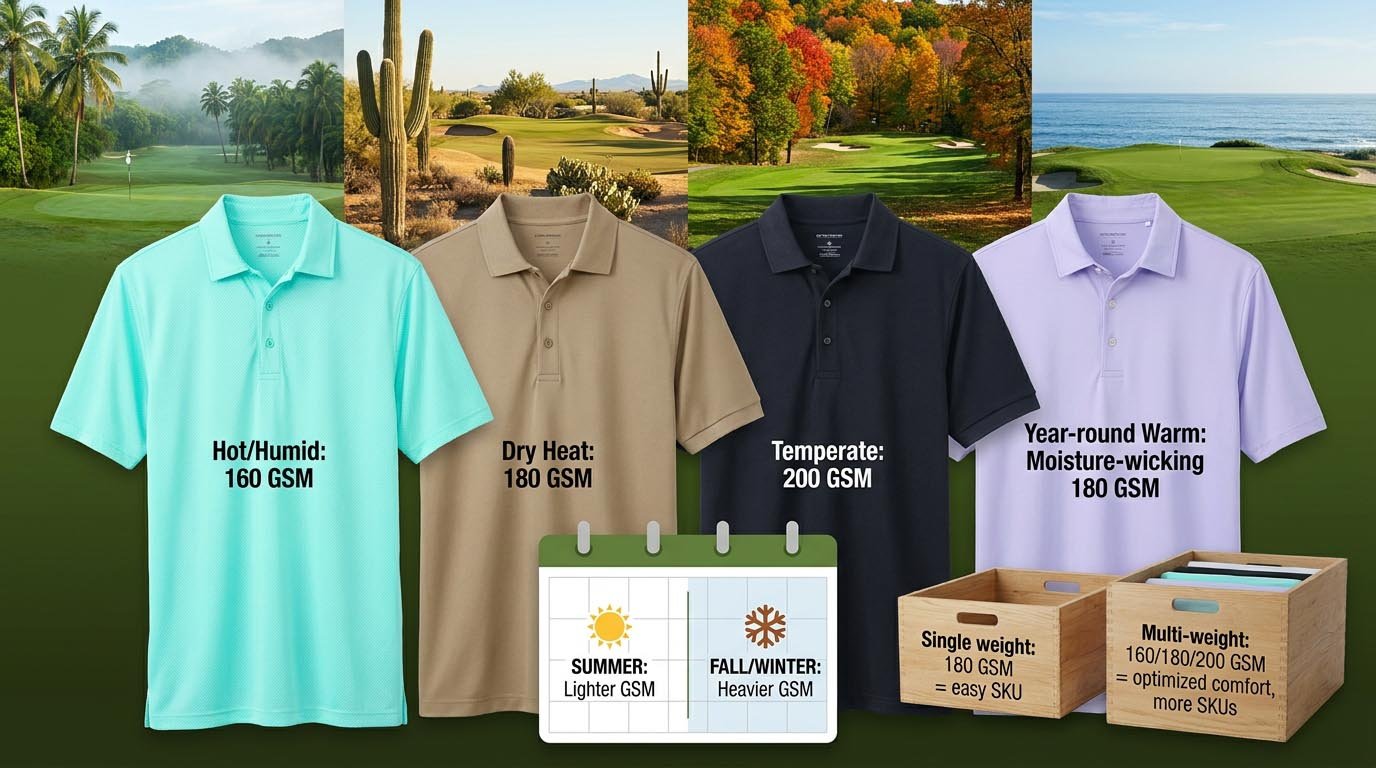
Hot and Humid Markets: Southeast Asia, Gulf Coast, Caribbean
Climate profile:
- Year-round heat: 28-38°C (82-100°F)
- High humidity: 60-90%
- Heavy sweating during play
- Slow evaporation (saturated air)
Optimal weight range: 150-180 GSM
150-160 GSM:
- For extreme heat (midday summer rounds)
- Maximum breathability and quick-dry
- Trade-off: May feel less substantial, light colors show through
- Best for: Performance-athletic positioning, younger demographic
160-170 GSM:
- Sweet spot for hot/humid
- Balances breathability with structure
- Adequate opacity in most colors
- Best for: General recreational golfers in tropical climates
170-180 GSM:
- Upper limit before discomfort
- Provides more coverage and structure
- Still acceptable breathability with proper construction
- Best for: Customers wanting traditional appearance without excessive heat
Construction requirements:
- Open pique or mesh zones mandatory
- Moisture-wicking finish essential
- Light colors perform better (reflect sun)
I see returns when: Buyers ship 200+ GSM to these markets (complaints about heat retention, excess sweating)
Hot and Dry Markets: Southwest US, Middle East, Australia Inland
Climate profile:
- Extreme heat: 35-45°C (95-113°F)
- Low humidity: 10-30%
- Intense sun (UV exposure)
- Rapid evaporation (sweat dries naturally)
Optimal weight range: 160-200 GSM
160-170 GSM:
- Summer peak heat (June-August)
- Lightweight for comfort
- Requires UPF treatment (less fabric = less UV protection)
- Best for: Performance-focused customers
170-190 GSM:
- Spring/Fall (March-May, September-November)
- Medium weight balances comfort and coverage
- Inherent UV protection from material coverage
- Best for: Year-round recreational play
180-200 GSM:
- Winter months (mild temperatures, still sunny)
- Provides warmth in 15-25°C (59-77°F) conditions
- Maintains breathability for activity
- Best for: Traditional club customers, cooler morning tee times
Construction requirements:
- UPF 40-50 rating critical (sun protection priority)
- Moisture-wicking helpful but less critical than humid climates
- Medium-to-dark colors provide better UV blocking
I see success when: Buyers prioritize sun protection over weight (customers willing to accept slightly heavier for UV coverage)
Temperate Markets: Europe, Northeast US, Pacific Northwest
Climate profile:
- Seasonal variation: 10-28°C (50-82°F)
- Moderate humidity: 40-70%
- Playing season: April-October (peak May-September)
- Traditional golf culture (dress expectations)
Seasonal weight strategy:
Summer (June-August): 180-200 GSM
- 180-190 GSM for performance lines
- 190-200 GSM for traditional styles
- Breathability important but less critical than tropical markets
- Customer expectation: Substantial feel (not ultra-lightweight)
Spring/Fall (April-May, September-October): 200-220 GSM
- 200-210 GSM for versatile mid-weight
- 210-220 GSM for traditional/premium
- Provides warmth in 12-20°C (54-68°F) conditions
- Customer expectation: Quality hand feel, structured collar
Winter (limited play): 220-240+ GSM
- Niche market (indoor simulators, winter golf)
- Heavier weight for warmth
- May incorporate double-knit or fleece-backed constructions
Construction requirements:
- Classic pique (traditional aesthetic expected)
- Quality finish (hand feel signals premium)
- Darker colors (navy, black, burgundy) popular
I see mistakes when: Buyers try 160 GSM summer options (feels cheap to European customers) or use one weight year-round (misses seasonal optimization)
Year-Round Warm Markets: Florida, Southern California, parts of Australia
Climate profile:
- Warm most of year: 20-35°C (68-95°F)
- Limited "cool" season: Brief winter mild (15-22°C / 59-72°F)
- High play frequency (golf 10-12 months)
Year-round strategy: 170-190 GSM
Single-weight approach:
- 180 GSM as universal compromise
- Works adequately for 80% of year
- Slightly warm in peak summer, slightly light in winter
- Best for: Simplified inventory, limited SKUs
Two-weight approach:
- 170 GSM for May-October (hot months)
- 190 GSM for November-April (mild months)
- Better climate optimization
- Best for: Larger brands with volume to support variants
Construction focus:
- Moisture-wicking year-round (consistent need)
- Lighter colors (reflect heat, popular in warm climates)
- Stretch blends (5% spandex) popular with active year-round players
Seasonal Buying Pattern Considerations
Peak purchase timing (North America pattern):
- March-April: Spring buying (200-220 GSM)
- May-July: Summer buying (170-190 GSM)
- August-September: Fall buying (200-220 GSM)
- October-December: Gift/holiday (varies)
Inventory planning implications:
- Single weight: Misses peak sales in off-optimal seasons
- Seasonal weights: Requires forecasting and transition timing
- Clearance risk: Seasonal items must sell through or be marked down
When single-weight makes sense:
- Small brands (under 2,000 units annually)
- E-commerce direct models (made-to-order)
- Limited capital (cannot fund multiple SKUs)
- Choose 180-190 GSM as most versatile compromise
When multi-weight makes sense:
- Established brands (5,000+ units annually)
- Wholesale distribution (partners expect seasonal offerings)
- Premium positioning ($70+ retail) where customers expect optimized options
Fit, Drape & Handfeel: Opacity, Stretch, Collar Structure and Silhouette
Fabric weight interacts with color, construction and customer body types to determine opacity, drape and collar performance—where light colors require 20-40 GSM higher than dark colors for equivalent coverage, athletic fits demand stretch integration regardless of base weight, collar structure depends on both GSM and interfacing choices, and customer perceptions of "premium hand feel" vary by demographic and regional expectations, making weight specification inseparable from design intent and target customer body diversity.
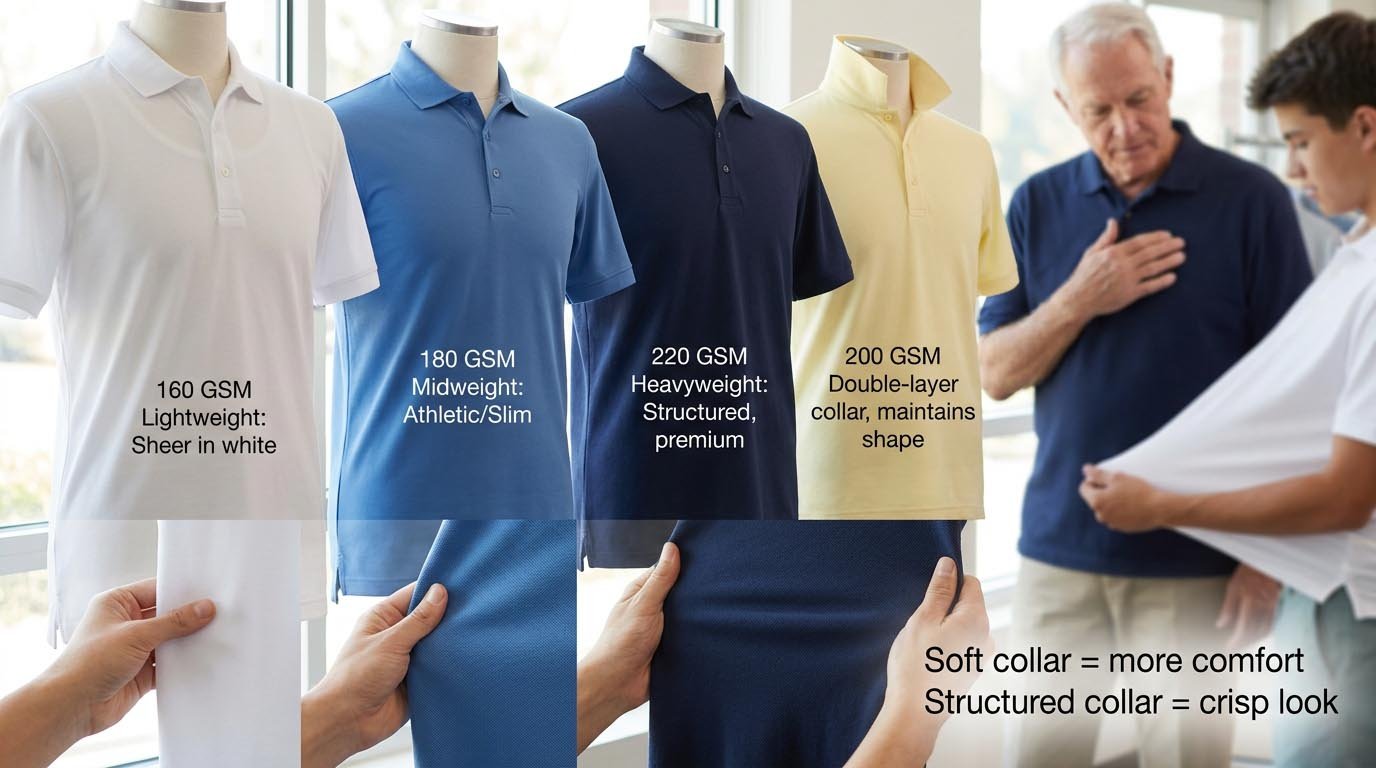
Opacity: Color and Weight Interactions
Light color transparency by weight:
White, light gray, pale yellow:
- 160 GSM: Highly transparent (undershirt, skin, nipples visible)
- 180 GSM: Moderately transparent (undershirt visible, skin less so)
- 200 GSM: Minimally transparent (undershirt visible only if contrasting)
- 220 GSM: Opaque (adequate coverage)
Medium colors (royal blue, kelly green, bright red):
- 160 GSM: Moderate transparency
- 180 GSM: Adequate opacity for most customers
- 200 GSM: Fully opaque
Dark colors (navy, black, charcoal, burgundy):
- 160 GSM: Adequate opacity
- 180 GSM: Fully opaque
- 200+ GSM: Excess opacity (no visual benefit)
Practical solutions for light colors:
-
Increase GSM: Add 20-40 GSM versus dark colors
- Cost impact: +$0.30-0.60 per unit
-
Tighter knit structure: Reduce space between yarns
- Trade-off: Less breathability
-
Double-layer construction: Inner layer provides coverage
- Cost impact: +$1.50-3.00 per unit
-
Limit light color offerings: Offer white/light colors only in heavier weights
- Reduces SKU complexity
I have seen: Brands launch all colors at 170 GSM, then face 30% return rate on white (transparency complaints) while dark colors perform well. Color-agnostic weight specifications fail.
Drape and Movement
How weight affects how fabric hangs and moves:
Lightweight (150-180 GSM):
- More fluid drape (fabric moves with body)
- Better for athletic/slim fits (less bulk)
- Can look "cheaper" if poorly constructed
- Wrinkles less (lighter fabric moves rather than creases)
Midweight (180-220 GSM):
- Balanced drape (substantial without stiff)
- Traditional polo silhouette
- Versatile across fit styles
- Most forgiving of construction quality variations
Heavyweight (220-260+ GSM):
- Structured drape (fabric holds shape)
- Better for classic/relaxed fits (fabric has presence)
- Can look "boxy" in slim fits (excess material)
- Wrinkles more (heavier fabric creases rather than moves)
Fit style considerations:
Slim/athletic fit:
- Requires lighter weight (160-190 GSM) or stretch integration
- Heavy fabrics restrict movement
- Customer complaint: "Feels tight" (even if pattern sized correctly)
Modern/regular fit:
- Works with most weights (170-220 GSM)
- Balanced ease allows fabric to drape naturally
Classic/relaxed fit:
- Benefits from heavier weight (200-240 GSM)
- Fabric drape fills out looser cut
- Lightweight in loose fit can look "baggy"
I redirect buyers asking "best fit": First choose target customer body type and style preference, then weight follows from fit choice.
Collar Structure and Performance
Weight affects collar stability:
Lightweight collars (150-170 GSM):
- Soften faster (20-30 washes before noticeable droop)
- Require interfacing/fusing for structure
- May curl or flatten with repeated wear
- Solution: Stiffer interfacing or built-in collar stays
Midweight collars (180-220 GSM):
- Good natural structure (fabric weight supports shape)
- Standard interfacing adequate
- 60-80 washes before significant softening
- Balances structure and comfort (not stiff on neck)
Heavyweight collars (220-260 GSM):
- Maximum structure (stands firmly, resists flattening)
- Minimal interfacing needed
- May feel stiff initially (breaks in over time)
- Premium appearance (collar maintains crisp look)
Collar construction choices:
Knit collar (same fabric as body):
- Weight-dependent structure
- Lightweight = soft collar
- Heavyweight = structured collar
- Most common in golf polos
Ribbed collar (different knit structure):
- Independent of body fabric weight
- Can use 180 GSM body with ribbed collar for structure
- Slightly higher cost: +$0.30-0.50 per unit
Fused/interfaced collar:
- Adds stiffness regardless of weight
- Allows lighter body fabric with structured collar
- Quality matters: Poor fusing creates bubbling after washing
Customer expectations vary:
- Traditional market: Expects firm, structured collar
- Athletic market: Prefers soft, flexible collar
- Weight alone cannot satisfy both (need construction differences)
Hand Feel Perceptions
"Premium" hand feel varies by demographic and region:
Older customers (55+) / Traditional markets:
- Associate heavier weight with quality
- Prefer substantial hand (fabric has presence)
- 200-240 GSM meets expectations
- Lightweight feels "cheap" regardless of cost
Younger customers (25-45) / Athletic markets:
- Associate technical feel with quality
- Prefer soft, smooth hand (microfiber)
- 160-190 GSM with finish treatments
- Heavy fabric feels "old-fashioned"
Value-conscious buyers:
- Weight signals quality (more material = more value)
- But price matters more than weight
- 180-200 GSM hits sweet spot (substantial enough without premium cost)
Premium buyers:
- Fiber quality matters more than weight
- Will pay for 160 GSM Pima cotton over 220 GSM basic cotton
- Hand feel from finish treatments (peaching, enzyme wash) valued
I ask buyers: "Who is your customer and what do they touch when evaluating quality?" Answer determines whether weight, fiber, or finish matters most.
Durability, Care & Cost: Pilling, Shrinkage, Colorfastness and Price Tiers
Durability outcomes like pilling resistance, shrinkage control and color retention depend on yarn quality, knit construction tightness and finish treatments applied—where lightweight fabrics with premium yarns and anti-pilling treatments outperform heavyweight fabrics with budget construction, making weight-focused cost reduction strategies counterproductive when they sacrifice yarn specs and finishing processes that determine whether polos last 30 washes or 120 washes in customer use.
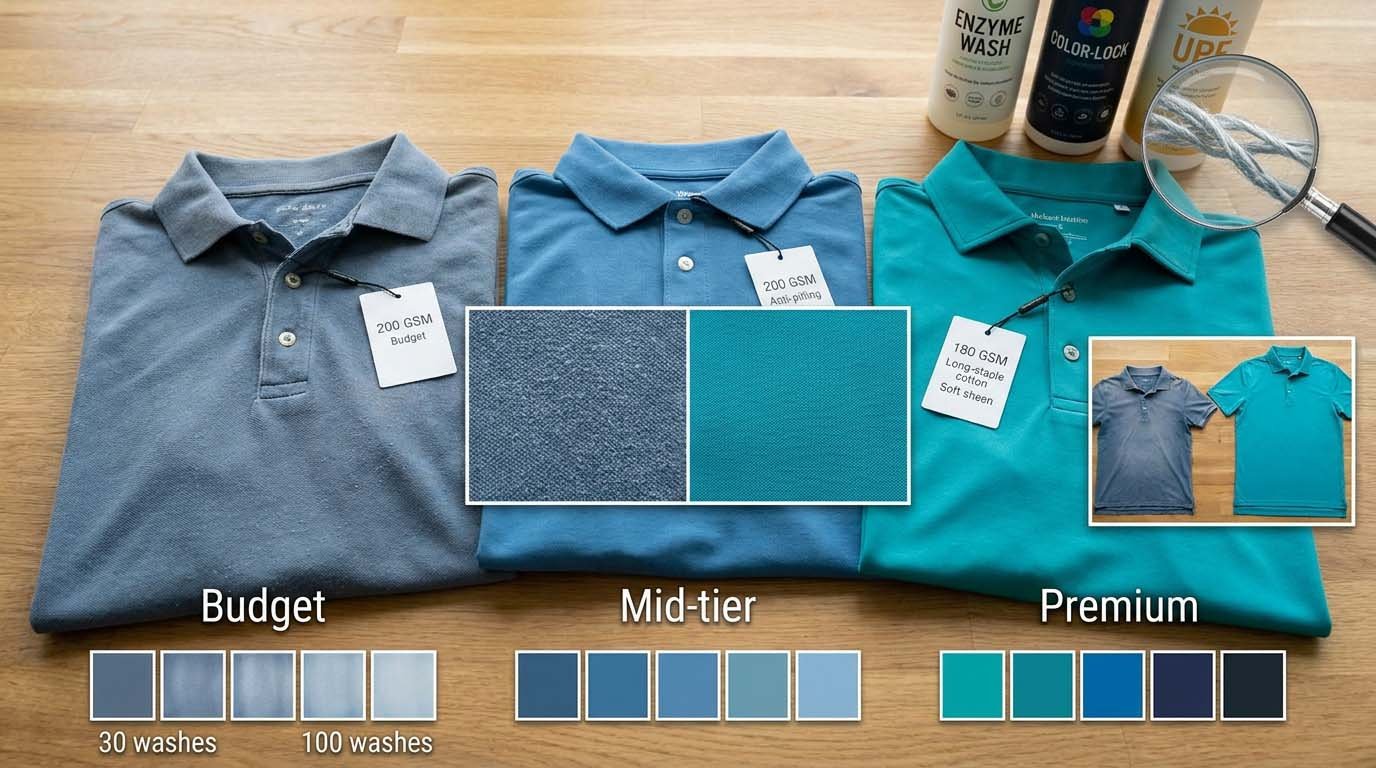
Pilling Resistance Across Weights
Pilling: Small fiber balls forming on fabric surface through abrasion
Weight's minimal impact on pilling:
- Heavier fabric ≠ less pilling
- Pilling determined by yarn quality and fiber length
Actual pilling factors:
Yarn type:
- Combed cotton: Long fibers, less pilling
- Standard cotton: Short fibers, more pilling
- Continuous filament polyester: No pilling (fiber has no loose ends)
- Staple polyester: Moderate pilling (short fibers)
Knit tightness:
- Tight knit: Less fiber movement, less pilling
- Loose knit: More abrasion, more pilling
- (Weight does not determine tightness—construction does)
Anti-pilling treatments:
- Chemical treatments: Bond fibers to surface
- Mechanical singeing: Burn off loose fibers
- Enzyme treatment: Digest short fibers
- Cost: +$0.20-0.50/yard
Pilling timeline by quality level:
Budget construction (no treatment):
- Visible pilling after 5-10 washes
- Heavy pilling by 20 washes
- Unacceptable appearance by 30 washes
Standard construction (basic treatment):
- Minor pilling after 20-30 washes
- Noticeable by 50 washes
- Acceptable through 80-100 washes
Premium construction (quality yarns + treatment):
- Minimal pilling through 60-80 washes
- Still acceptable at 120+ washes
- Lifespan limited by other factors (fading, shrinkage)
I have seen: Buyers specify "220 GSM" assuming weight ensures durability, then face pilling complaints because they ignored yarn specifications.
Shrinkage Control
Weight's relationship to shrinkage:
- Heavier fabrics may shrink more (more material to contract)
- Cotton shrinks 3-7% untreated regardless of weight
- Polyester does not shrink (synthetic fiber stable)
Shrinkage control methods:
Sanforizing (mechanical pre-shrinking):
- Reduces cotton shrinkage to <1-2%
- Cost: +$0.20-0.40/yard
- Essential for quality cotton or cotton-blend polos
Compacting:
- Similar to sanforizing
- Controls shrinkage in cotton fabrics
- Standard for premium lines
Fiber selection:
- Polyester/nylon: No shrinkage
- Cotton blends (65% poly/35% cotton): Minimal shrinkage (<2%)
- 100% cotton: Requires pre-shrinking treatment
Shrinkage testing:
- Request AATCC 135 test results
- Should show <3% shrinkage after multiple washes
- <2% for premium positioning
Customer impact:
- 5% shrinkage = Size Medium becomes Small
- Returns, exchanges, reputation damage
- Prevention cost ($0.30/unit) far less than return cost ($10-15/unit)
I emphasize: Weight does not prevent shrinkage. Pre-treatment and fiber choice do.
Colorfastness and Fading
Weight's minimal effect on color retention:
- Fading determined by dye quality and fixation
- Heavier fabric does not hold dye better
Colorfastness factors:
Dye quality:
- Reactive dyes (cotton): Good fastness
- Disperse dyes (polyester): Excellent fastness
- Low-quality dyes: Fade in 10-20 washes
Dye fixation process:
- Proper temperature and time: Ensures dye bonds
- Rushed process: Dye sits on surface (washes off)
Finish treatments:
- UV inhibitors: Prevent sun-fading
- Color-lock treatments: Improve wash fastness
Testing standards:
- AATCC 61 (Colorfastness to laundering)
- AATCC 16 (Colorfastness to light)
- Target: Grade 4-5 (minimal to no fading)
Fade resistance by fiber/color:
Best fade resistance:
- Dark polyester (navy, black)
- 80-120 washes before noticeable fading
Moderate fade resistance:
- Cotton with quality dyes
- Medium colors
- 40-80 washes
Poor fade resistance:
- Bright colors (red, royal blue) on cotton
- Low-quality dyes
- 15-30 washes
I see complaints when: Buyers choose cheapest dyeing to offset higher fabric cost—then face fading returns that exceed savings.
Cost-Quality-Weight Tiers
Budget tier ($25-40 retail):
Fabric specs:
- 180-200 GSM basic polyester or cotton-poly blend
- Standard yarns (no combing/enhancement)
- Minimal finish treatments
- Fabric cost: $3.00-4.50/yard
Expected lifespan:
- 30-50 washes before significant wear
- Pilling by 20 washes
- Color fading by 30 washes
- Acceptable for price point
Mid-tier ($45-75 retail):
Fabric specs:
- 180-220 GSM (varies by climate)
- Combed yarns or quality synthetic fibers
- Anti-pilling treatment
- Moisture-wicking or UPF treatment
- Fabric cost: $4.50-6.50/yard
Expected lifespan:
- 60-100 washes before significant wear
- Minimal pilling through 50 washes
- Color stable through 60-80 washes
- Good value for customer
Premium tier ($80-150 retail):
Fabric specs:
- 160-240 GSM (weight optimized for positioning)
- Long-staple cotton, microfiber polyester, or premium blends
- Multiple treatments (anti-pill, wicking, UV, anti-bacterial)
- Superior finish quality (peached, enzyme-washed)
- Fabric cost: $6.50-10.00+/yard
Expected lifespan:
- 100-150+ washes
- Minimal appearance degradation
- Professional appearance maintained
- Justifies premium price
Weight distribution by tier:
- Budget: Tends toward heavier (180-200 GSM) for perceived value
- Mid-tier: Versatile range (160-220 GSM) optimized for market
- Premium: Weight follows function (can be lighter with technical features)
Market Benchmarks & Testing: Typical GSM Ranges by Region and Lab Methods
Regional market conventions establish GSM ranges that signal product positioning—where North American country clubs expect 200-220 GSM traditional weights, European markets prefer 180-200 GSM year-round versatility, Asian markets demand 160-180 GSM lightweight performance, and Australian markets split between coastal resort courses favoring lighter weights and inland traditional clubs accepting heavier options, making regional selling strategy inseparable from weight specification decisions.
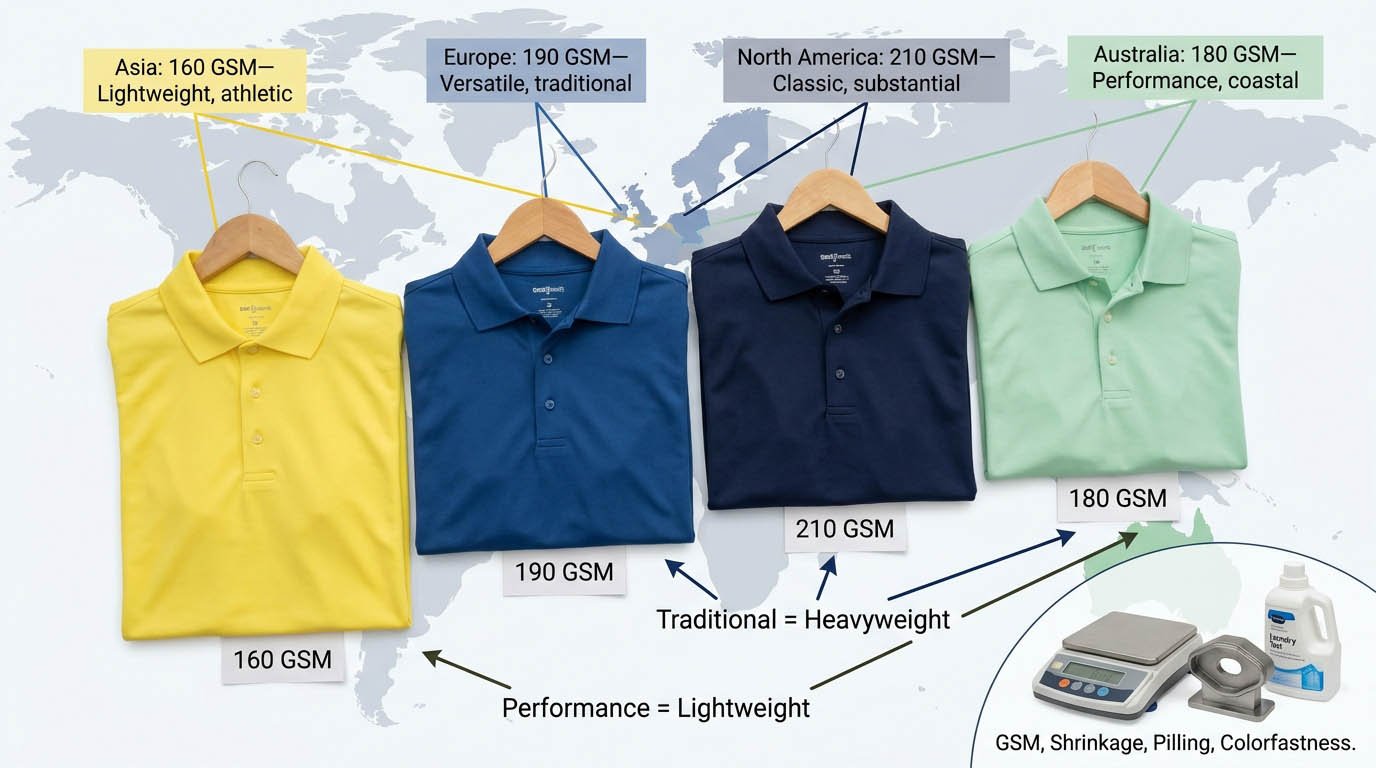
North American Market Conventions
Regional patterns:
Southeast (Florida, Georgia, Carolinas):
- 160-180 GSM dominant for summer
- Performance focus (moisture-wicking expected)
- Lightweight = appropriate (not cheap)
Northeast (New York, Connecticut, Massachusetts):
- 200-220 GSM preferred
- Traditional club culture (substance expected)
- Weight signals quality to older demographic
Southwest (Arizona, Nevada, Southern California):
- 170-190 GSM split between performance and traditional
- UPF focus (sun protection priority)
- Lighter than traditional but heavier than tropical
Pacific Northwest (Oregon, Washington):
- 190-210 GSM for mild, damp climate
- Moderate weight for year-round play
- Quality hand feel valued
Midwest (Illinois, Ohio, Michigan):
- 200-220 GSM traditional preference
- Seasonal play (May-September focus)
- Heavier weights for spring/fall shoulder seasons
European Market Conventions
Regional patterns:
UK/Ireland:
- 200-220 GSM year-round
- Cool, damp climate suits heavier traditional weights
- Tweed and cotton heritage influences expectations
Mediterranean (Spain, Italy, Southern France):
- 180-200 GSM balanced weight
- Hot summers but traditional aesthetics still valued
- Performance features integrated into traditional weights
Scandinavia:
- 220-240 GSM for cool climate
- Limited season (May-September)
- Warmth and structure prioritized
Central Europe (Germany, Austria, Switzerland):
- 190-210 GSM versatile range
- Quality construction valued over extremes
- Conservative styling (traditional appearance)
General European trend:
- Less extreme lightweight than Asian markets
- 180-200 GSM most common across regions
- Quality finish matters more than weight differentials
Asian Market Conventions
Regional patterns:
Southeast Asia (Singapore, Malaysia, Thailand, Vietnam):
- 150-170 GSM dominant
- Year-round heat demands lightweight
- Performance-athletic positioning successful
China:
- Wide range: 170-220 GSM
- North (Beijing): Heavier weights (seasonal cold)
- South (Guangzhou, Hong Kong): Lighter weights (subtropical)
Japan:
- 180-200 GSM preferred
- Quality finish extremely important
- Technical features valued but not at expense of hand feel
Korea:
- 180-210 GSM across seasons
- Four-season play requires versatility
- Premium positioning emphasizes construction quality
General Asian trend:
- Lighter than Western markets (climate-driven)
- Technical features expected even at mid-weight
- Color and finish as important as weight
Australian Market Conventions
Coastal regions (Sydney, Melbourne, Brisbane):
- 170-190 GSM for warm coastal climate
- Resort and casual play style
- Performance features popular
Inland regions (traditional club markets):
- 200-220 GSM for classic styling
- Traditional club culture similar to UK
- Heavier weights signal quality
General Australian trend:
- Climate diversity creates split market
- Performance lightweight gaining share
- Traditional heritage maintains heavyweight segment
Testing Methods (What to Request)
When verifying supplier claims:
1. GSM verification:
- ASTM D3776 (Mass per Unit Area)
- Simple weight measurement
- Should match specification ±5%
2. Shrinkage testing:
- AATCC 135 (Dimensional Changes after Home Laundering)
- Shows length and width changes
- Target: <3% shrinkage
3. Pilling resistance:
- ASTM D3511 or ICI Pilling Test
- Grades 1 (severe) to 5 (none)
- Target: Grade 4+
4. Colorfastness:
- AATCC 61 (Laundering)
- AATCC 16 (Light exposure)
- Target: Grade 4-5 (minimal change)
5. Tensile strength:
- ASTM D5034 (Breaking force)
- Ensures fabric can withstand stress
- Minimum standards vary by weight
What to ask suppliers:
- "Can you provide ASTM D3776 test report confirming GSM?"
- "What is shrinkage percentage after 5 washes per AATCC 135?"
- "What is pilling grade after 100 cycles per ASTM D3511?"
- "Do you have colorfastness test reports (AATCC 61 and 16)?"
Red flags:
- Supplier cannot provide test reports
- Claims "industry standard" without specific numbers
- Refuses to test samples you provide
- GSM varies significantly between batches (>10% variation)
Practical testing (no lab):
- Weight sample: Cut 10cm × 10cm square, weigh on scale, calculate GSM
- Wash multiple times: Check shrinkage, pilling, color change
- Compare to reference: Order competitor products, test side-by-side
FAQ: Choosing Golf Polo Fabric Weight
Can I use different fabric weights for different colors in the same product line?
Yes, and often recommended for light colors:
Opacity requirements vary by color:
- White/light colors: Need 20-40 GSM higher than dark colors
- Medium colors: Can match dark color weight
- Dark colors: Can use lighter weight without transparency
Example specification:
- White, light gray, pale yellow: 200 GSM
- Navy, black, burgundy, royal blue: 180 GSM
- Same style, color-specific weights
Considerations:
- Cost varies by color (+$0.30-0.60/unit for heavier white)
- May need separate SKUs (inventory management)
- Customer may not notice (unless comparing side-by-side)
When it makes sense:
- Light colors are significant portion of line (>30% of mix)
- Premium positioning (customers expect opacity)
- Returns history shows transparency complaints
When to skip:
- Light colors are small portion (<20% of mix)
- Budget positioning (customers accept minor show-through)
- Inventory complexity outweighs benefit
I recommend: Test samples in planned colors before committing. Transparency visible immediately.
How do I know if a supplier's GSM claim is accurate?
Three-level verification:
1. Request test report:
- ASTM D3776 standard test
- Shows exact GSM measurement
- Lab name and date visible
- Multiple sample measurements (should be consistent ±3%)
2. Physical sample testing:
- Cut 10cm × 10cm square (100 square cm)
- Weigh on gram scale (±0.1g accuracy)
- GSM = weight (grams) × 100
- Compare to claimed GSM
3. Batch consistency check:
- Request samples from 3-5 different dye lots
- Measure each
- Should vary <5% (if more, poor quality control)
What variations are acceptable:
- ±5%: Normal manufacturing variation
- ±10%: Concerning (suggests inconsistent processes)
- >10%: Unacceptable (major quality control issues)
Red flags:
- Supplier cannot provide test reports
- Claims "approximately" without specific number
- Different batches vary widely
- Sample GSM significantly different from bulk production
Practical reality:
- Most buyers never verify (trust supplier claims)
- Small variations rarely noticeable in use
- Significant deviations (>15%) become obvious (fabric feels different)
When to verify rigorously:
- First order with new supplier (establish baseline)
- Premium positioning (claims must be accurate)
- Large orders (>1,000 units) where consistency critical
How should I adjust fabric weight for stretch versus non-stretch polos?
Stretch integration affects weight perception:
Non-stretch fabric:
- Weight directly determines structure
- 200 GSM non-stretch feels substantial
Stretch fabric (5% spandex):
- Feels lighter than same GSM non-stretch
- Elasticity creates fluid drape
- 200 GSM stretch feels like 180 GSM non-stretch
Recommended adjustments:
If adding stretch to existing design:
- Increase GSM by 10-20 to maintain similar hand feel
- Example: 200 GSM non-stretch → 210-220 GSM stretch
If designing stretch-specific line:
- Can use lighter weight than non-stretch equivalent
- 180-200 GSM stretch provides good structure with mobility
Stretch fabric considerations:
Advantages:
- Freedom of movement (golf swing unrestricted)
- Form-fitting styles possible
- Modern customer expectation
Disadvantages:
- More expensive: +$1.00-2.50/yard for stretch
- Care-sensitive: Spandex degrades with heat/chlorine
- Shorter lifespan: Stretch wears out before fabric (80-100 washes typical)
Weight recommendation by fit:
- Slim/athletic fit with stretch: 170-190 GSM
- Regular fit with stretch: 180-200 GSM
- Relaxed fit with stretch: 190-210 GSM
I have seen: Buyers add stretch without adjusting weight, then fabric feels "thin" despite adequate GSM. Stretch changes tactile perception.
Should I offer multiple fabric weights or choose one versatile option?
Decision depends on brand scale and distribution model:
Single-weight strategy (simplified):
When it works:
- Small brands (<2,000 units/year)
- Direct-to-consumer models (made-to-order)
- Limited capital (cannot fund multiple SKUs)
- Single-region focus (climate consistent)
Recommended weight:
- 180-190 GSM as universal compromise
- Works acceptably in most climates (not optimal, but adequate)
- Poly-cotton blend with moisture-wicking
Advantages:
- Simplified inventory
- Lower MOQs (volume concentrated)
- Easier forecasting
- Lower development cost (one fabric to source/test)
Disadvantages:
- Suboptimal for all markets (compromise everywhere)
- Loses sales to climate-optimized competitors
- Cannot price-tier by weight/quality
Multi-weight strategy (optimized):
When it works:
- Established brands (5,000+ units/year)
- Wholesale distribution (partners expect variety)
- Multi-region sales (diverse climates)
- Premium positioning (customers expect optimization)
Recommended structure:
- Lightweight (160-180 GSM): Summer/hot climates
- Midweight (190-210 GSM): Spring/Fall/temperate
- Heavyweight (220-240 GSM): Winter/traditional (optional, niche)
Advantages:
- Climate-optimized (better performance in each market)
- Price tiering (lightweight performance premium, heavyweight traditional premium)
- Seasonal buying (retail partners expect seasonal weights)
- Maximizes revenue (captures customers unwilling to compromise)
Disadvantages:
- Complex inventory (3× SKUs)
- Higher MOQs (volume split across weights)
- Forecasting difficulty (predict weight mix)
- Development cost (sample/test multiple fabrics)
Hybrid approach (practical):
Start single-weight, add variants based on data:
- Year 1: Single 180-190 GSM
- Year 2: Add 160-170 GSM summer if hot-market sales strong
- Year 3: Add 210-220 GSM traditional if club/corporate sales grow
I advise: Start simple, expand based on customer feedback and sales data, not assumptions.
Conclusion
Fabric weight selection for golf polos depends on target market climate, seasonal timing and customer expectations—not universal standards. Hot/humid markets need 160-180 GSM quick-dry fabrics, temperate markets prefer 200-220 GSM traditional weights, with adjustments for color opacity, construction breathability and demographic preferences. GSM numbers mean nothing without first answering: where will customers play, what climate do they face, and what brand positioning do they expect? Match weight to market context—not arbitrary "premium" assumptions—to avoid returns from climate mismatch, transparency issues or durability failures disconnected from actual use conditions.