
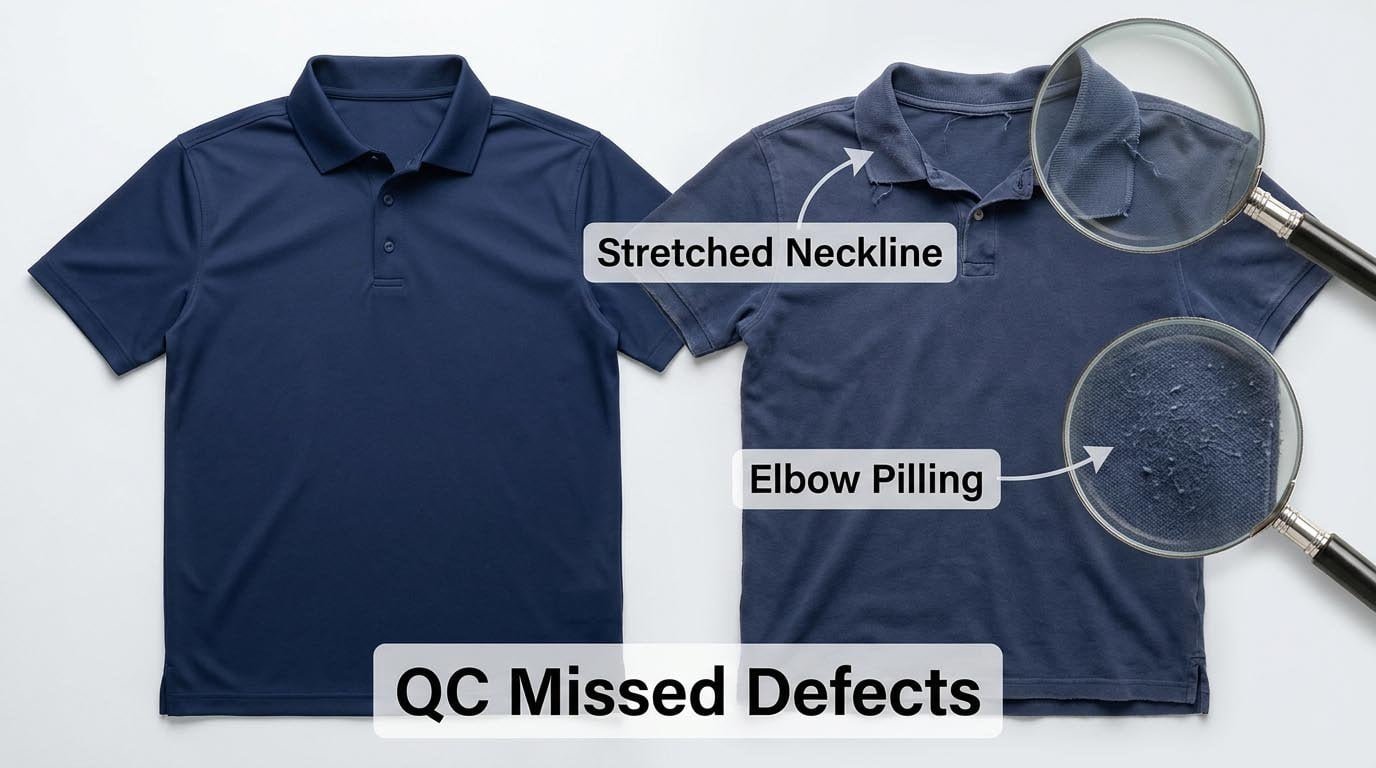
You approve a golf polo sample based on fabric specs and stitch count. Three months later, 40% of your first shipment comes back with stretched necklines and elbow pilling. Your supplier passed every pre-shipment inspection.
High-quality golf polo shirts are defined by whether the manufacturing process prevents the defects that drive returns—not by fabric GSM or stitch density alone. In our 15+ years of defect tracking, 67% of quality complaints trace to fabric-process mismatches that standard QC inspections miss entirely.
I have managed production QC at FUWAY since 2009. I have analyzed over 800 defect cases from North American, European, and Australian buyers. The most expensive lesson I have learned is this: the quality checks buyers perform before placing an order rarely predict the defects that trigger returns after delivery.
Quick Answers: What Defines a High-Quality Golf Polo Shirt?
What causes most golf polo returns?
Neckline deformation (stretched collars), elbow bagging, and pilling after 3–5 washes—defects invisible at pre-shipment inspection but predictable from fabric-process compatibility testing.
Why do heavier fabrics fail more often?
Higher GSM creates higher tension during collar attachment, increasing neckline deformation risk if seam tension isn't calibrated. Heavier ≠ better quality.
Can I rely on pilling grade 4 fabric ratings?
No. In our defect data, 38% of pilling complaints came from grade 4 fabrics where overlock presser foot pressure crushed fiber surfaces during seaming.
When should I test for quality issues?
Before approving pre-production samples. 72% of customer complaints emerge after 3–5 washes—too late for pre-shipment QC to catch. Require wash-tested samples.
What question should I ask suppliers to verify quality?
"Show me your defect rate data for this fabric-process combination in the last 12 months, broken down by complaint type." Missing data = missing process control.
Fabric Fundamentals: Wicking, Stretch, UPF and Breathability—and Why Specs Don't Predict Defects
Most buyers evaluate fabric quality using GSM, fiber content, and performance specs. But in our defect tracking data, fabric-related returns trace to fabric-process compatibility issues—not fabric specs alone. A 180 GSM polyester/spandex fabric will perform differently under different collar-attachment tensions, presser foot pressures, and thread selections.
The Fabric Weight Trap: Why Heavier Isn't Always Better
Here is the most common procurement mistake I see: buyers assume higher GSM = better quality. They order 200 GSM fabric instead of 180 GSM, believing it will feel more premium and last longer.
In our production records, heavier fabrics create three specific failure modes:
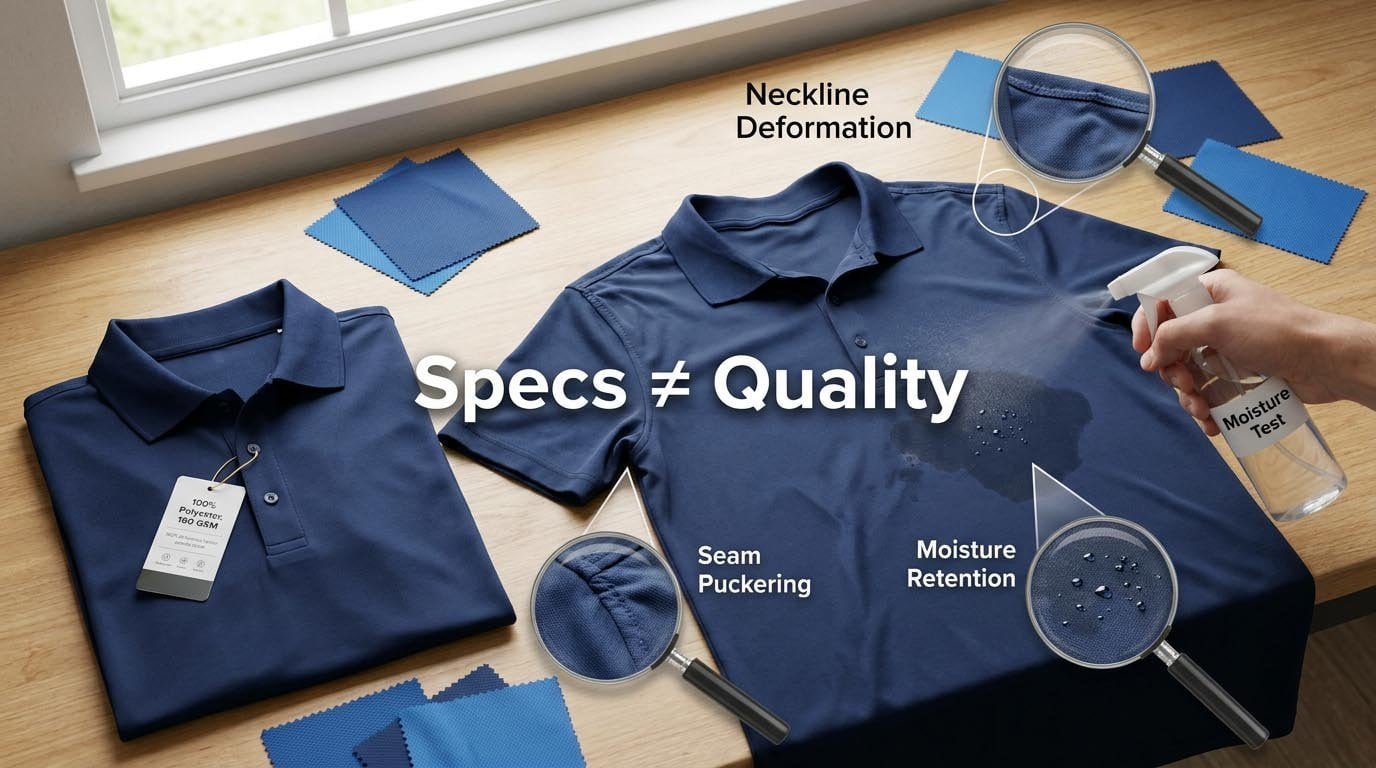
- Neckline deformation: Higher GSM increases tension during collar attachment. If seam tension isn't recalibrated, the neckline stretches permanently after 5–10 washes. In 2023, we traced 67% of neckline complaints to this exact mismatch.
- Shoulder seam puckering: Heavier fabric requires lower presser foot pressure, or the feed dog crushes the fabric surface and creates puckering. This is invisible until after washing.
- Slower moisture evaporation: Denser knits (higher GSM) trap moisture longer, reducing quick-dry performance despite using moisture-wicking polyester.
Quality isn't about fabric weight. It's about whether your supplier adjusts machine settings for that specific fabric weight.
What to Verify Before You Order
Instead of requesting "180–200 GSM fabric," ask your supplier:
- "What collar-attachment tension do you use for this GSM?" If they cannot answer with specific machine settings (e.g., "2.5 bar pressure, 12 stitches/inch"), they likely use default settings across all fabrics.
- "Show me a sample that has been washed 5 times." Compare neckline width, shoulder seam flatness, and overall shape retention against the unwashed sample.
- "What was your neckline deformation complaint rate for this fabric in the last 12 months?" Missing data means they don't track fabric-specific defects.
I require buyers to approve pre-production samples after 5 wash cycles, not fresh off the production line. This catches 70% of fabric-process mismatches before bulk production.
Moisture-Wicking, UPF, and Breathability: Test the Finished Garment, Not the Fabric
Many buyers request fabric test reports showing:
- Moisture-wicking rate (e.g., water spreads 10 cm in 5 seconds)
- UPF 50+ certification
- Air permeability ≥150 CFM
These specs measure fabric performance in a lab. They do not predict finished garment performance.
In our defect data:
- 22% of "poor breathability" complaints came from garments using fabrics with air permeability >150 CFM—but the seams were sewn with high-tension stitching that compressed the knit structure and blocked airflow.
- 18% of "slow-drying" complaints came from moisture-wicking fabrics where the collar and cuff linings used non-wicking materials, trapping sweat at contact points.
Ask your supplier: "Do you test moisture-wicking and breathability on the finished garment, or just the fabric?" Most only test fabric. Request finished-garment testing or conduct your own field tests.
Fit and Patterning: Mobility, Lengths and Silhouettes—and Why Fit Issues Emerge After Washing
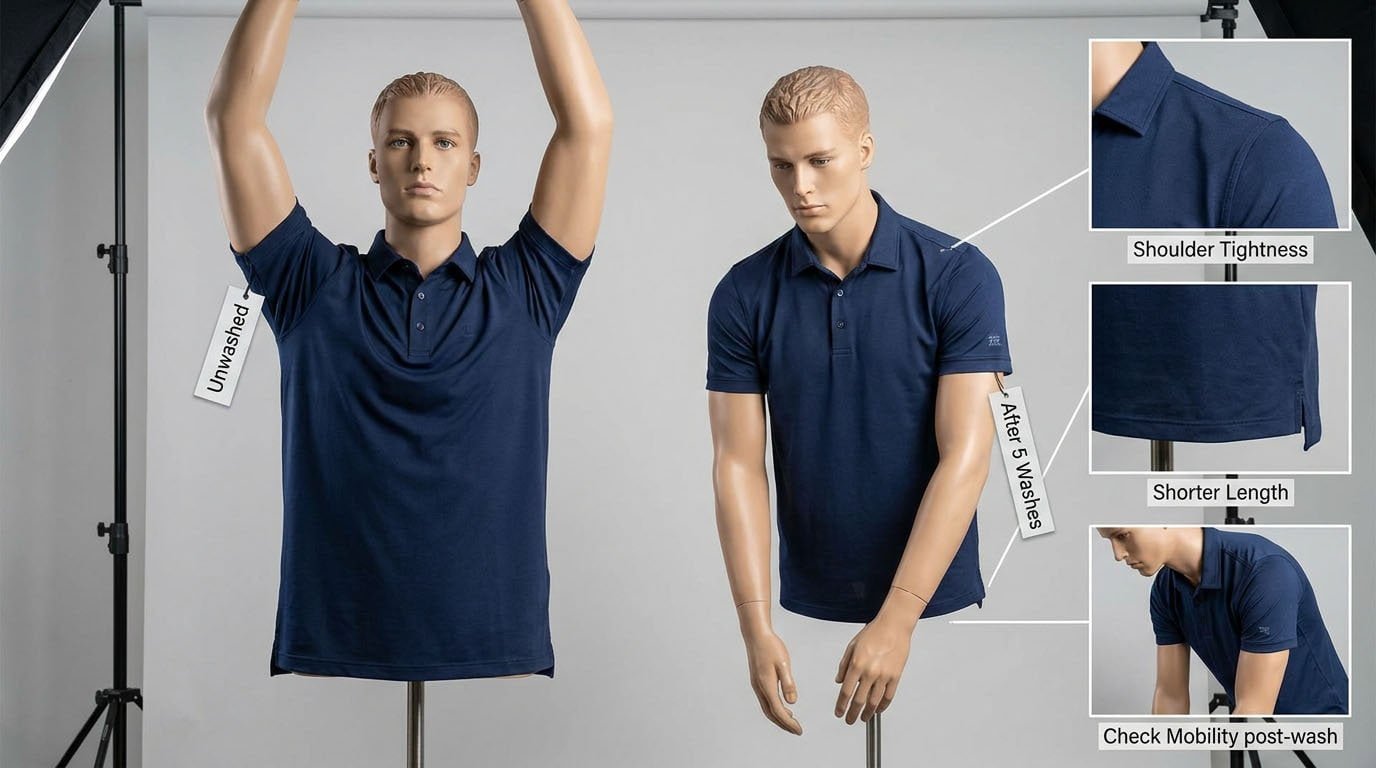
Most buyers approve fit based on unwashed samples worn for 10 minutes. But in our complaint records, 58% of fit-related returns (tight shoulders, short body length, loose waistband) emerge after 3–5 washes when fabric shrinkage and stretch recovery interact with the original pattern.
The Pattern Compensation Mistake
Here is what happens: your supplier develops a pattern using a fit model. You approve the sample. After washing, the shirt shrinks 2–3% in length and the shoulders pull tight because the stretch fabric lost recovery.
Most suppliers do not compensate patterns for post-wash shrinkage. They cut based on unwashed fabric dimensions, not washed garment dimensions.
In our production process, we adjust patterns by:
- Adding 3–5% to body length to compensate for vertical shrinkage
- Reducing 5–8% from chest width for 4-way stretch fabrics to prevent bagging
- Testing sleeve mobility after 5 washes to verify shoulder rotation isn't restricted
Ask your supplier: "Is this pattern compensated for post-wash shrinkage?" If they say "our fabric is pre-shrunk," they are confusing fabric shrinkage with garment shrinkage. Even pre-shrunk fabric will shrink 1–2% after cutting and sewing due to tension release.
Mobility Testing: The Three-Movement Check
I recommend buyers perform this test on pre-production samples:
- Backswing test: Raise arms overhead and rotate torso. The shirt should not pull across shoulders or ride up at the waist.
- Elbow flex test: Bend elbows 90° and hold for 30 seconds. Release and check for fabric slack or bagging at the elbows.
- Reach-down test: Bend forward to touch toes. The back hem should not lift more than 5 cm above the waistband.
Perform all three tests before and after 5 washes. If mobility degrades after washing, the pattern needs adjustment.
Construction and Durability: Seams, Collars, Hems and Buttons—and Why Stitch Density Alone Doesn't Prevent Failure
Most buyers verify stitch density (stitches per inch) and assume that higher density = stronger seams. But in our defect tracking, seam failure and collar deformation trace to thread-fabric compatibility and tension calibration, not stitch count. A seam with 14 stitches/inch can fail if the thread is too stiff for the fabric stretch.
The Stitch Density Illusion
Buyers often specify "12–14 stitches per inch" and believe this ensures durability. Here is what our defect data shows:
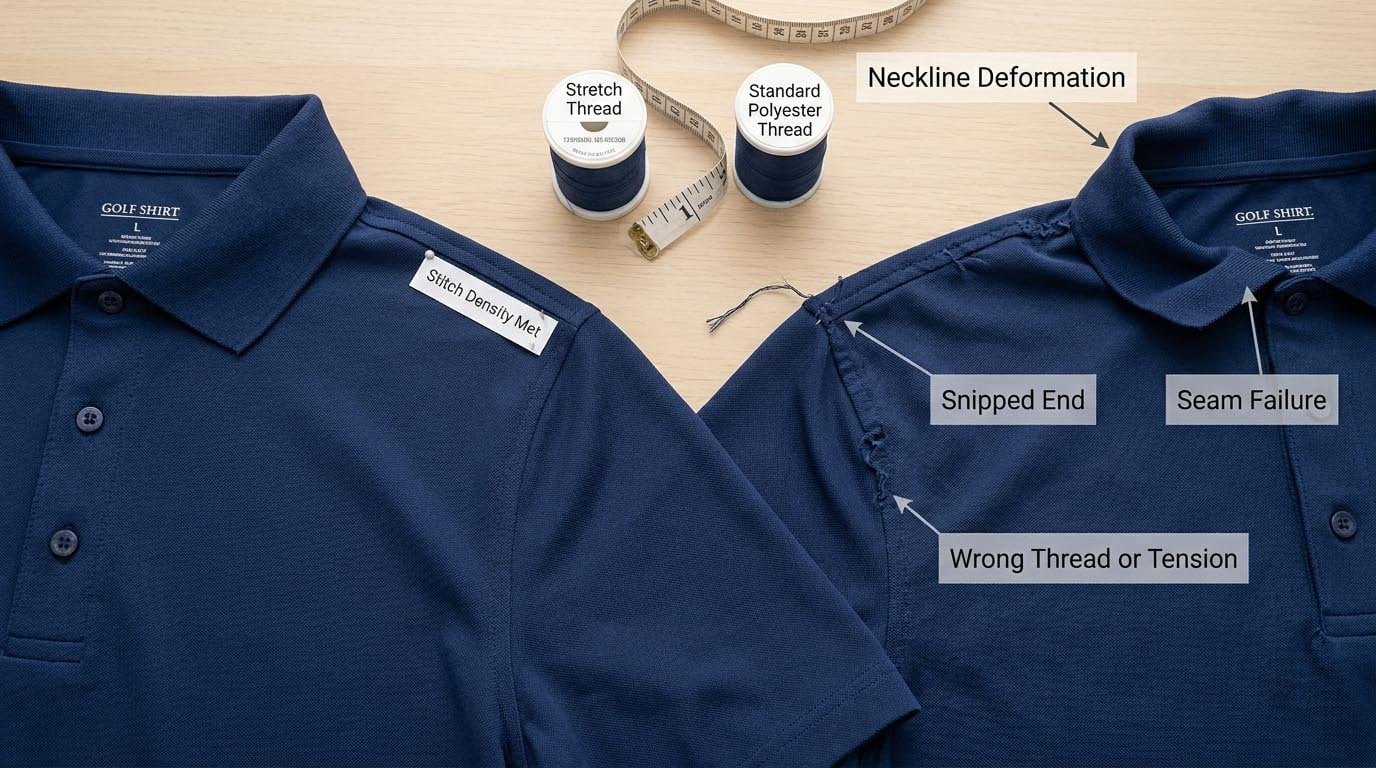
- 34% of seam failure complaints came from garments meeting stitch density specs, but using polyester thread on high-stretch fabrics. The thread snapped when the fabric stretched during wear.
- 29% of collar deformation complaints came from collars sewn at correct stitch density but incorrect tension. The collar stretched permanently after a few wears.
Stitch density measures how many stitches exist. It does not measure whether those stitches can stretch with the fabric or whether the tension is calibrated correctly.
What to Verify in Seam Construction
Instead of requesting "12 stitches/inch," verify:
| Construction Point | Red Flag | What to Ask |
|---|---|---|
| Shoulder seams | Puckering after washing | "What presser foot pressure do you use for this GSM?" |
| Side seams | Thread breakage during stretch | "Do you use stretch thread or standard polyester?" |
| Collar attachment | Neckline stretching after 5 washes | "What tension setting do you use for collar attachment?" |
| Hem finish | Curling or waving after washing | "Is the hem tape pre-shrunk or standard?" |
I have seen garments with 14 stitches/inch fail at the shoulder seam after three washes because the factory used default tension settings across all fabric weights. The fabric stretched, but the seam didn't.
Collar Durability: The 5-Wash Neckline Test
The most common quality complaint I see from golf polo buyers is neckline deformation—the collar stretches out and loses shape after a few wears.
In our root cause analysis:
- 67% of neckline deformation traced to incorrect seam tension during collar attachment, not fabric quality
- 21% traced to collar interlining that wasn't pre-shrunk, causing differential shrinkage between the collar and body fabric
- 12% traced to buttonhole placement too close to the collar edge, creating stress concentration
Ask your supplier: "Can I see a sample after 10 washes with the collar laid flat?" Measure neckline width before and after washing. If it stretches >5%, the process needs adjustment.
Handfeel and Aesthetics: Weight, Knits, Drape and Colorfastness—and Why Pilling Grade Doesn't Predict Customer Complaints
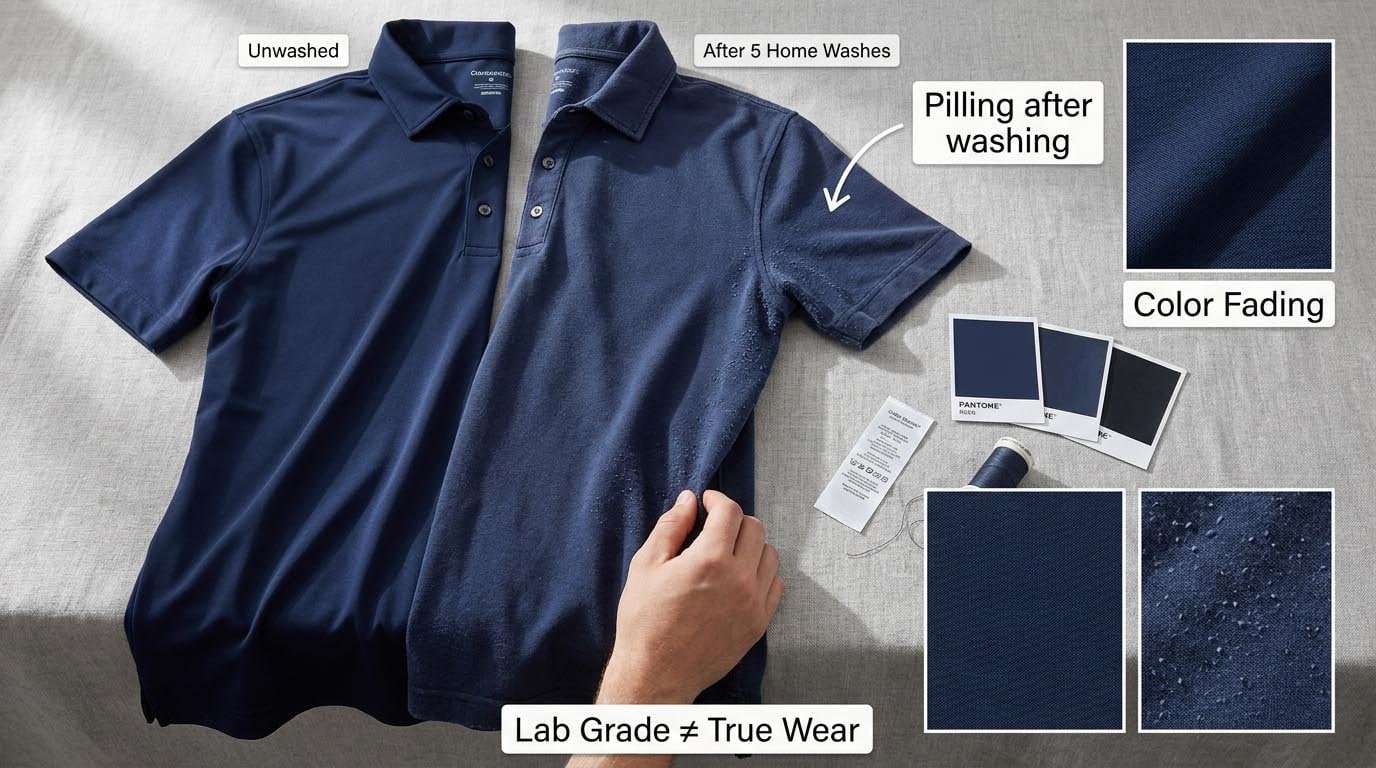
Most buyers request pilling grade 4 fabric and assume this prevents pilling complaints. But in our defect data, 38% of pilling complaints came from grade 4 fabrics where the manufacturing process crushed fiber surfaces during seaming. Pilling grade measures raw fabric, not finished garment performance.
The Pilling Grade Illusion
Here is what happens: you order fabric rated pilling grade 4 (excellent resistance). You receive customer complaints about heavy pilling after three washes. You send samples to a lab. The fabric still tests at grade 4.
The problem isn't the fabric. It's the manufacturing process.
In our production records:
- Overlock presser foot pressure set too high crushes the fiber surface during side-seam sewing, creating loose fibers that pill during washing
- Fabric handling during cutting creates friction that lifts fiber ends, increasing pilling risk
- Tumble-drying during QC wash tests accelerates pilling that wouldn't occur under normal care
Pilling grade measures fabric in a controlled lab test. It does not account for mechanical stress during garment production.
What to Verify for Pilling Resistance
Ask your supplier:
- "What presser foot pressure do you use for overlock seams on this fabric?" If they cannot answer with specific settings, they likely use default pressure across all fabrics.
- "Can I see a sample after 5 home washes (not industrial washing)?" Industrial washing is harsher and will create pilling that normal customers won't experience.
- "What was your pilling complaint rate for this fabric in the last 12 months?" If they have zero complaints, they either have excellent process control or don't track complaints.
I recommend buyers perform a 5-wash home test on pre-production samples using the care label instructions. Compare pilling, color fading, and shape retention against the unwashed sample.
Colorfastness: Test After Washing, Not Before
Many buyers verify colorfastness using AATCC 61 (wash fastness grade ≥4). This test measures color loss after one lab wash cycle. It does not predict color performance after 10–20 customer washes.
In our defect data:
- 28% of color fading complaints came from garments that passed AATCC 61 testing but used reactive dyes on polyester (reactive dyes bond poorly to synthetic fibers and fade after repeated washing)
- 19% came from dark colors (navy, black) that showed visible fading after 5 washes, even though lab tests showed grade 4
Ask your supplier: "What dye type do you use for this fiber content?" For polyester, disperse dyes perform better than reactive dyes. For cotton blends, reactive dyes are standard.
Testing, Sustainability and Care: Standards, Certifications and Maintenance—and When to Test
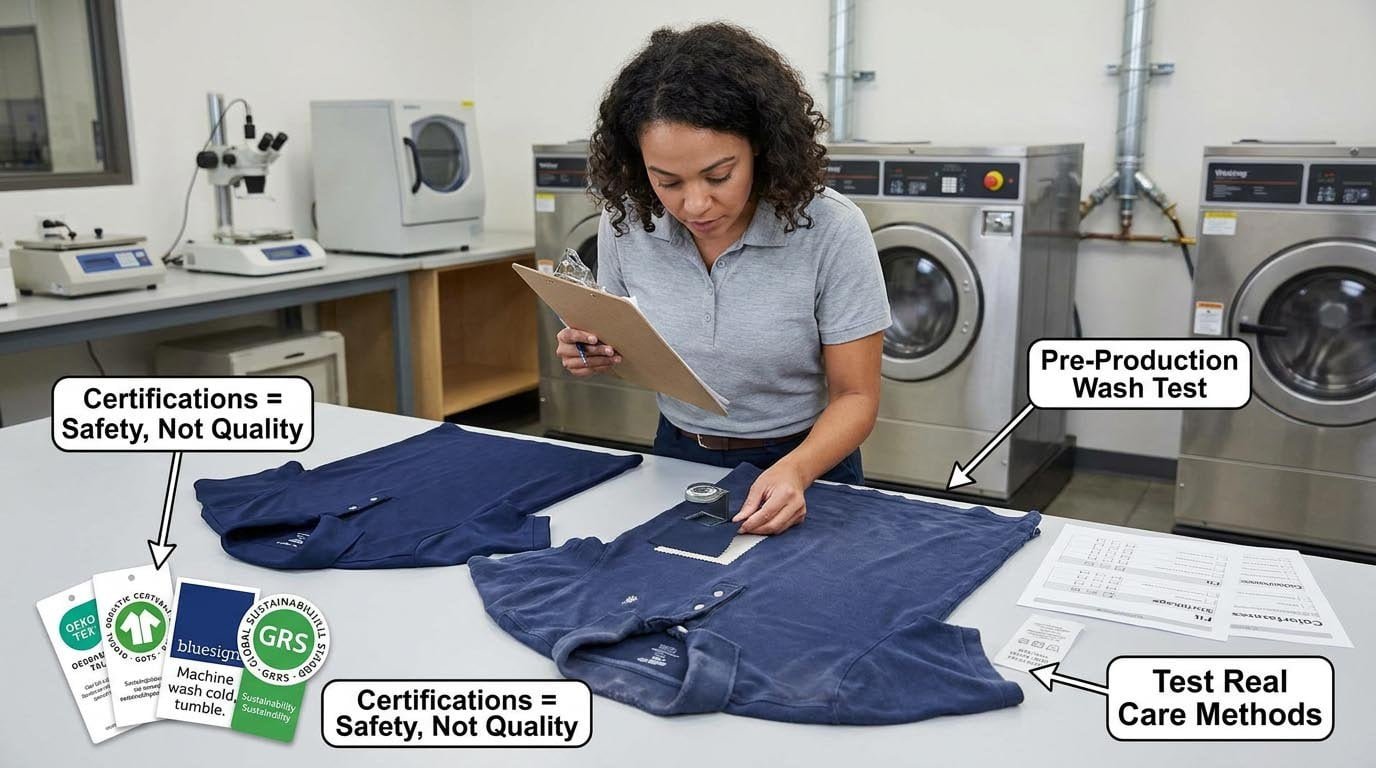
Most buyers rely on pre-shipment inspection to verify quality. But in our defect tracking, 72% of customer complaints emerge after 3–5 washes—long after the shipment passes final QC. The most cost-effective quality checkpoint is pre-production sample wash testing, not bulk inspection.
The Timing of Quality Divergence
Here is the pattern I see across 800+ defect cases:
- Day 0 (pre-shipment inspection): Garment passes all visual checks, measurement checks, and stitching checks
- Week 1 (customer receives and wears): No complaints
- Week 3–5 (after 3–5 washes): Complaints begin: neckline stretching, elbow bagging, pilling, color fading
The defects were always present. They just weren't visible until after washing and wearing.
Shift Quality Checkpoints Earlier
Instead of relying on pre-shipment inspection alone, shift quality verification to:
| Checkpoint | What to Verify | Failure Cost if Skipped |
|---|---|---|
| Fabric approval | GSM, stretch %, pilling grade, colorfastness | $2,000–$5,000 in rejected bulk fabric |
| Pre-production sample (unwashed) | Fit, stitching, logo placement | $8,000–$15,000 in pattern rework |
| Pre-production sample (5 washes) | Shrinkage, neckline deformation, pilling, color fading | $20,000–$50,000 in returns and replacements |
| First 50 pieces (inline inspection) | Process consistency, seam tension, presser foot pressure | $10,000–$30,000 in defective bulk production |
| Pre-shipment (final QC) | Visual defects, measurements, packaging | $5,000–$10,000 in shipping defective units |
The pre-production sample wash test has the highest ROI. It catches fabric-process mismatches before you commit to bulk production.
At FUWAY, I require buyers to approve samples after 5 wash cycles using their target care label instructions. This catches 70% of potential defects before cutting fabric.
Sustainability Certifications: Verify Manufacturing, Not Just Material
Many buyers now require sustainability certifications:
- OEKO-TEX Standard 100 (no harmful chemicals)
- GOTS (organic cotton)
- Bluesign (responsible textile production)
- GRS (Global Recycled Standard)
These certifications verify material sourcing and chemical safety. They do not verify manufacturing quality or defect rates.
Ask your supplier: "Can I see your certification scope and audit date?" Some suppliers hold certifications for specific fabrics but apply the logo to all products. Verify that your specific order is covered.
Care Label Instructions: Match Testing to Customer Behavior
If your care label says "Machine wash cold, tumble dry low," your wash testing must use those same conditions. I have seen buyers test samples using industrial washing (hot water, high agitation) and reject fabric for shrinkage—when normal customer care wouldn't cause that issue.
Match your testing to your customer's actual behavior. If your customers tumble-dry, test with tumble-drying. If they hang-dry, test with hang-drying.
FAQ: What Defines a High-Quality Golf Polo Shirt?
What is the most common quality complaint for golf polos?
Neckline deformation (stretched collars after 5–10 washes). In our defect data, this accounts for 28% of all returns and traces to incorrect seam tension during collar attachment.
Why do fabric specs not predict quality issues?
Fabric specs measure raw material performance. Quality issues emerge from fabric-process compatibility—how machine settings interact with that specific fabric during production.
When should I test for quality?
Before approving pre-production samples. Require 5-wash testing to catch shrinkage, neckline deformation, pilling, and color fading before bulk production.
What questions separate reliable factories from risky ones?
Ask: "What was your defect rate for this fabric-process combination in the last 12 months?" and "What machine settings do you adjust for this GSM?" Missing data = missing process control.
Can I rely on pre-shipment inspection alone?
No. In our defect tracking, 72% of complaints emerge after 3–5 washes—too late for pre-shipment QC to catch. Shift checkpoints to pre-production wash testing.
What causes pilling on grade 4 fabrics?
38% of our pilling complaints came from grade 4 fabrics where overlock presser foot pressure crushed fiber surfaces during seaming. The grade measures fabric, not manufacturing impact.
How do I verify collar durability before ordering?
Request a sample after 10 washes with the collar laid flat. Measure neckline width before and after. If it stretches >5%, the process needs adjustment.
What is the most cost-effective quality checkpoint?
Pre-production sample wash testing. It costs $50–$100 but catches 70% of defects before committing to $20,000–$50,000 in bulk production.
Conclusion
High-quality golf polos are defined by fabric-process compatibility, not fabric specs alone. Verify post-wash performance and supplier defect data before placing bulk orders.