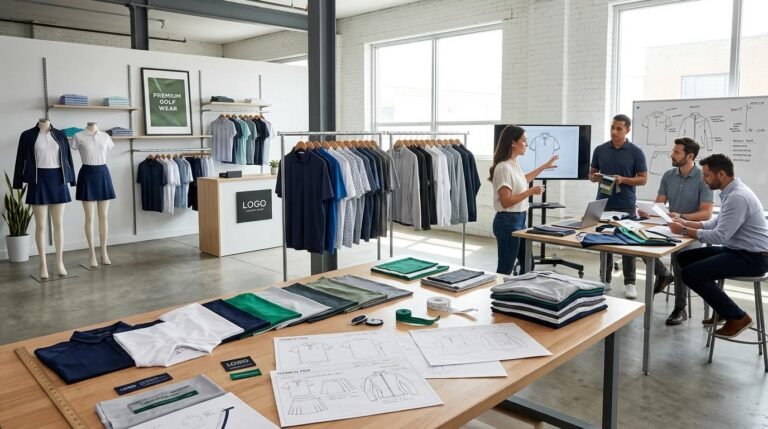
A client sent samples last month—tennis polos and running shorts—asking if we could "convert them to golf apparel." They expected minor tweaks, maybe add a logo. I explained we would need to change the hem length, adjust shoulder construction, switch to different fabric weight, and modify pocket placement. They were surprised. The differences looked small to them but each change served a specific purpose.
Golf apparel differs from regular sportswear not in athletic performance metrics but in design choices that address swing mechanics, dress code compliance, and extended wear time in social settings—but whether these differences justify higher costs depends entirely on your target customer and price positioning, not marketing claims about superiority.
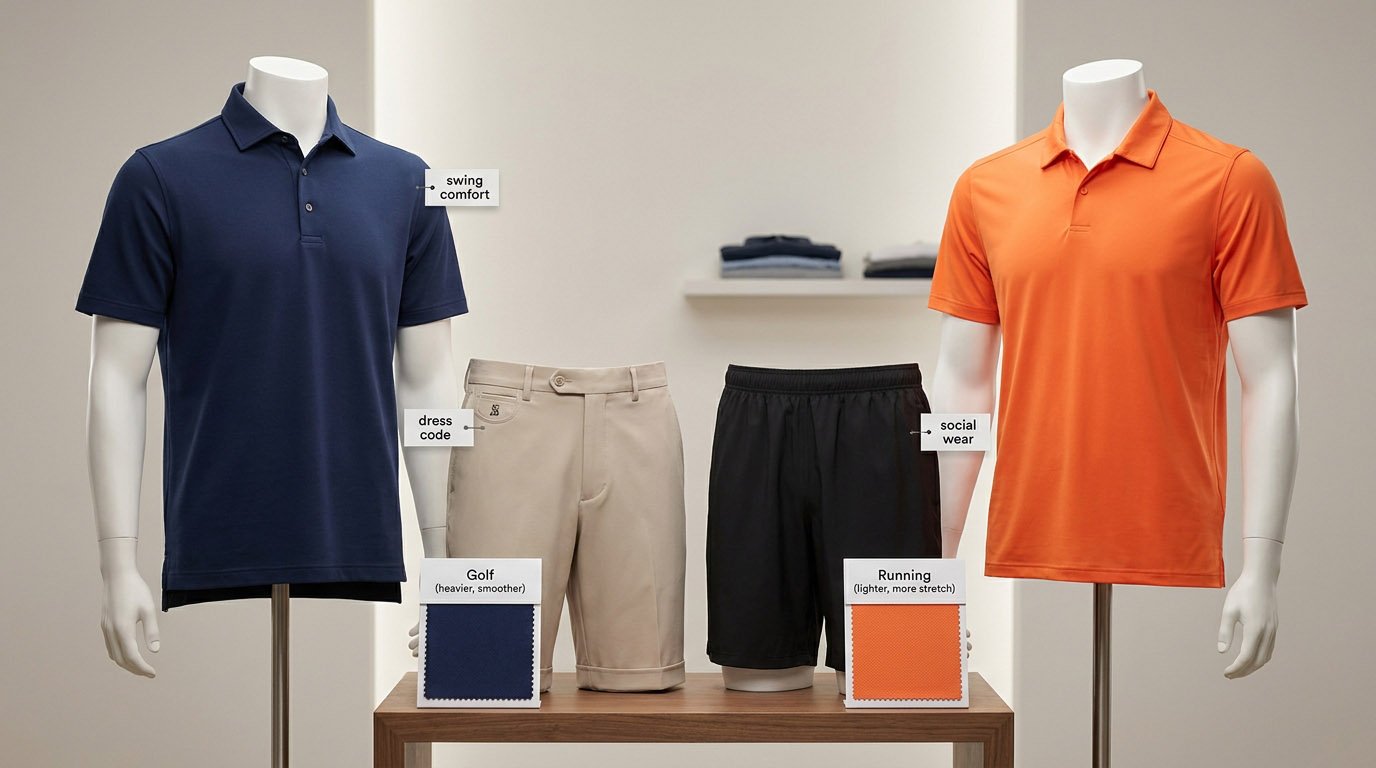
The confusion I see repeatedly: brands entering golf lines cannot tell which features matter versus which are marketing language. They fear paying for over-engineered specs they do not need, or falling into cheap territory that damages brand perception. I have worked with 60+ brands navigating this decision over 15 years. The successful ones match feature investment to their specific positioning. The struggling ones either overspend on features customers will not pay for, or under-deliver on visible quality markers that signal legitimate golf credibility. This guide shows you how to allocate development budget intelligently.
Quick Answers: What Golf Brands Misunderstand About Sportswear Differences
Q: Why can’t I repurpose tennis or gym polos for golf?
Golf polos must meet club dress codes: taller collars (2.5–3"), longer hem in back, minimal branding. Tennis/gym polos fail compliance, leading to customer rejections and costly redesigns.
Q: What’s the actual engineering difference in golf apparel mobility?
Golf requires shoulder rotation (90–110° backswing)—raglan sleeves or stretch panels at shoulders/side body, not just overall stretch. Typical athletic polos’ set-in sleeves restrict swing.
Q: Why is fabric GSM so important?
Golf = 160–200 GSM for structure and 4–5 hour comfort. Regular sportswear uses lighter fabrics (120–140 GSM) for brief, intense activity but looks cheap in golf context or overheats.
Q: What construction details signal “premium golf quality”?
High stitch density (14–16/inch), seam tape, collar reinforcement, dense embroidery—visible, tangible markers. Customers notice these more than fabric tech claims.
Q: How do price tiers affect design/features?
$45–55 polos: Dress code compliance, basic stretch, quality construction.
$75–95 polos: Premium fabric feel, visible construction upgrades, proven durability.
Don’t overspend on features customers won’t value at your price point—or underspend and disappoint.
What Makes Golf Apparel Different: Rules, Context and Use Cases?
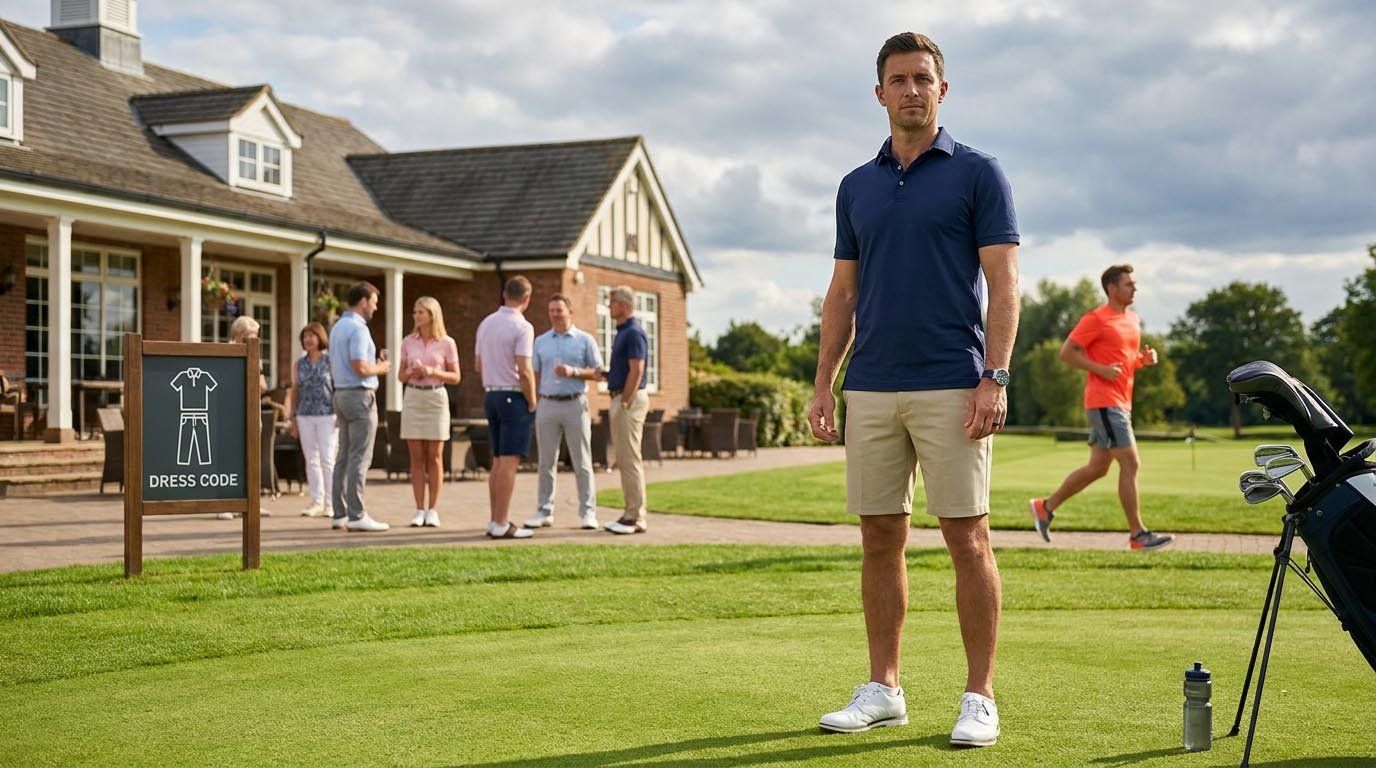
Golf apparel serves three simultaneous requirements that regular sportswear does not: unrestricted rotational movement for swing mechanics, compliance with club dress codes that vary from casual to formal, and presentable appearance through 4-5 hours of wear in social settings—regular athletic wear optimizes for only one of these (athletic performance), creating fundamental design divergence.
When clients ask "what makes golf apparel different," they expect technical answers about fabrics or features. The real answer starts with context: how the garment is used, where it is worn, and who is watching.
The Three Contexts That Shape Golf Apparel
Athletic Performance Context (30-40% of Design Priority)
Golf is physically less intense than running, cycling, or team sports:
- Low continuous cardio: Heart rate stays moderate except during walking between shots
- Brief explosive movements: Swing lasts 2-3 seconds, then rest period
- Extended duration: But activity spans 4-5 hours in varying temperatures
This combination means:
- Fabric does not need maximum moisture evacuation like running shirts
- But fabric must maintain comfort across long timeframes and temperature shifts
- Stretch must allow explosive rotation but maintain structure when standing still
Social/Dress Code Context (35-45% of Design Priority)
Golf happens in club environments with appearance standards:
- Visible to other players: Groups ahead/behind, clubhouse interactions
- Dress code enforcement: Many clubs restrict overly casual or athletic-looking apparel
- Professional appearance valued: Golf has business/networking associations
This combination means:
- Clean, refined aesthetics matter more than bold athletic styling
- Certain design elements trigger dress code issues (large logos, bright patterns, athletic cuts)
- Collar structure, hem design, and overall silhouette must look "proper"
Durability/Longevity Context (20-25% of Design Priority)
Golf apparel gets purchased less frequently but worn repeatedly:
- Average golfer buys 2-3 polos per year versus 4-6 gym shirts
- Garments get worn 20-40 times before next purchase
- Washing frequency is high due to sweat exposure
This combination means:
- Construction quality becomes more important than in frequent-replacement activewear
- Fabric must resist pilling, fading, and shape loss through many wash cycles
- Visible quality signals justify higher prices and longer replacement cycles
How These Contexts Create Design Divergence
Regular Athletic Sportswear Priority Ranking:
- Athletic performance (70-80%): Maximum mobility, breathability, moisture management
- Style/branding (15-20%): Bold visual identity, trend-forward aesthetics
- Durability (5-10%): Adequate for 6-12 month replacement cycle
Golf Apparel Priority Ranking:
- Dress code compliance + appearance (35-45%): Refined aesthetic, proper structure
- Athletic performance (30-40%): Adequate mobility, comfortable for extended wear
- Durability + perceived quality (20-25%): Construction must justify higher price and longer use
This difference in priority weighting drives every design choice: fabric selection, construction methods, styling details, and cost allocation.
Use Case Comparison Table
| Factor | Regular Athletic Sportswear | Golf Apparel | Why This Matters |
|---|---|---|---|
| Wearing Duration | 30-90 minutes | 4-5 hours | Golf fabric must stay comfortable and presentable longer |
| Movement Type | Linear (running), multi-directional (court sports) | Rotational (swing), low-intensity walking | Golf needs specific stretch placement, not overall mobility |
| Social Context | Gym/field (casual accepted) | Club/course (appearance standards) | Golf design must look refined, not purely athletic |
| Moisture Level | High continuous sweat | Moderate intermittent sweat | Golf fabric can be heavier for structure without compromising breathability |
| Purchase Frequency | 2-3 times per year | 1-2 times per year | Golf construction must justify longer ownership and higher price |
| Price Expectations | $25-45 mainstream athletic | $55-85 golf apparel | Golf customers pay premium if garment delivers on all three contexts |
The Client Confusion Pattern
I see this sequence repeatedly:
Client Starting Point: "We make quality athletic wear. Golf is just another sport, right?"
First Sample Feedback: "Why does the golf polo cost $3 more per piece than our tennis polo?"
Explanation Conversation: Golf polo has longer hem, reinforced shoulder construction, specific collar height, and fabric treatment the tennis polo does not need.
Client Reaction: "But those changes seem minor. Can we skip them to hit our target cost?"
Reality Check: You can skip them, but then you are selling athletic wear to golfers, not golf-specific apparel. Some customers will accept it. Many will notice the garment does not "feel right" for golf.
Positioning Decision: Either commit to golf-specific features and price accordingly, or position as "golf-inspired athleisure" at athletic wear prices.
The mistake: trying to split the difference—charging golf prices for athletic wear construction, or paying for golf features but positioning at athletic prices. Both create value perception mismatches.
Fabric & Function: Quiet Performance, UPF, Stretch and Weather Cred?
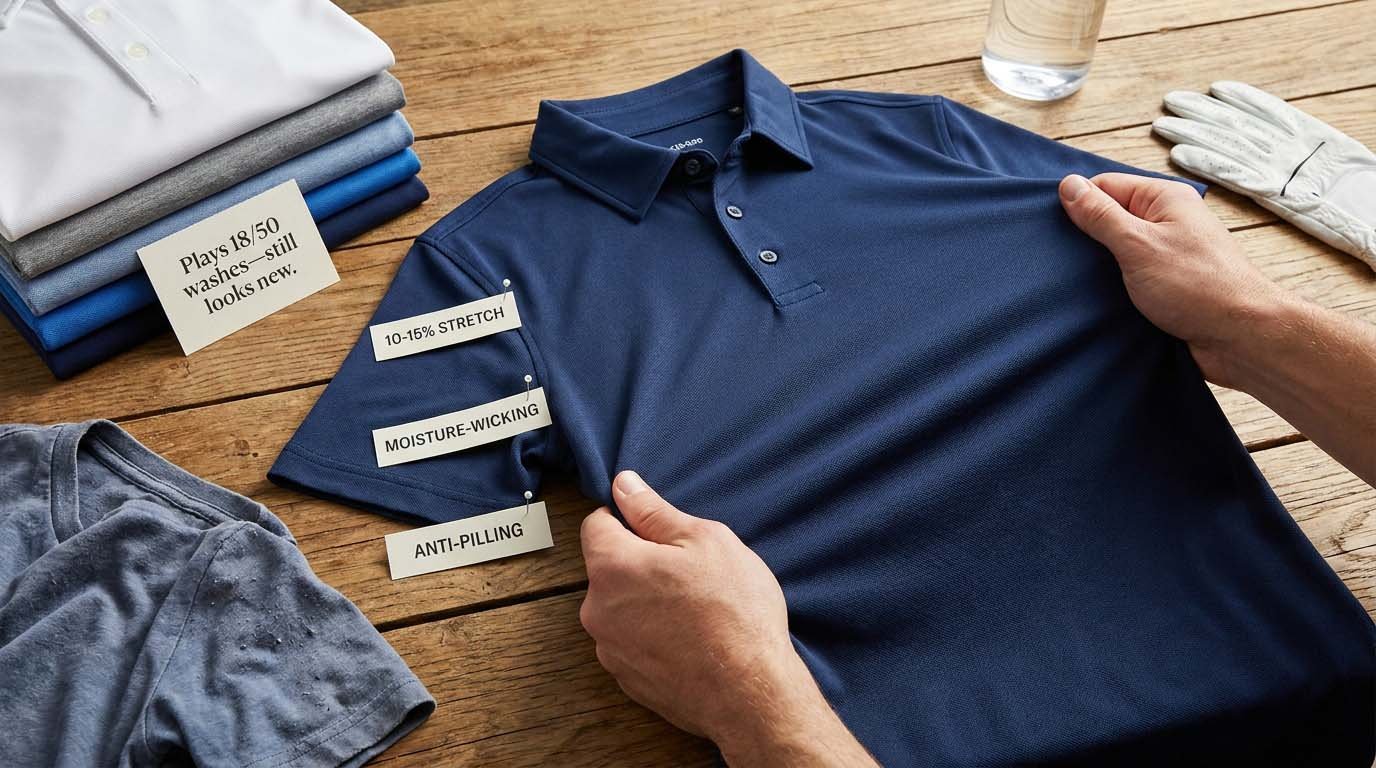
Allocate fabric budget to visible/tangible features customers can verify through wearing experience—hand feel, stretch behavior, and durability through washing—not invisible lab specifications like UPF ratings or moisture transport percentages that customers cannot confirm and competitors can claim regardless of reality.
Fabric conversations with new golf brands follow a pattern. They ask for "technical performance fabric" with impressive specs. I ask what problem they are solving for their customer. Often, they cannot articulate it—they just know "golf fabric should be technical."
The Fabric Investment Framework
Tier 1 Fabric Features: Always Worth Paying For
These features create tangible customer experience differences:
Adequate Stretch for Golf Swing
- Requirement: 10-15% horizontal stretch in shoulders/chest, 8-12% vertical stretch
- Why: Allows backswing rotation without restriction
- Cost impact: +$0.80-1.40 per meter versus non-stretch fabric
- Customer verification: They feel the difference during first swing
Appropriate Fabric Weight
- Requirement: 160-200 GSM for polos (varies by climate)
- Why: Balances structure, breathability, and opacity through 4-5 hours
- Cost impact: Proper weight is not more expensive, but wrong weight creates problems
- Customer verification: Garment feels substantial but not heavy, does not look cheap or transparent
Adequate Moisture Management
- Requirement: Polyester-dominant blends (85-95% poly) with wicking treatment
- Why: Prevents sweat accumulation during extended wear
- Cost impact: +$0.40-0.70 per meter versus cotton blends
- Customer verification: Noticeable dryness versus cotton during warm rounds
Pilling Resistance
- Requirement: Quality yarn and knit structure that resists surface abrasion
- Why: Golf apparel worn 30-50 times must maintain appearance
- Cost impact: +$0.30-0.60 per meter for anti-pilling treatment or better yarn quality
- Customer verification: After 5-10 washes, garment still looks new versus showing pills
Tier 2 Fabric Features: Worth Paying For at Mid/Premium Tiers Only
These features provide incremental benefits that justify higher pricing:
Enhanced Stretch (4-Way Stretch)
- Benefit: Unrestricted movement in all directions versus basic horizontal stretch
- Cost impact: +$1.20-2.00 per meter
- Customer verification: Noticeable during full swing, particularly for athletic players
- Positioning fit: $75-95+ retail golf apparel
Cooling/Thermoregulation Treatment
- Benefit: Accelerated heat dissipation in hot climates
- Cost impact: +$0.80-1.50 per meter
- Customer verification: Subjective—hard to isolate versus basic moisture wicking
- Positioning fit: Hot climate markets, premium positioning
Advanced Anti-Odor Treatment
- Benefit: Reduces smell after extended wear and multiple wears between washing
- Cost impact: +$0.60-1.20 per meter
- Customer verification: Noticeable on multi-day golf trips or frequent wear
- Positioning fit: Premium golf apparel, travel-focused messaging
Tier 3 Fabric Features: Marketing Value Exceeds Functional Value
These features are hard to verify and often do not create customer-perceived value:
High UPF Ratings (UPF 50+)
- Reality: Most polyester fabrics provide UPF 20-30 naturally without treatment
- Incremental benefit: UPF 50 versus UPF 25 means 2% vs 4% UV transmission—marginal real-world difference
- Cost impact: +$0.50-1.00 per meter for certification and treatment
- Customer verification: Impossible—cannot feel or see UPF difference
- Recommendation: If your positioning requires UPF claims, add it. Otherwise, use "built-in sun protection" without specific rating.
Antibacterial/Antimicrobial Treatment
- Reality: Prevents bacterial growth on fabric, but golf apparel gets washed regularly
- Benefit duration: Many treatments degrade after 15-20 washes
- Cost impact: +$0.40-0.90 per meter
- Customer verification: Cannot distinguish from anti-odor benefits
- Recommendation: Skip unless specific customer segment (multi-day tournaments, hot climates) requests it
Moisture Transport Rate Specifications
- Reality: Lab test measures liquid movement through fabric in controlled conditions
- Customer experience: Cannot distinguish between "3.5 rating" versus "4.2 rating" during golf
- Cost impact: Minimal—mostly marketing language
- Recommendation: Generic "moisture-wicking" claims are sufficient; specific numbers add no perceived value
Fabric Weight Strategy by Climate
Target market climate determines optimal fabric weight:
| Climate Zone | Recommended Fabric Weight | Fabric Type | Why |
|---|---|---|---|
| Hot/Humid (Southern US, Southeast Asia) | 160-180 GSM | Lightweight poly-blend, open knit | Maximum airflow, quick-dry properties |
| Temperate (Most US, Europe) | 180-200 GSM | Mid-weight poly-blend, standard knit | Balance of structure and breathability |
| Cool/Variable (Northern regions, year-round play) | 190-210 GSM | Heavier poly-blend, thermal properties | Adequate warmth, layering capability |
Using wrong fabric weight for climate creates problems:
- Too light: Garment looks cheap, transparent, flimsy
- Too heavy: Players overheat, complain about comfort
The "Technical Fabric" Sales Pitch
Fabric suppliers and competitors make impressive technical claims. Here is how to evaluate them:
Red Flag Claims to Question:
- "Moisture transport rate 40% faster than competitors" (not verifiable by customers)
- "Advanced cooling technology" (vague, hard to isolate from basic breathability)
- "Tested by tour professionals" (marketing association, not product verification)
- "Patented fabric treatment" (patent does not mean better performance)
Credible Claims to Value:
- "4-way stretch fabric" (customer can test by pulling garment in multiple directions)
- "Anti-pilling treatment tested to 50 washes" (customer will experience this over ownership)
- "20% lighter than standard golf fabric while maintaining opacity" (customer can feel weight difference)
- "Yarn-dyed color for fade resistance" (versus piece-dyed—verifiable construction method)
When clients ask me if they should pay $1.50 per meter more for a fabric with "advanced technology," I ask: "Can your customer verify this through wearing or washing? Will they notice the difference?" If the answer is unclear, the premium is not justified.
Fabric Cost-to-Value Decision Table
| Fabric Feature | Cost Premium | Customer Can Verify? | Worth It For... |
|---|---|---|---|
| Basic stretch (10-15%) | +$0.80-1.40/meter | YES (immediate feel) | All golf positioning |
| 4-way stretch | +$1.20-2.00/meter | YES (enhanced movement) | Premium tier ($75+ retail) |
| Moisture wicking treatment | +$0.40-0.70/meter | YES (dryness vs cotton) | All golf positioning |
| Anti-pilling treatment | +$0.30-0.60/meter | YES (after 10+ washes) | All golf positioning |
| UPF 50 certification | +$0.50-1.00/meter | NO (cannot feel/see) | Premium marketing positioning only |
| Antibacterial treatment | +$0.40-0.90/meter | NO (hard to distinguish) | Skip for most brands |
| Cooling technology | +$0.80-1.50/meter | MAYBE (subjective) | Hot climate brands only |
Fit & Construction: Polos, Bottoms, Pockets and Course Etiquette?
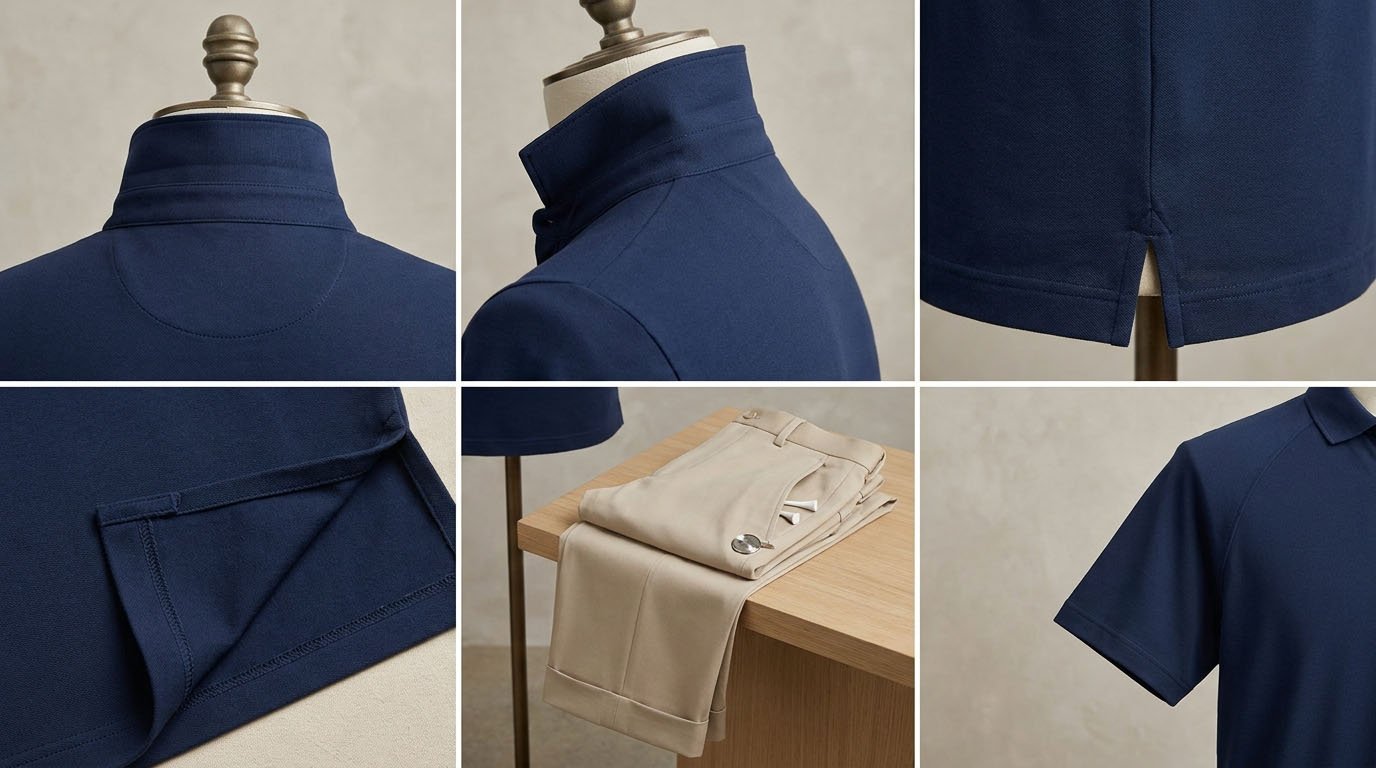
Invest in construction details that customers can see and feel when examining garments—stitch density, seam finishing, collar structure, and hem design—not hidden features that only manufacturing QC personnel notice, because customers judge quality through visible markers even if they cannot articulate technical specifications.
Fit and construction separate legitimate golf apparel from athletic wear with golf branding. These are the details customers handle in-store or notice during first wearing.
Polo Shirt Construction Differences
Collar Height and Structure
Golf polos versus athletic polos:
Golf-Specific Collar:
- Height: 2.5-3 inches when standing (enough to fold or wear up)
- Weight: Separate collar fabric (often double-ply) to maintain structure
- Interfacing: Fused or stitched stabilizer prevents curling after washing
- Button placket: 3-4 buttons for secure closure
Athletic Polo Collar:
- Height: 1.5-2 inches (minimal structure needed)
- Weight: Same fabric as body (lightweight, flexible)
- Interfacing: Minimal or none (reduces weight)
- Button placket: 2-3 buttons (shorter placket)
Construction cost difference: $0.60-1.20 per piece for proper golf collar
Why it matters: Proper collar height and structure signal "golf apparel" versus "athletic shirt." Dress code compliance depends on this. Collar that folds flat or curls after washing looks cheap.
Hem Length and Design
Golf polos have longer back hem:
Golf Polo Hem:
- Back hem: 2-3 inches longer than front (covers waistband during bending/swinging)
- Side vents: Optional but common (allows garment to drape properly)
- Hem finishing: Double-needle stitch or cover stitch for durability
Athletic Polo Hem:
- Even hem: Front and back same length (designed to be worn untucked)
- Side vents: Rare (casual athletic aesthetic)
- Hem finishing: Basic hem stitch (sufficient for shorter lifespan)
Construction cost difference: $0.40-0.80 per piece for extended hem and proper finishing
Why it matters: Longer back hem allows golf polos to be worn tucked (dress code requirement at many clubs) while maintaining coverage during movement. Even hem length signals athletic casualness that does not fit golf context.
Sleeve Construction for Swing Mobility
Golf polos need unrestricted shoulder rotation:
Golf-Optimized Construction:
- Raglan sleeves: Diagonal seam from collar to underarm (allows full shoulder rotation)
- Action-back panels: Diamond or rectangular stretch panels in shoulder blades
- Stretch fabric in sleeve cap: Even with set-in sleeves, stretch panel added
Standard Athletic Construction:
- Set-in sleeves: Perpendicular seam at shoulder (restricts rotational movement)
- No stretch zones: Uniform fabric throughout (adequate for linear motion)
Construction cost difference: $1.00-2.00 per piece for raglan or action-back construction
Why it matters: The single most common customer complaint about non-golf polos worn for golf: "It restricts my backswing." Proper sleeve construction eliminates this immediately.
Bottoms Construction Differences
Golf Pants Versus Athletic Pants:
| Feature | Golf Pants | Athletic Pants (running, training) | Why Golf Differs |
|---|---|---|---|
| Fabric Weight | 250-300 GSM | 180-220 GSM | Golf pants must maintain structure while sitting in carts, standing at address |
| Stretch Direction | 2-way or 4-way (depending on tier) | 4-way stretch (maximum mobility) | Golf prioritizes structure + adequate mobility; athletic maximizes mobility |
| Pocket Depth | Deeper (6-7 inches) | Shallow (4-5 inches) or none | Golf pockets hold tees, balls, gloves—items must stay secure during bending |
| Waistband | Structured with belt loops | Elastic or drawstring | Golf dress codes require belt-ready waistband |
| Hem Finish | Proper pant hem or cuff option | Tapered or raw edge | Golf pants must look refined, not athletic casual |
Construction cost difference for golf-appropriate pants: $2.50-4.50 per piece more than basic athletic pants
Pocket Placement and Functionality
Golf Polo Pockets:
Most golf polos skip chest pockets:
- Reason: Chest pockets create visual bulk and look casual
- Exception: Some casual golf brands include small chest pocket for scorecards/tees
- Cost impact: +$0.30-0.50 to add chest pocket
Golf Pants Pockets:
Pocket design matters significantly:
Front Pockets:
- Depth: 6-7 inches minimum (must hold golf balls without them falling out during bending)
- Reinforcement: Pockets should have bar-tack stitching at stress points
- Opening angle: Slight forward angle (easier access while standing)
Back Pockets:
- Right back pocket: Often button or zip closure (secures wallet, prevents items falling during swings)
- Left back pocket: Open or button (less critical)
Cargo pockets: Generally avoided in golf pants (too casual, dress code issues)
Why it matters: Golfers carry items (balls, tees, gloves, ball markers) that must stay secure for 4-5 hours. Pocket depth and closure directly impact functionality.
Stitch Density and Seam Finishing
Customers cannot count stitches per inch, but they feel the difference:
Value-Tier Stitching:
- 9-11 stitches per inch
- Basic single-needle seams
- Raw seam edges inside garment
- Cost: Baseline
Mid-Tier Stitching:
- 12-14 stitches per inch
- Double-needle critical seams (hem, shoulders)
- Overlock stitch or serged seams (clean interior finish)
- Cost: +$0.40-0.80 per piece
Premium-Tier Stitching:
- 14-16 stitches per inch
- Flatlock seams (flat interior, no chafing)
- Bar-tack reinforcement at all stress points
- Contrast thread for visual interest (if design calls for it)
- Cost: +$1.00-1.80 per piece
Why it matters: Higher stitch density creates garment that feels substantial, not flimsy. Clean interior seams prevent irritation during extended wear. These markers are how customers judge "quality" even if they do not know technical terms.
Construction Quality Verification
When evaluating samples, check these visible markers:
Quick Quality Check List:
- ✓ Collar maintains shape when folded and released (not floppy)
- ✓ Hem stitching is even and covers raw edge completely
- ✓ Seam allowance inside garment is finished (not raw threads)
- ✓ Button attachment uses reinforced stitching (not just two threads)
- ✓ Stretch test: Fabric returns to shape immediately after stretching
Red Flags:
- ✗ Collar curls or lays flat (insufficient interfacing)
- ✗ Visible loose threads or unfinished seam edges inside
- ✗ Stretched-out areas around buttons after brief wearing
- ✗ Hem puckering or waviness (tension issues during sewing)
These markers determine whether your product passes customer quality expectations at your price point.
Aesthetic & Branding: Colors, Logos, Decoration and Club Compliance?
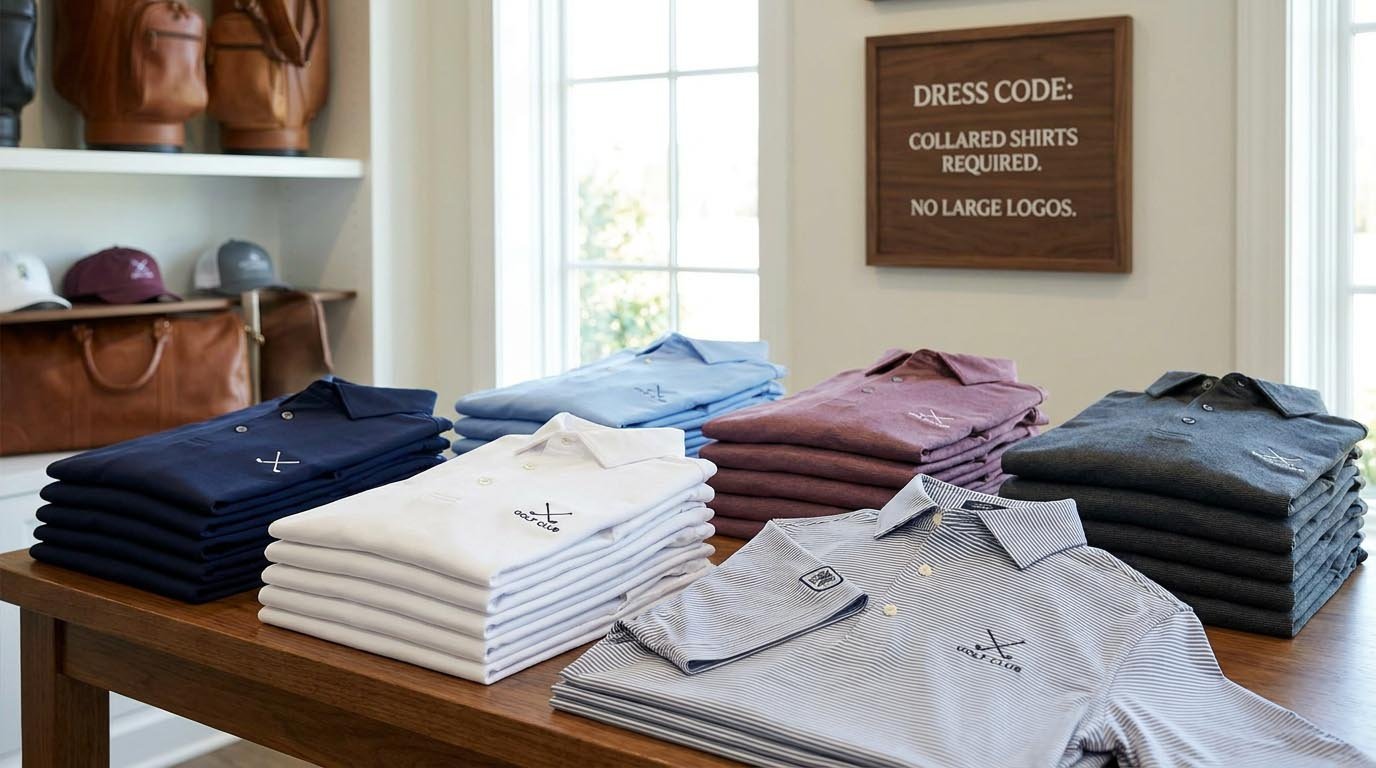
Design golf apparel aesthetics to signal "golf credibility" through color restraint, refined logo placement, and clean silhouettes—not through performance graphics or bold athletic branding that triggers dress code concerns and positions the product as "athletic-inspired" rather than golf-appropriate.
Visual design separates golf apparel from athletic sportswear as much as construction does. But the differences are subtle. Clients often miss them or dismiss them as "just styling."
Color Strategy: Golf vs Athletic Sportswear
Golf Apparel Color Palette:
Traditional golf colors:
- Navy, white, black: Core neutrals (60-70% of golf apparel sales)
- Light blue, gray, burgundy: Secondary classics (20-25%)
- Muted greens, subtle patterns: Accent options (10-15%)
Why these colors dominate:
- Dress code safe: Clubs accept classic colors universally
- Versatile: Pair easily with bottoms in various colors
- Timeless: Do not look dated after one season
- Professional appearance: Suitable for business golf or club events
Athletic Sportswear Color Palette:
Performance athletic colors:
- Bold brights: Neon yellow, bright orange, electric blue (30-40%)
- High contrast: Black with bright accents (25-30%)
- Dark heathers: Charcoal, black marled (20-25%)
- Neutrals: White, gray (15-20%)
Why these colors work in athletic context:
- Visibility: Bright colors serve functional purpose (running, cycling safety)
- Energy signaling: Bold colors convey athletic intensity
- Youth appeal: Younger athletes prefer bright, trend-forward colors
The Golf Brand Decision:
If your positioning is traditional/club-focused golf: Stick to classic palette with navy, white, light blue as core and limited accent colors.
If your positioning is lifestyle/athleisure golf: You can incorporate modern colors (heather tones, muted brights) but avoid neon or high-contrast athletic styling.
Color Investment Impact:
Color choices affect cost minimally:
- Yarn-dyed fabrics: +$0.80-1.50 per meter versus piece-dyed (better color fastness, fade resistance)
- Custom color development: $200-400 per color for dye lab matching (if you need specific brand colors)
- Standard colors: No premium (navy, white, black available from all fabric suppliers)
Logo Placement and Size Constraints
Golf-Appropriate Logo Placement:
Primary location: Left chest
- Size: 2.5-4 inches wide maximum
- Style: Clean embroidery or subtle screen print
- Positioning: 3-4 inches below collar point
Secondary location: Back shoulder or sleeve
- Size: 1.5-3 inches
- Purpose: Brand visibility without front dominance
Avoid these locations for traditional golf positioning:
- ✗ Large center-chest graphics (looks like casual t-shirt)
- ✗ Back-center large text/graphics (dress code issues at clubs)
- ✗ Multiple logos on front (looks cluttered, cheap)
- ✗ Logos larger than 4 inches on front (too dominant)
Athletic Sportswear Logo Placement:
Athletic brands use:
- Large chest graphics (6-10 inches)
- Full back prints (team/brand messaging)
- Sleeve stripes or bold graphics
- Multiple brand marks on single garment
This works for gym/field contexts but signals "athletic wear" rather than "golf apparel" and triggers dress code concerns.
Decoration Method Selection
Embroidery (most common for golf):
Advantages:
- Perceived premium quality
- Durable through 50+ washes
- Accepted universally in golf context
Cost structure:
- Setup fee: $80-150 per design (one-time)
- Per-piece cost: $2.50-4.50 depending on stitch count (6,000-9,000 stitches typical for golf logos)
Best for:
- Left chest logo on polos, quarter-zips, hoodies
- Premium positioning ($65+ retail)
Screen Printing (value alternative):
Advantages:
- Lower per-piece cost
- Can create soft-hand feel
- Good for tonal or subtle designs
Cost structure:
- Setup fee: $30-60 per color per location
- Per-piece cost: $1.20-2.80 for simple designs
Best for:
- Inside neck labels (brand name/size)
- Large back designs (if positioning is casual)
- Value tier products ($45-60 retail)
Limitations:
- Less durable than embroidery (fades/cracks after 20-30 washes)
- Can look less premium than embroidery
Heat Transfer/Sublimation:
Typically avoided in golf apparel:
- Reason: Does not convey premium quality perception
- Exception: Interior labels or care instructions
Pattern and Graphic Design Boundaries
Golf-Acceptable Patterns:
- ✓ Thin stripes (horizontal or vertical, max 3-4 colors)
- ✓ Subtle heathered effects (tonal variation)
- ✓ Small geometric patterns (checks, micro-prints)
- ✓ Tonal color-blocking (different shades of same color)
Patterns That Risk Dress Code Issues:
- ✗ Large bold prints (floral, abstract art)
- ✗ Camouflage patterns (too casual/hunting association)
- ✗ Bright tie-dye or gradient (too casual)
- ✗ Sports team graphics (looks like fan apparel, not golf apparel)
The general rule: If the pattern makes the garment stand out visually from 20 feet away, it is too bold for traditional golf context.
Club Compliance Checklist
Before finalizing design, verify these compliance factors:
Universal Acceptance Elements:
- ✓ Collared shirts (polos, button-downs)
- ✓ Solid colors or subtle patterns
- ✓ Clean, refined silhouette (not oversized or athletic-tight)
- ✓ Minimal exterior branding
Elements That Reduce Acceptance:
- ⚠ Large logos or text (30-40% of clubs may reject)
- ⚠ Bold patterns or graphics (25-35% rejection risk)
- ⚠ Athletic styling cues (drawstrings, kangaroo pockets, athletic cuts)
Elements That Often Fail Dress Codes:
- ✗ T-shirts without collar (rejected at 60-80% of traditional clubs)
- ✗ Cargo shorts or athletic shorts (rejected at 40-60%)
- ✗ Hoodies worn during play (rejected at 30-40%, though improving)
If your brand targets casual golf or public courses only, you have more design freedom. If you need to work at private clubs or traditional courses, design within conservative boundaries.
Go-to-Market: Assortment, Pricing Tiers, Channels and Partnerships?
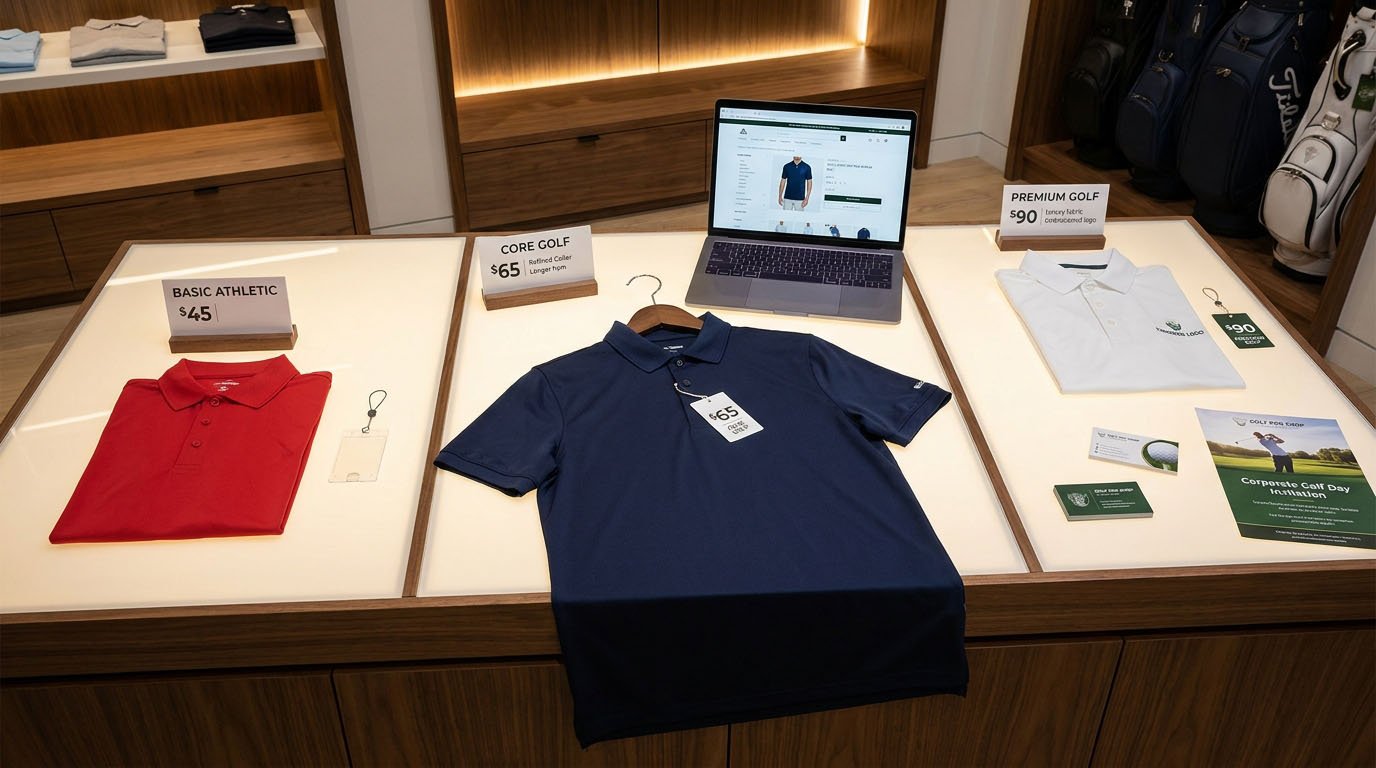
Position your golf apparel differentiation explicitly in pricing and channel strategy—if you are paying $3-5 more per piece for golf-specific features versus athletic sportswear construction, your retail pricing must justify this through clear positioning as "golf-appropriate" apparel, not generic "performance sportswear that happens to work for golf."
The construction and design differences between golf apparel and regular sportswear only create value if your go-to-market strategy communicates them effectively. I see brands invest in proper golf specifications, then price and position like athletic wear, confusing customers about what they are buying.
Pricing Structure to Reflect Differentiation
Golf Apparel Pricing Reality:
Golf-specific construction costs $2.50-5.50 more per piece than comparable athletic sportswear:
Performance Polo Example:
| Construction Type | Production Cost (1,000 pcs) | Retail Price | Positioning |
|---|---|---|---|
| Basic athletic polo (set-in sleeves, even hem, standard collar) | $11-14 | $40-50 | Mass-market athletic wear |
| Golf-appropriate polo (raglan sleeves, extended hem, golf collar) | $14-18 | $55-70 | Core golf apparel |
| Premium golf polo (4-way stretch, refined construction, quality embroidery) | $18-23 | $75-95 | Premium golf positioning |
The $3-5 production cost difference must translate to $15-20+ retail difference to maintain margins and signal quality positioning.
Common Pricing Mistakes:
Mistake 1: Golf construction, athletic pricing
- Example: Paying $16 per piece for proper golf polo, retailing $50-55 (pricing like athletic wear)
- Problem: Margins compressed to 55-60% (unsustainable), and customers expect athletic-level volume production/distribution at that price
Mistake 2: Athletic construction, golf pricing
- Example: Paying $12 per piece for basic athletic polo, retailing $65-75 (pricing like golf apparel)
- Problem: Customers compare to legitimate golf brands, notice construction shortcuts, feel overcharged
Correct Approach: Match construction investment to price positioning
- Golf-appropriate construction + golf retail pricing = clear value proposition
- Athletic construction + athletic pricing = different market segment (golf-inspired casual)
Channel Strategy by Product Positioning
Traditional Golf Channels (Pro Shops, Golf Specialty Retail):
Requirements:
- Golf-specific construction: Buyers know the difference and will reject shortcuts
- Dress code compliance: Must work at clubs where their customers play
- Premium positioning: $65-95 retail minimum for credibility in golf channels
Advantages:
- Customers pre-qualified (they play golf regularly)
- Higher price acceptance (golf customers expect premium)
- Less competition from athletic brands
Challenges:
- Strict buying standards (samples get scrutinized by experienced golf buyers)
- Seasonal ordering (must hit specific timeframes)
- Lower volume per account (typical order: 30-80 pieces per shop)
E-Commerce Direct-to-Consumer:
Requirements:
- Clear positioning: Must explicitly state "golf apparel" versus "athletic wear"
- Detailed product descriptions: Explain golf-specific features (customers cannot examine in person)
- Lifestyle photography: Show wearing contexts (on-course and casual)
Advantages:
- Control over pricing and positioning message
- Can test market response quickly
- Higher margins (no wholesale discounts)
Challenges:
- Customer acquisition costs ($20-40 per customer in competitive markets)
- Must educate customers on why golf apparel differs from athletic wear
- Higher return rates (12-18%) when customers unsure about fit/quality
Athletic Retail or General Marketplace Channels:
Requirements:
- Competitive athletic wear pricing: $45-65 retail to fit channel expectations
- Lifestyle crossover appeal: Cannot position as pure golf apparel
- Brand awareness: Compete with established athletic brands
Advantages:
- Broader customer base (not limited to golfers)
- Higher volume potential per channel
Challenges:
- Price pressure (hard to maintain $70+ pricing)
- Brand dilution risk (golf credibility questioned if sold alongside gym wear)
- Buyer confusion (buyers may not understand golf-specific features)
Assortment Strategy by Channel
For Golf Specialty Channels:
Core assortment:
- 3-4 polo styles (variety of collar types, fabric weights)
- 2-3 quarter-zip or layering options
- 2-3 pant styles (different fits, colors)
- 1-2 short styles
Why: Golf retailers want depth in core categories to serve regular players' needs.
For E-Commerce Direct:
Focused assortment:
- 2-3 polo styles maximum (reduce choice paralysis)
- 1-2 layering pieces
- 1-2 bottoms (pants OR shorts, not both initially)
Why: Online customers prefer simplified choices. Better to have strong inventory depth in fewer SKUs than fragmented inventory across many options.
For Athletic/Lifestyle Channels:
Lifestyle-first assortment:
- 1-2 versatile polo or casual button-down styles
- 1-2 hoodies or quarter-zips (emphasize casual wear)
- 1-2 hybrid pants/shorts (work for golf and daily wear)
Why: These customers prioritize versatility over golf-specific functionality.
Partnership and Collaboration Opportunities
Golf Instructor/Coaching Programs:
Potential:
- Instructors outfit students with matching apparel
- Creates group identity and repeat orders
Requirements:
- Bulk pricing: 15-25% off retail for 10-20 piece orders
- Custom embroidery: Academy or instructor logo
- Reliable restocking: Instructors want ongoing availability
Corporate Golf Events:
Potential:
- Tournament sponsors outfit participants
- Typical orders: 50-200 pieces per event
Requirements:
- Fast turnaround: 4-6 weeks from order to delivery
- Custom branding capability: Client company logo
- Quality guarantees: No defects (embarrasses corporate client)
Golf Club Member Shops:
Potential:
- Private clubs sell branded apparel to members
- Higher pricing tolerance (members value exclusivity)
Requirements:
- Premium construction: Members expect quality
- Exclusive designs: Clubs want unique items
- Small minimums: 20-40 pieces per style/color
Competitive Positioning Framework
Determine where your brand sits relative to established players:
| Positioning Tier | Brand Examples | Retail Price Range | Construction Investment | Target Customer |
|---|---|---|---|---|
| Mass Market | Generic brands | $30-50 | Minimal golf-specific features | Beginner/casual golfers, price-conscious |
| Core Golf | Mid-tier golf brands | $55-85 | Full golf-appropriate construction | Regular golfers, value quality-price balance |
| Premium Golf | Established golf brands | $85-120 | Enhanced construction, premium fabrics | Frequent golfers, club members |
| Luxury Golf | Designer/tour brands | $120-180+ | Maximum construction refinement | Status-conscious golfers, luxury buyers |
Positioning Decision:
Most new brands should target Core Golf tier: $55-85 retail, with proper golf construction that justifies the price versus athletic wear, while remaining accessible to regular golfers.
Avoid trying to compete at mass market pricing with proper golf construction—margins will not work. Avoid jumping to luxury positioning without brand credibility and distribution in premium channels.
FAQ: Golf Apparel vs Regular Sportswear
Can I just use my existing athletic sportswear patterns and add golf branding?
You can, but you will be selling athletic wear to golfers, not golf-specific apparel. The patterns need modifications: extend back hem by 2-3 inches, adjust shoulder construction for rotational mobility (raglan sleeves or stretch panels), increase collar height to 2.5-3 inches with proper interfacing, and add approximately 10-20 GSM fabric weight for structure. These changes add $2.50-4.50 per piece in production cost but create apparel that functions properly for golf. Without them, you will get customer complaints about hems coming untucked, restricted backswing, or floppy collars—and dress code rejections at traditional clubs. Many brands start with athletic patterns thinking they will save money, then redesign after negative feedback costs more than doing it right initially.
What fabric specifications actually matter versus marketing claims?
Focus fabric investment on features customers can verify through wearing: stretch behavior (10-15% minimum horizontal stretch—customers feel this during first swing), fabric weight (180-200 GSM for proper structure without heaviness), moisture-wicking treatment (noticeable dryness versus cotton), and anti-pilling properties (garment looks new after 10+ washes). These features add $1.50-3.00 per meter in fabric cost. Skip expensive "advanced technology" claims customers cannot verify: UPF ratings above 30 (marginal benefit over natural polyester protection), specific moisture transport percentages (no one can distinguish 3.5 versus 4.2 rating during play), antibacterial treatments that degrade after 15-20 washes, or vague "cooling technology" (hard to isolate from basic breathability). Match fabric investment to your price tier—$55-70 retail needs adequate stretch and moisture management; $85+ retail should add 4-way stretch and enhanced durability.
How do I verify my supplier is delivering golf-appropriate construction?
Check these visible quality markers in samples: collar maintains shape when folded and released (not floppy—indicates proper interfacing), hem stitching runs even and covers raw edge completely, interior seam finishing shows overlock or serged edges (not raw threads), stitch density feels substantial (12-14 stitches per inch minimum for mid-tier), and stretch test shows fabric returns to original shape immediately after pulling. Compare your sample to established golf brand polos sold at your target price point—handle them in stores to understand what construction quality customers expect at $65, $85, or $110 retail. If your sample feels noticeably cheaper than competitors at same price, you have construction gaps. Common shortcuts suppliers take: skipping collar interfacing (saves $0.40), using single-needle hem stitch instead of double-needle (saves $0.25), leaving interior seams unfinished (saves $0.35), reducing stitch density (saves $0.20-0.40). These "savings" destroy perceived quality.
Should I position as "performance golf apparel" or "golf lifestyle apparel"?
"Performance golf" positioning requires delivering tangible functional benefits: unrestricted swing mobility from proper sleeve construction, moisture management through 4-5 hour rounds, proven durability through 30-50 wears, and dress code compliance at traditional clubs. This positioning works when you invest in golf-specific features and can retail $70-95+. "Golf lifestyle" positioning emphasizes versatility—apparel works for golf but also daily casual wear, travel, and social activities. This positioning requires less golf-specific construction (can skip some features like extended hem or specialized collar) but must look stylish enough for non-golf contexts. This works at $55-75 retail with athletic-adjacent construction. The mistake: claiming "performance" positioning without investing in proper golf construction, or pricing "lifestyle" positioning at premium levels without delivering functional golf benefits. Match your construction investment to your positioning claims.
What construction differences justify higher pricing to customers?
Customers justify paying $65-85 for golf polos versus $40-50 for athletic polos when they can see and feel these differences: substantial collar that holds shape (versus thin athletic collar), longer back hem that stays tucked (versus even-length hem), stretch fabric that allows full backswing (versus restricted movement), heavier fabric weight that looks opaque and structured (versus thin athletic material), clean interior seam finishing (versus raw edges), and tight stitch density (versus loose, flimsy feeling). These construction markers add $3.50-5.50 per piece in production cost but create $20-30 retail price premium customers accept. The differences must be immediately apparent when customer handles garment—if they cannot distinguish your $75 golf polo from a $45 athletic polo in-store, you will not justify the price premium. Use competitor samples at your target price as benchmarks for construction quality customers expect.
How do dress code requirements affect design choices?
Traditional golf course dress codes restrict: collarless shirts (rejected at 60-80% of private clubs), large logos or graphics (30-40% rejection), bold patterns (25-35% rejection), athletic styling cues like drawstrings or kangaroo pockets (30-40%), and athletic-tight or oversized fits (20-30%). Design for dress code compliance if targeting regular golfers who play various courses—this means collared shirts with refined aesthetics, minimal branding (left chest logo 3-4 inches maximum), classic colors or subtle patterns, and clean silhouettes. If positioning as "casual golf" for public courses only, you have more freedom—can use bolder designs, larger graphics, or athletic styling. But understand this limits your market—customers who play multiple course types need apparel that works everywhere. Include dress code compliance in your positioning: "Accepted at all courses" is a selling point many brands undervalue. We see 15-20% of customer service inquiries ask "will this be allowed at my club?"—proactively addressing this in product descriptions reduces uncertainty.
What is the minimum production investment to launch golf apparel properly?
Plan $15,000-20,000 minimum for legitimate golf apparel launch with proper construction: $11,000-14,000 for 800-1,000 performance polos at $14-18 per piece (with golf-appropriate features), $800-1,200 for quality embroidery decoration (6,000-8,000 stitch count left chest logo), $1,200-2,000 for proper sampling and development (multiple revisions to get construction right), $800-1,500 for product photography showing golf context, and $1,200-2,000 for initial marketing, website, and operational setup. Brands trying to launch with $8,000-10,000 typically sacrifice construction quality to hit lower pricing or order insufficient inventory (300-400 pieces) that sells out of popular sizes quickly. Under-investing initially creates false economy—you either deliver substandard products that damage brand reputation, or sell out too fast to build momentum and lack capital to reorder. Better to start with one product category properly funded than multiple categories inadequately resourced.
Conclusion
Golf apparel differs from regular sportswear through design choices serving swing mechanics (raglan sleeves or stretch panels for rotation), dress code compliance (proper collar structure, refined aesthetics, extended hems), and extended wearing duration (heavier fabrics, reinforced construction). These differences add $2.50-5.50 per piece in production cost but only create value when matched to appropriate positioning and pricing ($55-85 retail for core market). Invest in features customers can verify through wearing—stretch behavior, fabric hand feel, construction quality—not invisible lab specifications.