
If you want to verify women’s golf polo shirt quality before bulk orders, do not approve a shipment based on one good-looking sample alone. You need to check how the fabric, fit, seams, collar, color, trims, and labels perform after washing and whether the factory can reproduce the same result consistently in bulk production.
In practical terms, that means checking:
- post-wash fabric hand-feel
- moisture-wicking performance
- stretch recovery
- seam quality and stitch consistency
- collar shape retention
- size consistency across multiple pieces
- colorfastness and pilling resistance
- button, label, and compliance details
A sample can look perfect because it was made slowly and inspected carefully. Bulk production is different. The real risk is not whether one sample passes. The real risk is whether the supplier can make the same shirt 500 or 1,000 times without visible variation or quality drop.
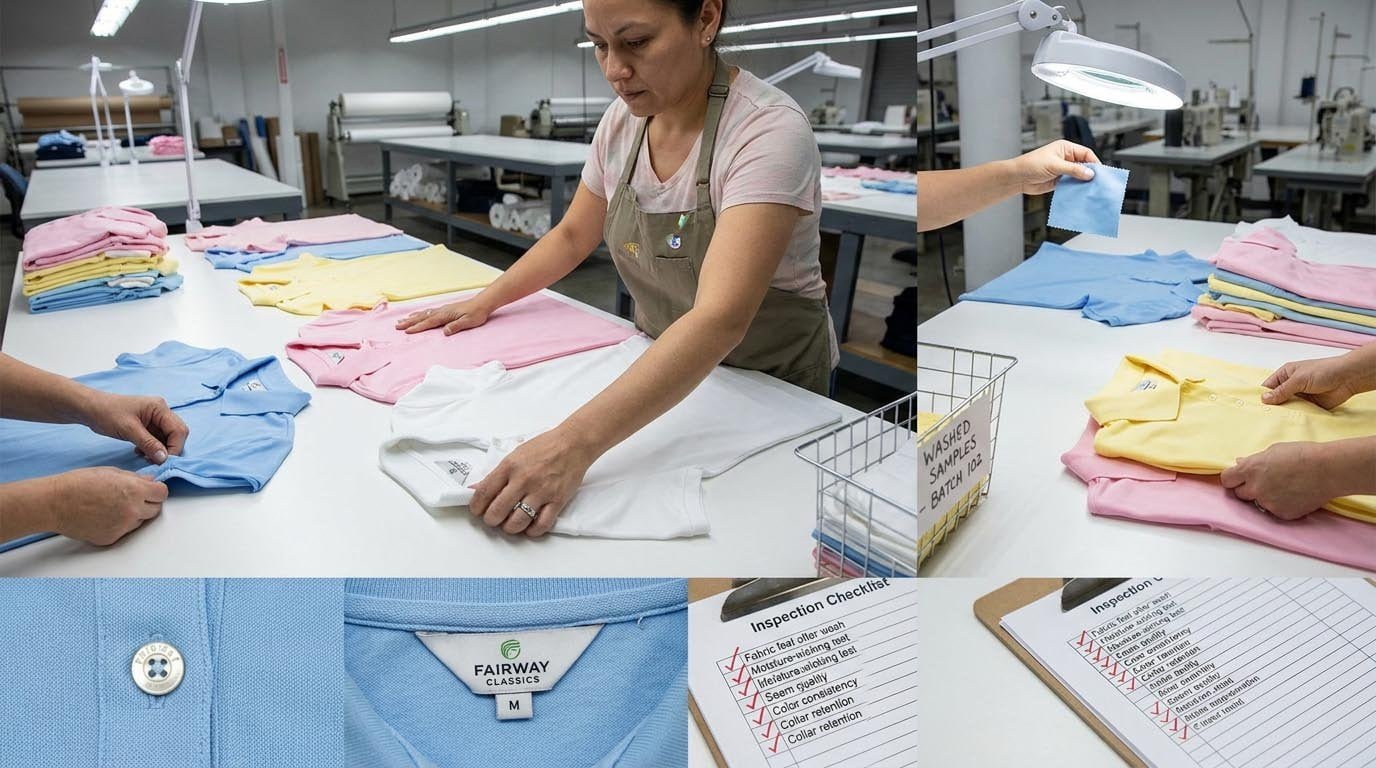
This guide explains how to inspect women’s golf polo shirts before placing a bulk order, what to test before mass production, and how to catch quality problems before they turn into customer complaints, returns, or dead inventory.
Quick Answer: What Should You Check Before a Bulk Order?
Before placing a bulk order for women’s golf polo shirts, check these 8 quality points:
| Quality Area | What to Check | Red Flag |
|---|---|---|
| Fabric feel | Hand-feel after 3 washes | Fabric turns stiff, rough, limp, or coated |
| Moisture management | Water absorption and spread | Water beads or stays in one wet spot |
| Stretch recovery | Recovery after extension | Fabric stays stretched out or bags |
| Seams | Stitch density and seam stability | Puckering, gaps, loose thread ends |
| Collar | Shape retention after washing | Bubbling, twisting, uneven points |
| Fit consistency | Measurements across multiple pieces | Length, bust, sleeve differences beyond tolerance |
| Color durability | Wash fastness, crocking, sunlight reaction | Fading, bleeding, transfer to white fabric |
| Trims and labels | Button strength, care labels, fiber content | Broken trims, wrong label info, compliance issues |
Short answer
Do not only check:
- GSM
- fabric composition
- one approved sample
- supplier promises
Also check:
- post-wash behavior
- production consistency
- multiple pieces from bulk
- real-use durability
The goal is not to approve one sample. The goal is to verify repeatable bulk quality.
Why Sample Quality Is Not the Same as Bulk Production Quality
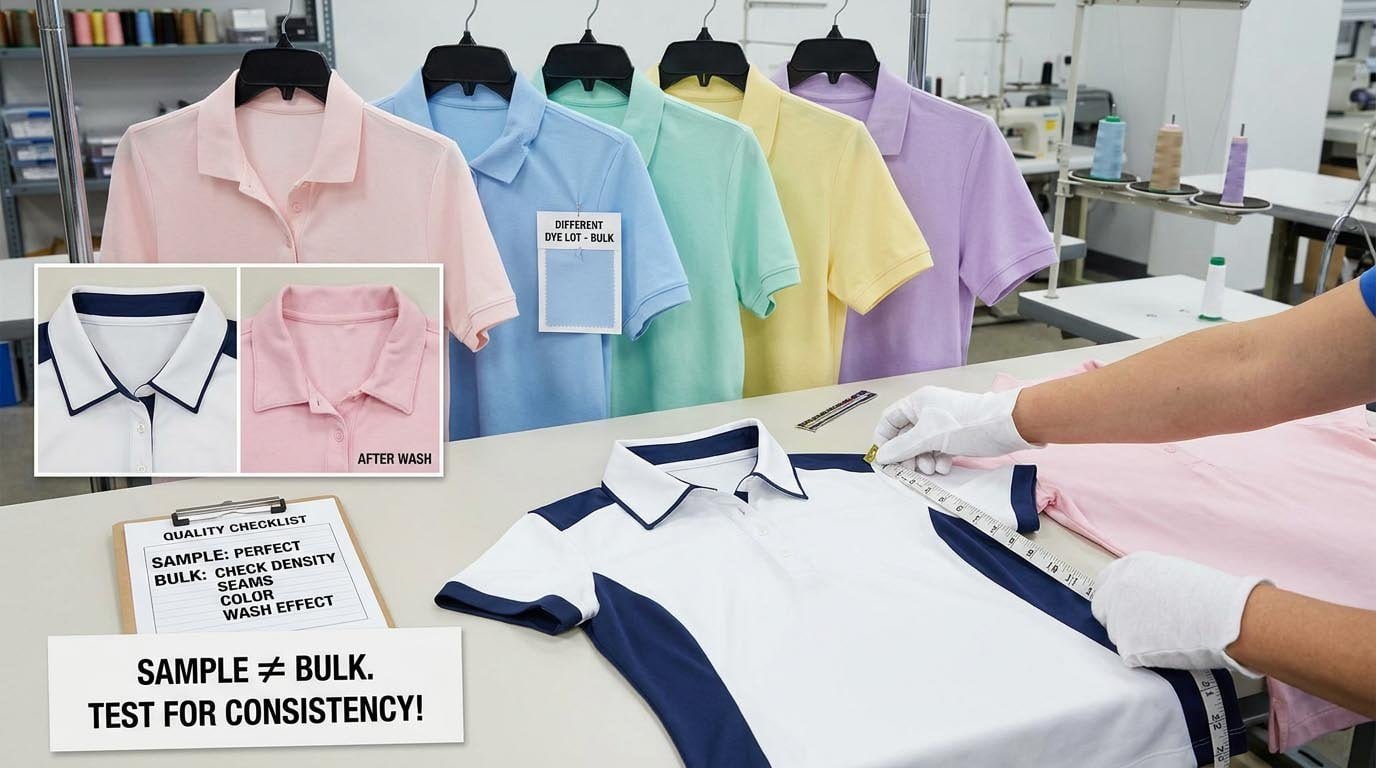
This is where many brands lose money.
A development sample is often:
- cut more carefully
- sewn more slowly
- pressed more cleanly
- checked by senior staff
- made from a different fabric batch than bulk
Bulk production is where real quality problems show up:
- stitch density becomes inconsistent
- seam allowances shrink
- collar shape changes
- color varies by dye lot
- fabric recovery weakens
- sizing drifts across the run
A sample can pass all visual checks and still fail in real production.
Common sample-to-bulk quality gaps
| Sample Stage | Bulk Production Risk |
|---|---|
| Carefully prepared sample yardage | Bulk fabric behaves differently after wash |
| Hand-checked stitching | Faster lines create uneven seam quality |
| Perfect collar pressing | Collar fusing fails after repeated wash |
| One approved size | Poor grading creates inconsistent fit across sizes |
| Single color approval | Dye lot variation changes final appearance |
This is why checking one polished sample is not enough.
To verify women’s golf polo shirt quality before bulk orders, you need to inspect:
- pre-production samples
- size set samples
- wash-tested samples
- bulk production pieces or TOP samples when possible
If you only approve the sample, you are approving appearance. If you test production consistency, you are approving quality.
What Fabric Tests Should You Do Before Bulk Golf Polo Production?
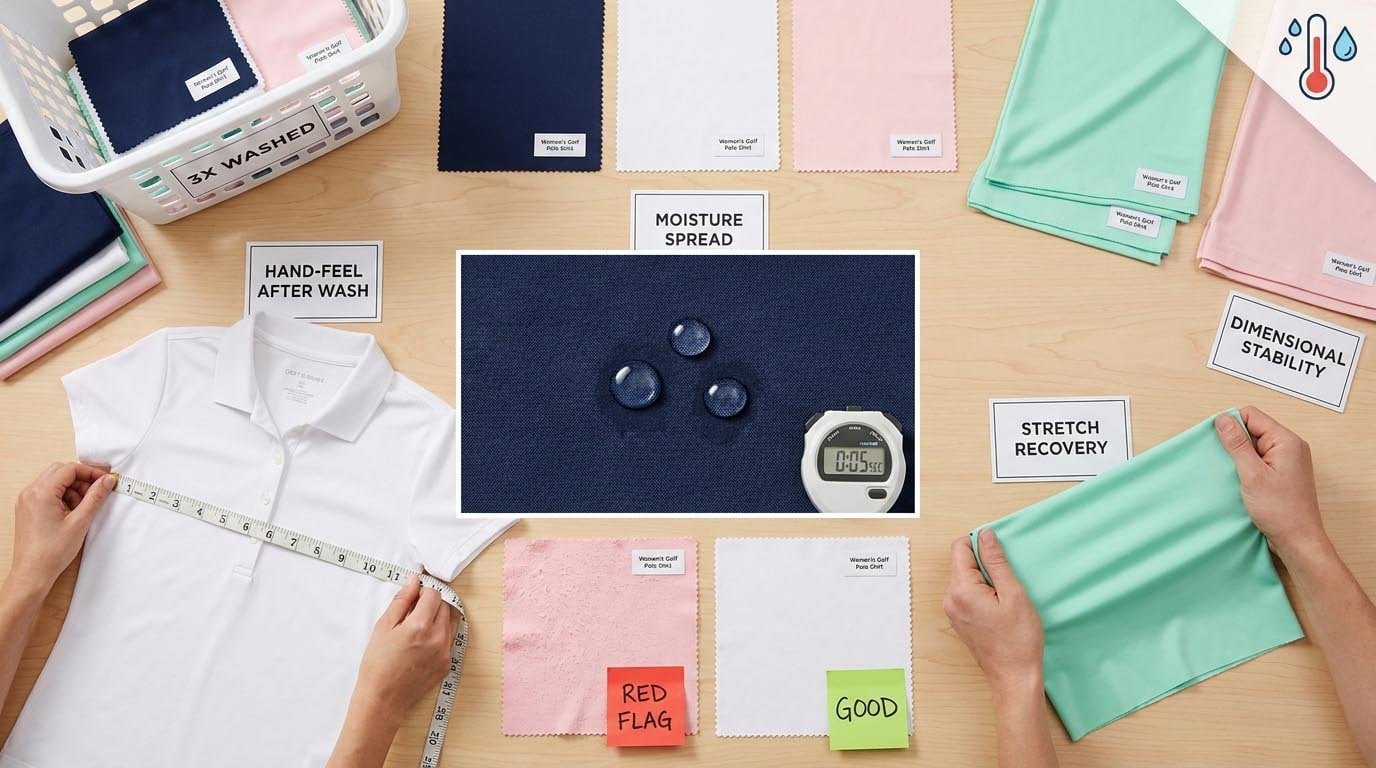
Fabric quality should be judged by how it performs after washing and wear, not just how it feels when new.
1. Test hand-feel after 3 home washes
A fresh fabric can feel smooth because of finishing treatments or temporary softeners.
That does not mean it will still feel good after customers wear and wash it.
Check:
- softness
- drape
- stiffness
- surface texture
- odor after washing
Red flags:
- the fabric becomes cardboard-stiff
- the surface turns rough
- the fabric becomes slimy or coated
- the hand-feel changes dramatically
2. Test moisture-wicking in a simple real-world way
Do not rely only on lab claims.
A practical test:
- pour water onto the fabric surface
- time how quickly it absorbs
- watch whether the moisture spreads outward
Good performance usually means:
- absorption begins quickly
- moisture spreads horizontally
- the wet area does not remain concentrated in one spot
If water beads or sits on the surface, the moisture management is weak or only treatment-based.
3. Check stretch recovery
Stretch fabrics are common in women’s golf polos, but stretch alone is not enough. The key is recovery.
Basic test:
- stretch the fabric
- hold briefly
- release
- compare how close it returns to original width and shape
Poor recovery leads to:
- elbow bagging
- waist distortion
- neckline shape loss
- loose-looking body fit after wear
4. Check dimensional stability after wash
Shrinkage or uneven relaxation is a major quality risk.
Measure before and after washing:
- body length
- bust width
- sleeve length
- hem width
- collar dimensions
If shrinkage is inconsistent from one piece to another, bulk quality will likely become a return issue.
5. Evaluate breathability in use, not just on paper
A fabric can sound technical but still feel hot on the body.
Wear test questions:
- does the shirt trap heat?
- does the back stay wet too long?
- does it feel sticky in humid conditions?
- does it remain comfortable during movement?
Fabric performance test table
| Test | What It Checks | Good Sign | Red Flag |
|---|---|---|---|
| 3-wash hand-feel | Finish durability | Similar feel after wash | Stiff, rough, limp, chemical feel |
| Water absorption test | Moisture response | Fast wetting and spread | Water beads or pools |
| Stretch recovery | Shape retention | Returns close to original shape | Stays stretched or deformed |
| Post-wash measurement | Dimensional stability | Small and consistent change | Uneven shrinkage or distortion |
| Wear test | Comfort and breathability | Drying comfort, less heat build-up | Sticky, hot, slow-drying feel |
How to Check Construction Quality in Women’s Golf Polo Shirts
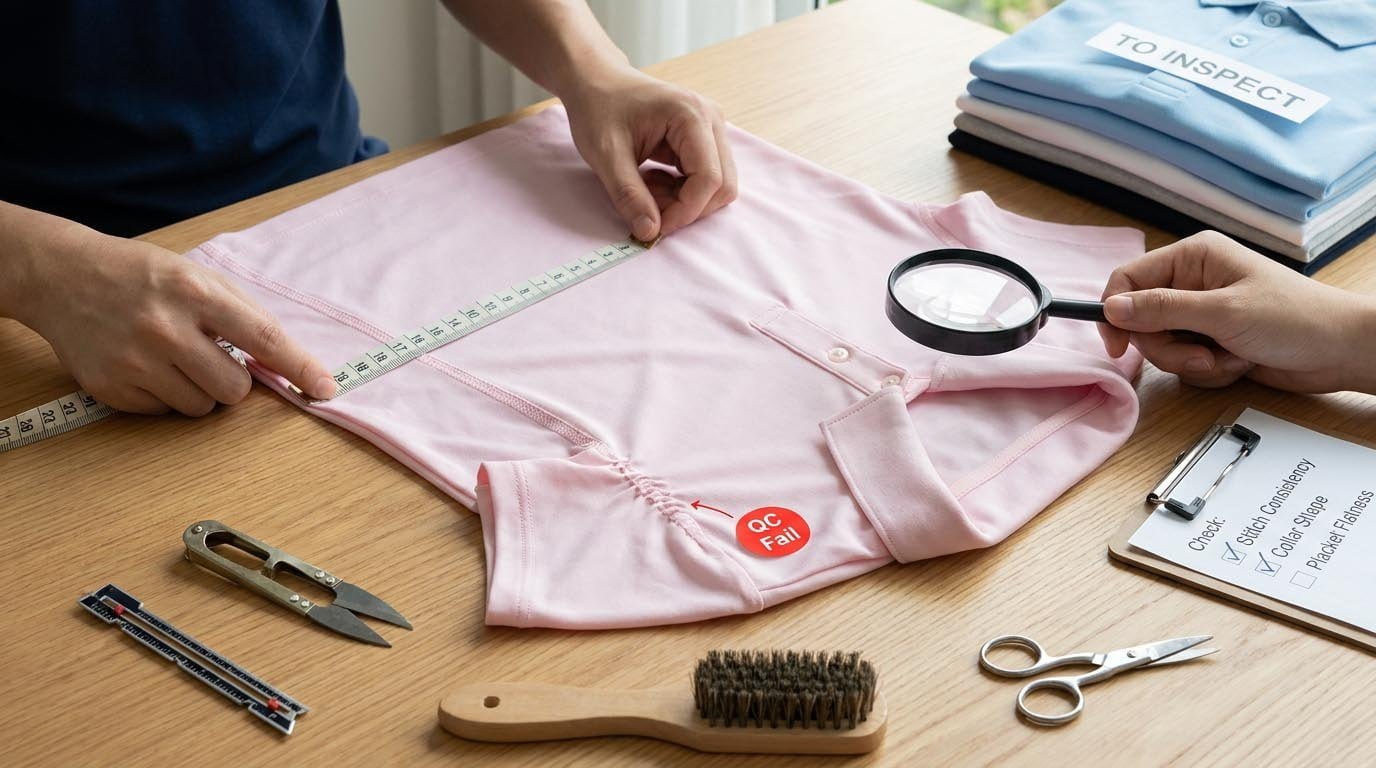
Construction quality often looks good in samples and weakens in bulk.
1. Inspect stitch density
Critical seams should have stable, even stitch density.
Check:
- side seams
- shoulder seams
- armhole seams
- placket attachment
- hem stitching
Problems to watch for:
- long uneven stitches
- loose tension
- seam puckering
- skipped stitches
- thread ends left untrimmed
2. Pull-test the seams
Use moderate hand force to test:
- side seams
- sleeve seams
- placket base
- vent opening
- hem join points
Seams should not:
- gap open
- ripple excessively
- show thread strain too early
3. Check collar quality after washing
Collar quality is a major quality signal in polo shirts.
Inspect:
- collar symmetry
- collar point alignment
- stand shape
- fusing stability
- edge smoothness
Common collar defects:
- bubbling from poor fusing
- one point longer than the other
- collar roll inconsistency
- waviness after wash
- twisting or collapse
4. Check placket quality
The placket should sit flat and clean.
Problems include:
- puckering
- twisting
- uneven width
- topstitch misalignment
- button spacing inconsistency
5. Turn the garment inside out
Interior construction often reveals the truth faster than the outside.
Look for:
- uneven seam allowance
- poor overlock finish
- exposed loose threads
- inconsistent stitching paths
- visible puckering not fixed by pressing
Construction inspection table
| Construction Area | What to Inspect | Red Flag |
|---|---|---|
| Side seams | Stitch consistency and seam strength | Gapping, puckering, loose tension |
| Armholes | Smooth seam attachment | Ridge, twist, skipped stitches |
| Collar | Symmetry and fusing | Bubbling, waves, uneven collar points |
| Placket | Flatness and alignment | Twisting, puckers, uneven width |
| Hem | Even stitching and clean finish | Rolling, twisting, visible tension changes |
How to Test Fit and Size Consistency Before Bulk Orders
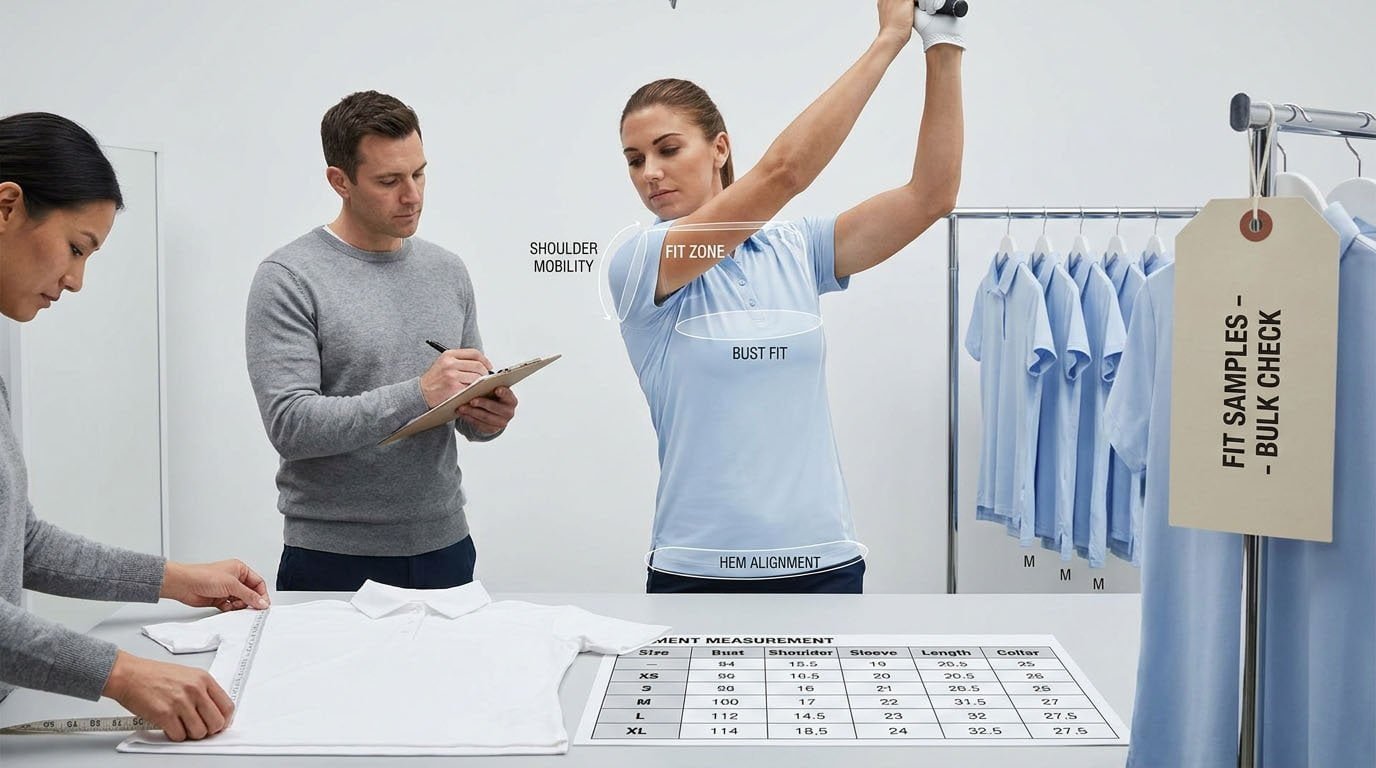
Fit problems are one of the biggest reasons women’s golf polos fail after launch.
Why fit issues appear in bulk
A single sample size does not prove the whole size range works.
Bulk problems often come from:
- weak grading
- different fabric stretch behavior
- cutting variation
- inconsistent fabric relaxation before cutting
- poor marker control
What to test before approval
1. Request a size set
Do not approve only one size.
Check at least the full size range you plan to sell.
2. Measure multiple pieces
Flat measurements should be checked across several garments, not just one.
Important points:
- bust
- waist
- body length
- shoulder width
- sleeve opening
- sleeve length
- collar width
- placket length
3. Test movement on body
Women’s golf polos need both appearance and mobility.
Check during movement:
- full shoulder rotation
- arm raise
- swing simulation
- sitting and bending
- torso turning
Critical fit zones for women’s golf polos
| Fit Zone | Why It Matters | What to Check |
|---|---|---|
| Bust area | Comfort and shape | No pulling, flattening, or excess strain |
| Shoulder and sleeve cap | Swing mobility | Arms lift without pulling body upward |
| Waist shape | Visual fit and comfort | Contour should not distort after movement |
| Hem line | Stability during play | Front and back should sit evenly |
| Side seam | Balance and appearance | Should fall straight without twisting |
Size consistency rules
When checking multiple pieces from production, watch for:
- body length variation
- sleeve mismatch
- collar size drift
- uneven bust measurements
- side seam twisting
If measurements vary too much across the same size, the factory may have weak cutting or in-line QC.
Fit consistency checklist
- compare 5 to 10 pieces in the same size
- compare all sizes in the size set
- test garments after washing
- test on real bodies when possible
- compare flat measurements with wear behavior
How to Check Colorfastness, Pilling, and Durability
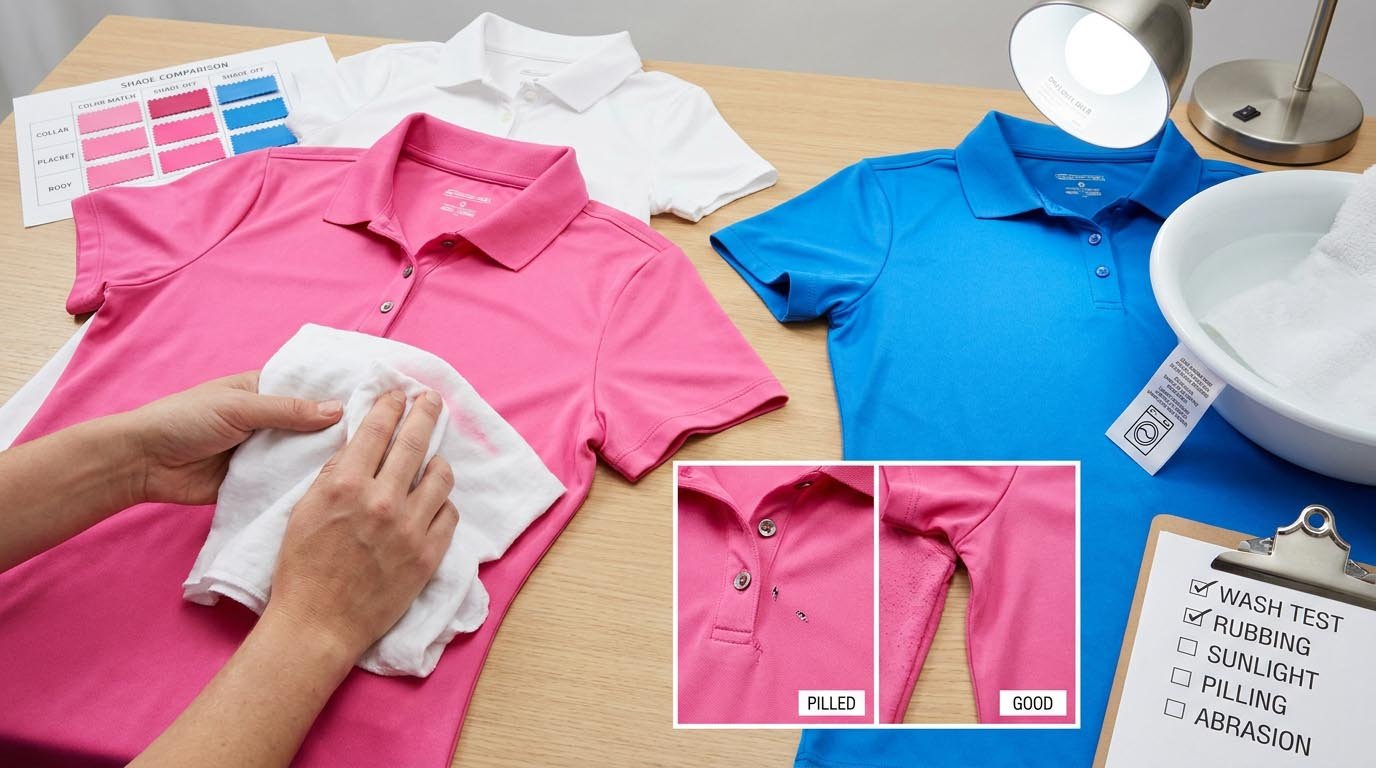
A women’s golf polo can look premium on day one and fail after a few wears if durability is weak.
1. Test colorfastness
Check whether color stays stable after:
- washing
- rubbing
- sweating
- sunlight exposure
- contact with lighter fabrics
Simple checks:
- wash a colored shirt with white fabric
- rub with a white cloth when dry and slightly wet
- compare washed pieces against original samples
- observe color under daylight, not only indoor factory lighting
2. Check dye lot consistency
Even if one sample is approved, bulk color can vary by fabric batch or dye lot.
Compare:
- collar and body shade
- multiple bulk pieces side by side
- sample vs production under daylight
- light and dark tones in the same order
3. Test pilling resistance
Pilling quickly makes polos look worn and low quality.
- underarm area
- side body
- sleeve underside
- contact zones with golf bags, seat belts, and bras
4. Check abrasion and snagging response
Women’s golf polos often contact:
- bag straps
- zippers
- jewelry
- watch edges
- sunscreen and sweat
Inspect for:
- pulled yarns
- surface fuzzing
- roughened texture
- obvious face damage
Durability testing table
| Test Type | What It Reveals | Red Flag |
|---|---|---|
| Wash fastness | Color durability after laundering | Fading, bleeding, uneven shade loss |
| Crocking test | Dry/wet rubbing stability | Color transfer to white cloth |
| Pilling test | Surface durability | Fuzz balls or rough surface early |
| Abrasion check | Wear resistance | Surface breakdown in contact zones |
| Sunlight comparison | Outdoor durability | Noticeable fading after exposure |
Care label reality check
A care label should reflect how customers actually wash the product.
If the shirt only survives under ideal treatment but not under normal home laundering, returns are likely.
A quality polo is not just one that looks good in the box. It should still look good after repeated wear, washing, and movement.
How to Verify Buttons, Labels, and Compliance Before Shipment
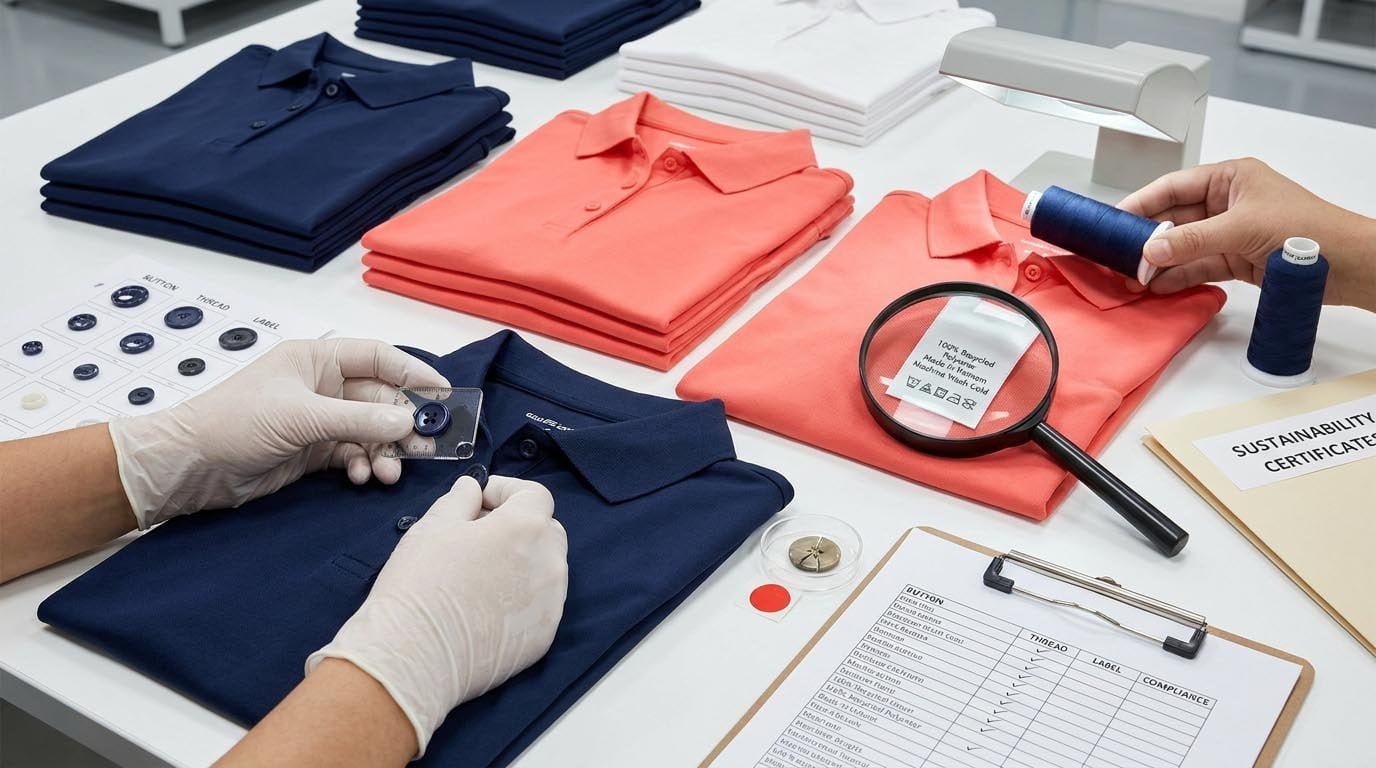
Small details create very visible failures.
1. Check buttons and button attachment
Inspect:
- button color consistency
- button thickness and edge quality
- attachment strength
- secure shank formation
- buttonhole sizing
Common failures:
- cracked buttons
- loose attachment
- weak thread
- buttonholes too tight or too loose
2. Check thread quality and color match
Thread problems often show up later as:
- seam opening
- color mismatch
- loose stitching
- poor durability after wash
Always check thread under:
- daylight
- warm indoor light
- cool LED light
3. Verify label accuracy
Incorrect labels can create compliance issues and customer claims.
Check:
- fiber content
- country of origin
- care instructions
- size labels
- brand labels
- legal formatting where required
4. Confirm sustainability claims only with proof
If the product is sold as recycled or certified, verify supporting documentation before shipment.
Do not rely only on verbal confirmation.
Trim and label verification table
| Item | What to Verify | Red Flag |
|---|---|---|
| Buttons | Attachment, finish, wash durability | Cracking, loosening, mismatch |
| Buttonholes | Size and finish | Fraying, tight passage, distortion |
| Thread | Strength and color match | Early breakage, visible mismatch |
| Care labels | Correct washing instructions | Wrong symbols or misleading care info |
| Fiber labels | Accurate composition | Mismatch with actual fabric |
| Origin labels | Correct country information | Missing or incorrect declaration |
Women’s Golf Polo Quality Inspection Checklist
Use this checklist before approving bulk production or shipment.
Fabric
- [ ] Fabric still feels good after 3 washes
- [ ] Moisture spreads rather than pooling
- [ ] Stretch recovery remains stable
- [ ] No major shrinkage or distortion after wash
- [ ] Breathability feels acceptable in wear test
Construction
- [ ] Side seams are even and secure
- [ ] Armholes are smooth and not twisted
- [ ] Collar points are symmetrical
- [ ] Collar stays clean after wash
- [ ] Placket lies flat
- [ ] Hems are even and do not twist
- [ ] Inside finishing is clean
Fit and consistency
- [ ] Full size set reviewed
- [ ] 5 to 10 pieces measured for consistency
- [ ] Bust, length, sleeve, and waist checked
- [ ] Swing and movement tested
- [ ] Washed garments still fit correctly
Durability
- [ ] No obvious color bleeding
- [ ] Minimal fading after wash testing
- [ ] No early pilling in friction areas
- [ ] No obvious snagging weakness
- [ ] Care instructions match real use expectations
Trims and labels
- [ ] Buttons are secure
- [ ] Buttonholes are clean and usable
- [ ] Thread color matches garment
- [ ] Fiber content label is correct
- [ ] Care label is correct
- [ ] Country of origin label is correct
- [ ] Any certification claims are documented
Common Mistakes Brands Make Before Bulk Orders
1. Approving only one perfect sample
One polished sample does not prove repeatable production quality.
2. Trusting lab reports without wear testing
A fabric can pass technical tests and still feel bad after washing or real use.
3. Skipping wash tests
Many problems only appear after laundering:
- shrinkage
- bubbling collars
- fading
- texture change
- pilling
4. Checking only one size
A medium can fit well while other sizes fail badly due to poor grading.
5. Ignoring trim and label details
Broken buttons, wrong care labels, and origin label mistakes can create returns or customs problems.
6. Not comparing multiple bulk pieces
Real quality control means checking consistency across several garments, not one piece.
7. Focusing on fabric specs more than production control
Spec sheets matter, but production consistency matters more.
The biggest quality mistake is confusing a good sample with a reliable supplier.
FAQ: Women’s Golf Polo Shirt Quality Control
How do you check women’s golf polo shirt quality before bulk orders?
Check post-wash fabric feel, moisture management, stretch recovery, seam quality, collar retention, size consistency, colorfastness, pilling resistance, and label accuracy across multiple pieces, not just one sample.
Why is sample quality different from bulk order quality?
Samples are often made more carefully and may use different fabric handling, sewing attention, or finishing. Bulk production introduces variation in cutting, stitching, fusing, washing behavior, and dye lots.
What is the most important fabric test before bulk production?
A 3-wash test is one of the most useful checks because it reveals texture change, shrinkage, finish durability, and general fabric stability after normal use.
How do I test moisture-wicking in a golf polo shirt?
Pour a small amount of water on the fabric and observe how quickly it absorbs and spreads. Good performance usually shows fast wetting and outward spreading rather than pooling in one spot.
How do I know if a polo collar will lose shape?
Wash the shirt several times and recheck collar symmetry, bubbling, point alignment, and edge smoothness. Poor fusing or unstable interlining often causes waves and separation.
What causes size inconsistency in bulk apparel orders?
Common causes include poor grading, uneven fabric relaxation before cutting, cutting variation, and weak in-line quality control during production.
How many pieces should I inspect before approving bulk quality?
Do not rely on one piece. It is better to inspect multiple garments from the same production run and compare measurements, construction details, and finishing consistency side by side.
What durability tests matter most for women’s golf polos?
The most practical checks are wash fastness, pilling resistance, snag response, stretch recovery, seam strength, and overall appearance retention after repeated home laundering.
Are buttons and labels really that important?
Yes. Small trim failures are highly visible to customers and label mistakes can create compliance, customs, or returns issues.
Can lab reports replace physical inspection?
No. Lab reports are useful, but they do not replace wash testing, wear testing, and inspecting real production pieces from the actual order.
Final Takeaway
To verify women’s golf polo shirt quality before bulk orders, focus on real performance and production consistency, not just technical claims or one approved sample.
A reliable quality control process should confirm that the shirt:
- still feels good after washing
- keeps its shape and fit
- manages moisture well
- holds color
- resists pilling and seam failure
- maintains collar and placket appearance
- stays consistent across the full bulk run
- includes correct trims, labels, and compliance details
The key question is not:
“Does this sample look good?”
The real question is:
“Can this supplier deliver the same quality across the full order?”
That is the standard that protects your margin, your product reputation, and your next reorder.