Critical garment defects involve safety hazards or serious regulatory noncompliance. Major defects significantly affect fit, function, durability, appearance, or saleability. Minor defects are smaller departures from the agreed workmanship standard that do not substantially affect use or saleability.
The defect name alone does not determine its grade. A stain, skipped stitch, or loose thread must be assessed against its location, extent, functional impact, and the buyer-approved requirements.
For apparel brands, importers, and manufacturers, the practical goal is to agree on these boundaries before production—not negotiate them after an inspection fails.
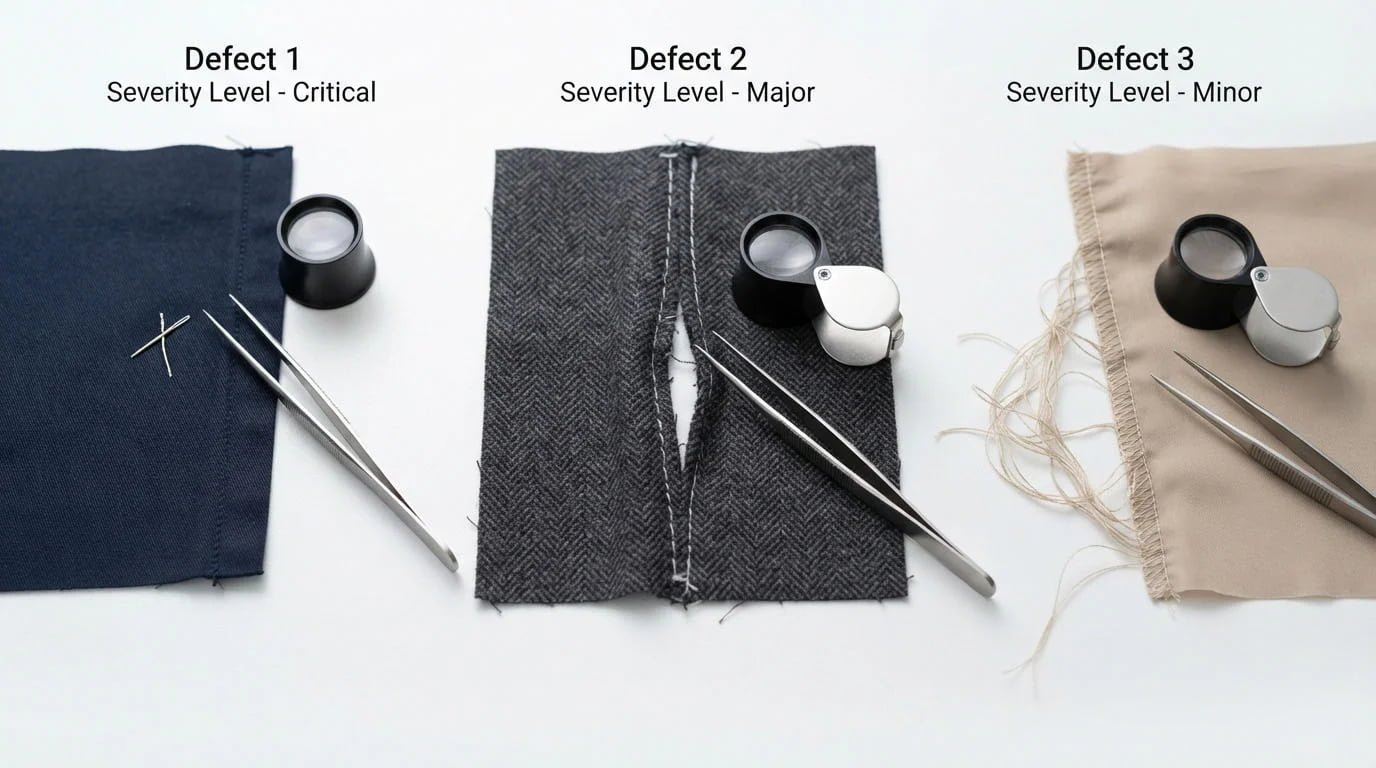
What Is the Difference Between Critical, Major, and Minor Defects?
Use the following table as a starting framework. Final classifications should follow the approved defect catalogue for the order.
| Classification | Main concern | Illustrative garment example | Initial response |
|---|---|---|---|
| Critical | Safety hazard or serious regulatory noncompliance | A sharp needle fragment embedded in a collar | Isolate affected goods and escalate immediately |
| Major | Significant loss of function, durability, fit, appearance, or saleability | A crotch seam that opens during the agreed functional check | Record and hold affected units for disposition |
| Minor | Limited workmanship or cosmetic nonconformity | An interior thread tail exceeding the agreed trimming standard without seam instability | Record, correct where required, and apply the inspection plan |
| Conforming variation | Difference that remains within approved requirements | A garment measurement inside its specified tolerance | Pass that characteristic |
A conforming variation is not automatically a minor defect. First establish whether a requirement has actually been missed.
Also separate the classification of a defect from the acceptance of a production lot. A major defect on one garment does not, by itself, determine the result for the entire shipment.
Examples of Critical, Major, and Minor Garment Defects
Critical Defects: Safety and Serious Compliance Risks
Examples include sharp needle fragments or hardware edges that could injure the wearer. A confirmed failure against an applicable safety requirement also needs immediate escalation.
Safety concerns take priority even when the problem is hidden or affects only a small area.
Regulatory issues require their own review. For the U.S. market, most covered textile products need fiber-content, country-of-origin, and responsible-business identification; covered garments also require care information. A label problem should be checked against the applicable requirement rather than treated as ordinary cosmetic variation. See the FTC’s textile-labeling guidance and care-labeling guidance. Federal Trade Commission
Not every labeling mistake has the same severity. Record the actual noncompliance, apply the approved classification, and prevent release until the applicable requirements are satisfied.
Major Defects: Significant Functional or Commercial Problems
Typical examples include:
- An open structural seam.
- A broken zipper that prevents normal closure.
- A prominent stain on the front of a light-colored polo.
- Incorrect branding or substantial logo distortion.
- Measurements outside approved tolerances that materially affect fit.
A garment becoming unusable does not automatically make the defect critical. For ordinary apparel, a nonfunctional closure is generally a major functional issue unless a safety consequence or the buyer’s approved classification requires different treatment.
Minor Defects: Limited Workmanship Deviations
A minor defect is still a departure from a requirement. Examples may include an interior trimming issue or a small stitch-appearance irregularity that exceeds the approved finish standard without weakening the seam.
Minor does not mean invisible, unlimited, or automatically acceptable. The issue must still be recorded and evaluated under the agreed plan.
Conversely, a slight color or measurement difference that meets all approved requirements should not be counted as a defect simply because it differs from the target value.
How Do Location, Visibility, and Function Change the Grade?
Assess appearance and functional importance separately.
The chest, collar, and placket of a golf polo are visually prominent. A crotch seam, pocket attachment, or underarm seam may be less visible but still important to durability and use.
An appearance-zone diagram can help inspectors work consistently, but a hidden location does not make a structural problem minor.
| Finding | Lower-impact situation | Higher-impact situation | Classification principle |
|---|---|---|---|
| Thread tail | Exceeds the interior trimming standard but is not unraveling | Stitching is coming undone and the seam opens | Distinguish finishing from seam failure |
| Skipped stitch | Isolated appearance issue with construction still meeting functional requirements | Seam gapes or fails the specified check | Judge construction and durability |
| Stain | Small, low-contrast interior mark outside the approved finish standard | Prominent mark on the chest of a white polo | Consider size, contrast, location, and permanence |
| Logo distortion | Small deviation meeting the approved appearance standard | Puckering or incorrect placement outside approved limits | Conforming work passes; material nonconformity may be major |
| Fabric hole | Suspected mark requiring closer examination | Confirmed yarn damage or a hole that expands during the agreed check | Verify the damage before assigning severity |
These are decision examples, not universal size thresholds.
For stretch golf apparel, use the specified functional checks where needed. A seam can look acceptable when flat yet fail during the approved extension test. Visual inspection alone cannot establish every durability or performance claim.
For decoration-specific inspection methods, see our embroidery quality control checklist.
How Should You Use the Tech Pack and Approved Sample?
Use a coordinated set of approved references:
- The current purchase order and technical specification.
- The measurement chart, POM definitions, and tolerances.
- The approved pre-production sample.
- Artwork, color, trim, and label approvals.
- The defect catalogue and inspection plan.
- Documented changes approved after sampling.
The sample provides a physical reference for appearance and construction. It does not override applicable requirements or automatically settle a conflict with the latest written specification.
If the documents disagree, clarify the requirement in writing before making a final acceptance decision.
Measurement Example: Pass Is Different From Minor
Suppose the approved flat half-chest measurement is 54.0 cm, with a tolerance of ±1.0 cm.
| Actual measurement | Result for that POM |
|---|---|
| 54.7 cm | Within tolerance: pass |
| 55.0 cm | At the upper limit: pass |
| 55.3 cm | Outside tolerance: record a nonconformity |
The out-of-tolerance result then follows the approved classification and corrective-action rules. It should not be reclassified simply to obtain a passing inspection.
At FUWAY, specified finished-garment measurements must remain within ±1.0 cm, with tighter limits applying where approved in the tech pack. See our golf apparel measurement tolerance guide for measurement-specific details.
Build a Garment Defect Classification Matrix Before Production
A useful matrix explains what the inspector should observe, which requirement applies, and how uncertain findings should be handled.
Avoid entries such as “bad stitching” or “small stain” without supporting criteria.
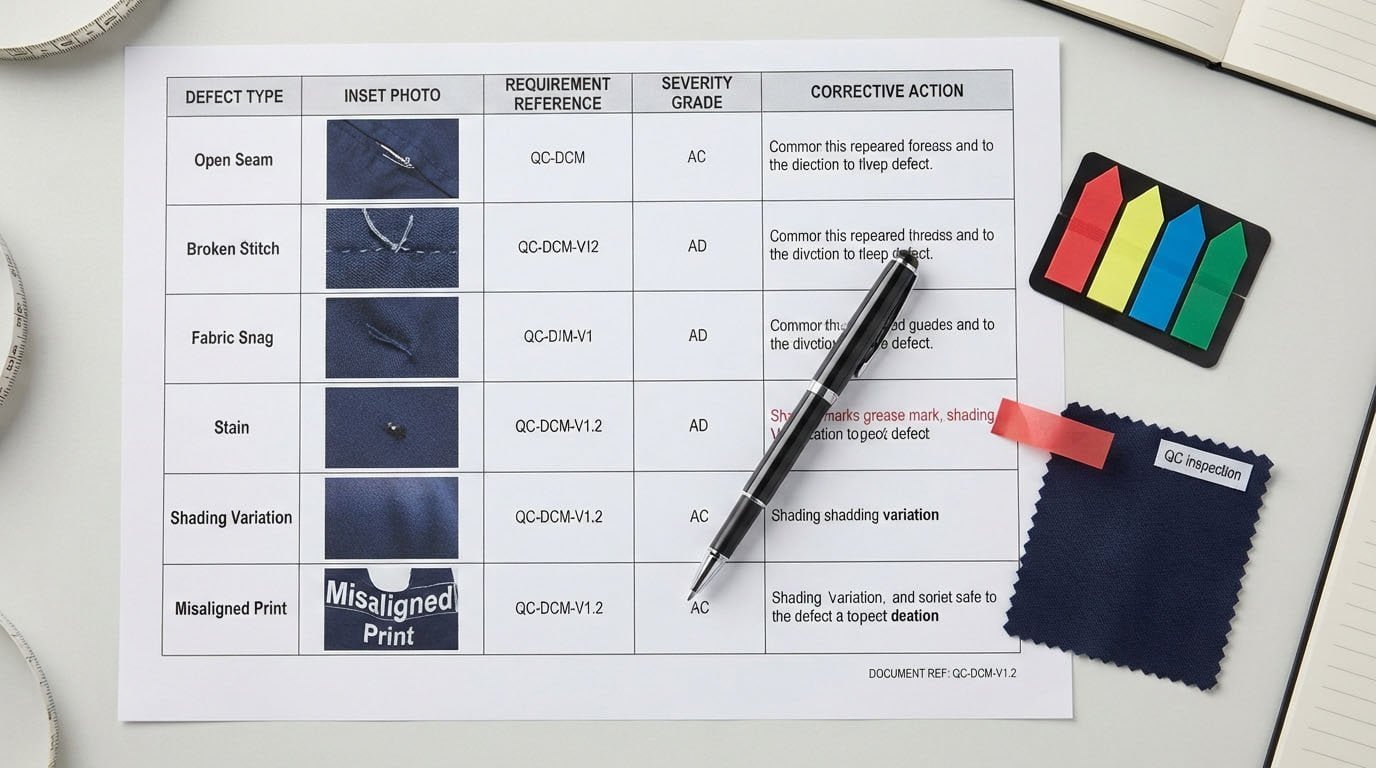
Use this framework to develop an order-specific catalogue:
| Defect or finding | Required reference or evidence | Classification approach | Required action |
|---|---|---|---|
| Needle fragment | Garment identification and documented finding | Critical safety hazard | Isolate and investigate affected production |
| Open structural seam | Construction specification and agreed functional check | Major where integrity or intended use is impaired | Hold, correct, and reinspect |
| Logo placement error | Approved artwork, measurement method, and tolerance | Apply the agreed appearance classification | Record deviation and confirm disposition |
| Measurement deviation | Current POM chart and actual reading | Pass within tolerance; classify genuine nonconformity | Remeasure if needed and document |
| Interior thread tail | Trimming standard and seam condition | Minor only where it breaches the standard without functional impact | Trim and verify |
| Required label error | Approved label and applicable requirement | Compliance review and approved catalogue determine severity | Correct and verify before release |
Add photographs showing acceptable work, a borderline condition, and an unacceptable condition where practical. Include a scale when defect size matters.
Each catalogue should also identify:
- Its revision and approval date.
- The styles and materials covered.
- The inspection conditions and methods.
- Who reviews borderline findings.
- How defects and affected garments are counted.
- Which corrective actions require reinspection.
Numerical thresholds should come from the approved product standard. Do not copy millimeter limits from an unrelated garment or retailer manual.
How Does Defect Classification Relate to AQL?
Classification describes the seriousness of a finding. Acceptance sampling determines how the inspection results affect the lot decision.
A sampling plan such as ANSI/ASQ Z1.4 specifies a system of sample selection and acceptance criteria. Before inspection, confirm the lot definition, inspection level, applicable plan, sample size, and acceptance and rejection numbers. ASQ
The counting method also matters. A garment with several findings creates different records depending on whether the plan counts nonconforming units or individual nonconformities. State the method in advance.
Keep three limits separate:
| Limit | What it controls |
|---|---|
| Product tolerance | Whether a characteristic meets specification |
| Defect classification rule | The severity of a nonconformity |
| Sampling acceptance criterion | Whether the inspected lot meets the agreed acceptance plan |
An AQL value is not permission to deliberately ship that percentage of defective clothing.
Where the critical-defect rule is acceptance number 0, rejection number 1, one critical finding fails that inspection. Finding none in a sample does not prove the entire lot contains no hazards.
For the broader inspection process, see our Golf Apparel Quality Control Guide.
What Should Buyers Do When a Defect Is Found?
Use a consistent sequence:
- Identify the requirement. Record the specification, sample, or catalogue reference.
- Check safety and compliance. Isolate suspected hazards and escalate unresolved compliance concerns.
- Evaluate function and appearance. Consider durability, fit, visibility, extent, and the agreed checks.
- Record the classification and evidence. Identify the garment, size, color, batch, and defect location.
- Apply the inspection plan. Use the agreed counting and acceptance rules.
- Verify corrective action. Confirm repairs and required reinspection before release.
For a borderline finding, retain the original evidence and seek a documented decision from the authorized reviewer. Do not quietly downgrade it to make the lot pass.
Suspected chemical contamination needs investigation and, where appropriate, testing. Odor alone does not establish the identity or concentration of a hazardous substance.
For shipment-release evidence, use our pre-shipment QC checklist for buyers.
Frequently Asked Questions
Can several minor defects become one major defect?
Only if the approved inspection protocol defines that rule. There is no universal conversion such as “two minors equal one major.” Document accumulation rules and the counting method before inspection.
Can a buyer accept a lot that failed inspection?
A buyer may authorize a documented concession for certain commercial nonconformities where permitted. The original inspection result should remain traceable. Commercial approval does not remove applicable legal obligations or unresolved safety concerns.
Does finding a critical defect mean every garment must be scrapped?
No. It requires containment and investigation. The disposition may involve sorting, corrective action, further verification, rejection, or disposal, depending on the hazard and applicable requirements. Removing the one discovered item does not establish that the rest are safe.
Are loose threads always minor defects?
No. An isolated trimming issue differs from unraveling stitches or a loose seam. A thread tail meeting the approved finish standard may not be a defect at all.
Can photographs replace physical inspection?
Photographs help communicate location and appearance. They cannot establish every measurement, seam-strength, chemical, or durability requirement. Use the specified inspection or test method for the characteristic being assessed.
Conclusion
Classify garment defects by the requirement missed and the consequence of that failure. Safety and serious compliance concerns need immediate escalation; significant fit, function, durability, and appearance problems generally belong in the major category; smaller workmanship nonconformities may be minor. Variations that meet the approved requirements should pass.
Before bulk production, align the tech pack, approved sample, defect catalogue, counting rules, and sampling plan. That gives the brand, factory, and inspector a shared basis for consistent decisions.
Developing custom golf shirts? Contact FUWAY with your tech pack, reference sample, and quality requirements to discuss the inspection criteria for your order.