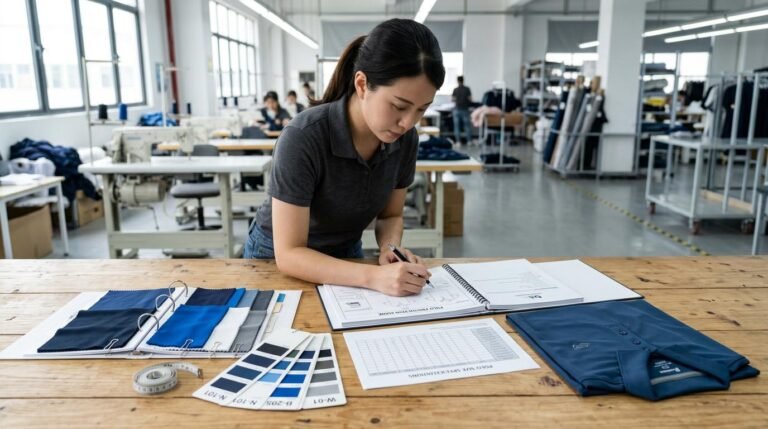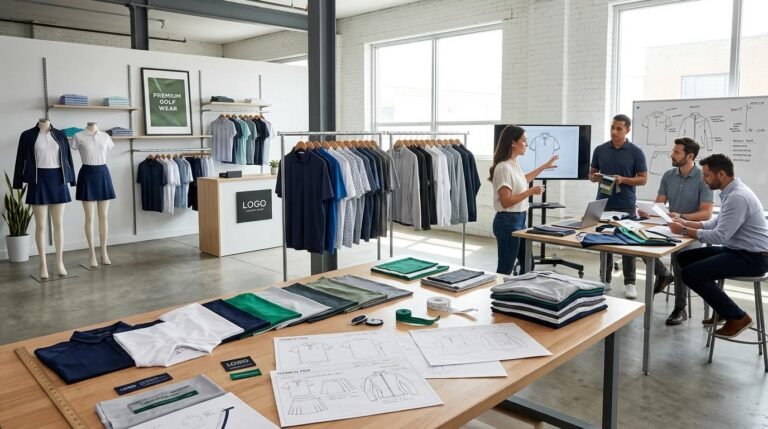
Choosing the best fabric for premium golf apparel is not about picking the heaviest material, the stretchiest blend, or the longest supplier spec sheet.
It is about choosing fabric that fits:
- your target climate
- your garment category
- your customer’s performance expectations
- your retail price point
A fabric that feels premium in California can feel heavy and uncomfortable in Florida. A polo fabric that works well for tops can fail completely in trousers. And a fabric that looks impressive in a showroom can still create returns if it pills, shrinks, or loses shape after repeated wear.
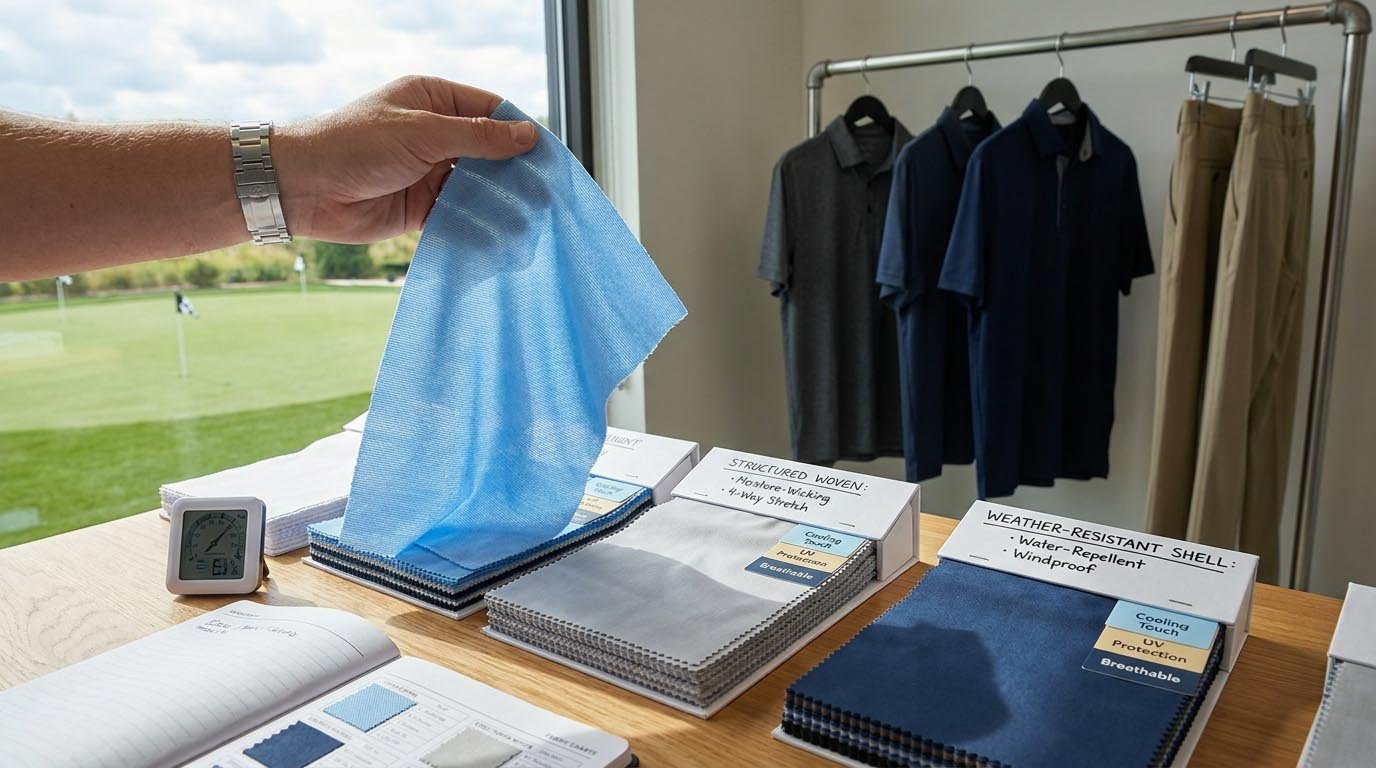
In this guide, I’ll explain how to choose the right fabric for:
- premium golf polos
- golf trousers and shorts
- golf outerwear
- different climate zones
- different price tiers
- better performance and lower return risk
I’m Will from FUWAY. Over the past 12 years, I’ve helped more than 200 brands develop golf apparel collections. This article is based on the most common fabric selection mistakes I’ve seen—and what works better in real production.
Quick Answer: Best Fabrics for Premium Golf Apparel
If you want the short answer first, here is the best starting point for most premium golf apparel programs.
Best fabric for premium golf polos
For most brands, the safest option is:
- 92-95% polyester / 5-8% spandex
- 180-240 GSM
- single-jersey or pique construction
- moisture-wicking performance
- UPF treatment for white or light colors
Then adjust by climate:
- Humid hot climates: 180-200 GSM, single-jersey or lightweight pique
- Dry hot climates: 220-240 GSM, pique or textured jersey
- Temperate climates: 240-260 GSM, interlock or double-pique
Best fabric for golf trousers and shorts
Golf bottoms usually need:
- 240-300 GSM
- twill, double-weave, or structured woven stretch fabric
- 96-98% polyester / 2-4% spandex
Best fabric for golf outerwear
Golf outerwear usually performs best with:
- bonded fabrics
- laminated weather-protection fabrics
- DWR-treated woven fabrics
- polyester or nylon blends depending on use
Key takeaway:
There is no universal best fabric for golf apparel. The right fabric depends on climate, category, customer expectation, and target retail price.
Why Fabric Selection Matters in Golf Apparel
Golf apparel sits between sportswear and lifestyle apparel.
Customers expect it to:
- look polished
- feel comfortable over 4-5 hours
- stretch during the swing
- manage sweat and heat
- resist shrinking and bagging
- still look premium after repeated washing
That means your fabric has to balance several factors at the same time:
- breathability
- moisture management
- stretch and recovery
- durability
- appearance
- cost control
Many brands make the same mistakes:
- choosing fabric by showroom hand-feel
- assuming heavier means more premium
- adding every possible finish
- using one fabric across polos, bottoms, and outerwear
- skipping real wear testing
Those mistakes usually lead to one of two problems:
- the product feels good at launch but performs poorly after real use
- the product costs too much for the brand’s retail positioning
The best golf apparel fabric is not the most technical fabric. It is the one that performs well in the real market you are selling to.
Choose Golf Apparel Fabric by Climate
Climate should be your first filter.
The same “performance fabric” can behave very differently depending on humidity, temperature, and evaporation conditions.
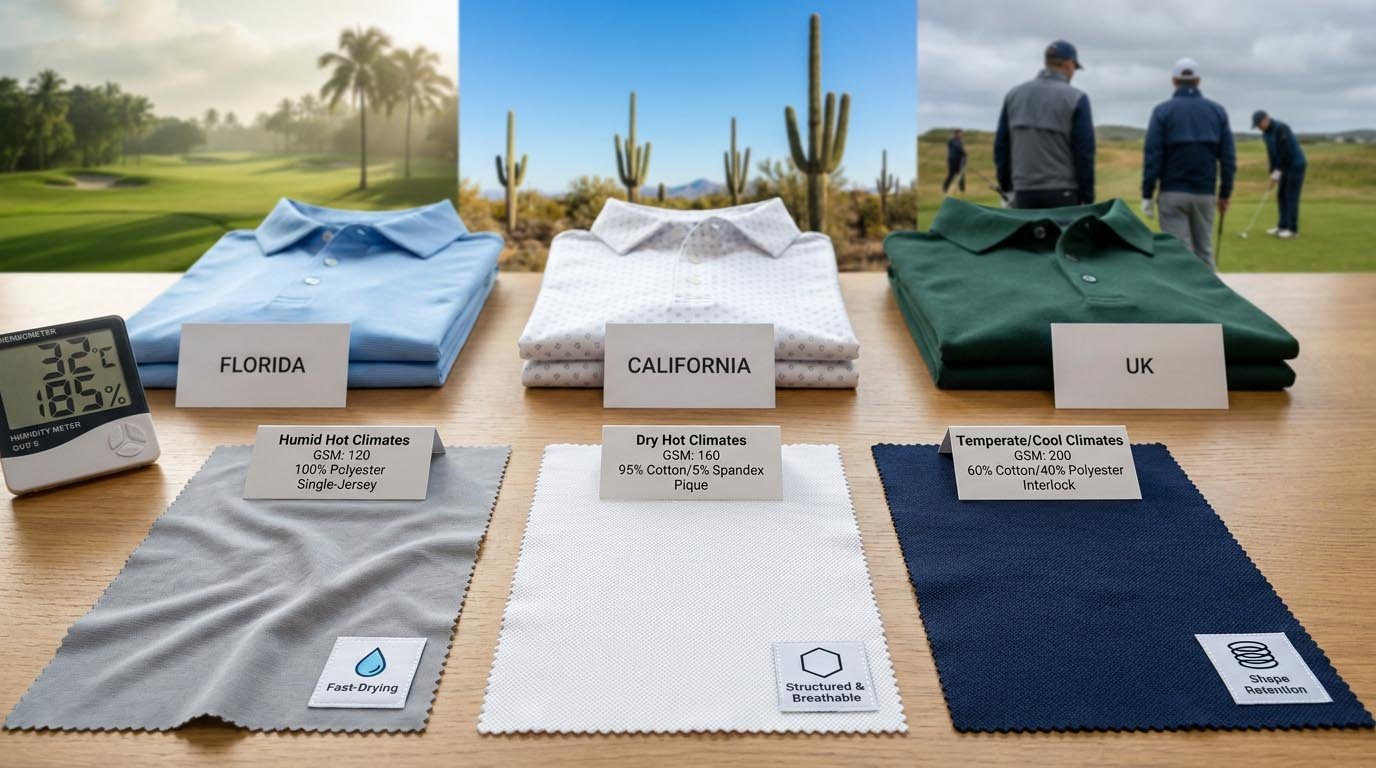
Why climate matters
A moisture-wicking label alone is not enough. Real comfort depends on:
- humidity level
- drying speed
- fabric weight
- knit or weave openness
- airflow around the body
A fabric that feels structured and premium in dry heat may feel heavy and clammy in humid heat.
Humid hot climates
Best for markets like:
- Florida
- Georgia
- Southeast US
- Southeast Asia
- Caribbean
- Gulf Coast
Recommended specs:
- 180-200 GSM
- single-jersey or lightweight pique
- 94-95% polyester / 5-6% spandex
- high air permeability
- fast-drying construction
Why it works:
In humid weather, sweat evaporates slowly. Heavier fabrics hold more moisture and stay damp longer. Lighter, more open constructions dry faster and reduce the wet-towel feeling many customers complain about.
Typical fabric cost:
- $6.50-9.50 per meter
Dry hot climates
Best for markets like:
- California
- Arizona
- Southwest US
- Middle East
- inland Australia
Recommended specs:
- 220-240 GSM
- pique or textured jersey
- 92-94% polyester / 6-8% spandex
- balanced breathability and structure
Why it works:
Dry air supports evaporation, so medium-weight fabrics can still feel comfortable. This gives brands more room to use structured fabrics that look premium without becoming overly hot.
Typical fabric cost:
- $8.50-11.50 per meter
Temperate or cooler climates
Best for markets like:
- UK
- Northern Europe
- Pacific Northwest
- Canada
Recommended specs:
- 240-260 GSM
- interlock or double-pique
- 90-92% polyester / 8-10% spandex
- more shape retention and moderate wind resistance
Why it works:
In cooler conditions, golfers often value structure, shape, layering comfort, and a more substantial hand-feel. Maximum breathability is less important than in humid summer markets.
Typical fabric cost:
- $9.50-14.00 per meter
Practical rule:
If you sell across very different regions, one fabric may not be enough. Many national brands perform better with two climate-based polo fabrics instead of one universal option.
Best Fiber Blends for Premium Golf Apparel
Fiber content shapes core performance.
It affects:
- moisture behavior
- drying speed
- softness
- stretch
- shrinkage
- durability
- long-term appearance
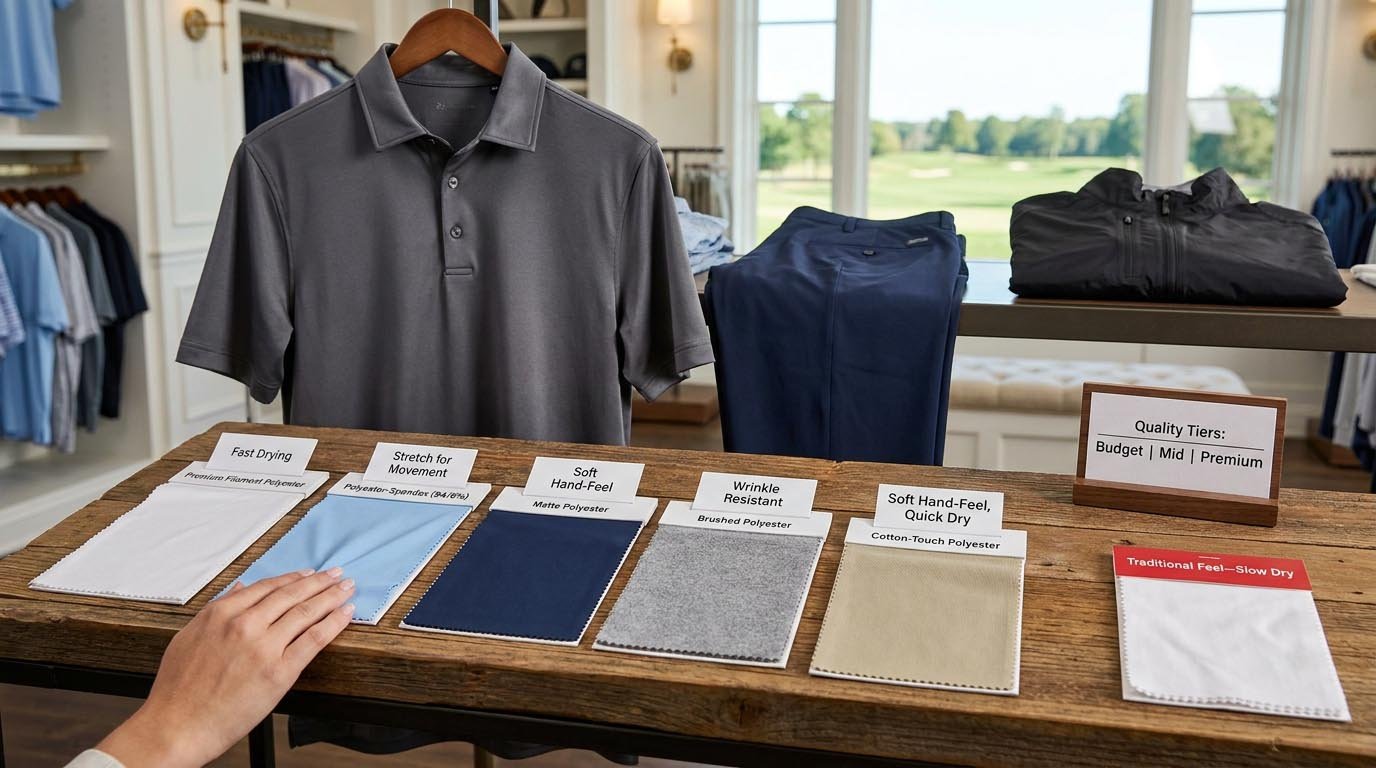
Polyester: the performance foundation
For most modern golf apparel, polyester is the best base fiber because it offers:
- fast drying
- low moisture absorption
- low shrinkage
- wrinkle resistance
- consistent production quality
- reasonable cost
For premium programs, not all polyester is equal.
Polyester quality tiers
Budget polyester
- lower cost
- often rougher hand-feel
- more pilling risk
- suitable for budget or promotional products
Mid-grade polyester
- smoother appearance
- acceptable durability
- works for entry premium lines
Premium filament polyester
- softer hand-feel
- lower pilling
- better surface appearance
- stronger long-term premium perception
If your retail price is above $70, better polyester quality is usually worth the added cost.
Polyester-spandex blends
For premium golf polos, the most practical blend is usually:
This gives:
- stretch for movement
- comfort during play
- better fit
- controlled recovery if construction is stable
Should you use cotton in golf apparel?
Usually not for performance-first golf polos.
Cotton still appeals to some golfers because it feels familiar and traditional. But in active use it usually underperforms because it:
- absorbs sweat
- dries slowly
- feels heavier when wet
- shrinks more
- loses shape faster
Cotton can still work for:
- lifestyle golf collections
- fashion-led programs
- customers who care more about traditional feel than on-course performance
A better alternative for many premium brands is:
- matte polyester
- brushed polyester
- cotton-touch polyester finish
This creates a softer, less synthetic feel without the moisture problems of cotton.
What about nylon?
Nylon can be a strong option for:
- golf trousers
- woven shorts
- outerwear
- abrasion-sensitive garments
Why it works:
- strong abrasion resistance
- soft hand in many woven constructions
- premium feel in bottoms and shells
But for polos, polyester is still more common, more scalable, and more cost-effective.
Key takeaway:
For premium golf polos, polyester-spandex is still the best all-around starting point. Use cotton only when the brand intentionally prioritizes traditional feel over performance.
How Much Spandex Should Golf Polos Have?
For most premium golf polos, the ideal spandex range is:
This gives a strong balance between:
- swing mobility
- day-long comfort
- shape retention
- durability over repeated wear
Practical spandex ranges
3-5% spandex
Best for:
- more structured polos
- classic fit styles
- customers who prefer a cleaner silhouette
Benefits:
- stronger recovery
- less risk of bagging
- more stable appearance
5-8% spandex
Best for:
- most premium golf polos
- comfort-focused performance styles
- brands balancing mobility and structure
Benefits:
- enough stretch for golf
- still stable enough for premium positioning
10-15% spandex
Best for:
- base layers
- compression apparel
- fitnesswear
Risks in golf polos:
- too much stretch
- more long-term shape loss
- softer, less stable collar and body appearance
Rule of thumb:
More stretch is not always better. For golf polos, too much spandex can hurt long-term shape retention.
Best Fabric Construction for Golf Polos, Bottoms, and Outerwear
Construction affects performance as much as fiber content.
The same poly-spandex blend can behave very differently depending on whether it is made as jersey, pique, twill, or bonded fabric.
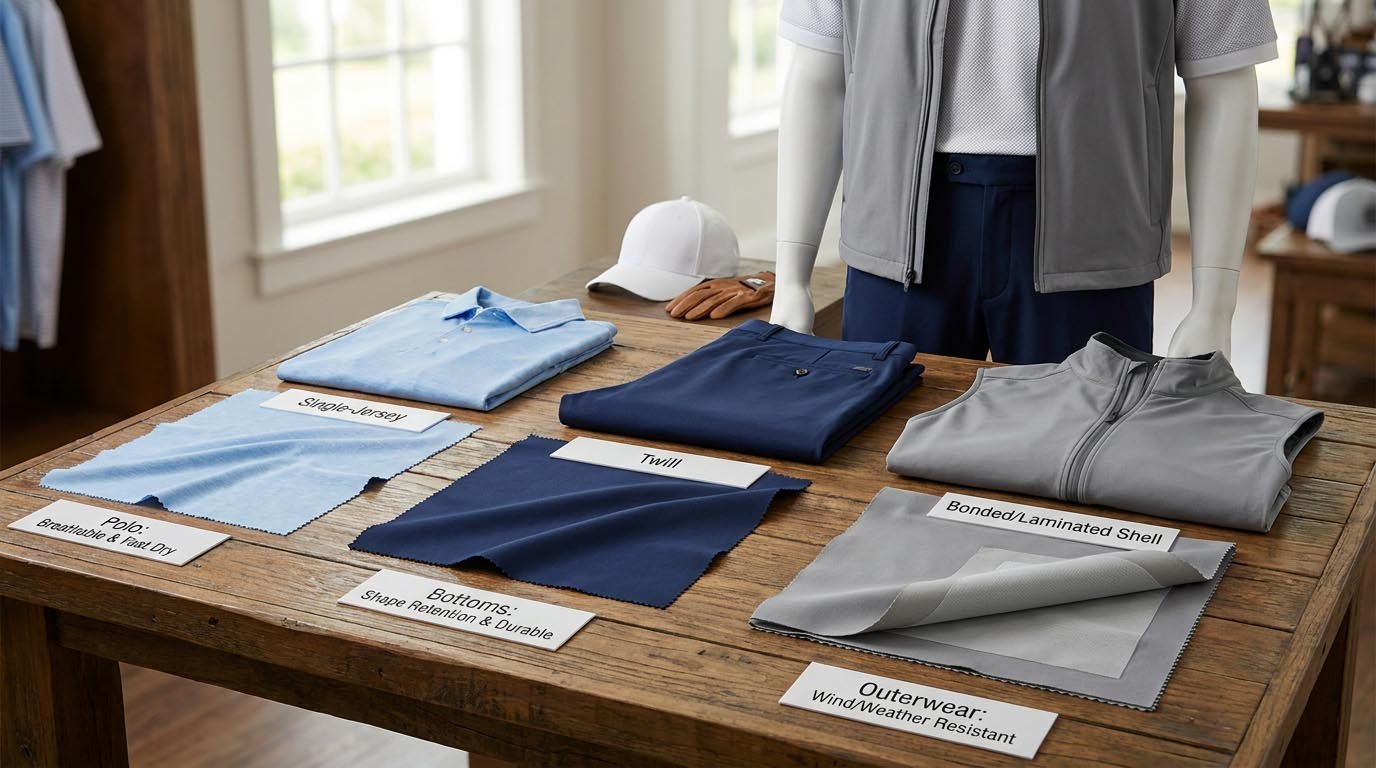
Best constructions for golf polos
Single-jersey
Best for:
- hot-weather polos
- humid markets
- lightweight performance collections
Pros:
- breathable
- soft
- lightweight
- fast-drying feel
Cons:
- less structure
- can snag or pill faster if yarn quality is poor
Pique
Best for:
- classic golf polos
- all-around premium polos
- brands that want traditional polo texture
Pros:
- textured surface
- more body than jersey
- better balance of structure and airflow
Cons:
- can feel warm if too heavy in humid climates
Double-pique or interlock
Best for:
- cooler regions
- more structured premium styles
- luxury positioning
Pros:
- more substantial hand-feel
- stable shape
- polished appearance
Cons:
- heavier
- slower drying
- less ideal for humid summer markets
Best constructions for golf trousers and shorts
Do not use polo fabric for bottoms.
Golf bottoms need:
- opacity
- abrasion resistance
- wrinkle resistance
- better shape retention at knees and seat
Twill
Best for:
- golf trousers
- structured golf shorts
- classic premium programs
Pros:
- durable
- polished appearance
- stable and practical
Double-weave
Best for:
- premium trousers
- cooler-weather bottoms
- more luxurious positioning
Pros:
- very stable
- strong opacity
- premium structure
Cons:
- heavier
- higher cost
Best constructions for golf outerwear
Bonded fabric
Best for:
- vests
- windshirts
- layering pieces
Benefits:
- wind resistance
- clean structure
- moderate weather protection
Laminated fabric
Best for:
- rain jackets
- technical premium outerwear
Benefits:
- stronger weather resistance
- useful for serious all-weather collections
DWR-treated woven shell
Best for:
- lightweight outerwear
- packable weather layers
- wind shells
Benefits:
- light
- practical
- often more affordable than membrane systems
Key takeaway:
Polos need breathability, bottoms need structure, and outerwear needs weather control. One construction cannot do all three well.
Golf Polo Fabric Weight Guide by Climate
Fabric weight affects:
- heat retention
- drying speed
- drape
- structure
- perceived quality
But heavier does not always mean better.
Recommended polo fabric weight by use case
| Climate / Positioning | Recommended Weight | Best Construction |
|---|---|---|
| Humid hot | 180-200 GSM | Single-jersey, lightweight pique |
| Dry hot | 220-240 GSM | Pique, textured jersey |
| Temperate | 240-260 GSM | Interlock, double-pique |
| Luxury cooler weather | 250-280 GSM | Premium pique, interlock |
How to think about GSM correctly
A 240 GSM polo may feel:
- premium and structured in a dry climate
- heavy and slow-drying in a humid climate
A 190 GSM polo may feel:
- comfortable and breathable in Florida
- too thin in a cooler market where customers expect more structure
That is why GSM should never be judged alone. It has to be considered together with:
- climate
- fiber blend
- construction
- product positioning
- customer expectation
Key takeaway:
The best GSM for golf polos depends on where customers play, not just on what feels premium in the sample room.
Which Fabric Finishes Are Worth Paying For?
Finishes can improve real performance, but they also add cost.
The goal is not to add everything. The goal is to add what your customer will actually notice and value.
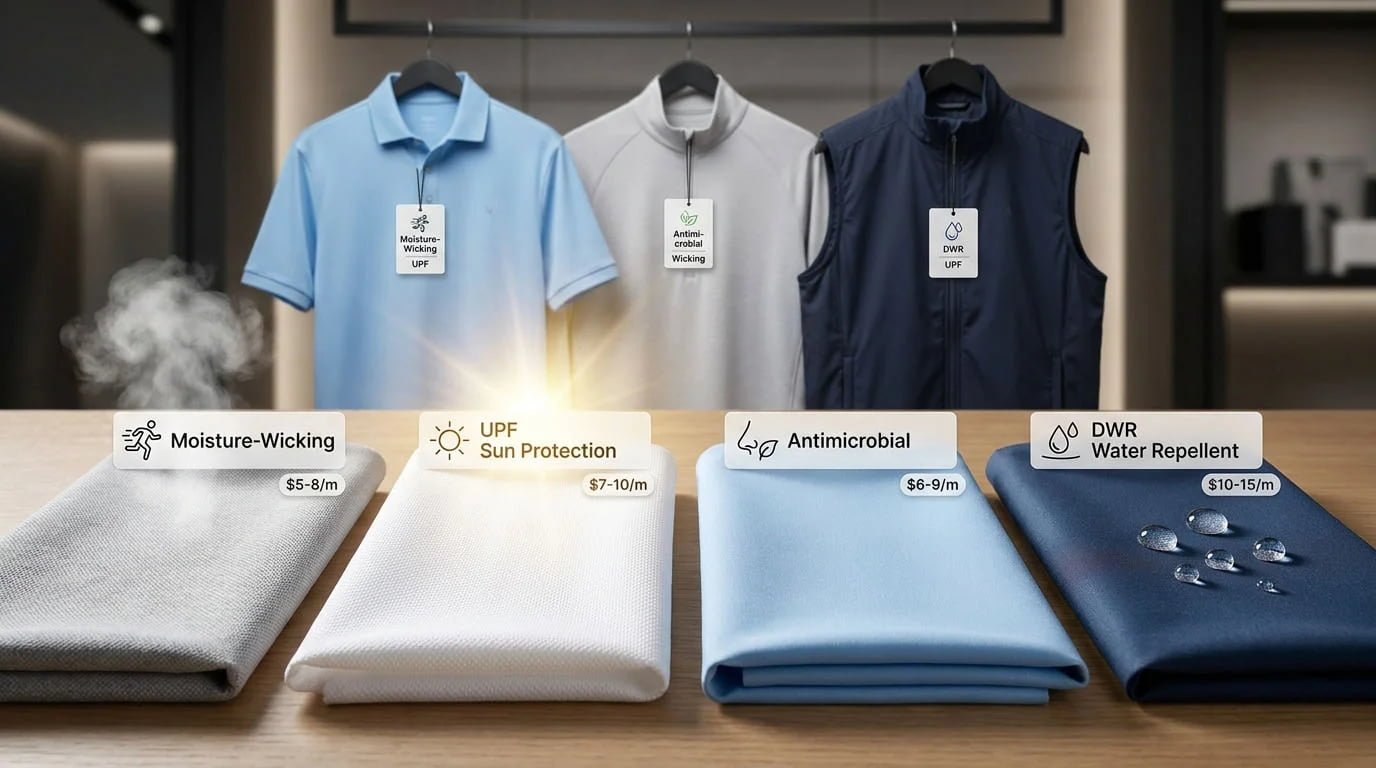
1. Moisture-wicking
Best for:
- golf polos
- base layers
- hot-weather active pieces
Two common approaches:
- Inherent wicking: built into yarn or fiber design, longer-lasting
- Chemical wicking finish: lower cost, but can weaken after repeated washing
Typical cost:
- $0.50-2.00 per meter
Best practice:
If your retail price is above $70, durable or inherent moisture management is usually worth it.
2. UPF sun protection
Best for:
- golf polos
- light tops
- sleeves
- sunny-market collections
Especially important for:
- white fabrics
- light colors
- strong sun climates
Typical cost:
- $0.60-1.50 per meter
Best practice:
Test UPF by color. Dark colors often perform better naturally; white usually needs treatment.
3. Antimicrobial / odor control
Best for:
- serious golfer collections
- humid climates
- performance-led premium lines
Less important for:
- casual lifestyle polos
- low-frequency wear products
- value-price collections
Typical cost:
- $0.80-2.00 per meter
Best practice:
Use it when odor control is part of the actual user experience—not just to improve the spec sheet.
4. DWR water repellent
Best for:
- outerwear
- vests
- windshirts
- packable weather layers
Usually unnecessary for:
- polos
- standard trousers
- base layers
Typical cost:
- $0.70-1.50 per meter
Best practice:
Where possible, use non-fluorocarbon DWR for better compliance and future-proofing.
Key takeaway:
The best finish package is the one that supports the garment’s real use case without pushing the cost beyond your retail model.
How to Match Fabric Cost to Retail Price
A common sourcing mistake is choosing fabric that the target retail price cannot support.
Practical fabric budget by retail tier
Retail $50-65
Recommended fabric target:
- $7-9 per meter
Focus on:
- core performance
- controlled cost
- limited but useful finishes
Retail $70-90
Recommended fabric target:
- $9-12 per meter
Focus on:
- better yarn quality
- stronger hand-feel
- selected finishes with clear value
Retail $100-150
Recommended fabric target:
- $12-18 per meter
Focus on:
- premium yarns
- advanced finishing
- luxury hand-feel
- stronger durability expectations
Simple sourcing rule
Start with your target retail price, then back-calculate what fabric cost the product can realistically carry.
If you choose a luxury fabric for an entry-premium price point, one of three things usually happens:
- your margin collapses
- your retail price rises too high
- the finished product becomes overbuilt for the market
Key takeaway:
Fabric selection is not just a material choice. It is a margin and positioning decision.
How to Test Golf Apparel Fabric Before Production
If your order volume is meaningful, testing is not optional.
A sample can feel excellent on day one and still fail badly after repeated washing or 18-hole wear.
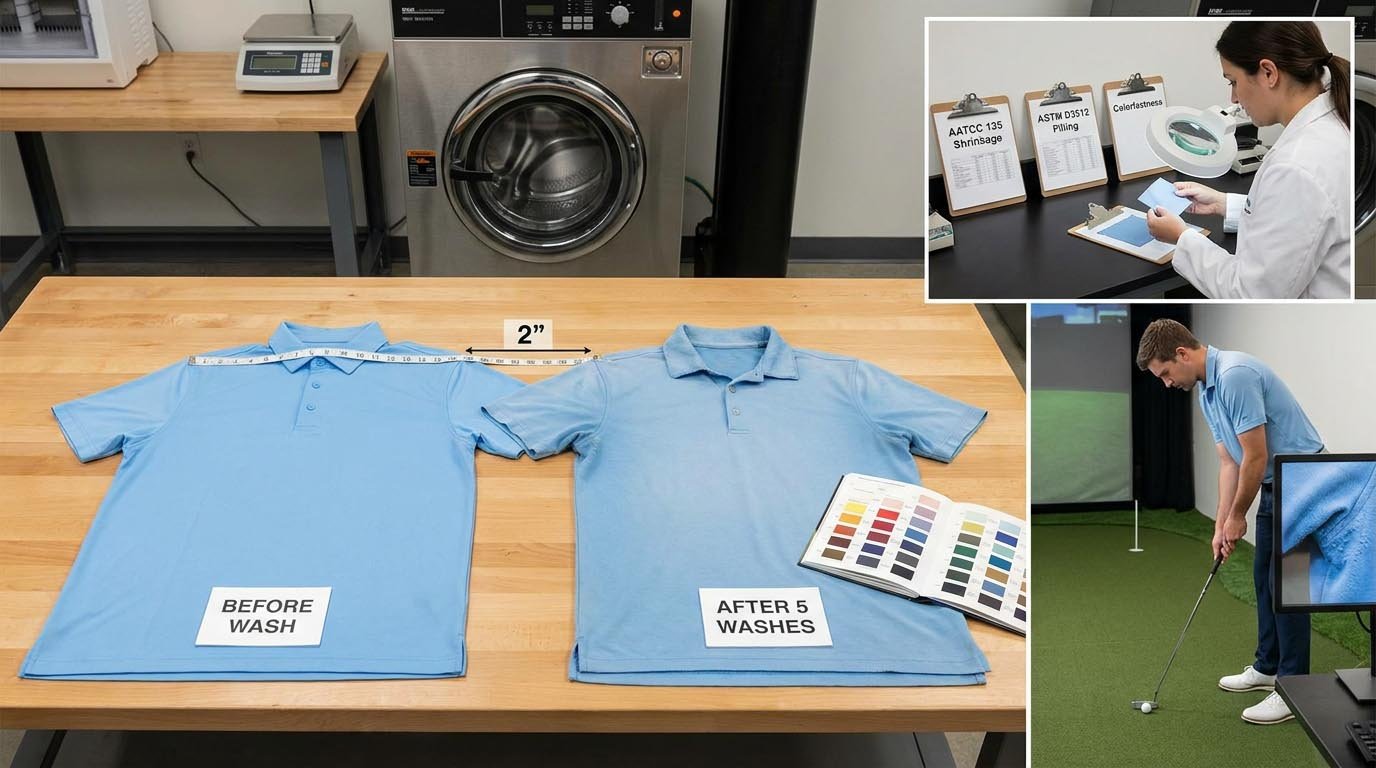
Minimum pre-production testing checklist
1. Wash testing
Check for:
- shrinkage
- shape stability
- colorfastness
Basic target:
- 5% shrinkage or less
- minimal visible color change
2. Wear trials
Use 5-10 sample garments over 4-6 weeks if possible.
Check for:
- pilling
- collar deformation
- body bagging
- odor retention
- comfort during real use
3. Optional lab testing
Useful tests include:
- AATCC 135 for shrinkage
- ASTM D3512 for pilling
- colorfastness testing
- stretch and recovery testing
Typical testing budget
For most premium programs:
- $250-600
That is usually far cheaper than:
- high return rates
- damaged brand perception
- unsellable inventory
- repeat quality complaints
Key takeaway:
A fabric is not proven because it feels good in the office. It is proven when it still performs after wash and wear testing.
Recommended Fabric Specs by Product Type
Premium golf polo
- Fiber: 92-95% polyester / 5-8% spandex
- Weight: 180-240 GSM
- Construction: single-jersey or pique
- Finishes: moisture-wicking, UPF for light colors
- Target fabric cost: $8-11 per meter
Premium golf trouser
- Fiber: 96-98% polyester / 2-4% spandex
- Weight: 240-300 GSM
- Construction: twill or double-weave
- Finishes: wrinkle resistance, optional performance finish based on use
- Target fabric cost: $9-14 per meter
Premium golf outerwear
- Fiber: polyester or nylon blend
- Weight: 200-280 GSM
- Construction: bonded or laminated
- Finishes: DWR, wind protection, optional membrane
- Target fabric cost: $12-18+ per meter
Common Fabric Mistakes Golf Apparel Brands Make
1. Assuming thicker fabric means higher quality
A heavier fabric may feel premium in a showroom but perform poorly in humidity.
2. Choosing fabric by supplier spec sheet alone
A “moisture-wicking” claim does not guarantee long-term comfort or wash durability.
3. Adding too many finishes
Every finish adds cost. Not every finish adds meaningful customer value.
4. Using one fabric across the full collection
Polos, bottoms, and outerwear have different performance priorities.
5. Overusing spandex
Too much stretch often leads to weaker long-term shape retention.
6. Skipping real wash and wear testing
Fresh fabric always looks better than fabric after 20 wears.
Practical lesson:
Most costly fabric mistakes are not caused by defective fabric. They are caused by poor matching between fabric and end use.
FAQ: Best Fabrics for Premium Golf Apparel
What is the best fabric for premium golf polos?
For most brands, a 92-95% polyester / 5-8% spandex blend in 180-240 GSM is the best starting point. Use lighter jersey for humid climates and pique for drier or more structured positioning.
Is polyester better than cotton for golf apparel?
For performance golf apparel, yes. Polyester dries faster, holds shape better, and manages sweat more effectively than cotton.
What GSM is best for golf polos?
It depends on climate:
- 180-200 GSM for humid heat
- 220-240 GSM for dry heat
- 240-260 GSM for cooler or more structured premium polos
How much spandex should a golf polo have?
Usually 5-8%. That gives enough stretch for golf movement without causing major shape-loss problems.
Should golf trousers use the same fabric as polos?
No. Trousers need woven constructions like twill or double-weave for opacity, abrasion resistance, and shape retention.
Is UPF treatment necessary for golf polos?
Often yes, especially for white and light-colored polos sold in sunny markets. Dark colors may need less help.
How much should I spend on fabric testing?
For premium orders above 1,000 units, $250-600 is a practical testing budget.
Should I use one golf polo fabric for every market?
Usually not. If you sell across humid, dry, and temperate markets, two climate-based fabric options often perform better than one universal fabric.
Final Takeaway
The best fabric for premium golf apparel is not the most expensive material or the one with the longest list of performance claims.
It is the fabric that best fits your:
- target climate
- customer use case
- garment category
- price point
- long-term quality expectations
For most premium golf polo programs, a strong starting point is:
- 92-95% polyester
- 5-8% spandex
- 180-240 GSM
- single-jersey or pique
- climate-adjusted finishing
- pre-production wash and wear testing
If you remember only one thing, remember this:
Premium golf apparel fabric selection is a business decision, not just a material decision.
When brands choose fabric based on real use conditions instead of showroom impressions, they usually get:
- lower return rates
- better customer satisfaction
- stronger repeat purchase potential
- healthier margins
Need Help Choosing the Right Golf Apparel Fabric?
If you are developing a premium golf apparel line, send us:
- your product category
- target market or climate
- target retail price
- order quantity
- any reference fabrics or tech packs
We can help you evaluate suitable fabric options for:
- golf polos
- golf trousers and shorts
- golf outerwear
- climate-specific collections
- premium private label development