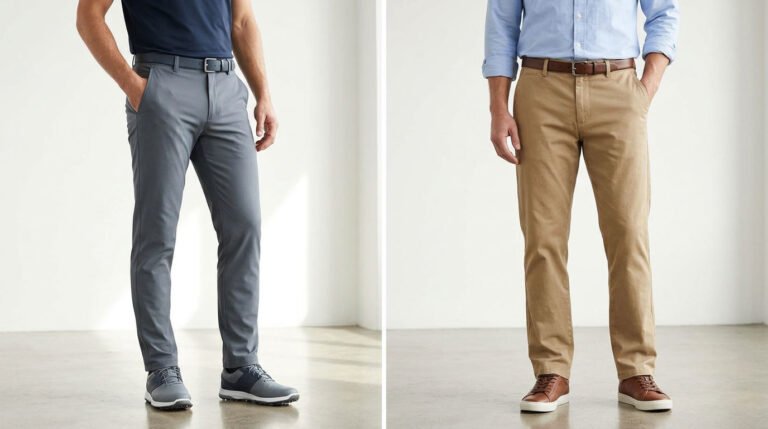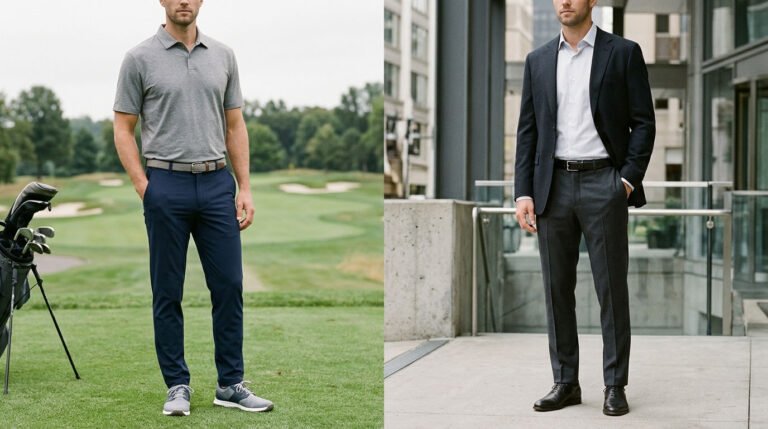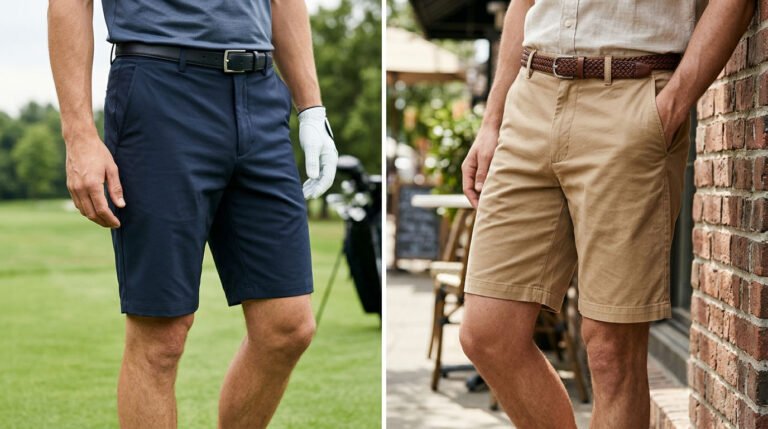
Imagine this: It's 7:00 AM. You're wearing the same pair of pants on the golf course, moving freely through every swing. By 9:00 AM, you're in a meeting, looking clean and professional, without a single odd glance. Is that possible?
The answer is yes — but only with the right pair.
Golf pants can absolutely work for business casual. But they don't earn a pass into the office simply because they're called "golf pants." The deciding factors come down to fabric sheen, waistband structure, pocket design, silhouette, and — perhaps most importantly — your specific workplace culture.

Some golf trousers are dead ringers for tailored chinos. Others scream "athletic wear" from across the room. For consumers, knowing the difference prevents awkward wardrobe missteps. For apparel brands, this gray area represents a powerful opportunity: to design versatile trousers that genuinely perform from the first tee to the last meeting.
This guide breaks down exactly when golf pants qualify as business casual, how they compare to chinos and dress pants, and what brands need to consider when developing a true office-to-course product.
Quick Answer: Are Golf Pants Business Casual?
Yes — but only some of them.
Golf trousers are far more likely to pass a business casual dress code when they feature:
- A matte or low-sheen fabric finish
- A clean, tailored silhouette
- A structured waistband with standard belt loops
- Simple front and back pocket designs
- Minimal or tonal visible branding
- A refined finish without overtly sporty details
That said, workplace expectations are not universal. A creative agency might embrace clean performance trousers without hesitation. A corporate law firm might not. The key is matching the garment's design language to the environment's expectations.
| Question | Short Answer |
|---|---|
| Are all golf pants business casual? | No. Suitability depends on design, fabric, and workplace rules. |
| Can you wear golf pants to the office? | Yes, if their appearance aligns with the office dress code. |
| Are golf pants the same as chinos? | No. They differ in fabric, construction, and intended performance. |
| Can golf pants replace dress pants? | Sometimes — in relaxed business casual settings, but not in formal offices. |
| What makes golf pants look professional? | Matte fabric, tailored fit, clean construction, and discreet branding. |
When Can You Wear Golf Pants to Work?
The single most important variable is your workplace. "Business casual" has no universal meaning. It shifts across industries, companies, and regions. Before choosing golf pants for the office, honestly assess where your workplace falls on the formality spectrum.
Casual and Creative Offices
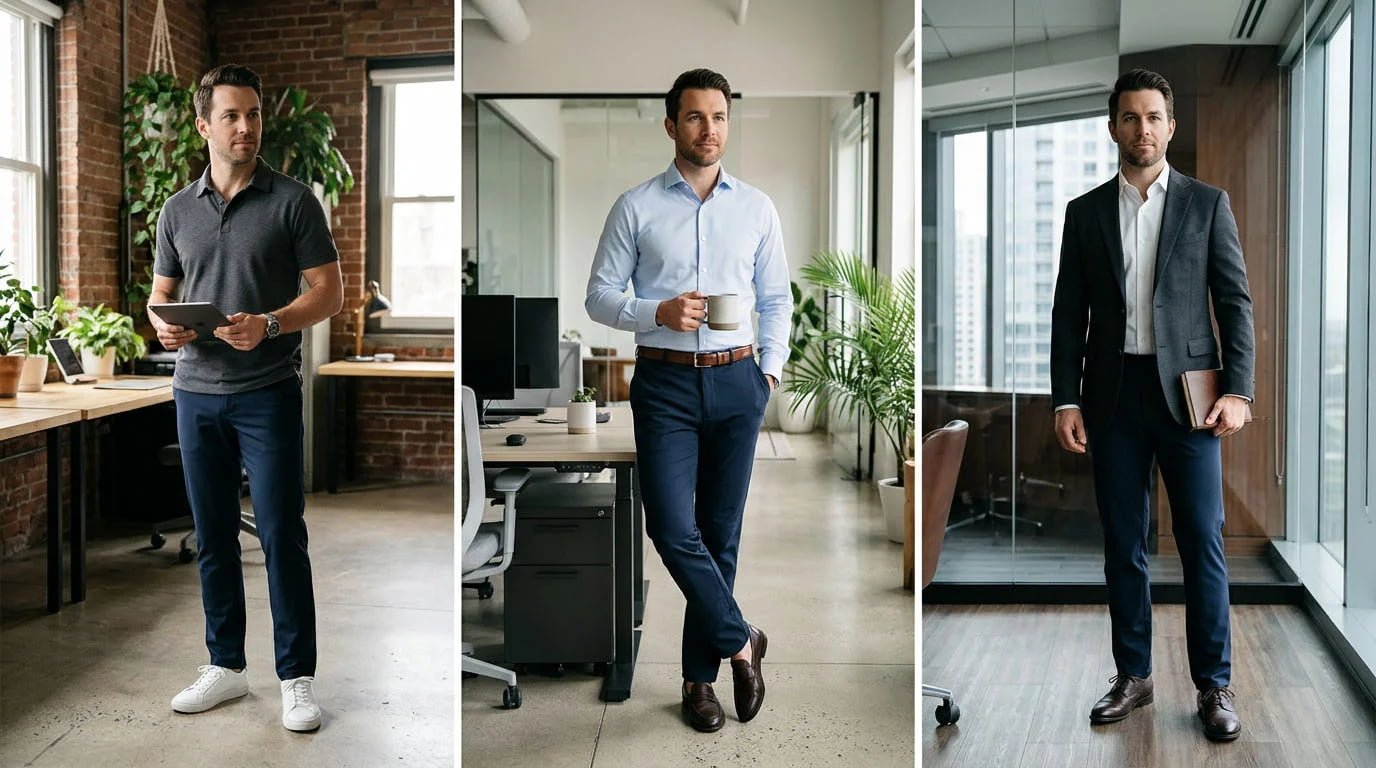
Tech firms, design studios, and other relaxed workplaces often give employees wide latitude. In these environments, clean, well-fitting performance trousers can blend in easily.
A simple combination — navy golf trousers with a plain polo shirt and minimal leather sneakers — can look intentional, comfortable, and completely office-appropriate.
Business Casual Offices
In more structured environments, golf pants need to look much closer to traditional chinos or tailored trousers.
When dressing for a business casual office, look for:
- A flat-front design
- A structured waistband
- Conventional pocket openings
- A straight or subtly tapered leg
- Fabric that does not read as shiny or technical
Pair them with a tucked-in shirt, a leather belt, and appropriate footwear. These small decisions anchor the look in "professional" rather than "sporting."
Traditional Corporate Workplaces
In finance, law, or client-facing consulting roles, dress codes often remain formal. Even the most refined golf trousers may fall short if the expectation is traditional wool dress pants.
In these settings, do not assume. Check the employee handbook or observe what colleagues and managers actually wear before introducing performance trousers into your rotation.
Golf Pants vs. Chinos vs. Dress Pants
Superficially, these three categories can overlap. But they are not interchangeable. Understanding their typical differences helps consumers make better decisions — and helps brands position their products accurately.
| Feature | Golf Pants | Chinos | Dress Pants |
|---|---|---|---|
| Primary purpose | Golf and athletic-inspired daily wear | Casual and business casual wear | Professional and formal wear |
| Common fabrics | Polyester, nylon, elastane blends | Cotton or cotton-blend twill | Wool, polyester, and tailored suiting blends |
| Stretch | Often built in for mobility | Varies widely by fabric | Varies by fabric |
| Surface appearance | Ranges from sporty to refined | Generally clean and casual | Typically more formal and uniform |
| Waistband | May include grip strips or stretch panels | Usually conventional construction | Structured, tailored construction |
| Pocket design | May include tee slots or security pockets | Typically simple slash pockets | Tailored pocket construction |
| Office suitability | Depends heavily on design and dress code | Often a safe choice for business casual | Standard for formal settings |
When Should You Choose Golf Pants?
Golf pants shine when you want freedom of movement without sacrificing a pulled-together look. They're especially useful for relaxed offices, business travel, and casual professional settings — provided the design is restrained enough.
When Are Chinos a Better Choice?
Chinos are the safer, more universally accepted option. Their familiar, traditional styling pairs effortlessly with button-downs, knitwear, and casual footwear. If you're unsure about your office's dress code, chinos are the lower-risk bet.
When Are Dress Pants Necessary?
For formal meetings, client presentations, and traditional corporate environments, dress pants remain the standard. Golf pants should never be positioned — or mistaken — as a universal replacement for tailored trousers.
What Makes Golf Pants Look Business Casual?
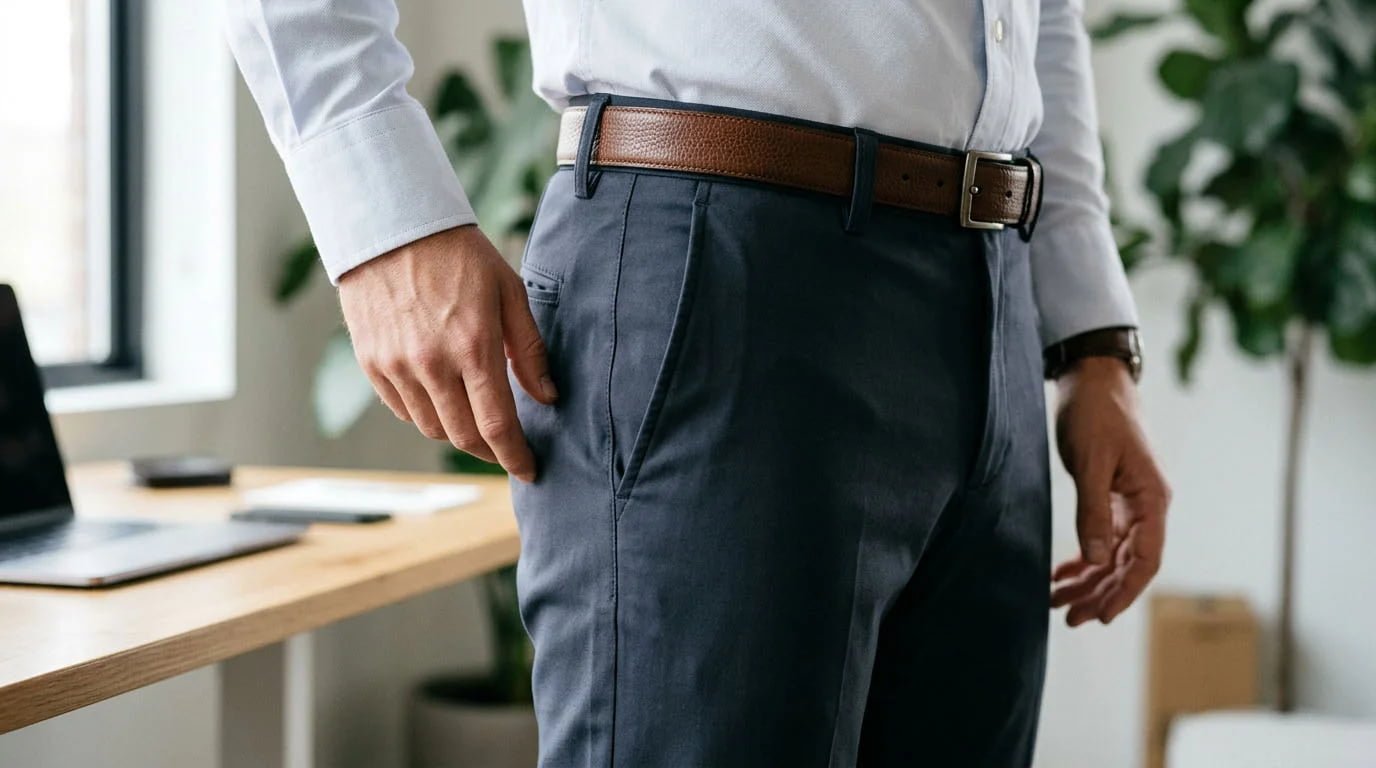
The gap between "athletic golf pant" and "office-appropriate trouser" almost always comes down to visual details. Performance features can stay — they just shouldn't dominate the appearance.
Fabric Appearance and Drape
Fabric is one of the first things people notice.
A high-shine finish, a heavily textured technical surface, or a fabric that clings aggressively to the legs can instantly push a garment toward the "activewear" category.
For a business casual design, prioritize:
- Matte or low-lustre finishes
- A clean, relatively smooth surface
- Full opacity
- Balanced drape that moves naturally
- A handfeel appropriate for indoor, professional settings
A note for brands: fiber composition alone is not the deciding factor. Polyester and nylon blends can absolutely work for office-oriented trousers. What matters is how the fabric is constructed, finished, and integrated into the overall garment design. Always evaluate the textile in relation to the pattern, not just the fiber label.
For a deeper technical breakdown, see our guide to what golf pants are made of.
Fit and Trouser Silhouette
A clean silhouette signals polish.
Straight and slightly tapered designs tend to work best, provided they fit the wearer's body proportions correctly.
Ignore vague labels like "slim" or "tailored" and focus on the actual outcome:
- Enough room through the seat and thighs to avoid pulling
- A comfortable waistband that stays in place
- A balanced leg shape that doesn't taper too aggressively
- A clean drape when both standing and sitting
- A hem length that works with the intended footwear
Crucially, golf pants should never be so tight that they restrict movement. A streamlined silhouette is a visual goal, not an excuse to sacrifice function.
For more detailed fit parameters, refer to How Should Golf Pants Fit?.
Waistband and Pocket Design
The waistband is a make-or-break detail for office acceptability.
A clean exterior with conventional belt loops reads as traditional and intentional. An exposed elastic panel or a visible drawcord does not.
For crossover golf pants, brands should consider:
- A structured exterior waistband
- Standard belt loops
- Hidden or partially concealed elastic where comfort stretch is needed
- A clean front closure
- Discreet internal functional details (e.g., a subtle grip strip)
Pockets matter just as much. Traditional slant pockets and simple back pockets signal "trouser." Cargo pockets, exposed zippers, or prominent tee dividers signal "gear." A concealed security pocket can add practical value without compromising the garment's visual language.
Branding and Visible Details
Large silicone logos, contrast graphics, and bold sport-specific branding can instantly disqualify a garment for office wear.
For office-oriented golf pants, aim for:
- Small tonal embroidery
- Discreet logo placement
- Minimal contrast stitching
- Clean hems
- Understated hardware and trims
The goal is not to erase all golf functionality. It's to integrate the functional story so that it doesn't override the visual one.
How to Style Golf Pants for the Office
Even the best-chosen golf trousers can look too athletic if the rest of the outfit sends conflicting signals. The objective is balance: comfort without sloppiness, polish without stiffness.

Choose Appropriate Shirts and Tops
A simple, well-chosen top changes everything.
- Button-down shirt: A classic anchor for business casual. Works with nearly any office-appropriate golf pant.
- Knit polo shirt: Suitable for relaxed professional settings. Avoid performance polos with heavy contrast details.
- Fine-gauge sweater: A useful layering piece for cooler offices.
- Clean long-sleeve shirt: Works well when the fabric and fit match the trouser's level of refinement.
Avoid pairing highly technical golf tops with trousers that are already pushing an athletic silhouette — unless your goal is to look like you're headed to the driving range.
Choose Suitable Footwear
Shoes define the bottom of your silhouette and carry disproportionate weight in outfit perception.
- Leather loafers — a safe, versatile choice
- Minimal leather sneakers where permitted
- Derby shoes for more structured business casual looks
- Clean, understated casual shoes
Traditional spiked golf shoes belong on the course. Even spikeless golf shoes can look too sporty indoors unless the design is exceptionally restrained.
Use Simple, Coordinated Colors
Neutrals are your easiest path to a foolproof outfit.
| Golf Pants Color | Suitable Top Colors |
|---|---|
| Navy | White, light blue, grey |
| Charcoal | White, black, light blue |
| Khaki | Navy, white, olive |
| Black | White, grey, light blue |
| Grey | Navy, white, black |
These combinations are starting points. The final outfit should still reflect the specific workplace and personal style.
When Are Golf Pants Not Appropriate for Work? Common "Minefields" to Avoid
Not every pair of golf pants belongs in a professional setting. Knowing what to avoid is just as important as knowing what to look for. Here are the most common pitfalls.
Minefield 1: Strict Corporate Dress Codes
Some workplaces explicitly require traditional tailored trousers. Performance fabrics, however refined, may fall outside the written or unwritten rules. When in doubt, defer to the more formal option.
Minefield 2: Formal Business Meetings
Client presentations, board meetings, and formal reviews call for a more conventional appearance. Even well-designed golf trousers may read as too casual for high-stakes settings.
Minefield 3: Overly Athletic Designs
This is one of the most common missteps — and the easiest to avoid once you know what to look for.
Imagine a pair of pants with oversized cargo pockets running down the sides, an exposed drawcord at the waist, reflective piping along the seams, and a glossy fabric that catches the light with every step. Even if it comes from a top-tier golf brand, when you walk into an office wearing it, the impression isn't "polished professional." It reads as "on the way to the gym" or "headed out for a weekend hike."
Why? Because every design element speaks the language of sport, utility, and the outdoors — not the language of credibility, composure, and professionalism that most workplaces expect.
The fix isn't to strip away function. It's to hide it intelligently. A hidden elastic waistband that looks structured from the outside. A single discreet zippered security pocket instead of bulky external pouches. Matte fabric instead of shiny. These quiet, intentional choices keep the performance intact while radically changing the garment's message.
Minefield 4: Poor Fit or Condition
Wrinkled, baggy, overly tight, or visibly worn trousers look unprofessional — no matter what category they fall into. For office-to-course pants, maintaining a crisp appearance through a full day of wear is essential.
Minefield 5: Assuming Rather Than Confirming
If your workplace dress code is unclear, ask. Don't assume that "performance chino" automatically qualifies as business casual.
The core principle: Technical performance does not automatically translate into professional appropriateness. Design intent and visual language always win.
How Brands Can Develop True Office-to-Course Golf Pants
For golf apparel brands, the office-to-course category represents a genuine product development opportunity — but it requires more thought than simply adding stretch to a chino pattern.
The product must be designed from the ground up for its dual-purpose reality.
Step 1: Define the Primary Wearing Scenario
Before selecting a single fabric or sketching a silhouette, clarify the target customer and their actual life.
Ask:
- Will the customer primarily wear this on the course or in the office?
- Is the target workplace relaxed, business casual, or relatively formal?
- Will these trousers be used for business travel?
- Will they be worn with polos, button-downs, or sweaters?
- Which markets and climates are being targeted?
A trouser designed primarily for golf may prioritize mobility, breathability, and visible performance features. A true hybrid trouser must make tradeoffs — often prioritizing a cleaner appearance while retaining just enough stretch and comfort for an afternoon round. Let the primary use case dictate the priorities.
Step 2: Select Fabric Based on Appearance and Performance
Evaluate fabric holistically, not just by fiber label.
Critical factors include:
- Fiber composition
- Fabric construction and weave
- Surface appearance and sheen level
- Stretch and recovery behavior
- Breathability
- Opacity under different lighting
- Drape and handfeel
- Care and durability requirements
There is no magic weight or fiber percentage that guarantees business casual suitability. The fabric must be evaluated in the context of the pattern, the intended climate, and the final use environment.
Step 3: Balance Performance and Traditional Construction
A successful crossover design hides its athletic capability in plain sight.
| Design Area | Development Direction |
|---|---|
| Waistband | Clean exterior profile with practical internal comfort features |
| Pockets | Conventional openings; discreet security storage where needed |
| Fabric | Performance stretch with an office-appropriate surface appearance |
| Fit | Tailored silhouette with sufficient mobility allowance |
| Seams | Clean construction; restrained visible stitching |
| Branding | Small, tonal, or discreet logo placement |
| Closure | Conventional front closure appearance |
These are directional, not universal. Every spec should be adjusted to the brand's target customer and product requirements.
For a comprehensive walkthrough of waistband types, pocket options, and construction decisions, see our full golf shorts and pants design guide.
Step 4: Validate the Sample — In Both Worlds
A trouser can look perfect in a tech pack and still fail in the real world. Validation means testing in both environments it claims to serve.
Office evaluation checklist:
- Does the fabric look appropriate under indoor lighting?
- Does the waistband remain comfortable after hours of sitting?
- Does the garment maintain a clean appearance all day?
- Do the pockets and closure look sufficiently refined?
Golf evaluation checklist:
- Is there full freedom of movement through the swing?
- Does the waistband stay comfortable during bending and walking?
- Can the wearer walk 18 holes comfortably?
- Do fabric and construction meet the stated performance claims?
A real-world cautionary example:
We once evaluated a sample that looked impeccable in the showroom. But after a half-day of office wear, a problem emerged: the fabric, engineered for maximum stretch and breathability, was too soft. After extended sitting, it formed visible knee bags that took too long to recover. On the golf course, this wasn't noticeable. In a boardroom, it looked sloppy.
The lesson: test for both dynamic and static performance. Movement tests alone are not enough. The garment must also hold its shape through hours of sitting, standing, and commuting.
Washing and care evaluations should follow the same dual-environment logic.
Only proceed to bulk production when the sample passes muster in both settings, against agreed specifications.
Pre-Production Checklist for Business Casual Golf Pants
Before approving a new office-to-course trouser for bulk, use this checklist to catch issues early.
- [ ] Primary and secondary wearing scenarios are clearly defined
- [ ] Target workplace formality level and market are identified
- [ ] Fabric appearance matches the intended positioning
- [ ] Fabric has appropriate opacity, drape, and handfeel
- [ ] Stretch and recovery behavior meet product requirements
- [ ] Fit looks clean without restricting movement
- [ ] Waistband has an office-appropriate exterior appearance
- [ ] Pocket placement and construction suit both use cases
- [ ] Visible branding and trims align with the design direction
- [ ] Sample has been evaluated in both office and golf environments
- [ ] Washing and care performance has been reviewed
- [ ] Final measurements and construction details are approved before bulk production
A clear checklist is one of the cheapest forms of risk management in apparel development. It helps catch misalignments before they become production problems.
For brands developing their own golf trouser collection, FUWAY also provides custom golf bottoms manufacturing and private label golf apparel development.
Frequently Asked Questions
Are golf pants considered business casual for men?
Some golf pants are entirely appropriate for men's business casual outfits — specifically those with a tailored fit, matte fabric, conventional pocket designs, and minimal athletic branding. Workplace dress codes vary, so there is no universal answer.
Can you wear golf pants with a dress shirt?
Yes. Golf pants with a clean silhouette and structured waistband pair well with button-down dress shirts in relaxed business casual environments. The overall outfit must still match the workplace standard.
Are golf pants more comfortable than chinos?
Not inherently. Many golf pants are designed with stretch and active movement in mind, while chinos vary widely depending on their fabric and construction. Comfort is highly individual and depends on the specific garment.
Can golf pants replace dress pants?
They can serve as an alternative in some relaxed business casual settings. However, they are not a universal substitute for traditional dress trousers, especially in formal workplaces.
What makes golf pants suitable for office-to-course wear?
A successful hybrid design combines a refined, non-technical appearance with functional performance. Key elements include appropriate fabric drape, comfortable stretch, a clean waistband, discreet pockets, and restrained branding.
What should brands consider when developing business casual golf pants?
Brands should define their target customer and workplace first. Fabric appearance, fit, waistband construction, pocket layout, branding, and thorough sample validation should all support the intended product positioning across both office and golf environments.
Conclusion
Golf pants can absolutely work in business casual settings — but the devil is entirely in the design details. Fabric sheen, waistband construction, pocket architecture, fit, and branding all send signals about where a garment belongs. Whether you're choosing a pair for yourself or developing a collection for the market, success comes from understanding and controlling those signals.
For consumers, the strategy is simple: match the design language to the dress code. For brands, the opportunity is richer: build crossover trousers that deliver genuine on-course performance without sacrificing off-course credibility.
At FUWAY, we support golf apparel brands with custom golf pants and bottoms development — from fabric selection and fit engineering to construction detailing and private label production.
For suitable projects, our typical MOQ starts at 100 pieces per style, with 50 pieces per color when the total style quantity is 100 pieces. Sampling generally takes 7–10 business days, while bulk production typically takes 3–4 weeks, depending on materials, customization, approvals, and production scheduling.
If you're planning to develop a business casual golf pants collection, contact FUWAY to discuss your product requirements.