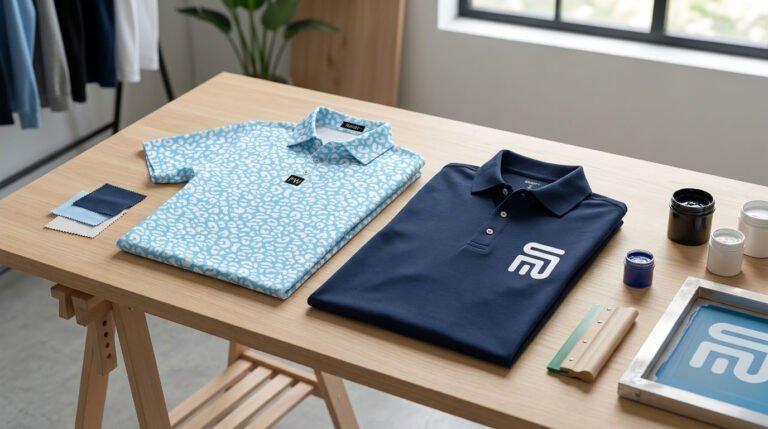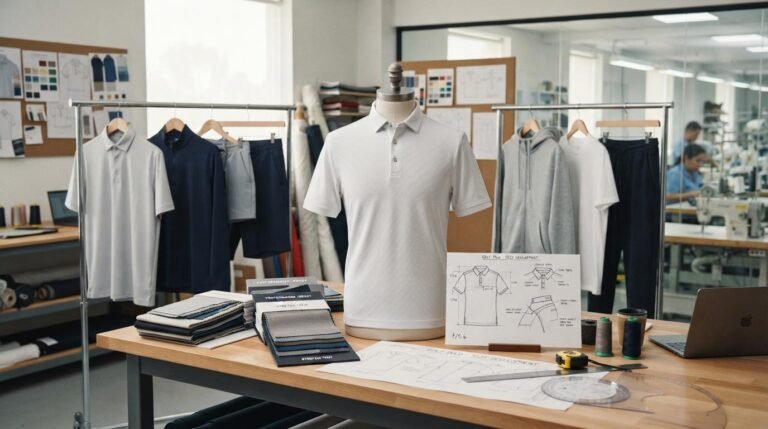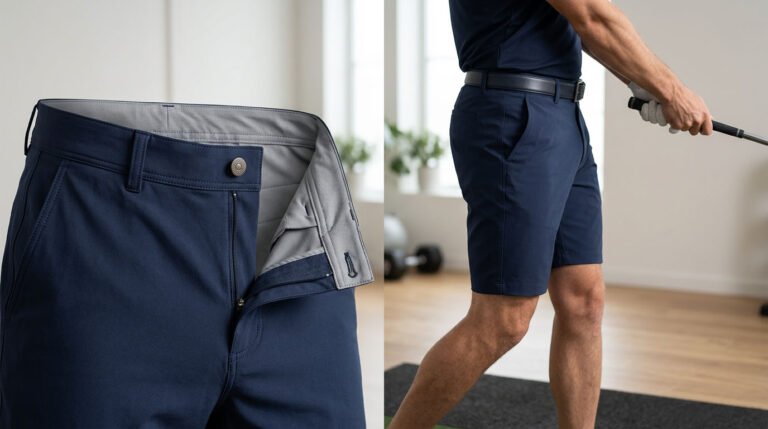
Private label golf apparel customization goes beyond adding a logo to a ready-made shirt. Depending on the manufacturer, brands may be able to change fabrics, colors, fit, collars, trims, labels, and packaging.
However, not every customization requires the same order quantity, development work, or production time.
Adding embroidery to an existing golf polo is different from developing a new collar construction or creating a proprietary performance fabric. Each change has its own technical and commercial requirements.
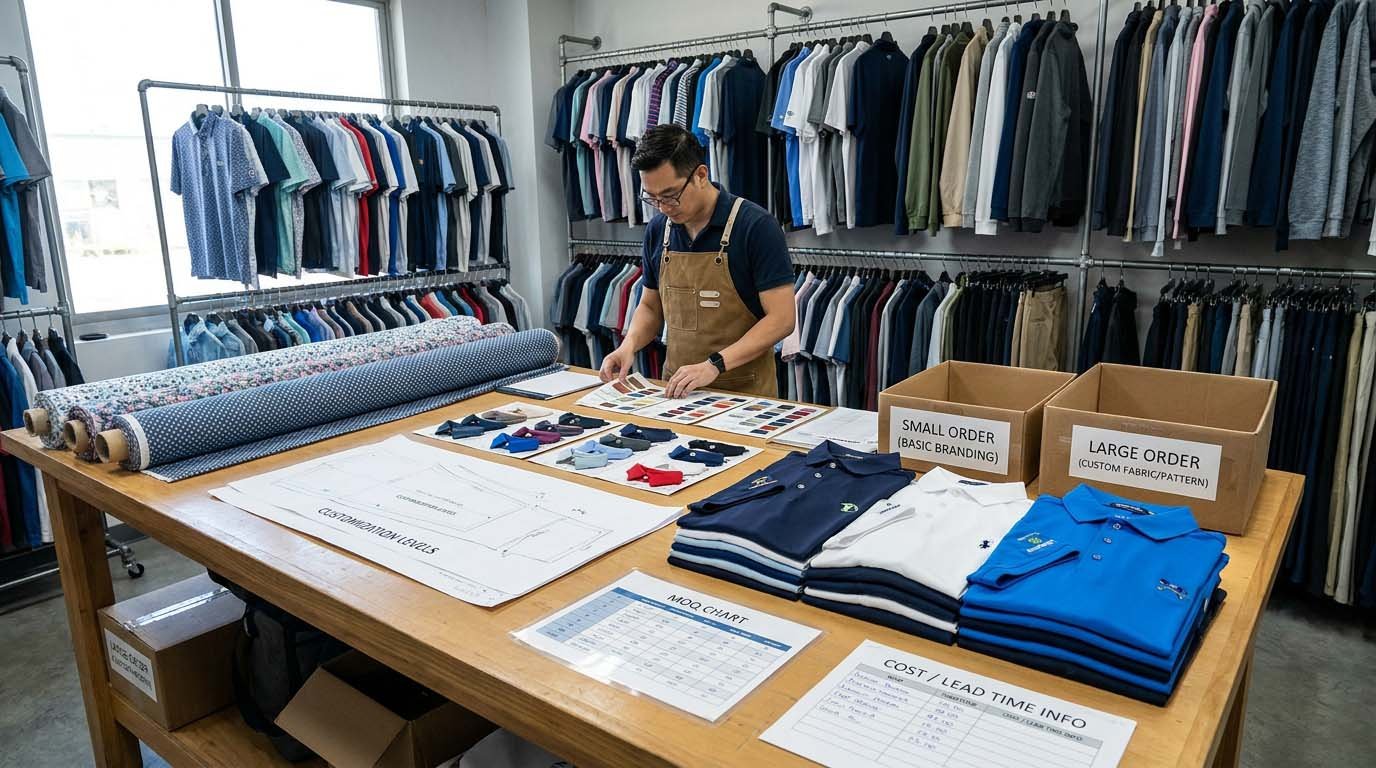
At FUWAY, we support golf apparel OEM/ODM and private label projects, including fabric sourcing, pattern adjustments, logo application, branded labels, and production development.
This guide explains what can realistically be customized, what affects MOQ and cost, and what buyers should approve before bulk production.
If you are new to the overall manufacturing process, start with our Private Label Golf Apparel Guide.
Quick Answer: What Can You Customize in Private Label Golf Apparel?
Most private label golf apparel programs offer some combination of:
- Branding: embroidery, printing, heat transfers, logos, and patches
- Labels and packaging: neck labels, care labels, hang tags, and branded packaging
- Fabrics and colors: available performance fabrics, stock colors, or custom development
- Fit: body length, sleeve length, width, grading, or new patterns
- Construction: collars, plackets, pockets, seams, waistbands, and trims
- Performance: moisture management, stretch, UV protection, and other verified fabric properties
The practical scope depends on the manufacturer's capabilities, material availability, required development, and order configuration.
Private Label Golf Apparel Customization Decision Matrix
The following table helps buyers evaluate what may be feasible for a small private label order.
| Customization Option | Feasibility Around 100 pcs/style | Main MOQ or Cost Driver |
|---|---|---|
| Embroidered or printed logo | Usually practical | Artwork, setup, application method |
| Custom neck and size labels | Often practical | Label production minimum |
| Stock fabrics and colors | Usually practical | Available material inventory |
| Minor fit adjustments | Project-dependent | Pattern changes and sampling |
| Custom collar or placket | Project-dependent | Construction and trim sourcing |
| Custom brand colors | Requires evaluation | Fabric dye-lot minimum |
| New fabric development | Requires separate evaluation | Mill MOQ and development |
| Special performance finishes | Requires separate evaluation | Material compatibility and testing |
| Custom packaging | Depends on packaging type | Packaging supplier minimum |
These are general feasibility guidelines, not guaranteed FUWAY production commitments. Final requirements must be confirmed for each project.
At FUWAY, typical custom apparel projects start around 100 pieces per style, depending on specifications. This does not mean every fabric, color, or trim configuration is available at that quantity.
A useful purchasing question is:
"Can this customization be achieved using existing materials and patterns, or does it require separate development or supplier minimums?"
That distinction is often more valuable than asking whether a manufacturer supports customization in general.
Step 1: Choose Your Branding, Label, and Packaging Options
Branding is often one of the most accessible ways to differentiate private label golf apparel.
Many brands can establish a recognizable identity through a consistent logo, labels, and product presentation without developing every garment component from scratch.
Logo Application Methods
| Method | Common Golf Apparel Use | What to Check |
|---|---|---|
| Embroidery | Polo chest logos, sleeves, outerwear | Stitch density, backing, fabric distortion |
| Heat Transfer | Technical tops, small logos, neck branding | Adhesion, temperature compatibility, wash durability |
| Screen Printing | Larger graphics, events, promotional clothing | Print hand-feel, color registration, curing |
| Sublimation | All-over patterns on suitable polyester fabrics | Fabric compatibility, print placement, color consistency |
Logo selection should consider both appearance and durability.
For example, dense embroidery on lightweight stretch fabric may cause puckering. A heat-transfer logo may look cleaner but requires appropriate adhesion and wash testing.
For detailed comparisons, see our Best Logo Methods for Golf Apparel.
Private Labels and Packaging
Common options include woven main labels, heat-transfer neck labels, size labels, care labels, hang tags, branded polybags, and retail packaging.
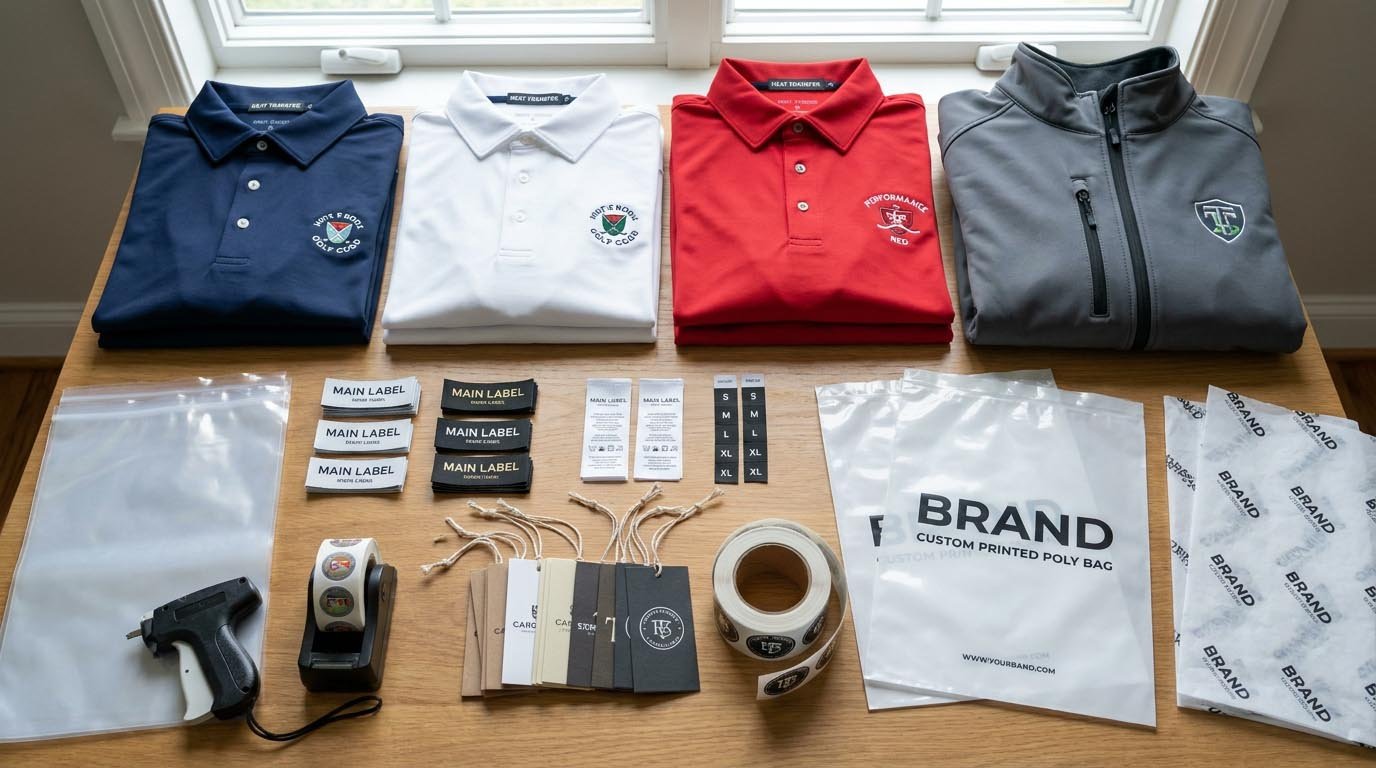
For a first collection, a practical combination might be:
- Embroidered or heat-transfer logo
- Branded neck label
- Required care and fiber-content labels
- Simple hang tag
- Standard individual packaging
The main commercial consideration is that label and packaging suppliers may have their own minimum quantities.
Before approval: Confirm artwork, dimensions, colors, material, placement, durability requirements, and whether packaging costs are included in the quotation.
Branding choices must also accommodate any labeling requirements applicable to the intended sales market.
Step 2: Understand Fabric, Color, and Performance Customization
Fabric selection affects comfort, appearance, cost, and manufacturing feasibility.
However, choosing an existing performance fabric is very different from developing a new fabric construction or proprietary finish.
Stock Fabric vs Custom Fabric
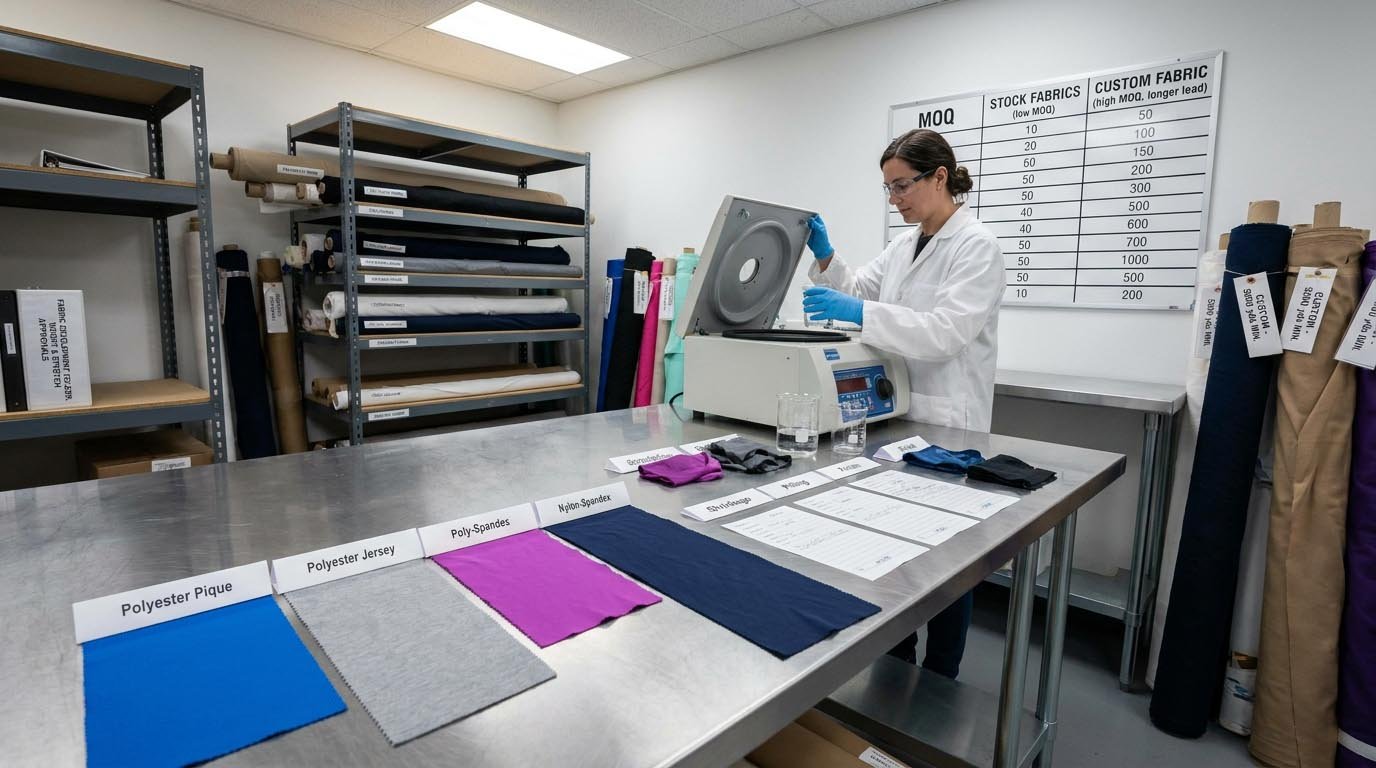
Common golf apparel material options include:
| Fabric | Typical Application | Key Evaluation Points |
|---|---|---|
| Polyester Piqué | Traditional golf polos | Texture, breathability, collar compatibility |
| Polyester Jersey | Lightweight performance polos | Drape, stretch, surface feel |
| Interlock Knit | Structured performance tops | Recovery, stability, hand-feel |
| Polyester-Spandex | Stretch golf apparel | Movement, shape retention |
| Nylon-Spandex Woven | Golf shorts, pants, outerwear | Recovery, abrasion, wrinkle behavior |
Available fabrics may reduce sourcing complexity, but their suitability and test history should still be verified for the specific project.
Custom fabric development may involve knitting, yarn selection, dyeing, finishing, or special construction.
Fabric mill MOQ is not automatically the same as garment MOQ. A mill may calculate minimums by weight, length, fabric type, or color. The resulting quantity of finished garments depends on fabric consumption, usable width, and production waste.
Brands planning special materials should discuss feasibility through FUWAY's Fabric Sourcing service.
Can You Match Exact Brand Colors?
Custom color matching is possible, but the process depends on the fabric and dyeing method.
For accurate evaluation, provide:
- Pantone textile references, where available
- A physical fabric or color reference
- The intended fabric composition and construction
- An acceptable color tolerance
- Written approval of lab dips or strike-offs, when required
A color may appear different on polyester piqué and smooth nylon fabric, even when the same visual target is used.
Buyers should approve colors on the intended material under suitable viewing conditions rather than relying on digital mockups alone.
What About Performance Features?
Brands may request moisture management, stretch, UV protection, anti-odor properties, or water repellency.
However, these are not all treatments that can simply be added during finishing.
For example:
- Four-way stretch depends on fabric construction and material properties.
- Moisture management may result from fiber selection, fabric construction, or finishing.
- DWR is a water-repellent finish requiring compatibility and durability assessment.
- UPF and anti-odor claims require appropriate supporting evidence for the product and intended claims.
Before promoting technical performance, confirm the relevant test methods, results, and whether they apply to the actual material being ordered.
FUWAY provides examples of available testing documentation on its Test Reports page. A report for one fabric should not automatically be treated as proof for every material or finished garment.
Step 3: Customize Fit, Collars, Plackets, and Construction
Fit and garment construction can make a private label product more distinctive than branding alone.
However, different products require different levels of development.
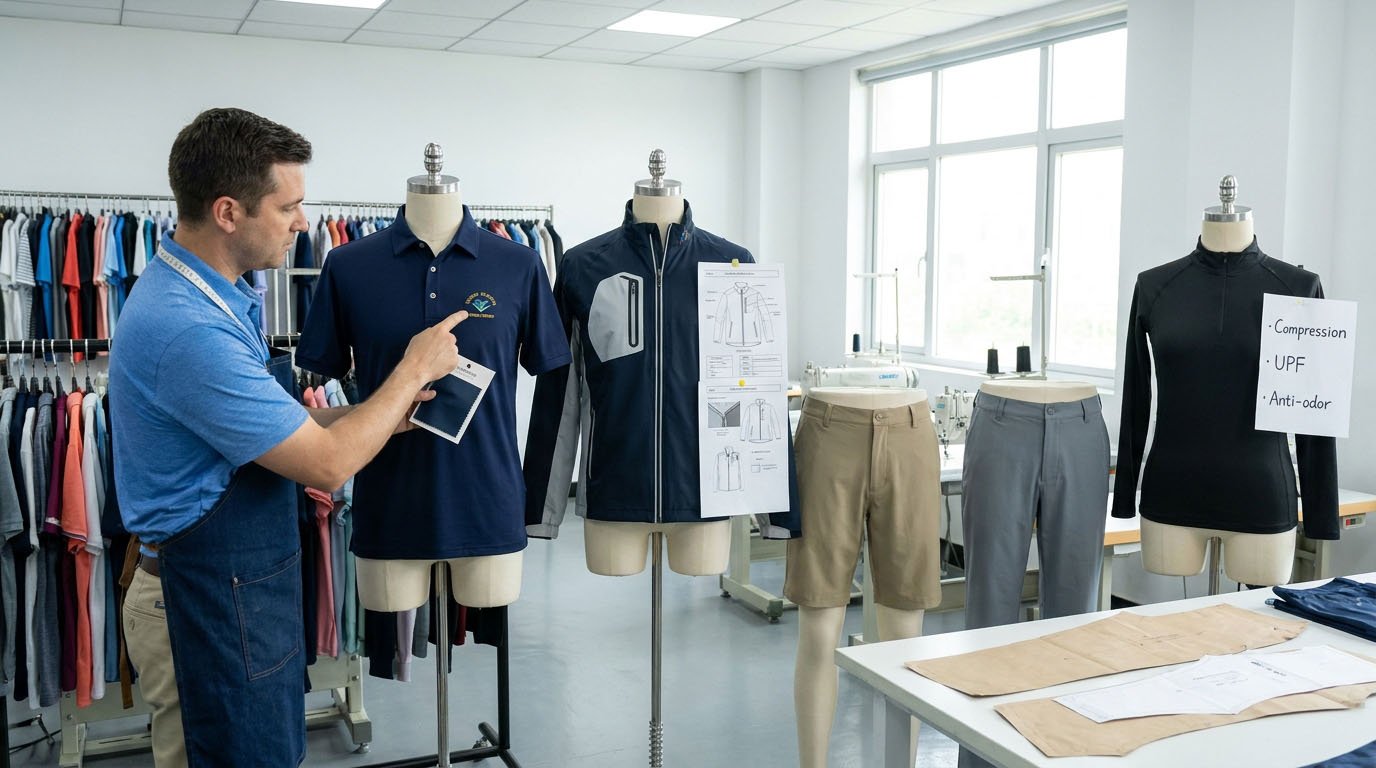
Customization by Product Category
| Golf Apparel Category | Common Customizations | Main Development Considerations |
|---|---|---|
| Golf Polos | Collar, placket, sleeve, hem, fit | Collar stability, armhole balance |
| Golf Shorts & Pants | Waistband, rise, pockets, inseam | Fit across sizes, stretch recovery |
| Quarter-Zips | Collar height, zipper, cuffs, panels | Layering comfort, zipper compatibility |
| Golf Jackets | Pockets, panels, lining, closures | Movement, construction complexity |
| Performance Tops | Fit, neckline, fabric, seams | Stretch, comfort, fabric stability |
Golf polos often offer a manageable starting point because existing patterns and fabric options may be available.
Bottoms generally require closer fit control around the waist, rise, hips, and thighs.
Outerwear may require additional development for layering, closures, lining, and mobility.
Minor Fit Adjustment vs Full Pattern Development
These are different types of customization.
| Minor Fit Adjustment | Full Pattern Development |
|---|---|
| Shorten body length | Create a new pattern block |
| Adjust sleeve length | Redesign shoulder and armhole balance |
| Refine hem shape | Change overall silhouette |
| Make limited width changes | Develop new size grading |
| Modify an existing pattern | Validate a new fit through sampling |
Full development does not automatically require a fixed minimum of 500 pieces.
Feasibility depends on the pattern work, sampling requirements, production setup, and whether development charges are economically acceptable.
For smaller projects, adjusting a suitable existing pattern may be more efficient than creating a completely new one.
Collar, Placket, and Trim Options
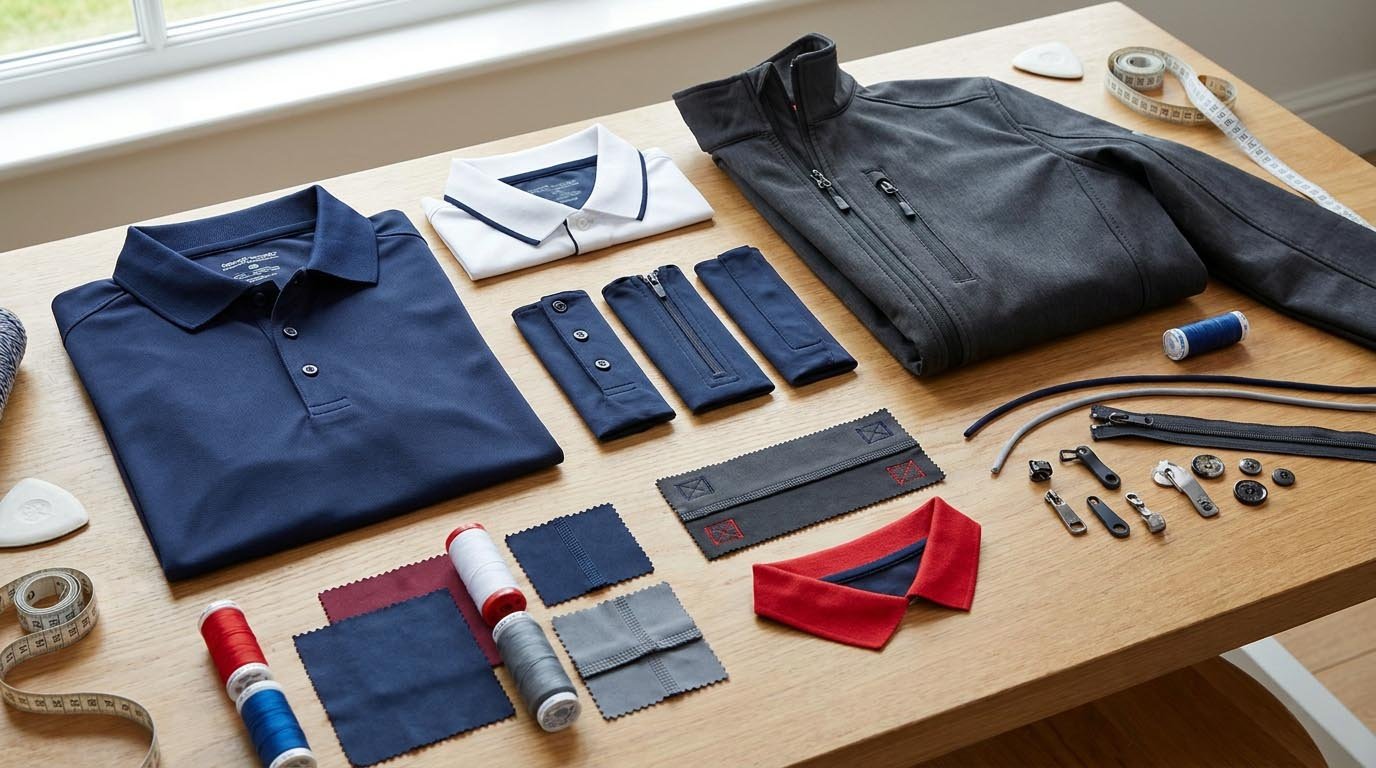
Golf polo customization may include:
- Rib-knit or self-fabric collars
- Contrast collar tipping
- Two-button or three-button plackets
- Zip or hidden plackets
- Contrast stitching or piping
- Custom buttons and selected trims
Some changes involve only component selection. Others require pattern adjustments or additional sewing operations.
For example, replacing standard buttons may be relatively straightforward when compatible components are available. Changing a button placket to a zipper may require new front construction, reinforcement, and sample approval.
Before approval: Confirm the pattern revision, finished measurements, material specifications, construction details, and appearance on a physical sample.
Step 4: Compare MOQ, Cost, and Lead-Time Impact
MOQ, cost, and lead time are related, but they do not always increase at the same rate.
A new pattern may add development expense without requiring a custom fabric order. Conversely, a proprietary fabric may trigger a substantial mill minimum even when the garment construction is simple.
Customization Impact Comparison
| Customization Type | Relative Cost Impact | Potential Lead-Time Impact | Main Constraint |
|---|---|---|---|
| Logo on available garment | Low to moderate | Limited | Artwork and application setup |
| Branded labels | Low to moderate | Supplier-dependent | Label MOQ and approval |
| Minor pattern adjustment | Moderate | Additional sample work | Pattern revision |
| Custom collar/placket | Moderate to high | Sampling and sourcing | Construction complexity |
| Custom dyeing | Project-dependent | Additional material lead time | Mill minimum and color approval |
| New fabric development | Often significant | Additional development time | Fabric production and testing |
| Specialized performance finish | Project-dependent | Testing and finishing time | Compatibility and evidence |
These comparisons are directional, not fixed prices or guaranteed production schedules.
What Is FUWAY's Typical Production Timeline?
For suitable standard projects, FUWAY typically uses the following reference periods:
| Stage | Reference Timeline |
|---|---|
| Sample development | Approximately 7–10 working days |
| Sample revisions | Additional time as required |
| Bulk manufacturing | Approximately 3–4 weeks after final approval and material readiness |
Complex pattern development, custom fabrics, special trims, or multiple approval rounds may require longer schedules.
These figures are not a guaranteed total delivery timeline and do not include international transit time.
The most reliable approach is to request a quotation that identifies which customization requirements affect the unit price, development charges, material minimums, and delivery schedule.
For more detailed MOQ considerations, read our Golf Apparel MOQ Guide.
Step 5: Approve Customization Before Bulk Production
Customization should not move into bulk manufacturing until the relevant specifications have been reviewed and approved.
The most common risks involve unclear artwork, unapproved substitutions, fit changes, and differences between the sample and final production requirements.
Customization Approval Checklist
| Approval Area | What the Buyer Should Confirm |
|---|---|
| Logo | Final artwork, method, size, position, and application quality |
| Fabric | Approved composition, weight, hand-feel, color, and performance requirements |
| Fit | Final measurements, tolerances, and size grading |
| Construction | Collar, placket, seams, pockets, and trims |
| Color | Approved swatch or lab dip where required |
| Labels | Artwork, placement, care information, and applicable requirements |
| Packaging | Materials, labels, folding, and packing quantities |
| Production | Approved sample, specifications, and documented changes |
For example, an approved chest logo on a medium polo should not automatically be assumed suitable for every garment size.
Likewise, approving the appearance of a custom collar does not replace checking its construction and behavior after washing.
Keep a Final Approved Specification
Before production begins, the factory and buyer should agree on:
- Final technical specifications and measurements
- Approved materials, colors, and trims
- Logo artwork and placement
- Sample comments and completed corrections
- Inspection requirements
- Any approved substitutions or deviations
Different projects may require development samples, fit samples, size sets, or pre-production samples.
For a full explanation of these stages, see our Golf Apparel Sampling Process Guide.
A customization request is not production-ready simply because the manufacturer says it is possible. It becomes production-ready when its requirements can be manufactured, checked, and approved consistently.
Step 6: Choose the Right Customization Level for Your Order
The right customization strategy depends on the product's commercial goals, not simply the maximum number of details a factory can change.
Example: 100 Golf Polos with a Custom Collar
Consider a startup requesting:
- 100 performance golf polos
- Available polyester-spandex fabric
- One stock fabric color
- Embroidered chest logo
- Custom neck label
- A modified collar shape
- Standard individual packaging
Rather than automatically rejecting the collar change because of order quantity, the manufacturer should evaluate:
| Requirement | Feasibility Question |
|---|---|
| Fabric | Is the requested material available? |
| Collar | Can an existing pattern be modified? |
| Collar Material | Is the required fabric or rib available in a suitable quantity? |
| Logo | Is embroidery compatible with the selected fabric? |
| Labels | Can label minimums and artwork requirements be met? |
| Sampling | What revisions and approvals are necessary? |
| Cost | Are there additional pattern, trim, or setup charges? |
If the collar can be produced with available materials and a manageable pattern adjustment, the request may be feasible.
If the design requires custom-knitted rib, special yarn dyeing, or additional construction development, the factory may propose an alternative, separate development cost, or revised minimum.
This is an illustrative sourcing scenario, not a confirmed FUWAY quotation.
Select the Level That Matches Your Product
A practical way to evaluate customization is:
Branding-focused: Existing fabric and pattern, with custom logos and labels.
Semi-custom: Available materials combined with selected fit, collar, trim, or construction changes.
Development-focused: New patterns, custom materials, proprietary colors, or specialized technical requirements.
These are planning categories, not rigid MOQ tiers.
Start by identifying which customizations directly contribute to your product's customer value. Ask the manufacturer to evaluate those requirements before expanding the development scope.
Frequently Asked Questions
Can I Customize Golf Polo Collars with an Order of Around 100 Pieces?
Potentially. Collar customization depends on whether existing patterns and materials can be adapted, the required construction, and development costs. A special collar does not automatically require a fixed 500-piece minimum.
What Is the MOQ for Private Label Golf Apparel?
FUWAY's typical starting MOQ is approximately 100 pieces per style, depending on the project. Separate minimums may apply to custom colors, fabrics, labels, trims, or decoration configurations.
Can I Supply My Own Fabric?
This may be possible, subject to fabric compatibility, required testing, material handling, and sourcing arrangements. The manufacturer should confirm whether the supplied fabric is suitable for the intended construction and production process.
Can I Match My Exact Brand Color?
Custom color development can be evaluated using textile color references and approved samples. Final results depend on the fabric and dyeing process, so acceptable color tolerances should be agreed before production.
Does Full Custom Development Always Require a Higher Garment MOQ?
Not necessarily. New patterns may require additional development and sampling costs, while custom fabrics or components may carry separate supplier minimums. The final requirement should be calculated for the specific project.
How Long Does Customization Take?
Standard FUWAY sample development typically takes approximately 7–10 working days for suitable projects. More complex fabric, fit, or component changes may require additional development and approval time.
Discuss Your Custom Golf Apparel Project with FUWAY
Private label golf apparel customization can range from simple branding to detailed product development.
The key is understanding which changes are technically feasible, how they affect MOQ and cost, and what must be approved before manufacturing.
At FUWAY, we support golf apparel brands with:
- OEM/ODM and private label manufacturing
- Performance fabric sourcing
- Pattern and fit adjustments
- Golf polo collar and construction customization
- Embroidery, printing, and branded labels
- Sampling, production, and quality control
Whether you need a branded golf polo using available materials or a more customized golf apparel collection, we can help evaluate your specifications and manufacturing requirements.
Planning a custom golf apparel project?
Contact FUWAY with your product references, design requirements, estimated quantity, and target timeline to discuss the available customization options.