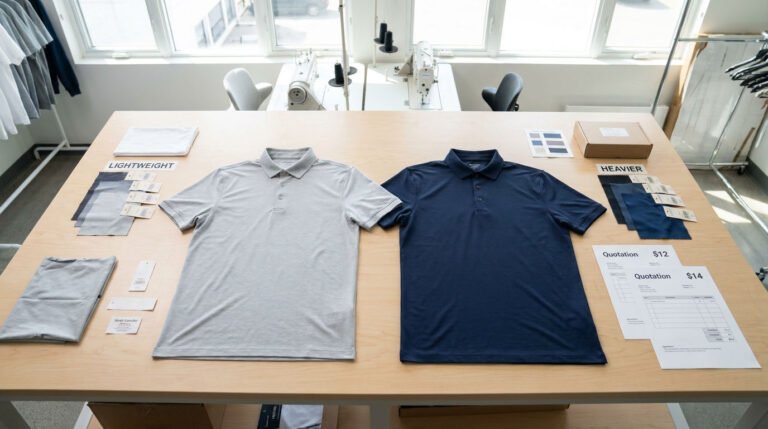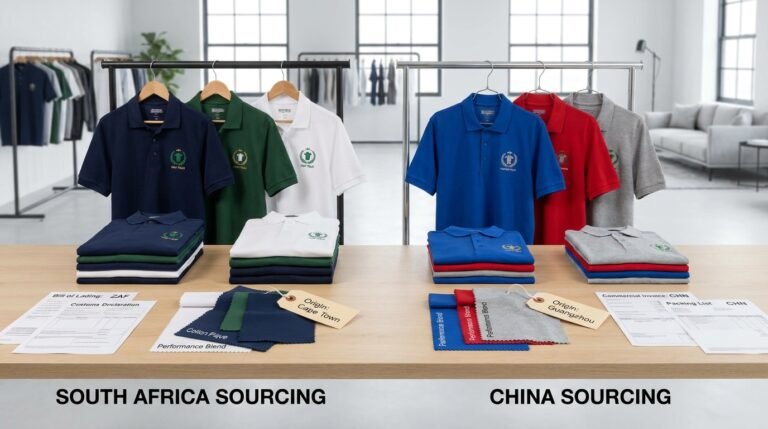
Choose Portugal when verified Portuguese production supports your brand positioning and the supplier can meet your product, quantity and delivery requirements. Choose China when a qualified supplier offers a better combination of technical capability, order flexibility and total delivered cost. For a small golf brand, the decision should come from comparable quotations and samples—not assumptions about either country.
Both locations have suppliers with different specialties, minimums and production models. A factory making excellent cotton polos may not be the right partner for stretch golf trousers, while a technical sportswear supplier may not accept your launch quantity.

This guide focuses on Portugal and China for small brands, particularly those selling in the United States. It does not treat Portugal as representative of all Europe or China as representative of all Asia.
FUWAY is a China-based OEM/ODM golf apparel manufacturer. The comparison below is a buyer decision framework, rather than an independent audit of factories in either country.
Portugal vs China: What Should Small Golf Brands Compare?
Start with the same product brief, quantity breakdown and delivery destination.
| Decision Factor | Portugal | China | What to Verify |
|---|---|---|---|
| Brand positioning | Relevant when Portuguese production is part of your intended product story | Relevant when origin is not the deciding purchase factor | Actual production location and support for origin claims |
| Small orders | Available from some suppliers | Available from some suppliers | Minimum per style, color, fabric and component |
| Technical capability | Depends on the selected manufacturer and material network | Depends on the selected manufacturer and material network | Comparable garments and material evidence |
| Cost | Requires a project-specific quotation | Requires a project-specific quotation | Equivalent specifications and delivered cost |
| Delivery to the US | Requires an international delivery plan | Requires an international delivery plan | Production milestones, freight and clearance |
| Communication | Assess working-hour overlap and technical clarity | Assess working-hour overlap and technical clarity | Response quality and change-control process |
| Reorders | Depend on material availability and capacity | Depend on material availability and capacity | Repeat-order minimums, pricing and continuity |
A supplier’s address does not establish where every production step happens. Confirm whether the business performs manufacturing itself, coordinates subcontractors or supplies decorated ready-made garments.
When Does Portugal Make Sense—and When Does China?
Consider Portugal When Origin Is Part of the Product Strategy
Portuguese production may be a strong fit when:
- Your intended customers value a specific Portuguese manufacturing story.
- A shortlisted supplier already produces garments comparable to your collection.
- Its material options, minimums and development charges fit your launch budget.
- You can manage development or visits more effectively through that supplier relationship.
If you are searching for golf apparel manufacturers in Europe, distinguish between companies selling their own collections and manufacturers accepting production for independent brands. A golf brand using Portuguese factories is not automatically an OEM supplier available to you.
For US sales, check origin labeling carefully. The FTC’s textile labeling guidance explains that imported textile products must identify the appropriate country of origin; a broad European Union designation is insufficient. Confirm the correct origin before approving labels. Federal Trade Commission
Consider China When the Supplier’s Production Package Fits Better
A Chinese supplier may be a strong fit when:
- It can source suitable performance materials at your proposed quantity.
- It demonstrates the required polo, bottoms, skort or outerwear construction.
- It can coordinate the necessary decoration, trims, labels and packaging.
- Its verified quotation and delivery plan work better for your business.
These advantages must be demonstrated by the individual supplier. A general clothing factory in China should not receive preference over a technically qualified Portuguese manufacturer simply because of its location.
For polo development, compare the actual fabric, fit, collar, placket and branding options available through a custom golf shirt manufacturing service.
Compare the Full MOQ Structure

An advertised “100-piece MOQ” does not tell you whether your collection is feasible.
Ask each supplier to separate:
- Garment minimum: the minimum for each style.
- Color minimum: the quantity required for each colorway.
- Fabric minimum: the purchasing commitment for the selected material.
- Component minimum: separate requirements for collars, zippers, labels or packaging.
- Reorder minimum: the conditions for replenishing a successful product.
For example, a proposed 200-piece order in two colors and five sizes creates ten size–color combinations. Confirm whether the supplier accepts your exact distribution rather than assuming the total quantity is sufficient.
Stock Materials Can Change the Comparison
Available fabrics and standard components can make a small order more workable in either country. Custom dyeing, knitting or component development may introduce additional minimums.
However, available stock is not necessarily a reliable reorder source. Ask:
- Is this a continuing fabric quality or a limited remaining lot?
- Can the same specification be reordered?
- What happens if the selected color becomes unavailable?
- Who owns and pays for unused material?
A lower garment MOQ can still involve a substantial material commitment. Our low MOQ golf apparel guide explains these order structures in more detail.
Compare Landed Cost and Launch Cash Separately
For a US brand, compare both suppliers to the same warehouse or fulfillment destination.
Delivered order cost = garments + development + agreed testing and inspection + freight and insurance + applicable import charges + delivery-related fees.
Avoid adding costs twice when they are already included in the supplier’s quotation. Record the quotation currency, delivery terms, named place and exclusions.
Ask your customs broker to confirm the classification, origin and applicable charges for the actual product and planned entry date. Do not use a single regional duty percentage for every golf garment.

A Lower Unit Price Can Require More Cash
The following figures are hypothetical arithmetic examples, not supplier quotations or country benchmarks.
| Quotation | Quantity | Garment Unit Price | Garment Purchase Value |
|---|---|---|---|
| Supplier A | 100 pieces | $22 | $2,200 |
| Supplier B | 300 pieces | $16 | $4,800 |
Supplier B offers a lower unit price but requires $2,600 more in garment purchasing before development, freight or import charges.
That larger order may be sensible if demand supports it. If demand is unproven, the smaller order may preserve more cash for marketing, fulfillment and reordering successful products.
Also compare payment timing. Two orders with similar total costs can create different cash pressure because of deposits, material prepayments and balance-payment milestones.
Do not assign an invented defect rate to either country. Record known charges and unresolved risks separately.
Compare Warehouse Arrival Dates, Not Factory Lead Times Alone

A quoted production duration is only useful when its starting and finishing points are clear.
Ask each supplier to schedule:
| Milestone | What to Confirm |
|---|---|
| Specification review | What must be finalized before development starts? |
| Sampling | Does the estimate include revisions and sample delivery? |
| Material preparation | Are fabrics and trims available or awaiting production? |
| Bulk production | Which approvals and payments start the production clock? |
| Inspection and release | Are testing, corrections and packing included? |
| Transport and clearance | When should the order reach your US destination? |
A factory quoting a shorter sewing period may still deliver later if material sourcing or sample revisions take longer.
Portugal’s proximity to EU buyers does not establish the delivery advantage for a US warehouse. Compare actual routes and shipping methods for your destination.
At FUWAY, typical initial sampling takes 7–10 working days, while bulk production is approximately 3–4 weeks, subject to fabric, construction, quantity and customization requirements. These are planning references; confirm project milestones and transport separately.
Test Communication Before Selecting the Supplier
During development, assess whether the supplier:
- Identifies missing specifications.
- Answers technical questions clearly.
- Records sample revisions accurately.
- Explains the cost and schedule impact of requested changes.
- Reports unavailable materials before substituting them.
Useful communication reduces avoidable revision rounds. Fast replies alone do not establish technical competence.
Verify Technical Capability Through Comparable Samples

Country-level comparisons become less useful once you have physical samples.
Ask each candidate to demonstrate the features that matter to your collection.
| Product | Priority Checks |
|---|---|
| Golf polo | Fabric recovery, collar shape, placket alignment and logo appearance |
| Golf shorts or trousers | Waistband comfort, mobility, pocket construction and fit |
| Golf skort | Outer fabric coverage, liner comfort and waistband stability |
| Quarter-zip | Zipper alignment, layering fit and seam appearance |
Do not assume that every golf garment requires synthetic fabric, an antimicrobial treatment or a particular UV rating. Select materials and performance requirements around the intended customer and product.
If you plan to make a performance claim, agree on the test method, acceptance criteria and relevant sample before production.
Check Material Access and Repeatability
Ask both suppliers for physical swatches and the proposed material specification. Confirm whether their sample fabric represents the intended bulk material.
A cotton-focused supplier should demonstrate the required stretch-knit capability when your product needs it. Equally, a performance specialist should demonstrate the hand feel and construction needed for a lifestyle collection.
FUWAY’s golf apparel fabric sourcing service can support material evaluation during development.
Treat Certificates as Specific Evidence
A certificate supports only the subject and scope it covers.
OEKO-TEX STANDARD 100 concerns testing for harmful substances. It does not, by itself, establish stretch recovery, moisture-management performance or logo durability. Ask for the certificate number, validity and covered article; use the verification route provided on the official STANDARD 100 page.
Keep the approved fabric, fit, color, decoration and construction references together. Before shipment, review production evidence against those references using a golf apparel pre-shipment QC checklist.
Make the Final Decision Using the Same Product Brief
Send every shortlisted supplier the same RFQ version. Include the same product specification, quantity by color and size, decoration, packaging, delivery destination and required arrival date.
Use our golf apparel RFQ template to keep the quotation basis consistent.
Before choosing Portugal or China, confirm that the selected supplier can:
- Produce the required garment at your actual order breakdown.
- Supply an acceptable sample and relevant supporting evidence.
- Explain the full purchasing and material commitment.
- Meet a credible delivery plan.
- Document substitution, quality-remedy and reorder conditions.
Once these requirements are satisfied, the golf apparel supplier scorecard can help compare qualified candidates without relying on unit price alone.
Frequently Asked Questions
Should a Small Brand Split Its First Collection Between Portugal and China?
It can work when different suppliers have distinct product strengths, but it adds development, freight and coordination tasks. For a small launch, split production only when the product or commercial benefit justifies the additional work.
Can I Transfer an Approved Sample to a Factory in Another Country?
A reference sample helps communicate the target, but the new supplier still needs to confirm materials, patterns, construction and decoration. Differences in fabric or production methods may require redevelopment. Approve the new supplier’s production reference before placing bulk orders.
Is a Full-Package Manufacturer Better Than Buying Fabric Separately?
It can simplify coordination when the supplier manages materials and garment production effectively. Buying fabric separately may suit brands with material-development experience or an established mill relationship. In either model, document responsibility for material approval, defects and replacements.
Can I Start Without a Complete Tech Pack?
Yes. Reference images, product requirements, estimated quantities and branding details can support an initial feasibility discussion. Mark undecided details clearly. Final pricing and bulk approval require sufficiently complete specifications.
Conclusion
Portugal and China can both suit a small golf brand when the individual supplier meets the project’s requirements. Portuguese production may support an origin-led product strategy; a qualified Chinese partner may provide a more suitable combination of materials, customization and order economics.
Compare the same product, purchasing commitment and warehouse arrival plan. Choose the supplier whose verified sample, commercial terms and production controls fit your launch.
To evaluate FUWAY for your collection, send your design brief or tech pack with quantities by style and color, your destination and target delivery date. Our team can review material options, order feasibility and development requirements before you commit to bulk production.