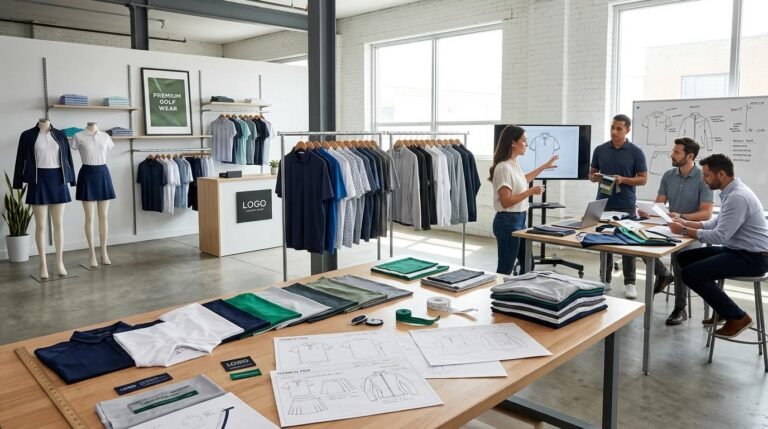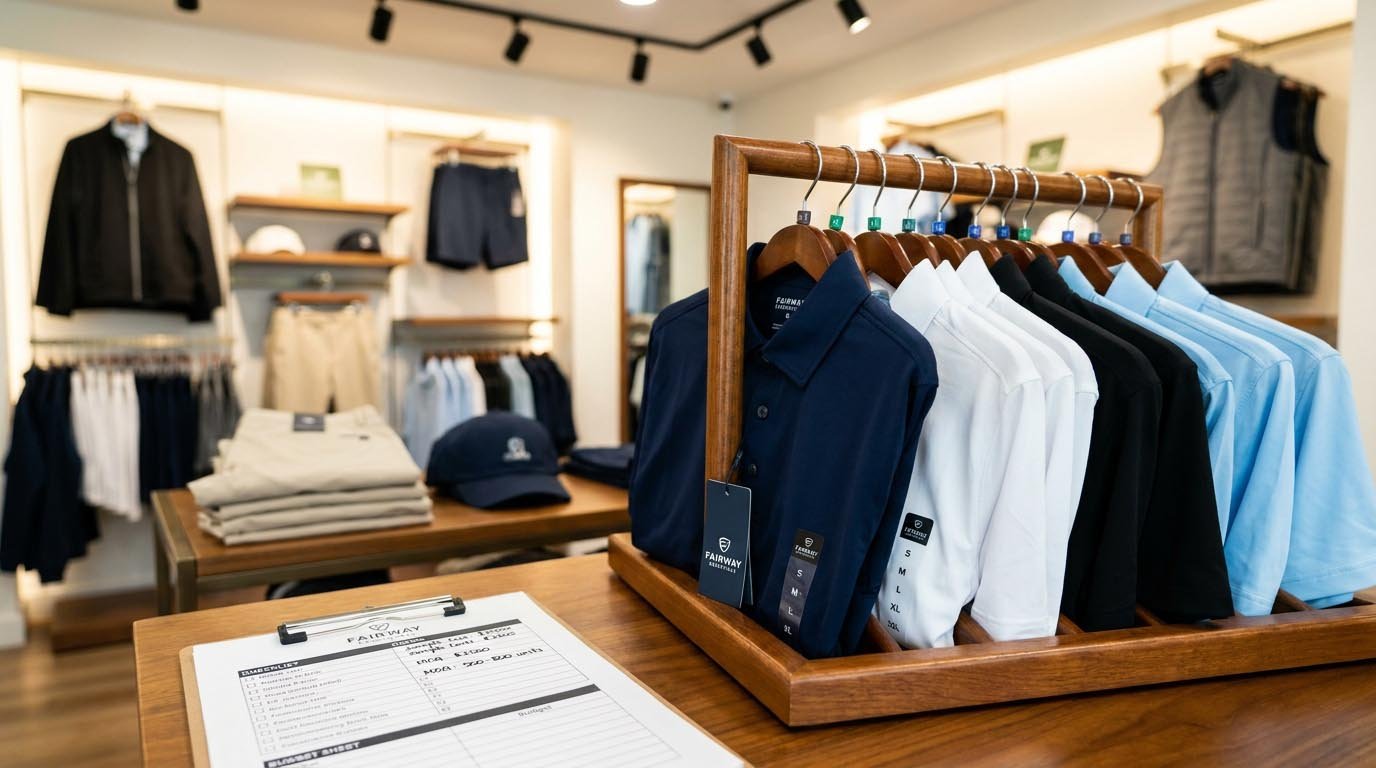

A client called six months ago wanting to launch a complete golf brand: polos, pants, shorts, jackets, vests, hats, accessories. Budget was $45,000. I asked which products their target customers needed most. Silence. They had not thought about that—they just wanted a "complete collection."
Launch golf apparel collections starting with performance polos as your anchor product, not because they are universally best, but because they offer the lowest commercial risk: flexible MOQ (500-800 pieces), proven repeat purchase rates, manageable sampling costs ($180-280), and predictable supply chain behavior that new brands need to build cash flow confidence.
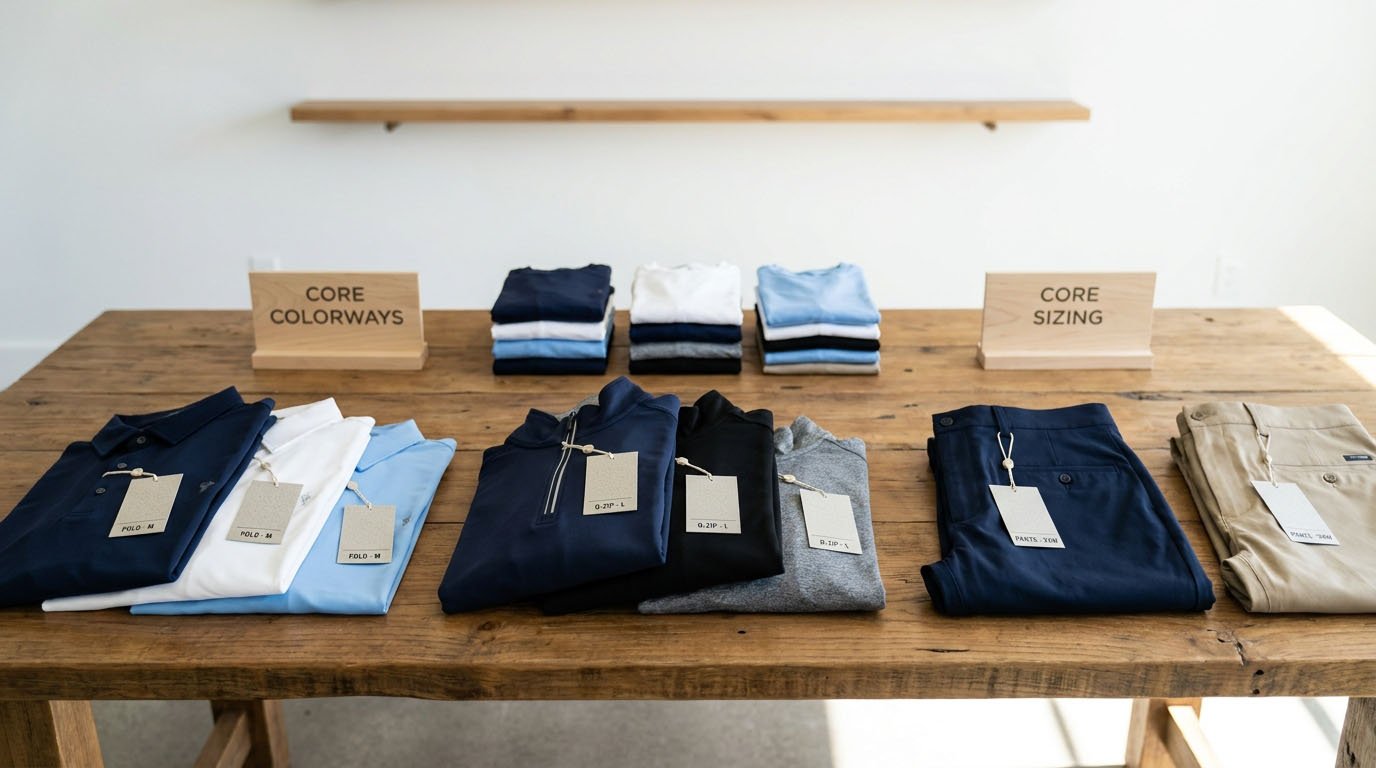
The question "which products should I launch first?" reveals a deeper confusion. New brands treat this as a preference decision—"I like quarter-zips, so I will start there." The actual decision involves capital allocation, inventory turnover, channel requirements, and market validation risk. I have guided 80+ brands through first-collection planning over the past 15 years. The brands that succeed start narrow and expand based on sales data. The ones that struggle launch too wide, run out of capital before validating product-market fit, and end up liquidating inventory at 40-50% discounts within six months. This guide shows you the decision framework I use when clients ask where to start.
Quick Answers: What New Golf Brands Get Wrong About Product Launch Order
Q: Should I start with polos, pants, or outerwear?
Polos require the lowest capital risk and fastest customer feedback (500–800 pcs, $5,500–12,800 order). Pants/outerwear cost 2–3× more cash up front and turn slower.
Q: When should layering (quarter-zips/hoodies) launch first?
If launching in fall/winter or in cold-climate regions with online retail, layering sells better than polos. Time your launch to your market’s golf season.
Q: Do I need a “full collection” to look credible at launch?
No—repeat data: polo buyers come back, enabling layering launches next; pants buyers churn slower. Grow with your audience’s actual buying patterns, not by collection checklists.
Q: How expensive is sampling for multi-category launches?
Very: $80–150/polo, $150–240/pant, $180–300/jacket. Total sampling for 6 styles = $900–1,500 before production. Multi-category sampling often delays launch 4–6 months and drains budget for real orders.
Q: Is outerwear or other high-margin items better for my first production run?
No. Inventory turnover matters more than margin. Polos restock fastest (45–90 days) so you can roll capital multiple times, building momentum—a slow-selling high-margin jacket doesn’t.
Start with the Core: Performance Polos as Your Anchor?
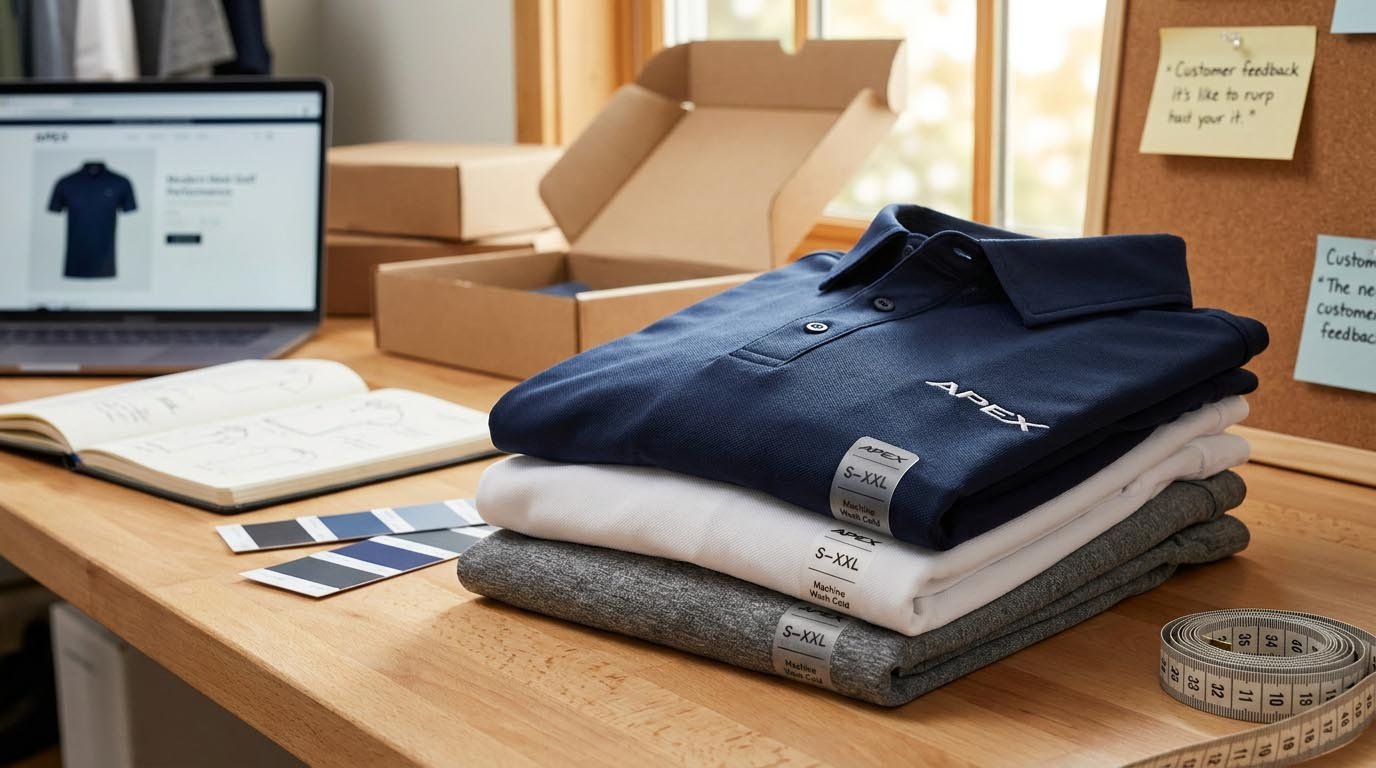
Launch performance polo shirts first when you have limited capital (under $20,000), no existing customer base, and need to validate product-market fit quickly—polos provide the fastest path to revenue, clearest customer feedback, and most flexible foundation for category expansion.
I tell clients: "Polos are not the most exciting product, but they are the safest first move for most brands." This recommendation frustrates founders who envision distinctive outerwear or innovative bottom designs. But commercial reality overrides creative preference when you are operating with limited capital and no market validation.
Why Polos Reduce Launch Risk
Lower Minimum Order Quantities
- Standard polo MOQ: 500-800 pieces across sizes and colors
- Pants/shorts MOQ: 800-1,200 pieces (pattern complexity requires higher volume)
- Outerwear MOQ: 800-1,200 pieces (technical fabrics demand minimum runs)
- Accessories MOQ: 300-500 pieces (lower absolute, but unit economics problematic)
The 500-800 piece polo MOQ allows testing with $5,500-12,800 capital commitment. This is achievable for bootstrapped entrepreneurs and leaves budget for marketing, website development, and operational needs.
Faster Production and Sampling Cycles
- Polo sampling: 12-18 days from tech pack to sample shipment
- Polo production: 35-45 days from order to shipment
- Combined timeline: 50-65 days from deposit to receiving inventory
Compare to:
- Pants sampling: 18-25 days, production: 45-55 days, combined: 65-80 days
- Outerwear sampling: 20-30 days, production: 50-65 days, combined: 70-95 days
The 15-30 day time advantage matters significantly when you need revenue quickly to fund next production or when launching into seasonal windows.
Proven Customer Purchase Behavior
In tracking client sales data across 40+ golf brands:
- Polo purchase frequency: Customers buy polos 2-4 times per year
- Pants purchase frequency: Customers buy pants 1-2 times per year
- Outerwear purchase frequency: Customers buy outerwear 0.5-1 times per year (every 1-2 years)
Polos create more frequent customer touchpoints, accelerating feedback loops and relationship building.
Flexible SKU Strategy
Polos allow efficient SKU management:
- 3-4 colorways × 5 sizes (S-XXL) = 15-20 SKUs
- Each colorway at 125-200 pieces maintains reasonable inventory depth
This breadth provides customer choice without fragmenting inventory too much. Compare to pants where 4 colorways × 7 sizes × 2 lengths = 56 SKUs, creating inventory management complexity too early.
When Polos Are NOT the Right Starting Point
Scenario 1: Launching in Fall/Winter Only (October-February)
If your launch timeline falls during cold-weather months in your target market, immediate customer need skews toward layering and outerwear. Launching polos in November means waiting 4-6 months for spring demand. Better to launch quarter-zips or lightweight hoodies that serve immediate seasonal needs.
Scenario 2: Established E-Commerce Traffic in Cold Climates
If you already operate a golf e-commerce site with traffic in cold-weather regions (Pacific Northwest, Northeast, Canada), customer search behavior and demand patterns favor outerwear and layering over base layers. Your data should guide product priority, not generic advice.
Scenario 3: Luxury/Premium Positioning from Launch
Premium golf brands positioning at $90-120 retail for polos face different constraints. At that price point, customers expect distinctive design and materials that require higher development investment. These brands might start with outerwear at $180-240 retail where the price-to-perceived value equation works better for differentiation.
Scenario 4: Wholesale-First Strategy with Buyer Requirements
Some wholesale buyers require minimum category breadth before placing purchase orders. If your go-to-market depends on wholesale and buyers demand tops + bottoms as entry requirement, you must adjust launch strategy to meet channel needs rather than optimize for lowest risk.
The Polo-First Launch Path
If polos make sense for your situation, here is the execution sequence:
Month 1: Design and Sampling
- Develop 2-3 core polo designs (different collar styles or fabric weights)
- Sample in 2-3 colorways per design
- Test fit, fabric, and construction quality
- Cost: $240-450 for sampling
Month 2: Production Order and Pre-Launch
- Place order for 600-800 pieces across best-performing samples
- While production runs, build website and marketing assets
- Gather email list through pre-launch campaign
- Set up operational infrastructure (fulfillment, customer service)
Month 3: Launch and Initial Sales
- Products arrive, QC and prep inventory
- Launch to email list and initial marketing push
- Gather customer feedback and sales data
Month 4-5: Evaluate and Plan Expansion
- Analyze which colorways and sizes sell fastest
- Identify customer requests for other product categories
- Plan next production (more polos in winning colors OR first expansion category)
Month 6: Second Production
- Reorder successful polo SKUs to maintain inventory
- Add 1-2 new categories based on customer feedback (quarter-zips, shorts, pants)
- Use profit from first polo sales to fund expansion
This path builds momentum while managing cash flow risk.
Polo Selection Criteria
Not all polos are equal. Choose specifications that balance performance, appeal, and cost:
| Feature | Entry Option | Recommended Option | Premium Option |
|---|---|---|---|
| Fabric | 100% polyester pique | Polyester-spandex blend (92/8) | Technical tri-blend with UV treatment |
| Fabric Weight | 160-180 GSM | 180-200 GSM | 200-220 GSM |
| Per-Piece Cost | $11-13 (800 units) | $13-16 (600 units) | $17-20 (600 units) |
| Retail Price | $45-55 | $55-70 | $75-95 |
| Best For | Value positioning, price-sensitive customers | Core market, balanced quality-price | Premium brands, performance focus |
I recommend most new brands start with the middle tier: polyester-spandex blend at 180-200 GSM, retailing $55-70. This provides quality differentiation from mass-market options while maintaining accessible pricing.
Year-Round Layers: Quarter-Zips and Lightweight Hoodies?
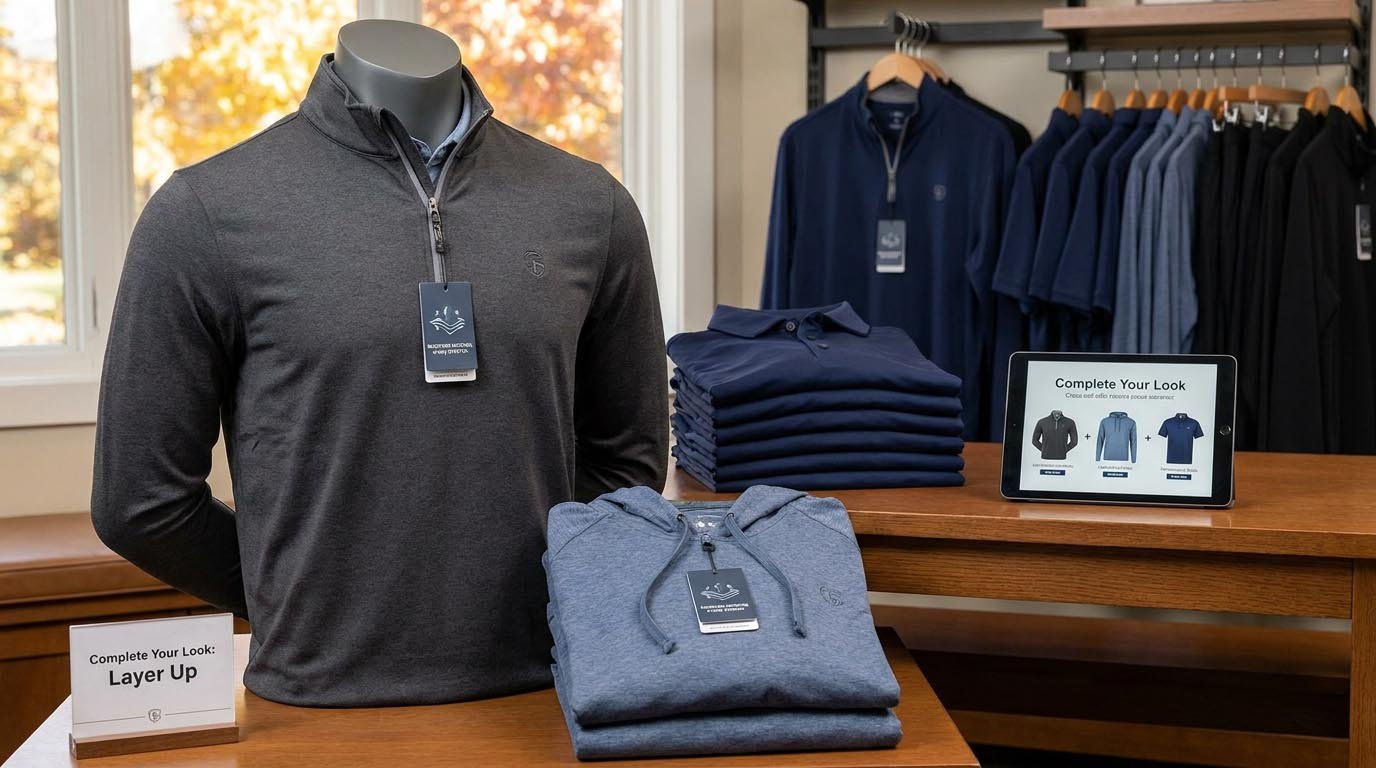
Add layering pieces as your second category once polo sales validate customer demand and generate reinvestment capital—quarter-zips and hoodies extend seasonal relevance and increase average transaction value by 20-30% through cross-selling opportunities.
Layering pieces sit between base layers and outerwear in both function and launch priority. They make sense as category two for most brands that started with polos. The question is timing: when do you add them, and which type (quarter-zips vs hoodies) first?
Why Layering Comes After Polos But Before Bottoms
Strategic Logic
Layering creates natural purchasing flow from your established polo customers:
- Customers buying polos in spring seek layering options when fall arrives
- 18-25% of polo customers purchase layering within 4-6 months in client sales data
- Layering pieces command higher average order value ($75-95) than adding more polos
- The category serves 6-9 months of weather conditions in most markets (not purely seasonal)
Commercial Advantages Over Bottoms
Compared to launching pants or shorts as your second category:
- Lower MOQ: Quarter-zips/hoodies require 800-1,000 pieces vs 1,000-1,500 for quality pants
- Simpler sizing: 5 sizes (S-XXL) vs 7-9 sizes with length variants for pants
- Less fit risk: Layering fit is more forgiving than pants fit (fewer returns from sizing issues)
- Broader seasonal window: Layering works 8-10 months in most climates; shorts are 4-6 months maximum
Quarter-Zips vs Hoodies: Which Layering Product First?
The choice depends on brand positioning and market:
Choose Quarter-Zips First If:
- Your brand positioning is traditional/classic golf apparel
- Target customers are ages 40+ (prefer refined, dress-code-friendly layering)
- Selling primarily through pro shops or golf specialty retail
- Target market has moderate climate where lightweight layering dominates
Quarter-Zip Advantages:
- Universal golf course acceptance (no dress code concerns)
- Perceived as "proper" golf apparel
- Price positioning $65-85 sits comfortably between polos and outerwear
- Production cost: $18-24 per piece at 800-1,000 units
Choose Hoodies First If:
- Your brand positioning is lifestyle/athleisure focused
- Target customers are ages 25-45 (embrace casual styling)
- Selling primarily through e-commerce direct-to-consumer
- Target market values versatility (golf + daily wear)
Hoodie Advantages:
- Strong lifestyle crossover appeal (worn beyond golf)
- Higher perceived value supports $75-95 retail pricing
- Resonates with younger demographics driving golf growth
- Production cost: $21-26 per piece at 800-1,000 units
Or Launch Both Simultaneously If:
- You have validated demand through 2-3 successful polo productions
- Available capital supports 1,600-2,000 piece order across both categories
- Customer feedback specifically requests both types
Layering Launch Timing
Ideal Timing After Polo Success:
Wait until you have:
- Sold through 60-70% of initial polo inventory
- Generated $15,000-25,000 in polo revenue
- Collected customer feedback requesting layering options
- Confirmed repeat purchase rate (customers buying second/third polos)
This typically happens 3-5 months after initial polo launch if market response is positive.
Seasonal Launch Windows:
Layering pieces have two optimal launch windows:
Fall Launch (August-September)
- Prime seasonal demand for layering pieces
- Customers actively shopping for cool-weather golf apparel
- Accounts for 50-60% of annual layering sales
- Risk: If you miss this window, inventory sits until next year
Spring Launch (February-March)
- Secondary seasonal window, still meaningful demand
- 25-35% of annual layering sales
- Safer if you are unsure of demand (smaller inventory commitment)
Avoid launching layering in November-January (too late for peak season, too early for spring) or May-July (limited immediate need, inventory sits 4-5 months).
Layering Product Specifications
Quarter-Zip Pullovers:
| Specification | Value Tier | Core Tier | Premium Tier |
|---|---|---|---|
| Fabric | Basic polyester fleece | Performance fleece with stretch | Technical fleece with windproofing |
| Fabric Weight | 240-260 GSM | 260-280 GSM | 280-320 GSM |
| Collar Height | 2 inches | 2.5-3 inches | 3-3.5 inches |
| Features | Basic construction, standard zipper | YKK zipper, moisture-wicking, stretch panels | Premium materials, multiple pockets, refined details |
| Cost per Piece | $16-19 (1,000 units) | $19-24 (800 units) | $26-32 (800 units) |
| Retail Price | $55-70 | $70-85 | $90-110 |
Hoodies:
| Specification | Value Tier | Core Tier | Premium Tier |
|---|---|---|---|
| Fabric | Cotton-poly blend fleece | Performance poly-blend with stretch | Technical 4-way stretch with moisture management |
| Fabric Weight | 320-340 GSM | 300-320 GSM | 280-300 GSM (lighter but more functional) |
| Construction | Basic fit, standard hood | Athletic fit, raglan sleeves, lined hood | Performance fit, articulated shoulders, premium finishes |
| Cost per Piece | $18-22 (1,000 units) | $22-28 (800 units) | $30-38 (800 units) |
| Retail Price | $60-75 | $75-95 | $100-130 |
For most brands adding layering as category two, I recommend core tier specifications. This provides quality differentiation while maintaining margins and accessible pricing for your growing customer base.
Layering Launch Budget
Minimum viable layering launch (one category):
Quarter-Zips (800 pieces):
- Production cost: $15,200-19,200 at $19-24 per piece
- Sampling: $200-350
- Photography: $400-800
- Total investment: $16,000-20,500
Hoodies (800 pieces):
- Production cost: $17,600-22,400 at $22-28 per piece
- Sampling: $250-400
- Photography: $400-800
- Total investment: $18,500-23,800
This represents 2-3× your initial polo investment, requiring confidence that market demand exists based on polo sales performance.
Course-Ready Bottoms: Stretch Pants and Golf Shorts?
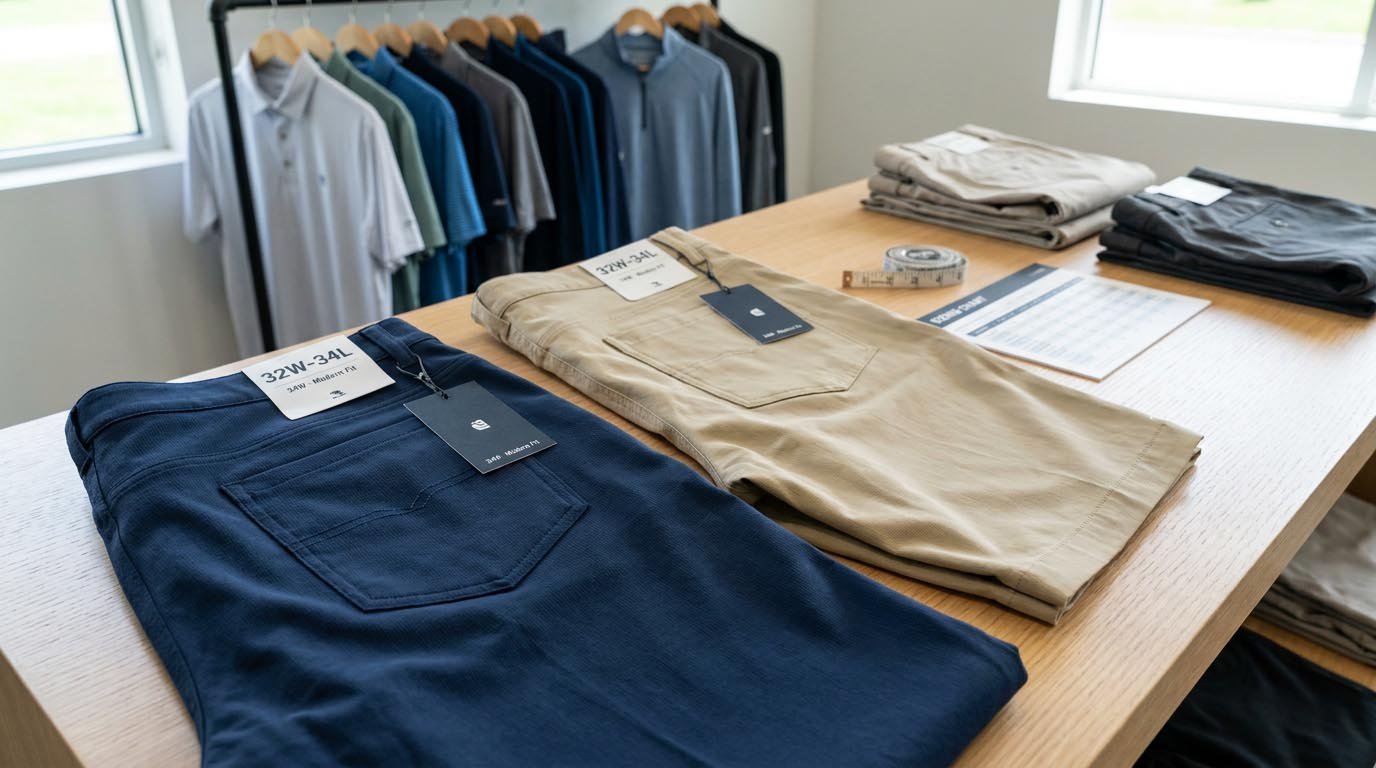
Launch bottoms as your third category after establishing base layers and layering pieces—pants and shorts require higher inventory investment, more complex sizing, and longer sales cycles, making them risky as early-stage products despite their necessity for complete golf outfits.
Bottoms feel essential. Clients ask "how can I call myself a golf brand without pants and shorts?" The answer: easily, if you are managing limited capital and building sustainable growth. Bottoms come with hidden complexity that new brands underestimate.
Why Bottoms Come Later in Launch Sequence
Higher Capital Requirements
Bottoms demand more inventory investment:
- Minimum order: 1,000-1,500 pieces (pattern complexity requires volume)
- Cost per piece: $18-24 for quality golf pants, $14-19 for shorts
- Total investment: $18,000-36,000 for pants, $14,000-28,500 for shorts
This represents 3-4× the capital of initial polo launch, requiring proven revenue and cash flow before commitment.
Complex Sizing and Fit Challenges
Pants sizing creates operational complexity:
Standard Golf Pants Sizing Matrix:
- Waist sizes: 30, 32, 34, 36, 38, 40, 42 (7 sizes)
- Inseam lengths: Short (30"), Regular (32"), Long (34") (3 lengths)
- Total SKUs per colorway: 21 unique size combinations
With 3-4 colorways, you are managing 63-84 SKUs for pants alone versus 15-20 SKUs for polos. This inventory complexity strains warehousing, forecasting, and restocking.
Higher Return Rates
Pants generate higher return rates than tops:
- Polo return rate: 8-12% across client brands
- Pants return rate: 18-25% (fit issues, length problems, waist sizing mismatches)
- Shorts return rate: 12-18% (length and fit preferences vary widely)
Higher returns mean:
- More customer service time resolving sizing questions
- Capital tied up in returned inventory
- Revenue loss from processing fees and reshipping
Longer Purchase Cycle
Customers buy bottoms less frequently than tops:
- Average customer buys 2.5-3.5 polos within 6 months
- Average customer buys 1.2-1.8 pants in 12 months
- Average customer buys 1.5-2.2 shorts per season
Lower purchase frequency means slower cash flow return on inventory investment.
When to Add Bottoms to Your Collection
Wait to launch bottoms until:
Revenue Milestone: You have generated $40,000-60,000 in cumulative revenue from polos and layering
Customer Base: You have 500-800 customers who purchased tops and might buy bottoms
Inventory Health: You maintain healthy turnover on existing categories (not sitting on dead stock)
Operational Capacity: You can handle increased complexity in customer service and fulfillment
This typically happens 8-12 months after initial launch if growth trajectory is positive.
Pants vs Shorts: Which First?
Choose Pants First If:
- Target market is moderate-to-cold climate (limited shorts weather)
- Target customers are business-focused professionals (prefer long pants even in warm weather)
- Launching in fall/winter (pants demand immediate, shorts wait until spring)
- Brand positioning is traditional/formal golf apparel
Pants Advantages:
- Year-round product in many climates (9-12 months of wear)
- Higher retail price ($80-120) means better per-unit revenue
- Perceived as more essential than shorts for "complete" golf wardrobe
Choose Shorts First If:
- Target market is warm/hot climate (year-round shorts weather or 6+ month summer seasons)
- Target customers are younger demographics (prefer shorts for casual golf)
- Launching in spring/summer (immediate demand)
- Brand positioning is casual/lifestyle golf apparel
Shorts Advantages:
- Lower MOQ and cost ($14-19 per piece vs $18-24 for pants)
- Simpler sizing (typically just waist sizes, no length variants)
- Faster production (less complex pattern and construction)
- Lower return rates than pants (fewer fit variables)
Or Launch Both Simultaneously If:
- You have $35,000-60,000 capital for bottoms category
- Strong customer feedback requesting both
- Two distinct seasonal windows in your market (cold season = pants, hot season = shorts)
Bottoms Specification Guidance
Golf Pants:
Focus on stretch performance and modern fit to differentiate from dated golf pants:
| Feature | Entry Specification | Recommended Specification | Premium Specification |
|---|---|---|---|
| Fabric | Poly-cotton blend, minimal stretch | Poly-spandex blend (92/8), 2-way stretch | Technical fabric, 4-way stretch, water-resistant |
| Fit Style | Classic straight leg | Modern tapered leg | Slim tapered performance fit |
| Features | Basic 5-pocket, zip fly | Stretch waistband, multiple pockets | Articulated knees, reinforced areas, premium details |
| Cost per Piece | $16-20 (1,200 units) | $20-26 (1,000 units) | $28-36 (1,000 units) |
| Retail Price | $65-85 | $85-110 | $120-150 |
Golf Shorts:
Prioritize comfort and versatility for both on-course and casual wear:
| Feature | Entry Specification | Recommended Specification | Premium Specification |
|---|---|---|---|
| Fabric | Cotton-poly blend | Poly-spandex with stretch | Technical quick-dry with UV protection |
| Inseam Length | 9-10 inches (one length) | 9" and 11" options | Multiple length options with athletic cut |
| Features | Basic pockets, standard waistband | Stretch waistband, phone pocket | Premium details, moisture-wicking, multiple functional pockets |
| Cost per Piece | $13-16 (1,200 units) | $16-20 (1,000 units) | $22-28 (1,000 units) |
| Retail Price | $50-65 | $65-80 | $85-110 |
I recommend most brands launch bottoms at recommended tier to provide meaningful quality versus mass-market options while controlling costs during category expansion phase.
Managing Bottoms Inventory Complexity
Smart SKU Strategy for First Bottoms Launch:
Instead of launching full size matrix, start with core sizes only:
Pants Core Sizes:
- Waist: 32, 34, 36, 38 (4 sizes instead of 7)
- Length: Regular only (1 length instead of 3)
- Colorways: 2-3 colors
- Total SKUs: 8-12 instead of 42-63
This approach:
- Reduces initial inventory by 60-70%
- Covers 65-75% of typical customer demand
- Allows market testing before full size expansion
Shorts Core Sizes:
- Waist: 30, 32, 34, 36, 38 (5 sizes)
- Colorways: 2-3 colors
- Total SKUs: 10-15
Add extended sizes (28, 40, 42 waist) and length variants after validating demand in core sizes.
Weather Credibility: Vests, Windbreakers and Rain Shells?
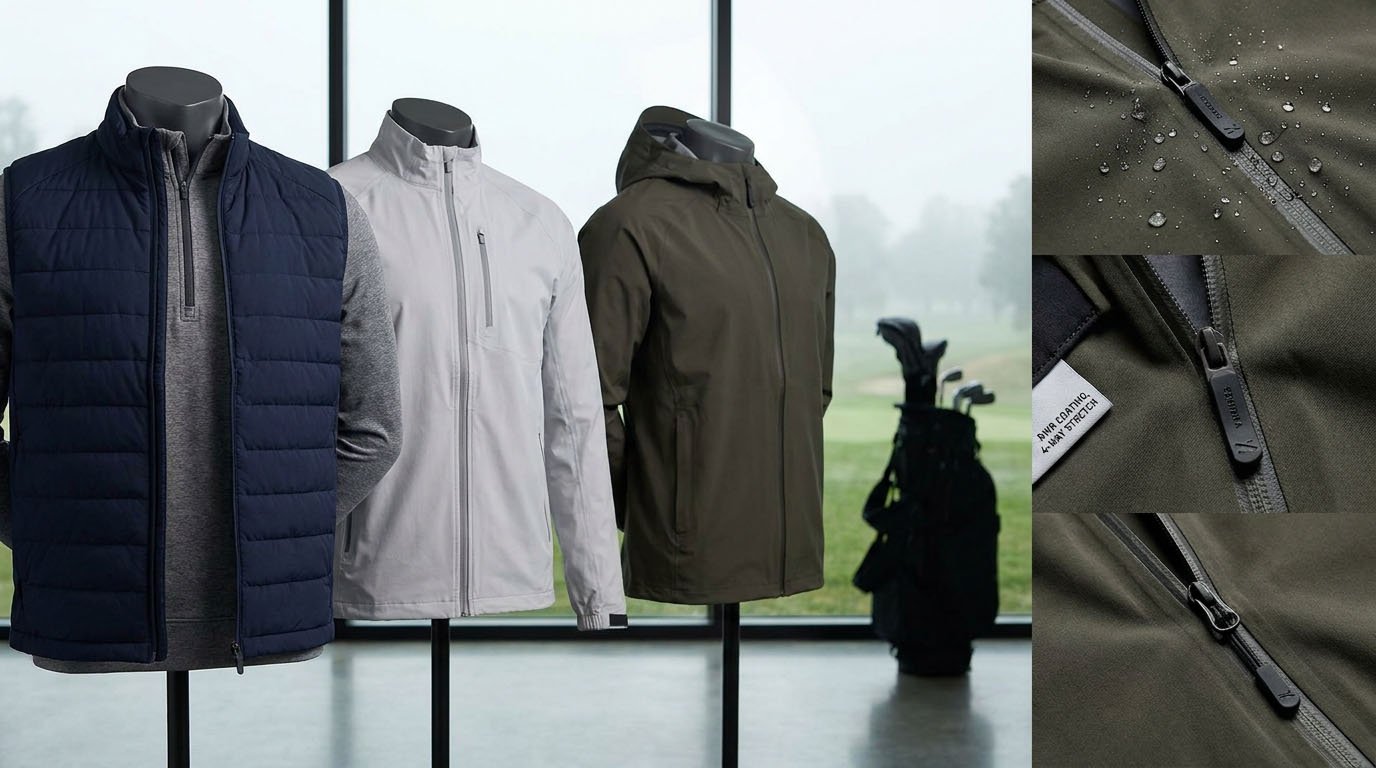
Add outerwear as your fourth category only after establishing sales momentum in base layers, layering, and bottoms—outerwear requires the highest investment, longest production timelines, and most seasonal dependency, making it the final piece for most new collections.
Outerwear looks appealing. High retail prices ($110-180) suggest strong margins. Premium appearance elevates brand perception. But outerwear introduces the most risk for emerging brands due to capital intensity and seasonal constraints.
Why Outerwear Comes Last for Most Brands
Highest Capital Requirements
Outerwear demands maximum upfront investment:
- Minimum order: 800-1,200 pieces (technical fabrics require volume)
- Cost per piece: $28-38 for vests, $35-48 for windbreakers, $42-58 for rain shells
- Total investment: $22,400-45,600 for vests, $28,000-57,600 for windbreakers
This represents 4-5× your initial polo investment, requiring substantial proven revenue before commitment.
Most Seasonal Dependency
Outerwear sales concentrate in narrow windows:
- Vest sales: 65-75% occur October-February (5 months)
- Rain shell sales: Spring/fall spikes, but unpredictable (weather-dependent)
- Windbreaker sales: More distributed but still seasonal (March-May, September-November)
Missing seasonal launch windows means inventory sits 6-8 months before next peak demand.
Longest Production Timelines
Outerwear requires extended development and production:
- Sampling: 20-35 days (complex patterns, multiple components)
- Production: 55-70 days (technical fabrics, detailed construction)
- Total lead time: 75-105 days from order to receiving inventory
This 10-14 week timeline means planning 4-5 months ahead of when you need products in stock—difficult forecasting for new brands without historical data.
Most Technical Specifications
Outerwear specifications involve complex trade-offs:
- Waterproofing vs breathability (higher ratings increase cost exponentially)
- Insulation type and weight (synthetic, down, or none—each serves different conditions)
- Seam sealing requirements (critical for rain protection, adds cost and production time)
New brands often over-specify (adding unnecessary features that inflate cost) or under-specify (creating products that fail performance expectations).
When You Are Ready for Outerwear
Launch outerwear when:
Financial Capacity: You have $30,000-50,000 available for outerwear inventory without straining operations
Market Validation: You have 1,000-1,500 customers from previous categories who might purchase outerwear
Operational Maturity: You have 12-18 months experience managing seasonal inventory cycles
Customer Requests: You receive consistent requests for outerwear from existing customers
This typically happens 12-18 months after initial launch for brands with healthy growth.
Which Outerwear Style First?
Vests Are the Safest Outerwear Entry Point:
Vests offer advantages for first outerwear launch:
Lower Cost and Complexity:
- Production cost: $28-38 per piece (vs $35-48 for windbreakers)
- Simpler construction: No sleeves reduces pattern complexity and fabric usage
- Shorter production time: 50-60 days vs 60-70 days for jackets
Broader Seasonal Window:
- Useful in spring, fall, and mild winter (7-9 months in many regions)
- Layers well over polos and quarter-zips (complements existing products)
- Less weather-dependent than rain shells
Golf-Specific Appeal:
- Traditional golf outerwear choice (strong course acceptance)
- Does not restrict swing motion (unlike some jackets)
- Professional appearance for club environments
Vest Specifications:
| Feature | Entry Tier | Recommended Tier | Premium Tier |
|---|---|---|---|
| Insulation | Thin synthetic fill | Mid-weight synthetic or down | Premium down or advanced synthetic |
| Fabric | Basic poly shell | Water-resistant poly with stretch | Technical fabric with DWR coating |
| Features | Basic zip pockets | Multiple pockets, interior pocket, adjustable hem | Premium zippers, packable design, multiple tech features |
| Cost per Piece | $24-30 (1,000 units) | $30-38 (800 units) | $40-52 (800 units) |
| Retail Price | $85-110 | $110-140 | $150-190 |
Windbreakers Are Good Secondary Outerwear:
After vests, add windbreakers if:
- Customer feedback requests lightweight jacket option
- Target market has windy conditions (coastal, exposed courses)
- You want spring/fall transition piece with broader casual wear appeal
Windbreaker Advantages:
- Lighter weight than insulated jackets (easier to pack and carry)
- Multi-use appeal (golf, hiking, travel)
- Lower cost than fully waterproof shells
Rain Shells Are Specialized Outerwear:
Rain shells are the highest-risk outerwear option:
Challenges:
- Expensive: $42-58 per piece production cost
- Weather-dependent sales: Need rain during golf season to sell
- High customer expectations: Must perform in actual rain (failures generate returns and complaints)
- Technical specifications critical: Waterproofing, breathability, seam sealing must be correct
Launch rain shells only if:
- Your target market has consistent rain during golf season (Pacific Northwest, UK, etc.)
- You have budget for premium specs (10,000mm+ waterproofing, sealed seams)
- You are confident in supplier capability to deliver true rain protection
Outerwear Investment Reality Check
Minimum Viable Outerwear Launch (Vests):
800 pieces across 4 colorways and 5 sizes:
- Production cost: $24,000-30,400 at $30-38 per piece
- Sampling: $300-500
- Photography: $500-1,000
- Total investment: $25,000-32,000
This is 4-5× your polo investment and should only happen after those earlier categories are generating consistent revenue.
Build the Assortment: SKUs, Colorways, Sizes and Price Tiers?
Structure your assortment to provide customer choice without fragmenting inventory—limit initial offerings to 3-4 colorways per product, standard size ranges, and single price tiers until sales data reveals which variations drive actual demand versus perceived completeness.
New brands make two opposite mistakes: launching with too few options (limiting customer choice and revenue potential) or too many options (fragmenting inventory and creating dead stock). The balance comes from understanding which variations customers value enough to pay for and which variations primarily exist to make the brand "look complete."
The SKU Proliferation Problem
Every additional option multiplies inventory complexity:
Example: Single Polo Style
- 3 colors × 5 sizes = 15 SKUs
- Minimum order 600 pieces = 40 pieces per SKU
Expanding to 5 Colors and 6 Sizes:
- 5 colors × 6 sizes = 30 SKUs
- Same 600 pieces = 20 pieces per SKU
Cutting per-SKU depth in half creates:
- Higher risk of stockouts in popular combinations
- More dead stock in slow-moving combinations
- Increased inventory management complexity
The discipline: expand options only when justified by demand data.
Colorway Strategy for New Collections
Recommended Colorway Structure:
For Each Product Category:
Launch Phase (First 6-12 Months):
- 3-4 core colors maximum per product
- Focus on universally appealing neutrals and classics
- Ensure adequate depth in each color (150-200 pieces minimum)
Growth Phase (After 12+ Months):
- Maintain 3-4 core colors that sell consistently
- Add 1-2 seasonal or trend colors as experiments
- Retire slow-selling colors after each production cycle
Safe Color Palettes by Product:
Polos:
- Primary colors: Navy, white, black
- Secondary colors: Light blue, gray, burgundy
- Accent colors: Bright colors (green, orange, yellow) as small-batch tests
Layering (Quarter-Zips/Hoodies):
- Primary colors: Navy, black, charcoal gray
- Secondary colors: Heather gray, cream/off-white
- Accent colors: Forest green, burgundy, tan
Bottoms:
- Primary colors: Navy, khaki, gray
- Secondary colors: Black, stone/tan
- Accent colors: Limited—most customers want neutrals
Outerwear:
- Primary colors: Navy, black
- Secondary colors: Gray, charcoal
- Accent colors: Rarely successful—customers are conservative with outerwear investments
Size Range Strategy
Standard Golf Apparel Sizing:
Tops (Polos, Quarter-Zips, Hoodies):
- Core range: S, M, L, XL, XXL (5 sizes)
- Covers approximately 75-80% of male customers
- Add XS and XXXL after validating demand in core sizes
Bottoms:
- Waist sizes: Start with 32, 34, 36, 38 (4 sizes)
- Add 30, 40, 42 after validating core size demand
- Length: Start with Regular only (32" inseam), add Short/Long after validation
Size Distribution Guidelines:
Based on client sales data, typical size distribution:
| Size | Percentage of Sales | Pieces per 600-Unit Order |
|---|---|---|
| XS | 3-5% | 18-30 (often skipped initially) |
| S | 12-15% | 72-90 |
| M | 25-30% | 150-180 |
| L | 28-32% | 168-192 |
| XL | 18-22% | 108-132 |
| XXL | 8-12% | 48-72 |
| XXXL | 2-4% | 12-24 (often skipped initially) |
Adjust these ratios based on your target demographic—younger customers skew toward S-L, older customers toward L-XXL.
Price Tier Strategy
Single-Tier Approach for Launch Phase:
New brands should launch with one price tier per product category:
Reasons:
- Simplifies product development (one set of specs to perfect)
- Reduces capital requirements (no inventory across multiple tiers)
- Clearer brand positioning (not confusing customers with choices)
- Easier to communicate value proposition
Recommended Retail Pricing by Category:
| Product | Retail Price Range | Target Position |
|---|---|---|
| Performance Polo | $55-70 | Core market, balanced quality-price |
| Quarter-Zip Pullover | $70-85 | Premium layering, year-round value |
| Hoodie | $75-95 | Lifestyle versatility, quality construction |
| Golf Pants | $85-110 | Modern stretch performance |
| Golf Shorts | $65-80 | Comfortable, versatile |
| Vest | $110-140 | Premium outerwear entry point |
These prices position above mass-market but below luxury, accessible to regular golfers willing to invest in quality.
Multi-Tier Strategy for Growth Phase
After 18-24 months of sales data, consider adding tiers:
When to Add Value Tier (20-30% Below Core):
- You have established brand credibility at core pricing
- You want to capture price-sensitive customers
- E-commerce data shows high cart abandonment due to price
- You can maintain 50%+ margins at lower price point
When to Add Premium Tier (40-60% Above Core):
- Customer feedback requests higher-quality options
- You have capacity for technical fabric innovation
- Competitor analysis shows opportunity for differentiation
- You can justify clear performance benefits versus core tier
Avoid "Good/Better/Best" Initially:
Three-tier assortments fragment limited inventory and confuse new customer bases. Wait until you have:
- $100,000+ annual revenue per product category
- Clear customer segmentation (some want value, others want premium)
- Operational capacity to manage multiple SKU structures
Assortment Planning Example
Year 1 New Golf Brand Collection:
Month 1-5: Polo Launch
- 2 polo styles (different collar types)
- 3 colors each: Navy, white, light blue
- 5 sizes: S-XXL
- Total: 30 SKUs, 600 pieces
- Investment: $7,800-9,600
Month 6-10: Add Layering
- 1 quarter-zip style
- 3 colors: Navy, black, gray
- 5 sizes: S-XXL
- Total: 15 SKUs, 800 pieces
- Investment: $15,200-19,200
Month 11-15: Add Bottoms
- 1 pant style
- 2 colors: Navy, khaki
- 4 waist sizes: 32, 34, 36, 38
- 1 length: Regular
- Total: 8 SKUs, 1,000 pieces
- Investment: $20,000-26,000
End of Year 1 Assortment:
- 53 total SKUs across 3 categories
- 2,400 total pieces in inventory (mix of active and sold)
- $43,000-55,000 cumulative production investment
This represents conservative, sustainable growth that validates each category before expanding.
FAQ: Launching a Golf Apparel Collection
What is the minimum budget needed to launch a golf apparel brand?
Plan for $12,000-18,000 minimum to launch with performance polos only. This covers: $8,000-12,000 for 600-800 pieces at $11-16 per piece, $200-400 for sampling, $800-1,500 for product photography, $1,000-2,000 for website and initial marketing, and $1,000-2,000 for operational setup (business registration, packaging, initial inventory storage). Launching with multiple categories simultaneously requires $25,000-40,000 to adequately fund production across product types while maintaining sufficient inventory depth. Many brands fail by under-capitalizing—they order 300-400 pieces total to minimize risk, then sell out of popular sizes quickly and lack budget to reorder. Better to start with one category well-funded than multiple categories inadequately stocked.
How long does it take from starting design to selling first products?
Expect 3-4 months minimum for controlled launch: 3-4 weeks for design development and sampling (assuming you use experienced manufacturers with template customization), 5-7 weeks for production once order is placed, 3-5 weeks for ocean shipping from Asia (or 7-10 days for air freight at 3-4× cost), and 1-2 weeks for receiving, QC, photography, and launch preparation. Brands that rush this timeline risk quality issues or launching with insufficient inventory. Brands that extend it excessively lose momentum and tie up capital in prolonged development. Use this timeline for planning: if you want products available for spring golf season (March-April), initiate design and sampling in November-December previous year.
Should I manufacture in Asia or domestically for first production?
Asia (primarily China, Vietnam, Bangladesh) offers the best combination of quality, cost, and capability for first productions under $30,000. Production costs run 40-60% lower than domestic manufacturing for comparable quality. Example: performance polos cost $13-16 per piece in Asia at 600-800 unit MOQ versus $22-28 per piece domestically at 300-500 unit MOQ. Domestic manufacturing makes sense when: you have $50,000+ production budgets where domestic cost premium is manageable, your value proposition depends on Made in USA/local manufacturing, or you need very short lead times (2-4 weeks vs 8-12 weeks) for rapid testing. Most successful golf brands I work with start in Asia to conserve capital, then explore domestic options after establishing revenue streams.
How many products should be in my first collection?
Launch with 1-2 product categories maximum, preferably just polos. Brands that launch with 5-6 product types simultaneously (polos, pants, shorts, quarter-zips, hats, accessories) spread capital too thin—typically 200-300 pieces per product, creating insufficient depth in any category and high risk of stock-outs in popular items. Better approach: 600-800 pieces in polos across 3-4 colorways provides adequate selection and inventory depth to validate market demand before expanding. After first reorder of polos based on sell-through data, add second category (layering or bottoms depending on season). This sequence builds momentum while managing risk. You do not need a complete collection to launch—you need one category executed well.
How do I decide between launching with polos or another product type?
Choose polos unless specific conditions apply: if launching in October-February in cold climates, start with quarter-zips or hoodies to serve immediate seasonal needs. If you have existing customer base from other golf products, survey them on which apparel they most want—data beats assumptions. If your brand positioning is premium/luxury ($90-120 retail polos), consider starting with outerwear at $150-220 where price-to-value perception works better. If selling wholesale-first and buyers require tops + bottoms minimum, you must launch both simultaneously regardless of risk factors. For 90% of new brands: limited capital, no existing customers, direct-to-consumer e-commerce, general market positioning—polos offer lowest risk and fastest validation path.
What colorways should I offer in my first golf apparel collection?
Start with 3-4 colorways maximum per product, focusing on universally appealing neutrals. For polos: navy, white, light blue or black as your first three. For layering pieces: navy, black, charcoal gray. For bottoms: navy, khaki or gray. Avoid the temptation to launch with 6-8 colors because it looks more complete—this fragments inventory (100-150 pieces per color instead of 200-250) and increases risk of slow-moving SKUs. In our client base, navy alone accounts for 30-35% of polo sales, white 20-25%, and top 3 colors combined = 70-80% of volume. Add accent colors (burgundy, green, yellow) only after validating core colors sell through. Retire slow-selling colors after each production—do not reorder them just to maintain selection.
How do I price my golf apparel to be competitive but profitable?
Research comparable products from established golf brands in your target positioning (avoid comparing to Nike/Adidas mass market or luxury brands if that is not your target). Price 10-15% below comparable competitors for first launch to overcome brand-newness hesitation, then adjust to match competitors once customer reviews and credibility establish. Target 60-70% gross margins on production cost: if your polos cost $14 per piece delivered, price them at $55-65 retail initially, moving toward $65-75 as brand matures. Margins below 55% are unsustainable for small brands after operational costs, customer acquisition, and channel fees. Avoid competing on lowest price—this attracts customers who will not stay loyal and prevents funding next production from profits.
Should I offer extended sizes (XS, XXXL) in my first collection?
Skip extended sizes initially unless you have specific data showing demand. Standard S-XXL covers 75-80% of customers and allows better inventory depth per size. With 600 pieces across 5 sizes you get 120 per size; adding XS and XXXL drops to 86 per size (7 sizes), increasing stockout risk in core sizes. Add extended sizes after: you have sold through 70%+ of initial inventory in core sizes, customer service data shows meaningful requests for XS or XXXL (10+ requests = meaningful), and you are ordering 1,200+ pieces where extended sizes do not excessively fragment inventory. The exception: if your brand specifically targets younger slim customers (XS likely needed) or larger body types (XXL-XXXL needed), include relevant extended sizes from launch.
Conclusion
Launch golf apparel collections starting with performance polos (500-800 pieces, $11-16 per piece) unless seasonal timing or specific market conditions justify alternative entry points. Add layering as category two, bottoms third, and outerwear last—each expansion should follow validated demand from previous categories and require 3-6 months of sales data before commitment.