
You approved the sample polo—perfect fit, great fabric, clean construction. Then the 500-piece bulk order arrives and the collars curl differently, the sleeves feel tighter, and the hem length varies by half an inch across sizes.
A design sketch won't prevent this. You need a complete tech pack that specifies construction tolerances, fabric shrinkage rates, and grading rules—the engineering blueprint that keeps your polo consistent across 500 units, not just the hand-sewn sample you approved.
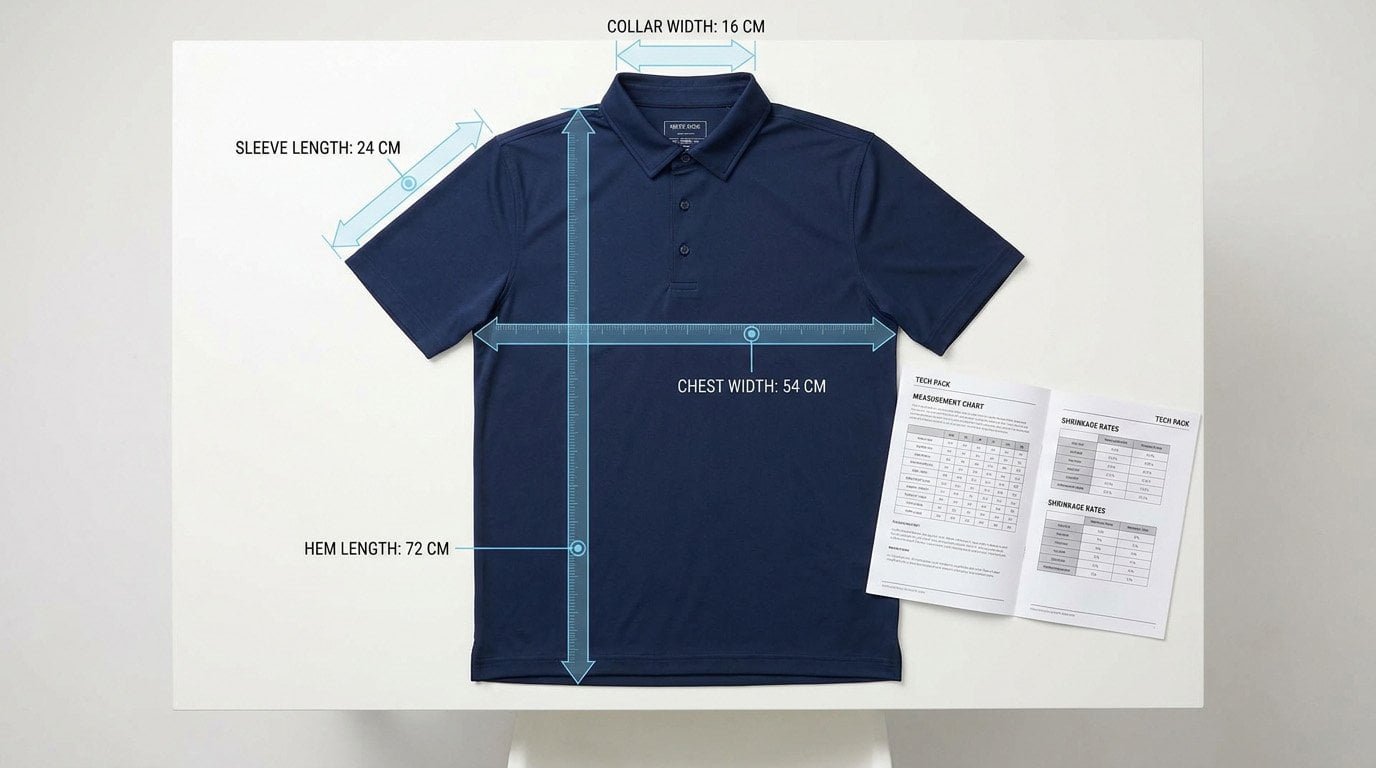
I handle tech pack communication for custom golf polo projects at FUWAY, and I see the same pattern repeat: brands send beautiful design renders, we make a sample, they approve it, then they're shocked when the bulk production doesn't match exactly. The gap isn't bad manufacturing—it's missing technical specifications that only appear once you move from one hand-sewn sample to 500 machine-sewn units. Let me show you what a production-ready tech pack actually contains and why each detail matters.
Quick Answers: Custom Golf Polo Tech Pack and Pattern
What's the minimum information needed in a golf polo tech pack?
You need five core elements: garment measurements with tolerances (±0.5cm max), fabric specifications including shrinkage rate, construction details for collar/placket/sleeves, size grading increments, and decoration placement with clearances. Missing any one of these causes production delays or rework.
Why does my bulk order fit differently than the approved sample?
Samples are often hand-sewn with adjusted tension—bulk production uses machine settings optimized for speed, not precision fit. Your tech pack must specify seam allowances (±2mm) and stitch density (12-14 per inch) to replicate sample fit at scale.
Do I need separate tech packs for different fabric types?
Yes—pique cotton and performance jersey have different shrinkage rates (3-5% vs 5-8%) and stretch recovery. A tech pack designed for 180gsm pique won't work on 120gsm moisture-wicking fabric without adjustment to seam allowances and collar construction.
Can I use a t-shirt pattern for a polo?
Not directly—polos require collar stand patterns (3-5cm height), button placket construction (2-3cm finished width), and sleeve plackets or cuffs. We estimate 40% of first-time polo brands try to modify t-shirt patterns and face fit issues around the neckline and button closure.
How long does pattern development take before bulk production?
Expect 2-3 weeks for initial pattern development, plus 1-2 revision rounds (5-7 days each) after sample fitting. Brands that provide complete tech packs upfront save 10-15 days versus those who iterate through multiple sample rounds.
From Brief to Fit Block: Target User, Silhouette and Size Range
Your polo design starts with user body type and movement needs—a classic-fit club polo for senior golfers requires completely different pattern blocks than a slim-fit performance polo for competitive players.
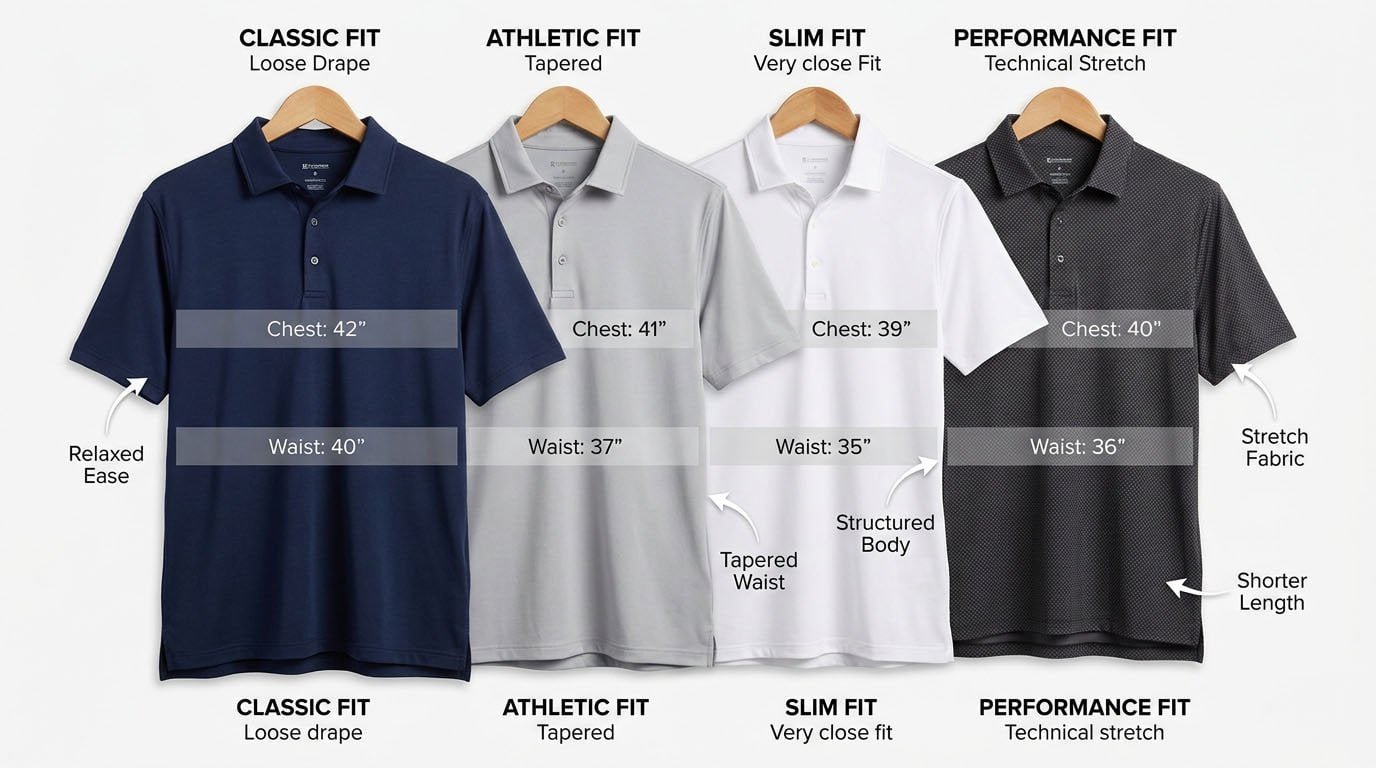
Before I can draft a pattern, I need answers to three questions that most first-time brands haven't considered: Who wears this? How do they move? What other polos do they already own?
The target user question isn't marketing demographics—it's body measurement reality. A 55-year-old country club member averages a 42-inch chest with 34-inch waist (8-inch drop). A 30-year-old competitive player averages 40-inch chest with 30-inch waist (10-inch drop). Same labeled size, totally different fit blocks.
Here's how user profiles shape pattern decisions:
| User Type | Chest/Waist Drop | Preferred Fit | Pattern Adjustments |
|---|---|---|---|
| Senior club golfers | 6-8 inch | Classic (loose) | Longer body length (+2cm), fuller chest (+3cm) |
| Corporate casual | 8-10 inch | Athletic (tapered) | Standard proportions, slight waist taper |
| Competitive players | 10-12 inch | Slim/performance | Shorter body (-1cm), narrow shoulders, stretch fabric |
| Women golfers | Varies widely | Fitted or classic | Adjusted shoulder slope, dart construction, shorter sleeves |
I've seen 25+ projects fail at fit approval because the brand assumed "golf polo" means one universal silhouette. A brand targeting competitive players used a classic-fit block—the sample felt baggy and restrictive during swings. We rebuilt with 3cm narrower chest, 2cm shorter body, and athletic taper—approved in one revision.
Silhouette definition determines every subsequent pattern measurement:
- Classic fit: 10-15cm ease at chest (garment measures 10-15cm larger than body), minimal waist taper, longer body length that covers belt line when tucked
- Athletic fit: 8-10cm ease at chest, 5cm waist taper from chest to hem, body length ends at top of hip bone
- Slim fit: 5-8cm ease at chest, 8cm waist taper, cropped body length, requires stretch fabric for movement
- Performance fit: 8-12cm ease with 4-way stretch fabric, designed for arm extension and torso rotation
Size range planning creates grading headaches if you don't think it through upfront. The common mistake: "We'll do S/M/L/XL/XXL like everyone else."
Reality check—what's your core size distribution? For golf club orders, we see 40% Large, 30% XL, 20% Medium, 10% XXL across 500-piece runs. If you're making 100 units, don't spread evenly—you'll have leftover smalls and miss demand for XL.
Size grading increments matter more than customers realize:
- Standard increment: 5cm chest, 2.5cm length between sizes—works for classic fit
- Condensed increment: 4cm chest, 2cm length—better for slim fit with tight size clustering
- Extended increment: 6cm chest, 3cm length—needed for XXL-XXXL sizes where body proportions change more dramatically
One corporate buyer wanted XS-XXXL range (7 sizes) for a 200-piece order. I walked them through the math: MOQ 30 pieces per size = 210 minimum, plus you'll have 40-50 XS and XXXL leftovers. They narrowed to M-XXL (4 sizes), hit their budget, and sold out.
Tech Pack Essentials: BOM, Measurement Chart, Tolerances and Callouts
A complete tech pack is the difference between one revision cycle and four—it specifies every measurement, material choice, and construction detail so the factory can execute your design without guessing.
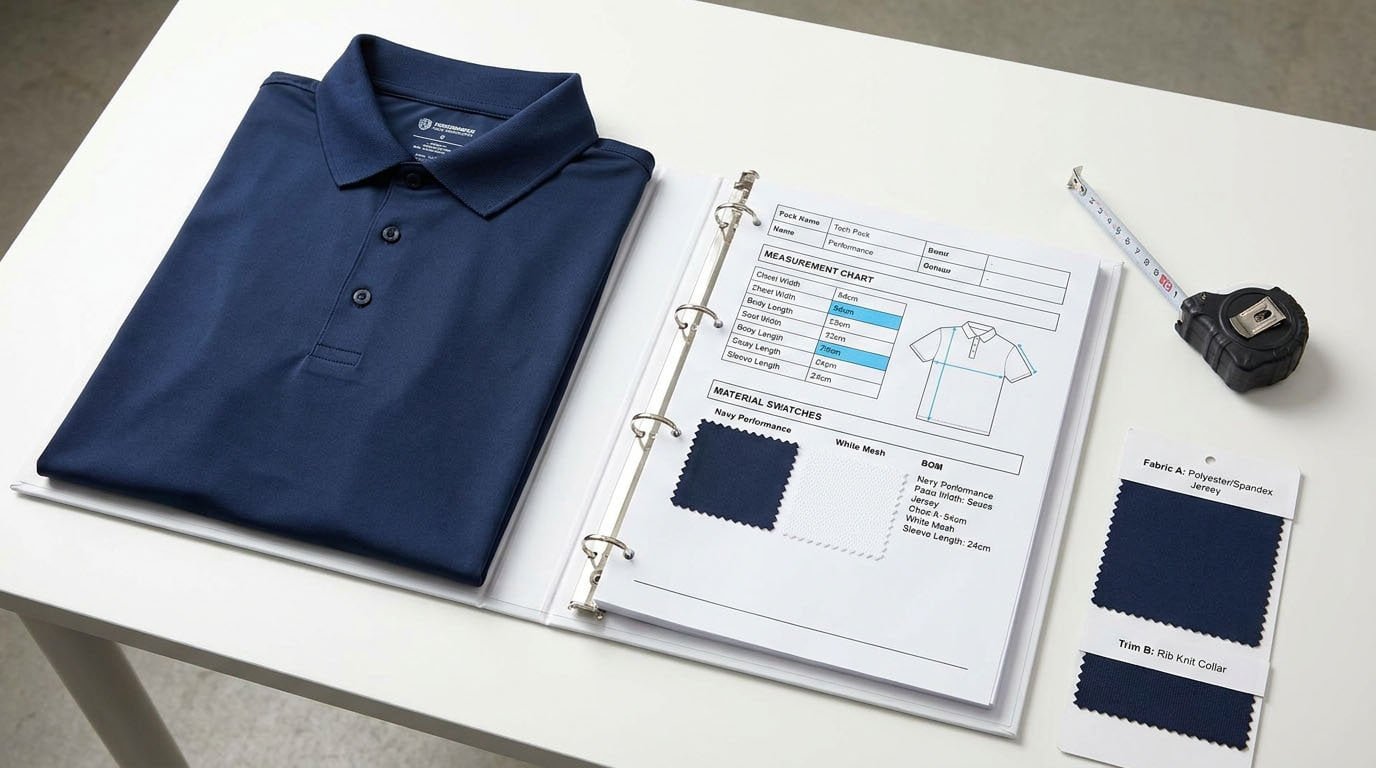
I receive 30-40 new polo projects monthly, and 60% arrive with incomplete tech packs. The missing information always falls into the same categories—and fixing it adds 10-15 days to the timeline.
Bill of Materials (BOM) lists every component:
Must-include items most brands forget:
- Main fabric: Weight (180gsm), composition (100% cotton pique), color (Pantone 19-4052), shrinkage rate (3-5% length, 2-3% width)
- Rib collar fabric: Weight (240gsm), composition (95% cotton, 5% spandex), color match to body, stretch recovery (>85%)
- Interlining: Type (woven or fusible), weight (40gsm), placement (collar, placket, shoulder)
- Buttons: Size (12mm), holes (2 or 4), color (match or contrast), attachment method (cross-stitch or bar-tack)
- Thread: Composition (polyester), weight (40s/2), color match to seams and topstitching
- Care label: Material (satin or woven), dimensions (5×3cm), washing instructions
The shrinkage rate is the most commonly missing spec. Without it, we can't adjust pattern blocks to compensate for fabric relaxation. A 180gsm cotton pique shrinks 4-5% in length after the first wash—if we don't grade that into the pattern, your approved 72cm body length becomes 68.5cm after customers wash it. Now every review complains the polo is "too short."
Measurement chart defines the garment dimensions:
Critical measurements with real tolerance requirements:
| Measurement Point | How to Measure | Tolerance | Why It Matters |
|---|---|---|---|
| Chest width | 1" below armhole, across front | ±1cm | Core fit—too tight restricts swing |
| Body length | High shoulder to hem, center back | ±1cm | Too long untucks during play, too short rides up |
| Sleeve length | Shoulder seam to cuff edge | ±0.5cm | Visible difference—customers notice this first |
| Collar height | Fold line to top edge | ±0.3cm | Affects formality—too low looks casual, too high is stiff |
| Placket width | Button center to fold edge | ±0.3cm | Must align with buttonholes—misalignment looks cheap |
| Armhole depth | Shoulder seam to underarm point | ±1cm | Deep armholes cause fabric bunching, shallow ones restrict movement |
I've handled 15+ rework requests where the only issue was missing tolerance specs. The factory made the sample at 72cm body length, the brand approved it, then bulk production came in at 71-73cm across units. The brand claimed it was "wrong"—but without specified tolerance, anything within ±1.5cm is industry standard. Now they paid for remake because they didn't write "±0.5cm" in the tech pack.
Callouts clarify construction details that aren't obvious from measurements:
Common missing callouts that cause rework:
- Collar construction: "Two-piece collar with separate stand (3.5cm) and fall (5cm), interfaced with woven interlining, topstitched 0.3cm from edge"
- Placket finish: "Five-button placket, finished width 2.5cm, reinforced bartack at bottom, grosgrain facing on interior"
- Sleeve hem: "Ribbed cuff (6cm height) with elastane for recovery, or plain hem with 4cm turn-up and topstitch"
- Side vents: "7cm side vents with bartack reinforcement, or closed hem with curved shape"
- Shoulder construction: "Forward shoulder seam (3cm offset) for better arm mobility, or standard shoulder seam at natural shoulder point"
One brand sent a tech pack that said "classic polo collar." We made a 5cm stand height (industry classic). They wanted 3.5cm (their brand's signature). Remake cost $800 on a 200-piece order. The fix: write exact measurements, not style names.
Pattern Making & Grading: Collar/Placket, Armhole/Sleeve, Shoulder/Yoke, Hem
Pattern precision determines whether your polo fits consistently across sizes—a 1cm error in collar stand height or armhole depth compounds across the size range and creates fit complaints in 40% of units.
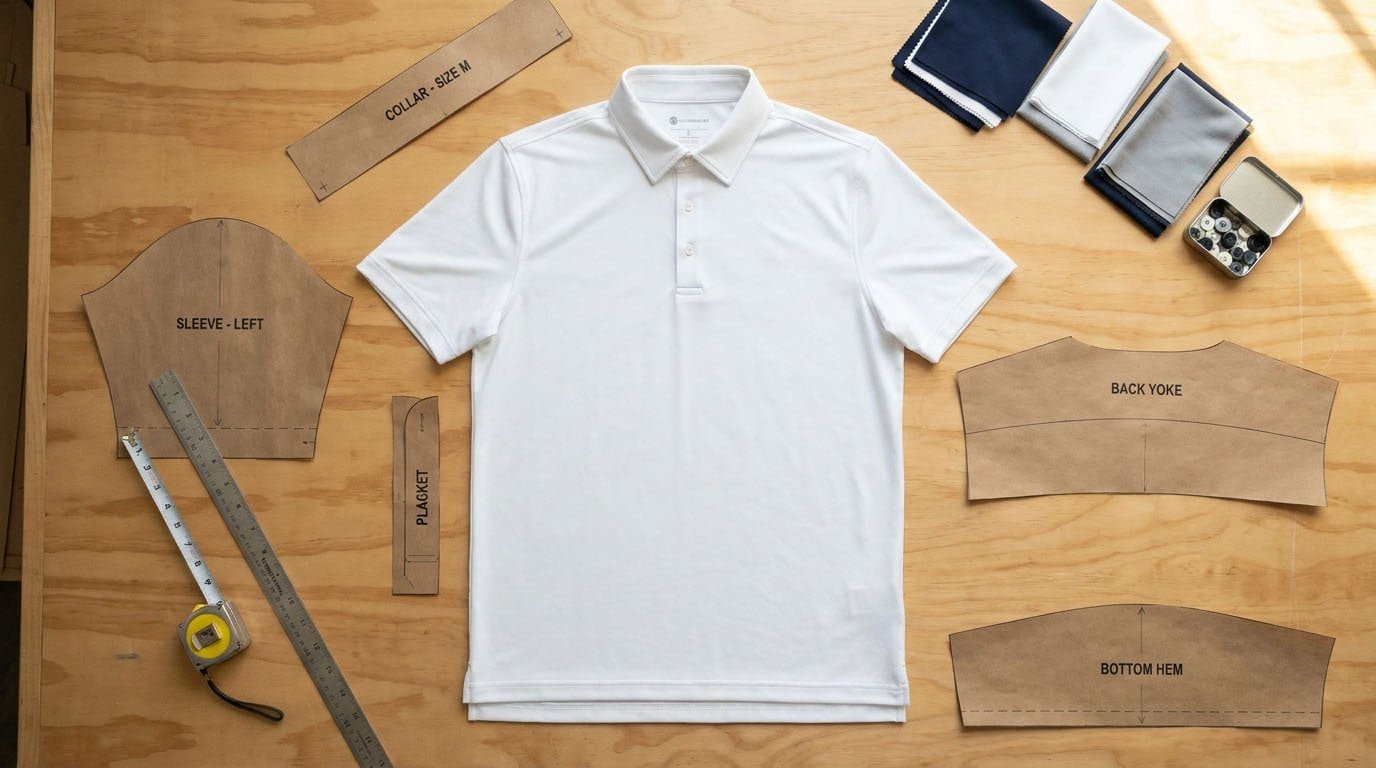
Pattern making is where design intent meets fabric physics. The collar that looked perfect on your sketch might curl backward on 180gsm pique because the pattern didn't account for fabric stiffness. I've redone 30+ collar patterns this year for that exact reason.
Collar and placket construction causes the most first-sample failures.
Collar components and their fit impact:
- Collar stand (band): Height determines formality—3-3.5cm for casual, 4-4.5cm for traditional club wear. Too low and it flops open, too high and it digs into the neck during head turns.
- Collar fall (points): Length affects whether the collar lays flat or stands up—6-7cm for modern polos, 8-9cm for vintage styles. Must be sized to sit flat without curling when the button is closed.
- Collar curve: The front opening angle—45-degree angle for sport collars, 30-degree for dress polos. Wrong angle causes the collar to gap or choke.
We pattern-test collars on five fabric weights before approving a design. A collar that works on 200gsm pique flops open on 120gsm jersey because the lighter fabric can't support the same stand height. For performance fabrics, we reduce stand height by 0.5-1cm and add more curve to compensate.
Placket width and button spacing determine whether your polo looks clean or homemade:
- Placket width: 2.5cm finished for standard polos, 3cm for larger buttons or workwear styles
- Button count: 3 buttons minimum (casual), 4-5 buttons standard (golf club), 6+ buttons (formal)
- Button spacing: 10-12cm between buttons—closer spacing prevents gaping, wider spacing looks casual
- Bottom reinforcement: Bartack or box stitch at the bottom placket opening—prevents tearing during wear
The hidden detail: placket grain direction. Cut on cross-grain and the placket ripples. Cut on straight grain and it stays flat but uses more fabric. We angle-cut plackets on bias grain for stretch fabric polos—adds flexibility without sacrificing shape.
Armhole and sleeve patterns control arm mobility:
Standard golf polo armhole depth: chest width ÷ 4 + 3cm. So a polo with 54cm chest width gets a 16.5cm armhole depth. Too shallow (14cm) and you can't raise your arms—too deep (19cm) and fabric bunches under the arm during swings.
Sleeve pattern choices:
- Set-in sleeve: Traditional polo construction, clean shoulder line, requires precise armhole curve matching—1mm mismatch creates puckering
- Raglan sleeve: Athletic look, more arm mobility, harder to position chest logos (the seam crosses the decoration area)
- Dropped shoulder: Casual modern fit, uses wider body pattern, loses formal polish
Sleeve length measurement trick: measure from center back neck to wrist with arm bent 90 degrees, then subtract half the back width. Most brands measure from shoulder point—that works for t-shirts, not polos with set-in sleeves.
Shoulder and yoke construction affects both appearance and durability:
- Split yoke (two pieces): Premium detail, allows back pleats or darts for fit adjustment, required for formal golf club wear
- Single-piece yoke: Simpler construction, lower cost ($0.30-0.50 per unit), works for athletic and casual fits
- Forward shoulder seam: Shifts the shoulder seam 2-3cm forward from natural shoulder point—improves arm mobility for golf swings, prevents seam from sitting at stress point
We test yoke patterns with arm extension motion—if the shoulder seam restricts backward arm reach by more than 10%, we adjust the yoke width or add back pleats.
Hem construction seems simple but affects drape:
- Straight hem: Clean finish, stays tucked easily, works for classic and athletic fits
- Curved hem (scooped): Modern look, 1-2cm shorter at sides than center, designed to be worn untucked
- Side vents: 6-8cm vents at side seams improve hip mobility when tucked, prevent bunching around belt line
Grading the hem curve across sizes is tricky—if you use a fixed curve radius, it looks too flat on small sizes and too dramatic on large sizes. We scale the curve proportionally to body width—the curve depth increases by 0.3cm per size grade.
Fabrics & Performance: Pique vs Jersey, Wicking, UPF, Odor, Stretch and Anti‑Snag
No fabric delivers every performance attribute at maximum level—you're choosing a balance between moisture management, stretch, durability, and comfort based on your customer's actual golf conditions.
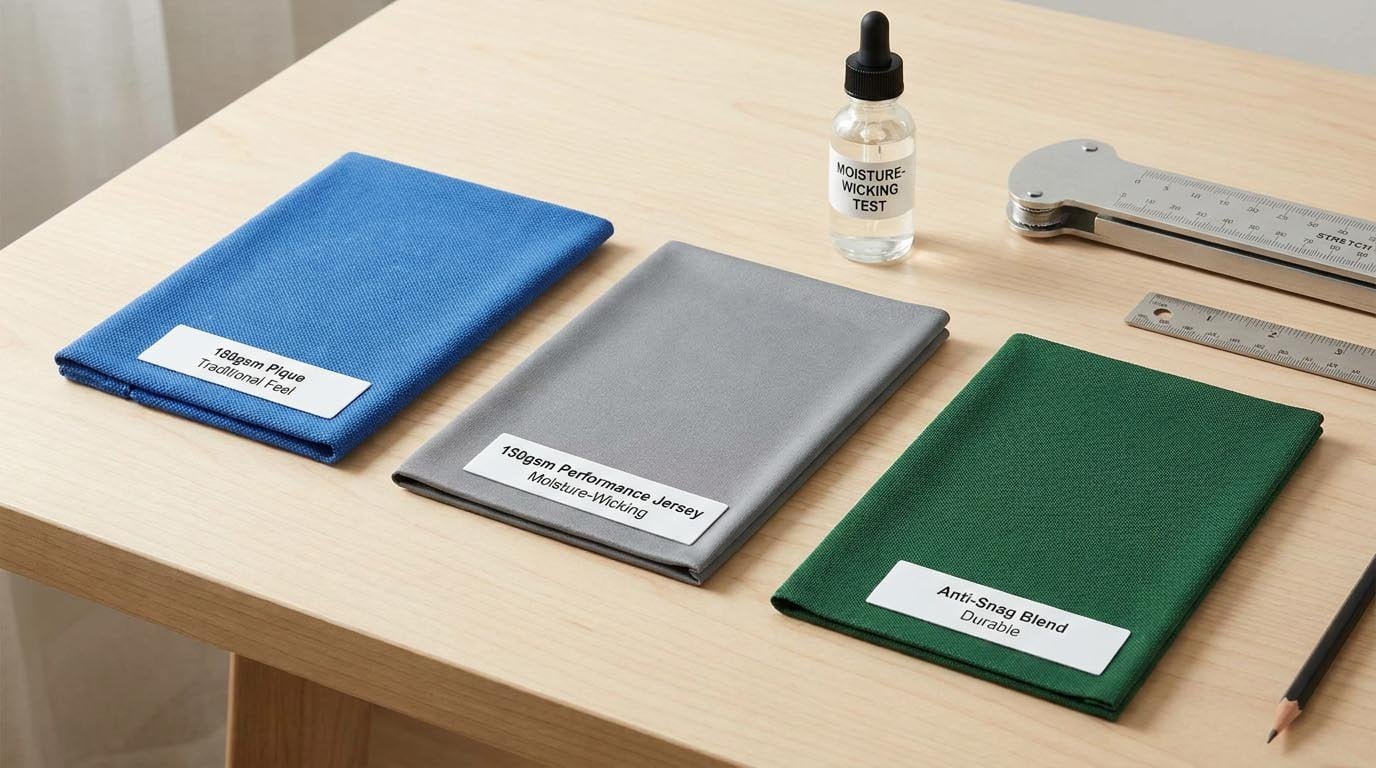
The fabric conversation I have most often: "Can we get maximum moisture-wicking, high stretch, UPF 50+, anti-odor, and soft hand feel—all in 100% cotton?" No. These attributes compete with each other, and some combinations are physically impossible.
Pique vs jersey defines your polo's character:
Pique cotton (traditional):
- Structure: Textured waffle knit, 180-220gsm weight
- Breathability: Excellent—the texture creates air channels against skin
- Moisture management: Moderate—cotton absorbs but doesn't wick
- Stretch: Low (5-10%)—requires larger ease allowances
- Durability: High—50+ washes with minimal pilling
- Best for: Golf clubs, corporate wear, hot/dry climates
Performance jersey (modern):
- Structure: Smooth knit, 100-140gsm weight, polyester-dominant blends
- Breathability: Good but fabric-dependent—tight knits trap heat
- Moisture management: Excellent—polyester wicks sweat to surface for evaporation
- Stretch: Medium to high (15-25%)—allows athletic fit without restriction
- Durability: Medium—30-40 washes before surface fuzz appears
- Best for: Hot/humid climates, competitive players, athletic brands
I've run comparison tests on 40+ fabric samples. The customers who complain about "poor breathability" in performance polos usually picked 130gsm+ tight-knit polyester—it wicks great but traps heat. The fix: drop to 110gsm open-knit or switch to cotton-poly blend that prioritizes airflow over maximum wicking.
Performance attribute trade-offs you must understand:
| Attribute | How to Achieve | What You Sacrifice | Realistic Expectation |
|---|---|---|---|
| Maximum wicking | 100% polyester, tight knit | Breathability, soft feel | Keeps skin dry but feels warm in humid heat |
| High stretch | Spandex/elastane 5-10% | Recovery after wash, shape retention | Comfortable but may stretch out after 20 washes |
| UPF 50+ protection | Tight knit, chemical treatment | Breathability, hand feel becomes stiffer | Works but less comfortable for all-day wear |
| Anti-odor | Silver ions, chemical treatment | Adds $2-3 per unit, fades after 30 washes | Effective for 1 season, not permanent |
| Cotton-soft feel | Cotton 50%+ blend | Wicking speed drops 40%, slower drying time | Feels better but performs worse in heat |
The fabric spec I see misunderstood most: "4-way stretch." Customers think this means maximum flexibility. It doesn't—it means the fabric stretches in both directions (length and width) versus 2-way stretch (width only). A fabric can be 4-way stretch with only 10% extension—still restricted for athletic motion.
Here's what stretch percentages actually mean for golf polos:
- 5-10% stretch: Classic fit required, can't use slim patterns
- 15-20% stretch: Athletic fit works, supports tapered silhouettes
- 25-30% stretch: Slim fit possible, but recovery issues after wash—fabric may not return to original shape
- 30%+ stretch: Performance fit for compression styles, requires special dyeing and finishing
Fabric weight affects everything:
- 100-120gsm: Ultra-light, maximum wicking, feels delicate—works for competitive play in extreme heat, not durable for club wear
- 140-160gsm: Balanced weight for performance polos, good durability and wicking
- 180-200gsm: Standard weight for pique cotton, premium feel, hot in humid climates
- 220gsm+: Heavyweight, premium luxury feel, only works in air-conditioned clubhouses or cool climates
One corporate buyer wanted 100gsm ultra-light fabric for "premium feel." I explained that 100gsm reads as cheap and see-through—premium perception requires 160gsm minimum. We compromised at 150gsm moisture-wicking blend—performed well, felt substantial.
Anti-snag features matter more for golf than other sports:
Golf bags, cart straps, and Velcro glove closures constantly catch fabric. Standard knit polos develop snags and pulls within 10-15 rounds. Anti-snag finishes work by:
- Tighter knit density: Harder for snags to penetrate, but reduces breathability by 15-20%
- Polyester-dominant blends: Polyester resists snagging better than cotton, but feels less soft
- Chemical coating: Adds protection but stiffens hand feel, fades after 20-30 washes
For golf club orders where durability matters, I recommend 180gsm pique cotton-poly blend (60/40) or 150gsm anti-snag polyester—both deliver 30+ rounds before visible wear.
Construction & Trim: Seams, Collars, Vents, Labels, Logos and Care
Construction details invisible on samples become visible quality signals in bulk production—stitch density, seam type, and trim placement determine whether your polo feels premium or looks rushed.
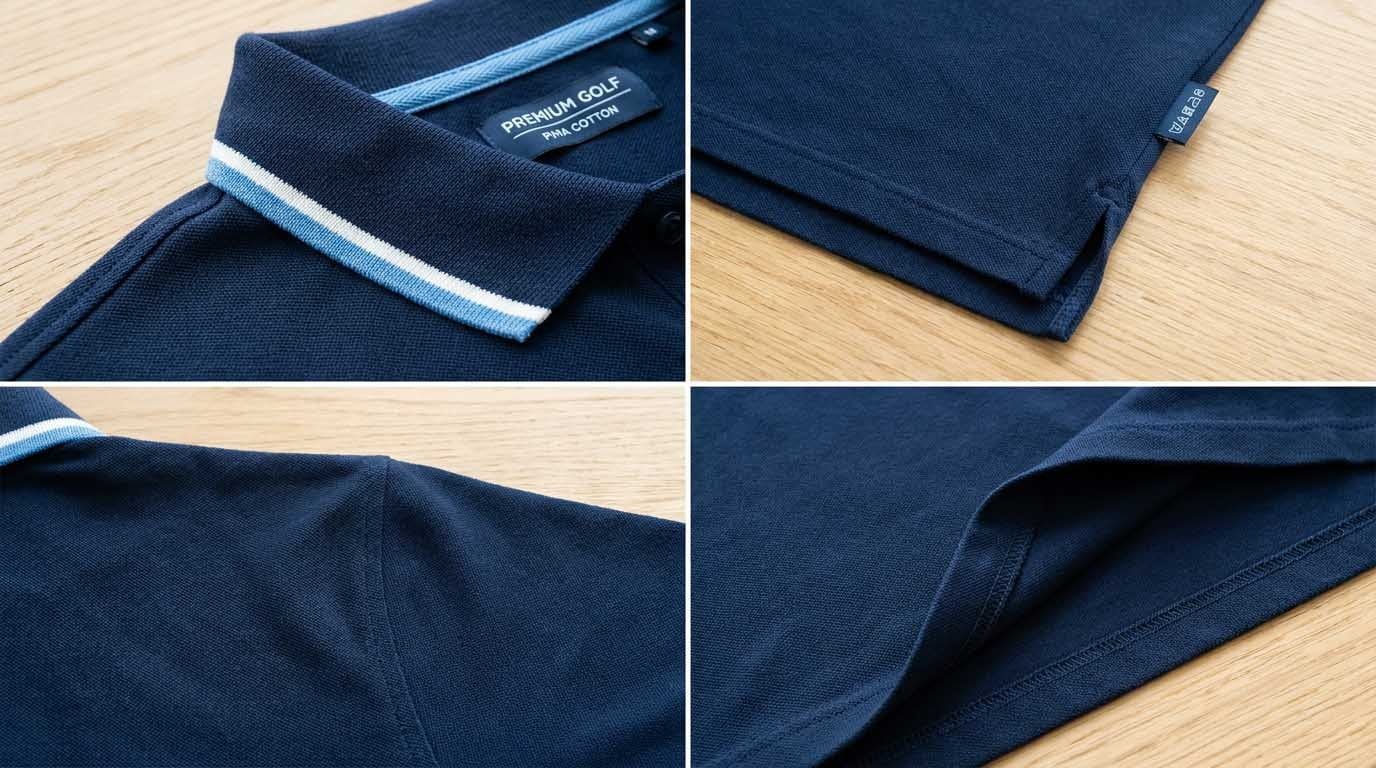
The quality gap between sample and bulk production shows up in construction execution. Samples get hand-adjusted by experienced sewers—bulk production runs through machine operators following spec sheets. If your tech pack doesn't specify construction methods, the factory defaults to fastest/cheapest options.
Seam types and their applications:
| Seam Type | Where Used | Visual/Durability | Cost Impact |
|---|---|---|---|
| Overlock (serged) | Side seams, shoulder seams | Visible thread on inside, prevents unraveling | Standard, no premium |
| Flat-felled | Side seams (premium option) | Clean finish on both sides, extra durable | +$0.50-0.80 per unit |
| Cover stitch | Hem, sleeve cuffs | Two needle lines visible on front, clean inside | +$0.30-0.50 per unit |
| Topstitch | Collar, placket, yoke | Decorative stitch visible on outside, reinforces seams | Standard for collars |
| Bartack | Placket bottom, vent tops | Small reinforcement stitch, prevents tearing | Standard, critical for durability |
I specify flat-felled seams for premium club orders—it costs more but delivers visible quality difference. For budget corporate orders, overlock seams work fine as long as we use 4-thread construction instead of 3-thread (prevents seam separation under stress).
Stitch density matters more than customers realize:
- 8-10 stitches per inch: Budget tier—seams may gap under tension
- 12-14 stitches per inch: Standard—works for most golf polos
- 16-18 stitches per inch: Premium—required for stretch fabrics and fine-knit jerseys
Too many stitches per inch isn't always better—on heavyweight pique, excessive stitch density creates rigid seams that prevent natural fabric drape. We adjust density based on fabric weight and stretch.
Collar and cuff trim finishes:
- Ribbed collar: Uses rib knit fabric (2×2 or 1×1 rib) with elastane for shape recovery—must be pre-shrunk or it warps after first wash
- Self-fabric collar: Cut from same pique or jersey as body—cleaner look but requires interfacing for structure
- Contrast tipping: Colored stripe on collar and cuff edges—adds $0.80-1.20 per unit, common in retail brands
- Piping/trim tape: Narrow fabric strip sewn into collar/placket edges—premium detail, adds $1-1.50 per unit
One brand wanted contrast tipping but didn't specify whether it's on collar only or collar + cuffs + placket. We quoted for collar only. They expected all three. The difference: $1.20 per unit × 500 pieces = $600 budget mismatch.
Side vents improve comfort but affect tucking:
- No vents (closed hem): Cleanest look, stays tucked best, restricts hip movement slightly
- 6-7cm vents: Standard for golf polos, improves mobility when tucked
- 8-10cm vents: Athletic fit preference, easier to untuck quickly, can look too casual for clubs
Vents must have bartack reinforcement at the top—without it, the vent tears open within 15-20 wears from stress during sitting.
Label and logo placement affects comfort:
- Main label: Back neck inside collar—use satin or woven labels, avoid heat transfer (feels scratchy)
- Care label: Left side seam or back neck below main label—include fabric composition, washing temp, and origin
- Size label: Back neck below main label or inside collar—use printed size tags (no scratchy woven tags)
We've had 8+ projects where brands requested heat transfer neck labels to save cost ($0.10 per unit), then got complaints about neck irritation. For golf polos worn 4-6 hours, pay the extra $0.15 for woven labels.
FAQ: Custom Golf Polo Tech Pack, Pattern and Performance
How detailed should my tech pack be for a first sample?
Include all measurements with ±0.5cm tolerances, fabric specs with shrinkage rates, and construction callouts for collar/placket/seams. Missing specs delay production by 7-10 days per revision. We recommend 15-20 detail callouts minimum for a production-ready tech pack.
Can I adjust the pattern after approving the first sample?
Yes, but each revision adds 5-7 days and may cost $50-150 depending on changes. Minor tweaks (button spacing, hem length) are quick—major changes (collar reconstruction, different fit block) require new pattern development.
Do I need to send physical fabric samples or can I just specify the weight?
Physical samples are better—fabric weight alone doesn't tell us knit structure, stretch direction, or hand feel. If you can't send samples, provide fabric mill reference numbers or detailed composition and knit specs (single jersey, pique, rib, etc.).
What's the difference between sample pattern and production pattern?
Sample patterns are hand-graded and may use approximations—production patterns must include precise grading increments, seam allowances, and notch markings for machine operators. Expect 1-2cm fit differences if the factory doesn't adjust the pattern for production.
Can I use the same collar pattern for pique and jersey fabrics?
No—collar stand height and curve must adjust for fabric stiffness. A collar designed for 200gsm pique will collapse on 120gsm jersey. We reduce stand height by 0.5-1cm and add more curve for lighter fabrics.
How do I know if my polo needs stretch fabric?
If your fit is slim or athletic with chest ease under 10cm, you need 15-20% stretch minimum. Classic fits with 12cm+ ease work on non-stretch fabrics. Test by measuring your target user's chest and adding 8-12cm—if that garment measurement feels tight, you need stretch.
What shrinkage allowance should I add to my measurements?
Add 3-5% to length and 2-3% to width for cotton pique, 5-8% to length and 3-5% to width for cotton jersey. Polyester-dominant fabrics shrink less (2-3% max). Always request pre-washed samples to verify shrinkage before bulk production.
Can I skip the tech pack if I'm ordering a stock design with my logo?
For stock designs, you still need a decoration tech pack: logo file (vector), placement (exact measurements from seams), method (embroidery/print), and size. Even stock polos fail if decoration specs are missing.
Conclusion
A complete tech pack controls bulk production consistency—specify measurements with tolerances, fabric shrinkage, and construction methods to avoid the sample-to-bulk fit gap that causes 30%+ rework rates for first-time custom polo brands.