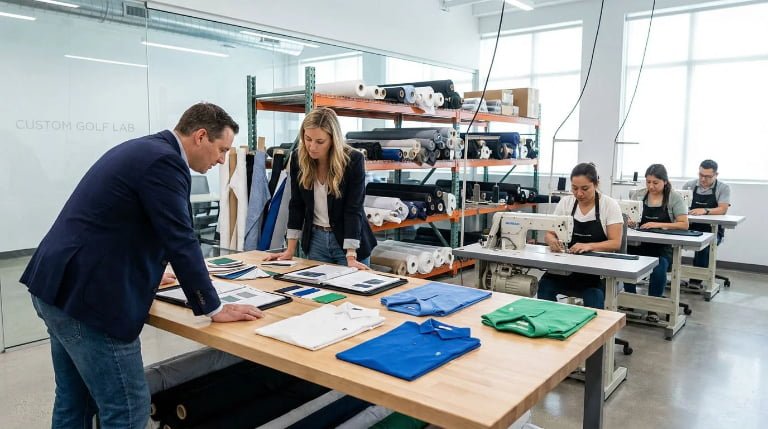

Switching clothing manufacturers can put an established product at risk. A missing pattern file, outdated tech pack, or misunderstood sample can change the fit, fabric feel, and construction that customers already recognize.
To transfer tech packs and samples to a new factory successfully, confirm file ownership, prepare the latest approved specifications and physical samples, resolve discrepancies, and validate the new factory's output before bulk production. The goal is to transfer the product standard—not simply copy an existing garment.
This guide explains how golf apparel brands can move established styles between manufacturers while protecting fit, materials, workmanship, and repeat-order consistency.

Document Material and Construction Intent
A sample may feel similar to another fabric while having different stretch recovery, weight, or wash stability.
For technical golf apparel, note the approved material source, fiber composition, construction, and required performance.
This is especially important for stretch polos, quarter-zips, golf shorts, and skorts.
If the original material is unavailable, the new manufacturer should propose an alternative for brand approval rather than make an unapproved substitution.
FUWAY's Fabric Sourcing service can support the evaluation of replacement performance fabrics when the original specification cannot be sourced.
Transfer decision: Treat the sample as an important physical reference, but do not allow it to override documented specifications without review.
Step 4: Resolve Differences Between Samples and Specifications
One of the greatest factory-transfer risks is disagreement between the physical sample and the digital tech pack.
For example, the previous manufacturer may have adjusted a golf polo's chest width during production without updating the measurement chart.
If the new factory copies the sample while relying on outdated specifications for other sizes, fit consistency can be lost.
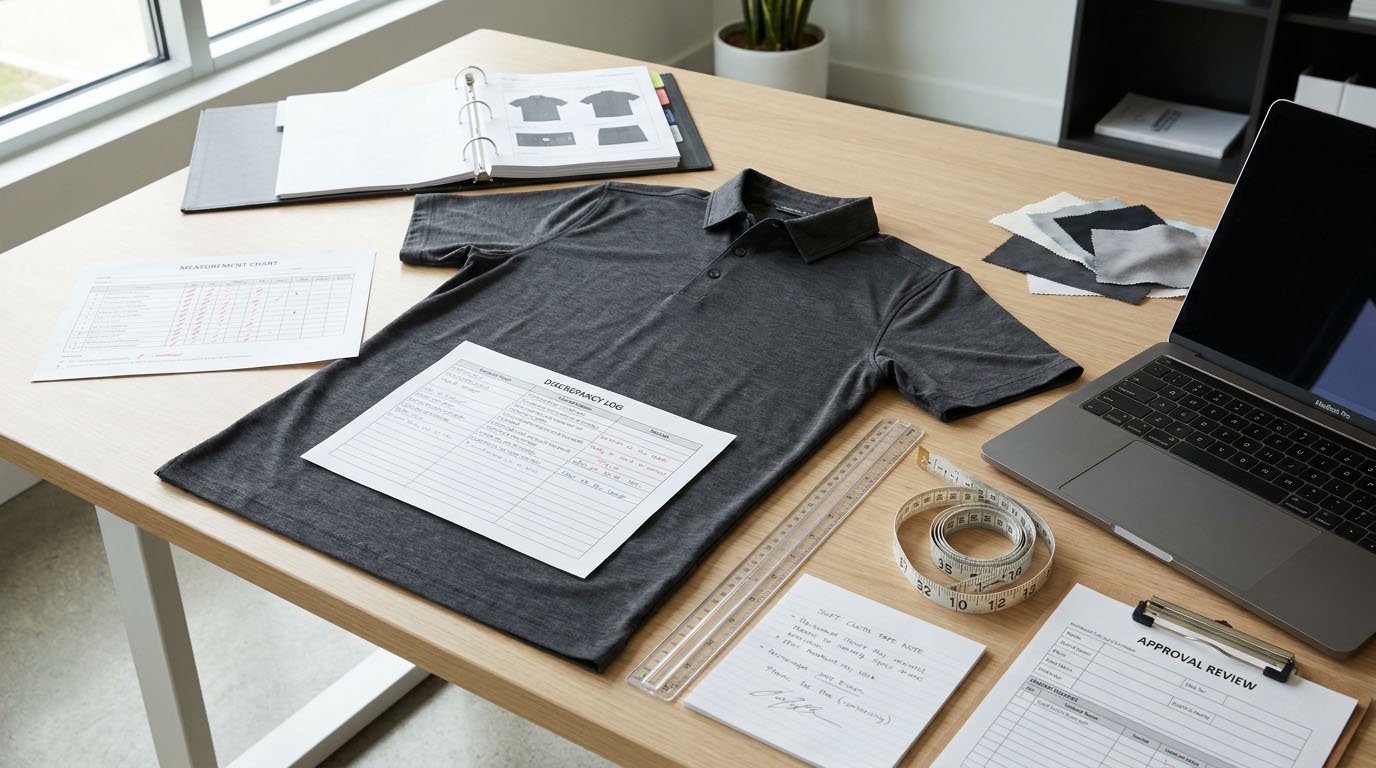
Create a Factory Handover Discrepancy Log
The new factory should compare the transferred sample against the latest documentation and record differences before pattern development or bulk production.
The following example illustrates how discrepancies can be managed.
| Check Point | Tech Pack | Physical Sample | Required Action |
|---|---|---|---|
| Polo chest width | 54.0 cm | 55.2 cm | Hold for brand decision |
| Collar height | 4.0 cm | 4.0 cm | Confirm reference |
| Hem finish | 2.5 cm | 3.0 cm | Confirm intended construction |
| Logo placement | Left chest | Left chest | Verify approved coordinates |
| Fabric | Specified piqué | Different hand feel | Confirm material identity |
In the chest-width example, the difference is +1.2 cm.
At FUWAY, finished-garment measurements must remain within ±1.0 cm of the approved target, with tighter tolerances where specified in the tech pack.
Therefore, the +1.2 cm discrepancy cannot simply be accepted as normal production variation. It requires investigation and an explicit brand decision.
If the brand intentionally changes the target measurement, the revised specification must be approved and recorded before validation continues.
Establish One Approved Manufacturing Standard
Neither the sample nor the tech pack should automatically take priority when they conflict.
Instead, the brand and new manufacturer should agree on the final requirement.
The discrepancy log should identify the issue, proposed correction, responsible person, approval status, and final document revision.
After approval, all relevant drawings, POM charts, BOM entries, and construction notes should reflect the same decision.
Transfer decision: Do not release conflicting instructions to the production team.
Step 5: Validate the New Factory's Counter-Sample
Receiving the correct documents does not prove that the new manufacturer can reproduce the garment consistently.
Different factories use different equipment, production methods, pattern systems, and material suppliers.
A counter-sample confirms whether the new factory has interpreted the approved requirements correctly.
What Must the Counter-Sample Confirm?
For an established golf apparel style, concentrate on the characteristics that must remain consistent after the transfer.
| Validation Area | What to Compare |
|---|---|
| Fit | Approved measurements, proportions, and movement |
| Fabric | Composition, weight, stretch, recovery, and hand feel |
| Construction | Collar, placket, seams, waistband, or liner details |
| Decoration | Logo size, placement, color, and appearance |
| Wash performance | Dimensional stability and visible distortion |
| Workmanship | Finishing quality and critical construction details |
For example, a golf polo may look identical before washing but develop a different collar shape or body length afterward.
Those differences should be investigated before the style receives final production approval.
Use Two Practical Approval Gates
Gate 1 — Counter-Sample Approval
The factory reproduces the style to confirm pattern interpretation, measurements, fit, and construction.
Development materials may be used if their limitations are documented.
Gate 2 — Pre-Production Sample Approval
The factory submits a sample using the approved production materials, trims, artwork, and intended manufacturing methods.
The brand checks the complete garment against the agreed transfer standard.
If a sample fails, record the corrective action and request revalidation rather than approving the defect verbally.
For a detailed explanation of sample stages, see FUWAY's Golf Polo Shirt Sampling Process Guide.
Transfer decision: A successful counter-sample is an important milestone, but it does not replace final pre-production approval.
Step 6: Approve the New Production Standard Before Bulk
Once the validation samples pass, the brand and manufacturer should freeze the approved product standard.
This means confirming which specifications, materials, construction details, artwork files, and physical samples will control bulk production.
A signed reference sample should be linked to the corresponding approved document versions.
Compare the First Bulk Run With the Original Standard
Factory transfer does not end when the PP sample is approved.
The first production run is an additional opportunity to detect inconsistencies introduced by bulk manufacturing.
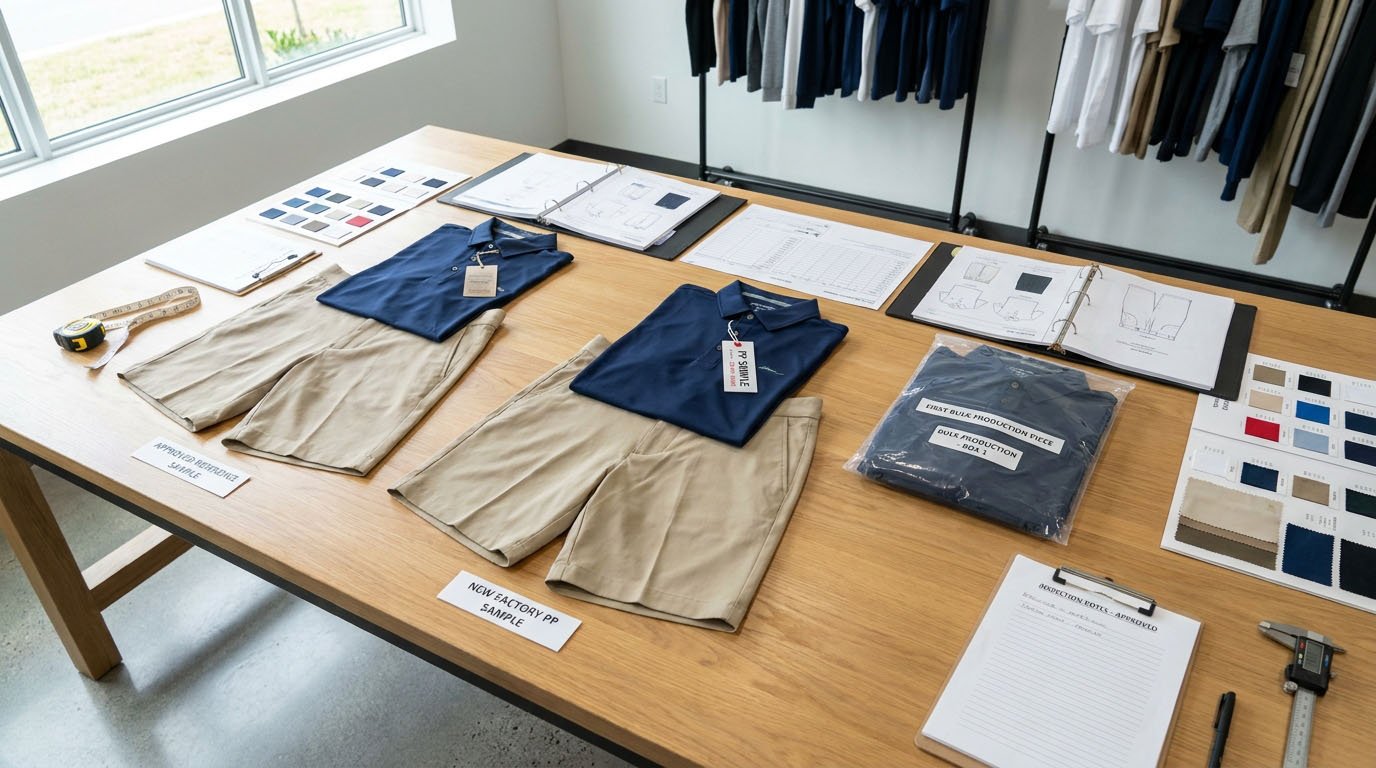
A practical verification process compares three reference stages:
| Production Stage | Verification Purpose |
|---|---|
| Previous approved standard | Establish original product requirements |
| New factory PP sample | Confirm the transferred specifications |
| First bulk production | Verify actual production consistency |
Check critical measurements, fabric appearance, logo placement, workmanship, and any previously identified defects.
Unapproved deviations should be investigated, corrected, and rechecked before the affected production is accepted.
More comprehensive inspection planning is covered in FUWAY's Golf Apparel Quality Control Guide.
Protect Repeat-Order Consistency
A successful first order does not guarantee that future orders will remain identical.
Before the transfer project is closed, retain the approved tech pack, sample identification, material codes, supplier references, inspection records, and final revision log.
If a fabric supplier, trim, pattern, or construction method changes later, the factory should document the change and obtain approval when required.
This creates a controlled reference for:
Previous Approved Style → New Factory PP Sample → First Bulk Order → Repeat Orders
The objective is consistent reproduction of the approved product—not just a successful first sample.
Factory Transfer Handover Checklist
Use this checklist as the final release review before authorizing the new manufacturer to begin bulk production.
| Handover Requirement | Required Evidence |
|---|---|
| File ownership and transfer permissions confirmed | Contract review or documented authorization |
| Latest technical files received | Version-controlled file register |
| Approved reference samples identified | Sample labels and receiving record |
| Material specifications confirmed | Approved BOM and fabric references |
| Historical defects documented | Must-Preserve / Must-Fix record |
| Discrepancies resolved | Signed discrepancy log |
| Counter-sample reviewed | Recorded fit and construction decisions |
| PP sample approved | Written approval and reference sample |
| Bulk QC reference established | Approved standards and inspection plan |
A factory transfer is ready for bulk only when critical unresolved issues have been closed and the required approvals are documented.
FAQ: Transferring Tech Packs and Samples to a New Factory
Can a New Factory Copy an Existing Garment Without a Tech Pack?
A manufacturer may be able to develop a garment from an authorized physical reference, but the result may not match the original specifications.
Without approved measurements, grading, material requirements, and construction notes, the new factory must reconstruct important decisions. Additional validation is therefore necessary.
What If the Original Factory Refuses to Provide CAD or Pattern Files?
First confirm the contractual ownership and access rights.
If the files cannot be obtained, the new factory may need to create replacement patterns using the approved garment, measurements, and available technical documents. The resulting patterns must be tested and approved before bulk production.
How Many Physical Samples Should Be Sent to the New Factory?
Where available, two samples are useful: one intact approved reference and another for detailed construction review.
However, the necessary number depends on the product, available references, and whether destructive examination is permitted.
Sample status and intended use matter more than simply sending multiple garments.
How Long Does a Factory Transfer Take?
The timeline depends on documentation completeness, pattern availability, fabric sourcing, sample corrections, and approval speed.
An established style with complete technical files may move faster than one requiring new patterns or replacement materials.
Request a project-specific schedule after the new factory reviews the transfer package rather than relying on a universal transfer timeline.
Can a New Factory Quote Before Receiving the Final PP Sample?
Yes. A preliminary quotation can be prepared from the available tech pack, BOM, quantity, and material requirements.
However, unresolved specifications or material changes may affect the final price.
The commercial assumptions should be confirmed before the order proceeds, and bulk cutting should not begin before the required technical approvals are completed.
Conclusion: Transfer Product Knowledge, Not Just Files
Successfully transferring tech packs and samples to a new factory requires more than forwarding documents and shipping an approved garment.
Brands need to confirm ownership rights, organize current references, separate approved features from previous defects, resolve technical discrepancies, and validate the new factory's output before bulk production.
Most importantly, the process should preserve consistency across the original approved style, the new factory's samples, the first bulk order, and future repeat orders.
At FUWAY, we support golf apparel brands with OEM/ODM manufacturing, technical specification review, fabric sourcing, sampling, and production quality control.
If you are considering moving an established golf polo, quarter-zip, shorts, or skort style to a new manufacturer, contact FUWAY to discuss your existing specifications, approved samples, and transfer requirements.