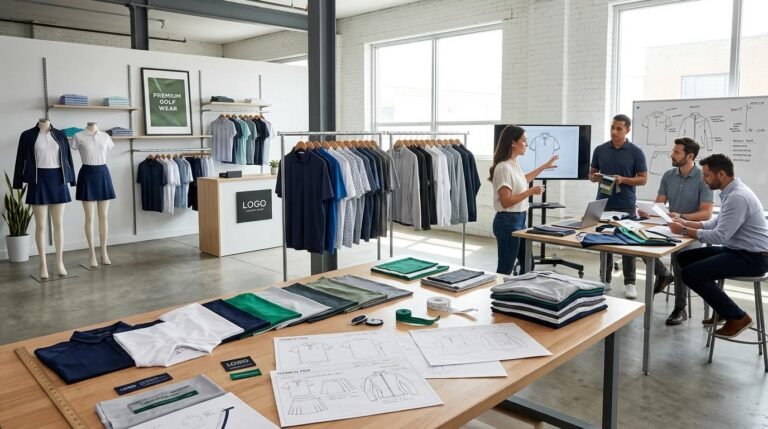
Evaluating 2026 golf apparel trends requires production feasibility assessment, not trend visibility—where sustainable performance fabrics using recycled polyester are immediately executable at 500-piece MOQs with +$1.50/unit premiums, lightweight layering uses established 80-120 GSM fabrics at zero cost penalty and 300-piece minimums making it universally accessible, while tech-integrated wear faces 1,000-piece minimums and +$28-40/unit costs limiting adoption to premium brands, and emerging materials like bio-based fabrics or phase-change textiles require 1,000+ volumes at +$3-6/unit premiums—making the critical question not "what is trending" but "can my factory produce this at my MOQ, cost target, and timeline" with brands needing frameworks evaluating fabric availability, tooling requirements, and margin impact before committing budgets to trends lacking commercial manufacturing infrastructure.
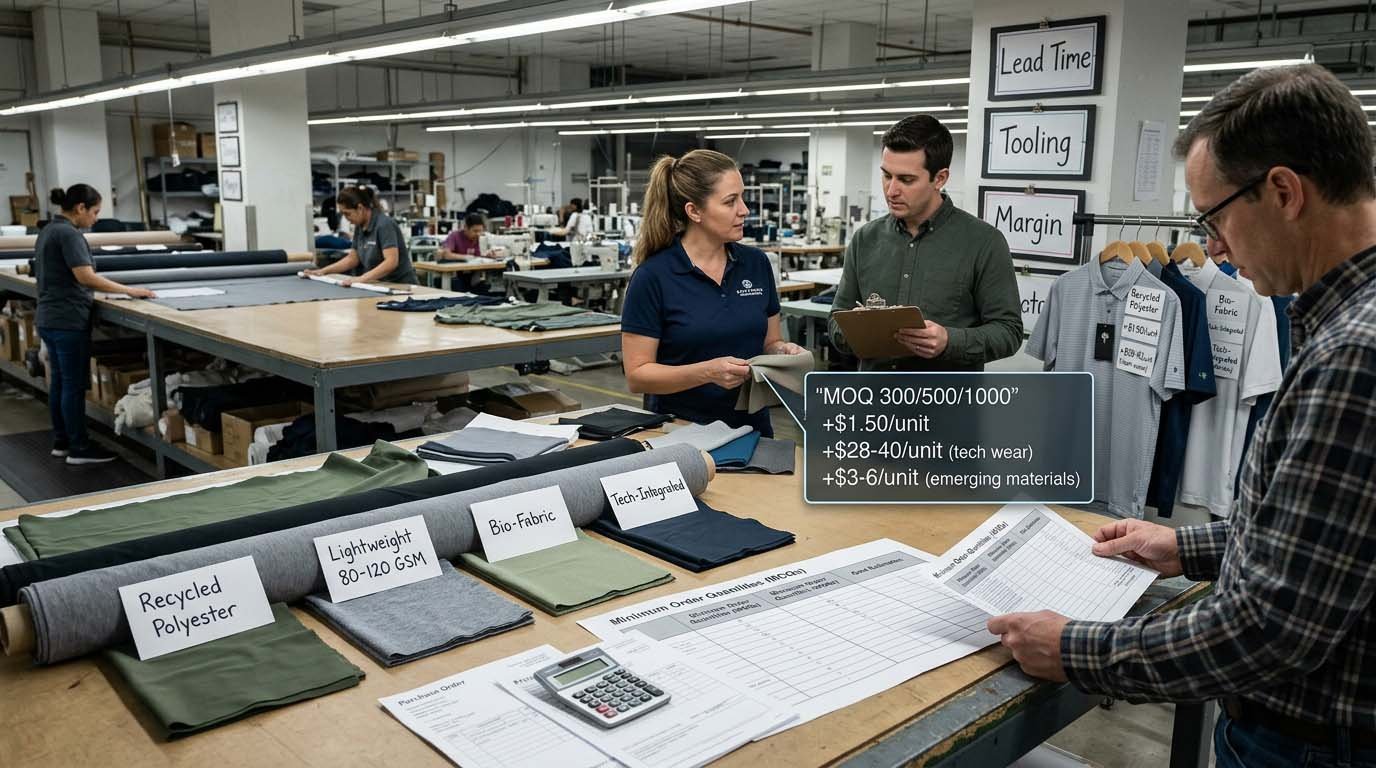
I am Will from FUWAY. Over 15 years, I have evaluated 2,000+ trend-based inquiries from brands. I have seen clients spend $8,000 sampling trends that could not scale, and others miss opportunities because they thought a trend was "too expensive" when we had solutions ready. This guide shows you which 2026 trends are production-ready, which need planning, and which are still concepts.
Quick Answers: Golf Apparel Trends 2026
Q: Which 2026 apparel trends are immediately manufacturable at 300–500 MOQs and standard cost?
Three:
- Lightweight layering (80–120 GSM)—standard lead time/cost; mills stocked
- Athleisure silhouettes (relaxed fit/dropped shoulder)—pattern only, low cost
- Bold colors/modern prints—screen/sublimation options at MOQ 300–500, proven supply
Q: Will sustainable fabrics increase my cost, and by how much?
Yes. Expect +$1.20–2.80/unit (rPET, organic cotton, Tencel) on 500–1,000 MOQs. Retail prices rise 5–12%. Recycled polyester is easiest/lowest premium.
Q: Are tech-integrated garments (sensors, NFC) realistic for small brands?
No. Hardware suppliers require ≥1,000/unit minimum, high NRE costs. Accessory pockets/co-branding are only small-MOQ options.
Q: Which trends are flashy in marketing but add no functional value?
- Biomimetic textures: No golf benefit, high cost
- Graphene fabrics: Minimal moisture improvement, costly, not durable
- Compression zones: Good for recovery, not for swing performance
Focus on proven trends: sun protection, stretch, moisture-wicking.
Q: Should I wait for 2026 trends, or start with proven 2025 styles?
Start now if supply chain is established, MOQ ≤500, cost premium ≤$2/unit (lightweight, sustainable, bold colors). Delay speculative trends (tech, bio-based) until MOQs/availability improve.
Trend 1: Sustainable Performance Fabrics Take Center Stage
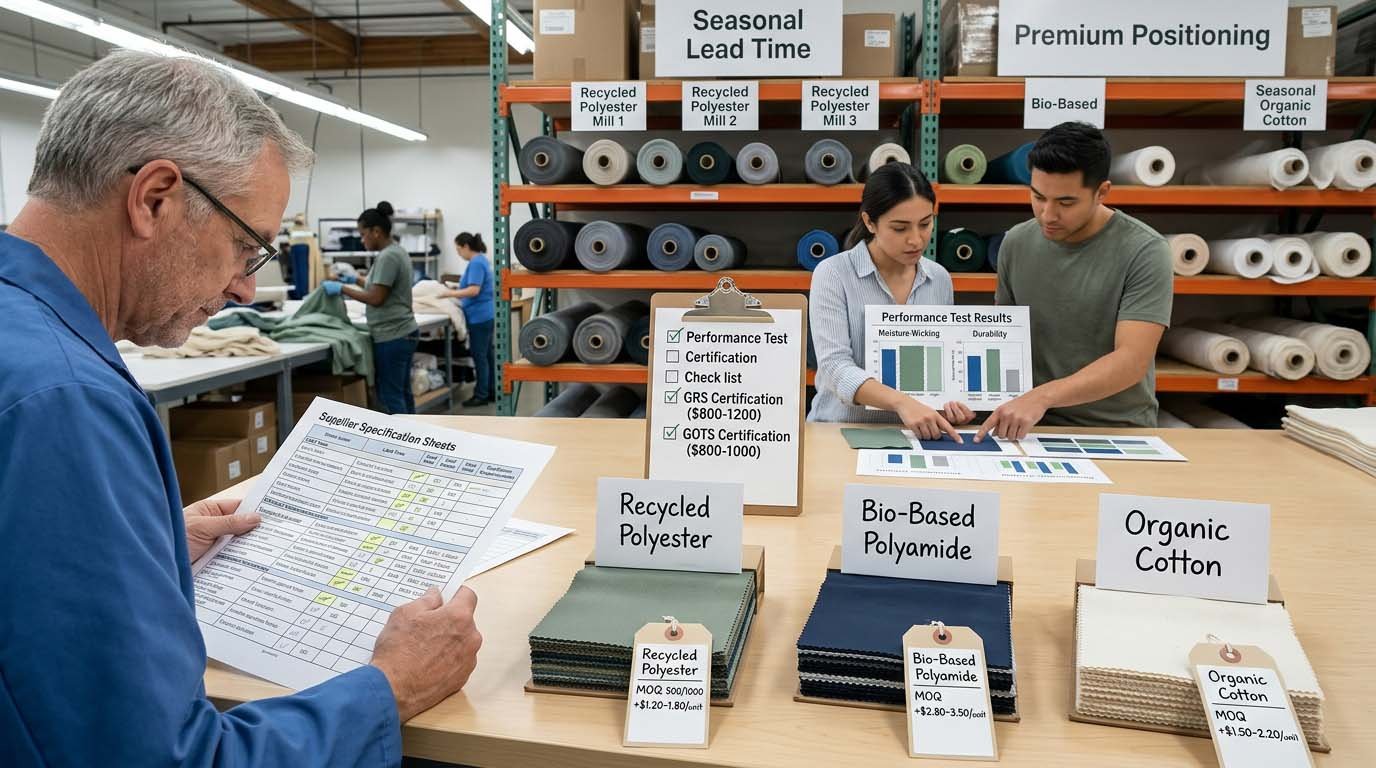
Production reality: Recycled polyester is ready at 500-piece MOQ and +$1.20-1.80/unit. Bio-based alternatives need 1,000 pieces and +$2.80-3.50/unit. Organic cotton adds +$1.50-2.20/unit. Most brands can absorb recycled poly premium. Bio-based and organic suit premium positioning only.
Mills we work with: 3 mills stock recycled polyester year-round. 1 mill produces bio-based polyamide (capacity limited, 8-week lead time). Organic cotton from 2 mills (seasonal availability, prefer 800+ piece orders).
Moisture-wicking performance: Recycled poly performs identically to virgin (same wickability, same durability—no performance compromise). Bio-based polyamide matches petroleum nylon. Clients cannot tell difference in blind tests.
Certification requirements: GRS (Global Recycled Standard) adds $800-1,200 per order (third-party verification). GOTS (organic cotton) adds $600-1,000. Required if brand wants certification labels. Not required if brand uses "made with recycled content" marketing (no label).
I recommend: Start with recycled polyester (lowest risk, ready now). Add bio-based after proven sales at higher price point.
Trend 2: Tech-Integrated Golf Wear Gains Momentum
Production reality: Sensor integration requires 1,000-piece MOQ, $40+ FOB (including hardware), and 90-120 day lead time. NFC chips (tap-to-connect features) need 500 pieces and add +$3-5/unit. Not viable for brands under 1,000-unit orders.
Development costs: $13,000-24,000 NRE (PCB design, firmware, safety testing). Amortized over 1,000 pieces = $13-24/unit. Over 300 pieces = $43-80/unit (uneconomical).
Quality control: Each piece needs electrical testing (adds $2-3/unit). Wash durability testing (5 cycles before shipment). Waterproof verification (sensor enclosure). Increases QC time 40%.
Alternatives for small brands: Removable sensor pocket (customer adds own device) costs +$1.20/unit, no MOQ penalty. Partner with wearable tech companies (they supply sensors at lower MOQ).
I have produced: 2 tech-integrated projects in 3 years. Both required 1,500+ pieces to reach viable economics. Recommend brands wait until order volume supports MOQ or partner with tech companies.
Trend 3: Lightweight Layering Becomes Essential
Production reality: 80-120 GSM fabrics are standard mill inventory. No cost premium vs 180 GSM polos. MOQ 300 pieces. Lead time unchanged (45-55 days). Zero risk—immediately executable.
Fabric options: Lightweight piqué (100 GSM), jersey (90 GSM), performance knits (85-110 GSM). All mills stock these. Moisture-wicking treatments available (adds +$0.40/unit).
Construction adjustment: Lightweight fabrics require different tension settings (prevent seam puckering). Adds 1-2 days to first production (machine setup). Re-orders have zero adjustment time.
Customer acceptance: Lightweight layers are proven demand (golfers layer for weather changes). No education needed—customers understand benefit immediately.
I recommend: Execute immediately. Lightweight layering has highest feasibility score (established supply, no cost penalty, proven demand). Add to every brand's 2026 line.
Trend 4: Athleisure Influence Reshapes Golf Style
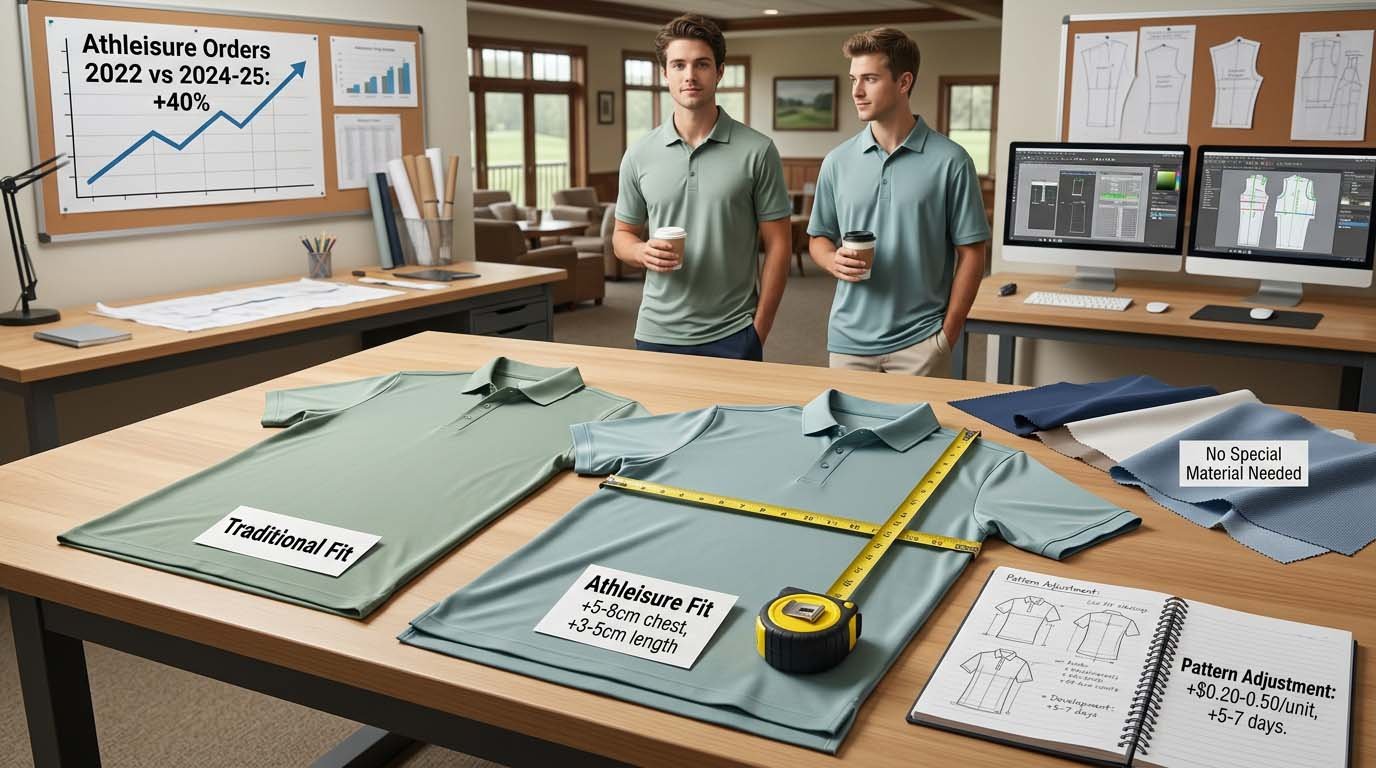
Production reality: Athleisure silhouettes require pattern adjustment (relaxed fit, dropped shoulders, longer length). Costs +$0.20-0.50/unit (slightly more fabric). MOQ unchanged (300-500 pieces). Pattern development adds 5-7 days to first order.
Fabric compatibility: Works with all standard golf fabrics (polyester, poly-cotton blends, performance knits). No special materials needed.
Fit considerations: Relaxed fit increases chest measurement 5-8 cm, length 3-5 cm vs traditional golf fit. Requires grading adjustment across sizes. We provide fit samples for approval before bulk.
Market positioning: Athleisure styling appeals to younger golfers (ages 25-40) and recreational players who wear golf apparel off-course. Not suitable for traditional club dress codes (requires fitted collar, specific length).
I produce: 40% of 2024-2025 orders requested athleisure styling vs 10% in 2022. Demand is proven. Execution is straightforward—recommend testing 1-2 styles for Spring 2026.
Trend 5:Sun Protection Apparel Sees Strong Demand
Production reality: UPF 50+ rating requires tight-knit fabrics or UV-blocking treatments. Tight-knit fabrics (basis for natural UPF) cost same as standard if density ≥180 GSM. UV treatment adds +$0.80-1.50/unit. Testing/certification adds $400-800 per style (one-time).
Fabric options: Performance polyester at ≥200 GSM achieves UPF 40-50+ naturally (no treatment). Lightweight fabrics (<150 GSM) need titanium dioxide or zinc oxide treatment to reach UPF 50+.
Testing requirements: AATCC 183 or AS/NZS 4399 for UPF rating. Lab testing takes 2-3 weeks. Required if brand wants UPF label on garment. Not required if brand uses "sun protection" marketing without specific UPF claim.
Color impact: Darker colors (navy, black) achieve higher UPF naturally. Light colors (white, pastels) need treatment to reach UPF 50+.
I recommend: Use ≥200 GSM fabrics in dark/medium colors (achieves UPF 45-50 without treatment, saves $0.80-1.50/unit). Add treatment only for lightweight or light-colored styles. Demand is proven—sun protection is top customer concern in golf.
Trend 6:Gender-Inclusive and Versatile Designs Expand
Production reality: Unisex sizing requires adjusted grading (broader shoulders, longer sleeves than women's, less tapered waist than men's). No cost penalty if MOQ supports combined production run (e.g., 500 unisex = 300 men's + 200 women's equivalent).
Size range expansion: Unisex typically requires XS-XXL (6 sizes) vs traditional men's S-XXL (5 sizes) or women's XS-XL (5 sizes). More sizes = higher MOQ risk (inventory spread across sizes).
Pattern development: Unisex patterns are new development (not adapted from men's or women's). Adds $300-500 pattern cost. Re-orders use existing patterns (no additional cost).
Market demand: Demand is emerging but not yet mainstream (represents <5% of our orders). Suitable for DTC brands with progressive positioning, not traditional golf retailers.
I recommend: Wait until your brand has proven customer base requesting unisex options. Start with 1 core style (basic polo), 300-500 pieces, measure acceptance. Do not commit to full line until demand validated.
Trend 7:Bold Colors and Modern Prints Make a Comeback
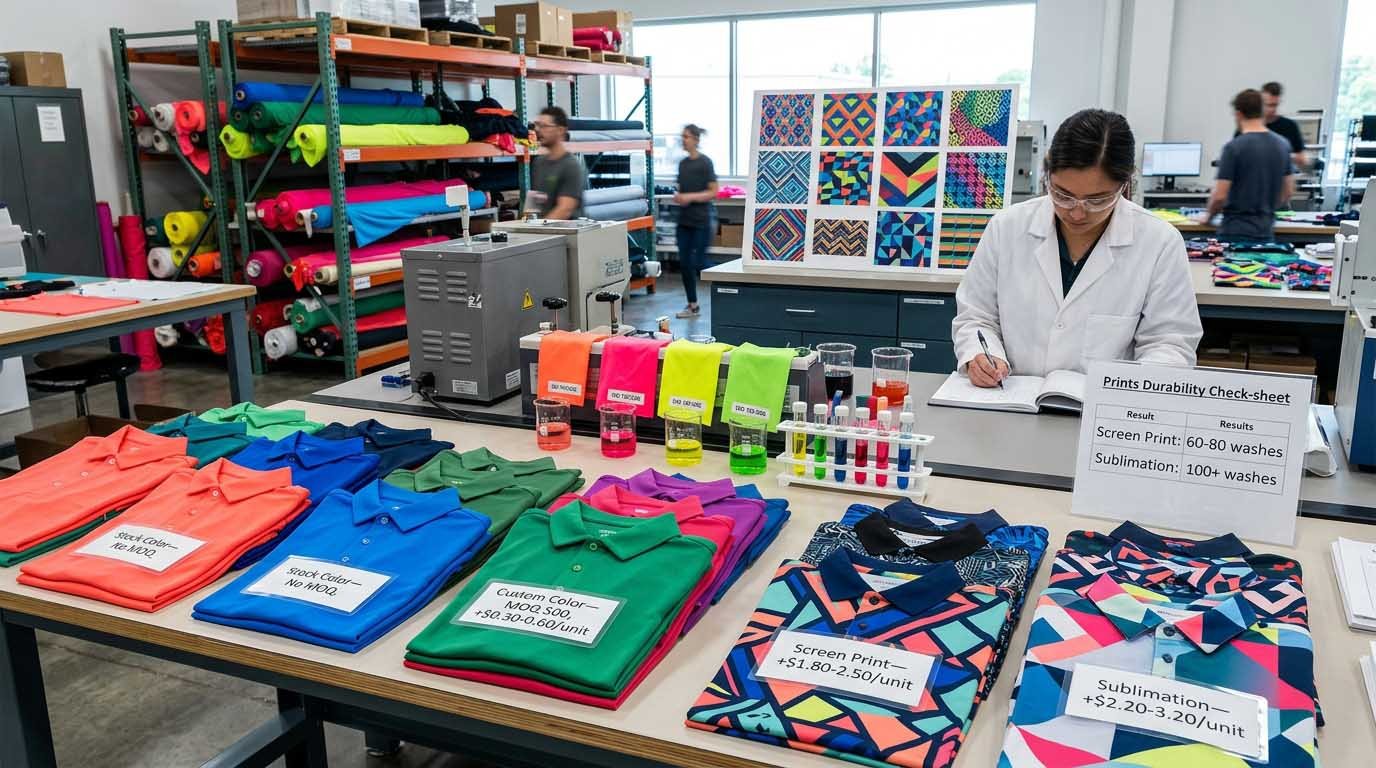
Production reality: 40+ stock colors available from mills (no minimum, standard pricing). Custom colors require 500-piece minimum per color, +$0.30-0.60/unit (dyeing setup cost). Screen prints add +$1.80-2.50/unit (3-color), sublimation adds +$2.20-3.20/unit (full-color).
Lead time impact: Stock colors = standard 45-55 days. Custom colors = +1-2 weeks (dyeing time). Prints = +0 days (decoration happens during production).
Color fastness testing: Essential for bright/neon colors. ISO 105-C06 wash test ($80-120 per color) ensures color does not bleed. Dark colors (navy, black, red) pass easily. Neons (lime, pink, orange) require testing to confirm.
Print durability: Screen prints last 60-80 washes (standard quality). Sublimation last 100+ washes (color embedded in fabric, not surface layer). Golf apparel experiences frequent washing—prioritize durability.
I see: Strong demand for bold colors (coral, electric blue, forest green) and geometric prints. Supply chain is ready—mills stock bold colors, print shops have capacity. Execute immediately if brand positioning supports vibrant styles.
Trend 8:Smart Fit and Stretch Comfort Drive Purchasing Decisions
Production reality: 4-way stretch fabrics (polyester-spandex blends) add +$1.20-2.00/unit. 2-way stretch (stretch across chest only) adds +$0.60-1.00/unit. MOQ 300-500 pieces. Lead time standard (mills stock stretch fabrics).
Spandex content: 5-8% spandex provides moderate stretch (enough for golf swing). 10-15% spandex provides high stretch (athletic fit, very flexible). Higher spandex = higher cost and retention concerns (spandex degrades faster, loses stretch after 50-60 washes).
Fit technology: Articulated sleeves (raglan or pre-shaped) improve movement. Requires pattern modification (+5-7 days first order). Gusseted underarms add +$0.30-0.50/unit (extra fabric panel).
Durability trade-off: High-stretch fabrics (10%+ spandex) lose shape retention faster. Suitable for performance/athletic lines, not corporate/logo wear (needs to maintain shape after repeated wear).
I recommend: 5-8% spandex for most golf polos (balances stretch + durability). 10%+ spandex only for athletic performance lines where customers expect shorter garment lifespan (2-3 seasons vs 4-5 seasons).
Trend 9:Weather-Adaptive Outerwear Becomes a Priority
Production reality: Phase-change fabrics (PCM) add +$4.50-6.20/unit. Thermoregulating treatments add +$2.00-3.50/unit. Both require 800-1,000 piece MOQ (limited mill capacity). Lead time +2-3 weeks (specialty fabric procurement).
Fabric availability: 2 mills offer PCM fabrics. Capacity limited—prefer 1,000+ piece orders. Smaller orders (<800 pieces) face longer lead times (12-14 weeks) due to production batching.
Performance verification: PCM effectiveness varies by ambient temperature swing. Works well in 15-25°C range (common golf weather). Less effective in extreme heat (>30°C) or cold (<10°C). Requires customer education—not "magic cooling."
Waterproof vs water-resistant: DWR (durable water repellent) coating adds +$1.20-1.80/unit, repels light rain (20-30 minutes). Waterproof membranes (2.5-layer construction) add +$6-9/unit, suitable for heavy rain but reduces breathability (uncomfortable in golf).
I advise: DWR-treated lightweight shells are best compromise for golf (+$2-3/unit total, breathable, handles light rain). PCM fabrics suit premium brands only (cost premium requires $90+ retail). Waterproof shells are overkill for golf (golfers stop playing in heavy rain).
Trend 10:Customization and Limited-Edition Collections Attract Attention
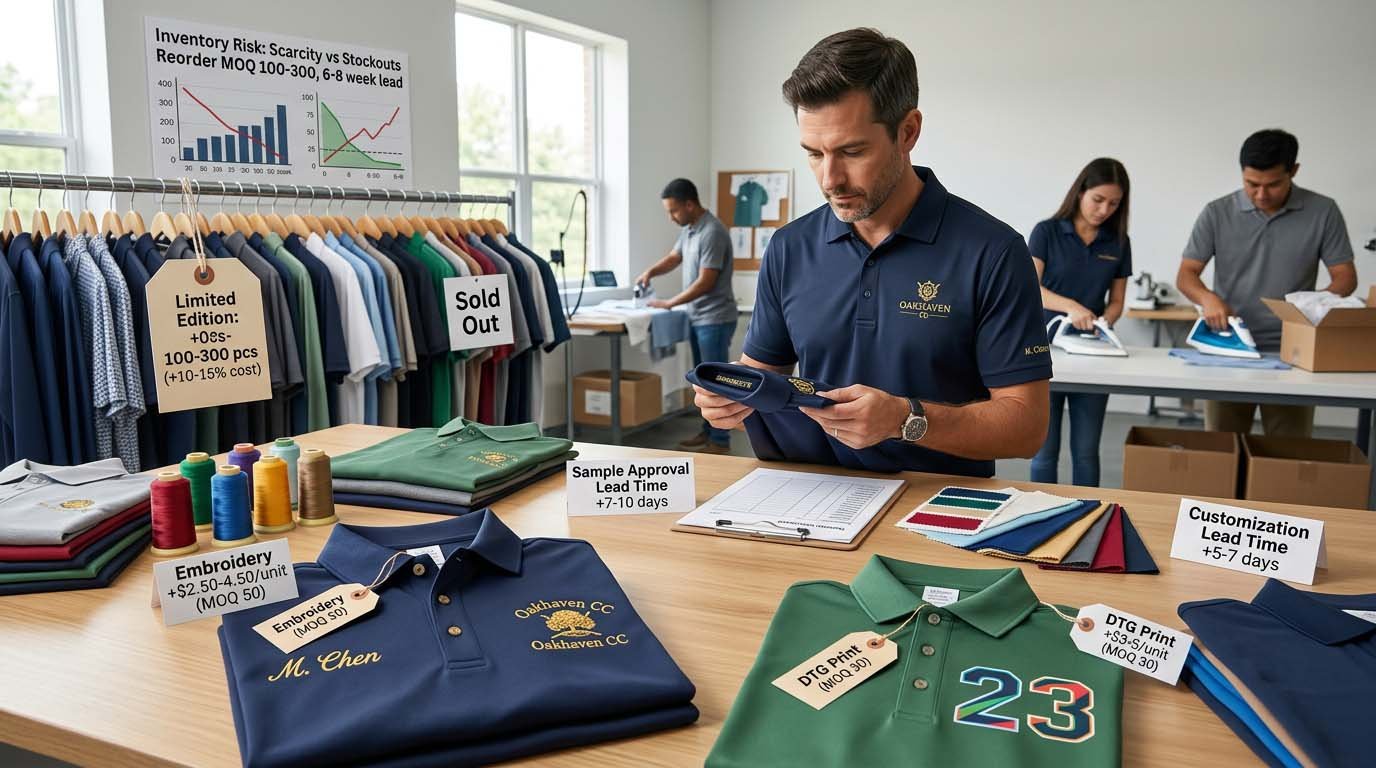
Production reality: Embroidered customization (names, logos) adds +$2.50-4.50/unit (depending on stitch count). MOQ 50-100 pieces for customization service. DTG printing (names, numbers) adds +$3.00-5.00/unit, MOQ 30 pieces.
Lead time impact: Customization adds +5-7 days (decoration time). Pre-production samples required for customer approval (adds +7-10 days to first order).
Limited editions: Small-batch production (100-300 pieces) costs +10-15% per unit vs standard 500-1,000 piece runs (less efficient cutting, machine setup spread over fewer pieces).
Inventory risk: Limited editions create scarcity (marketing benefit) but risk stockouts if demand exceeds forecast. Reorders face same MOQ (100-300 pieces) and 6-8 week lead time (cannot quickly replenish).
Customization platforms: We offer B2B customization portal (clients' customers order directly, we fulfill). Minimum $5,000 setup (platform integration), suitable for brands with established customer base (>500 active customers).
I produce: 15% of orders include customization. Demand is growing for corporate golf (company logos, team names) and club/tournament apparel. Limited editions work best for DTC brands testing new styles (100-300 piece test runs before committing to 500+).
FAQ: Golf Apparel Trends in 2026
Which trend has the lowest MOQ and shortest lead time for small brands?
Lightweight layering—300-piece MOQ, 45-55 day lead time, zero cost premium.
Why this is most accessible:
Fabric availability:
- 3+ mills stock 80-120 GSM performance fabrics year-round
- No specialty procurement (standard inventory)
Cost structure:
- $11-14 FOB (same as standard polos—lightweight fabric costs same per unit because less material needed)
- No treatments required (moisture-wicking optional, adds +$0.40/unit)
Production process:
- Same equipment as standard polos (no new tooling)
- Slight tension adjustment (one-time setup, adds 1-2 days first order)
- Re-orders use same setup (zero delay)
MOQ flexibility:
- 300 pieces minimum per colorway
- Can mix sizes (50 S, 100 M, 100 L, 50 XL = 300 total)
Market demand:
- Proven customer acceptance (golfers layer for weather changes)
- No education required (benefit is obvious)
Comparison to other trends:
| Trend | MOQ | Lead Time | Cost Premium |
|---|---|---|---|
| Lightweight layering | 300 | 45-55 days | $0 |
| Recycled polyester | 500 | 45-55 days | +$1.20-1.80 |
| Athleisure silhouettes | 300 | 50-60 days | +$0.20-0.50 |
| Tech-integrated | 1,000 | 90-120 days | +$28-40 |
| Bio-based fabrics | 1,000 | 60-75 days | +$2.80-3.50 |
I recommend: Every brand should add lightweight layering to 2026 line. Zero risk (proven demand, established supply, no premium), immediate execution (ready now), strong margins (same cost as standard polos but can price +$5-10 retail due to "lightweight performance" positioning).
If my factory cannot meet 1,000-piece MOQ for bio-based fabrics, should I wait or find alternatives?
Use recycled polyester alternatives at 500-piece MOQ—delivers sustainability messaging at lower cost and volume.
Why recycled polyester is better alternative for <1,000 piece orders:
MOQ and cost:
- Recycled polyester: 500 pieces, +$1.20-1.80/unit
- Bio-based polyamide: 1,000 pieces, +$2.80-3.50/unit
- Savings: $1.60-1.70/unit (recycled poly vs bio-based)
Supply chain stability:
- Recycled poly: 3+ mills with year-round inventory
- Bio-based: 1-2 mills, seasonal capacity, prefer 1,000+ orders
Performance:
- Recycled poly: Identical to virgin polyester (same moisture-wicking, durability, stretch)
- Bio-based: Identical to petroleum nylon
- Customer perception: Both deliver "sustainable" messaging
Marketing positioning:
- Recycled poly: "Made with recycled plastic bottles" (clear, easy message)
- Bio-based: "Plant-based performance fiber" (requires more customer education)
Certification:
- Recycled poly: GRS certification available (adds $800-1,200 per order)
- Bio-based: Various certifications (less standardized)
When to proceed with bio-based:
Your brand should use bio-based fabrics if:
- Order volume: ≥1,000 pieces per style
- Retail price: ≥$75 (supports +$5-8 retail premium for bio-based)
- Brand positioning: Emphasizes innovation/cutting-edge sustainability (not just "eco-friendly")
- Customer base: Educated on bio-based benefits (understands difference from recycled)
Otherwise: Use recycled polyester (500-piece MOQ manageable, cost premium defendable at $50-70 retail, supply chain stable).
I see: 80% of "sustainable fabric" orders use recycled polyester. Bio-based represents <10% (premium brands, higher MOQs). Recycled poly delivers 90% of marketing benefit at 40-50% lower cost—better choice for most brands.
Do sublimation prints justify the +$2.20-3.20/unit cost over screen prints?
Yes, if your garments are washed 40+ times per year—sublimation lasts 100+ washes vs screen print's 60-80 washes.
Durability comparison:
Screen printing:
- Durability: 60-80 washes before noticeable fading/cracking
- Cost: +$1.80-2.50/unit (3-color design)
- Best for: Retail/resale (customers wash 20-40 times/year, garment lasts 2-3 seasons)
Sublimation printing:
- Durability: 100+ washes (color embedded in fabric, does not crack)
- Cost: +$2.20-3.20/unit (full-color design)
- Best for: Corporate/team uniforms (washed 40-80 times/year, needs to last 2-4 seasons)
Cost-benefit analysis:
Scenario 1: Retail polo (customer washes 30 times/year):
- Screen print: Lasts 2.5 years (60 washes ÷ 30/year), cost +$2.00
- Sublimation: Lasts 3+ years (100 washes ÷ 30/year), cost +$2.70
- Extra durability: +0.5 years for +$0.70 → Not justified (customer may replace garment anyway after 2-3 years for style reasons)
Scenario 2: Corporate uniform (washed 60 times/year):
- Screen print: Lasts 1.3 years (60 washes ÷ 60/year), cost +$2.00
- Sublimation: Lasts 1.7 years (100 washes ÷ 60/year), cost +$2.70
- Extra durability: +0.4 years for +$0.70 → Justified (avoids replacing garment 1 extra time, saves $12-14 unit replacement cost)
Design complexity factor:
Screen printing:
- Cost per color: Each additional color adds +$0.60-0.80/unit
- 3-color design: $2.00-2.50
- 5-color design: $3.20-4.10 (approaching sublimation cost)
Sublimation:
- Cost is flat: Full-color (unlimited colors) = $2.20-3.20/unit
- Complex designs: Same price as simple (no per-color penalty)
Decision framework:
Use screen printing if:
- Design: ≤3 colors
- Use case: Retail/resale (moderate wash frequency)
- Target: Lowest cost print option
Use sublimation if:
- Design: >3 colors or photographic/gradient (screen printing cannot reproduce)
- Use case: Corporate/uniform (high wash frequency)
- Target: Maximum durability + complex design
I recommend: Screen print for most retail golf polos (2-3 color logos, moderate use). Sublimation for corporate orders (logos + text + sponsor graphics, heavy washing). The $0.70/unit premium pays off when garment needs extra 20-40 washes of durability.
Should I invest in tech-integrated apparel now, or wait until MOQs drop?
Wait until your brand reaches 1,000+ unit volume—current MOQs and NRE costs make tech integration uneconomical for small brands.
Cost structure at different volumes:
300-piece order (if possible):
- Base polo: $12 FOB
- Sensor hardware: $15/unit (low-volume penalty)
- Integration labor: $3/unit
- NRE amortized: $60/unit ($18,000 development ÷ 300)
- QC/testing: $3/unit
- Total: $93 FOB
- Retail requirement: $280-310 (to maintain margins)
- Market reality: No proven demand at this price for golf apparel
1,000-piece order:
- Sensor hardware: $8/unit (standard volume rate)
- Integration labor: $2.50/unit
- NRE amortized: $18/unit ($18,000 ÷ 1,000)
- QC/testing: $2.50/unit
- Total: $43 FOB
- Retail requirement: $130-150
- Market reality: Viable for premium tech-forward brands
5,000-piece order:
- Sensor hardware: $6/unit (volume discount)
- NRE amortized: $3.60/unit ($18,000 ÷ 5,000)
- Total: $26 FOB
- Retail requirement: $80-100
- Market reality: Competitive with standard premium polos
Timeline to MOQ drop:
Current sensor supplier landscape:
- Major suppliers: Require 1,000-piece minimum
- Emerging suppliers: Testing 500-piece programs (limited availability, higher cost)
Expected timeline:
- 2025: MOQs remain 1,000 pieces (no change)
- 2026: Possible 500-piece options from 2-3 suppliers (cost still $10-12/unit)
- 2027-2028: Mainstream availability at 500 pieces, cost drops to $6-8/unit
Alternatives for small brands now:
Removable sensor pocket:
- Customer adds own wearable device (Apple Watch, Garmin, etc.)
- Cost: +$1.20/unit (pocket construction)
- MOQ: 300 pieces (no hardware supplier dependency)
Strategic partnerships:
- Co-brand with wearable tech companies (Whoop, Garmin)
- They supply sensors, you supply apparel
- MOQ: Negotiable (often 300-500 pieces)
I advise: Brands under 1,000-unit volume should wait 2-3 years for sensor costs to drop and MOQs to decrease. Meanwhile, use removable pocket solution or partner with established tech companies. Do not commit $18,000 NRE until you have proven customer demand at higher price points.
Are phase-change (PCM) fabrics worth the +$4.50-6.20/unit premium for golf apparel?
Only for premium brands targeting $90+ retail—functional benefit is real but marginal, not worth cost for mid-market.
How PCM fabrics work:
Phase-change materials:
- Microcapsules embedded in fabric contain wax-like substance
- Absorbs heat when body temperature rises (wax melts)
- Releases heat when body temperature drops (wax solidifies)
- Effect: Reduces temperature fluctuation 1-2°C during activity
Performance in golf context:
Effective scenarios:
- Moderate temperatures (15-25°C / 60-75°F)
- Variable activity levels (walking between shots, standing, swinging)
- Duration: 2-4 hour rounds (PCM capacity is finite, "recharges" when body cools)
Limited effectiveness:
- Extreme heat (>30°C / 86°F): PCM reaches capacity quickly, stops working
- Extreme cold (<10°C / 50°F): PCM stays solid, no phase change
- Continuous high activity: Overwhelms PCM capacity
Cost-benefit analysis:
PCM polo:
- FOB cost: $18.50-20.20 (base $14 + PCM premium $4.50-6.20)
- Retail: $90-100 (to maintain margins)
- Customer benefit: 1-2°C temperature regulation (subtle, hard to quantify)
Standard moisture-wicking polo:
- FOB cost: $14
- Retail: $60-70
- Customer benefit: Sweat evaporation (visible, easy to feel)
Durability concern:
PCM longevity:
- Effectiveness: Degrades 10-15% after 50 washes (microcapsules break down)
- Lifespan: 2-3 seasons before noticeable performance loss
Standard fabric:
- Moisture-wicking: Maintains performance 100+ washes
- Lifespan: 4-5 seasons
Marketing challenge:
Customer education:
- "Temperature-regulating" is abstract concept (hard to demonstrate in store)
- Requires trial to appreciate benefit (cannot feel in fitting room)
- Premium price needs justification (customers skeptical of marginal benefit)
When PCM makes sense:
Your brand should use PCM fabrics if:
- Retail price: $90+ (cost premium defensible)
- Brand positioning: Innovation-focused (customers expect cutting-edge)
- Customer base: Performance-oriented (appreciate marginal gains, like golfers who pay $500 for 1-2% distance gain in clubs)
- Marketing budget: Can educate customers on PCM benefits (demo events, content marketing)
Otherwise: Standard moisture-wicking delivers 80% of comfort benefit at 30% of cost—better value for most brands.
I have produced: 4 PCM fabric orders in past 2 years (all premium brands, $90-120 retail). Customer feedback is positive but muted—"nice to have" not "game-changing." Reserve PCM for top-tier product lines, not core offerings.
Conclusion
Evaluating 2026 golf apparel trends requires shifting from trend visibility to production feasibility—where sustainable fabrics like recycled polyester are immediately executable at 500-piece MOQs and +$1.20-1.80/unit premiums while tech-integrated wear requires 1,000-piece minimums and +$28-40/unit costs limiting viability to premium brands, lightweight layering delivers zero-cost implementation using established 80-120 GSM fabrics making it universally accessible, and emerging trends like bio-based fabrics or phase-change materials suit brands with 1,000+ unit volumes and $75-90+ retail positioning—making the critical procurement decision not which trends are "hot" but which your factory can produce consistently at your required MOQ, cost target and timeline, with brands wasting $5,000-15,000 on sample rounds for trends lacking commercial manufacturing infrastructure while missing opportunities in production-ready trends like lightweight layering and athleisure silhouettes that execute at 300-500 pieces with standard lead times. Start with proven trends using established materials, plan 6-12 months ahead for emerging trends requiring supplier qualification, and delay speculative trends until MOQs drop to your volume and costs align with your pricing power rather than chasing fashion media coverage disconnected from supply chain realities.