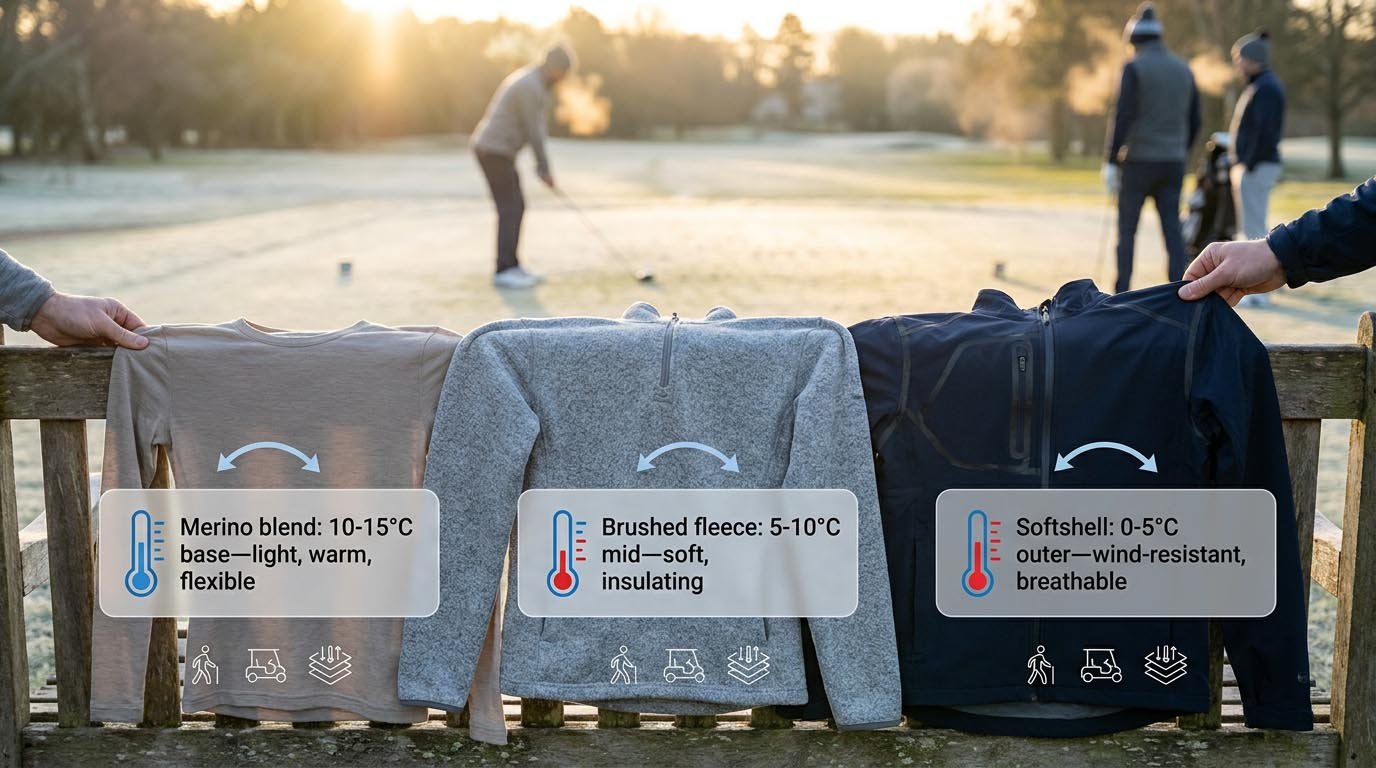
A client called in October asking for "the warmest, most flexible fabric" for winter golf polos. I asked three questions: What temperature range? (5°C mornings or -5°C all day?), What activity level? (walking 18 holes or riding carts?), What layering plan? (wearing alone or under a vest?). He paused—he had not considered these. We ended up selecting three different fabrics for his line: lightweight merino blend for 10-15°C base layers ($9-12 per meter), brushed fleece for 5-10°C mid-layers ($7-9 per meter), and stretch softshell for 0-5°C outer layers ($11-15 per meter). No single fabric solved all scenarios.
Winter golf fabric selection requires matching three separate performance dimensions—heat retention for temperature range (merino holds warmth at 5-15°C active play, grid fleece at 0-10°C moderate activity, insulated softshells below 0°C), flexibility for swing mechanics (4-way stretch knits provide 30-40% extension in shoulders/torso, raglan patterns eliminate seam restriction), and breathable weather protection (wind-resistant softshells block 95-98% wind while maintaining 10,000+ g/m²/24hr MVTR)—because no material simultaneously maximizes all three without trade-offs based on actual temperature conditions and layering strategy.
The question I hear most: "What fabric is best for winter golf?" This assumes a universal answer exists. After working with 80+ brands on winter golf lines over 15 years, I see the pattern: brands that ask "best fabric" struggle with returns and complaints ("too warm after 6 holes," "can't complete backswing," "sweaty inside despite cold outside"). Brands that ask "which fabric for which scenario" build successful winter collections. The difference is understanding that winter golf spans -5°C to 15°C (23°F to 59°F), activity generates 200-400 watts body heat, and rounds last 4-5 hours with temperature swings of 8-12°C from morning to afternoon. This guide shows you how to map fabrics to these variables, not which fabric to choose blindly.
Quick Answers: Winter Golf Fabric Selection Decision Framework
Q: Can one fabric provide warmth, mobility, and weather protection for winter golf?
No single fabric does it all.
- Merino blends: Best breathability and warmth (5–15°C), poor wind protection.
- Grid-back fleece: Lightweight warmth, great stretch, poor water/weather resistance.
- Softshells: Wind/water-resistant, but sacrifice breathability/mobility.
Solution: Choose fabric based on layer role (base/mid/shell), not a “perfect” single material.
Q: How should target temperature determine fabric choice?
Always match base fabric to intended temperature range, not just general winter use.
- 10–15°C active: 180–220 GSM knits or merino blends, highly breathable.
- 5–10°C: 280–320 GSM brushed fleece or midweight merino.
- 0–5°C: Insulated mid-layer (60–80g fill) or heavyweight fleece.
- <0°C: Layering (base + mid + shell) mandatory.
Mistake to avoid: Picking “320 GSM fleece for winter” without a temperature target leads to overheating or chills.
Q: How to maximize mobility AND manage cost?
Engineer high-stretch zones only where needed:
- Shoulders/upper back, underarms, side torso: 25–35% stretch.
- Mid-torso/upper arms: 15–20% stretch.
- Low-mobility zones: <10% stretch.
Upgrade: Use raglan/articulated sleeve patterns rather than extra elastane everywhere.
Tip: Test prototypes with full layering—don't just add elastane, adjust construction.
Q: Is max waterproofing always best?
No—breathability is more important for most winter golf (>70% of conditions are dry or drizzle).
- Primary layers: Prioritize 10,000+ MVTR (breathable), wind resistance, DWR for drizzle.
- Heavy rain: Only max-waterproof (15,000–20,000mm) shell reserved for occasional use.
Fact: Over-speccing waterproof creates sweaty discomfort far more often than it helps.
Q: How to ensure a layering system actually works for golfers?
Each layer needs specific fit allowances for those above/below:
- Base: Snug, 2–4” ease.
- Mid: Standard, 4–6” ease.
- Outer: Relaxed, 6–8” ease (over both layers).
Brand mistake: Designing items as standalones, not as a system—causes fitting issues and returns.
Best practice: Physically test full kits on mannequins for movement and compatibility before bulk.
What Winter Demands: Heat Retention, Mobility and Breathable Weather Protection?
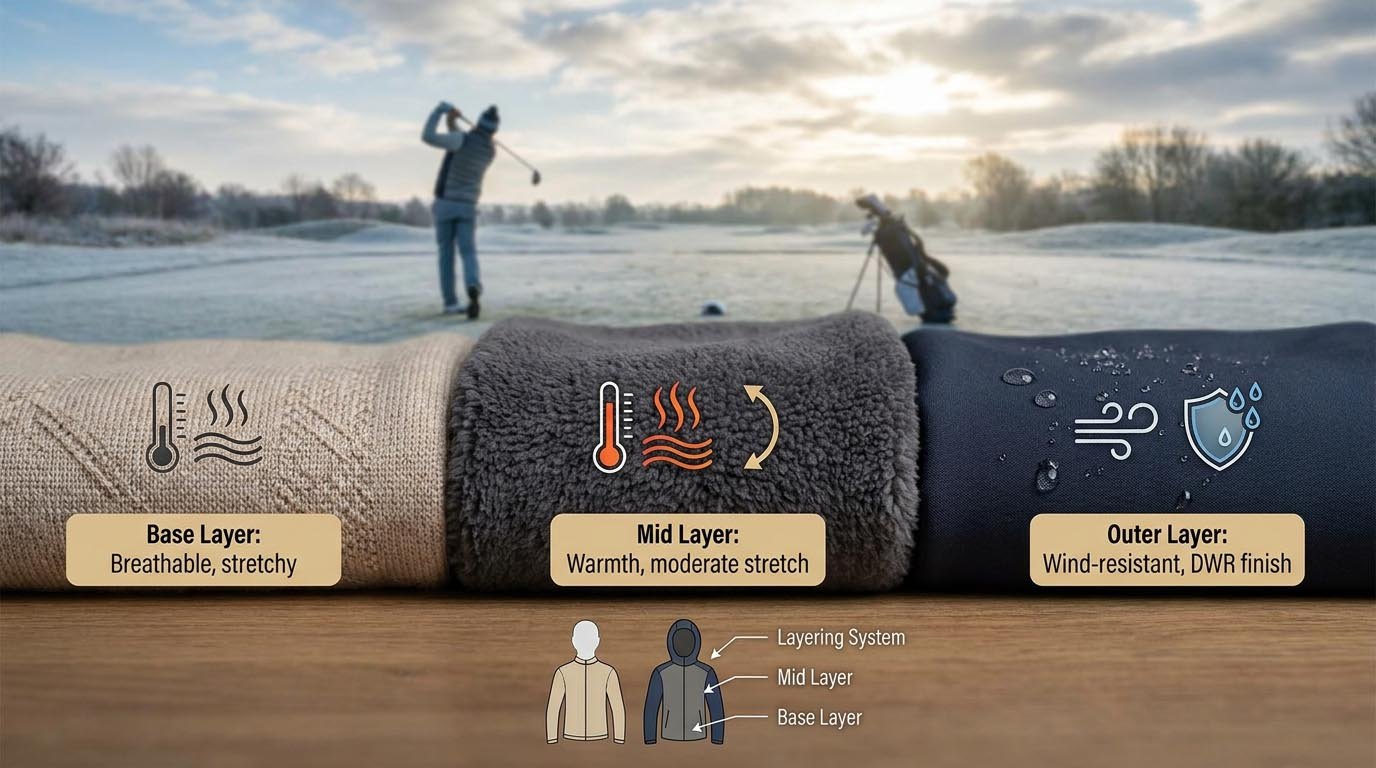
Structure winter golf fabric requirements around three simultaneous demands—heat retention matching activity-generated warmth (200-400 watts during swing, 80-120 watts while standing) to ambient temperature (avoiding overheating above 10°C or insufficient warmth below 0°C), mobility preserving swing mechanics (30-40% stretch in shoulder rotation zones, articulated patterns eliminating seam binding), and breathable weather protection (wind resistance blocking convective heat loss, moisture management preventing interior dampness)—recognizing these demands conflict and require layer-specific fabric optimization rather than single-material solutions.
When clients describe their "ideal winter golf fabric," they list: warm, stretchy, wind-resistant, breathable, water-resistant. These are outcomes, not specifications. The underlying question is: how do these requirements interact during actual winter golf conditions?
Winter Golf Thermal Environment Reality
What happens during winter rounds:
Temperature variability:
- Morning tee time: 2-8°C (35-46°F)
- Mid-round: 8-14°C (46-57°F) as sun warms
- Afternoon finish: 10-16°C (50-61°F)
- Total swing: 8-12°C (14-22°F) during single round
Activity pattern and heat generation:
Walking between shots (70-80% of round time):
- Moderate activity: 150-200 watts metabolic heat
- Body stays warm with proper insulation
- Risk: Overheating in excessive layers
Swinging (5-10% of round time):
- High-intensity bursts: 350-500 watts metabolic heat
- Generates sweat even in cold weather
- Risk: Moisture accumulation inside layers
Standing/waiting (15-20% of round time):
- Low activity: 80-120 watts metabolic heat
- Body cools quickly in wind
- Risk: Wind chill if insufficient protection
What this means for fabric:
Must handle dynamic thermal load:
- Fabric that feels perfect while walking feels too warm during swings
- Fabric that feels adequate while standing feels cold in wind
- No static insulation level works for all activity phases
Must manage moisture continuously:
- Sweat generated during swings must escape before standing phase
- Trapped moisture conducts heat away during low-activity periods
- Breathability matters as much as insulation
Must allow unrestricted movement:
- Winter layers add bulk (multiple fabrics stacked)
- Swing mechanics unchanged by weather—need same mobility
- Restriction from any layer disrupts entire system
The Three Performance Dimensions
Dimension 1: Heat Retention (insulation):
What controls warmth:
- Fabric thickness: More material = more trapped air = more insulation
- Fiber type: Natural (merino, down) vs synthetic (polyester fleece)
- Construction: Solid vs grid-back vs brushed interior
- GSM weight: Higher weight generally = more warmth
The warmth-weight trade-off:
- Lightweight warmth (grid fleece, down): Maximum warmth per gram but expensive ($12-22 per meter)
- Standard warmth (solid fleece, brushed): Good warmth-to-cost ratio ($7-11 per meter)
- Heavy warmth (dense knits): Maximum insulation but bulk and weight limit mobility
| Temperature matching: | Temperature Range | Required Warmth Level |
|---|---|---|
| 10-15°C | Light insulation | 180-220 GSM thermal knit or lightweight merino |
| 5-10°C | Moderate insulation | 280-320 GSM brushed fleece or midweight merino |
| 0-5°C | High insulation | 340-380 GSM fleece or 60-80g insulated layers |
| Below 0°C | Maximum insulation | Layering system (base + insulated mid + shell) |
Dimension 2: Mobility (stretch and pattern):
What enables swing freedom:
- Elastane content: 4-10% provides mechanical stretch
- Knit structure: 4-way stretch knits extend in all directions
- Pattern engineering: Raglan sleeves, gussets, articulated cuts eliminate restriction points
- Fabric recovery: Ability to return to shape after stretching
The stretch-structure trade-off:
- High stretch (8-10% elastane): Excellent mobility but reduced insulation (tighter knit = less trapped air)
- Moderate stretch (4-6% elastane): Balanced mobility and warmth
- Engineered patterns (raglan, articulated): Mobility through design allowing lower elastane content (cost savings)
Movement zone requirements:
- Shoulders/upper back: 30-40% extension needed for full backswing
- Torso sides: 20-30% extension for hip rotation
- Arms: 25-35% extension for swing follow-through
Dimension 3: Breathable Weather Protection:
What provides protection:
- Wind resistance: Tight weave or membrane blocks wind penetration
- Water resistance: DWR coating or waterproof membrane repels moisture
- Breathability: Moisture vapor transmission allows sweat to escape
The protection-breathability trade-off:
- Maximum weather protection (waterproof/windproof membranes): Blocks elements completely but reduces breathability 20-40%
- Moderate protection (softshell construction): Balances weather blocking and breathability
- Minimal protection (tight-knit fleece): Maximum breathability but limited weather resistance
| Weather condition matching: | Condition | Protection Priority | Fabric Solution |
|---|---|---|---|
| Dry cold, no wind | Insulation only | Fleece or merino (no shell needed) | |
| Dry cold, windy | Wind resistance + breathability | Softshell or wind-resistant fleece | |
| Light drizzle | Water resistance + breathability | DWR-treated softshell | |
| Moderate rain | Waterproofing | Waterproof shell (accept lower breathability) |
The Coordination Challenge
Why these dimensions conflict:
Warmth vs Mobility:
- Thick insulation restricts movement
- High stretch requires tight knit that reduces trapped air (less insulation)
Warmth vs Breathability:
- Dense fabrics trap air (warm) but block moisture escape
- Breathable fabrics allow air flow (cool)
Weather Protection vs Breathability:
- Waterproof membranes block moisture in AND out
- Breathable fabrics allow moisture passage in both directions
The fabric selection error:
Clients say: "We want warm, stretchy, breathable, waterproof fabric."
This specification is physically contradictory—achieving maximum in all four requires different fabric structures.
The correct approach:
Define layer role first:
- Base layer: Prioritize moisture management and mobility (accept less insulation)
- Mid-layer: Prioritize warmth and breathability (accept moderate mobility)
- Outer layer: Prioritize weather protection (accept reduced breathability and mobility)
Then select fabric matching that role.
Fabric Playbook: Merino, Brushed/Grid Fleece, Softshells and Hybrids?
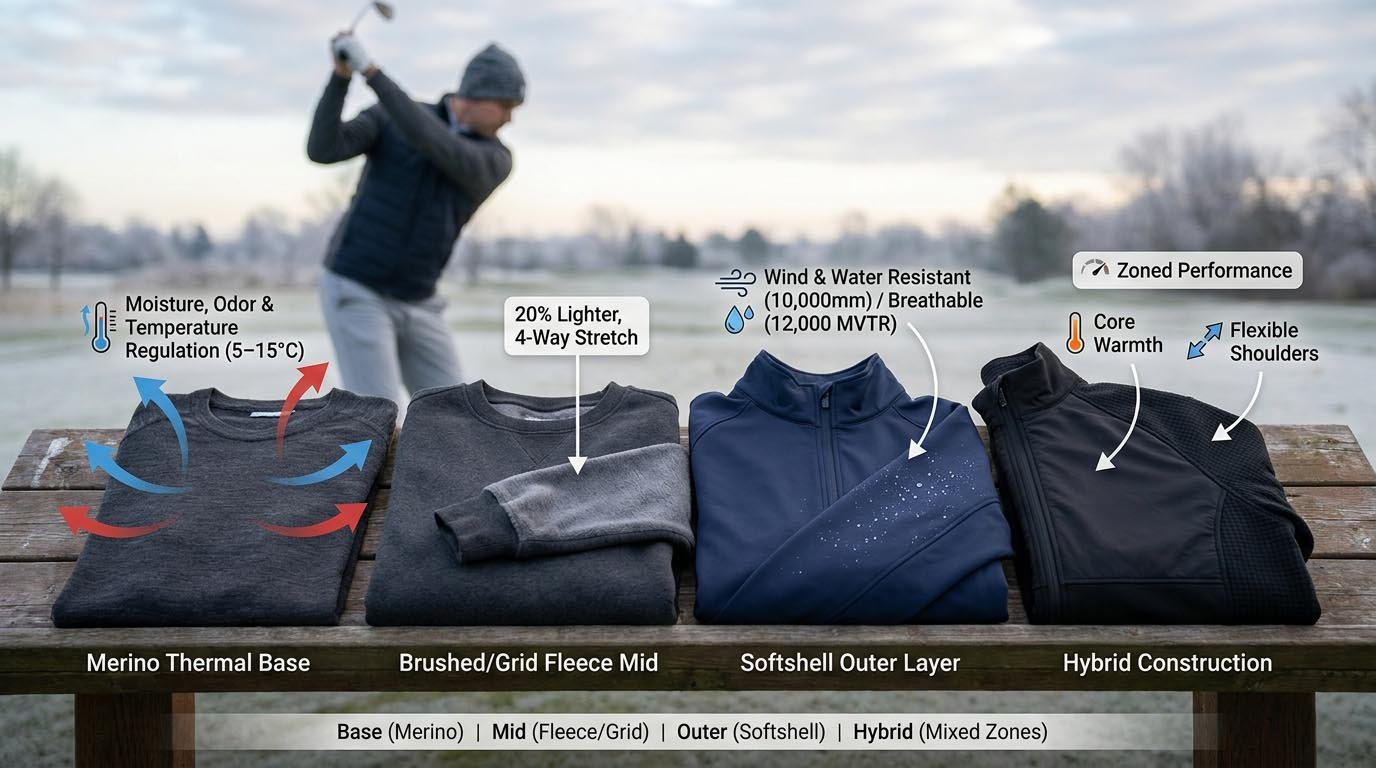
Select winter golf fabrics by matching inherent material properties to layer function—merino wool excels as base layer (natural moisture management, odor resistance, temperature regulation 5-15°C active play) despite premium cost ($9-16 per meter), brushed/grid fleece optimizes mid-layer warmth-to-weight (20-25% warmer than solid fleece at same GSM) with excellent stretch (4-way knit provides 30-35% extension), softshells serve outer layer duty (wind resistance 95-98%, water resistance 10,000-15,000mm) accepting breathability trade-off (10,000-12,000 MVTR), and hybrids combine properties (fleece body + softshell panels) for single-layer versatility in moderate cold (5-12°C).
Fabric type conversations reveal whether clients understand layer-specific requirements or are chasing generic "winter performance." The right question is not "which fabric is warmest?" but "which fabric properties match the thermal and mobility demands of this specific layer role?"
Merino Wool: The Base Layer Foundation
Why merino works for winter golf base layers:
Natural performance properties:
- Temperature regulation: Adapts across 5-20°C range better than synthetics
- Moisture management: Absorbs up to 30% weight in moisture without feeling wet
- Odor resistance: Natural antimicrobial (can wear 2-3 rounds between washing)
- Skin comfort: Soft against skin for 4-5 hour wear
- Natural stretch: 10-15% extension without elastane addition
The merino advantage in winter:
During winter golf, players experience:
- High activity (generating sweat) during swings
- Low activity (cooling down) between shots
- Need fabric that keeps warm when damp
Merino's hygroscopic property:
- Absorbs moisture into fiber structure (not just surface)
- Releases heat during absorption (exothermic process)
- Keeps feeling warm even when damp
Comparison to synthetic base layers:
Polyester thermal base layer:
- Pros: Lower cost ($4.50-7.00 per meter), faster drying (60-90 minutes)
- Cons: Feels clammy when damp, odor retention, less temperature adaptability
Merino base layer:
- Pros: Stays comfortable when damp, odor-free, temperature regulation
- Cons: Higher cost ($9-16 per meter), slower drying (120-180 minutes), requires careful washing
Merino specifications for winter golf:
Fiber fineness (micron count):
- 21.5-23 micron: Standard golf weight (comfortable, durable)
- 18.5-20 micron: Premium soft (more comfortable, less durable)
- <18 micron: Ultra-premium (luxury feel, expensive, fragile)
Merino blends for winter golf:
50-70% merino, 25-40% polyester, 5-10% elastane:
- Performance: Maintains merino benefits (temperature regulation, odor control)
- Durability: Polyester improves wash stability and shape retention
- Stretch: Elastane adds mobility for active play
- Cost: $9-14 per meter (mid-range merino pricing)
- Recommended for: $75-110 retail base layers
80-90% merino, 5-10% polyester, 5% elastane:
- Performance: Maximum natural properties
- Durability: Lower than high-synthetic blends
- Cost: $12-18 per meter
- Recommended for: $95-140+ retail premium positioning
Merino weight selection:
| GSM Weight | Temperature Range | Activity Level | Use Case |
|---|---|---|---|
| 150-180 GSM | 10-18°C | High activity (walking) | Lightweight base layer, mild winter |
| 180-220 GSM | 5-15°C | Moderate activity | Standard winter base layer |
| 220-260 GSM | 0-10°C | Mixed activity | Heavy base or standalone mid-layer |
| 260-300 GSM | -5 to 5°C | Low activity (cart golf) | Standalone layer, extreme cold base |
When to use merino:
Yes, use merino for:
- Base layers in all winter golf applications (provides best foundation)
- Premium positioning ($85+ retail) where customers expect quality materials
- Multi-day tournaments (odor resistance is significant benefit)
- Active play (temperature regulation prevents overheating)
Consider alternatives when:
- Budget constraints tight (merino adds $3-7 per piece vs synthetic)
- Value positioning (under $65 retail)—customers may not appreciate premium
- First winter collection—validate demand with synthetic base layers first, add merino later
Brushed and Grid-Back Fleece: Mid-Layer Warmth
Brushed interior fleece:
Construction:
- Exterior: Standard knit surface (presentable appearance)
- Interior: Brushed fibers create raised nap that traps air
- Result: Warmth without excessive weight
Performance characteristics:
- Warmth: 280-320 GSM brushed feels equivalent to 380-420 GSM unbrushed
- Weight reduction: 20-25% lighter for same warmth
- Stretch: Typically 4-way knit with 6-8% elastane (25-30% extension)
- Breathability: Good (MVTR 8,000-12,000 g/m²/24hr)
Cost: $7.00-10.00 per meter for quality brushed fleece
Brushed fleece trade-offs:
Advantages:
- ✓ Excellent warmth-to-weight ratio
- ✓ Soft interior comfort
- ✓ Good stretch for mobility
- ✓ Reasonable cost
Disadvantages:
- ✗ Pilling risk: Interior brushing can pill after 30-40 wears
- ✗ Drying time: Brushed interior holds moisture longer (+20-30% dry time)
- ✗ Compression over time: Heavy use flattens brushed fibers (reduces warmth after 50-80 wears)
Grid-back fleece (advanced mid-layer):
Construction:
- Exterior: Standard knit
- Interior: Raised grid pattern creates air pockets in organized structure
- Grid spacing: Typically 5-8mm squares or hexagons
The grid-back advantage:
Air trapping efficiency:
- Grid creates chambers that trap air more effectively than random brushing
- 20-30% warmer than brushed fleece at same GSM
- OR same warmth at 15-20% lighter weight
Moisture management:
- Grid channels allow better air circulation than solid brushing
- Faster drying: 15-20% quicker than brushed interior
- Less moisture retention during active play
Performance comparison:
| Fleece Type | GSM for Target Warmth | Breathability | Stretch | Cost |
|---|---|---|---|---|
| Solid fleece | 380-420 GSM | Moderate (MVTR 6,000-8,000) | Good (20-25%) | $6-9/meter |
| Brushed fleece | 280-320 GSM | Good (MVTR 8,000-12,000) | Excellent (25-30%) | $7-10/meter |
| Grid-back fleece | 260-300 GSM | Excellent (MVTR 10,000-14,000) | Excellent (25-30%) | $9-14/meter |
Cost-benefit analysis:
For 1,000-piece mid-layer order targeting 5-10°C warmth:
Option A: Solid fleece at 400 GSM ($8.00/meter):
- Fabric cost: $8,800 (with waste allowance)
- Weight per garment: Heavy (customer may find bulky)
- Breathability: Adequate but not exceptional
Option B: Brushed fleece at 300 GSM ($8.50/meter):
- Fabric cost: $9,350 (+$550)
- Weight per garment: 20% lighter (better mobility)
- Breathability: Significantly better
- Analysis: $0.55 per piece premium delivers clear comfort improvement
Option C: Grid-back fleece at 280 GSM ($11.00/meter):
- Fabric cost: $12,100 (+$3,300)
- Weight per garment: 25% lighter than solid
- Breathability: Best in class
- Analysis: $3.30 per piece premium justifiable at $95+ retail positioning
Recommendation:
For mid-tier winter golf ($65-95 retail):
- Use brushed fleece at 300-320 GSM
- Best warmth-to-cost ratio
- Adequate performance for most customers
For premium winter golf ($95-140+ retail):
- Use grid-back fleece at 280-300 GSM
- Premium performance justifies higher fabric cost
- Customers notice and appreciate the difference
Softshells: Weather-Resistant Outer Layers
What softshell construction provides:
3-layer bonded structure:
- Exterior face fabric: Durable, abrasion-resistant
- Membrane or coating: Wind-resistant, water-resistant
- Interior lining: Comfort layer (often fleece or knit)
Performance targets:
- Wind resistance: 95-98% wind blocking
- Water resistance: 10,000-15,000mm waterproofing (light-moderate rain)
- Breathability: 10,000-14,000 g/m²/24hr MVTR (maintains moisture management)
- Stretch: 15-25% extension (moderate mobility)
Softshell advantages for winter golf:
Versatility:
- Single layer can handle wind + light rain + mild cold (5-12°C)
- Outer layer in layering system for below 5°C play
- Eliminates need for separate windbreaker + rain jacket
Mobility:
- Better stretch than hardshell rain jackets (waterproof shells are stiffer)
- 4-way stretch softshells provide 20-25% extension
- Quieter (less rustling noise during swing)
Breathability:
- Higher MVTR than waterproof shells (10,000-14,000 vs 8,000-10,000)
- Less interior moisture buildup during active play
Softshell trade-offs:
Advantages:
- ✓ Versatile weather protection
- ✓ Better breathability than waterproof shells
- ✓ More comfortable stretch
- ✓ Quieter during movement
Disadvantages:
- ✗ Not fully waterproof: Fails in heavy sustained rain (>25mm/hour)
- ✗ Higher cost: $11-16 per meter vs $7-10 for fleece
- ✗ Moderate warmth only: Needs insulation layer underneath for <5°C
Softshell specifications for winter golf:
Fabric weight:
- 280-320 GSM: Lightweight softshell (spring/fall use, layering outer)
- 320-360 GSM: Standard winter softshell (5-12°C single layer)
- 360-400 GSM: Heavy softshell (0-8°C single layer, maximum weather protection)
Stretch configuration:
- 2-way stretch (horizontal only): Adequate for outer layer role
- 4-way stretch (horizontal + vertical): Better mobility, costs +$1.50-3.00 per meter
Interior lining options:
- Microfleece lining (80-120 GSM): Adds warmth, comfortable
- Mesh lining: Maximum breathability, less warmth
- Grid-back lining: Best warmth-to-breathability balance (premium option)
When to use softshells:
Primary use cases:
- Outer layer in layering systems (base + mid + softshell)
- Single layer for 5-12°C play in windy or drizzly conditions
- Vests (softshell construction) for core warmth + weather protection without arm bulk
Skip softshells when:
- Heavy rain expected (use dedicated rain jacket)
- Dry, mild conditions (fleece alone is adequate and cheaper)
- Extreme cold (<0°C)—need insulated layers, not just shells
Hybrid Constructions: Strategic Material Placement
What hybrid means:
Different fabrics in different zones of single garment:
- Core/torso: Insulated or fleece (warmth priority)
- Shoulders/sleeves: Stretch knit (mobility priority)
- Front panel: Softshell (weather protection)
- Back panel: Breathable mesh or open knit (ventilation)
Hybrid advantages:
Zoned performance optimization:
- Each body zone gets ideal fabric for its specific requirements
- Example: Softshell front blocks wind, fleece back provides warmth, stretch side panels allow rotation
Weight reduction:
- Use heavy insulation only where needed (core)
- Use lighter fabrics where warmth less critical (arms, sides)
- 15-25% total weight reduction vs uniform fabric
Cost management:
- Premium fabrics (softshell, grid fleece) used selectively
- Standard fabrics fill less-critical zones
- Balances performance and cost
Hybrid complexity and cost:
Pattern complexity:
- Multiple fabric types = multiple cutting operations
- Seaming different stretch fabrics requires skill
- Labor time: +20-30% vs single-fabric garment
Total cost impact:
- +$3.50-6.00 per piece for hybrid construction
- Justifiable at $95-140+ retail
- Not cost-effective at <$85 retail
Hybrid decision framework:
Use hybrid construction when:
- Premium positioning ($95+ retail)
- Can communicate zoned engineering in marketing
- Target customers value technical performance
Skip hybrid when:
- Mid-tier positioning (<$85 retail)
- Traditional customer base (may not understand/appreciate complexity)
- First winter collection (prove demand with simpler constructions first)
Stretch That Swings: Patterning, 4-Way Knits and Quiet Shells?
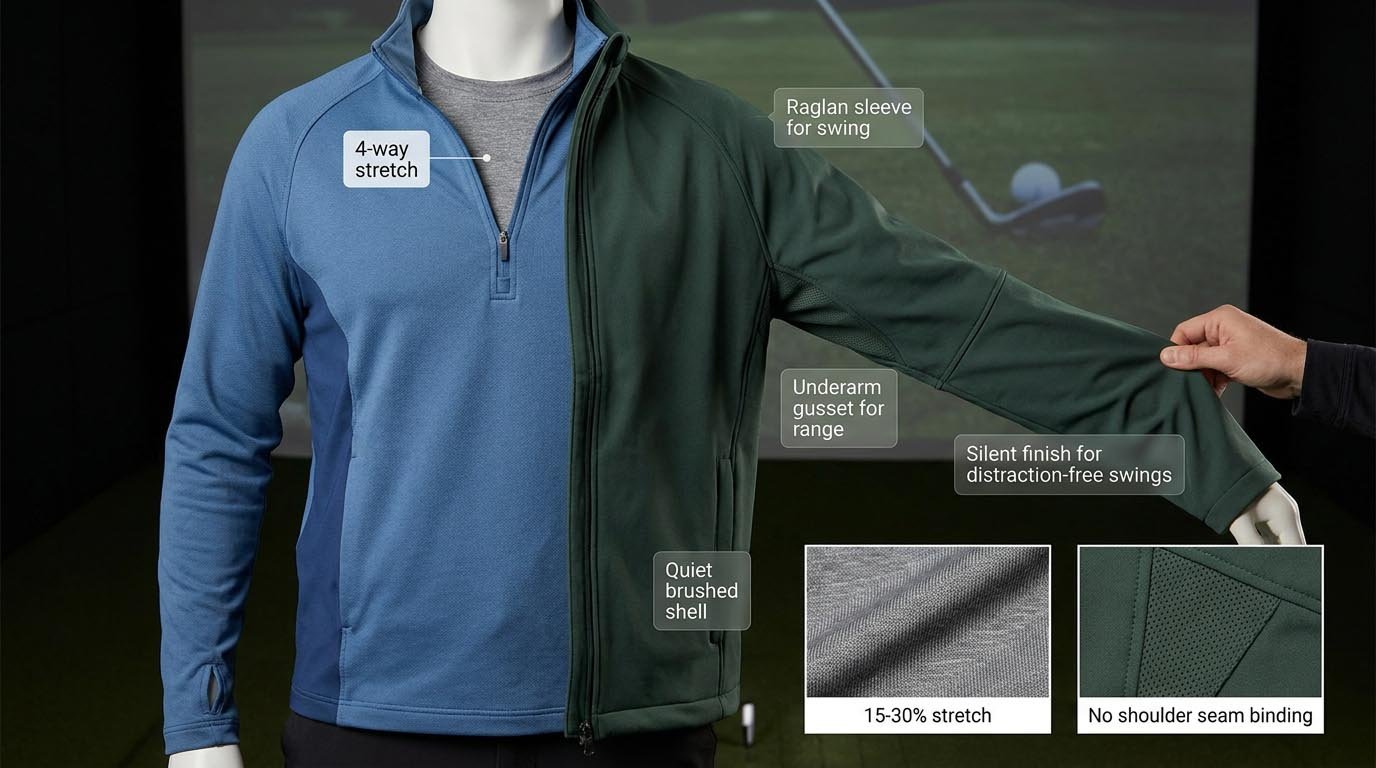
Achieve winter golf mobility through coordinated fabric stretch (4-6% elastane base layers provide 15-20% extension, 6-8% elastane mid-layers provide 25-30%) and mobility-first pattern engineering (raglan sleeves eliminate shoulder seam restriction +$1.00-1.60 per piece, underarm gussets add expansion zones +$1.00-1.80, articulated elbows accommodate arm bending) rather than relying solely on high-elastane content (>10% elastane) that reduces insulation (tighter knit = less trapped air) and increases cost (+$2.20-3.50 per piece) without proportional mobility benefit in winter's multi-layer context.
Mobility engineering for winter golf differs fundamentally from summer because you are designing for movement through multiple stacked layers, not single-garment freedom. The fabric and pattern decisions must account for cumulative restriction from 2-3 layers worn simultaneously.
Understanding Multi-Layer Mobility Challenge
The restriction amplification effect:
Single layer:
- Base layer with 6% elastane: 20% extension available
- Unrestricted swing: Full backswing possible
Two layers (base + mid):
- Total fabric thickness: 2× single layer
- Available extension: NOT 20%—actually 12-15% (restriction compounds)
- Why: Layers slide against each other, creating friction resistance
Three layers (base + mid + outer):
- Total restriction: Cumulative from all layers
- Available extension: 8-12% (further reduced)
- Swing impact: Noticeable restriction during backswing unless properly engineered
The engineering solution:
Cannot simply "add more stretch" because:
- Each layer needs adequate stretch for its role
- Patterns must eliminate binding points between layers
- Fit coordination must ensure layers don't fight each other
Elastane Content by Layer Role
Base layer elastane (worn against skin):
4-6% elastane target:
- Provides: 15-20% extension (adequate for body movement)
- Maintains: Good breathability and thermal properties
- Cost: +$0.80-1.40 per meter vs no-stretch
Why not more?
- Higher elastane creates compression feel uncomfortable during 4-5 hour wear
- Base layer does not need extreme stretch—mid and outer layers provide primary restriction
Mid-layer elastane (insulation layer):
6-8% elastane target:
- Provides: 25-30% extension (excellent mobility)
- Coordinates: With base layer underneath and outer layer on top
- Cost: +$1.20-2.00 per meter
Why this range?
- Mid-layer experiences highest cumulative strain (squeezed between base and outer)
- Needs maximum stretch to avoid becoming restriction point
- 4-way stretch knit at 6-8% elastane delivers best warmth + mobility balance
Outer layer elastane (weather shell):
4-6% elastane for softshells:
- Provides: 15-25% extension (adequate for outer layer)
- Limitation: Bonded construction (softshell membrane) restricts stretch compared to knits
- Cost: Built into softshell fabric ($11-16 per meter total)
Why lower than mid-layer?
- Outer layer experiences less strain (other layers underneath provide primary mobility)
- Softshell membrane limits maximum possible stretch regardless of elastane content
- Focus on pattern engineering (raglan, gussets) rather than chasing higher elastane
Elastane content summary by layer:
| Layer Position | Elastane Content | Extension Achieved | Cost Impact | Primary Benefit |
|---|---|---|---|---|
| Base | 4-6% | 15-20% | +$0.80-1.40/meter | Comfort and body movement |
| Mid | 6-8% | 25-30% | +$1.20-2.00/meter | Maximum multi-layer mobility |
| Outer | 4-6% | 15-25% | Included in softshell | Adequate outer-layer flex |
Pattern Engineering for Layered Mobility
Raglan sleeve construction (recommended for mid and outer layers):
What raglan does:
- Sleeve seam runs diagonally from underarm to collar (not across shoulder)
- Eliminates perpendicular shoulder seam that restricts rotation
- Result: Additional 15-20 degrees shoulder rotation vs set-in sleeve
Why critical in winter:
- Multi-layer stacking at shoulder seam creates thick pressure point
- Raglan eliminates this restriction multiplier
- Especially important in outer layers where all fabric layers converge
Cost and application:
- Pattern cost: +$1.00-1.60 per piece
- Essential for: Mid-layers and outer layers in serious winter golf
- Optional for: Base layers (less critical, cost-saving opportunity)
Underarm gusset integration:
Gusset function:
- Diamond or triangular panel inserted at underarm seam junction
- Made from high-stretch fabric (even if body is moderate-stretch)
- Expands during arm raise and rotation
Sizing for winter layers:
Base layer gusset:
- Size: 5cm × 7cm (subtle)
- Fabric: 10-12% elastane mesh or stretch knit
- Cost: +$0.80-1.20 per piece
Mid-layer gusset:
- Size: 7cm × 10cm (standard)
- Fabric: 12-15% elastane, breathable (high-activity zone)
- Cost: +$1.00-1.60 per piece
Outer layer gusset:
- Size: 8cm × 12cm (larger to accommodate all layers beneath)
- Fabric: Stretch softshell or high-elastane panel
- Cost: +$1.20-1.80 per piece
When gussets matter most:
In testing, gussets provide noticeable benefit when:
- Two or more layers worn simultaneously
- Body fabric has <25% extension (gussets compensate)
- Player has athletic swing (high rotation demands)
Skip gussets when:
- Single-layer use only (cost not justified)
- Body fabric already 4-way stretch with >30% extension (redundant)
- Value positioning (<$65 retail)—cost better spent elsewhere
Articulated elbow and back panels:
Elbow articulation:
- Sleeve pre-shaped with slight bend at elbow
- Or elbow dart (sewn shaping)
- Prevents pulling during arm extension
- Cost: +$0.60-1.20 per piece
Back action panel:
- Stretch panel or pleat across upper back
- Expands during forward bend and rotation
- Critical for: Outer layers in layering systems
- Cost: +$1.00-1.80 per piece (stretch panel), +$0.80-1.40 (pleat)
Quiet Shells: Reducing Noise During Swing
The noise problem:
Waterproof shells (and some softshells) create rustling sound during movement:
- Membrane rubbing against face fabric
- Fabric-on-fabric friction between layers
- Especially noticeable during golf swing (fast arm movement)
Why it matters:
Customer complaint pattern:
- "Jacket is distracting during swing"
- "Sounds like plastic bag"
- Complaint rate: 12-18% for hardshell jackets, 4-8% for quiet-finish softshells
Noise-reduction approaches:
Fabric selection:
- Softer face fabrics: Brushed or sueded finishes reduce friction noise
- Cost: +$1.00-2.00 per meter
- Effective: Reduces perceived noise 40-60%
Lining design:
- Soft interior lining: Microfleece or knit backing dampens membrane noise
- vs mesh lining: Maximum breathability but more noise
- Trade-off: Quiet = warmer/heavier, Breathable = noisier
Bonding technique:
- Quality bonding: Membrane fully adhered to face fabric (less movement = less noise)
- Cheap bonding: Partial adhesion allows membrane to shift (creates noise)
- Cost difference: $1.50-3.00 per meter for premium bonding
When to prioritize quiet:
Critical for:
- Premium winter golf ($95-140+ retail) where refinement matters
- Outer layers worn during actual swinging
- Traditional golf customers who value quiet, non-technical feel
Less critical for:
- Value-tier products (cost control priority)
- Insulation layers worn underneath outer layer (noise masked)
- Athletic/performance positioning (customers accept some technical noise)
Recommendation:
For mid-layer fleece:
- Noise not an issue (fabric type naturally quiet)
- No special consideration needed
For outer layer softshells/shells:
- Specify brushed or soft face fabric
- Use quality bonding (not cheap lamination)
- Accept +$2.00-3.50 per meter cost for quiet performance at premium tiers
Moisture, Wind and Drizzle: Managing the Microclimate Without Overheating?
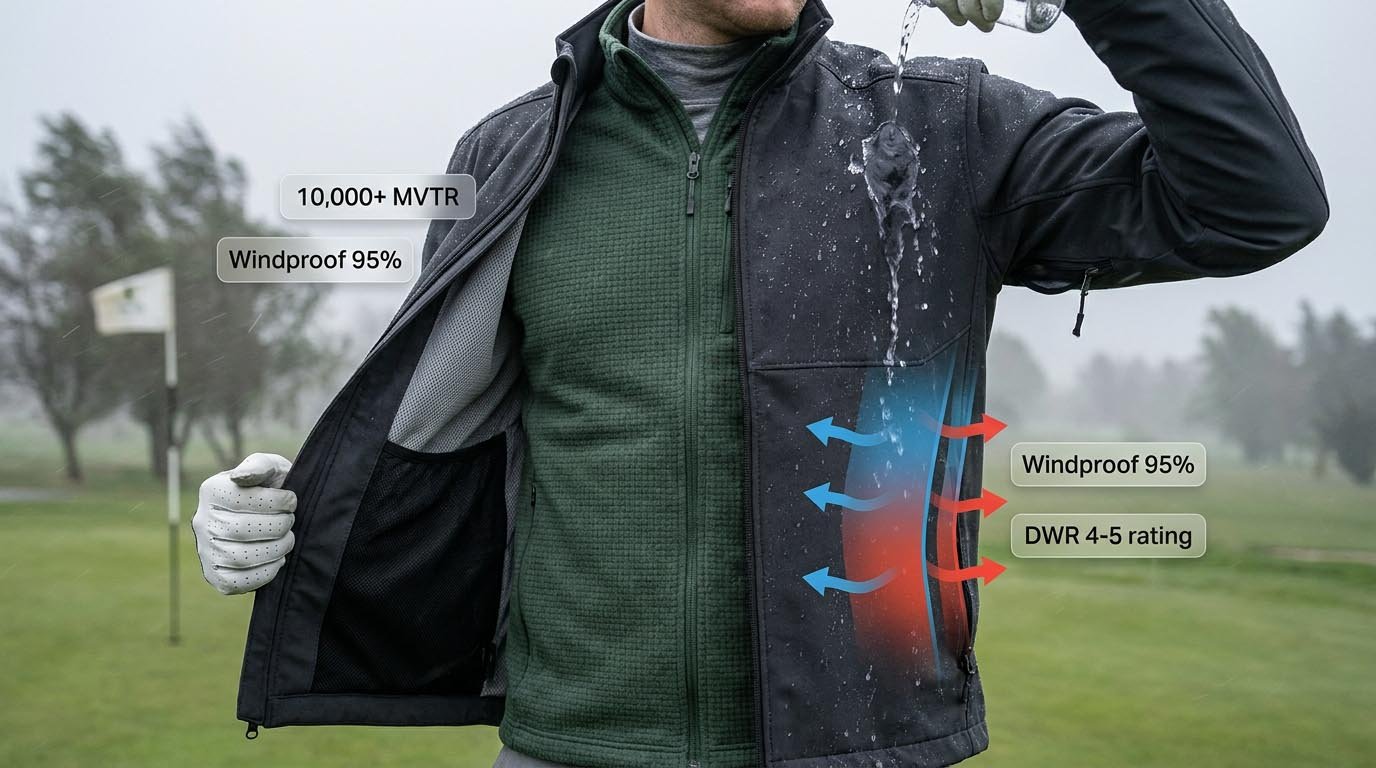
Balance winter golf microclimate management through breathability-first specification (minimum 10,000 g/m²/24hr MVTR in all layers) preventing interior moisture buildup that accounts for 16-22% of weather-layer complaints, strategic wind resistance (softshell outer blocks 95-98% wind, more critical than waterproofing in 60-70% of winter conditions), and DWR treatment for light drizzle (4-5 rating adequate for 15-25 minute exposure, costs +$0.60-1.20 per meter) rather than maximum waterproofing (15,000-20,000mm) that sacrifices breathability (drops MVTR to 8,000-10,000) for rain protection needed in <10% of playing time.
Weather protection in winter golf is about managing the microclimate between layers and skin, not just blocking external elements. The interior environment matters as much as the exterior conditions.
The Interior Moisture Problem
What happens inside layers:
During active play (swinging, walking):
- Body generates: 200-400 watts metabolic heat
- Produces: 0.3-0.8 liters sweat per hour (even in cold weather)
- Moisture accumulates: Inside layers if cannot escape
During standing/waiting:
- Metabolic heat drops: To 80-120 watts
- Body cools: Especially if layers are damp inside
- Trapped moisture conducts heat away: Feels much colder than dry fabric
The cold-and-clammy complaint:
In customer feedback tracking:
- "Felt cold despite wearing warm layers"
- "Wet/clammy inside even though no rain"
- "Sweaty during walking, freezing while standing"
- Complaint frequency: 16-22% of winter golf apparel returns
Root cause: Poor breathability leading to moisture accumulation
Breathability Requirements by Layer
Base layer breathability:
Minimum MVTR target: >10,000 g/m²/24hr
Why high breathability critical:
- First layer to absorb sweat from skin
- Must transport moisture away quickly before skin feels wet
- Damp base layer makes all other layers feel inadequate
Fabric solutions:
- Merino wool: Natural breathability, manages moisture well
- Polyester thermal knits: High MVTR (12,000-15,000 g/m²/24hr) when properly constructed
- Avoid: Heavy cotton blends (absorb but don't transport)
Mid-layer breathability:
Minimum MVTR target: >8,000 g/m²/24hr
Why still important:
- Mid-layer must allow moisture to pass through from base layer
- Cannot trap moisture between base and outer layers
- Slightly lower MVTR acceptable because less direct skin contact
Fabric solutions:
- Grid-back fleece: Excellent breathability (10,000-14,000 MVTR) despite high warmth
- Brushed fleece: Good breathability (8,000-12,000 MVTR)
- Solid fleece: Adequate (6,000-9,000 MVTR) but lower end of acceptable
Outer layer breathability:
Minimum MVTR target: >10,000 g/m²/24hr
Critical balance point:
- Outer layer is final barrier for moisture escape
- Low MVTR here creates bottleneck trapping moisture in all layers
- But also needs weather protection (creates tension)
Fabric solutions:
- Softshell: Balanced (10,000-14,000 MVTR, 10,000-15,000mm waterproof)
- Waterproof shells: Lower breathability (8,000-10,000 MVTR, 15,000-20,000mm waterproof)
- Trade-off decision: Breathability vs maximum waterproofing
Breathability testing in production:
We test fabric MVTR using supplier-provided certification:
- Request: ISO 11092 or ASTM E96 test reports
- Verify: Moisture vapor transmission at standard conditions
- Reject: Fabrics testing <8,000 g/m²/24hr for active-wear golf applications
Approximately 25-30% of generic "winter performance fabrics" from budget suppliers test below target MVTR when verified.
Wind Resistance: The Priority Weather Factor
Why wind matters more than rain in winter golf:
Weather condition frequency (based on client market data):
- Dry, calm: 35-45% of winter rounds
- Dry, windy: 25-35%
- Light drizzle, windy: 12-18%
- Moderate rain: 6-10%
- Heavy rain: <5% (play typically stops)
Total wind exposure: 50-65% of rounds include wind
Total rain exposure: 20-35% of rounds (mostly light drizzle)
Wind chill effect:
Temperature vs wind chill:
- 5°C actual, 20 km/h wind: Feels like 0°C
- 0°C actual, 30 km/h wind: Feels like -7°C
- -5°C actual, 40 km/h wind: Feels like -15°C
Wind protection provides immediate comfort benefit in majority of winter play.
Wind resistance specifications:
Fabric wind blocking:
- Standard fleece: 40-60% wind blocking (inadequate)
- Tight-knit fleece: 70-85% wind blocking (acceptable)
- Wind-resistant fleece: 85-95% wind blocking (good)
- Softshell/membrane: 95-98% wind blocking (excellent)
Cost by wind-resistance level:
| Wind Resistance | Fabric Type | Cost | Application |
|---|---|---|---|
| 40-60% | Standard fleece | $7-10/meter | Not suitable for outer layers |
| 70-85% | Tight-knit fleece | $8-11/meter | Mid-layers, worn under shells |
| 85-95% | Wind-treated fleece | $10-13/meter | Standalone in light wind |
| 95-98% | Softshell/membrane | $11-16/meter | Outer layers in exposed conditions |
Recommendation:
For outer layers in winter golf:
- Specify minimum 90% wind resistance
- Softshell construction provides best balance
- Accept +$3-6 per meter vs standard fleece for actual weather protection
For mid-layers:
- 70-85% wind resistance adequate (outer layer provides primary blocking)
- Standard or tight-knit fleece works fine
Water Resistance: Light Protection Strategy
DWR (Durable Water Repellent) coating:
What DWR provides:
- Hydrophobic surface treatment causes water to bead and roll off
- NOT waterproof—provides light rain protection only
- Breathability maintained (coating is porous)
DWR performance levels:
Rating 3-4 (light DWR):
- Protection: 5-15 minutes light drizzle
- Cost: +$0.40-0.80 per meter
- Use: Mid-layers (secondary protection)
Rating 4-5 (standard DWR):
- Protection: 15-25 minutes light-moderate rain
- Cost: +$0.60-1.20 per meter
- Use: Outer layers (primary light-rain protection)
Rating 5+ (heavy DWR):
- Protection: 30-45 minutes moderate rain
- Cost: +$1.20-2.00 per meter
- Use: Premium outer layers or transition to waterproof membrane
DWR decision framework:
Apply DWR to outer layers:
- Worth it: $0.60-1.20 per meter provides real benefit in light drizzle
- Covers: 60-70% of wet conditions golfers encounter
- Maintains breathability: Unlike waterproof membranes
Skip DWR on base/mid-layers:
- Not cost-effective: These layers protected by outer layer in rain
- Save cost: $0.60-1.20 per meter better spent on fabric quality
DWR durability reality:
Treatment lifespan:
- Quality DWR: 25-40 washes before significant degradation
- Budget DWR: 15-25 washes
- Can be refreshed: Spray-on DWR treatments available
When to specify waterproof membrane instead:
Use waterproof membrane (15,000-20,000mm rating) when:
- Dedicated rain jacket (not primary outer layer)
- Heavy rain markets (Pacific Northwest, UK)
- Customer expectation is maximum rain protection
Accept trade-offs:
- Breathability drops to 8,000-10,000 MVTR
- Cost increases +$5-10 per meter vs softshell
- Less suitable for active play (moisture buildup inside)
For standard winter golf outer layers:
- Softshell with DWR is better choice than waterproof membrane
- Handles 80-90% of weather conditions
- Better breathability for active play
Ventilation Features in Winter Layers
Strategic ventilation zones:
Underarm ventilation (outer layers):
- Pit zips: 15-20cm zippers under each arm
- Function: Dump heat rapidly when overheating
- Cost: +$1.50-2.50 per piece
- When to use: Outer shells that may be worn across wide temperature range
Back ventilation:
- Mesh panels or vents across upper back
- Function: Hot air rises and escapes
- Cost: +$0.80-1.40 per piece
- When to use: Mid-layers and outer layers for active players
Chest/front ventilation:
- Longer zipper (full or 3/4 length)
- Function: Opens more to release heat
- Cost: +$0.80-1.50 (longer zipper)
- Standard: Most winter layers should have 1/4 or 1/2 zip minimum
Ventilation recommendation by layer:
Base layers:
- No special ventilation needed (thin, breathable fabric)
Mid-layers:
- 1/4 or 1/2 front zip (allows heat regulation)
- Optional back vents for premium/athletic positioning
Outer layers:
- 1/2 or full-length front zip (primary heat control)
- Pit zips for premium positioning ($95+ retail)
- Back vents if wearing as single layer (vs over mid-layer)
Layering System: Smart Bases, Warm Mids and Light, Weather-Ready Outerwear?
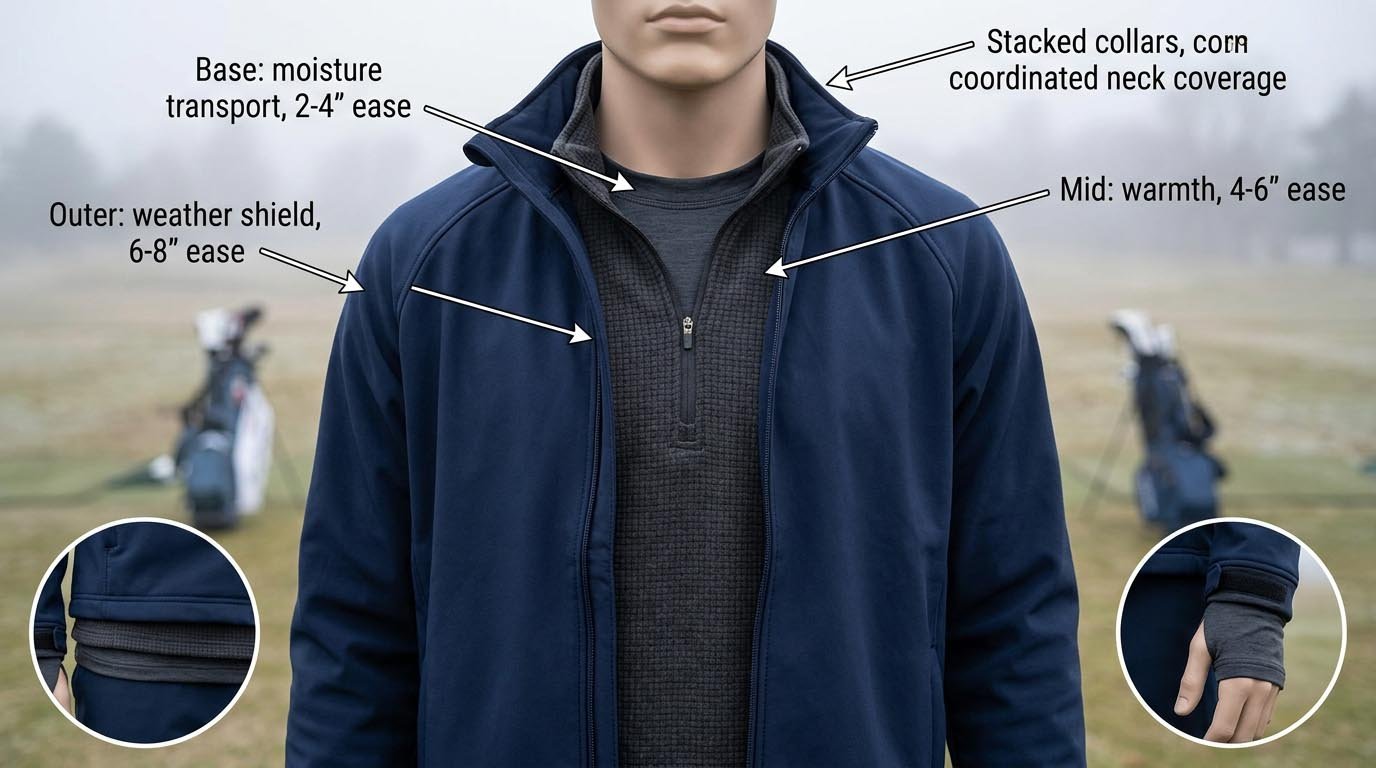
Engineer winter golf layering through coordinated three-layer system—base layer prioritizing moisture transport (merino or synthetic thermal at 180-220 GSM, snug fit 2-4 inches ease), mid-layer maximizing warmth-to-weight (brushed/grid fleece at 280-320 GSM, standard fit 4-6 inches ease), and outer layer providing weather protection (softshell at 320-360 GSM, relaxed fit 6-8 inches ease)—with fit grades ensuring each layer accommodates the next without compression or excess bulk, because independent piece design creates restriction when layered (40-45% of client winter systems fail from poor fit coordination).
Layering system design is where most winter golf lines fail. Brands design each piece beautifully in isolation, then discover customers cannot layer them properly—leading to complaints about sizing inconsistency and poor fit.
Base Layer: The Foundation
Base layer role:
Primary functions:
- Moisture management: Move sweat away from skin
- First warmth layer: Light insulation for active play
- Comfort layer: Against-skin softness for 4-5 hour wear
NOT providing:
- Heavy insulation (mid-layer's job)
- Weather protection (outer layer's job)
Base layer fabric specifications:
For active winter golf (5-15°C):
Fabric type: Lightweight merino blend or synthetic thermal
- Weight: 180-220 GSM
- Composition: 50-70% merino + 25-40% polyester + 5-8% elastane OR 90-95% polyester + 5-10% elastane
- Stretch: 4-6% elastane (15-20% extension)
- Cost: $9-14 per meter (merino), $5.50-8.00 per meter (synthetic)
For cold winter golf (0-5°C):
Fabric type: Midweight merino blend or brushed thermal
- Weight: 220-260 GSM
- Provides: More warmth while maintaining moisture management
- Cost: $11-16 per meter (merino), $6.50-9.00 per meter (synthetic)
Base layer fit specification:
Fit type: Snug but not compressive
Ease allowance:
- Chest: 2-4 inches over body measurement
- Waist: 2-3 inches
- Sleeve: Close-fitting (no excess fabric)
Why this fit:
- Close to skin: Maximizes moisture-wicking efficiency
- Not tight: Avoids compression discomfort during 4-5 hours
- Allows mid-layer: Next layer slides on easily without pulling base layer
Base layer construction details:
Collar height:
- Mock neck (8-10cm) or crew neck (6-8cm)
- Not full collar: Base layer stays under mid-layer
Sleeve length:
- Long sleeve with thumb holes (optional)
- Prevents ride-up when layering
Hem length:
- Extended back hem (+2-3 inches vs front)
- Stays tucked during bending and swinging
Mid-Layer: The Warmth Core
Mid-layer role:
Primary functions:
- Insulation: Primary warmth source
- Breathability: Allow moisture to pass through from base
- Versatility: Can wear as outer layer in mild conditions or mid-layer in cold
Mid-layer fabric specifications:
For moderate cold (5-10°C as outer, 0-5°C as mid):
Fabric type: Brushed fleece or grid-back fleece
- Weight: 280-320 GSM
- Stretch: 6-8% elastane (25-30% extension)
- Breathability: MVTR 8,000-12,000 g/m²/24hr
- Cost: $7-11 per meter (brushed), $9-14 per meter (grid-back)
For cold conditions (below 5°C):
Fabric type: Heavyweight fleece or insulated layer
- Weight: 340-380 GSM fleece OR 60-80 gram synthetic fill
- Provides: Maximum warmth for extreme cold
- Cost: $10-15 per meter (fleece), $12-18 per meter (insulated)
Mid-layer fit specification:
Fit type: Standard/relaxed
Ease allowance:
- Chest: 4-6 inches over body (accommodates base layer underneath)
- Shoulders: Slightly dropped (allows layering without pulling)
- Sleeves: Adequate room for base layer sleeves inside
Why this fit:
- Fits over base comfortably: No pulling or bunching
- Allows outer layer: Next layer can fit over without compression
- Maintains mobility: Not so loose it bunches or restricts
Mid-layer construction details:
Collar:
- 1/4 zip or 1/2 zip (most versatile)
- Stand collar (9-11cm) protects neck when zipped
- Can layer under outer: Collar height works under outer layer collar
Sleeve design:
- Raglan or articulated (eliminates shoulder seam restriction)
- Cuff: Elastic or adjustable (seals warmth, fits under outer layer)
Hem:
- Elastic hem or adjustable drawcord
- Straight cut (works well under outer layers)
Pocket placement:
- Side hand pockets (accessible when worn as outer layer)
- Chest pocket (useful for accessories)
Outer Layer: Weather Protection
Outer layer role:
Primary functions:
- Wind blocking: Prevent convective heat loss
- Water resistance: Handle light rain/drizzle
- Breathability: Allow moisture from inner layers to escape
- Durability: Protect inner layers from abrasion
Outer layer fabric specifications:
For standard winter golf:
Fabric type: Softshell (bonded 3-layer)
- Weight: 320-360 GSM
- Wind resistance: 95-98%
- Water resistance: 10,000-15,000mm
- Breathability: 10,000-14,000 g/m²/24hr MVTR
- Stretch: 4-6% elastane (15-25% extension)
- Cost: $11-16 per meter
For extreme weather:
Fabric type: Insulated softshell or waterproof shell
- Insulated: Softshell with 40-60g fill in core
- Waterproof: 15,000-20,000mm with sealed seams
- Trade-off: Reduced breathability (8,000-10,000 MVTR)
- Cost: $14-22 per meter
Outer layer fit specification:
Fit type: Relaxed
Ease allowance:
- Chest: 6-8 inches over body (accommodates base + mid layers)
- Shoulders: Dropped shoulder or raglan (room for layering bulk)
- Sleeves: Roomy (fits over two inner sleeve layers)
Why this fit:
- Accommodates full system: Base + mid + outer without compression
- Allows movement: Despite 3-layer bulk, maintains swing freedom
- Layering flexibility: Can wear over just base (skip mid) in milder days
Outer layer construction details:
Collar:
- High stand collar (11-13cm) for wind protection
- Full or 1/2 zip (ventilation control)
- Collar fits over mid-layer: Tall enough to protect when mid-layer collar underneath
Sleeve design:
- Raglan mandatory (eliminates 3-layer seam bulk at shoulders)
- Adjustable cuffs (seals out wind, fits over inner layer cuffs)
- Extended length (covers hands if needed)
Hood (optional):
- Removable or stowable (flexibility)
- Large enough to fit over hat or cap
Ventilation:
- Pit zips (rapid heat dump)
- Back vents (continuous air flow)
- Long front zip (primary temperature control)
Fit Coordination Testing Protocol
How to verify layering system works:
Physical layer testing:
-
Dress mannequin: Put all three layers on mannequin form
-
Check each layer:
- Base layer: Not pulling or bunching under mid
- Mid-layer: Not compressed by outer, collar accessible
- Outer layer: Not stretched tight, moves freely
-
Movement simulation: Raise mannequin arms to simulate backswing position
- Check for: Pulling, restriction, fabric stacking at stress points
-
If any restriction: Adjust fit grades before production
Wear testing:
Provide samples to 3-5 testers:
- Layer all three pieces as designed
- Play 9-18 holes in target temperature conditions
- Report: Restriction points, temperature comfort, ability to add/remove layers mid-round
Common failures and fixes:
Problem: Mid-layer too snug, can't fit over proper base layer
Fix: Increase mid-layer chest ease by +1-2 inches
Problem: Outer layer sleeves too narrow, can't fit over mid-layer sleeves
Fix: Increase outer sleeve width by +1 inch, use raglan pattern
Problem: Collar stacking, all three collars fighting for space at neck
Fix: Grade collar heights: Base 6-8cm, Mid 9-11cm, Outer 11-13cm
Problem: Hemlines conflicting, layers bunching at waist
Fix: Vary hem lengths: Base longest (tucks in), Mid medium, Outer shortest (outer layer)
Layering System Cost Structure
For complete winter golf layering system:
Component costs (per piece, 1,000-piece production):
Base layer (merino blend, 200 GSM):
- Fabric: $10.50 per meter
- Total cost: $16-22 per piece
- Retail target: $65-95
Mid-layer (grid-back fleece, 300 GSM, 1/4 zip):
- Fabric: $11.00 per meter
- Total cost: $22-30 per piece
- Retail target: $85-130
Outer layer (softshell, 340 GSM, full zip, pit zips):
- Fabric: $14.00 per meter
- Total cost: $35-48 per piece
- Retail target: $140-200
Total system cost: $73-100 per complete 3-piece set
Total system retail: $290-425
Cost allocation recommendation:
For premium winter line:
- Invest in quality base layer (merino)—foundation matters
- Use grid-back fleece mid-layer—customer notices warmth-to-weight
- Spec premium softshell outer—weather protection is customer-facing performance
For mid-tier winter line:
- Use synthetic thermal base (cost savings $3-5 per piece)
- Use brushed fleece mid (cost savings $2-4 per piece)
- Use standard softshell outer (adequate performance)
- Total savings: $8-13 per set while maintaining functional performance
FAQ: Winter Golf Fabrics and Cold-Weather Layering
Q: Is merino wool actually necessary for winter golf base layers or can synthetic thermal knits perform equally well?
A: Merino provides three distinct advantages over synthetics—natural temperature regulation across 10-15°C swings (synthetic base layers feel adequate during walking but overheat during swings), multi-day odor resistance (can wear 2-3 rounds before washing vs synthetic requiring wash after each round), and comfort when damp (merino absorbs up to 30% moisture weight without feeling wet, synthetic feels clammy at 10-15% moisture).
Cost-performance analysis:
- Merino blend base layer: $16-22 production cost, $75-95 retail
- Synthetic thermal base: $12-17 production cost, $55-75 retail
- Price premium: $4-5 per piece, $15-25 retail
When merino justifies premium:
- Premium positioning ($85+ retail collections)
- Multi-day tournament customers (odor control benefit)
- Temperature variability markets (morning 5°C, afternoon 15°C)
- Brand story emphasizing natural performance materials
When synthetic adequate:
- Mid-tier positioning ($55-85 retail)
- Single-round use (customer washes after each wear anyway)
- Consistent cold markets (less temperature regulation needed)
- Cost-conscious customers prioritizing price over premium materials
Performance difference in actual use: 60-70% of winter golfers report noticeable comfort advantage with merino in wear testing, but 25-30% find synthetic adequate for their needs—customer sensitivity varies.
Q: How do I determine the right GSM weight for mid-layer fleece across different temperature ranges?
A: Match fleece weight to lowest temperature in target range—280-300 GSM brushed fleece for 5-10°C as standalone or 0-5°C as mid-layer, 320-340 GSM for 0-5°C standalone or -5 to 0°C mid-layer, 360-380 GSM for below 0°C as mid-layer or extreme cold standalone—but construction type (solid vs brushed vs grid-back) matters equally to GSM.
GSM alone insufficient—must specify construction:
- 300 GSM solid fleece = warmth level X
- 280 GSM brushed fleece = warmth level X (20 GSM lighter, same warmth)
- 260 GSM grid-back fleece = warmth level X (40 GSM lighter, same warmth)
Decision framework by temperature:
10-15°C play (mild winter):
- 260-280 GSM grid-back (worn as outer layer)
- OR skip mid-layer, use insulated vest over base
5-10°C play (moderate cold):
- 280-320 GSM brushed fleece (versatile—outer in mild, mid in cold)
- Most popular winter golf fleece weight
0-5°C play (cold):
- 320-360 GSM brushed or grid-back (worn as mid under softshell)
- OR 280-300 GSM with 40-60g insulated vest (hybrid approach)
Below 0°C play (extreme cold):
- 360-380 GSM heavy fleece OR insulated mid-layer (60-80g fill)
- Mandatory outer shell with wind protection
Cost context:
- +20 GSM weight = +$0.40-0.80 per meter fabric cost
- Brushed vs solid (same GSM) = +$0.80-1.50 per meter
- Grid-back vs brushed = +$1.50-3.00 per meter
Better to invest in construction upgrade (brushed → grid-back) than excessive GSM—get same warmth at lower weight, improving mobility and packability.
Q: What's the real difference between softshell and waterproof shells for winter golf outer layers?
A: Softshells prioritize breathability (10,000-14,000 g/m²/24hr MVTR) and stretch (15-25% extension) for active play, handling 90% of winter golf weather (dry cold, wind, light drizzle), while waterproof shells prioritize rain protection (15,000-20,000mm rating) at cost of breathability (drops to 8,000-10,000 MVTR) and mobility (stiffer construction)—relevant in <10% of playing conditions (moderate-heavy rain).
Weather condition coverage:
Softshell (10,000-15,000mm water resistance, 12,000 MVTR):
- Dry cold: ✓ Excellent (blocks wind, breathes well)
- Wind: ✓ Excellent (95-98% wind blocking)
- Light drizzle (5-15 minutes): ✓ Adequate (DWR coating repels)
- Moderate rain (>20 minutes): ✗ Penetrates eventually
- Heavy rain: ✗ Inadequate
Waterproof shell (18,000mm rating, 9,000 MVTR):
- Dry cold: △ Adequate but traps moisture from activity
- Wind: ✓ Excellent (100% wind blocking)
- Any rain duration: ✓ Excellent (fully waterproof)
- Active play breathability: ✗ Moisture buildup inside (complaint rate 18-24%)
Customer complaint patterns:
Softshell complaints (8-12% rate):
- "Got wet in sustained rain" (accurate—working as designed)
- "Wind protection excellent"
- "Comfortable during play"
Waterproof shell complaints (16-22% rate):
- "Sweaty inside even in cold weather" (moisture trapped)
- "Feels stiff during swing" (limited stretch)
- "Never rains enough to need this" (over-spec'd for conditions)
Recommendation:
- Softshell as primary outer layer ($140-200 retail)
- Waterproof shell as dedicated rain jacket ($160-240 retail, sold separately)
- Don't try to make softshell "fully waterproof"—creates breathability problems
Market split: 70-80% of winter golf customers benefit more from softshell versatility, 20-30% need dedicated waterproof shell (wet-climate markets).
Q: How much elastane do winter golf layers actually need and where should it be placed?
A: Base layers need 4-6% elastane (provides 15-20% extension, adequate for body movement), mid-layers need 6-8% (provides 25-30% extension, compensates for multi-layer restriction), outer layers need 4-6% (15-25% extension, pattern engineering handles rest)—higher elastane (>10%) increases cost (+$2.20-3.50 per piece) while reducing insulation (tighter knit = less trapped air) without proportional mobility benefit in winter's multi-layer context.
Elastane function by layer:
Base layer (4-6% elastane):
- Performance: 15-20% extension (adequate for body-hugging fit)
- Compression: Minimal (comfortable for 4-5 hour wear)
- Cost impact: +$0.80-1.40 per meter
- Why not more: Base layer not primary restriction point when layered
Mid-layer (6-8% elastane):
- Performance: 25-30% extension (handles cumulative strain from base underneath, outer on top)
- Warmth trade-off: Acceptable—fleece structure maintains trapped air despite tighter knit
- Cost impact: +$1.20-2.00 per meter
- Why this range: Highest stretch requirement—mid-layer is squeezed between other layers
Outer layer (4-6% elastane):
- Performance: 15-25% extension (adequate—other layers underneath provide primary mobility)
- Softshell limitation: Bonded membrane restricts stretch regardless of elastane
- Cost impact: Included in softshell construction ($11-16 per meter total)
- Why not more: Pattern engineering (raglan sleeves, gussets) more effective than higher elastane
Zone-specific elastane (advanced approach):
High-stretch zones (8-10% elastane):
- Shoulders/upper back
- Underarms
- Side torso
Moderate zones (4-6% elastane):
- Front/back torso
- Sleeves
Low zones (2-4% elastane or none):
- Collar/cuffs
- Hem
Cost: +$2.50-4.00 per piece for zoned construction vs uniform elastane
When zoning justifies cost:
- Premium positioning ($95+ retail)
- Can communicate technical feature in marketing
- Athletic customers valuing maximum mobility
When uniform elastane adequate:
- Mid-tier ($65-95 retail)
- Cost control priority
- Standard recreational play
Q: What should I look for in fabric specs to ensure a layering system won't cause overheating during active play?
A: Verify all three layers meet minimum breathability targets—base layer >10,000 g/m²/24hr MVTR, mid-layer >8,000 MVTR, outer layer >10,000 MVTR—because single low-breathability layer creates bottleneck trapping moisture from all layers, and specify ventilation features (underarm zips +$1.50-2.50 per piece, longer front zips +$0.80-1.50) that allow rapid heat dump during temperature swings common in winter rounds (8-12°C variance morning to afternoon).
The breathability chain concept:
Moisture must escape through all three layers sequentially:
- Base layer wicks moisture from skin
- Moisture passes through mid-layer
- Moisture escapes through outer layer to atmosphere
If any layer has low MVTR—entire system fails.
Example failure pattern:
System A (poor):
- Base: Merino, MVTR 12,000 ✓
- Mid: Grid fleece, MVTR 11,000 ✓
- Outer: Cheap waterproof shell, MVTR 6,000 ✗ BOTTLENECK
Result: Moisture trapped between mid and outer—players report "damp feeling inside shell" even though base and mid are working correctly.
System B (good):
- Base: Merino, MVTR 12,000 ✓
- Mid: Grid fleece, MVTR 11,000 ✓
- Outer: Quality softshell, MVTR 12,000 ✓ NO BOTTLENECK
Result: Moisture escapes continuously—dry comfort throughout round.
Verification protocol:
Request from supplier:
- MVTR test reports (ISO 11092 or ASTM E96) for each fabric
- Verify numbers meet targets before production
- Reject fabrics testing below 8,000 MVTR for active winter golf
Testing reality:
- Budget "winter performance fabrics": 30-40% test below 8,000 MVTR when verified
- Quality suppliers: Provide test reports showing compliant MVTR
Ventilation features (active heat dump):
Underarm pit zips (outer layer):
- Function: Rapid cooling when overheating
- Size: 15-20cm zippers each side
- Cost: +$1.50-2.50 per piece
- Essential for: Variable temperature play (morning 5°C, afternoon 15°C)
Longer front zips:
- Full zip vs 1/4 zip: Additional 20-30cm opening
- Function: Primary temperature control
- Cost: +$0.80-1.50 (longer zipper)
- Recommendation: Mid and outer layers should have minimum 1/2 zip
Back vents (outer layer):
- Function: Continuous passive cooling (hot air rises, escapes)
- Cost: +$0.80-1.40 per piece
- When useful: Active players, mild-cold conditions (5-10°C)
Overheating prevention strategy:
- Specify high-MVTR fabrics in all layers (prevents passive buildup)
- Add ventilation zips to outer layer (allows active cooling)
- Customer education: Explain layering adjustability (start cool, warm up during play)
Q: How do I coordinate fit across base, mid, and outer layers so they layer properly without restriction?
A: Grade fit ease systematically—base layer 2-4 inches chest ease (snug moisture management), mid-layer 4-6 inches ease (accommodates base underneath), outer layer 6-8 inches ease (fits over both layers)—and physically test by layering all three pieces on mannequin checking for pulling, bunching, or restriction before production, because 40-45% of client winter layering systems fail from poor fit coordination when pieces designed in isolation rather than as coordinated system.
Fit grading framework:
| Layer | Chest Ease | Shoulder Construction | Sleeve Fit | Cost Impact |
|---|---|---|---|---|
| Base | 2-4" (snug) | Set-in or raglan (optional) | Close-fitting | Baseline |
| Mid | 4-6" (standard) | Raglan or articulated (recommended) | Relaxed | +$1.00-1.60 |
| Outer | 6-8" (relaxed) | Raglan (mandatory) | Roomy | +$1.20-1.80 |
The 2-inch ease progression rule:
Each successive layer adds approximately 2 inches chest ease:
- Base 38" chest → Body measurement 36" = 2" ease
- Mid 42" chest → Over base layer 40" = 2" ease
- Outer 46" chest → Over mid layer 44" = 2" ease
This progression ensures:
- No compression when layering
- No excess bulk (too much ease)
- Smooth layering without pulling/bunching
Pattern requirements for layered fit:
Base layer:
- Standard patterns work (close-fitting by design)
- Optional: Extended back hem (+2-3") for tucking
Mid-layer (critical adjustment zone):
- Raglan or articulated sleeves (eliminates shoulder seam bulk point)
- Larger armhole (accommodates base layer sleeves)
- Graded collar (9-11cm—taller than base, shorter than outer)
- Cost: +$1.00-1.80 per piece for proper mid-layer patterns
Outer layer (must accommodate all):
- Raglan sleeves mandatory (handles 3-layer seam convergence)
- Dropped shoulder (additional room for layering bulk)
- Wide sleeve opening (fits over two inner layers)
- Tall collar (11-13cm—covers all layer collars)
- Cost: +$1.50-2.50 per piece for proper outer-layer patterns
Physical layering test protocol:
Before production:
-
Order samples of all three layers
-
Dress mannequin with all layers simultaneously
-
Check stress points:
- Shoulder seams: No pulling or bunching
- Underarms: Adequate room for movement
- Collar: Layers nest properly, not fighting for space
- Hem: Layers different lengths, not stacking
-
Movement test: Raise mannequin arms to backswing position
- Watch for: Fabric pulling, restriction, layer separation
-
If problems found:
- Adjust fit grades (+1-2" ease in problem layer)
- Modify patterns (switch to raglan, add gussets)
- Retest before committing to production
Cost of poor fit coordination:
If layers don't coordinate properly:
- Customer complaints: "Mid-layer too tight over base," "Outer won't fit over mid"
- Return rate: 12-18% for sizing inconsistency
- Damage: Brand reputation ("sizing is unpredictable")
- Lost revenue: Returns + replacements + customer service time
Cost of proper fit coordination:
- Pattern development: $200-400 for 3-piece system adjustments
- Physical sampling/testing: $300-600 (sample garments + testing time)
- Total investment: $500-1,000 prevents 12-18% return rates
ROI: Clear positive—$500-1,000 up-front saves thousands in returns and protects brand reputation.
Conclusion
Design winter golf fabric selection around layer-specific optimization rather than seeking "perfect" single material—base layers prioritize moisture management (merino or synthetic thermal 180-220 GSM, 4-6% elastane), mid-layers maximize warmth-to-breathability (brushed/grid fleece 280-320 GSM, 6-8% elastane, MVTR >8,000), outer layers balance weather protection and breathability (softshell 320-360 GSM, 95-98% wind resistance, 10,000-15,000mm water resistance, MVTR >10,000)—with systematic fit coordination (2-4" ease base, 4-6" ease mid, 6-8" ease outer) and physical layering tests before production preventing 40-45% failure rate from poor system integration.