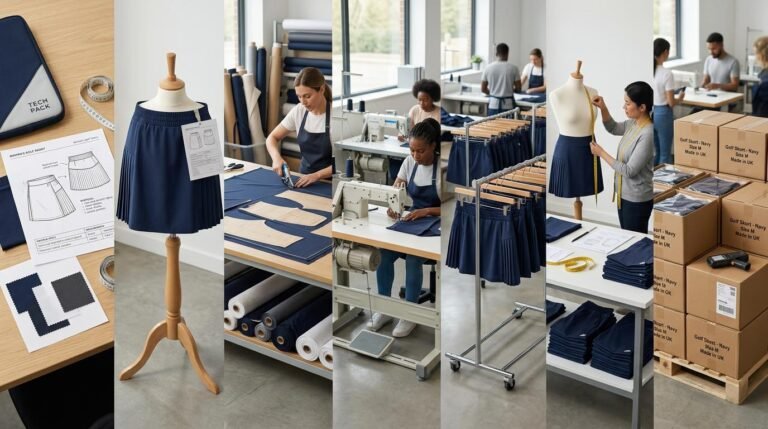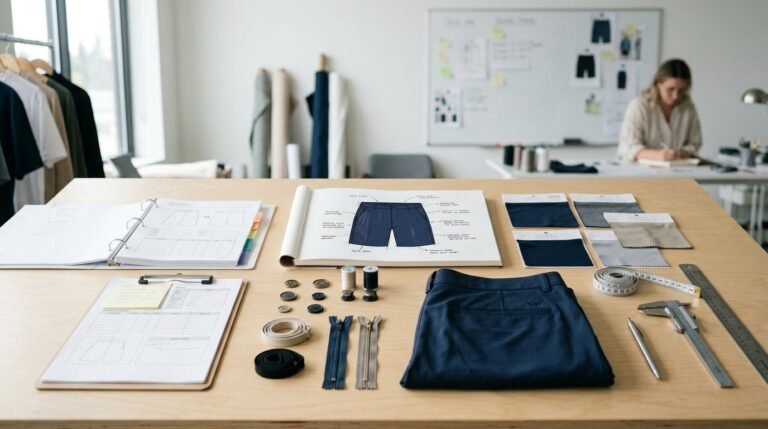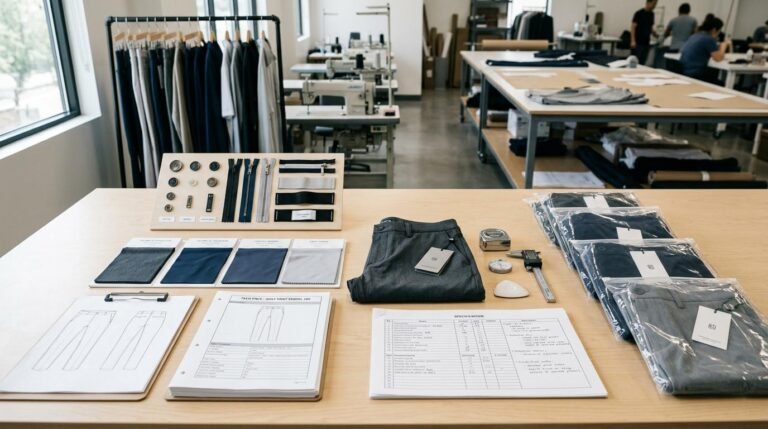
Launching a golf apparel brand is not just a design exercise. It is a planning problem shaped by budget, MOQ, SKU count, timeline, and inventory risk.
One new brand came to me with an ambitious first collection plan:
- 12 styles
- 8 colors
- 5 sizes
- 480 SKUs
- 1,200 total pieces
- $45,000 total budget
- 6-month launch target
On paper, it looked exciting. In production, it was not workable.
The issue was not creativity. The issue was structure.
With 12 styles at 100 pieces each, the order volume per style was too low to support efficient production. Sampling and development costs were too high. Inventory depth per SKU was too thin. Shipping would be fragmented. There was no budget left for delays, revisions, or mistakes.
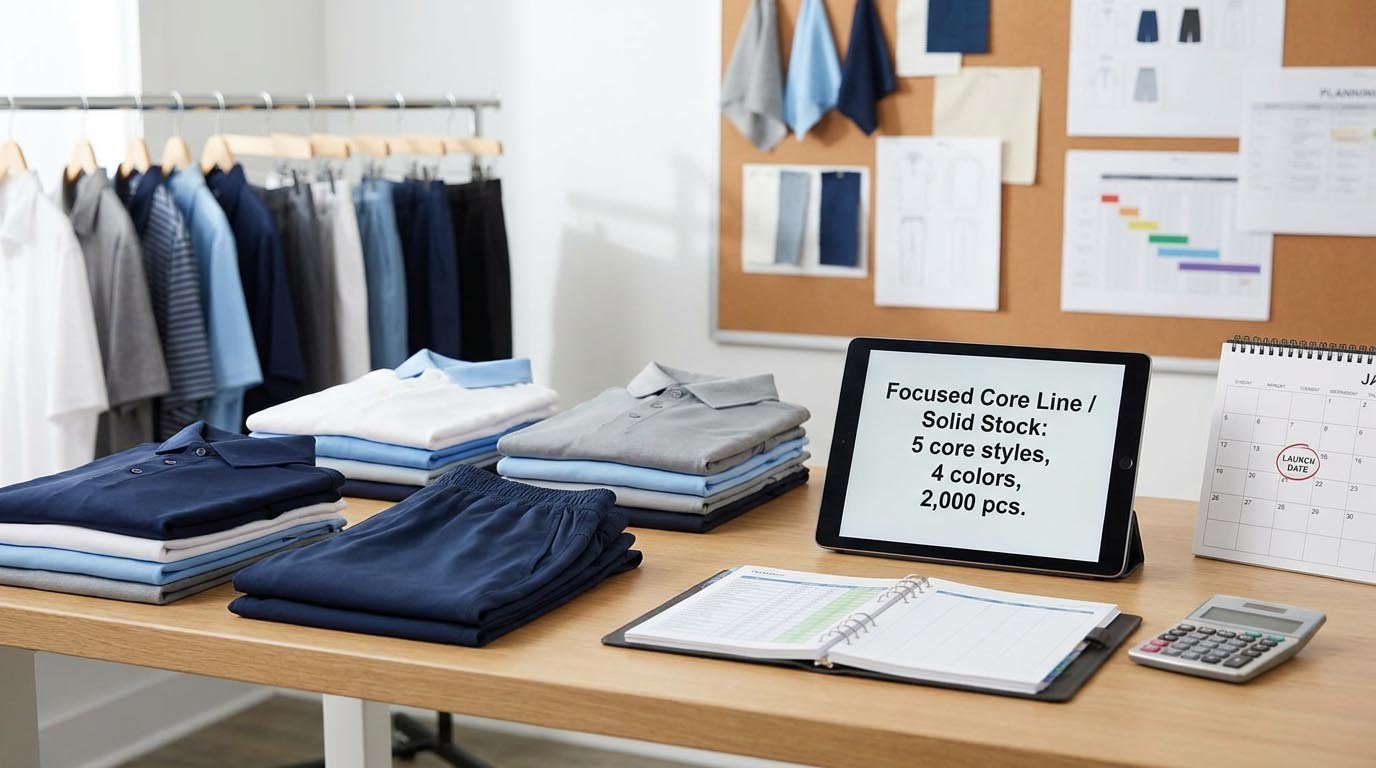
We rebuilt the plan into:
- 5 core styles
- 4 colors
- 5 sizes
- 2,000 total pieces
- stronger per-style volume
- lower development waste
- better production economics
The result was a cleaner launch, more useful inventory, and a line the brand could actually sell and reorder.
That is the core lesson of golf apparel product line planning:
A strong first collection is not the one with the most styles. It is the one that can actually be developed, produced, sold, and reordered profitably.
I’m Will from FUWAY. Over the past 15 years, I’ve worked with more than 150 new brands developing golf apparel collections. In this guide, I’ll show you how to plan a golf apparel product line that is realistic to produce, easier to launch, and more likely to generate useful sales data.
Quick Answer: How to Plan a Golf Apparel Product Line
If you are launching your first golf apparel collection, the safest structure for most new brands is:
- 4 to 6 core styles
- 3 to 4 colors per style
- 4 to 5 sizes
- 1,500 to 3,000 total pieces
- 300 to 500 pieces per style
- 7 to 9 months from planning to retail
- $55,000 to $70,000 total starting budget for a well-executed first collection
For most new brands, that usually means starting with:
- 3 golf polos
- 1 or 2 shorts or trousers
- optional 1 lightweight outerwear piece only if budget and timeline allow
This structure works because it helps you:
- stay closer to factory MOQ requirements
- control sampling and development costs
- avoid SKU fragmentation
- hold meaningful inventory per SKU
- test demand with real sales data
- place more economical reorders if styles perform well
Key takeaway:
A successful first golf apparel line is usually narrow and deep—not broad and thin.
Why Most First Golf Apparel Line Plans Fail
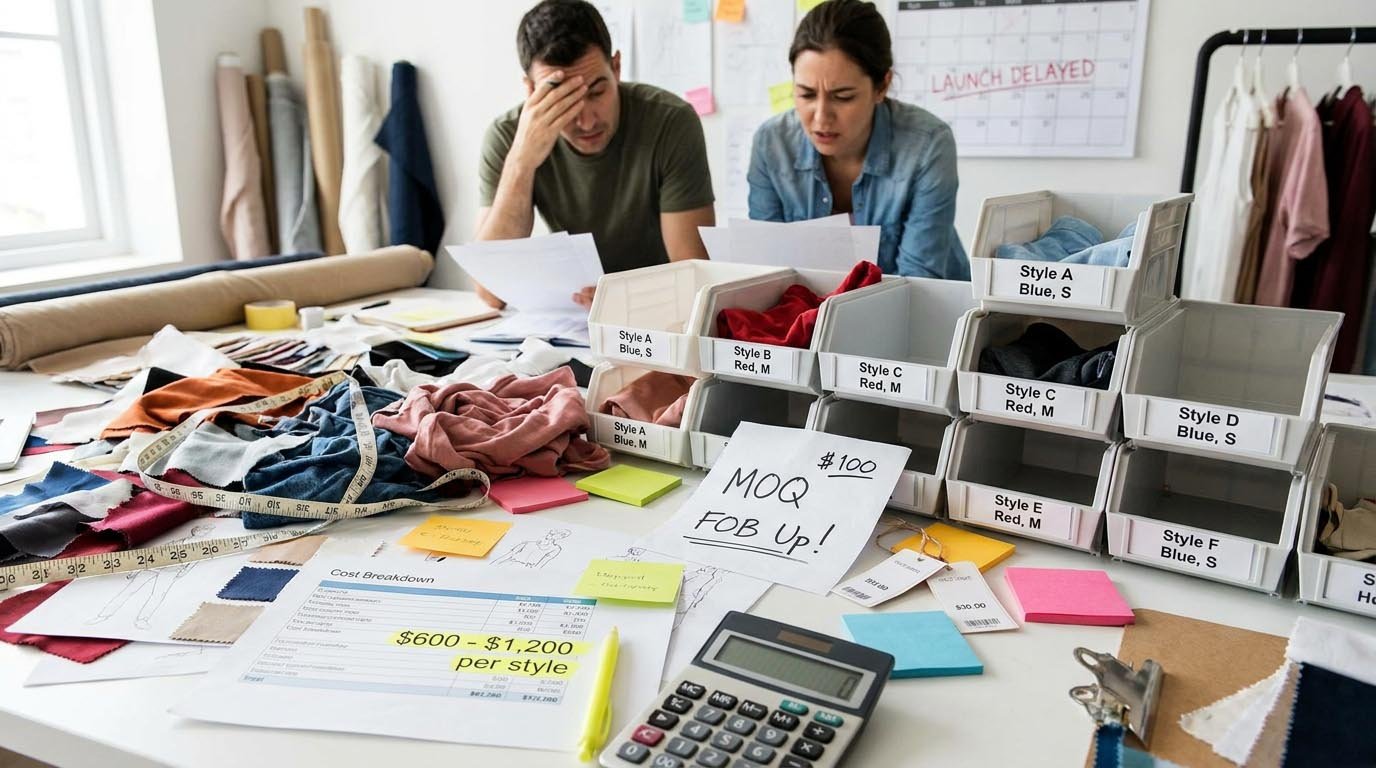
Most first-time founders do not fail because they lack ideas. They fail because they treat style count, color count, size range, order volume, and budget like separate decisions.
They are not separate. They are connected.
A typical first draft often looks like this:
- 10 to 12 styles
- 4 to 8 colors
- 5 to 6 sizes
- 1,000 to 1,500 total pieces
- launch in 4 to 6 months
On paper, this looks flexible. In production, it usually creates three immediate problems.
1. Development costs rise too quickly
Each style carries independent development cost, including:
- initial samples
- revision samples
- pattern adjustments
- fit review
- trim work
- tech pack support if outsourced
For many first collections, real development cost lands around:
$600 to $1,200 per style
| Style Count | Estimated Development Cost |
|---|---|
| 4 styles | $2,400-$4,800 |
| 6 styles | $3,600-$7,200 |
| 10 styles | $6,000-$12,000 |
| 12 styles | $7,200-$14,400 |
The more styles you launch, the more budget disappears before bulk production begins.
2. MOQ pressure increases your FOB
Most factories want meaningful order volume per style. In many golf apparel programs, the practical range is:
- 300 to 500 pieces per style
- and in some cases, higher depending on color and fabric setup
If you spread a small budget across too many styles, factories often respond with:
- higher FOB prices
- less flexibility
- slower approvals
- lower priority in production
3. Inventory becomes too fragmented to learn from
Every additional color and size multiplies SKU count.
If you launch:
- 8 styles
- 4 colors each
- 5 sizes
You already have:
160 SKUs
If your total order is 1,600 pieces, average depth is only:
10 pieces per SKU
That is too thin to:
- test demand properly
- maintain size runs
- identify best sellers clearly
- reorder efficiently
Practical lesson:
Your first collection should be designed for operational clarity, not maximum variety.
Step 1: Define Your Brand Positioning and Price Tier
Before deciding how many styles to launch, decide what level of golf apparel you are actually building.
This matters because positioning determines:
- your fabric budget
- trim level
- fit expectations
- factory type
- acceptable FOB target
- realistic retail range
A simple positioning framework
Entry tier
- Retail: $45-$65
- Typical FOB target: $16-$24
- Best for:
- basic performance polos
- stock fabrics
- simple construction
- lower-risk first launches
Mid-market tier
- Retail: $60-$85
- Typical FOB target: $22-$32
- Best for:
- most new golf apparel brands
- performance-led products
- improved fit and trims
- practical MOQ programs
Premium tier
- Retail: $95-$150
- Typical FOB target: $35-$50
- Best for:
- luxury hand-feel
- higher-end trims
- more refined construction
- stronger brand budgets
The mistake many new brands make
Many founders want premium positioning while budgeting at a mid-market level.
That creates a mismatch between:
- what customers expect
- what the product delivers
- what the retail price asks them to pay
If your FOB budget is around $22 to $28, you are usually building a solid mid-market golf product, not a true luxury one.
Key takeaway:
Positioning is not a slogan. It is the alignment between your retail price, your FOB budget, and the quality your customer receives.
Step 2: Choose the Right Number of Styles for Your First Collection
For most new brands, the best starting point is:
4 to 6 total styles
That is enough to look like a real collection without spreading budget, time, and inventory too thin.
Recommended style mix for most first launches
A practical first golf apparel line usually includes:
- 3 polos
- 1 short
- 1 trouser or second short
- optional 1 lightweight layering piece
This works better than launching too much outerwear early, because outerwear usually requires:
- higher FOB cost
- more complex construction
- longer development time
- greater seasonal risk
Why 4 to 6 styles is the sweet spot
With 4 to 6 styles, you can usually:
- manage development cost better
- place stronger orders per style
- reduce factory resistance
- simplify quality control
- test category demand more clearly
- reorder strong performers more efficiently
Style count by total order volume
| Total Order Volume | Recommended Style Count | Pieces per Style |
|---|---|---|
| 1,000-1,500 pcs | 3-5 styles | 250-400 pcs |
| 1,500-2,500 pcs | 4-6 styles | 300-500 pcs |
| 2,500-3,500 pcs | 5-7 styles | 350-600 pcs |
Rule of thumb:
If your total order is under 2,000 pieces, launching more than 6 styles usually creates avoidable cost pressure and weak inventory depth.
Step 3: Control SKU Count Before It Controls Your Budget
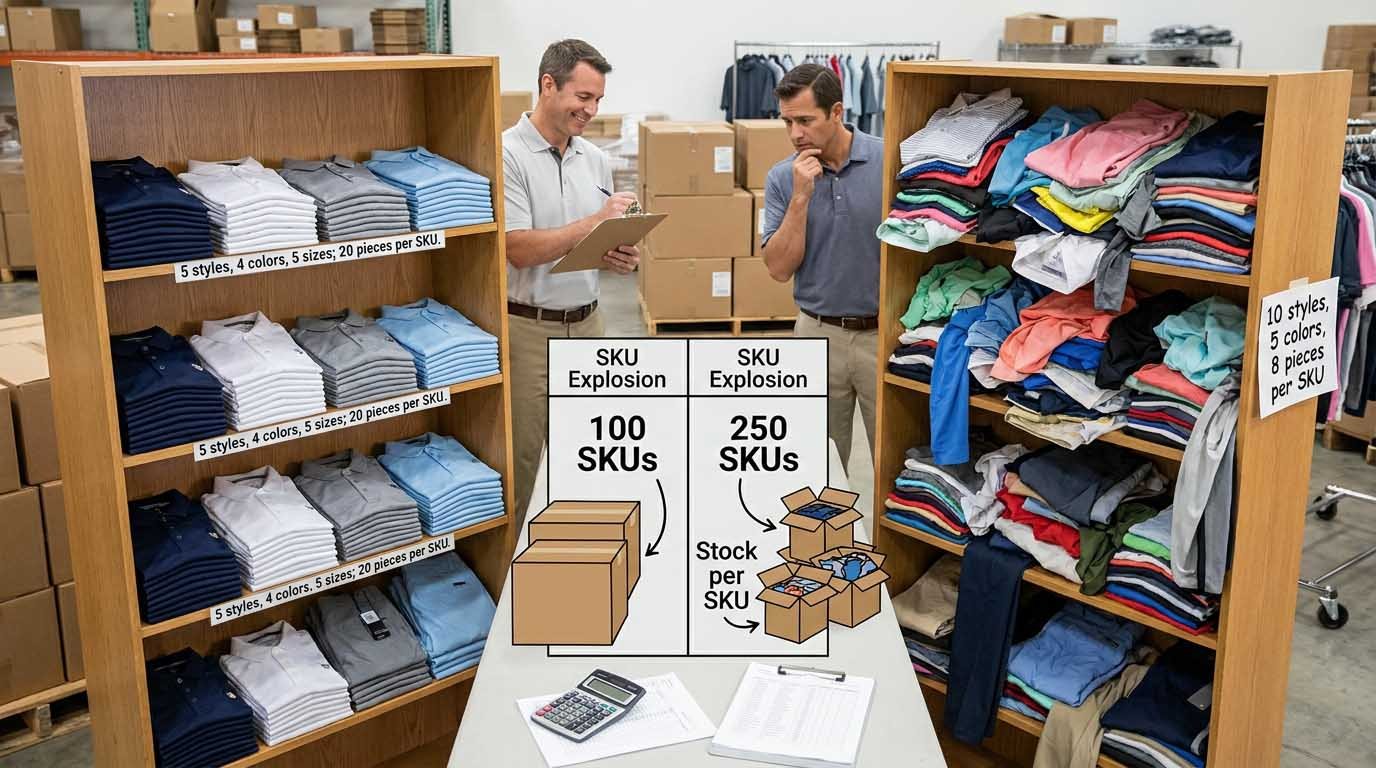
One of the fastest ways to damage a first collection is to create too many SKUs.
A SKU is the combination of:
- style
- color
- size
Even a simple line can become operationally difficult if every style comes in too many colors and too many sizes.
Example of SKU expansion
If you launch:
- 5 styles
- 4 colors
- 5 sizes
You create:
100 SKUs
If you order 2,000 pieces total, average inventory depth becomes:
20 pieces per SKU
That is workable.
But if you launch:
- 10 styles
- 5 colors
- 5 sizes
You create:
250 SKUs
At the same 2,000 total pieces, average depth falls to:
8 pieces per SKU
That is not enough for reliable sell-through analysis or economical reorders.
Better first-launch SKU logic
For most new brands, a better structure is:
- fewer styles
- fewer colors
- stronger depth per SKU
Recommended target:
60 to 120 total SKUs for a first collection
That gives customers enough choice without turning inventory into confusion.
Key takeaway:
Customer choice matters, but not as much as having enough stock depth to learn what actually sells.
Step 4: Build a Realistic Budget for Development and Production
Many first-time founders underestimate development cost and overestimate how much product their budget can support.
A realistic first collection budget should include four buckets:
- development
- production
- shipping and duties
- contingency
Typical budget allocation
For many first golf apparel collections:
- 10-15% development
- 65-70% production
- 10-12% shipping and duties
- 8-10% contingency
Example: $60,000 first-collection budget
| Budget Area | Estimated Amount |
|---|---|
| Development | $6,000-$8,000 |
| Production | $39,000-$42,000 |
| Shipping and duties | $6,000-$7,000 |
| Contingency | $5,000-$6,000 |
Typical development costs
Per style, expect to budget for:
- sampling: $160-$450
- revisions: $80-$300
- pattern work: $150-$350
- tech pack support: $200-$400 if outsourced
A realistic first collection usually lands around:
$5,000 to $9,000 in total development cost
especially if you have 4 to 6 styles and need at least one revision round on most of them.
Why contingency matters
Many first collections run into unplanned costs from:
- extra sample rounds
- trim changes
- fabric substitutions
- inspection problems
- shipping timing changes
- rework
If you do not hold a contingency reserve, you often solve those problems by:
- cutting styles
- lowering quality
- rushing approvals
- delaying launch
Practical rule:
Never build a first collection budget with zero buffer.
Step 5: Plan Order Volume Around MOQ and Cost Efficiency
For most new golf apparel brands, the best first production range is:
This range usually offers the best balance between:
- manageable capital risk
- factory acceptance
- more stable FOB pricing
- stronger inventory depth
- better freight efficiency
Why very small orders are expensive
If total volume is only 500 to 1,000 pieces, brands often face:
- small-order premiums
- weaker fabric pricing
- less efficient shipping
- thinner SKU depth
Why very large first orders are risky
If total volume is 5,000+ pieces, unit cost may improve, but so does your exposure:
- more capital tied up
- greater inventory risk
- higher storage cost
- bigger downside if product-market fit is weak
General volume economics
| Total Volume | Typical Result |
|---|---|
| 500-800 pcs | high unit cost, weak SKU depth |
| 1,000-1,500 pcs | workable but still cost-sensitive |
| 1,500-3,000 pcs | best balance for most new brands |
| 3,000-5,000 pcs | better pricing but higher inventory risk |
Key takeaway:
Your first order should be big enough to be efficient, but small enough to survive if demand is weaker than expected.
Step 6: Choose Categories, Colors, and Sizes Strategically
A strong first line is not just about style count. It is also about choosing the right assortment mix.
Best category mix for most first golf brands
For a first launch, I usually recommend:
- 60-70% tops
- 30-40% bottoms
- limited or no outerwear
Why?
Because:
- polos usually drive brand discovery
- bottoms help complete the outfit
- outerwear consumes development time and budget quickly
How many colors should a first collection have?
For most brands, the safest structure is:
- 3 core colors per style
- optional 4th color only for hero styles
Best starting colors are usually:
- navy
- white
- gray or black
These colors are easier to merchandise, easier to reorder, and safer for first-season demand.
How many sizes should you offer?
Most first collections do better with:
- 4 sizes: S-XL
or - 5 sizes: XS-XL
A narrower size range helps you:
- reduce SKU count
- increase depth per size
- avoid overcommitting stock to low-volume edge sizes
Example: smart first-line assortment
| Category | Styles | Colors per Style | Sizes | Result |
|---|---|---|---|---|
| Polos | 3 | 3-4 | 4-5 | core assortment |
| Shorts | 1 | 2-3 | 4-5 | supporting bottom |
| Trousers | 1 | 2 | 4-5 | completes line |
Practical lesson:
For a first launch, depth usually beats breadth.
Step 7: Keep Fabrics, Fit, and Trims Practical for a First Launch
New brands often spend too much time and money chasing custom details that customers may not notice.
A better first-launch strategy is to focus on:
- proven stock fabrics
- clean fit
- reliable construction
- selected visible trims
Stock vs custom fabric
For first collections, stock fabrics usually make more sense because they offer:
- lower development cost
- faster sampling
- easier replenishment
- lower production risk
Custom fabric development can add:
- $800-$2,500 in development cost
- 3-4 weeks in lead time
- higher MOQ pressure
- fabric price premiums
If your goal is to validate the market, stock performance fabrics are often the smarter choice.
Pattern strategy
You usually have three options:
- factory standard blocks
- modified factory blocks
- fully custom patterns
For most new brands, the best balance is:
modified factory blocks
This gives you:
- lower pattern cost
- faster development
- better fit than a stock block
- less risk than full custom development
Trim strategy
Invest where the customer notices:
- buttons
- neck labels
- logo patch or branding
- hang tags
Save on what most customers rarely notice:
- excessive packaging
- overbuilt hidden trims
- unnecessary luxury upgrades on non-visible details
Key takeaway:
In a first collection, better fit and cleaner execution usually matter more than custom fabric storytelling.
Step 8: Build a Production Timeline That Matches Reality
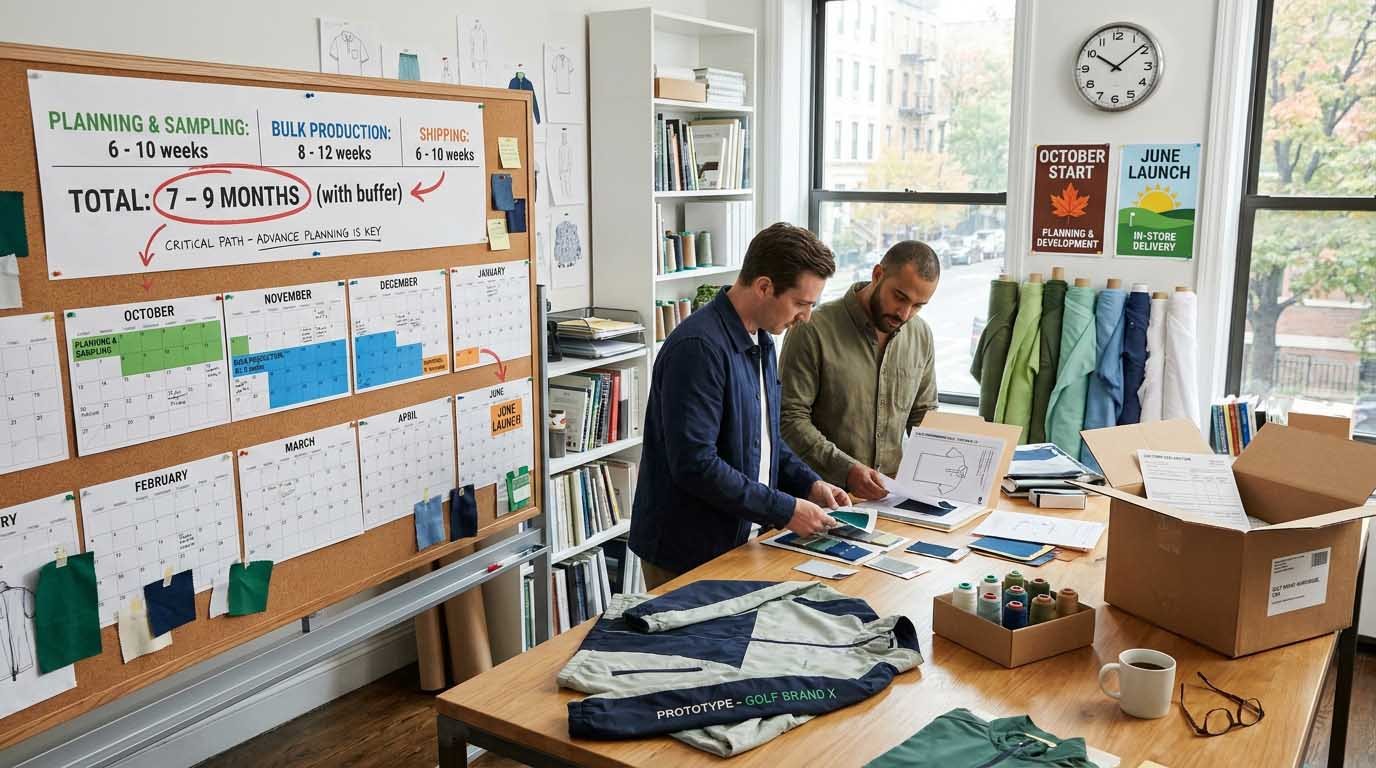
One of the biggest planning mistakes new brands make is assuming they can go from concept to retail in 4 or 5 months.
In most cases, a realistic first collection timeline is:
Typical timeline breakdown
1. Planning and sampling: 6-10 weeks
Includes:
- line planning
- tech packs
- fabric selection
- initial samples
- revisions
- final approvals
2. Bulk production: 8-12 weeks
Includes:
- fabric booking
- cutting
- sewing
- finishing
- packing
- production scheduling
3. Shipping and warehouse arrival: 6-10 weeks
Includes:
- ocean freight
- customs clearance
- domestic delivery
- warehouse receiving
Realistic launch planning
If you want product in hand for a June launch, do not start in March.
You should usually begin planning around:
October to December of the previous year
especially if:
- you are a new customer to the factory
- your collection needs revisions
- your launch date matters seasonally
Why brands underestimate timelines
Common delay points include:
- sample revisions take longer than expected
- custom colors slow fabric approval
- factory queues delay production start
- QC problems trigger rework
- freight and customs move slower than planned
Practical rule:
Work backward from your target launch date and build in buffer. Compression usually costs money.
Step 9: Use One Factory or Multiple Suppliers?
For most first golf apparel collections under 3,000 pieces, one factory is usually the better choice.
Why one factory works better early
Using one supplier gives you:
- one communication channel
- simpler sample coordination
- more unified production timing
- easier quality control
- better volume concentration with the factory
When multiple suppliers become useful
Multiple suppliers make more sense when:
- order volume is much larger
- categories are highly technical
- outerwear needs specialist construction
- you are building supply chain redundancy
For a first launch, splitting a small order across multiple factories usually creates more friction than value.
Common multi-factory problems
- timing mismatches
- split shipments
- extra coordination time
- lower leverage with each supplier
- quality inconsistency across categories
Key takeaway:
For a first collection, operational simplicity usually matters more than specialization.
Step 10: Add Quality Gates Before Bulk Production Ships
A first order should never move from sample approval to shipment without quality checkpoints.
At minimum, I recommend three quality gates.
1. Fabric inspection
Before cutting, confirm:
- shade consistency
- defect level
- fabric construction
- color approval
2. Inline inspection
At around 30-50% production completion, inspect:
- measurements
- construction quality
- collar and placket execution
- logo placement
- sewing consistency
This helps catch systemic issues before all goods are completed.
3. Final random inspection
Before balance payment and shipment, inspect:
- packed goods
- measurement tolerances
- defect rate
- labeling accuracy
- packaging and carton assortment
For first orders, third-party inspection is usually worth the cost.
Typical inspection cost:
- $250-$500 per visit
That is far cheaper than:
- receiving a defective bulk order
- missing launch timing
- damaging brand reputation
Practical rule:
Pay for prevention, not post-shipment damage control.
Recommended First Collection Structure for New Golf Apparel Brands
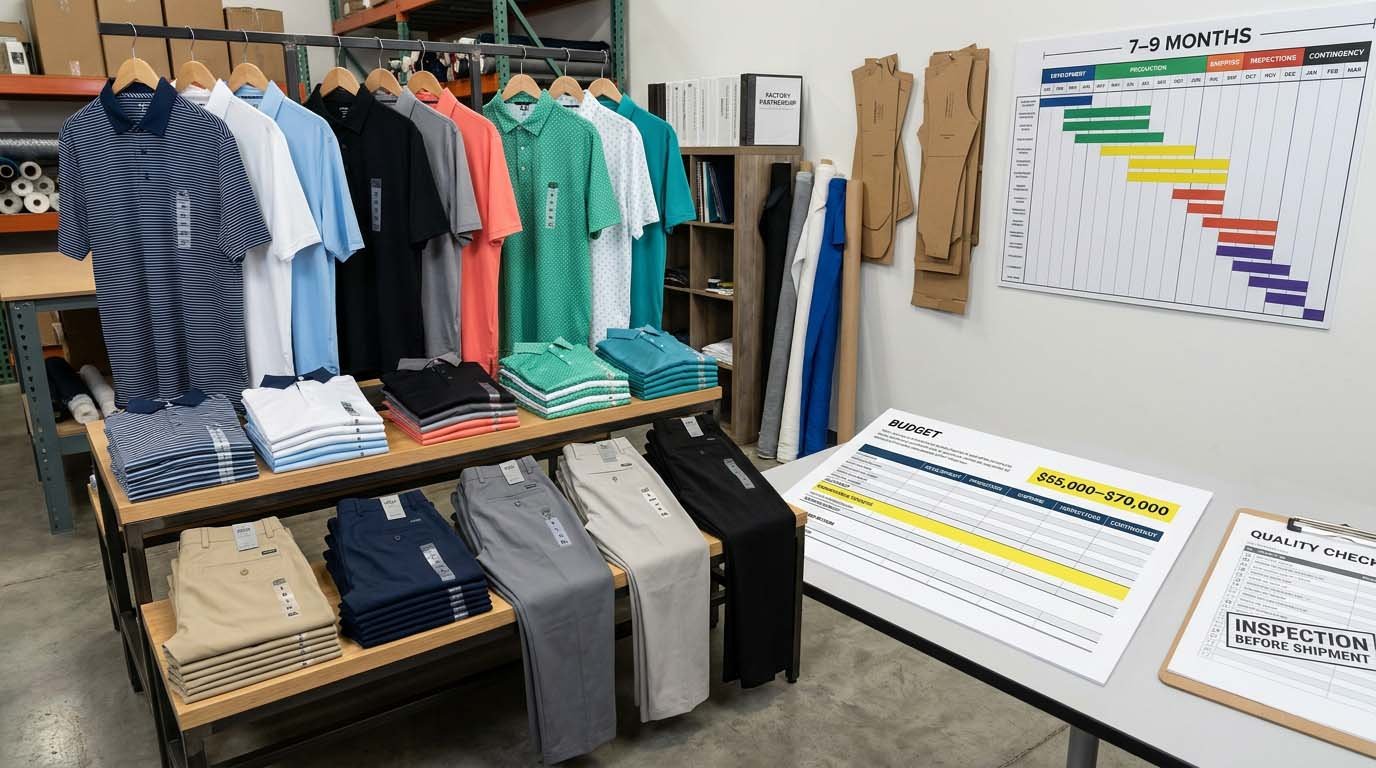
If you want a practical model to start from, here is a structure that works well for many first launches.
Recommended first collection
Product mix
- 3 polos
- 1 short
- 1 trouser
Assortment
- 3 colors per polo
- 2-3 colors per bottom
- 4-5 sizes
- 1,800 to 2,500 total pieces
Budget
- $55,000-$70,000 total
- enough for:
- development
- production
- shipping
- inspections
- contingency
Timeline
- 7-9 months
- from planning to warehouse arrival
Production strategy
- one factory
- stock performance fabrics
- modified standard patterns
- selected custom trims
- inspection before shipment
Why this structure works
It gives you:
- enough assortment to look credible
- enough volume per style to control cost
- enough inventory depth to test demand
- enough simplicity to execute well
Common Golf Apparel Line Planning Mistakes
1. Launching too many styles
More styles usually mean:
- higher development cost
- smaller orders per style
- weaker pricing
- more complexity in production and inventory
2. Offering too many colors too early
Extra colors multiply SKU count and dilute stock depth.
3. Underestimating sampling cost
Most first collections need at least one revision round. Many need more.
4. Planning around unrealistic timelines
Rushing usually increases cost and lowers execution quality.
5. Chasing custom fabric too soon
Custom materials often add cost and lead time before demand is proven.
6. Splitting small orders across multiple suppliers
This usually increases coordination work, delays, and quality inconsistency.
7. Ignoring reorder economics
If your line is too fragmented, even your winners may be hard to reorder profitably.
Key takeaway:
Most first-launch problems are planning problems, not manufacturing problems.
FAQ: How to Plan a Golf Apparel Product Line
How many styles should a new golf apparel brand launch with?
For most brands, 4 to 6 styles is the strongest starting point.
What is a good first order size for a golf apparel collection?
Usually 1,500 to 3,000 pieces total, depending on budget and channel.
What MOQ should I expect from a golf apparel factory?
Many factories work best when you can place around 300 to 500 pieces per style, though exact MOQs vary by fabric, color, and construction.
How much should I budget for sampling and development?
For most first collections, plan $5,000 to $9,000 total.
How long does a first golf apparel collection take to launch?
In most cases, 7 to 9 months from planning to retail-ready inventory.
Should I use custom fabrics in my first collection?
Usually not. Stock performance fabrics are often the better first-launch choice because they reduce cost and speed up development.
Should I work with one factory or several?
If your first collection is under 3,000 pieces, one factory is usually the simpler and safer option.
How many colors should I launch per style?
Usually 3 core colors is enough for a strong first launch.
How many sizes should I offer at launch?
Most new brands do best with 4 or 5 sizes, depending on customer profile and inventory strategy.
Why is SKU count so important?
Because every extra style, color, and size combination reduces inventory depth and makes reordering more difficult.
Final Takeaway
Planning a golf apparel product line is not about launching as many products as possible.
It is about creating a first collection that can actually be:
- developed on budget
- produced efficiently
- shipped on time
- sold with useful data
- reordered if it works
For most new brands, the best first launch is not a 10- or 12-style collection.
It is usually:
- 4 to 6 styles
- 3 to 4 colors
- 4 to 5 sizes
- 1,500 to 3,000 total pieces
- 7 to 9 months of lead time
- a budget with real development and contingency built in
If you remember one thing, remember this:
Your first golf apparel line should be designed to learn, not to impress.
The brands that launch with focus usually spend less, move faster, and get better data for their second collection.
Need Help Planning Your Golf Apparel Product Line?
If you are building your first golf apparel collection, send us:
- your target retail price
- planned categories
- expected order volume
- launch timeline
- target market or climate
We can help you evaluate:
- style count
- MOQ fit
- budget structure
- fabric options
- line plan feasibility
- private label golf apparel development