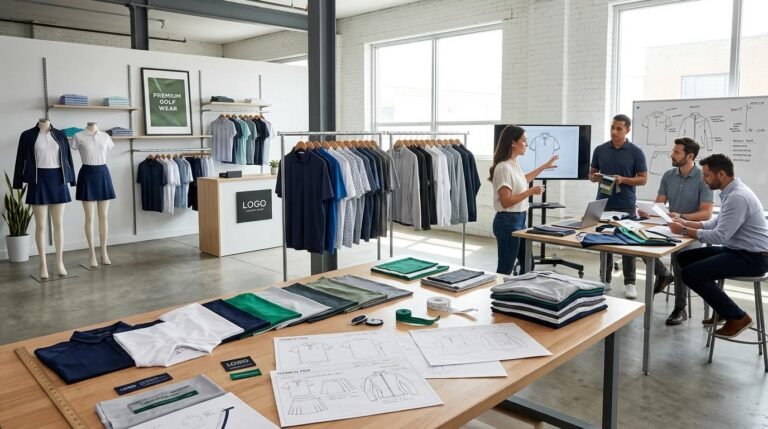
Choosing custom golf apparel is not just about comparing two polo spec sheets or taking the lowest FOB quote. For golf clubs, courses, country clubs, resorts, and pro shops, the real challenge is selecting apparel that matches how the garments will actually be used.
A staff uniform program and a pro shop retail program are not the same purchase.
Staff polos may be worn several days a week, washed constantly, and judged by how long they stay clean, structured, and professional-looking. Pro shop merchandise, on the other hand, has to support retail pricing, club branding, member expectations, and sell-through. Two suppliers may both offer a “moisture-wicking polyester golf polo”, but over time the difference in yarn construction, collar engineering, decoration durability, and quality control can become very clear.
That is why golf apparel sourcing should not be based on price alone.
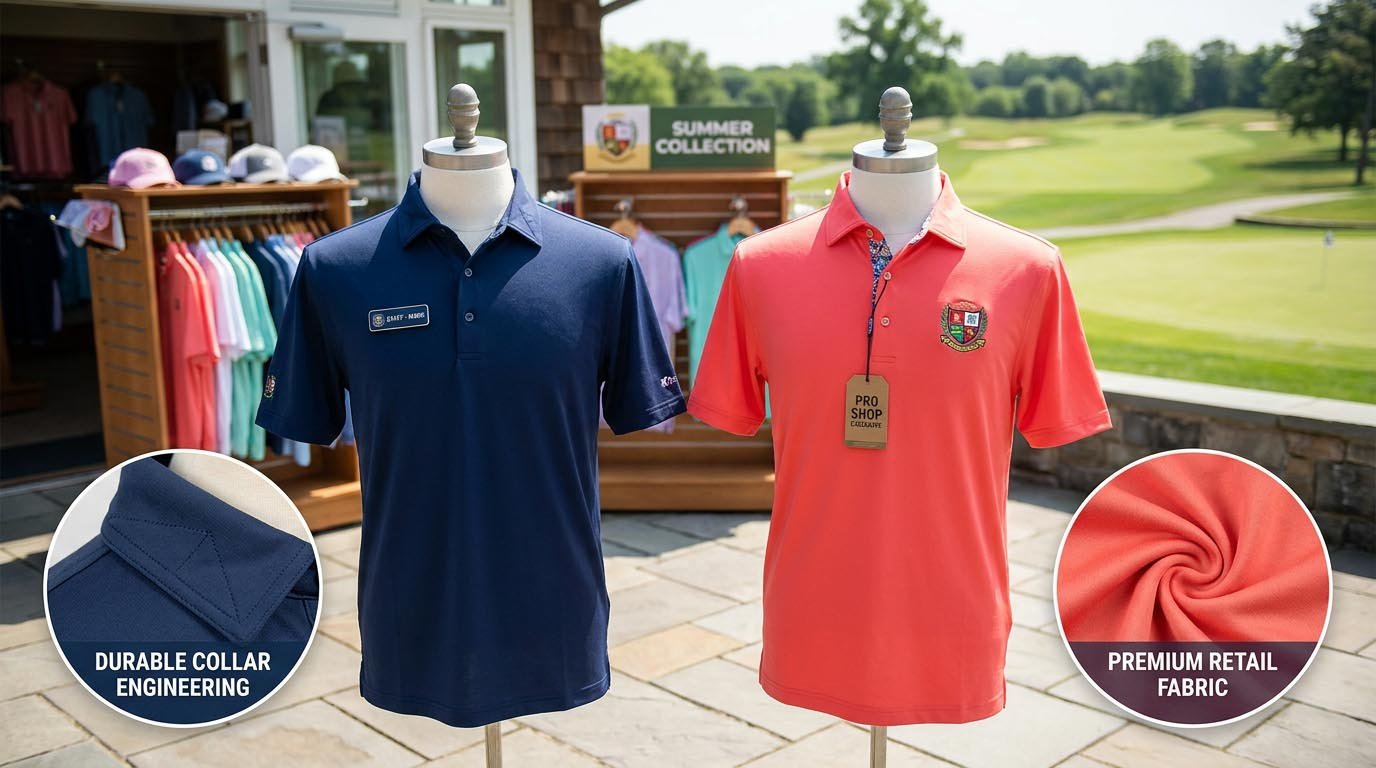
This guide explains how golf clubs, golf courses, country clubs, resorts, and pro shops can evaluate custom golf apparel more effectively. It covers:
- how to separate staff uniform programs from pro shop retail programs
- what makes one custom golf polo hold up better than another
- how to choose fabrics, fits, sizes, and colors
- how to evaluate embroidery, print, heat transfer, and patches
- how to plan MOQ, lead times, samples, and reorders
- how to think about margins, retail pricing, and merchandising support
Quick Answer: What Should Golf Clubs and Pro Shops Look for in Custom Apparel?
Golf clubs and pro shops should evaluate custom apparel based on use case first, not just quote price.
If the apparel is for staff uniforms
Focus on:
- durability after repeated washing
- fabric pilling resistance
- collar structure retention
- embroidery durability
- size coverage for the real employee population
- reorder reliability
- cost per wear over time
If the apparel is for pro shop retail
Focus on:
- retail price positioning
- fabric hand feel and perceived value
- logo subtlety and premium appearance
- sell-through potential
- margin structure
- merchandising support
- seasonal inventory planning
The most common mistake
Many buyers compare:
- same FOB price
- same GSM
- same fiber content
- same “moisture-wicking” claim
But still get very different results because they did not compare:
- yarn construction
- finish durability
- collar construction
- decoration quality
- wash performance
- QC depth
- reorder consistency
The right custom golf apparel program is the one that fits your operating reality, not the one that looks cheapest on paper.
Staff Uniforms vs Pro Shop Merchandise: Start Here
The first decision in any custom golf apparel project is understanding what kind of order you are placing.
Staff uniform programs
These are operational purchases.
The main goals are usually:
- professional appearance
- durability
- comfort during long shifts
- easy reordering
- fair size coverage for employees
- cost control over time
Typical products include:
- staff polos
- quarter-zips
- outerwear
- shorts or pants
- event uniforms
- front-desk and golf operations uniforms
Key evaluation question:
How well does the product hold up after repeated use and washing?
Pro shop retail programs
These are merchandise purchases.
The main goals are usually:
- strong perceived value
- club or resort branding
- retail margin
- member or guest appeal
- sell-through
- seasonal merchandising
Typical products include:
- premium club-logo polos
- resort-branded collections
- limited-edition drops
- member gift programs
- tournament collections
- signature retail capsules
Key evaluation question:
Does the product justify the retail price and fit the club’s brand image?
Why this distinction matters
A staff uniform order may do best with:
- stock fabric
- simple one-location embroidery
- broader size coverage
- repeat-friendly colors
- reliable replenishment
A pro shop program may need:
- better hand feel
- more refined logo execution
- premium trims or labels
- more elevated branding
- stronger retail presentation
If you treat a staff uniform order like a retail collection, you may overspend. If you treat pro shop merchandise like a uniform order, you may hurt sell-through.
How Golf Facility Type Changes Apparel Buying Decisions
Different golf facilities have different priorities, and that changes what “good custom golf apparel” really means.
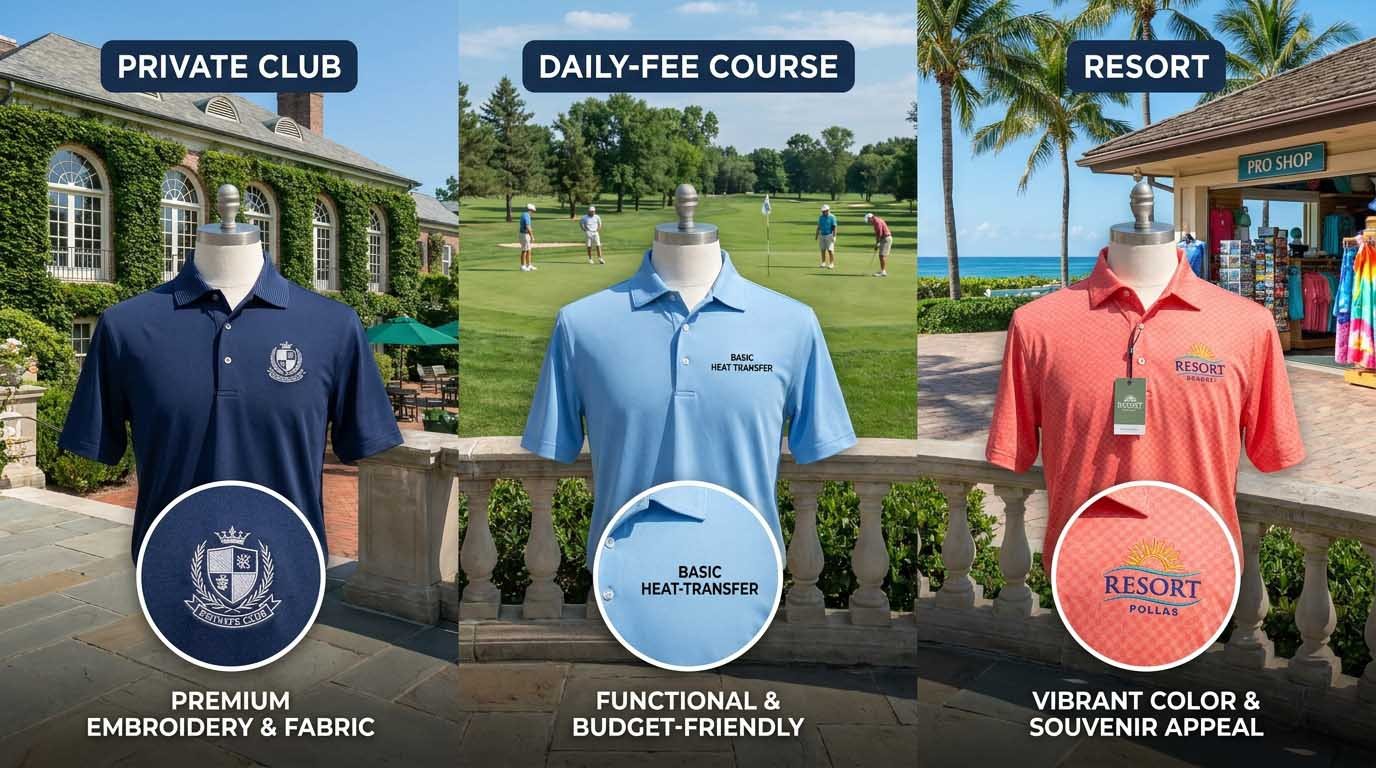
Private clubs
Private clubs often prioritize:
- member-facing appearance
- premium brand perception
- refined logo execution
- stronger fabric hand feel
- consistent visual standards across staff
- elevated retail presentation
For private clubs:
- staff uniforms often need better durability and more polished finishing
- pro shop merchandise often needs to feel exclusive, not generic
Typical direction:
- stronger collar construction
- cleaner embroidery
- premium-feel polos
- more brand-sensitive color choices
- higher-end retail assortment
Daily-fee and municipal courses
Daily-fee and municipal operations often prioritize:
- practical cost control
- comfort and functionality
- simpler ordering
- reliable quality
- faster restocking
- good cost-per-wear
Typical direction:
- stock programs
- standard performance polos
- balanced fabric quality
- simpler logo programs
- fewer unnecessary custom details
Resorts and destination facilities
Resorts often sit between operations and branding.
They usually care about:
- guest perception
- visual consistency with resort identity
- souvenir appeal
- higher-margin retail opportunities
- seasonal or tourism-driven collections
Typical direction:
- polished staff uniforms
- place-based branding
- retail collections that feel giftable
- premium color stories
- elevated logo placement or trims
Why this matters for sourcing
A private club may accept a higher FOB if it supports prestige, appearance, and durability.
A municipal course may need a more efficient balance between performance and cost.
A resort may justify a higher FOB if the retail program supports stronger margins and guest demand.
Before comparing suppliers, define your facility type, customer expectation, and usage intensity. That gives context to every price and quality decision.
What Makes One Custom Golf Polo Better Than Another
Two custom golf polos can look similar on a spec sheet and still perform very differently in real use.
What buyers often compare
- fabric weight
- fiber composition
- moisture-wicking claim
- FOB price
- logo decoration price
What buyers often miss
- yarn construction
- fabric surface quality
- collar engineering
- pilling resistance
- wash-fastness
- stitching reinforcement
- finishing consistency
- QC process
Yarn construction matters
For example, one polo may use:
while another uses:
- staple-spun polyester
Both can be labeled polyester.
Both can be sold as moisture-wicking.
Both may look similar when new.
But over time:
- staple-spun yarn is often more prone to fuzzing and pilling
- filament yarn often maintains a cleaner, smoother surface longer
That difference becomes especially important in:
- staff uniform programs
- repeat-wash environments
- premium retail programs where surface quality affects perceived value
Collar construction matters
Collars often reveal quality problems early.
A lower-grade collar may:
- curl
- lose shape
- separate after washing
- make the whole polo look worn even if the body fabric is still usable
A stronger collar usually depends on:
- interlining quality
- fusing consistency
- stitch stability
- appropriate collar fabric structure
Finish durability matters
A polo may wick well when new because of a temporary finish.
Another may perform more consistently because of fiber structure or more durable finishing.
If the wicking claim fades quickly after repeated washing, buyers may not notice that on arrival, but users will notice after months of wear.
The real comparison happens after use
That is why samples should not be judged only by first-touch feel or a spec sheet. The more useful question is:
How will this polo look after repeated wear, repeated washing, and real on-course use?
The real quality difference in custom golf polos usually shows up after repeated use, not at first inspection.
Fabric Selection: Washing Method, Durability, and Comfort
Fabric selection should be based on how the apparel will actually be worn and washed.
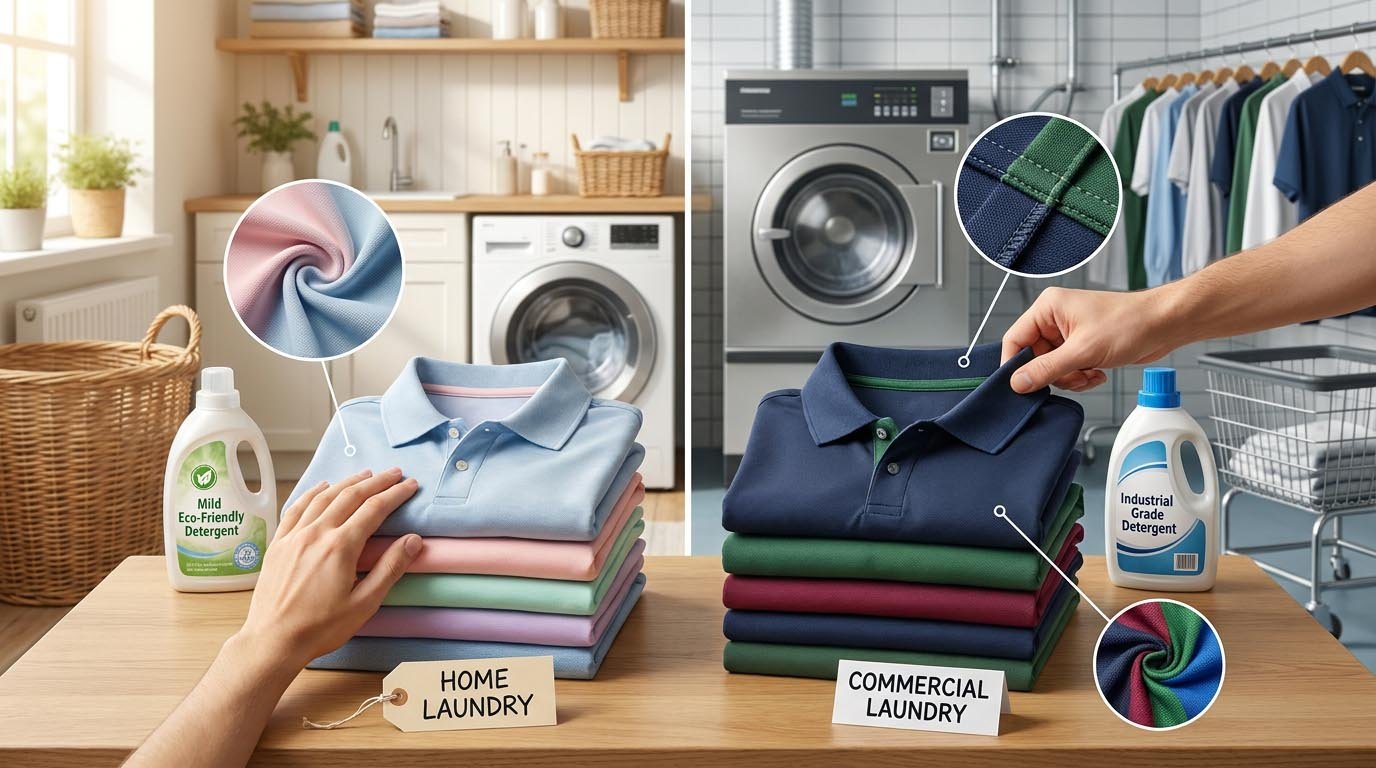
First question: home laundry or commercial laundry?
This is one of the most important sourcing questions for staff uniforms.
If garments are home washed
You may be able to use:
- lighter performance fabrics
- simpler collar construction
- moderate pilling tolerance
- lower-cost stock fabric programs
This often works for:
- smaller teams
- seasonal staff
- less aggressive wash cycles
- facilities without industrial laundry stress
If garments are commercially laundered
You usually need more durability.
Commercial laundry puts more stress on:
- fabric surface
- collar construction
- thread
- colorfastness
- dimensional stability
In these cases, buyers should pay closer attention to:
- polyester yarn type
- pilling resistance
- collar reinforcement
- thread quality
- construction consistency
- color retention
Fabric points to evaluate for custom golf apparel
Ask about:
- yarn type
- GSM
- knit type
- moisture management method
- pilling resistance
- wash-fastness
- UV performance if relevant
- hand feel
- color retention
Staff apparel fabric priorities
For staff uniforms, the best fabric is not always the softest one at first touch.
It is the fabric that still looks clean and professional after repeated wear and repeated wash cycles.
Retail apparel fabric priorities
For pro shop retail, fabric should balance:
- premium hand feel
- appearance
- comfort
- price-point logic
- brand fit
Members and guests often judge value quickly through:
- touch
- drape
- smoothness
- collar feel
- overall finishing
A common sourcing mistake
Some buyers use the same fabric logic for all programs.
But a home-wash staff program, a commercial-laundry staff program, and a premium pro shop retail program may each need different fabric priorities.
For golf clubs, fabric selection should match laundry reality, wear frequency, and brand positioning.
Fit, Size Range, and Size Curve Planning
A strong custom golf apparel program needs the right size strategy, not just a standard size list.
Staff uniform sizing
Staff uniform orders usually need broader size coverage because they must fit a real employee population, not a retail average.
Typical priorities:
- fairness
- comfort across job roles
- mobility
- enough edge sizes
- replacement stock for turnover
For many clubs, staff programs should consider:
- XS through 3XL, depending on workforce
- actual employee size data where possible
- extra buffer in frequently needed replacement sizes
Retail size planning
Pro shop retail sizing is different.
Retail orders usually focus more on:
- core sizes
- sell-through efficiency
- avoiding slow-moving inventory
- exchange management
Many pro shops begin with:
- S-XL
or - S-2XL depending on customer base
Fit direction matters
Before production, define whether the garment should be:
- athletic fit
- regular fit
- classic fit
This affects:
- who feels comfortable in the garment
- who is likely to buy it
- how modern or traditional the product feels
- return and exchange rates
Why sample testing matters
Do not approve fit based on one size only if possible.
A stronger process is to review:
- fit on real staff or target users
- more than one representative size
- mobility during normal movement
- body length, sleeve comfort, collar feel, and chest balance
Grading quality matters
A polo that fits well in size M can still be wrong in XL if the grading is not handled correctly.
Things to review include:
- chest growth across sizes
- body length progression
- sleeve balance
- collar proportion
- mobility in larger sizes
Common size planning mistakes
- using retail size assumptions for staff uniforms
- ignoring larger sizes in uniform programs
- overbuying edge sizes in retail
- failing to plan exchange stock in core sizes
- approving one sample size without checking grading logic
Size planning should reflect who will wear the garment, not just what a generic size chart says.
Colors, Dye Lots, and Reorder Consistency
Color is not just a styling issue. It is also a replenishment issue.
Staff uniform color strategy
For staff programs, the safest approach is usually:
- one core color
or - two approved uniform colors
Why:
- easier reordering
- fewer dye consistency problems
- simpler employee presentation
- lower inventory complexity
Pro shop retail color strategy
Retail can support more variety because choice helps sell-through.
A practical launch structure may include:
- core neutrals such as navy, white, or gray
- one or two seasonal colors
- club-aligned accent colors if brand appropriate
Why dye lot consistency matters
Even if a reorder uses the same named color, it may not be visually identical to the original production lot.
This matters especially when:
- reordered staff uniforms are worn beside older uniforms
- clubs expect long-term color consistency
- brand colors are sensitive
- retail programs reorder best sellers across seasons
How to reduce color problems
Useful strategies include:
- ordering a little extra stock in the first run
- keeping approved color references
- using dye-to-match service when needed
- limiting unnecessary color variation
- planning reorder timing earlier
Outdoor use adds another factor
Golf apparel is exposed to sun.
If light fastness is weak, color may fade unevenly over time, especially in darker shades.
That means long-term color consistency depends on both:
- how the fabric was dyed
- how the garments age in actual use
For golf clubs, the best color plan is the one you can reorder confidently.
Logos and Decoration: Embroidery, Print, Heat Transfer, and Patches
Decoration method should be chosen based on durability, design complexity, order quantity, and brand positioning.
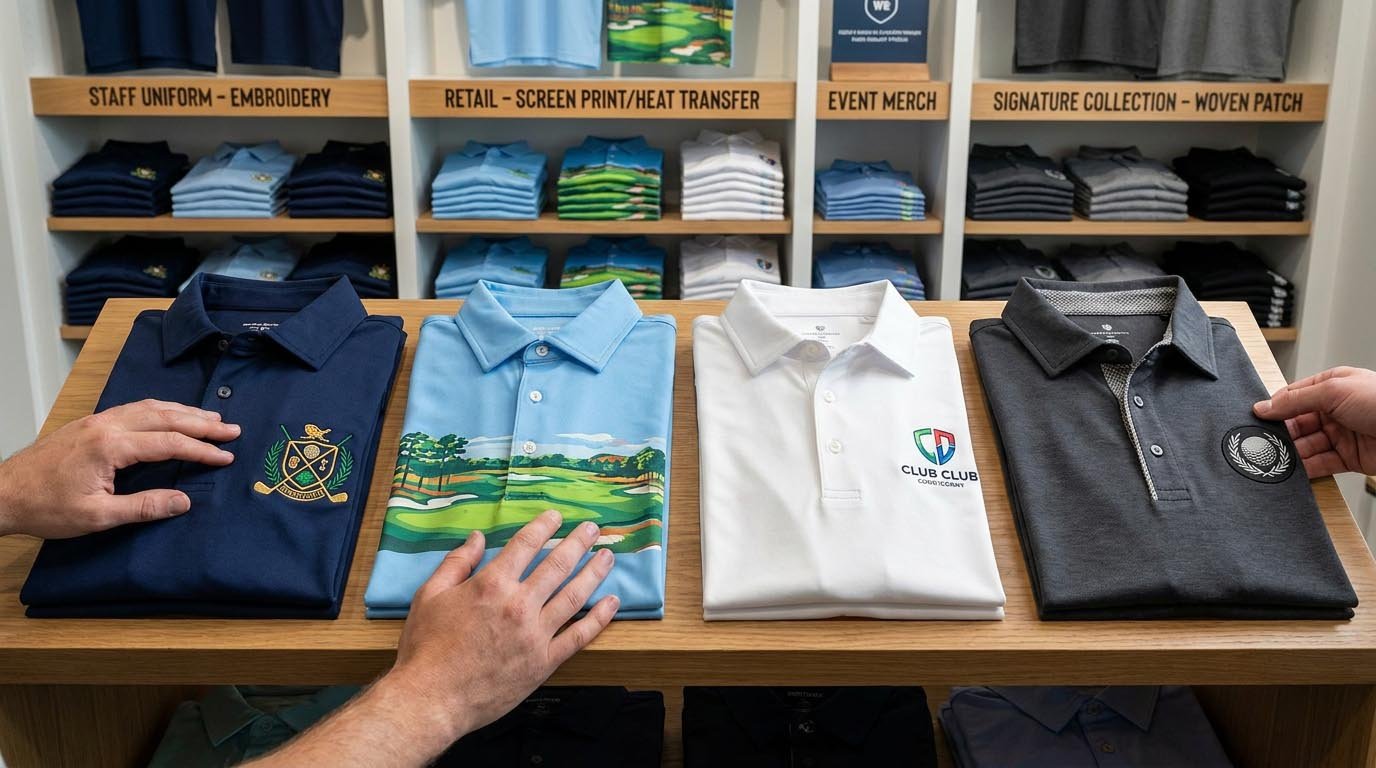
Embroidery
Best for:
- staff uniforms
- classic club logos
- long-use garments
- premium logo presentation
Advantages:
- durable
- professional-looking
- strong for repeated washing
- high perceived value
Limitations:
- not ideal for very fine detail
- too many colors can create bulk and puckering
- very small text may not read well
Embroidery works best when the logo is adapted properly for the medium.
Screen printing
Best for:
- larger graphics
- event merchandise
- fashion-led retail items
- moderate-wear applications
Advantages:
- handles more graphic detail
- can be cost-effective for larger runs
- works well for seasonal retail graphics
Limitations:
- usually less durable than embroidery for heavy-wash programs
- may crack, fade, or age faster depending on ink, placement, and use
Heat transfer
Best for:
- lower quantities
- full-color artwork
- quick-turn projects
- limited retail or event items
Advantages:
- good for complex art
- lower setup burden for small runs
- fast application
Limitations:
- not usually the first choice for long-term staff uniform use
- durability may be lower than embroidery
Woven patches and premium trims
Best for:
- elevated retail collections
- premium club merchandise
- resort collections
- signature launches
Advantages:
- strong tactile value
- elevated presentation
- supports premium retail positioning
Why logo adaptation matters
One of the biggest mistakes buyers make is sending an official crest and expecting every fine detail to translate perfectly into embroidery.
In reality, logos often need to be adjusted for production:
- fewer colors
- thicker lines
- clearer text
- better scaling
- cleaner shape definition
That is not weakening the brand.
It is improving how the brand executes on the garment.
Staff logo strategy vs retail logo strategy
In many programs:
- staff uniforms benefit from clearer, more visible branding
- retail polos often sell better with more subtle branding
A retail polo that looks too much like a staff uniform may be harder to sell at premium pricing.
The best logo decoration is not always the most detailed version. It is the version that looks best on the garment in the real world.
MOQ, Samples, Lead Times, and Reorders
Ordering custom golf apparel successfully depends on planning beyond the first PO.
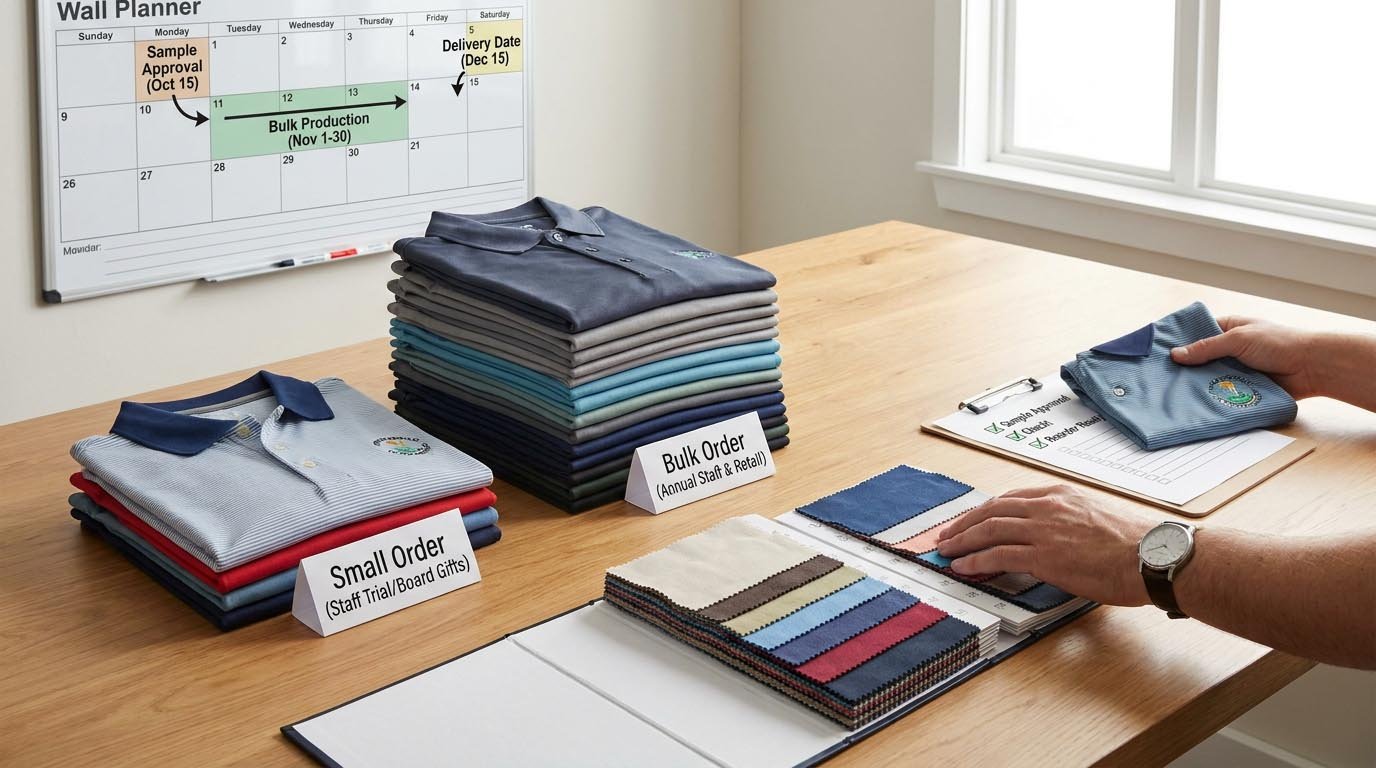
Understanding MOQ
MOQ is not just a factory rule. It reflects production efficiency.
Lower-volume orders usually cost more per piece because:
- setup is spread over fewer units
- fabric buying is less efficient
- trim and decoration setup costs are less amortized
- production scheduling is less attractive to the factory
Typical MOQ logic
In general:
- very small orders often carry a premium
- mid-size orders may be possible with limited customization
- 200-300 pieces is often where pricing becomes more efficient
- larger programs can usually negotiate better terms
When smaller orders still make sense
Small orders may still be reasonable for:
- staff trials
- board gifts
- limited retail capsules
- anniversary collections
- test launches
But buyers should understand they are usually paying for flexibility, not efficiency.
Why samples matter
For golf clubs and pro shops, samples should be used to confirm:
- fabric hand feel
- collar quality
- logo size and placement
- fit
- color
- construction
- decoration execution
If the order matters, sample approval should happen before bulk production.
Lead times by program type
Staff uniforms using stock programs
These are often faster because they use:
- stock fabric
- standard base styles
- simpler logo application
- less design development
Custom retail collections
These usually take longer because they may involve:
- style development
- custom colors
- custom trims
- more sample rounds
- more complex decoration
- retail packaging or merchandising details
Plan backward from your in-hands date
A common mistake is asking for a quote first and only later thinking about the actual wear date or retail launch date.
A better approach is to start with:
- when uniforms are needed on staff
- when retail product must be on shelf
- how much sampling time is required
- whether there is time for one revision round
- whether shipping should be standard or expedited
Reorders are easier when the first order is organized well
A good first program should lock in:
- approved logo files
- approved fabrics
- approved color references
- size curves
- fit comments
- packaging expectations
That makes future reorders faster and more reliable.
Smart reorder planning
A common mistake is ordering only what is immediately needed.
Better planning often means considering:
- annual staff turnover
- replacement needs
- seasonal hiring
- retail replenishment windows
- whether combined staff + retail ordering can improve cost
- whether a slightly larger first order improves long-term economics
MOQ strategy should be based on 12-month demand planning, not just today’s quantity request.
Retail Pricing, Margins, and Merchandising Support
For pro shop retail, sourcing decisions should be made backward from retail price and margin targets.
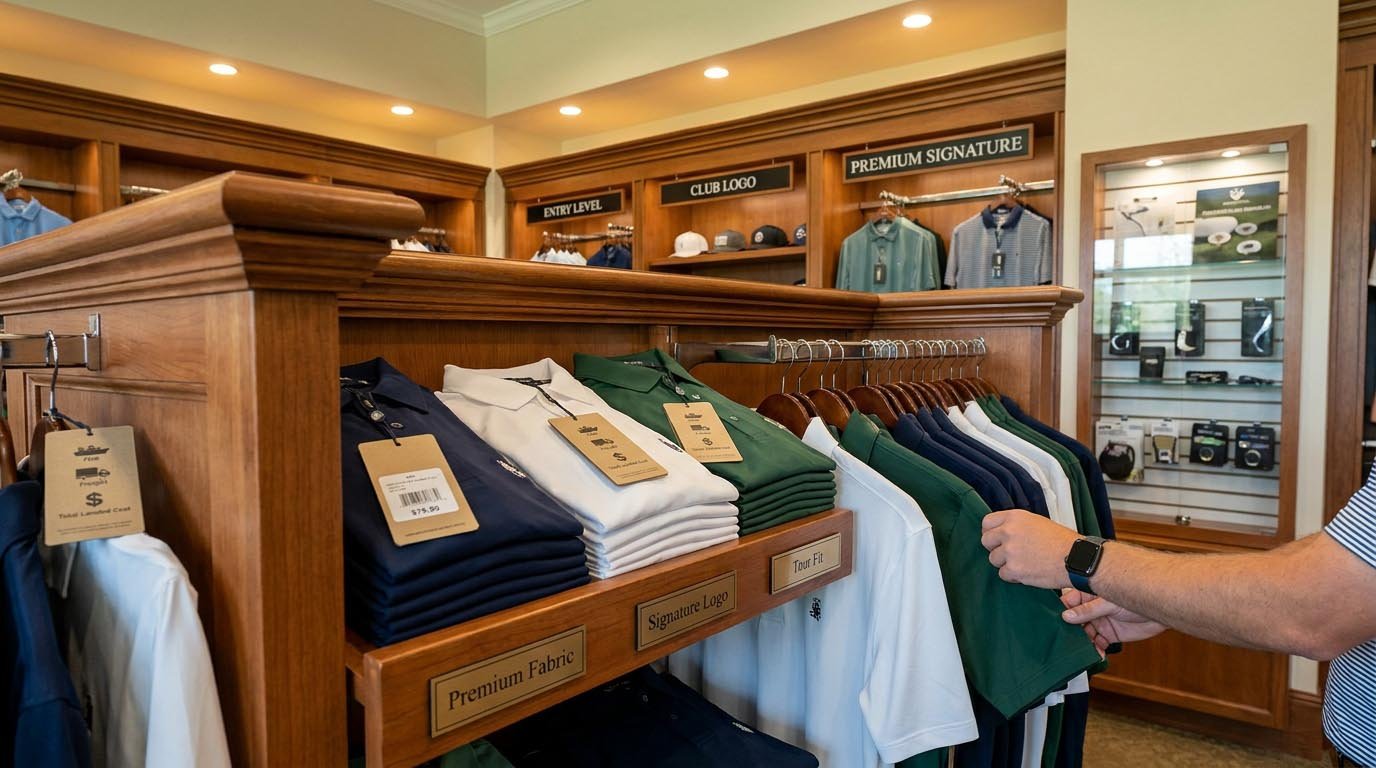
Start with retail price positioning
Ask:
- Is this an entry retail item?
- A mid-premium club-logo polo?
- A premium signature collection?
- A resort souvenir item?
The answer affects what FOB range makes sense.
Landed cost matters more than FOB alone
To understand true retail math, include:
- FOB
- decoration
- freight
- duty
- packaging if relevant
That total landed cost is what should be compared against retail price.
Why cheap FOB can hurt retail
If a polo looks too basic, feels too cheap, or has a uniform-like appearance, it may be difficult to justify a premium retail price even if the margin math looks attractive on paper.
Retail success depends on:
- perceived value
- brand fit
- display quality
- logo sophistication
- product differentiation
Staff program economics are different
For staff uniforms, the right question is often not:
Which option is cheapest today?
The better question is:
Which option gives the best cost per wear over time?
If a lower-cost staff polo needs replacing much faster, the lower FOB may actually become more expensive over 12-24 months.
Merchandising support matters
For pro shop programs, support tools can improve sell-through:
- branded hangtags
- display signage
- hanger programs
- product benefit cards
- retail-ready packaging
- staff selling guides
These details help customers understand why the product is worth buying.
Presentation affects perceived value
Even a good product can underperform in retail if it is merchandised like a commodity.
Pro shop apparel often sells better when:
- the story is clear
- logo placement feels intentional
- the display is organized
- customers can understand fabric and fit benefits quickly
For retail golf apparel, the best supplier is not just the one with the lowest quote. It is the one whose product and support help you sell through profitably.
FAQ: Custom Golf Apparel for Clubs and Pro Shops
What is the difference between custom golf apparel for staff and for pro shop retail?
Staff apparel is usually purchased for durability, consistent appearance, fit coverage, and easy reordering. Pro shop retail is purchased for margin, branding, perceived value, and sell-through.
How do I choose between two custom golf polo quotes with similar specs?
Do not compare only GSM, fiber content, and FOB. Also compare yarn construction, pilling resistance, collar construction, decoration quality, wash durability, and QC process.
Is embroidery the best option for custom golf polos?
For staff uniforms and long-use polos, embroidery is usually the strongest option because it is durable and professional-looking. For fashion-led or graphic-heavy retail items, print or patches may be a better choice depending on the design.
What size range should golf clubs order for staff uniforms?
Most staff programs need a broader size range than retail. Use real employee size information where possible and allow for turnover and replacements.
Should pro shops stock the same size curve as staff uniforms?
Usually no. Retail should focus on the most commercially relevant sizes for your customer base, while staff programs must prioritize actual fit coverage across the workforce.
What is a realistic MOQ for custom golf apparel?
That depends on customization level and supplier model, but many efficient production programs begin around 200-300 pieces. Smaller orders are often possible at a higher cost per piece.
How far in advance should a golf club order custom apparel?
For staff uniforms, plan earlier than you think, especially before season openings. For custom retail collections, allow extra time for development, sampling, and merchandising preparation.
What is the biggest mistake golf clubs make when buying custom apparel?
Treating all custom apparel like the same purchase. Staff uniforms, member retail, resort merchandise, event items, and limited editions all require different sourcing logic.
Can golf clubs combine staff uniforms and retail programs in one order?
In some cases, yes. Combining programs can help improve MOQ efficiency, but only if timing, product positioning, and vendor capabilities align.
Why do two moisture-wicking polos with similar specs perform differently?
Because fiber content and GSM alone do not tell the whole story. Yarn type, finishing method, collar construction, stitching quality, and wash performance all affect long-term results.
Final Takeaway
The best custom golf apparel programs begin with the right sourcing question:
What is this apparel actually for?
If it is for staff uniforms, evaluate:
- wash durability
- cost per wear
- fit coverage
- reorder reliability
- logo durability
If it is for pro shop retail, evaluate:
- perceived value
- margin
- logo refinement
- fabric hand feel
- merchandising support
- sell-through potential
For golf clubs, courses, resorts, and pro shops, two polos with similar specs can perform very differently because of less visible variables such as yarn construction, collar engineering, finish durability, and production control.
That is why strong buying decisions depend on more than a quote sheet.
The best results usually come from:
- matching the product to the program type
- matching fabric to laundry and wear conditions
- planning MOQ and replenishment strategically
- choosing decoration methods that fit both design and durability needs
- building retail price and margin logic before ordering
Need Help Sourcing Custom Golf Apparel?
As a custom apparel manufacturer, we help golf clubs, golf courses, country clubs, resorts, and pro shops develop:
- custom golf polos
- staff uniform programs
- club-logo retail apparel
- resort-branded collections
- embroidery and decoration solutions
- reorder-friendly apparel programs
If you already have a logo, target price, quantity, or launch timeline, send us your project brief and we can help you evaluate the right custom golf apparel program for your club.