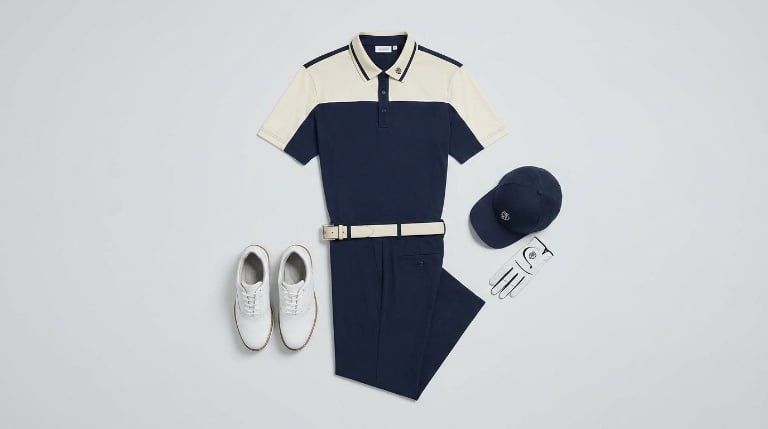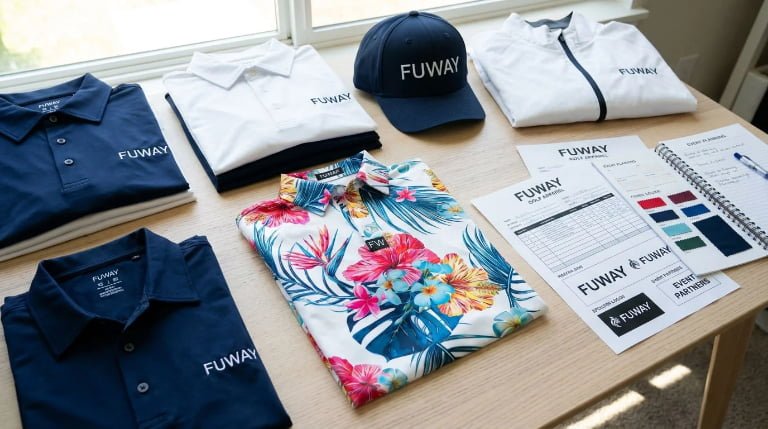
To source corporate golf apparel, first decide whether you need existing shirts with a company logo or fully custom garments. Then give suppliers the same product brief, compare complete order costs, approve decorated samples, and document the standards for bulk production and reorders.
This guide focuses on branded golf shirts for corporate purchasing teams, uniform distributors, and businesses managing repeat apparel programs. The aim is to buy shirts that meet the wearing requirements and remain practical to order again.
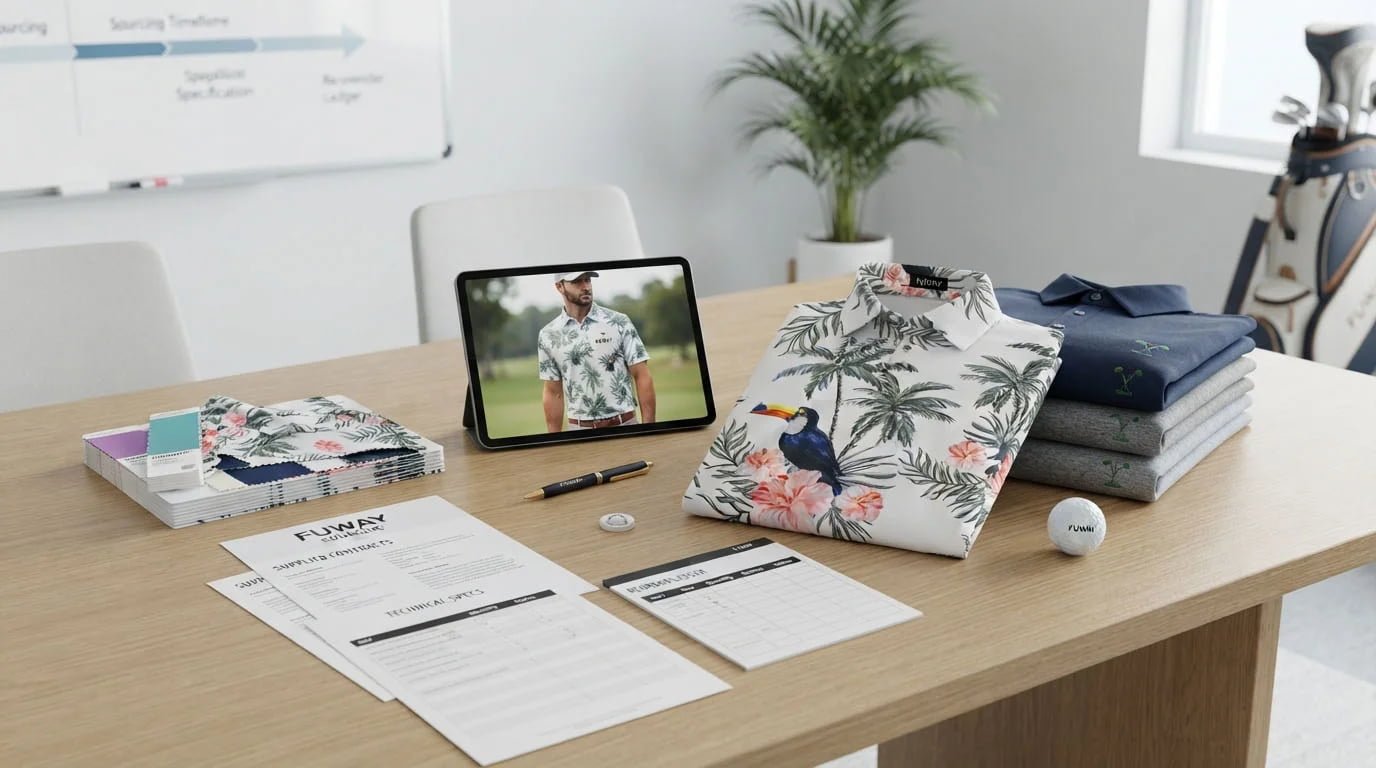
Key 1. Choose Between Stock Shirts and Custom Manufacturing
These routes solve different purchasing needs. Confirm which route each supplier is quoting before comparing prices.
| Buying route | When it may fit | What to verify |
|---|---|---|
| Existing shirts with added logos | Small orders, established apparel brands, or limited development time | Available sizes and colors, decoration capacity, replenishment availability |
| Custom OEM/ODM production | A specific fit, fabric, garment color, or private-label program | Development requirements, material minimums, sampling stages, bulk schedule |
Stock decoration usually offers less control over garment construction. Custom manufacturing provides more development options but requires approvals before production and may involve separate fabric or color minimums.
Neither route guarantees faster delivery in every case. A stock shirt can be unavailable in key sizes; a custom order can be delayed by material development or sample revisions.
For a fixed-date golf outing with participant lists and sponsor artwork, use the separate teams, clubs, and events ordering guide for event planning.
Key 2. Translate the Wearing Scenario Into a Product Brief
Describe where the shirts will be worn, how often they will be washed, and who needs to wear them. These details help suppliers propose suitable materials without guessing what “premium” means.
| Intended use | Product priorities | Sample checks |
|---|---|---|
| Outdoor client golf days | Comfortable movement, moisture management, suitable coverage | Swing and reach test, opacity, comfort in expected conditions |
| Trade shows and office visits | Consistent appearance, collar shape, suitable fit | Collar and placket appearance, comfort while standing and sitting |
| Recurring staff uniforms | Care durability, stable sizing, replacement availability | Repeated laundering, seam condition, shade and fit consistency |
| Client gifts | Appropriate presentation, useful sizing options, packaging | Hand feel, garment dimensions, decoration and packing finish |
Specify fiber composition and knit construction separately. Polyester and cotton are fibers; piqué, jersey, and interlock describe fabric structures. A polyester piqué and a cotton piqué can look similar while behaving differently in use.
GSM describes fabric mass per unit area. It does not, by itself, establish breathability, snag resistance, or suitability for embroidery. Avoid selecting a shirt solely because it falls within a supposedly ideal weight range.
Likewise, polyester content alone does not prove moisture-wicking performance. Where a claim matters to the purchase, request relevant test evidence. AATCC TM195 evaluates liquid moisture management properties of textile fabrics; it does not certify every aspect of wearer comfort.
Ask for evidence supporting any required UPF rating rather than assuming that polyester or a particular finish delivers the stated protection.
Confirm Fit With Garment Measurements
Use a garment measurement chart, with clear measurement methods, rather than size labels alone. Record the required fit options and size quantities separately where patterns differ.
Request representative fitting samples when practical. Check upper-back movement, sleeve comfort, body length, and opacity in light colors. A correct base-size sample does not establish that every size fits correctly.
Key 3. Specify the Logo on the Actual Fabric
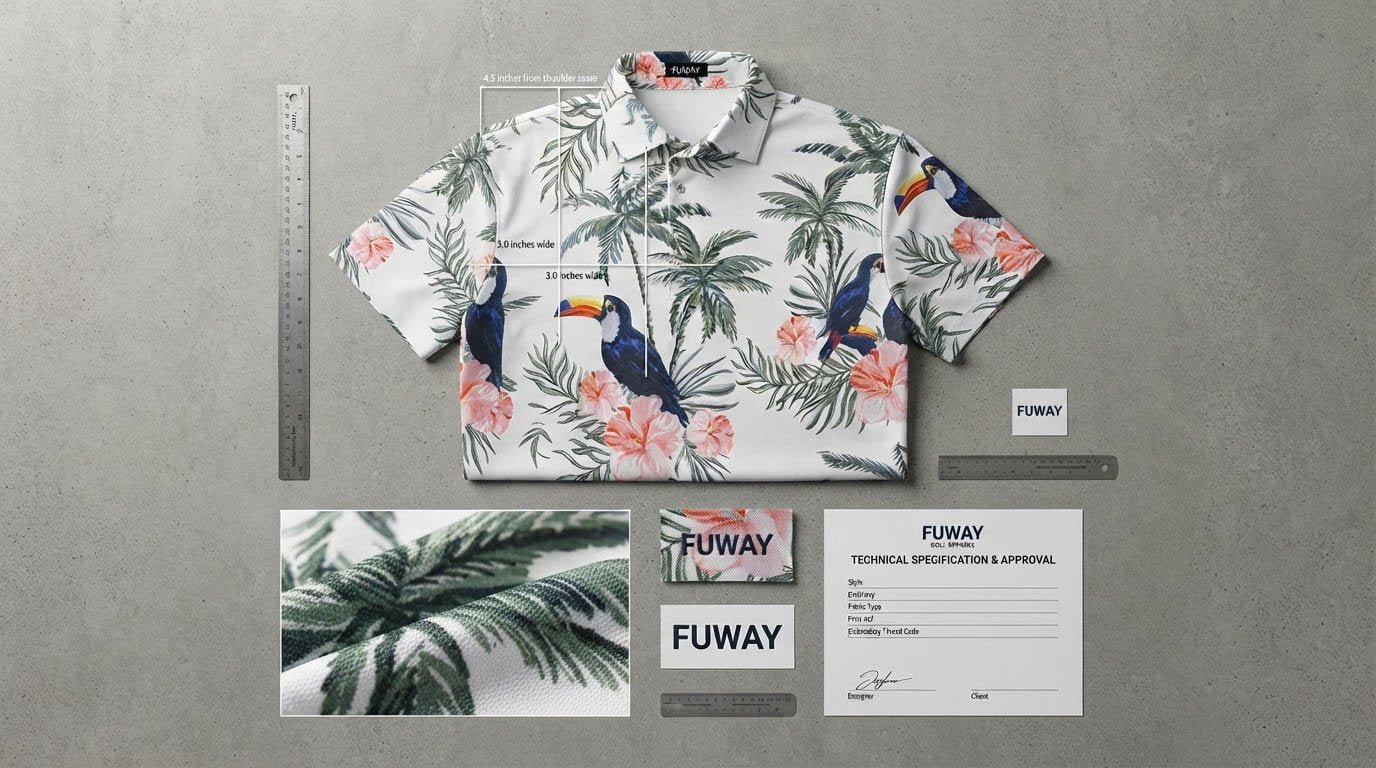
A digital proof shows the proposed layout. A decorated sample reveals texture, stiffness, color interaction, and comfort.
| Method | Useful application | Approval focus |
|---|---|---|
| Embroidery | Small corporate marks and textured branding | Detail legibility, stitch density, backing comfort, puckering |
| Heat transfer | Detailed logos and suitable performance fabrics | Stretch compatibility, adhesion, press marks, color migration |
| Screen printing | Repeat graphics with suitable fabric and ink systems | Coverage, curing, hand feel, wash appearance |
| Sublimation | Full-color designs on compatible polyester-rich fabrics | Base-fabric suitability, color proof, pattern alignment |
There is no universal fabric-weight cutoff that makes embroidery acceptable or unacceptable. Logo size, stitch density, fabric stability, and backing all affect the result.
DTG and sublimation are different processes. Do not treat them as interchangeable ways to produce a print with no effect on breathability. Suitability depends on the substrate, printing system, pretreatment where applicable, and graphic coverage.
For a detailed comparison, see the golf apparel logo methods guide.
Record the approved artwork version, logo dimensions, color reference, placement reference points, and decoration method. Confirm how placement should be handled across the size range, and nominate one person to approve branding changes.
Key 4. Send One RFQ and Compare the Complete Order Cost
Use one request for quotation (RFQ) across suppliers. Mark unresolved items as requests for recommendations so that provisional assumptions remain visible.
| RFQ field | Information to provide |
|---|---|
| Sourcing route | Existing shirts with decoration or custom manufacturing |
| Product | Polo style, reference garment, intended use, fit options |
| Fabric | Composition, knit structure, target weight, required performance |
| Quantity | Pieces by style, color, size, and logo variation |
| Branding | Artwork files, logo dimensions, positions, decoration method |
| Approval | Required physical samples and named approval owner |
| Quality | Measurement methods, tolerances, testing and inspection requirements |
| Packaging | Labels, individual packing, carton or department sorting |
| Delivery | Required arrival date, destination, shipping responsibility |
| Repeat orders | Likely reorder quantities and continuity requirements |
If you do not know the appropriate composition or GSM, provide a reference shirt and the wearing requirements. Ask each supplier to identify its proposed specification clearly.
Check What the Quote Includes
Compare garment cost, decoration, setup or digitizing, samples, development, labels, packaging, testing, inspection, freight, and any applicable duties or taxes. Ask suppliers to identify exclusions and explain the delivery terms.
Clarify whether minimums apply by style, color, fabric, or decoration variation. A total order quantity may conceal several smaller production groups.
Also ask:
- Are samples and production quoted against the same fabric specification?
- Are larger sizes or extra logo positions priced differently?
- What changes would trigger a revised quote?
- What happens if inspection identifies nonconforming goods?
- What are the reorder minimums and setup charges?
A comparable quote is one whose assumptions and responsibilities you can trace.
Key 5. Approve Samples Against Written Acceptance Criteria
Separate practical buyer checks from formal laboratory testing. Wearing and washing a sample can identify problems, but cannot substantiate a numerical UPF rating or every performance claim.
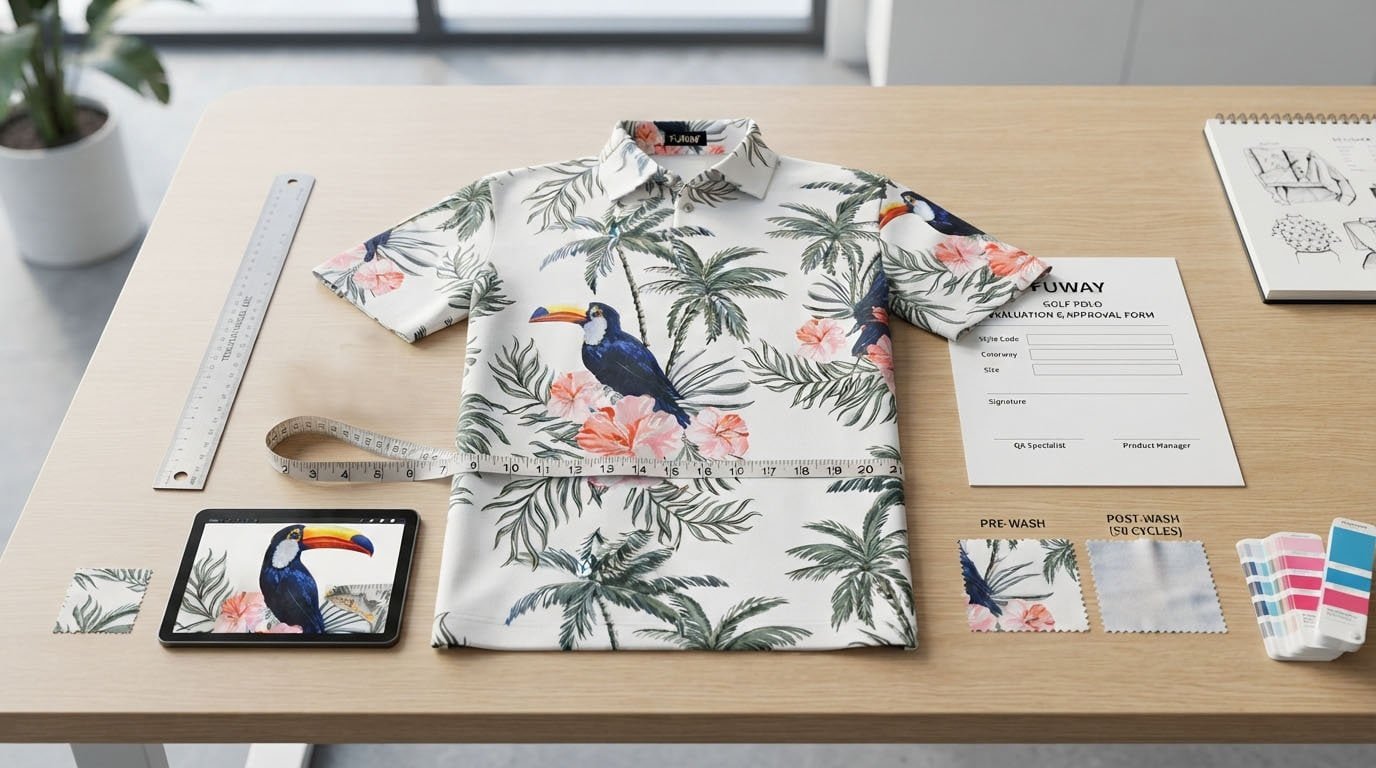
Use this approval sequence:
- Measure before washing. Record agreed garment dimensions using the specified measurement methods.
- Check fit in use. Ask representative wearers to reach, sit, and simulate a golf swing.
- Review decoration. Check spelling, dimensions, position, color, backing comfort, and appearance on the actual fabric.
- Wash and dry as specified. Record the care conditions and number of cycles agreed for evaluation.
- Re-measure and inspect. Review dimensional change, seam twisting, collar shape, shade, and logo condition.
Set dimensional-change limits before testing. Do not assume that “3%–5% shrinkage” is an automatic industry acceptance rule for every shirt.
Keep sewing measurement tolerances separate from wash-related dimensional change. At FUWAY, specified finished-garment measurements use a tolerance of ±1.0 cm, with tighter requirements applied where specified in the approved tech pack. Washing acceptance criteria require their own defined conditions and limits.
Use a Clear Approval Decision
| Decision | Appropriate action |
|---|---|
| Approve | Record the approved sample and specification versions; authorize the agreed production stage |
| Hold | Resolve missing test evidence, unclear measurements, or unapproved substitutions |
| Revise and resubmit | Correct failed fit, decoration, or care-performance requirements and review the revised sample |
Keep an identified approved reference sample. Written approval should state what was accepted and whether any exceptions remain.
Key 6. Control Bulk Production and Preserve Reorder Records
Ask the supplier what evidence will be supplied at each checkpoint, rather than accepting a general promise that quality is checked.
| Checkpoint | Evidence to request |
|---|---|
| Before cutting | Approved material references, shade review, relevant test results, confirmed size specification |
| During production | Measurement records, initial decoration approval, records of recurring defects and corrections |
| Before shipment | Inspection results, size and quantity reconciliation, packing list, unresolved issue status |
Inspection reports provide evidence within their stated scope. A sampled inspection does not prove that every garment is defect-free.
The broader golf apparel quality control guide explains production controls and inspection planning in more detail.
Check Certification Scope
If a purchasing policy requires certified textiles, verify the certificate’s validity and covered products. A fabric certificate should not automatically be presented as certification of the complete decorated garment.
For example, OEKO-TEX STANDARD 100 concerns testing for harmful substances. It does not establish fit, moisture management, or logo durability.
Plan Reorders Before the First Shipment
Retain fabric references, approved shade standards, garment specifications, logo files, decoration settings, sample identifiers, and packaging instructions. Ask how the supplier handles discontinued fabrics, replacement styles, and new dye lots.
For orders distributed across offices, agree on department labels, size sorting, and destination quantities before packing. Separate manufacturing consistency from fulfillment accuracy: both affect whether employees receive usable shirts.
Frequently Asked Questions
Can a small corporate order use fully custom manufacturing?
It depends on the supplier and specification. Existing shirts with added logos may be more practical for small orders. FUWAY’s suitable custom projects generally start at approximately 100 pieces per style; fabric, color, and customization can change the exact requirements.
How much time should we allow for a FUWAY custom polo order?
Typical sampling takes 7–10 working days, with bulk production approximately 3–4 weeks after sample approval, subject to material availability and project complexity. Allow additional time for revisions, any separately scheduled testing or inspection, and shipping. Confirm a project-specific arrival plan before committing to an event date.
Will a reorder match the first order exactly?
Do not assume an exact match across new material batches. Retained standards help control consistency, but suppliers should review shade, fabric availability, and specification changes before each repeat order. Approve substitutions before production.
What should happen if a sample passes but bulk goods fail inspection?
Identify the affected requirement, sizes, and production batches. Request corrective action and appropriate reinspection against the approved standard. Agree on remedies and shipment-release responsibilities in the purchase terms before placing the order.
Conclusion
Effective corporate golf shirt sourcing connects a suitable buying route with a clear brief, comparable quotes, documented sample approval, and controlled repeat production. The most useful purchase record tells both sides exactly what was approved, what must be checked, and how changes will be handled.
FUWAY supports custom golf polo development for suitable OEM/ODM and private-label projects. To discuss a corporate program, send FUWAY your requirements, including intended use, approximate quantity by style and color, fit needs, artwork, destination, and required arrival date.