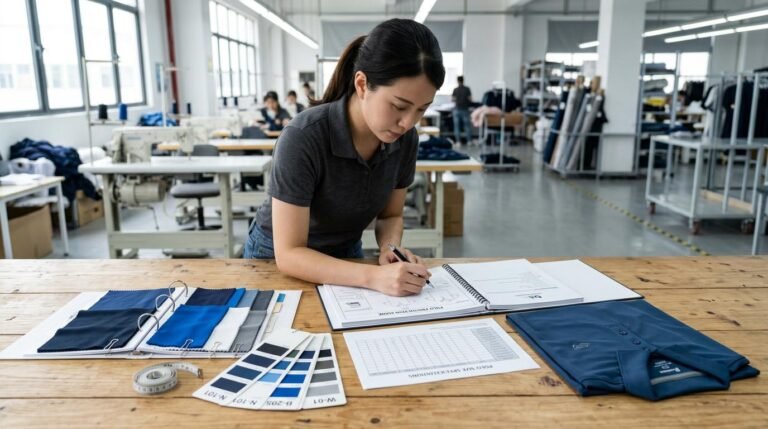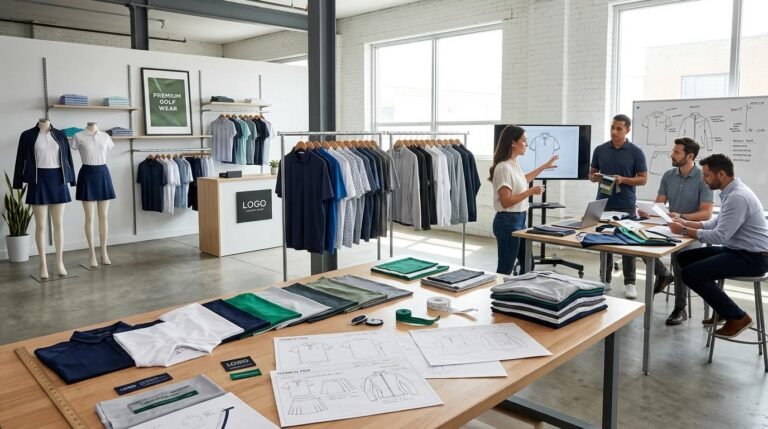
Your club approved the budget for new uniforms, the committee wants "something that stands out," but no one can define what that means beyond "not boring white polos with our logo."
Stand-out doesn't mean bold patterns or neon colors—it means strategic design details that create instant recognition from 50 feet away while maintaining formal club aesthetics. Color-blocking, contrast piping, custom collar treatments, and consistent trim elements deliver differentiation at 10-15% cost premium versus basic embroidered polos.
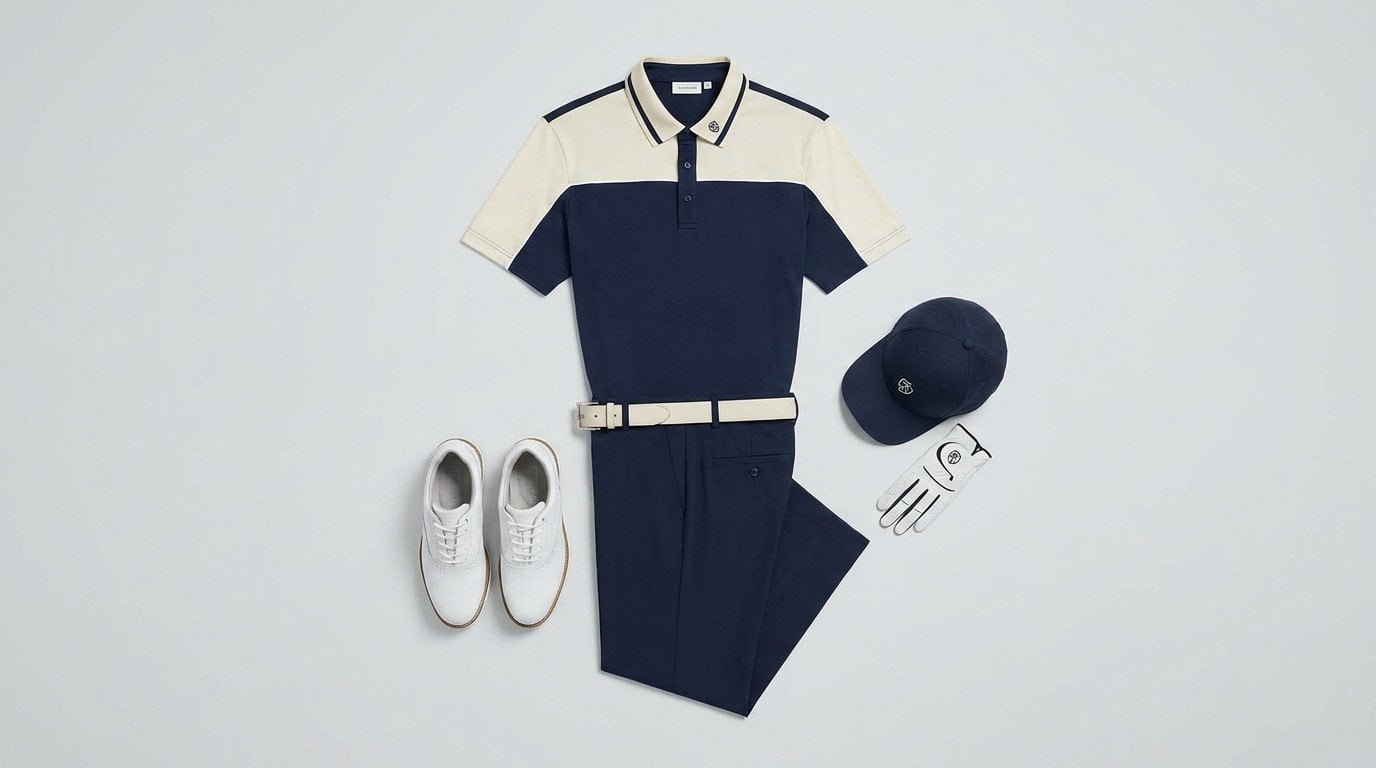
I've helped clubs design uniforms for 15 years at FUWAY, and the request always sounds the same: "We want to look professional but different from other clubs." Then they show me inspiration photos from PGA Tour pros wearing designs that would get rejected at their own club's dress code. The gap between "tournament-TV cool" and "our members will actually wear this" is where good uniform design lives. Let me show you which design elements create visual impact without sacrificing club formality or blowing your budget.
Quick Answers: Golf Club Uniform Design and Customization
What's the easiest way to make club uniforms distinctive?
Consistent color-blocking across all uniform pieces—use your club's two signature colors in 70/30 ratio (dominant color on body, accent on sleeves/collar). Costs only $0.80-1.20 more per polo versus single-color design but creates instant visual recognition in group photos and tournaments.
Do custom design elements increase minimum order quantities?
Usually yes—basic embroidered polos need 50-100 pieces, but custom color-blocking, piping, or patterns require 200-300 minimum because of pattern making and setup. One workaround: use stock silhouettes with custom trim colors to keep MOQ at 100-150 pieces.
Can we add member names without ordering separate sizes for everyone?
Absolutely—we produce blank uniforms in your size distribution (40% Large, 30% XL, etc.), then add individual names after members claim sizes. This works for orders above 100 pieces where you know your general size breakdown from previous years.
How much does contrast piping add to production cost?
$0.50-0.80 per garment for single-location piping (collar edge or sleeve cuff). $1.50-2.00 for full treatment (collar + placket + cuffs + side vents). The visual impact is significant—piping makes a $25 polo look like $45 in perceived value.
Should we match professional tour player designs for our club uniforms?
No—tour designs prioritize camera visibility and sponsor placement, not country club dress codes. Copy the design principles (color consistency, clean lines, strategic contrast) but adapt sizing and formality. Tour polos use athletic fits; club uniforms need classic fits that work for 45-75 year-old members.
Define Club Identity & Dress Code: Palette, Logos and Etiquette
Your club uniform must balance two opposing forces: creating visual distinction that builds member pride while respecting the conservative dress code that defines club culture—this tension shapes every design decision.
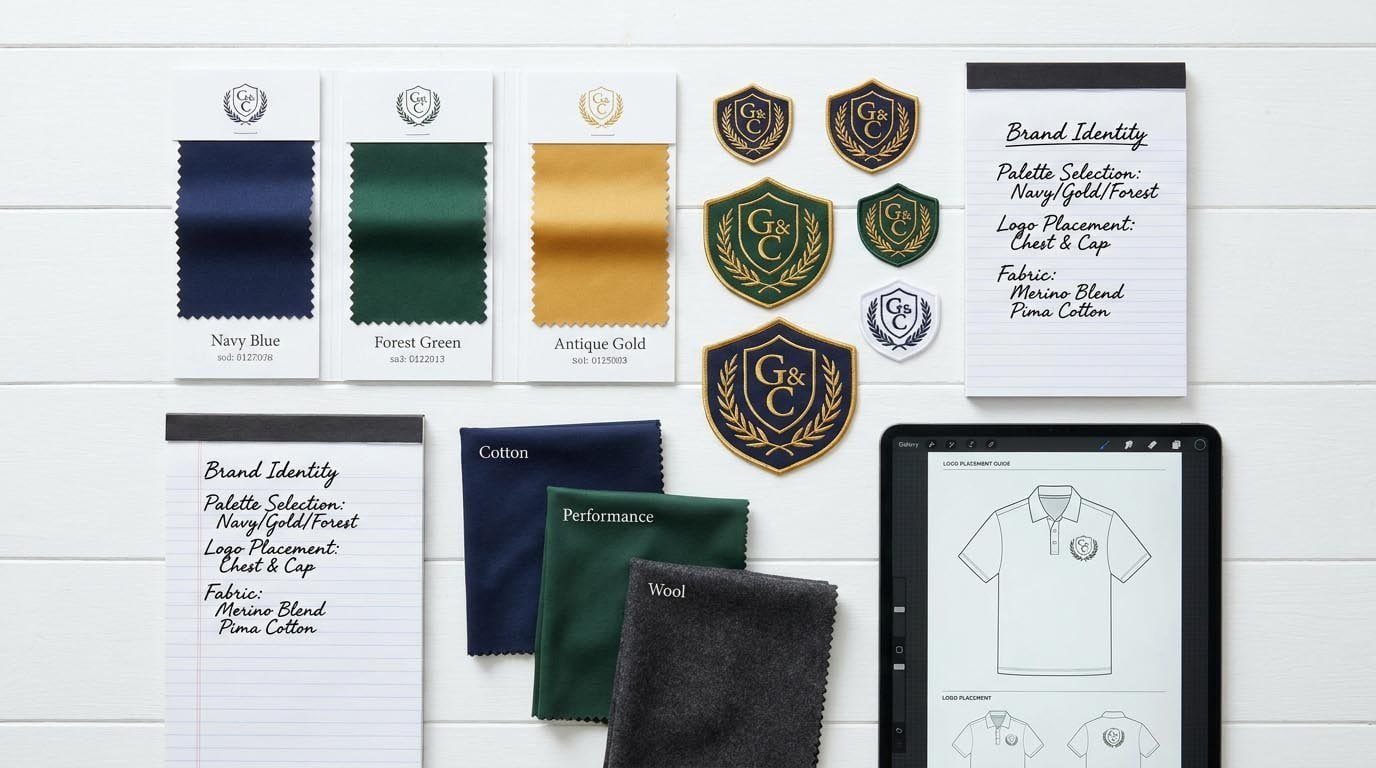
Before I sketch a single design, I ask clubs to answer three questions most haven't discussed: What emotions should our uniform communicate? What do competing clubs in our region wear? What's our actual dress code enforcement reality?
The identity definition I see clubs skip: distinguishing between club personality and member demographics. A club with 200-year heritage and average member age 62 needs different design language than a 15-year-old club with 40-something professionals who play speed golf before work.
Here's how club characteristics translate to design constraints:
| Club Type | Identity Markers | Design Boundaries | Common Mistakes |
|---|---|---|---|
| Traditional/Heritage | Formal, prestigious, exclusive | Navy/forest/burgundy palette, classic fits, minimal contrast | Trying to look "modern" and losing members over formality |
| Modern/Contemporary | Active, social, inclusive | Brighter palette allowed, athletic fits okay, creative patterns possible | Going too casual and failing tournament dress codes |
| Resort/Public | Welcoming, recreational, diverse | Maximum flexibility, performance fabrics, relaxed fits | Lacking any distinct identity at all |
| Corporate/Executive | Professional, networking-focused | Conservative palette, tailored fits, premium fabrics | Boring designs that members never wear outside required events |
I worked with a 120-year-old club that wanted "fresh and modern" uniforms. The committee showed me inspiration photos with color-blocked sleeves and bold patterns. I asked: "Will your 70-year-old members wear this to Thursday men's league?" Silence. We redesigned with subtle contrast piping and tonal striping—modern enough to feel updated, traditional enough that 90% of members ordered.
Color palette selection determines 60% of your visual identity:
Primary color (club's dominant hue):
- Must work across 5-7 skin tones and look good in outdoor lighting
- Should match or complement clubhouse architecture, logo, and course signage
- Test how it photographs in group shots—some blues look purple on camera
Secondary color (accent/contrast):
- Creates visual interest without overwhelming—use in 30% or less of the design
- Should have sufficient contrast from primary for visibility—light blue + navy works, navy + black doesn't
- Consider seasonal variations: lighter in summer, darker in winter
Common palette mistakes I see in 40% of first-time club uniform orders:
- Matching corporate brand colors exactly: A tech company's electric blue looks great on screens, terrible on 200gsm pique cotton under sun
- Using three or more colors equally: Creates visual chaos—pick one dominant, one accent
- Ignoring logo color compatibility: Club crest has gold details, uniform palette is silver/gray—the logo looks wrong
One club's crest featured forest green and gold. Their inspiration photos used navy and white (cleaner, more modern). We created mock-ups both ways—the navy version looked stylish but disconnected from 40 years of club identity. Final decision: forest green primary, white secondary, gold piping—felt fresh but authentic.
Logo treatment creates recognition:
Size and placement standards:
- Left chest: 3.5-4 inches wide, positioned 3 inches below shoulder seam—this is the visibility sweet spot
- Back yoke: 4-5 inches wide for team name or tournament info—keeps front clean
- Sleeve: 2-3 inches wide—only if you need sponsor visibility or additional branding
Logo execution methods:
- Embroidery: Premium feel, 50+ wash durability, works for detailed crests with 6+ colors
- Woven patches: Ultra-premium, luxury club aesthetic, adds $3-5 per garment
- Sublimation: Only on polyester fabrics, unlimited colors, no texture
The logo size mistake: clubs see 4-inch chest logos on their old uniforms and request 5-6 inches "to make it more prominent." Larger logos don't increase pride—they decrease wearability. Members feel like walking billboards. Stay at 3.5-4 inches unless your logo is extremely simple (text-only or single icon).
Dress code reality check:
Written dress code versus enforcement:
- Written: "Collared shirts, no denim, proper golf shoes"
- Enforcement reality: Members wear performance joggers and spikeless sneakers without comment
- Uniform design impact: Don't design for the written code—design for what actually gets worn and accepted
I've seen clubs design ultra-formal uniforms (conservative colors, traditional fits, minimal detail) based on written dress code, then members never wear them because the actual club culture is more relaxed. Survey your top 50 active members about what they currently wear during weekend rounds—that's your real dress code.
Stand‑Out Design Elements: Color‑Blocking, Piping, Patterns and Trims
Visual differentiation comes from strategic detail placement—collar treatments, sleeve contrasts, and trim elements that cost 10-20% more but create 200% better recognition in tournament fields.
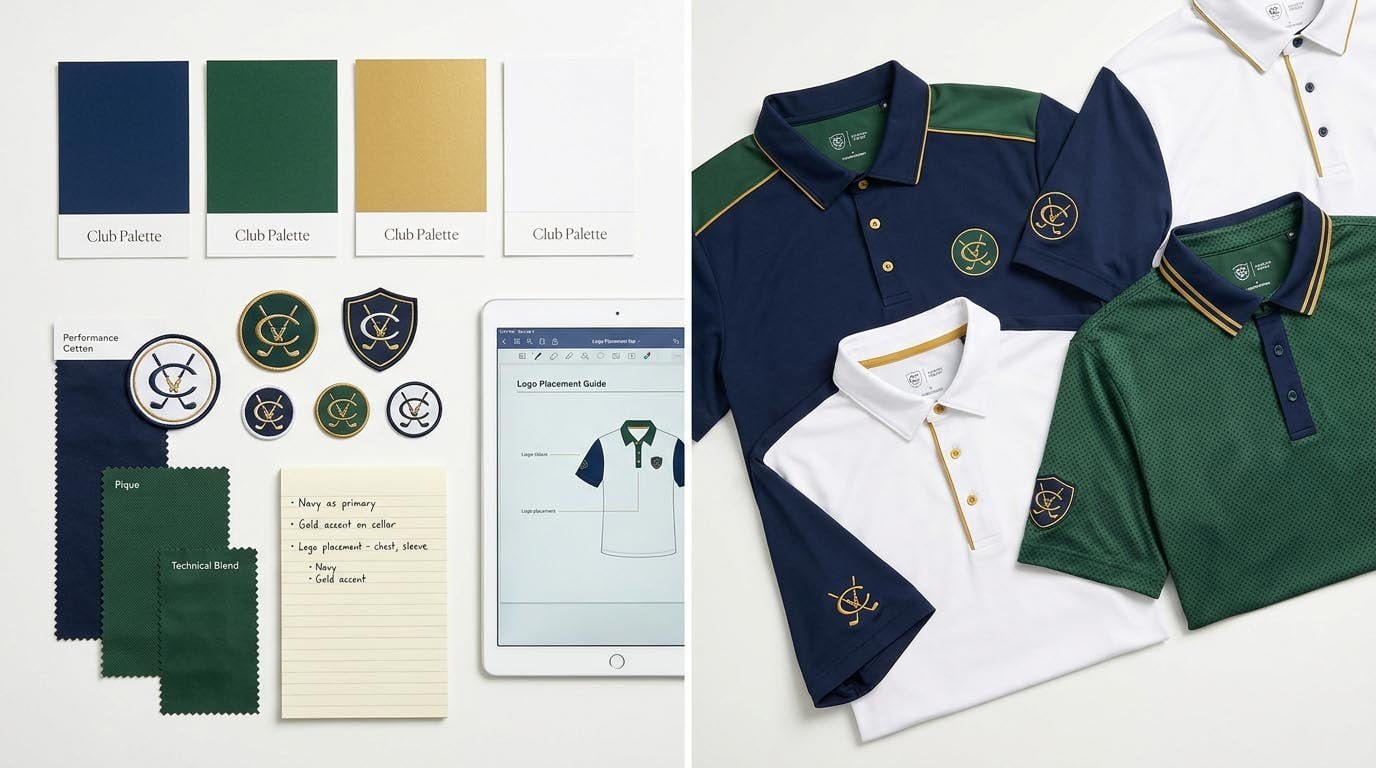
The design question I hear most: "What makes one club uniform look premium versus another?" It's rarely the fabric (most clubs use similar 180-200gsm pique) or the cut (classic fit dominates). It's the intentional contrast details that separate forgettable polos from recognized club identity.
Color-blocking strategies that work for club uniforms:
Contrast sleeves (raglan or set-in):
- Execution: Body in primary color, sleeves in secondary color
- Visual impact: High—creates distinctive silhouette from any angle
- Cost: +$1.20-1.80 per unit (two-color cutting and sewing)
- MOQ impact: Usually requires 200+ pieces (pattern development cost)
- Risk: Athletic/casual feel—verify dress code acceptance first
Shoulder yoke contrast:
- Execution: Upper back panel in contrasting color, visible from behind
- Visual impact: Medium—great for team photos and tournament lineups
- Cost: +$0.80-1.20 per unit
- MOQ impact: 150-200 pieces minimum
- Advantage: More formal than contrast sleeves, works for conservative clubs
Side panel inserts:
- Execution: Vertical panels along torso sides in contrast color
- Visual impact: Medium—creates slimming visual line
- Cost: +$1.50-2.00 per unit (complex pattern cutting)
- MOQ impact: 250-300 pieces (higher pattern complexity)
- Use case: Modern athletic clubs, younger membership
A 150-member club wanted contrast sleeves like they saw on TV. I calculated the cost: 200-piece MOQ × $26 per unit = $5,200. Their previous order was 120 basic polos at $22 = $2,640. The $2,560 increase got rejected. Compromise: shoulder yoke contrast at 150-piece MOQ for +$0.80 = $3,420 total—approved.
Piping and trim details deliver high impact at low cost:
Collar piping:
- Placement: Outer edge of collar, 0.3-0.5cm width
- Cost: +$0.40-0.60 per unit
- Visual lift: Makes standard collar look custom/premium
- Color options: Single color or dual-piping (two thin lines)
Placket trim:
- Placement: Along button placket edges
- Cost: +$0.50-0.70 per unit
- Formality: High—traditional club aesthetic
- Pairing: Works best with matching collar piping
Cuff piping:
- Placement: Sleeve hem edge
- Cost: +$0.30-0.50 per unit
- Cohesion: Creates visual connection with collar detail
Full piping package (collar + placket + cuffs): +$1.50-2.00 per unit—the visual difference versus plain polo is dramatic. We tested this with before/after photos sent to club committees—85% chose the piped version when cost difference was under $2.
Pattern and texture options:
Tonal stripes (same color family, subtle contrast):
- Execution: 0.5-1cm stripes in 5-10% lighter/darker shade of primary color
- Cost: +$0.50-0.80 per unit (jacquard or printed)
- Formality: High—reads as texture, not pattern
- Advantage: Adds visual interest without violating conservative dress codes
Micro-dot or geo patterns:
- Execution: Small repeating pattern, 1-3mm scale
- Cost: +$0.80-1.20 per unit
- Formality: Medium—modern but not loud
- Risk: Can look busy in group settings—test with mockups
Heathered fabrics:
- Execution: Blended yarn colors create subtle depth
- Cost: +$0.30-0.60 per unit (yarn dyeing premium)
- Formality: High—sophisticated texture
- Benefit: Hides minor stains better than solid colors
Pattern caution: I've rejected 15+ designs this year where clubs wanted bold stripes or large-scale patterns inspired by fashion brands. These work in retail but fail in club uniformity—members don't want to stand out individually, they want the group to look cohesive. Keep patterns subtle and tonal.
Collar treatment variations:
Contrast collar underside:
- Execution: Inner collar fabric in secondary color, visible when collar is popped
- Cost: +$0.60-0.90 per unit
- Style impact: Modern, young demographic appeal
- Functionality: Members who play with popped collars for sun protection get visual interest
Striped collar (rugby-style):
- Execution: 1-2cm horizontal stripes in two-tone color
- Cost: +$0.80-1.20 per unit (requires rib knit fabric)
- Heritage: Traditional club aesthetic
- Caution: Can look dated if stripes are too wide (>1.5cm)
Button contrast:
- Execution: Buttons in secondary color versus primary shirt color
- Cost: +$0.15-0.25 per unit
- Subtlety: Understated detail that members notice up close
- Coordination: Match to piping or trim colors for cohesion
Fabric & Performance Choices: UPF, Wicking, Stretch and Weather Options
Club uniforms must balance traditional aesthetics with modern performance—members expect the classic pique look but demand moisture-wicking and stretch that didn't exist in traditional cotton polos.
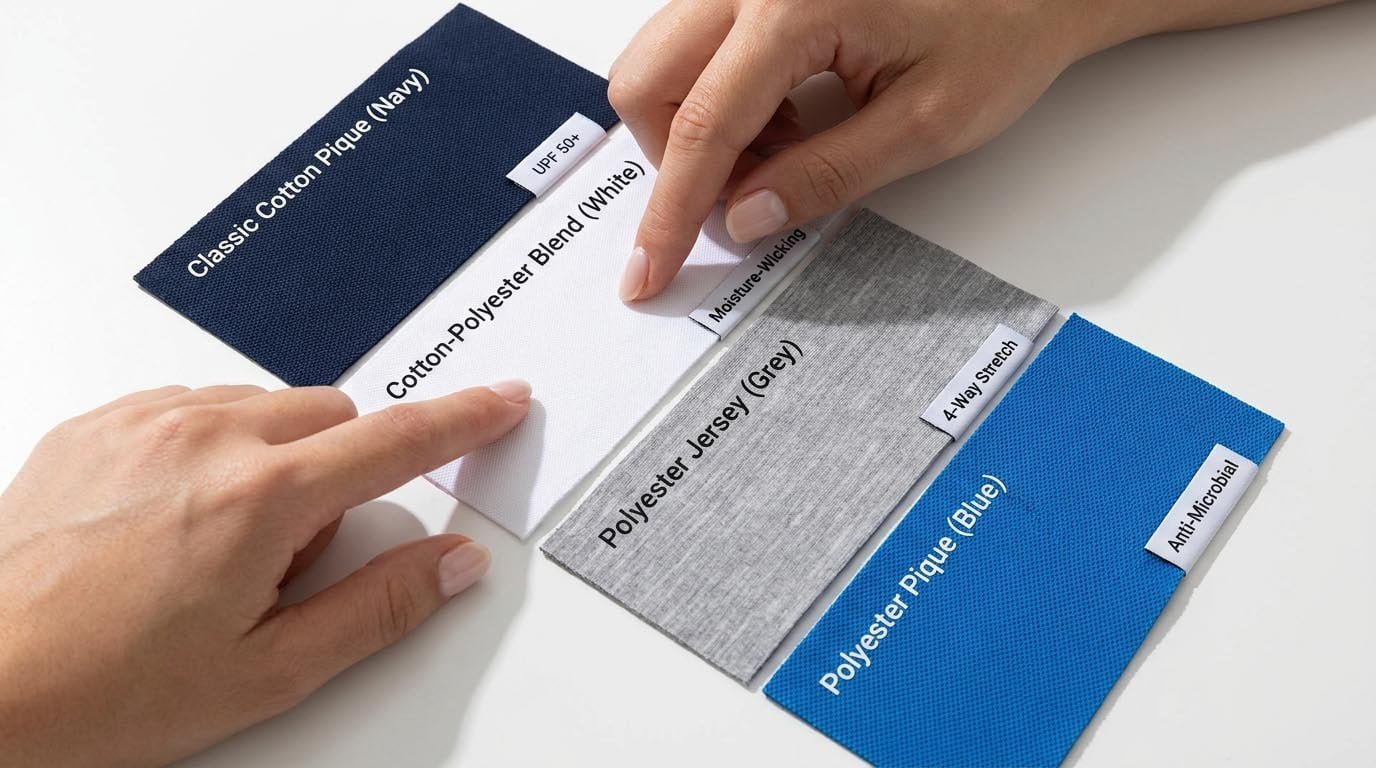
The fabric conversation has changed completely in the last 5 years. Clubs used to order 100% cotton pique without question. Now 60% of club orders request performance blends that look traditional but handle 95°F summer rounds better than pure cotton ever could.
The cotton pique standard (still requested by 40% of clubs):
Pros:
- Classic appearance: The textured waffle knit defines "golf polo" visually
- Breathability: Air channels in the knit structure allow heat escape
- Embroidery-friendly: Stable structure supports detailed logo work
- Durability: 50+ washes with minimal pilling
Cons:
- Weight when wet: Cotton absorbs sweat, adds 200-300g to shirt weight
- Slow drying: Takes 3-4 hours to dry after sweaty round
- Wrinkles easily: Needs ironing to look crisp
- No stretch: Requires 10-12cm ease in pattern for mobility
Cost: $22-26 per unit for 180-200gsm weight at 200-300 piece orders
Performance cotton-poly blends (growing to dominant choice):
60/40 cotton-polyester pique:
- Weight: 180-200gsm, same structure as pure cotton
- Wicking: 40% better moisture transport than 100% cotton
- Drying time: 1-2 hours versus 3-4 for cotton
- Wrinkle resistance: Much better—looks acceptable without ironing
- Durability: 40-45 washes before surface fuzz appears
- Cost: $24-28 per unit (+$2 versus cotton)
50/50 cotton-polyester (balance point):
- Feels more like cotton than 60/40
- Still delivers 60% of performance benefits
- Popular with traditional clubs making first move to performance fabrics
A 180-member club ordered 250 cotton pique polos, then complained after the first summer tournament: "They're too hot and take forever to dry." We remade with 60/40 blend at +$2 per unit = $500 total increase. Member feedback: 95% preferred the new fabric. The club reordered in year two.
Full synthetic performance fabrics:
100% polyester jersey (smooth, athletic):
- Weight: 120-140gsm, lightweight feel
- Wicking: Maximum—pulls sweat to surface instantly
- Stretch: 15-20% with mechanical stretch (no spandex needed)
- UPF: 30-50 rating depending on knit density
- Appearance: Smooth, not textured—less traditional look
- Cost: $20-24 per unit (cheaper than cotton-poly blends)
- Trade-off: Breathability lower than cotton pique in humid heat
Polyester pique (textured, traditional appearance):
- Weight: 160-180gsm, mimics cotton pique texture
- Appearance: Closest synthetic match to traditional golf polo look
- Performance: Full wicking, UPF 40+, quick-dry
- Durability: 30-35 washes before pilling becomes visible
- Cost: $22-26 per unit, competitive with cotton-poly
- Best for: Clubs wanting maximum performance without sacrificing traditional aesthetic
I recommend polyester pique for hot-climate clubs (Southwest US, Southeast in summer). It delivers cotton pique appearance with full synthetic performance. Cold-climate clubs can stick with cotton-poly blends—the breathability advantage matters more when you're not sweating heavily.
Performance feature priorities:
UPF (sun protection):
- UPF 30: Blocks 96.7% of UV—minimum acceptable
- UPF 50+: Blocks 98%+ of UV—maximum protection
- Cost impact: Usually $0-0.50 (achieved through tight knit or treatment)
- Requirement: Essential for sunbelt clubs and all-day tournaments
Moisture-wicking:
- Rating: Look for "moisture management" test scores >3.5/5
- Real difference: Polyester wicks 3-4× faster than cotton
- Member experience: Shirt feels dry even when sweating heavily
- Trade-off: Polyester can feel warmer in high humidity despite being dry
Stretch:
- 10-15% stretch: Adequate for classic fit polos, improves comfort in addressing position and follow-through
- 20-25% stretch: Enables athletic fit without restriction
- Source: Mechanical stretch (knit structure) or spandex/elastane 3-5%
- Risk: Spandex reduces durability—25-30 washes before shape loss
Anti-microbial/odor control:
- Technology: Silver ion treatment or chemical finish
- Effectiveness: Reduces odor 60-80% over untreated fabric
- Duration: Effective for 20-30 washes, then fades
- Cost: +$1-1.50 per unit
- Value question: Does your club uniform get worn frequently enough between washes to justify this? For weekly league play, yes. For monthly tournaments only, probably not.
Weather-specific options:
Summer/hot weather priorities:
- Lightweight fabric (130-150gsm maximum)
- Maximum breathability (open-knit structure)
- Bright colors (light blue, white, gray) reflect heat
Winter/cool weather options:
- Heavyweight pique (200-220gsm) or fleece-backed jersey
- Long-sleeve option in same design language
- Layering-friendly fit (slightly roomier to wear over base layer)
One club in Arizona ordered 200gsm cotton pique—too heavy for their climate. Members complained about overheating during summer rounds. We offered 140gsm polyester pique as replacement—same visual texture, 40% lighter weight. The club now orders both weights: heavy for December-February, light for March-November.
Customization Ideas: Personalization, Crest Treatments and Special Editions
Individual personalization and special edition designs build member pride and exclusivity—but they require different order planning, size allocation strategies, and longer production timelines than standard uniform runs.
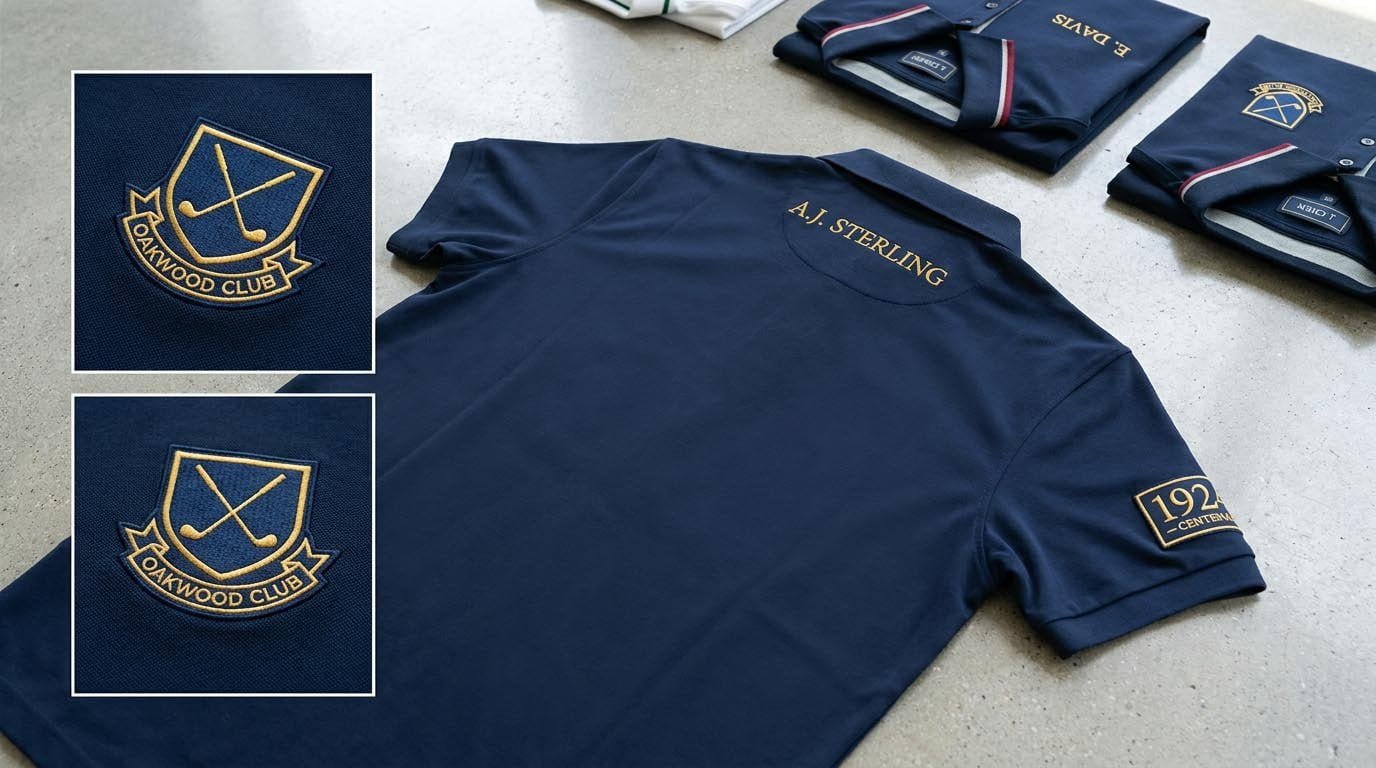
The customization request I hear most: "Can we add member names to the uniforms?" Yes—but it changes your entire order workflow. You can't order 200 pre-embroidered polos and distribute them. You need size projection, claim process, and post-embroidery decoration—adds 7-10 days to delivery and $3-5 per unit in setup complexity.
Name personalization strategies:
Individual name embroidery:
- Placement: Back yoke center (4-5cm below collar) or left chest below logo
- Cost: $3-5 per name depending on letter count (6-12 letters standard)
- Font: Block or script—script looks elegant, block reads better from distance
- Size: 1.5-2cm letter height for back yoke, 1cm for chest
- Color: Match club primary color or contrast for visibility
Process workflow:
- Order blank uniforms in projected size distribution (40% L, 30% XL, 20% M, 10% XXL)
- Members claim specific sizes and submit name spelling
- Add individual names to claimed units
- Distribute personalized uniforms
Lead time impact: +10-12 days versus standard embroidered uniforms
One 120-member club wanted personalized uniforms but couldn't decide on size distribution. I suggested: Survey members' current polo sizes before ordering. They got 98% accurate size orders—only 3 unclaimed units out of 120. Without the survey, clubs typically have 15-20% unclaimed or wrong sizes.
Number personalization (team competition formats):
Back number placement:
- Size: 8-10cm height for visibility in tournament photos
- Cost: $2-3 per number
- Material: Embroidery or tackle twill (sewn fabric numbers)
- Pairing: Combine with name above or below number
Pocket number (discreet option):
- Size: 3-4cm height
- Placement: Upper left chest near heart, above club logo
- Use case: League identification without dominating the design
Crest and badge treatments:
Standard embroidered crest:
- Size: 3.5-4 inches, 8,000-12,000 stitches
- Cost: $4-6 per logo at 200+ piece orders
- Durability: 50+ washes with zero fading
Woven badge (premium upgrade):
- Construction: Woven fabric patch with merrowed edge, sewn onto polo
- Size: 3-4 inches typically
- Cost: $6-10 per badge (includes patch production and attachment)
- Visual impact: Ultra-premium feel, works for heritage clubs and high-end establishments
- Advantage: Finer detail possible than embroidery—0.5mm line thickness versus 1.5mm for embroidery
3D embroidered crest (dimensional effect):
- Technique: High-stitch-count embroidery with puff foam underneath to create raised effect
- Cost: +$1-2 versus standard embroidery
- Impact: Logo literally stands out from fabric surface
- Limitation: Works best on simple shapes—complex details lose effect
A 200-year-old club wanted their crest to reflect heritage. Standard embroidery looked flat. We proposed woven badges at $8 per unit—$1,600 total increase on their 200-unit order. The board approved after seeing samples. Member feedback: "Looks like our clubhouse oil paintings—worth every penny."
Special edition designs:
Championship/tournament editions:
- Differentiation: Add event year and name to back yoke or sleeve
- Production: Order 50-100 units for tournament participants
- Exclusivity: Creates collectible status—members want these more than standard uniforms
- Cost: Same base price, +$2-3 for event-specific embroidery
Anniversary editions:
- Elements: Special color palette, commemorative text ("Est. 1923 - 100 Years"), anniversary logo variation
- Member appeal: High—everyone wants the limited edition
- Order strategy: Make anniversary design the standard uniform for that year—creates unified look for all 12-month events
Captains/officers editions:
- Differentiation: Contrast collar or sleeve stripe versus standard member uniform
- Quantity: Small run (10-20 units) requires negotiation with manufacturer—many have 50-unit minimums
- Alternative: Add "Captain" or "Board Member" embroidery to standard uniform—lower MOQ, same differentiation
- Cost: +$2-4 per unit for contrast elements, or +$3 for title embroidery
Member tier systems (controversial but effective):
Some clubs use uniform variation to denote membership level:
- Full members: Standard design with full club crest
- Associate members: Same design, simplified crest or no crest
- Junior members: Youth sizing, modified color (brighter or lighter version)
Caution: This creates visible hierarchy that some clubs avoid for inclusivity reasons. Survey your membership culture before implementing tier-based designs.
Fit, Range & Accessories: Inclusive Sizing, Silhouettes and Head‑to‑Toe Kits
Uniform programs fail when they ignore body diversity—a 25-year-old athletic female assistant pro and a 68-year-old male senior champion need completely different fits, and both represent your club equally.
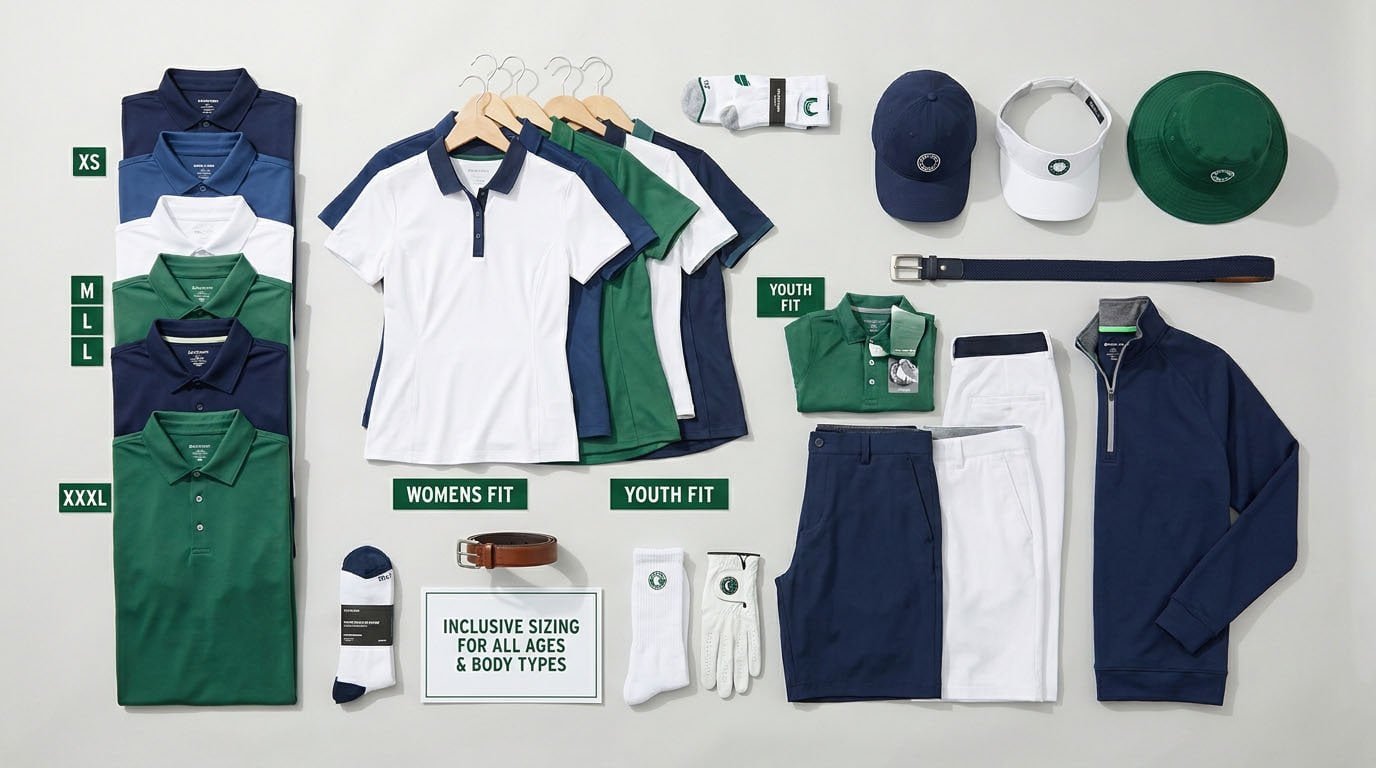
The sizing conversation most clubs avoid: "We'll do S-XXL and that covers everyone." It doesn't. In every 200-member club, you'll have 10-15% who don't fit standard sizing—and they're the ones who won't order uniforms because you didn't plan for them.
Size range planning based on membership demographics:
Men's sizing (standard range):
- S-XXL: Covers 80-85% of male golfers
- Add XS: If you have junior members or assistant pros under 30
- Add XXXL: If your senior membership includes larger builds—this is 15-20% of country clubs in our experience
Sizing reality from 500+ club orders:
- Medium: 15-20% of orders
- Large: 35-40% (the plurality—plan accordingly)
- XL: 25-30%
- XXL: 10-15%
- Small and XXXL combined: 5-10%
Women's sizing (requires separate development):
The mistake: offering unisex sizing and expecting women members to order. Women's golf polos need:
- Different shoulder slope (narrower, more angled)
- Bust darts or princess seams for proper chest fit
- Shorter body length (2-3cm versus men's)
- Narrower sleeve opening
- Smaller collar stand (3cm versus 3.5-4cm for men)
Women's size distribution differs from men's:
- XS-S: 30-35%
- M: 35-40%
- L-XL: 25-30%
A mixed-gender club with 60 male, 40 female members ordered 100 unisex polos in standard distribution. Only 12 women ordered—the rest complained about poor fit. We developed women's sizing for their next order: 60 men's (standard distribution), 40 women's (shifted toward S-M)—91% participation versus 52% previously.
Fit silhouette options:
Classic fit (most club orders):
- Chest ease: 10-12cm
- Body length: Covers belt line when tucked
- Sleeve fit: Loose, minimal taper
- Target demographic: 45-75 age range, comfort prioritized
- Advantage: Flattering on most body types—doesn't highlight weight
Athletic fit:
- Chest ease: 8-10cm
- Body length: Ends at hip bone
- Sleeve fit: Tapered, ends mid-bicep
- Target demographic: 25-45 age range, active players
- Requirement: 15-20% stretch fabric needed—won't work on cotton pique
Performance fit (rare in clubs):
- Chest ease: 6-8cm with 4-way stretch
- Body length: Cropped (ends above hip bone)
- Sleeve fit: Compression-style
- Target demographic: Competitive players only
- Club acceptance: Low—too casual for most club dress codes
I recommend two fit options if your membership has clear age divide: Classic for senior members (60+), athletic for younger members (under 45). This requires pattern development for both, so MOQ increases to 150-200 per fit = 300-400 total. Only worth it for large clubs (300+ members).
Inclusive sizing specifics:
Tall sizing (often forgotten):
- Add 3-5cm body length and 2-3cm sleeve length
- Offered as LT, XLT, XXLT (Tall variants)
- Typical demand: 5-8% of orders for clubs with taller member averages
Big & tall sizing:
- XXXL and up with proportional length increases
- Requires separate pattern grading—not just scaling up XL
- MOQ challenge: 30-50 pieces per size when total demand is 10-15 units
Youth/junior sizing:
- Ages 8-16 require completely different pattern—not scaled-down adult
- Size labels: YS, YM, YL, YXL to distinguish from adult
- Typical demand: 15-25 units for clubs with junior programs
Accessories for complete uniform program:
Matching shorts:
- Cost: $18-24 per pair at 100-200 piece orders
- Fabric: Stretch twill or performance blend
- Details: Match polo piping color on waistband or pocket trim
Matching pants (cooler weather):
- Cost: $28-35 per pair
- Fabric: Stretch cotton-poly or lightweight wool blend
- Fit: Flat front (modern) or pleated (traditional)
Outerwear coordination:
- Quarter-zip pullover: $35-45, same color palette as polos
- Vest: $32-40, great for shoulder-season play
- Full-zip jacket: $45-60, windproof/water-resistant for poor weather
Headwear:
- Performance caps: $12-18, embroidered logo on front panels
- Visors: $10-15, popular with women members
- Bucket hats: $15-22, growing popularity for sun protection
Head-to-toe kit pricing (polo + shorts + cap):
| Uniform Level | Polo Cost | Shorts Cost | Cap Cost | Total Kit | Member Appeal |
|---|---|---|---|---|---|
| Basic | $24 | $20 | $14 | $58 | Acceptable for required events |
| Standard | $28 | $24 | $16 | $68 | Good for regular club play |
| Premium | $35 | $30 | $18 | $83 | High for tournaments and special events |
Most clubs order 2-3 polo designs (different colors) but one shorts and one cap design—gives members outfit variety without multiplying costs. Total program investment: 3 polos + 1 shorts + 1 cap = $58 + $28 + $28 + $24 + $16 = $154 per member—reasonable for full-season club wardrobe.
Conclusion
Stand-out club uniforms balance visual differentiation (color-blocking, piping, custom crests) with dress code formality—prioritize strategic details over bold designs, plan inclusive sizing, and choose performance fabrics that members will actually wear in your climate. Budget $25-35 per polo for quality that lasts 3-5 years of regular use.