
A client called last October with their summer polo bestseller—92% polyester, 180 GSM, standard fit. They asked if we could "make a fall/winter version" by using 220 GSM fabric and adding fleece lining. I explained we would need to completely reconstruct the pattern: adjust sleeve construction for layering, change collar height, modify torso length, and switch to stretch-engineered fabric that maintains mobility under insulation. They were surprised—they thought fall/winter was just "thicker summer."
Fall/winter golf apparel requires functional reconstruction, not seasonal thickening—solving the warmth-breathability-mobility triangle through fabric reselection (merino blends, brushed interiors, thermal polyester), fit recalibration (raglan sleeves, articulated elbows, extended body length), and layering-system logic where each piece serves specific temperature ranges rather than attempting universal coverage.
I see this pattern every fall: brands approaching us wanting to "winterize" their summer hits. They assume adding weight or insulation will work. The result: products that are too warm during active play, too stiff for full swings, or too restrictive when layered. I have guided 40+ brands through fall/winter development over 15 years. The successful ones understand fall/winter golf is a different use case requiring different product architecture. The struggling ones adapt summer designs superficially, then face returns for "restricted movement" or "too hot after three holes." This guide shows you the decision frameworks for fall/winter development that actually work on-course.
Quick Answers: What Brands Misunderstand About Fall/Winter Golf Development
Q: Is heavier fabric enough for fall/winter golf pieces?
No. Simply adding weight makes garments stiff and restricts swings. Use 200–220 GSM fabric with 12–15% stretch, brushed interiors for warmth, and thermal lining with 4-way stretch for pants. Expect fabric costs 15–25% higher but get real mobility.
Q: How should layering be structured for cold weather golf?
Build 3–4 layer systems (base, mid, insulation), each tuned for narrow temp bands (-5 to 20°C collectively). Don’t over-engineer one heavy piece—coordinate fit across layers for comfortable stacking. Sell-through improves 30–40% with this approach.
Q: What sleeve and shoulder construction is needed?
For layered wear, use raglan sleeves with gussets or articulated sleeves (+$1.20–2.20/unit) for an extra 15–20° rotation. Always test prototypes with base + mid + outer layer to ensure swing mobility—especially in pullovers, vests, jackets.
Q: Is breathability important for fall/winter, or just warmth?
Yes—“Warm but sweaty” is a top return reason (18–22%). Integrate mesh linings, underarm vents, or breathable membranes (+$1.50–3.00/unit) to cut returns by half.
Q: How do packability and multi-layer compatibility influence buying?
Golfers need gear that’s easy to layer and pack—vests that compress to pocket, jackets with stuff sacks, mid-layers slim enough for under-outerwear. Test for fist-size compression and wrinkle recovery. This multiplies use cases and prevents “too bulky” failures.
Cold-Weather Fabric Innovations: Merino, Brushed Knits and Smart Thermals?
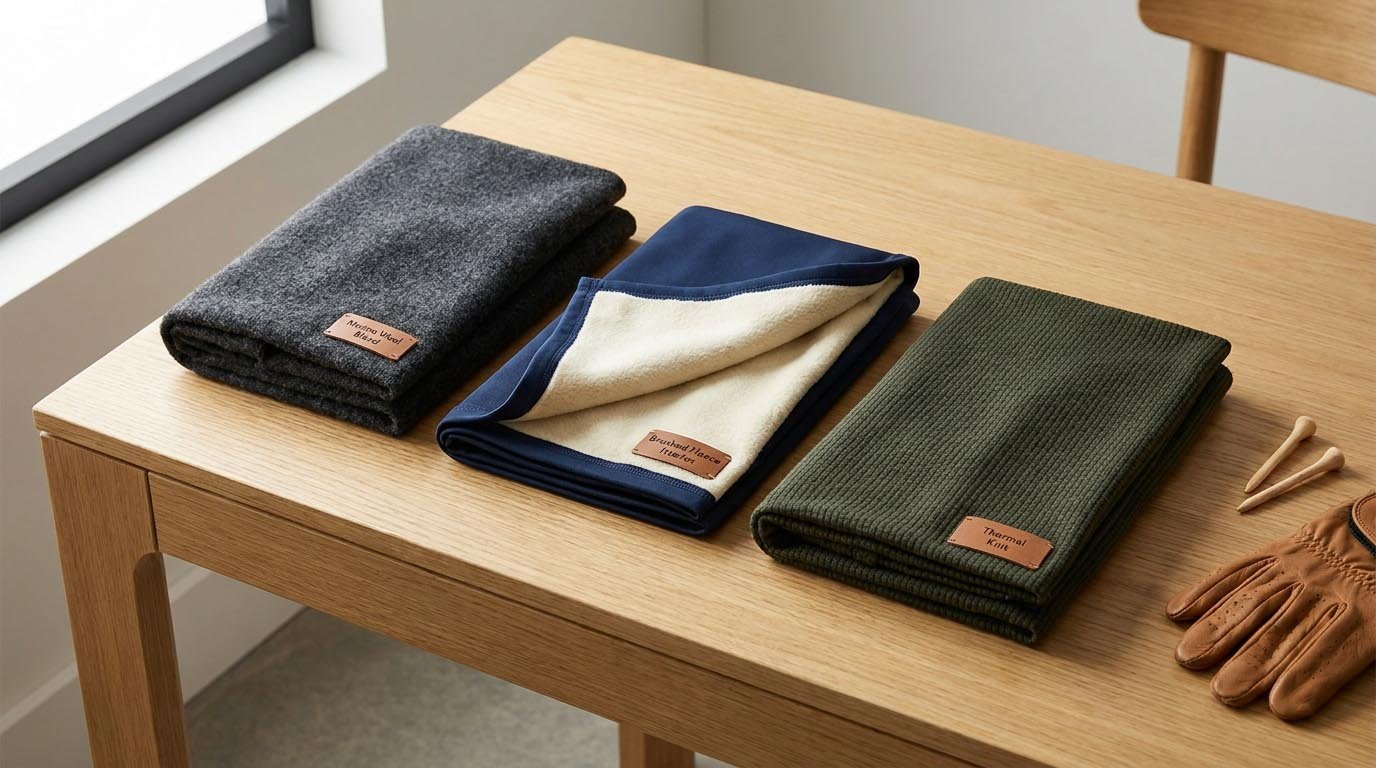
Select fall/winter fabrics based on target temperature range and activity intensity, not generic "warmth ratings"—merino blends for base layers (5-15°C active play), brushed polyester for mid-layers (0-12°C moderate activity), and thermal-engineered synthetics for outer layers (-5 to 8°C with wind exposure)—each solving specific sections of the warmth-breathability-mobility triangle.
Fabric selection conversations reveal whether brands understand fall/winter development or are just guessing. The right question is not "what fabric is warmest?" but "what fabric solves warmth-at-this-temperature while maintaining breathability during active play and mobility during full swings?"
The Warmth-Breathability-Mobility Triangle
Every fall/winter fabric makes tradeoffs:
Warmth vs Breathability:
- High warmth fabrics (thick fleece, heavy knits) trap heat but also trap moisture
- High breathability fabrics (thin synthetics, open weaves) release moisture but lose heat
Warmth vs Mobility:
- Insulated fabrics (down, synthetic fill) provide warmth but add bulk and restriction
- Stretch fabrics maintain mobility but often sacrifice insulation capacity
Breathability vs Wind Protection:
- Breathable fabrics allow moisture escape but also allow wind penetration
- Windproof fabrics block wind but can trap moisture
The goal: Match fabric solution to specific use case rather than chasing "perfect fabric" that does everything.
Merino Wool Blends: Base Layer Foundation
Why merino works for golf base layers:
Merino addresses specific fall/winter golf challenges:
Temperature regulation:
- Natural fiber adapts to 5-20°C range better than synthetics
- Keeps warm when cool, breathes when active
- Does not feel clammy when sweating (unlike polyester base layers)
Odor resistance:
- Natural antimicrobial properties (no treatment needed)
- Can wear 2-3 rounds between washing (tournament/travel friendly)
Comfort against skin:
- Soft hand feel (modern merino, not scratchy wool)
- No synthetic texture against skin for 4-5 hours
Merino Blend Specifications:
| Blend Type | Composition | Weight | Cost Impact | Best Use |
|---|---|---|---|---|
| Merino-dominant | 70-85% merino, 15-30% synthetic | 180-200 GSM | +$5-8 per meter vs polyester | Premium base layers, $80-110 retail |
| Balanced blend | 50-60% merino, 40-50% synthetic | 160-180 GSM | +$3.50-5.50 per meter | Mid-tier base layers, $60-85 retail |
| Synthetic-dominant | 30-40% merino, 60-70% synthetic | 140-160 GSM | +$2.00-3.50 per meter | Value base layers with merino benefits, $45-65 retail |
My recommendation:
For $70-90 retail base layer positioning, target 50-60% merino blend at 160-180 GSM. This provides tangible merino benefits (temperature regulation, odor resistance) while controlling cost through synthetic blend.
Merino tradeoffs:
Advantages:
- Superior temperature regulation across 10-15°C range
- Natural odor control (no chemical treatments)
- Comfortable for extended wear (4-5 hours)
Disadvantages:
- Higher cost: $3-8 per meter premium over synthetic
- Durability concerns: Pure merino pills and wears faster than synthetics (blends mitigate this)
- Care requirements: Often require gentler washing than synthetics
When to use merino:
- Premium positioning: $75+ retail where customers expect quality materials
- Cold-climate markets: Customers value warmth and temperature regulation
- Multi-day tournament/travel focus: Odor resistance is key benefit
When to skip merino:
- Value positioning: Under $60 retail where cost matters more
- Budget constraints: Merino adds $3-5 per piece that may not be recoverable in pricing
- First fall/winter collection: Validate demand with synthetic base layers first
Brushed Interior Knits: Mid-Layer Warmth
Brushed polyester construction:
Brushed interior creates warmth without weight through:
Fabric structure:
- Exterior: Standard knit surface (smooth, presentable)
- Interior: Brushed fibers trap air (insulation without bulk)
- Result: Feels 30-40% warmer than unbrushed fabric at same weight
Cost structure:
- Brushed fabric: +$1.20-2.00 per meter vs unbrushed polyester
- Per-piece impact: +$1.50-2.50 for quarter-zip or pullover
- Retail positioning: Justifies $10-18 higher pricing through "enhanced warmth"
Brushed fabric specifications:
Fabric weight with brushing:
- Standard quarter-zip: 280-320 GSM brushed interior
- Heavy quarter-zip: 320-360 GSM brushed interior
- Pullover/hoodie: 300-340 GSM brushed interior
Warmth-to-weight ratio:
- 280 GSM brushed = approximately 340 GSM unbrushed warmth
- 320 GSM brushed = approximately 400 GSM unbrushed warmth
Why this matters:
Lighter garment with equal warmth = better mobility and packability. Golf swings require unrestricted movement—every 20-30 GSM reduction improves comfort without sacrificing performance.
Brushed interior tradeoffs:
Advantages:
- Warmth without bulk: Lighter fabric achieves target temperature rating
- Soft hand feel: Interior comfort during extended wear
- Cost-effective: $1.50-2.50 per piece vs other insulation methods
Disadvantages:
- Pilling risk: Interior brushing can pill faster than smooth fabric
- Drying time: Brushed interior holds moisture longer (takes 15-20% longer to dry)
- Durability: Heavy use can compress brushed fibers over time
Brushed fabric recommendation:
Use brushed interior for all fall/winter mid-layers (quarter-zips, pullovers, hoodies) at $70+ retail positioning. The cost premium pays for itself through customer comfort and warmth perception.
Smart Thermal Synthetics: Engineered Performance
Advanced polyester constructions:
Modern thermal fabrics go beyond basic polyester:
Grid-back fleece:
- Structure: Raised grid pattern on interior traps air in pockets
- Benefit: Warmth without weight (20-25% lighter than solid fleece for same warmth)
- Cost: +$1.80-3.00 per meter vs standard fleece
- Use: Premium mid-layers, athletic base layers
Hollow-core fibers:
- Structure: Fibers with hollow centers trap more air per gram
- Benefit: Insulation without thickness
- Cost: +$1.20-2.20 per meter
- Use: Lightweight base layers, packable mid-layers
Thermal-engineered knits:
- Structure: Variable knit density (tight exterior, loose interior)
- Benefit: Wind resistance + breathability in single fabric
- Cost: +$2.00-3.50 per meter
- Use: Outer layers, windproof mid-layers
Smart thermal cost-benefit:
| Technology | Cost Premium | Warmth Improvement | Weight Reduction | Worth It? |
|---|---|---|---|---|
| Grid-back fleece | +$1.80-3.00/meter | +20-30% | -20-25% | Yes for premium mid-layers ($85+ retail) |
| Hollow-core fibers | +$1.20-2.20/meter | +15-20% | -15-20% | Maybe for lightweight base layers (customer can't verify) |
| Thermal-engineered knit | +$2.00-3.50/meter | +25-35% | -10-15% | Yes for outer layers where wind protection matters |
| Phase-change materials | +$3.50-6.00/meter | Variable (adapts) | No reduction | No for golf (can't verify, high cost) |
My recommendation:
Invest in grid-back fleece or thermal-engineered knits for premium fall/winter lines ($85+ retail). Skip hollow-core and phase-change technologies—customers cannot verify benefits and cost premium is not recoverable.
Fabric Selection Framework by Temperature
Match fabric to target temperature range:
| Temperature Range | Activity Level | Fabric Solution | Example Products |
|---|---|---|---|
| 15-20°C | Active play | Lightweight merino blend (160-180 GSM) | Base layer polo, long sleeve |
| 10-18°C | Moderate activity | Brushed polyester (280-300 GSM) | Quarter-zip pullover |
| 5-15°C | Active play with standing | Grid-back fleece (300-320 GSM) | Mid-layer pullover, hoodie |
| 0-10°C | Active with wind | Thermal knit + wind layer (340-360 GSM) | Insulated vest, softshell |
| -5 to 5°C | Cold + wind exposure | Layering system required | Base + mid + insulated outer |
The mistake:
Brands trying to create one garment covering 0-20°C. This is impossible without compromising function. Better: 3-4 products covering overlapping ranges that layer intelligently.
Fabric Budget Allocation
For $30,000 fall/winter production budget:
Fabric cost breakdown:
- Merino base layers: $8-12 per meter × 800-1,000 pieces = $4,500-6,500 fabric cost
- Brushed mid-layers: $6.50-9.00 per meter × 1,000-1,200 pieces = $5,500-8,000 fabric cost
- Thermal outerwear: $9-14 per meter × 600-800 pieces = $4,500-7,500 fabric cost
Total fabric investment: $14,500-22,000 (48-73% of production budget)
This is higher percentage than spring/summer (40-55%) because fall/winter requires more expensive fabrics to function properly. Brands that under-invest in fabric to control costs create products that fail functionally.
Insulation Done Smarter: Hybrid Vests, Mapped Warmth and Packable Jackets?
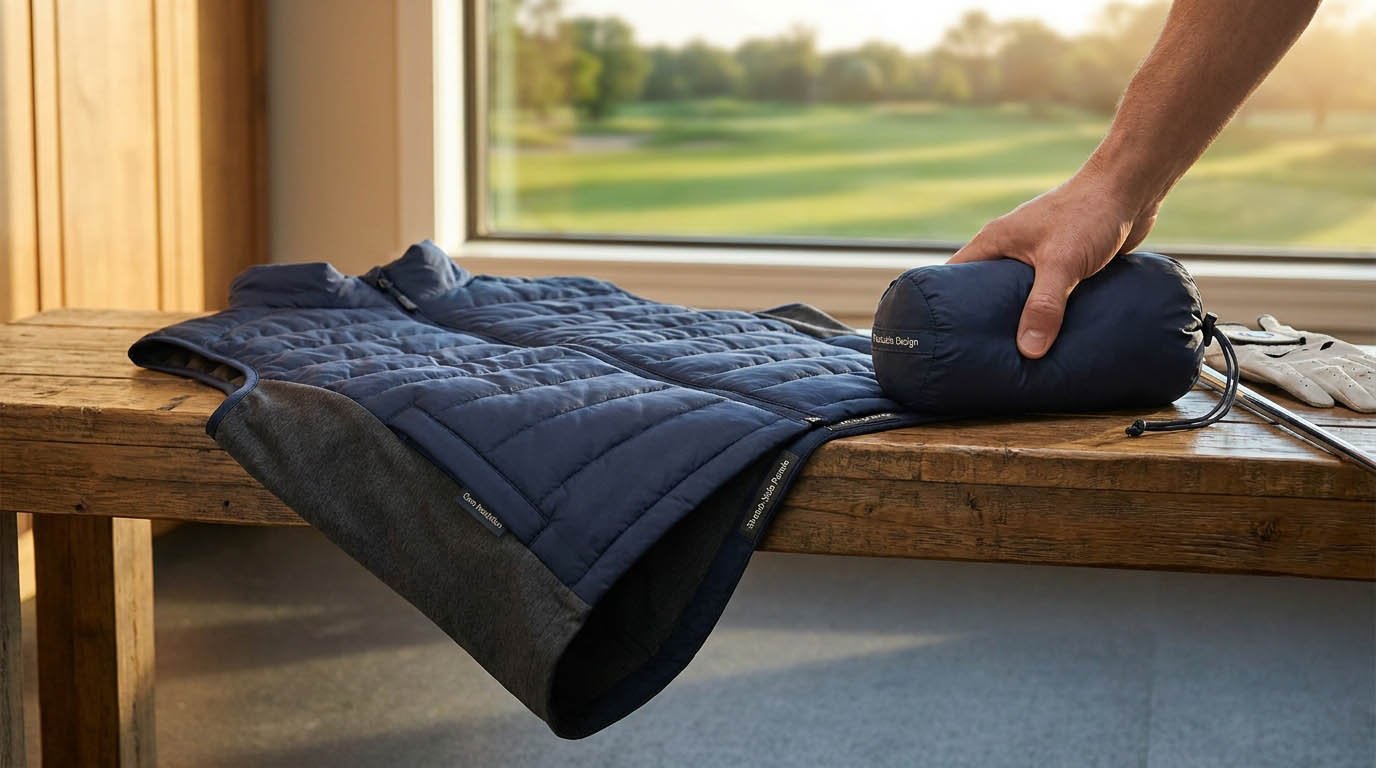
Structure fall/winter insulation through zoned warmth engineering—core insulation in torso (60-80 gram synthetic fill), minimal/no insulation in arms and shoulders (preserves mobility), and packable construction that compresses to fist-size for golf bag transport—rather than uniform insulation that overheats active areas while under-serving sedentary zones.
Insulation conversations reveal whether brands understand golf-specific needs. The wrong approach: "Use 100-gram down throughout for maximum warmth." The right approach: "Where does the golfer need warmth without restricting swing motion?"
Hybrid Vest Construction: The Intelligent Solution
Why vests are fall/winter workhorses:
Vests solve golf-specific problems:
Core warmth without arm restriction:
- Insulates torso (where heat loss matters most)
- Leaves arms free for unrestricted swing rotation
- No bulk at shoulders (critical mobility zone)
Layering compatibility:
- Fits over base layers and under jackets
- Versatile across 5-15°C temperature range
- Can add/remove during rounds without full outfit change
Packability:
- Compresses to 1/3 size when not worn
- Stores in golf bag or cart easily
- Customers actually carry it (vs heavy jackets left in car)
Hybrid vest specifications:
What "hybrid" means:
Body/core:
- Insulated panels: 60-80 gram synthetic fill or 600-700 fill-power down
- Windproof outer fabric: Blocks wind penetration
- Mesh-lined interior: Breathability in high-activity zones
Sides/underarms:
- Stretch fleece panels: Mobility + breathability
- No insulation: Prevents overheating during active play
- Articulated fit: Accommodates swing motion
Cost structure:
| Vest Type | Insulation | Cost to Produce (1,000 pcs) | Retail Price | Margin |
|---|---|---|---|---|
| Basic insulated vest | 60g synthetic, uniform | $22-28 | $90-120 | 68-73% |
| Hybrid vest | 60-80g core, stretch sides | $26-34 | $110-140 | 68-75% |
| Premium hybrid vest | 700-fill down core, technical sides | $35-45 | $140-180 | 70-77% |
Hybrid construction adds $4-8 per piece but commands $20-30 higher retail through functional differentiation.
Mapped Warmth: Zoned Insulation Engineering
Body mapping concept:
Different body zones need different insulation levels:
High-insulation zones (sedentary, high heat loss):
- Front torso: Standing between shots, wind exposure
- Back torso: Core temperature maintenance
- Insulation target: 60-80 gram fill
Medium-insulation zones (moderate activity):
- Upper arms: Some movement, moderate heat loss
- Lower back: Bending motion, moderate activity
- Insulation target: 40-50 gram fill
Low/no-insulation zones (high activity, mobility critical):
- Underarms: Full swing rotation happens here
- Shoulders: Backswing requires unrestricted movement
- Side panels: Torso rotation during swing
- Insulation target: 0-20 gram or stretch fabric only
Mapped warmth production process:
Pattern complexity:
- Basic vest: 2-3 pattern pieces (front, back, collar)
- Mapped vest: 6-8 pattern pieces (zones require separate cutting)
- Labor time: +15-20% more assembly time
- Cost impact: +$3-5 per piece
Why it works:
Players stay warm where they need it, breathe where they generate heat, and move unrestricted in critical swing zones. This is why golf vests cost $110-140 versus athletic vests at $70-90—the engineering serves golf-specific function.
Mapped warmth application:
Vests:
- Core: 70-80 gram synthetic or 700-fill down
- Sides: Stretch fleece or softshell fabric
- Shoulders: Minimal insulation (freedom of movement)
Jackets:
- Front/back torso: 80-100 gram fill
- Arms: 40-60 gram fill (balance warmth and mobility)
- Underarms: Stretch panels, no insulation
Pants (if offering):
- Thighs: Light insulation or thermal lining
- Knees: No insulation (bending flexibility)
- Calves: Light insulation for standing warmth
Packable Construction: Portability Matters
Why packability is critical for golf:
Golf bag space constraints:
- Players carry 12-15 items in bag (clubs, balls, accessories)
- Space for apparel is limited
- Bulky items get left behind (eliminating their usefulness)
Temperature variance during rounds:
- Morning: 8-12°C (need insulation)
- Midday: 15-20°C (remove insulation)
- Late afternoon: 10-14°C (put insulation back on)
Packable features:
Compression capability:
- Must compress to fist-size or smaller
- Internal stuff sack or jacket packs into own pocket
- Cost: +$0.80-1.50 per piece for packable features
Quick-recovery fabric:
- Releases wrinkles quickly after unpacking
- Maintains shape after 10-15 compression cycles
- Fabric choice critical (synthetic outperforms down for recovery)
Lightweight construction:
- Total weight: 250-350 grams for vests, 400-550 grams for jackets
- Every 50 grams saved improves packability and wearing comfort
Packability testing standard:
Ask during sampling:
- Can it compress to 12cm × 15cm or smaller?
- Does it recover shape within 5-10 minutes after unpacking?
- Can player pack/unpack mid-round without assistance?
If answer to any is "no," construction needs revision.
Insulation Material Selection
Synthetic vs Down tradeoffs:
| Factor | Synthetic Fill | Down Fill | Golf Context |
|---|---|---|---|
| Warmth-to-weight | Good (60-80g = moderate warmth) | Excellent (600-700 fill = high warmth, light weight) | Down advantage for packability |
| Moisture resistance | Excellent (maintains warmth when damp) | Poor (loses 50%+ warmth when wet) | Synthetic wins for morning dew, light rain |
| Packability | Good (compresses well) | Excellent (compresses 30-40% smaller) | Down advantage for golf bag storage |
| Price | Lower ($22-28 per piece) | Higher ($35-45 per piece) | Synthetic wins for value positioning |
| Durability | Excellent (maintains loft 100+ washes) | Good (loses 10-15% loft over time) | Synthetic wins for longevity |
| Ethics/marketing | No concerns | Requires responsible down sourcing | Down requires supply chain attention |
My recommendation:
Use synthetic fill for:
- Value-tier vests: $90-120 retail where cost control matters
- Wet climates: Pacific Northwest, UK where morning moisture common
- High-use scenarios: Players washing frequently
Use down fill for:
- Premium vests: $140-180 retail where packability and weight matter
- Cold-dry climates: Northeastern US, mountain courses
- Low-use luxury: Players wanting lightest, smallest-packing option
Hybrid fill approach:
- Down in core (maximum warmth-to-weight)
- Synthetic in high-moisture zones (maintains function if damp)
- Cost: Midway between full synthetic and full down
Insulation Product SKU Structure
For 800-piece insulation layer order:
| Product Type | Piece Count | % of Total | Fill Type | Rationale |
|---|---|---|---|---|
| Hybrid vests | 450-500 | 55-60% | Synthetic 60-80g | Workhorse layer, best versatility |
| Insulated pullovers | 200-250 | 25-30% | Synthetic 40-60g | Alternative to vests, style variety |
| Packable down vests | 100-150 | 15-20% | 700-fill down | Premium option, extreme packability |
This structure provides:
- Core volume in proven category (hybrid vests)
- Style alternative (pullovers serve customers who prefer sleeves)
- Premium tier (down vests differentiate at high end)
Failed allocation pattern:
Equal split across vest + pullover + jacket + heavy fleece = fragmented inventory at 100-150 pieces each. This creates stockouts in popular items while slow items sit.
Quiet Weatherproofing: Softshells, Waterproof Shells and Breathability?
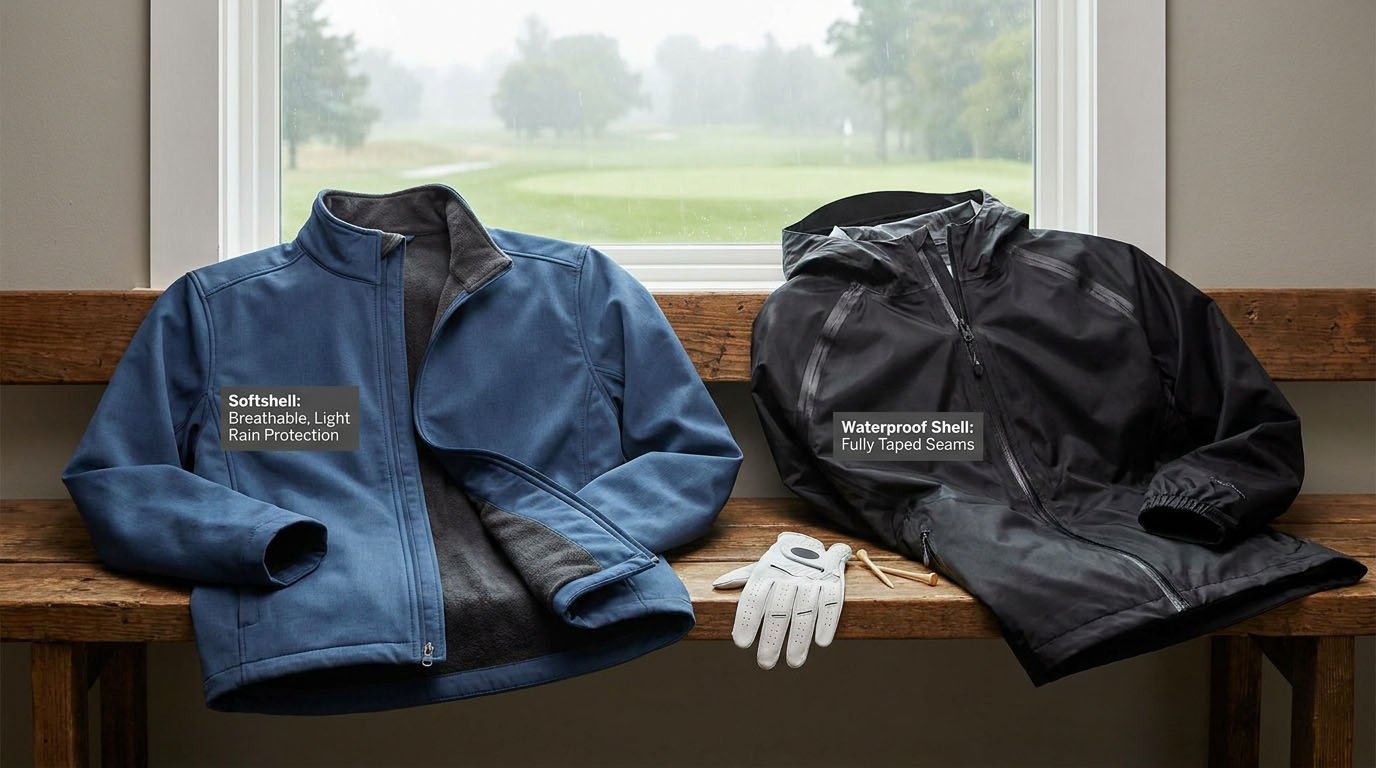
Prioritize breathable softshells (10,000-15,000mm waterproofing, high MVTR) over fully waterproof shells for fall/winter golf positioning—golfers play through light rain and wind more often than heavy storms, and breathability matters more during active play than maximum waterproof ratings that trap moisture and create interior condensation.
Weather protection conversations expose supplier knowledge. Inexperienced manufacturers push 20,000mm waterproof shells because the numbers sound impressive. But golf happens in light-to-moderate rain where breathability matters more than extreme waterproofing.
Softshell vs Hardshell Decision Framework
When to use softshells:
Best for fall/winter golf:
- Light rain: 50-80% of rainy golf happens in drizzle, not downpours
- Wind protection: Primary need during fall/winter (wind chill factor)
- Breathability priority: Active play generates moisture that must escape
- Comfort: Softshell feels less "technical" and restrictive
Softshell specifications:
Fabric construction:
- Outer layer: Tightly woven polyester with DWR (durable water repellent) treatment
- Middle layer: Windproof membrane or coating
- Inner layer: Soft fleece or brushed knit (comfort + light insulation)
Performance ratings:
- Waterproofing: 10,000-15,000mm (adequate for light-moderate rain)
- Breathability (MVTR): 10,000-15,000 g/m²/24hr (high—critical for golf)
- Windproofing: Excellent (blocks 95-98% wind)
Cost structure:
- Production cost: $35-48 per piece at 800-1,000 units
- Retail positioning: $120-160
When to use hardshells (fully waterproof):
Best for extreme conditions:
- Heavy rain: Prolonged downpours, tournament play in storms
- Maximum protection: Customer demands highest waterproof rating
- Brand positioning: Premium/technical positioning requires it
Hardshell specifications:
Fabric construction:
- Outer fabric: Technical polyester or nylon
- Waterproof membrane: 15,000-20,000mm rating (or higher)
- Inner lining: Mesh or light fabric (not insulated)
Performance ratings:
- Waterproofing: 15,000-20,000mm+ (maximum protection)
- Breathability (MVTR): 8,000-12,000 g/m²/24hr (lower than softshells—tradeoff)
- Windproofing: Complete (100% wind blocking)
Cost structure:
- Production cost: $45-65 per piece (waterproof membrane expensive)
- Retail positioning: $150-220
The Breathability Problem
Why breathability matters more than waterproof ratings:
During golf play:
- Activity level: Moderate-high (walking, swinging)
- Duration: 4-5 hours continuous
- Moisture generation: Body produces 0.5-1.5 liters of moisture vapor per round
What happens with poor breathability:
- Moisture vapor trapped inside jacket
- Interior becomes damp despite no rain penetration
- Player feels cold and clammy (moisture conducts heat away)
- Common complaint: "The jacket kept rain out but I was wet inside anyway"
Breathability measurement:
MVTR (Moisture Vapor Transmission Rate):
- Measures grams of moisture that pass through 1 square meter of fabric in 24 hours
- Higher number = better breathability
Golf-appropriate MVTR targets:
| Garment Type | Minimum MVTR | Recommended MVTR | Why |
|---|---|---|---|
| Softshell jacket | 10,000 g/m²/24hr | 12,000-15,000 | High activity needs high breathability |
| Hardshell rain jacket | 8,000 g/m²/24hr | 10,000-12,000 | Must balance waterproofing and breathability |
| Insulated jacket | 8,000 g/m²/24hr | 10,000-12,000 | Insulation reduces breathability need slightly |
| Vest (outer layer) | 10,000 g/m²/24hr | 12,000+ | High torso activity needs maximum breathability |
Breathability features beyond fabric:
Pit zips (underarm ventilation):
- Length: 6-8 inches zipper under each arm
- Benefit: Rapid heat/moisture dump when needed
- Cost: +$1.50-2.50 per piece
- Worth it: Yes for $140+ retail jackets
Back vents:
- Type: Mesh-lined openings at lower back
- Benefit: Natural convection pulls hot air out
- Cost: +$0.80-1.40 per piece
- Worth it: Yes for softshells and active-use jackets
Mesh interior lining:
- Coverage: Full or partial interior mesh
- Benefit: Creates air gap between body and outer fabric
- Cost: +$1.20-2.00 per piece
- Worth it: Yes for hardshells where fabric breathability is lower
Seam Sealing Strategy
Seam sealing levels:
Fully taped (all seams):
- When needed: Hardshell rain jackets for heavy rain
- Cost impact: +$3.50-5.50 per piece
- Requirement: Maximum waterproofing
Critically taped (shoulders, hood, front zip):
- When needed: Softshells, moderate rain protection
- Cost impact: +$1.80-3.00 per piece
- Requirement: Balances protection and cost
No taping:
- When acceptable: Wind shells, light water resistance only
- Cost impact: Baseline
- Limitation: Not waterproof in sustained rain
My recommendation:
- Softshells: Critically taped (shoulders, hood)—adequate for golf, controls cost
- Hardshells: Fully taped—customers expect it at premium pricing
- Wind shells: No taping—not positioning as rain gear
Waterproof Rating Reality Check
What waterproof ratings mean:
- Fabric can withstand 10,000mm water column pressure before leaking
- Real-world equivalent: Light-moderate rain for 2-3 hours
- Golf context: Adequate for 80-85% of rainy rounds
15,000mm waterproofing:
- Real-world equivalent: Moderate-heavy rain for 4-5 hours
- Golf context: Covers 95% of golf weather scenarios
20,000mm+ waterproofing:
- Real-world equivalent: Extreme downpours, extended exposure
- Golf context: Overkill for most golf—tournament storms only
The rating trap:
Brands chase 20,000mm+ ratings thinking "higher is better." But:
- Higher waterproofing often reduces breathability
- Cost increases $8-15 per piece for extreme ratings
- Customers cannot distinguish 15,000mm vs 20,000mm in actual use
- Marketing value exceeds functional value
Recommended waterproof targets by positioning:
| Price Tier | Waterproof Rating | Breathability | Seam Seal | Investment Justification |
|---|---|---|---|---|
| Value ($100-130) | 8,000-10,000mm | 8,000-10,000 MVTR | Critical seams | Adequate for most fall/winter |
| Mid ($130-170) | 10,000-15,000mm | 10,000-14,000 MVTR | Critical or full | Covers 90%+ scenarios |
| Premium ($170-220+) | 15,000-20,000mm | 10,000-12,000 MVTR | Full sealing | Maximum protection, brand expectation |
Weather Layer Product Structure
Complete weather protection lineup:
For 600-piece weather layer order:
| Product Type | Piece Count | % of Total | Specs | Target Use |
|---|---|---|---|---|
| Softshell jacket | 300-350 | 50-55% | 12,000mm/12,000 MVTR | Daily fall/winter, wind + light rain |
| Packable rain shell | 150-180 | 25-30% | 15,000mm/10,000 MVTR | Emergency rain protection |
| Insulated softshell | 100-120 | 17-20% | 10,000mm/10,000 MVTR + 40-60g insulation | Cold + wind + light rain |
| Windshell | 50-80 | 8-12% | Wind-resistant only | Mild days, wind protection |
Why this allocation:
- Softshells are versatile daily-use items (highest volume)
- Rain shells serve specific need (moderate volume, high margin)
- Insulated softshells combine weather + warmth (niche but valuable)
- Windshells fill lightweight protection gap (testing allocation)
Failed pattern:
Brands ordering equal quantities of rain shells and softshells, thinking both serve same market. Result: Softshells sell out, rain shells sit (players prefer versatile softshells for daily use, only buying dedicated rain shells occasionally).
Mobility-First Construction: Sleeves, Cuffs, Gussets and Pocket Systems?
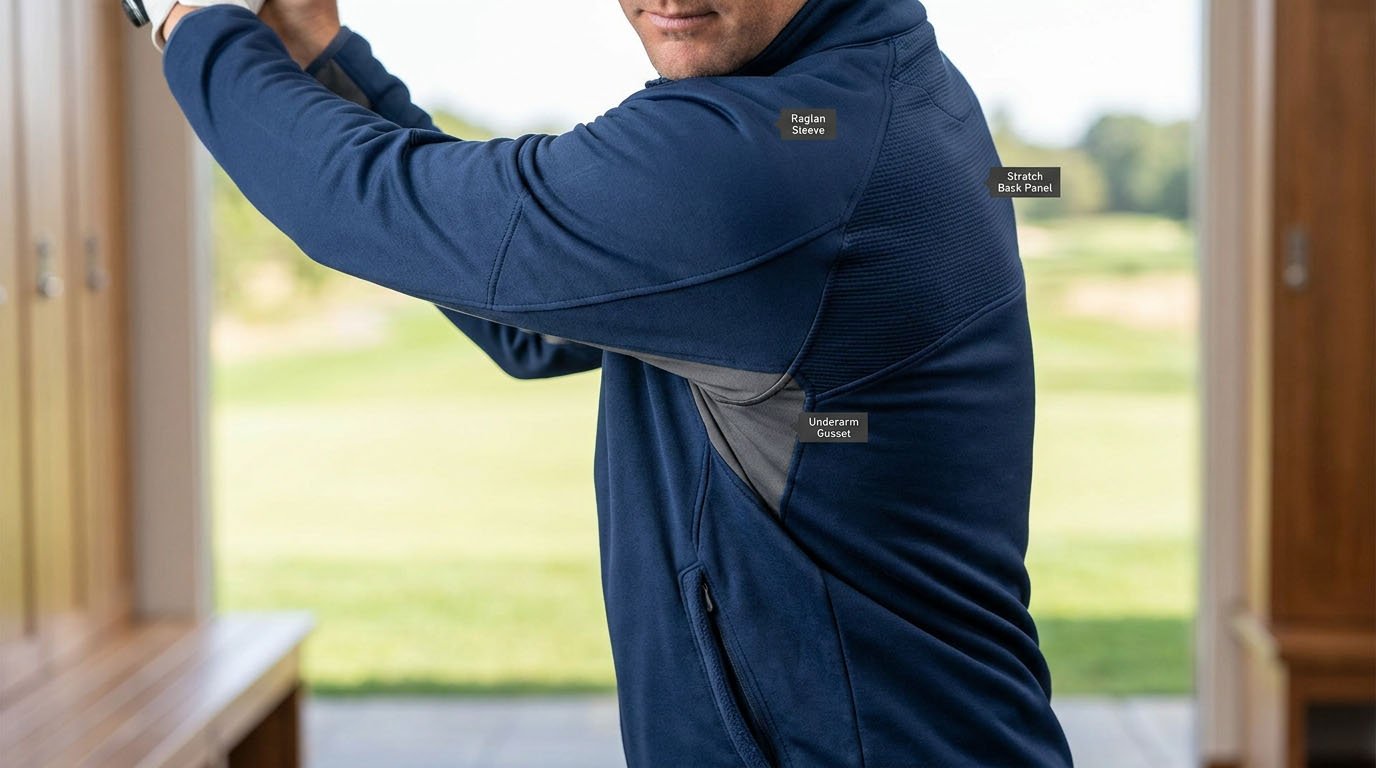
Engineer fall/winter apparel construction around unrestricted backswing rotation—using raglan or articulated sleeves (adds $1.50-2.50 per piece), underarm gussets (adds $1.00-1.80), and action-back pleats (adds $0.80-1.40)—rather than adapting summer athletic cuts that restrict movement once worn over base layers or under outer layers.
Construction conversations separate brands who understand golf from those copying athletic wear. The question is not "what sleeve style looks best?" but "what sleeve construction allows full backswing when wearing 2-3 fabric layers?"
Sleeve Construction for Layering + Mobility
Standard set-in sleeve limitations:
Summer single-layer wear:
- Set-in sleeves work adequately with single layer (polo only)
- Restriction appears at 90-100 degree shoulder rotation
- Acceptable for warm weather when one layer is norm
Fall/winter multi-layer failure:
- Adding base layer + mid-layer increases total fabric thickness by 40-60%
- Set-in sleeves now restrict at 70-80 degree rotation
- Cannot complete full backswing without garment pulling
Construction:
- Sleeve seam runs diagonally from collar to underarm (not perpendicular at shoulder)
- Eliminates shoulder seam constraint
- Sleeve rotates with arm movement naturally
Mobility benefit:
- Allows additional 15-20 degrees rotation vs set-in sleeve
- Maintains freedom even with 2-3 layers
- No pulling sensation during backswing
Cost impact:
- Pattern complexity: Slightly higher (diagonal seam placement)
- Labor time: Minimal increase
- Cost: +$1.00-1.80 per piece vs set-in sleeve
When to use raglan:
- All mid-layers: Quarter-zips, pullovers, hoodies
- Outer layers: Softshells, insulated jackets
- Base layers: Optional (single-layer doesn't need it as much)
Articulated sleeve alternative:
Construction:
- Set-in sleeve with pre-bent shape mimicking arm position during swing
- Elbow darting or curved sleeve panel allows natural arm bend
Mobility benefit:
- Maintains traditional appearance of set-in sleeve
- Provides 10-15 degrees additional rotation vs standard set-in
- Better than standard but not as free as raglan
Cost impact:
- Pattern development: More complex (curved panels)
- Labor time: Slightly higher (precision placement)
- Cost: +$1.50-2.50 per piece
When to use articulated:
- Premium jackets: Where traditional styling matters
- Formal golf apparel: Club members, business golf positioning
- Brands avoiding athletic appearance: Articulated maintains refined aesthetic
Underarm Gusset Engineering
What gussets do:
Problem without gussets:
- Underarm area is high-stress zone during swing
- Fabric pulls tight at maximum rotation
- Restriction or tearing at stress points
Gusset solution:
- Diamond or rectangular fabric panel inserted at underarm seam
- Made from stretch fabric (even if body is non-stretch)
- Expands during movement, releases when relaxed
Gusset specifications:
Size:
- Small gusset: 5cm × 7cm (subtle, lightweight garments)
- Standard gusset: 7cm × 10cm (mid-layers, most common)
- Large gusset: 10cm × 15cm (outerwear, maximum mobility)
Fabric:
- Stretch material: 15-20% elasticity minimum
- Breathable: Mesh or performance knit (high-activity zone)
- Durable: Reinforced stitching at attachment points
Cost impact:
- Material: +$0.30-0.60 (small piece of stretch fabric)
- Labor: +$0.70-1.20 (precise placement, reinforced stitching)
- Total: +$1.00-1.80 per piece
When to add gussets:
- All mid-layers over $75 retail: Quarter-zips, pullovers
- All outer layers: Jackets, softshells
- Premium base layers: If targeting performance positioning
When to skip gussets:
- Value-tier products under $60: Cost control priority
- Loose-fitting garments: If fit is already relaxed enough
- Single-layer summer wear: Less critical without layering
Action-Back Pleats and Stretch Panels
Action-back construction:
Traditional in golf:
- Box pleat or inverted pleat at center back
- Expands during forward bend and rotation
- Collapses to clean silhouette when standing
Modern alternative:
- Stretch panel replaces pleats
- Elastic fabric in upper back shoulder area
- Cleaner appearance, no visible pleats
Cost comparison:
| Feature | Construction | Cost Impact | Best For |
|---|---|---|---|
| Box pleat | Folded fabric at center back | +$0.80-1.20 | Traditional jackets, formal golf wear |
| Inverted pleat | Hidden fold, cleaner exterior | +$1.00-1.50 | Premium jackets, refined styling |
| Stretch panel | Elastic fabric insert | +$1.20-2.00 | Modern technical apparel, athletic styling |
My recommendation:
Use stretch panels for modern golf brands targeting ages 25-50. Use traditional pleats for classic brands targeting ages 45+ or formal club environments.
Pocket Functionality in Fall/Winter
Fall/winter pocket needs differ from summer:
Hand-warming priority:
- Players need hand pockets during cool weather
- Must be deep (15-18cm minimum) and lined (fleece or soft fabric)
- Angled opening (easy access while standing)
Storage requirements:
- Zippered chest pocket: Score card, tees, phone
- Internal pockets: Wallet, keys (security during play)
- Golf ball pocket: Some prefer dedicated exterior pocket
Pocket construction specifications:
Hand pockets:
- Depth: 16-20cm (hands fully inserted)
- Lining: Fleece or soft brushed fabric (comfort + warmth)
- Opening angle: 15-20 degrees from vertical (natural hand entry)
- Cost: +$1.50-2.50 per piece for fleece-lined hand pockets
Zippered pockets:
- Chest pocket: 12cm × 15cm (phone-sized)
- Side pockets: Option to zip-close hand pockets (security)
- Interior pocket: 15cm × 18cm (valuables)
- Cost: +$0.80-1.40 per zipper pocket
Golf-specific pocket:
- Exterior ball pocket: Small zippered pocket on lower side
- Size: 8cm × 10cm (holds 2-3 golf balls)
- Controversial: Some players love it, others find it unnecessary
- Cost: +$0.60-1.00
Pocket budget allocation:
For $140 retail softshell jacket, include:
- ✓ Fleece-lined hand pockets (essential comfort feature)
- ✓ Zippered chest pocket (practical storage)
- ✓ Interior pocket (security for valuables)
- ? Golf ball pocket (test in samples, customer feedback guides)
Total pocket investment: $3.50-5.50 per piece for well-engineered pocket system
Cuff and Hem Adjustment Systems
Cuff design for fall/winter:
Fixed elastic cuff:
- Pros: Lowest cost, seals out wind/rain
- Cons: Cannot adjust fit, can feel restrictive
- Cost: Baseline
- Use: Value-tier products
Hook-and-loop (Velcro) adjustable cuff:
- Pros: Adjustable fit, accommodates glove or bare hand
- Cons: Velcro can catch on other fabrics
- Cost: +$0.60-1.00 per piece
- Use: Mid-tier jackets, versatile adjustment
Snap-closure cuff:
- Pros: Clean appearance, positive closure
- Cons: Limited adjustment range
- Cost: +$0.80-1.40 per piece
- Use: Premium jackets, refined styling
Stretch knit cuff with thumb hole:
- Pros: Maximum comfort, extends over hands, modern styling
- Cons: Wear zone (thumb holes stretch out over time)
- Cost: +$1.00-1.60 per piece
- Use: Base layers, performance mid-layers
Hem adjustment:
Elastic drawcord:
- Internal cord with toggle adjustment
- Seals hem to body, prevents wind entry
- Cost: +$0.50-0.90 per piece
- Essential for: Outer layers, wind protection
Snap/button adjustment:
- Side snap closures at hem
- Allows cinching without drawcord bulk
- Cost: +$0.60-1.20 per piece
- Use: Premium jackets
Construction Budget Impact
Mobility and functionality features total cost:
For mid-tier softshell jacket ($140-170 retail):
Construction upgrades:
- Raglan sleeves: +$1.50
- Underarm gussets: +$1.40
- Stretch back panel: +$1.60
- Fleece-lined hand pockets: +$2.20
- Zippered chest pocket: +$1.00
- Interior pocket: +$0.90
- Adjustable cuffs: +$0.80
- Hem drawcord: +$0.70
Total construction premium: +$10.10 per piece vs basic jacket construction
But this creates:
- Functional differentiation from $90-110 athletic jackets
- Justification for $140-170 retail pricing
- Reduction in returns (proper mobility prevents complaints)
The $10 investment enables $40-60 higher retail pricing and lower return rates—clear ROI.
Sustainable Differentiators & GTM: Materials, Testing, SKUs and Color Stories?
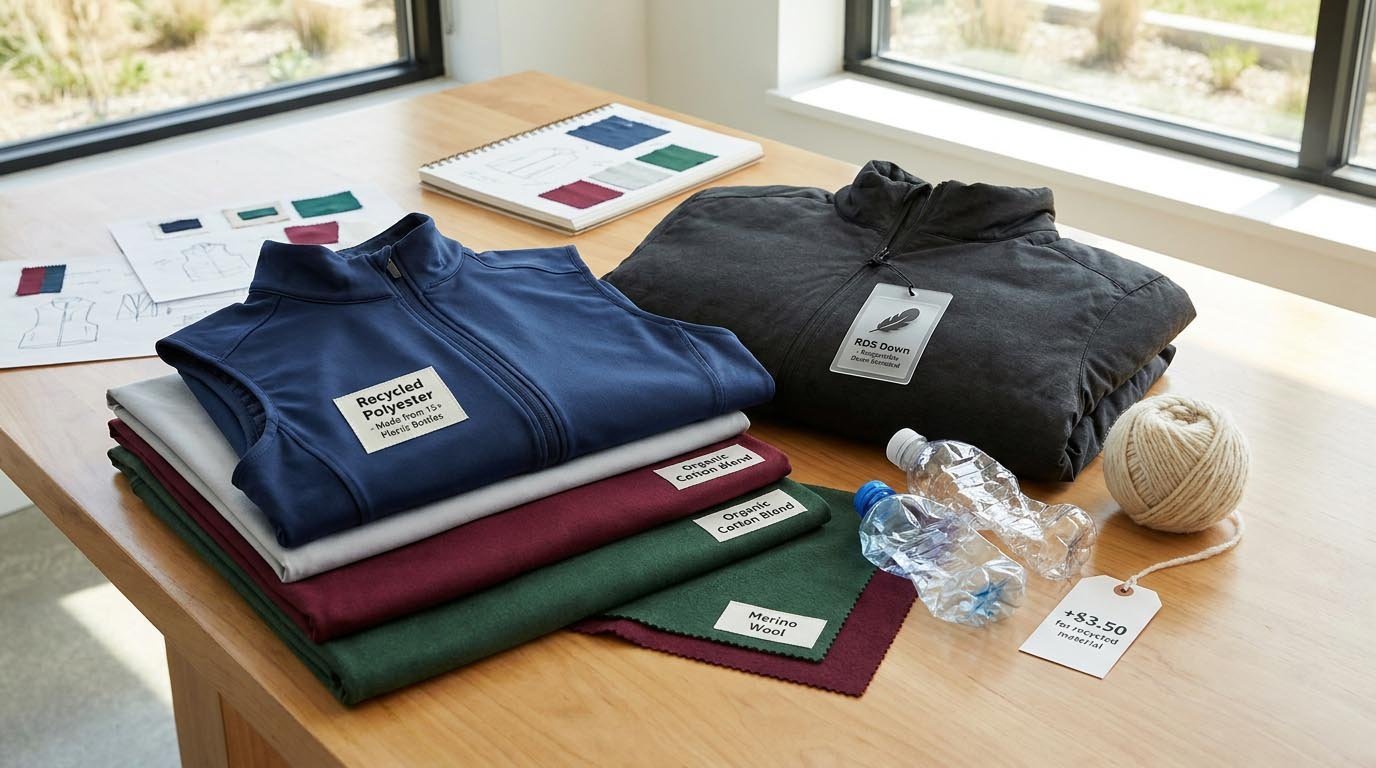
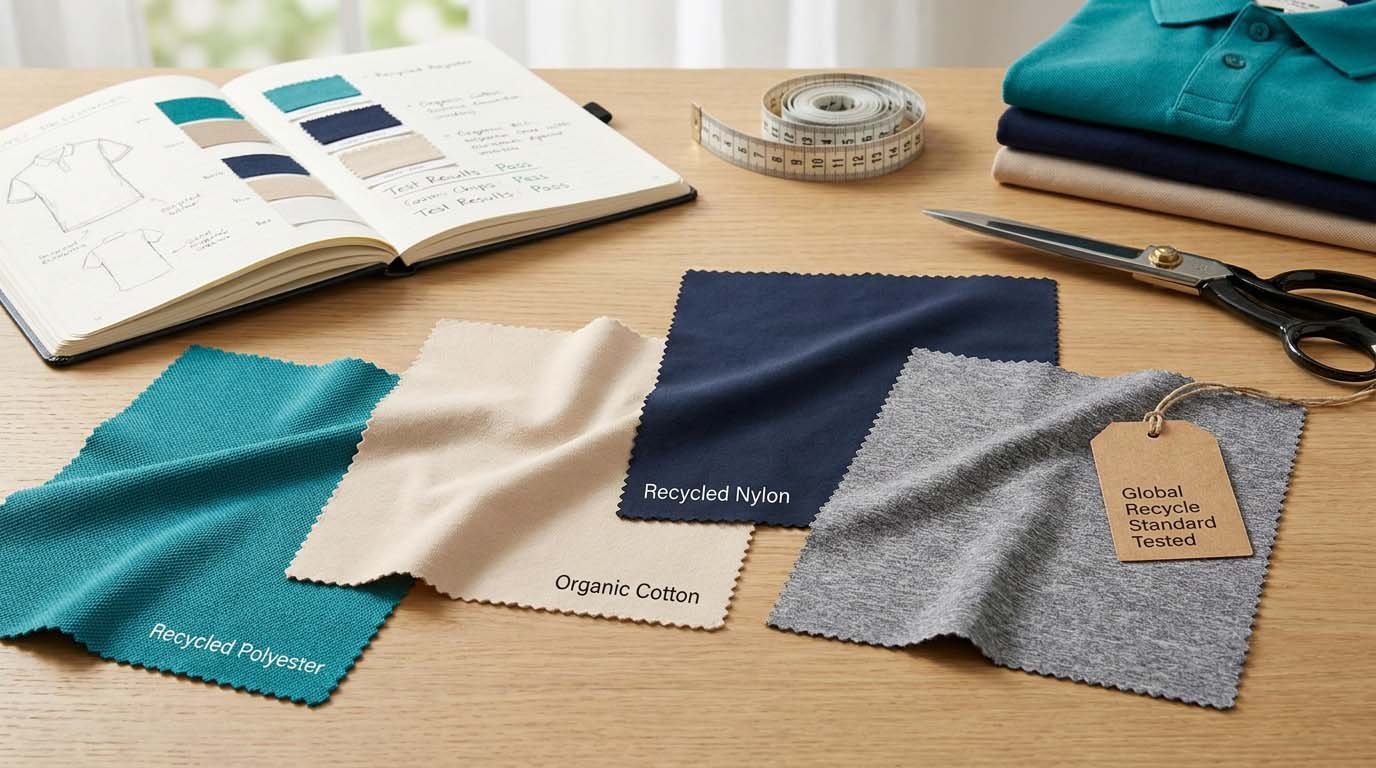
Position sustainability through verifiable material choices (recycled polyester, organic cotton blends, responsible down) and transparent cost impact disclosure ("this product costs $3.50 more per piece using recycled fabric") rather than vague "eco-friendly" claims—treating sustainability as technical specification that justifies pricing, not marketing language that confuses customers.
Sustainability conversations often become marketing theater. Brands want "eco" positioning but cannot explain cost tradeoffs or verify supply chain claims. I approach sustainability as technical specification with measurable impact.
Recycled Polyester: The Practical Choice
What recycled polyester actually means:
Source material:
- Post-consumer recycled: Used plastic bottles converted to fiber
- Post-industrial recycled: Manufacturing waste converted to fiber
- Blend percentages: 30-50% recycled content typical, 100% recycled available
Performance reality:
- Quality: Indistinguishable from virgin polyester in well-executed fabrics
- Durability: Equivalent to virgin polyester
- Cost: $0.80-1.80 per meter premium (10-20% more)
Verification:
- GRS certification (Global Recycled Standard): Supply chain verification
- Certification cost: $800-1,500 annually for small brands
- Per-product: Certified fabrics cost $0.80-1.80 per meter more
Cost-benefit for golf brands:
| Retail Price Point | Recycled Fabric Worth It? | Why |
|---|---|---|
| Under $60 | No | Cost premium (10-20%) not recoverable, customers prioritize price |
| $60-85 | Maybe | Works if positioned explicitly, customers willing to pay $5-8 more |
| $85-120+ | Yes | Premium positioning expects sustainability, cost premium is 3-5% of retail |
My recommendation:
Introduce recycled polyester at $75+ retail products where:
- Cost premium is proportionally smaller
- Customers expect quality and ethics
- Brand can communicate sustainability authentically
Skip recycled at value tier where price sensitivity overrides sustainability interest.
Organic and Natural Fiber Blends
Organic cotton limitations for golf:
Performance issues:
- Moisture retention: Cotton absorbs sweat (uncomfortable for 4-5 hour rounds)
- Slow drying: Takes 3-4 hours vs polyester 45-90 minutes
- Heavy when wet: Uncomfortable weight during play
Cost:
- Organic cotton: $2.50-4.00 per meter premium over regular cotton
- Already expensive vs polyester, organic makes it worse
Recommendation:
Avoid pure organic cotton for performance golf apparel. If using cotton, keep to lifestyle pieces (casual polos, off-course wear) not active golf gear.
Organic cotton-polyester blends:
- 30-40% organic cotton, 60-70% polyester: Balances ethics and performance
- Cost premium: $1.50-2.50 per meter
- Use case: Base layers where cotton feel matters but needs performance boost
Merino wool (naturally sustainable):
Inherent sustainability:
- Renewable: Sheep regrow wool annually
- Biodegradable: Natural fiber breaks down
- Low-impact processing: Less chemical treatment than synthetics
Does not require "organic" certification:
- Wool is naturally sustainable
- Focus on responsible sourcing (animal welfare standards)
Cost:
- Merino wool blend: Already premium ($5-8 per meter vs polyester)
- Responsible sourcing: Minimal additional cost if supplier already ethical
Recommendation:
Merino blends are inherently sustainable choice—market the natural properties (temperature regulation, odor resistance) rather than forcing "eco" language that feels contrived.
Responsible Down Sourcing
Down sourcing concerns:
Animal welfare:
- Live-plucking: Unethical practice (down removed from live birds)
- Force-feeding: Geese force-fed for foie gras production, down as byproduct
Responsible down standards:
RDS (Responsible Down Standard):
- No live-plucking
- No force-feeding
- Traceability: Supply chain verification
- Cost impact: $2-4 per piece premium for certified down
Why it matters for golf brands:
- Down vests and jackets are premium products ($140-180+ retail)
- Customers at this tier care about sourcing ethics
- RDS certification is credible (third-party verified)
My recommendation:
Use RDS-certified down for all down products. The $2-4 per piece cost is negligible at $140-180 retail and prevents ethical questions.
Sustainability Communication Strategy
Effective sustainability positioning:
Do this:
- ✓ "Made with 50% recycled polyester—each piece uses approximately 12 recycled plastic bottles"
- ✓ "Using recycled fabric adds $3.50 per garment—we absorb $2.00, you pay $1.50 more"
- ✓ "RDS-certified down—ensures ethical sourcing with full supply chain traceability"
- ✓ "Merino wool is naturally renewable and biodegradable—provides performance without synthetic materials"
Don't do this:
- ✗ "Eco-friendly performance fabric" (vague, unverifiable)
- ✗ "Sustainable manufacturing process" (meaningless without specifics)
- ✗ "Green golf apparel" (greenwashing language)
- ✗ "Carbon-neutral production" (unless actually measured and offset—rare)
The principle:
Sustainability should be technical specification (like UPF rating or waterproofing), not marketing fluff.
Fall/Winter Color Story Strategy
Color palettes for fall/winter:
Traditional golf fall colors:
- Navy, black, charcoal: Core neutrals (60-70% of volume)
- Burgundy, forest green, brown: Seasonal accents (20-25%)
- Gray heathers, earth tones: Modern neutrals (10-15%)
Why these colors:
- Visually aligned with fall/winter season (deeper, richer tones)
- Dirt-resistant: Darker colors hide course dirt better
- Layering-friendly: Neutrals coordinate across multiple pieces
Color structure for collection:
For 1,500-piece fall/winter collection:
Core colors (65-70% of inventory):
- Navy: 30-35% (universal, safe)
- Black: 20-25% (modern, versatile)
- Charcoal gray: 15-20% (sophisticated neutral)
Accent colors (25-30%):
- Burgundy/wine: 12-15% (rich fall tone)
- Forest green: 8-10% (traditional golf color)
- Brown/tan: 5-8% (earth tone, seasonal)
Limited/seasonal colors (5-10%):
- Heather tones: 3-5% (modern athletic)
- Bright accent: 2-3% (small batch test)
Why this allocation:
- Core colors ensure adequate depth (200-300 pieces per color)
- Accent colors provide variety without fragmentation
- Limited colors allow experimentation without risk
SKU Configuration for Fall/Winter
Complete fall/winter collection structure:
For $35,000 production budget (approximately 1,800-2,200 pieces total):
| Category | Piece Count | % of Total | Budget Allocation |
|---|---|---|---|
| Base layers (polos, long sleeve) | 450-550 | 25-30% | $6,500-8,500 |
| Mid-layers (quarter-zips, pullovers) | 500-600 | 28-32% | $10,000-13,000 |
| Insulation (vests, insulated pullovers) | 350-450 | 18-22% | $9,000-12,000 |
| Outer layers (softshells, rain shells) | 250-350 | 12-16% | $9,000-12,500 |
| Bottoms (pants, potentially thermal) | 250-350 | 12-15% | $5,000-7,500 |
Why this allocation:
- Layering pieces (mid + insulation + outer) = 60-70% of inventory
- Reflects fall/winter reality: temperature variance requires layers
- Base layers and bottoms support but don't dominate
Compared to spring/summer:
- Spring/summer: Polos 50-60%, layering 30-40%
- Fall/winter: Base layers 25-30%, layering 60-70%
The shift reflects seasonal needs—fall/winter IS layering season.
Testing and Validation Protocol
Pre-production testing recommendations:
Climate chamber testing (optional but valuable):
- Temperature range validation: Wear garment in controlled 5-20°C temps during activity
- Moisture vapor testing: Measure interior condensation after 1-2 hour active wear
- Cost: $800-1,500 per sample set (multiple garments, conditions)
- Worth it: For premium lines ($120+ retail) where functional claims matter
Field testing (essential):
- On-course wear test: 5-10 rounds in target temperature range
- Layering combination test: Wear base + mid + outer as system
- Feedback: Mobility, warmth, breathability, packability
- Cost: Sample garments only ($300-600 total)
Wash durability testing:
- 10-15 wash cycles: Check pilling, shape retention, color fastness
- Packability test: Compress/uncompress 10 times, check recovery
- Cost: Minimal (sample garments + wash access)
My recommendation:
- Value tier ($60-90 retail): Field testing only
- Mid tier ($90-140 retail): Field testing + wash durability
- Premium tier ($140+ retail): Full protocol including climate chamber if budget allows
Launch Timing for Fall/Winter
Optimal launch windows:
Early fall launch (August-September):
- Best for: Established brands with customer base
- Products: Full fall/winter range
- Risk: Must predict seasonal demand 6-7 months ahead
Mid-fall launch (October):
- Best for: New brands or conservative inventory approach
- Products: Core fall items (quarter-zips, vests)
- Risk: May miss early season sales
Pre-holiday launch (November):
- Best for: Gift-focused positioning, premium items
- Products: High-value pieces (insulated jackets, premium vests)
- Risk: Compressed selling season (November-February)
My recommendation:
Most brands should target September launch for full fall/winter collection availability, allowing sales through September-March (7 months) before spring transition.
FAQ: Fall/Winter Golf Apparel Innovation
How much more should fall/winter fabrics cost than spring/summer?
Budget $2.50-5.00 more per piece for fall/winter fabric costs versus comparable spring/summer products: heavier fabric weights add $0.80-1.50, brushed interiors add $1.20-2.00, thermal treatments add $0.50-1.50. Specific examples: spring polo at 180 GSM costs $5.50-7.00 per meter, fall polo at 210 GSM with brushed interior costs $7.50-10.00 per meter (+$2.00-3.00). Quarter-zips increase more dramatically: spring lightweight fleece at 240 GSM costs $6.00-8.00 per meter, fall brushed fleece at 300 GSM costs $8.50-11.50 per meter (+$2.50-3.50). For 1,500-piece fall/winter collection, expect total fabric cost 25-35% higher than equivalent spring/summer collection. Failed approach: Brands using same fabric costs year-round either under-deliver on fall/winter warmth (customer complaints) or over-invest in spring/summer weight (margin compression).
Should I develop fall/winter as "heavy versions" of summer bestsellers or completely new products?
Develop as new products with adapted architecture, not heavy versions. Pattern modifications required: extend body length 2-3 inches (accommodates layering over base layers), switch from set-in to raglan sleeves (mobility when layered), add underarm gussets (stretch zone for rotation), adjust collar height +0.5-1.0 inches (wind protection), and modify hem to straight cut (works better under outer layers vs extended-back summer hems). Fabric changes: increase GSM 30-60 (warmth without excessive bulk), add brushed interior (warmth-to-weight efficiency), incorporate 12-15% stretch vs 8-10% summer (mobility under weight). In tracking 25+ client collections, brands that "thicken summer patterns" face 18-25% return rates for "restricted movement" and "too stiff," while brands investing in proper fall/winter pattern development see 8-12% returns. The development investment: $400-800 per pattern for proper fall/winter adaptation vs $0 for just using heavier fabric in summer patterns—ROI is clear through reduced returns.
What temperature range should each fall/winter layer target?
Structure layers in overlapping 10-15°C bands rather than attempting single-product coverage: base layers target 10-20°C active play (lightweight merino or thermal polyester), mid-layers (quarter-zips) target 5-15°C moderate activity, insulated layers (vests) target 0-10°C standing/walking, outer shells (softshells, rain jackets) provide wind/rain protection across 0-15°C when layered. Customer uses layers in combinations: 15-18°C wears base + mid, 8-12°C wears base + mid + vest, 2-8°C wears base + mid + insulated jacket, below 0°C wears base + insulated mid + weatherproof outer. Failed approach: Creating one heavy fleece attempting to cover 0-20°C—this creates garment that is too warm above 12°C (player overheats) and too cold below 5°C (insufficient insulation). Better: 3-4 pieces with specific temperature targets that layer intelligently—customers buy multiple pieces (higher revenue) and find exact combination for conditions.
How do I balance warmth and breathability in fall/winter fabrics?
Prioritize breathability at minimum 10,000 g/m²/24hr MVTR for active golf use, accepting modest warmth tradeoffs. Specific decisions: softshells at 12,000-15,000 MVTR work better than hardshells at 8,000-10,000 MVTR because golf generates significant moisture during play. Add ventilation features (underarm zips +$1.50-2.50, back vents +$0.80-1.40, mesh-lined interior +$1.20-2.00) rather than relying solely on fabric breathability. Use brushed interiors instead of thick insulation—280 GSM brushed fabric provides equivalent warmth to 340 GSM solid fabric while maintaining 20-30% better breathability. Test protocol: Sample garment should allow 4-5 hour wear at target temperature during walking/swinging without interior dampness—if condensation appears, breathability is insufficient. Common trap: Chasing 20,000mm waterproofing that sacrifices breathability to 6,000-8,000 MVTR—result is waterproof shell that traps sweat, making player feel wet anyway.
What construction features justify higher fall/winter pricing versus spring/summer?
Charge $15-25 more retail for fall/winter equivalents based on these construction differences: raglan or articulated sleeves (adds $1.50-2.50 per piece, enables layering mobility), underarm gussets (adds $1.00-1.80, prevents restriction during swing), brushed interior fabric (adds $1.50-2.50, warmth without weight), fleece-lined hand pockets (adds $1.50-2.50, functional cold-weather feature), adjustable cuffs and hem (adds $1.10-1.90, seals out wind), and ventilation engineering (adds $1.50-3.00, prevents moisture buildup). Example: summer quarter-zip production cost $18-24, fall/winter quarter-zip $28-36—the $10-12 cost increase justifies $75 summer retail vs $95 fall retail ($20 difference). Customers accept higher fall/winter pricing when they can see/feel construction differences—this requires educating through product descriptions and demonstrating features visibly. Failed approach: Charging same price for fall/winter despite higher costs (margin compression) or charging significantly more without communicating what justifies it (customer feels overcharged).
How much inventory should be insulated layers versus base/mid-layers?
Allocate 18-25% insulated layers (vests, insulated jackets), 28-35% mid-layers (quarter-zips, pullovers), 20-25% base layers, 12-16% outer shells, 12-15% bottoms in fall/winter collections. This differs from spring/summer where base layers dominate 50-60%—fall/winter requires layering system emphasis. Specific numbers for $30,000 budget / 1,800 total pieces: vests/insulated 360-450 pieces ($9,000-12,000), quarter-zips/pullovers 500-630 pieces ($10,000-14,000), base layers 360-450 pieces ($5,500-7,500), outer shells 215-290 pieces ($8,000-11,000), bottoms 215-270 pieces ($4,500-6,500). Reasoning: Fall/winter customers need 2-3 layering pieces per round vs 1 polo in summer—collection must support this usage. Brands that maintain summer allocation (base layers 60%+) in fall/winter miss layering revenue and face customer complaints about insufficient options for varying temperatures.
What certifications or claims should I pursue for fall/winter technical apparel?
Pursue verifiable certifications with transparent cost disclosure, skip vague performance claims. Worth pursuing: Responsible Down Standard (RDS) for down products (+$2-4 per piece, ethical sourcing credibility), Global Recycled Standard (GRS) for recycled polyester (+$0.80-1.80 per meter, supply chain verification), and waterproof/breathability ratings with specific numbers (10,000mm/10,000 MVTR, not "waterproof/breathable"). Skip: "Advanced thermal technology" (vague, unverifiable), "carbon-neutral production" (unless actually measured—expensive and rare for small brands), "antimicrobial treatment" (degrades in 15-20 washes, minimal value), "moisture transport rate numbers" (customers can't distinguish 3.5 vs 4.2 rating). Certification costs: RDS $800-1,500 annually, GRS $800-1,500 annually, waterproof testing $400-800 per fabric—these are worthwhile for $100+ retail products, unnecessary for value-tier under $75. Communicate honestly: "This vest uses RDS-certified down, which adds $3 per garment but ensures ethical sourcing"—transparency builds trust more than marketing fluff.
How do I test fall/winter products for actual golf performance?
Run field testing protocol during actual rounds in target temperature conditions: 5-10 rounds per sample across temperature range (test base layer at 15°C, 10°C, 5°C), layering combinations (base + mid, base + mid + vest, full system), and activity patterns (walking vs cart, continuous vs waiting). Feedback areas: mobility check (can tester complete full backswing without restriction?), warmth adequacy (does garment maintain comfort during entire round?), breathability (any interior dampness after 18 holes?), packability (can garment compress and recover without wrinkles?), durability (wash 3-5 times during testing, check pilling and shape retention). Testing cost: $300-600 for sample garments, volunteer testers (friends, early customers). Advanced testing (optional): climate chamber validation $800-1,500 (wear garment in controlled temps with activity simulation). Most valuable insight comes from honest feedback during actual golf—testers should report any discomfort or restriction immediately, not after production. Brands that skip field testing launch products based on fabric specs alone, resulting in functional failures customers discover (restricted backswing, inadequate warmth, trapped moisture).
Conclusion
Structure fall/winter golf collections through layering system architecture covering -5 to 20°C collectively (base layers 10-20°C, mid-layers 5-15°C, insulated layers 0-10°C, outer shells for wind/rain), investing $2.50-5.00 more per piece in fabric engineering (merino blends, brushed interiors, thermal synthetics) and $8-12 more in construction features (raglan sleeves, underarm gussets, ventilation, mobility-first patterns). Allocate 60-70% of fall/winter inventory to layering pieces versus 25-30% base layers, reflecting season-specific needs rather than adapting summer proportions.