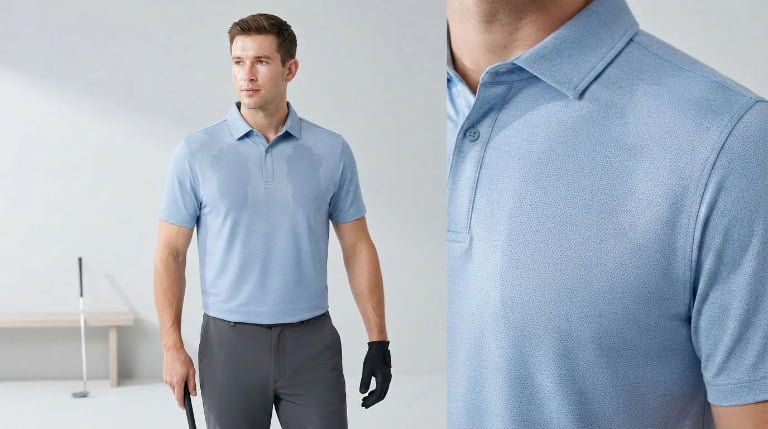
Moisture-wicking is one of the most common performance claims in golf apparel. But a fabric labeled moisture-wicking does not necessarily dry quickly, release water vapor efficiently, or feel comfortable during a summer round.
For golf apparel brands, the challenge is not simply finding a fabric that moves sweat. It is understanding what each laboratory test measures and whether the results support the product's intended use.
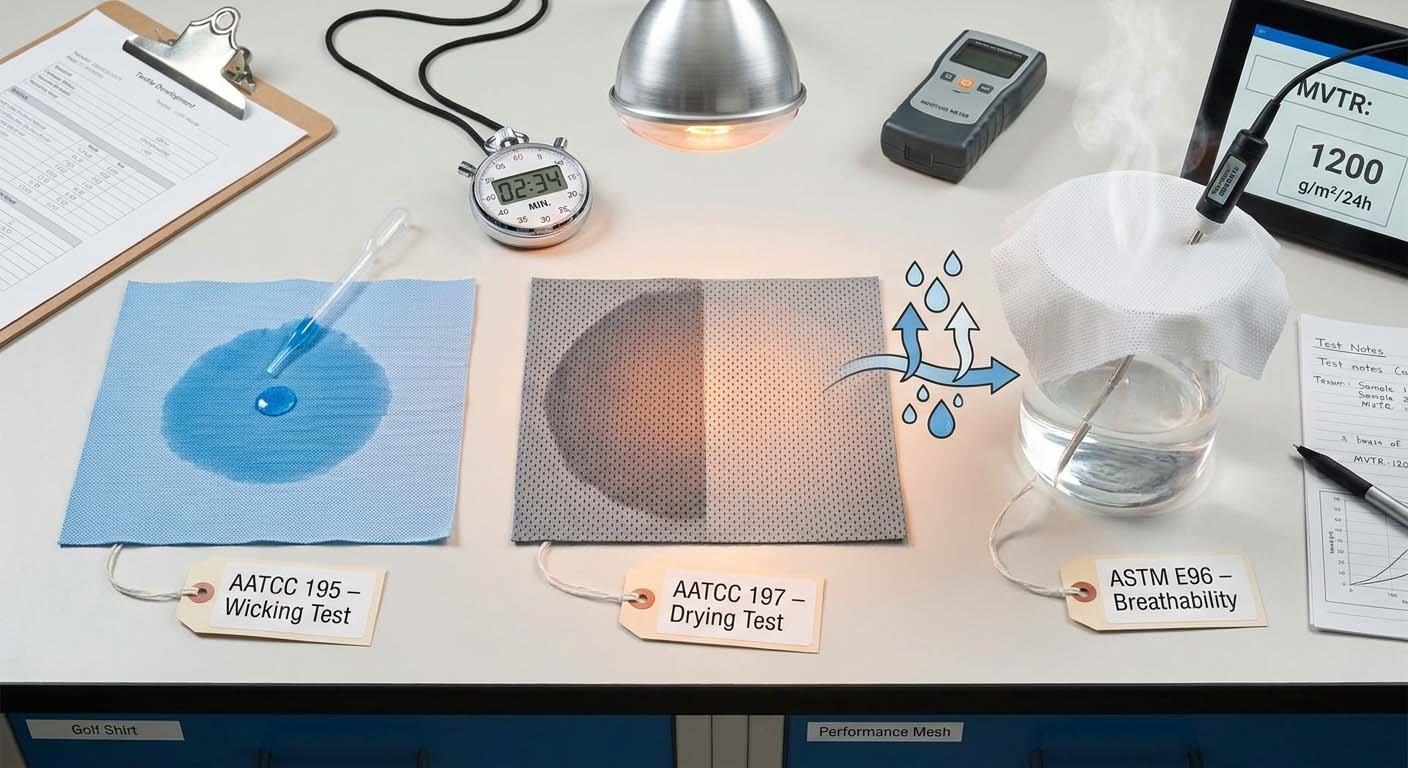
Three properties are often confused:
- Wicking: How liquid moisture moves across or through fabric.
- Drying: How quickly absorbed or retained moisture evaporates.
- Water vapor transmission: How readily water vapor passes through a material under defined conditions.
These properties interact, but they are not interchangeable.
This guide explains how moisture management works, what AATCC 195, AATCC 197, drying tests, and ASTM E96 measure, and how golf apparel buyers can verify supplier claims before bulk production.
Quick Answer: Which Tests Measure Moisture-Wicking Performance?
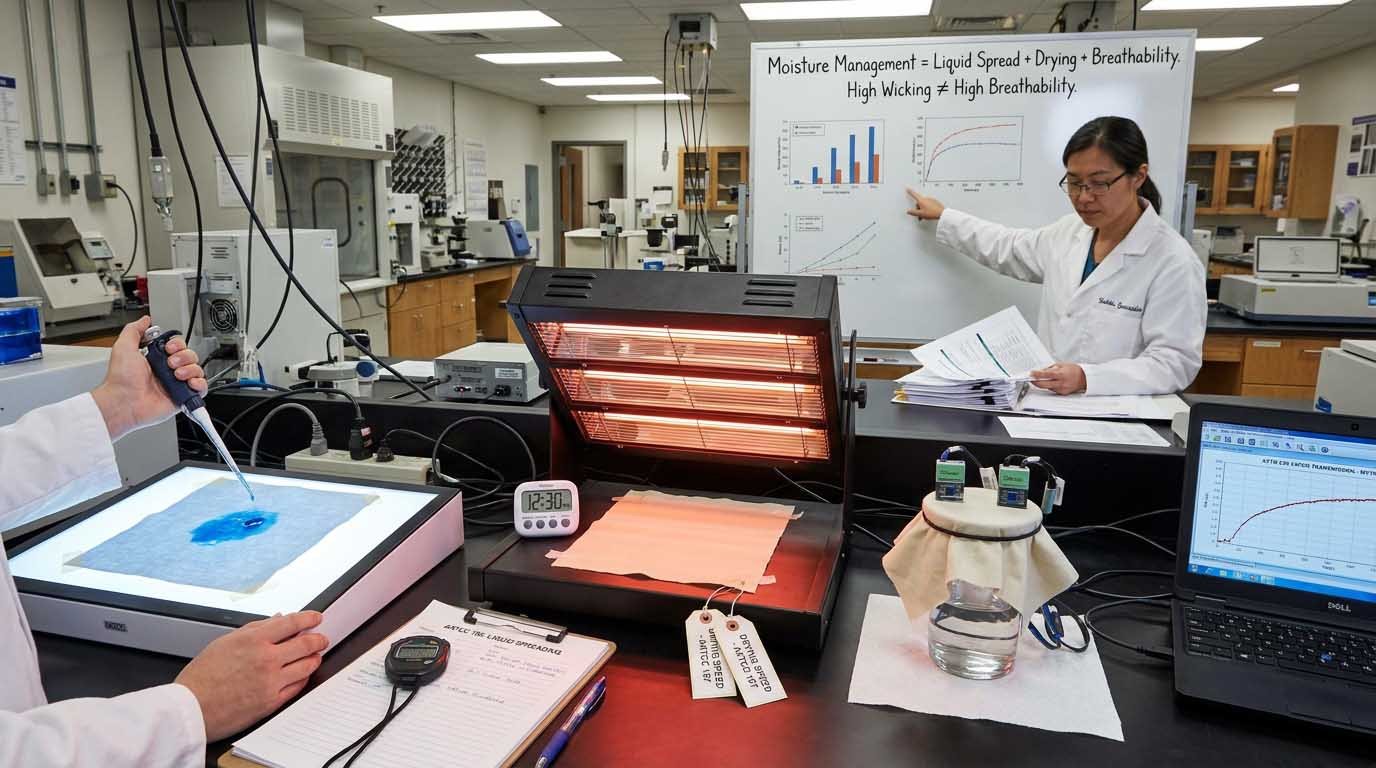
AATCC 195 measures liquid moisture management, AATCC 197 measures vertical wicking to specified distances, AATCC 199 and 201 evaluate drying performance, and ASTM E96 measures water vapor transmission.
No single test establishes overall comfort.
| Test Standard | What It Measures | Typical Reported Results | Main Purpose |
|---|---|---|---|
| AATCC 195 | Liquid moisture absorption, spreading, and transport | Wetting time, spreading speed, one-way transport, OMMC | Overall liquid moisture management |
| AATCC 197 | Vertical wicking to specified distances | Time or wicking rate | Capillary transport |
| AATCC 213 | Vertical wicking at specified times | Distance or wicking rate | Alternative wicking evaluation |
| AATCC 199 | Drying time using a moisture analyzer | Drying time | Moisture evaporation |
| AATCC 200 | Drying rate with air flow | Drying rate | Airflow-assisted drying |
| AATCC 201 | Drying rate using a heated plate | Drying rate | Drying under a heated test setup |
| ASTM E96/E96M | Water vapor transmission | WVTR / MVTR | Water vapor transport |
AATCC 197 and 213 address different vertical-wicking measurement approaches. Neither is a standard drying-time test.
For official method descriptions, refer to the AATCC testing standards directory.
Buyer takeaway: Choose tests according to the performance claim. A fabric with excellent liquid spreading may still have disappointing drying performance or feel uncomfortable in certain wearing conditions.
Step 1. Understand Wicking, Drying, and Water Vapor Transmission
These three mechanisms influence moisture-related comfort, but each describes a different process.
1.1 Liquid Wicking: Moving Sweat Through Fabric
Wicking describes the movement of liquid water through capillary pathways in yarns and fabric structures.
When sweat contacts a golf polo, liquid may spread along the inner surface, move through the fabric thickness, or distribute across the outer surface.
This behavior is influenced by:
- Fiber surface properties and wetting behavior
- Yarn structure and capillary pathways
- Fabric density and knit construction
- Moisture-management finishes
Effective spreading can distribute liquid over a larger area, potentially supporting evaporation.
However, fast spreading does not automatically mean that moisture moves away from the skin-facing surface.
A fabric may spread liquid quickly along its inner face while providing limited through-thickness transport.
1.2 Quick-Dry: Removing Liquid Moisture
Drying describes the removal of liquid moisture through evaporation.
Its rate depends on fabric characteristics and environmental conditions, including temperature, humidity, and airflow.
For golf polos, drying performance matters because retained moisture can affect garment weight, skin feel, and comfort between periods of activity.
A fabric that absorbs or spreads sweat quickly may still take longer to dry.
Therefore, brands making both moisture-wicking and quick-dry claims should evaluate these properties separately.
1.3 Water Vapor Transmission: Allowing Vapor to Pass
Water vapor transmission describes how moisture in vapor form passes through a fabric or material under specified test conditions.
This is different from liquid sweat movement.
A material's water vapor transmission can be important for layered or coated golf apparel, particularly when a garment restricts moisture movement.
However, water vapor transmission and air permeability are not identical.
Air permeability measures airflow through fabric under a pressure difference. ASTM D737 is one method used for this purpose.
For an uncoated summer golf polo, air permeability, drying performance, garment ventilation, and wear comfort may be as relevant as vapor transmission.
Why Fabric Construction Matters
Fiber content alone does not establish moisture-management performance.
Two polyester-spandex fabrics can behave differently because of their yarn structure, knit density, finishing, and fabric weight.
A moisture-management finish may improve wetting or spreading, but its durability should be checked after the agreed laundering procedure.
For broader comparisons of polyester, cotton blends, and knit constructions, see our Best Fabric for Golf Polo Shirts guide.
This article focuses on verifying performance rather than selecting the best fabric composition.
Step 2. Compare AATCC and ASTM Moisture Management Test Methods
Understanding the scope of each standard helps prevent incorrect supplier comparisons.
2.1 AATCC 195: Liquid Moisture Management
AATCC TM195 evaluates how liquid moisture behaves on and through a fabric.
A moisture management tester uses sensors to monitor the wetting, absorption, and spreading behavior of the two fabric surfaces.
It is particularly useful when comparing performance polo fabrics designed to manage liquid sweat.
The report may include several measurements and an Overall Moisture Management Capability (OMMC) index.
Important limitation: AATCC 195 does not directly measure drying time or water vapor transmission.
2.2 AATCC 197 and 213: Vertical Wicking
Vertical wicking tests examine the ability of fabric to transport liquid upward from a submerged edge.
The current methods distinguish two approaches:
- AATCC 197: Vertical wicking rate to specified distances.
- AATCC 213: Vertical wicking rate at specified times.
These methods help compare capillary transport characteristics.
They do not establish how quickly a completely wetted garment dries.
A buyer reviewing an older test report should also check the method version because AATCC separated the two approaches in 2022.
2.3 AATCC 199, 200, and 201: Drying Performance
Drying performance should be evaluated using an appropriate drying method.
Relevant options include:
- AATCC 199: Drying Time of Textiles: Moisture Analyzer.
- AATCC 200: Drying Rate of Textiles at Their Absorbent Capacity: Air Flow.
- AATCC 201: Drying Rate of Fabrics: Heated Plate.
These methods use different experimental conditions and may report different drying-related measurements.
They should not be treated as interchangeable simply because all relate to drying.
For example, results obtained with a heated plate should not automatically be compared with results from a moisture-analyzer method.
The buyer and laboratory should agree on the method before testing.
2.4 ASTM E96: Water Vapor Transmission
ASTM E96/E96M determines water vapor transmission rate using gravimetric procedures.
Depending on the agreed setup, the reported result may be expressed in:
g/m²/24 h — grams of water vapor transmitted per square meter over 24 hours.
The method includes different arrangements, such as desiccant and water methods, under specified temperature and humidity conditions.
A critical limitation is that results from different procedures or environmental conditions are not necessarily comparable.
The ASTM E96/E96M standard specifically addresses this limitation.
Consequently, a fabric with a higher reported MVTR cannot automatically be considered more comfortable than another fabric tested under different conditions.
Brands should avoid using one universal MVTR threshold to classify all golf apparel fabrics as poor, good, or excellent.
Step 3. How to Read an AATCC 195 Test Report
AATCC 195 is useful for golf apparel development because it provides more detailed information than a single moisture-wicking marketing claim.
However, the report must be interpreted carefully.
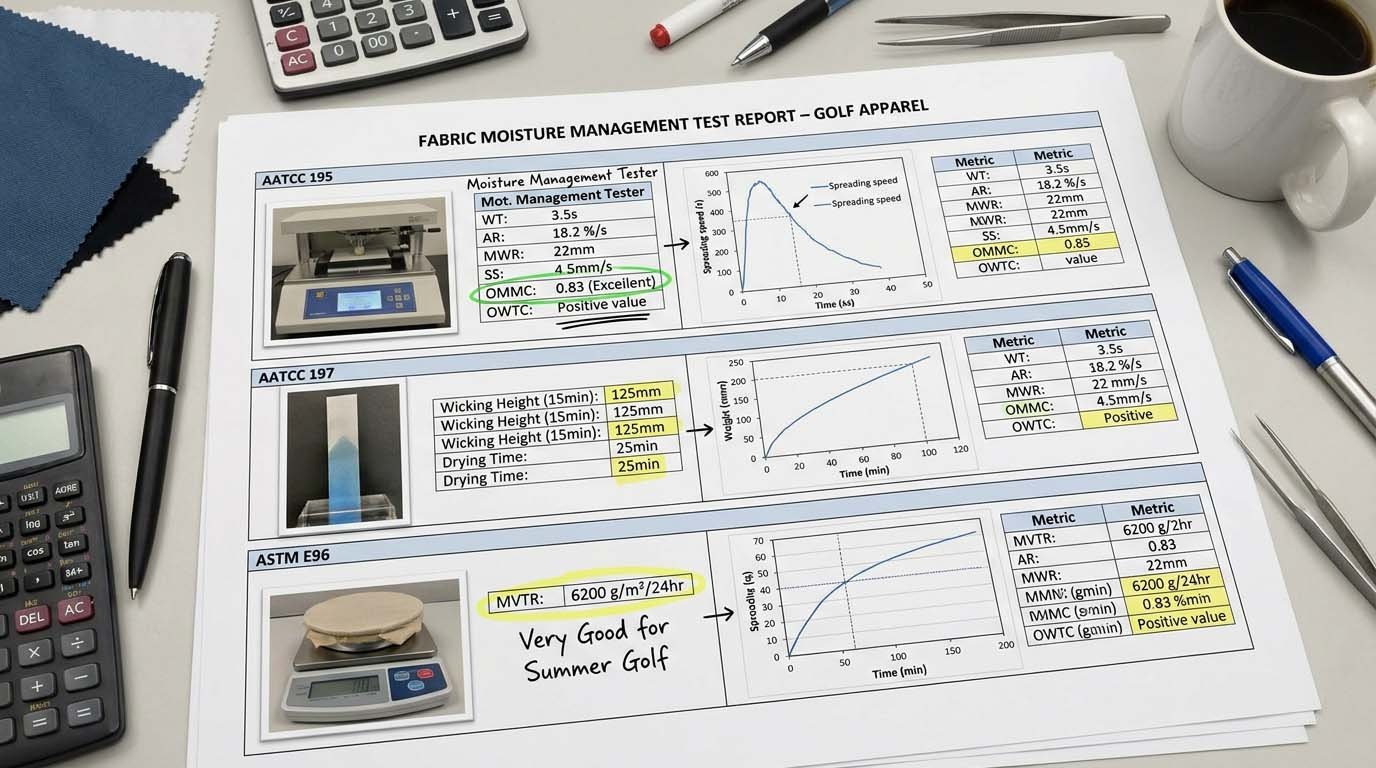
3.1 Understand the Main Metrics
| Metric | What It Indicates | What Buyers Should Check |
|---|---|---|
| Wetting Time (WT) | Time before liquid is detected on each surface | Whether the relevant surface wets as intended |
| Absorption Rate (AR) | Rate of moisture absorption during testing | Differences between fabric faces |
| Maximum Wetted Radius (MWR) | Extent of liquid spreading | Whether moisture spreads across the intended face |
| Spreading Speed (SS) | Rate of outward liquid spreading | Comparative spreading performance |
| One-Way Transport Capability (OWTC) | Difference in liquid accumulation between surfaces | Whether transport favors the intended direction |
| Overall Moisture Management Capability (OMMC) | Composite index based on selected moisture-management characteristics | Overall performance alongside individual metrics |
OMMC is useful for initial screening, but it should not replace examination of the underlying results.
For example, a fabric may show strong surface spreading while delivering less effective moisture transport toward its intended outer face.
3.2 Check the Fabric Orientation
For golf apparel, the skin-facing and outer surfaces can behave differently.
This is especially important for engineered double-face fabrics.
Before interpreting one-way transport results, confirm:
- Which fabric face was positioned against each sensor.
- Which face will contact the skin in the finished garment.
- Whether the reported transport direction matches the intended garment construction.
A favorable value does not help if the fabric was tested in an orientation inconsistent with actual wear.
3.3 Compare Results Under Equivalent Conditions
When comparing two suppliers, ask whether they used:
- The same test method and version
- Comparable specimen preparation
- The same test orientation
- Comparable laboratory conditions
- Identifiable fabric specifications
If the conditions differ, a numerical ranking may be misleading.
Example:
Suppose Fabric A has a higher OMMC value, but Fabric B shows stronger one-way transport toward the intended outer surface.
Neither result should be considered the automatic winner.
The appropriate choice depends on the performance target, other test results, and the garment's end use.
Step 4. Evaluate Drying and Water Vapor Transmission Separately
A moisture-wicking report is only part of a complete fabric evaluation.
4.1 How to Evaluate Drying Results
Before approving a quick-dry claim, ask the laboratory or supplier:
- Which drying method was used?
- How was moisture introduced into the specimen?
- What environmental conditions were maintained?
- Was the test performed before or after washing?
- What units and endpoint criteria were reported?
Drying time and drying rate are not identical measurements.
A shorter drying time under one method does not necessarily mean better results under another.
Avoid comparing reports from unrelated methods without an established basis.
4.2 How to Interpret MVTR Results
MVTR and WVTR are commonly used terms for water vapor transmission rate.
Higher values can indicate greater water vapor transmission within a comparable test setup.
However, the result is influenced by the procedure and environmental conditions.
When reviewing an ASTM E96 report, check:
- Whether the desiccant or water method was used
- Test temperature and humidity conditions
- Specimen preparation and sealing
- Sample identification
- Reported units and calculations
A single number such as 5,000 g/m²/24 h has limited purchasing value without this context.
It should not become a universal minimum for summer golf polos.
4.3 What About Air Permeability?
For lightweight and open-knit golf fabrics, airflow may be important to wearer comfort.
ASTM D737 measures air permeability, which is distinct from water vapor transmission.
When airflow is a meaningful part of the product claim, brands can discuss this additional test with their laboratory.
Practical recommendation: Do not automatically require ASTM E96, ASTM D737, and every AATCC method for every style. Select the tests that correspond to the actual claims, product construction, and buyer requirements.
Step 5. Select Tests by Golf Apparel Product Type
The most useful moisture-management specification is not the one with the highest numerical targets.
It is the one that defines the relevant performance, testing method, and acceptance criteria for the product.
Moisture Management Test Selection Matrix
| Golf Apparel Product | Recommended Evaluation | Key Buying Decision |
|---|---|---|
| Summer Performance Polo | AATCC 195 + suitable drying test; airflow assessment where relevant | Can the fabric manage liquid sweat and dry as intended? |
| Performance Base Layer | AATCC 195, including one-way transport | Does moisture move in the intended direction? |
| Golf Shorts | Select moisture and drying tests according to fabric and design | Does the fabric meet the actual performance claim? |
| Golf Quarter-Zip | Moisture management and vapor transmission as relevant | Does the material work within the intended layering system? |
| Golf Rain Jacket | Vapor transmission plus separately specified waterproof testing | Are breathability and water protection appropriately balanced? |
| Casual Golf Polo | Tests based on stated claims and customer requirements | Does the fabric meet its promised performance level? |
Define Approval Criteria Before Testing
Buyer requirements should specify:
Test method + specimen condition + required result + acceptance rule.
Acceptance limits should come from relevant buyer specifications, validated reference samples, contractual requirements, or justified product-development criteria.
They should not be copied from generic online charts without checking whether the same method and conditions apply.
For brands developing custom fabrics, FUWAY's Fabric Sourcing service can help align material selection with intended product requirements before sampling.
Step 6. Verify Supplier Test Reports Before Bulk Production
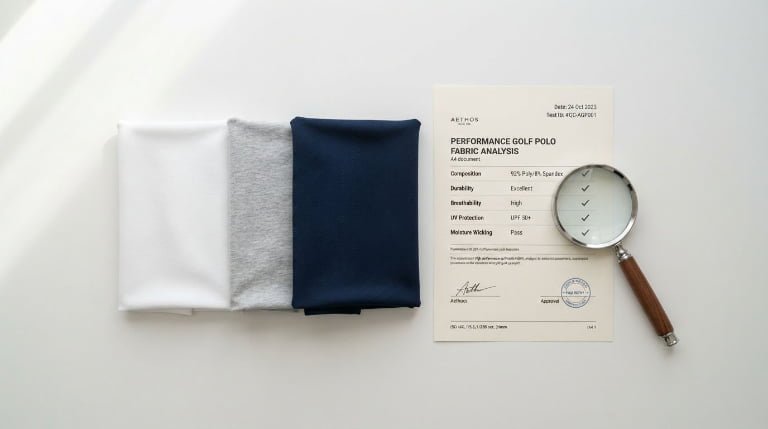
A supplier's statement that a fabric is "moisture-wicking" is not enough for technical approval.
Buyers should request a complete, traceable report and confirm that it represents the fabric intended for production.
6.1 Supplier Test Report Approval Checklist
| Review Item | What to Verify |
|---|---|
| Laboratory | Name, identity, and applicable accreditation or technical capability |
| Test Method | Exact standard, version, and selected procedure |
| Fabric Identity | Fabric code, composition, knit structure, GSM, and lot reference |
| Sample Orientation | Identification of skin-facing and outer surfaces where relevant |
| Test Conditions | Environmental and specimen conditions required for interpreting results |
| Results | Complete individual measurements and relevant calculated indices |
| Test Date | Whether the report applies to the current material specification |
| Wash Durability | Whether performance was assessed after agreed laundering |
| Approval Criteria | Whether the results meet the buyer's agreed specification |
| Bulk Traceability | Whether the production fabric can be linked to the approved sample |
A report does not become invalid simply because it is older than a fixed number of months.
The more important question is whether the tested construction, finish, and material specification still match the product being purchased.
Where the material has changed, updated testing may be necessary.
6.2 Common Supplier Report Red Flags
Only a marketing score is provided.
An OMMC summary without the underlying metrics may be insufficient for evaluating one-way transport.
The fabric description is too generic.
A report identifying the sample only as "polyester knit" may not provide adequate traceability.
The tested material cannot be matched to the production lot.
A result from a different finish, construction, or supplier lot may not represent the ordered material.
Testing conditions are missing.
For condition-sensitive methods such as ASTM E96, missing environmental details make comparison difficult.
Performance claims are broader than the testing supports.
AATCC 195 results should not be used as proof that a garment dries within a particular time.
These problems do not automatically mean a supplier is unreliable, but they should be clarified before fabric approval.
For examples of FUWAY's published testing documentation, visit our Test Reports page. Project-specific moisture-management reports should be requested separately where required.
6.3 Check Performance After Washing
Moisture-management performance may change after laundering, particularly where chemical finishes contribute to the initial result.
A practical approval plan should identify:
- The relevant laundering procedure.
- The agreed number of wash cycles.
- Whether the fabric will be evaluated before and after washing.
- The acceptance criteria for retained performance.
The number of cycles should reflect the project specification rather than an assumed universal durability requirement.
6.4 Link Testing to Production Approval
A reliable development process connects laboratory evidence to a traceable material approval.
Fabric Swatch → Lab Evaluation → Garment Sample Review → Pre-Production Approval → Bulk Fabric Verification
At each stage, confirm that the material being evaluated matches the specification carried forward.
Before cutting bulk fabric, the buyer and manufacturer should agree on:
- The approved reference fabric and its identification
- Which properties require lot-level verification
- Whether a change in mill, yarn, construction, or finish triggers retesting
- How deviations will be reviewed and approved
For the broader system of staged inspections, see FUWAY's Golf Apparel Quality Control Guide.
The objective is to prevent a situation where the approved sample has documented moisture-management performance, but the production fabric has not been adequately linked to that approval.
Step 7. Why Lab Results May Differ From On-Course Comfort
Laboratory measurements provide controlled, repeatable evidence about specific fabric properties.
They do not guarantee that a golfer will feel equally comfortable in every climate or during every activity.
7.1 Temperature and Humidity
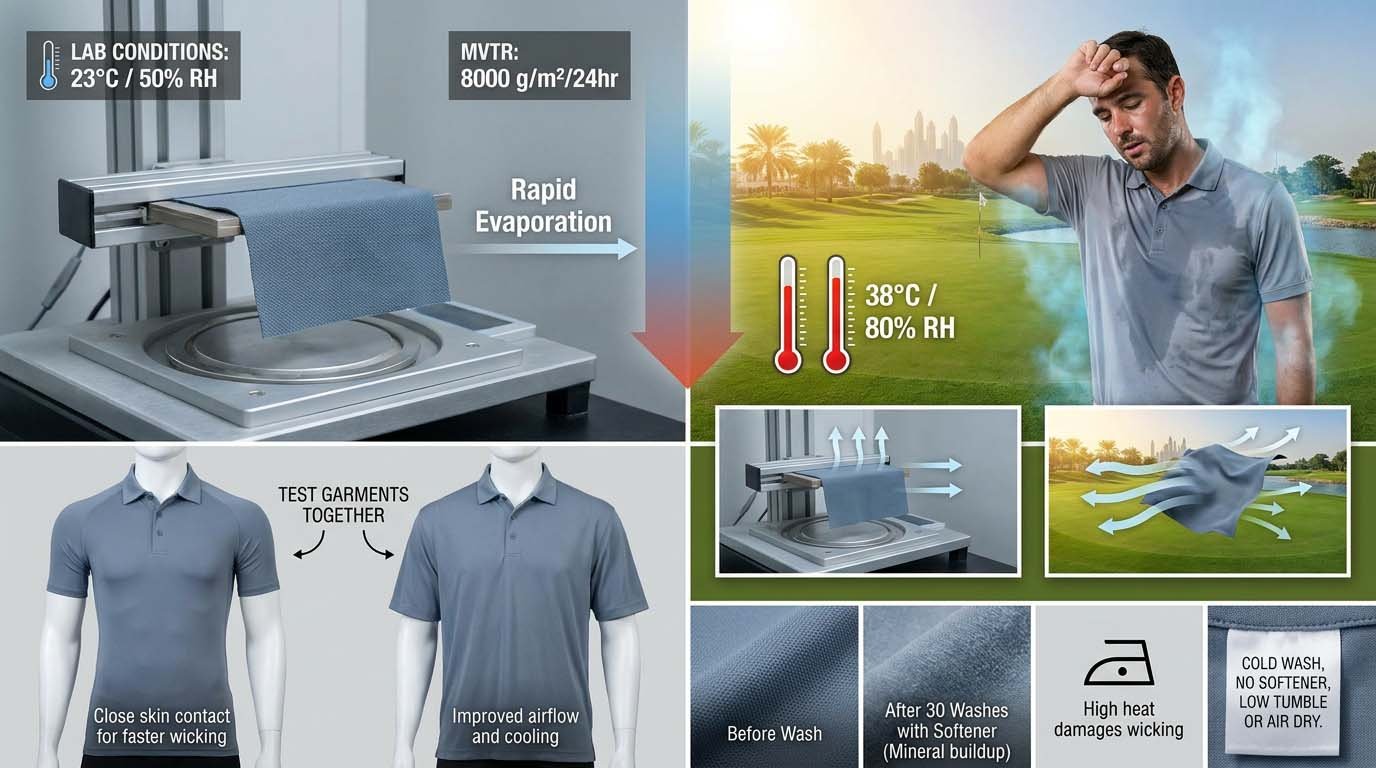
Evaporation depends partly on the surrounding environment.
In high humidity, moisture removal can become more difficult because the vapor pressure difference between the wet surface and surrounding air may be reduced.
This means a fabric that performs well in a controlled laboratory may feel different during golf in a hot, humid environment.
Instead of applying an arbitrary MVTR increase for tropical markets, brands should choose relevant tests and supplement them with wearer trials under representative conditions.
7.2 Air Movement and Garment Fit
Air movement influences heat and moisture exchange.
The same fabric may feel different in a close-fitting polo and a relaxed-fit polo because of variations in skin contact, garment ventilation, and movement.
A close fit may support liquid transfer where fabric contacts the skin, while a looser fit may allow more airflow.
Neither is universally superior.
Evaluate the fabric in the intended garment rather than relying only on swatch testing.
7.3 Layering
A quarter-zip worn over a polo creates a different moisture-management system than either garment worn alone.
Each layer can affect how moisture and vapor move.
For layered golf apparel, wear testing should reflect the intended combination of garments.
7.4 Laundering and Care
Detergents, fabric softeners, washing conditions, and drying procedures can affect some finishes and fabric properties.
A care label should reflect the actual materials and validated care requirements.
Brands should avoid making long-term moisture-wicking claims without suitable supporting evidence.
Buyer takeaway: Lab tests verify specific performance properties. Wear trials help determine whether the complete garment delivers the intended comfort in realistic conditions.
Frequently Asked Questions About Moisture-Wicking Testing
Is AATCC 195 a quick-dry test?
No. AATCC 195 evaluates liquid moisture management, including wetting, absorption, spreading, and one-way transport.
Quick-dry claims should be supported by an appropriate drying method, such as AATCC 199 or AATCC 201, depending on the intended measurement.
What is the difference between AATCC 197 and AATCC 213?
Both evaluate vertical wicking.
AATCC 197 measures wicking performance to specified distances, while AATCC 213 measures performance at specified times.
Neither is a standard drying-time method.
Does a higher MVTR mean a golf polo is more breathable?
A higher MVTR indicates greater measured water vapor transmission under comparable test conditions.
However, different methods or environmental conditions can produce results that are not directly comparable.
MVTR alone does not establish overall breathability or wearer comfort.
Should a golf apparel brand retest fabric before bulk production?
Retesting should be risk-based and agreed in advance.
It is particularly relevant when material specifications, finishes, manufacturing sources, or production lots change, or when contractual requirements call for additional verification.
The key is to confirm that bulk fabric matches the approved material and its required performance.
Conclusion: Verify Moisture-Wicking Claims, Not Just Marketing Labels
Moisture-wicking performance involves several distinct fabric behaviors.
AATCC 195 evaluates liquid moisture management. AATCC 197 and 213 evaluate vertical wicking. AATCC 199/200/201 address drying performance. ASTM E96 evaluates water vapor transmission.
These results should be interpreted separately and compared only under appropriately matched conditions.
For golf apparel brands, the strongest approach is to select tests based on the intended performance claim, review complete supplier reports, define approval criteria before production, and verify that bulk fabrics match the approved reference.
At FUWAY, we support OEM/ODM golf apparel development, including fabric sourcing, custom construction, sampling, and production coordination.
If you are developing performance golf polos or other custom golf apparel, contact FUWAY with your fabric requirements, intended market, and testing expectations to discuss suitable material development and verification options.