
I've seen brand buyers reject entire shipments over a single collar that wouldn't hold its shape. After 15 years handling quality disputes in OEM factories, I know this pain is avoidable.
A well-made golf polo passes three field tests: flat stitching under light, fabric that snaps back when stretched, and trims that stay crisp after washing. These checks reveal a factory's quality system—not just their fabric supplier.
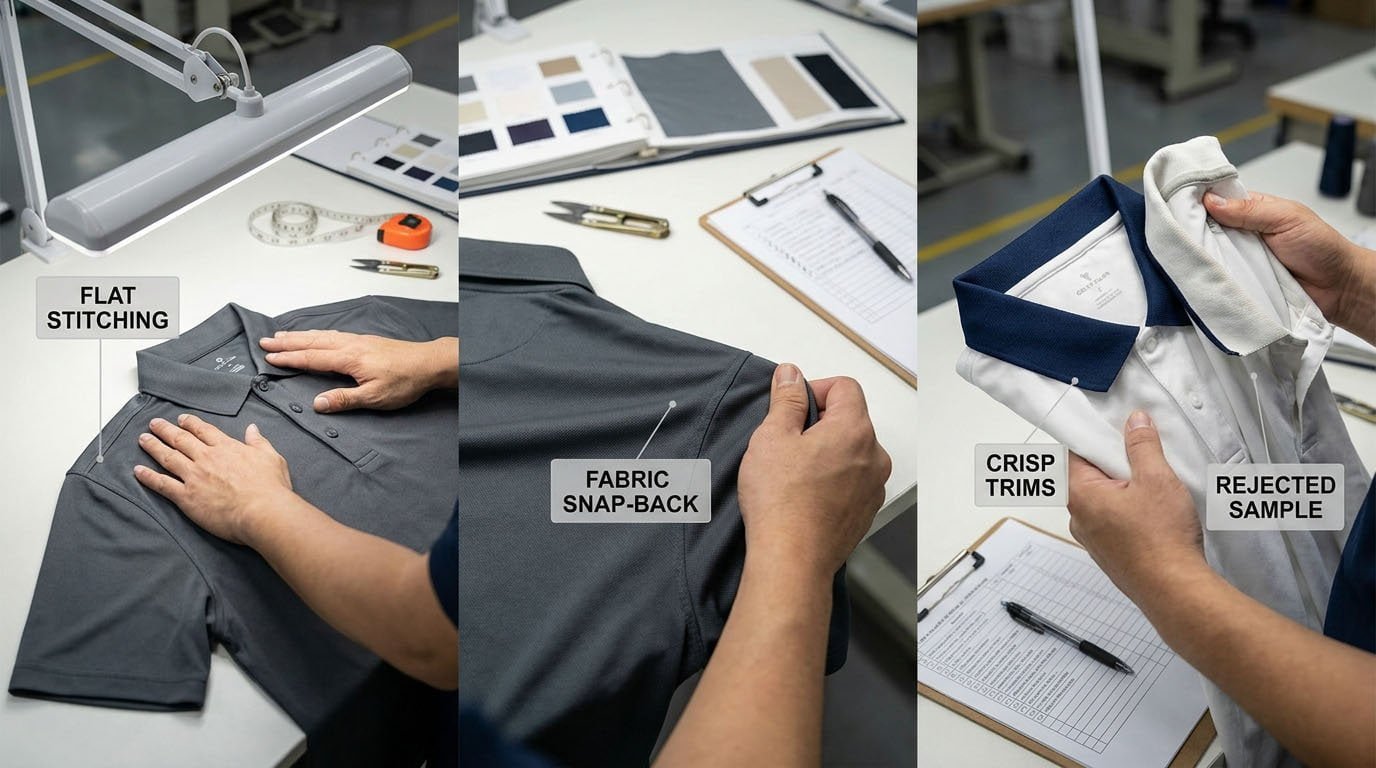
Most buyers focus on fabric weight and price. That's where quality disputes start. I've explained to countless brand buyers why their 180gsm polo still failed—because gram weight alone never equals quality. The real risk lies in stitching integrity, structural stability, and whether a factory tracks defects transparently. Let me show you what I verify on every factory floor.
Quick Answers: Identifying Quality Golf Polos in 60 Seconds
Can I check quality without lab tests?
Yes. Pull the collar edges apart—quality fabric snaps back to shape within 2 seconds. Check seams under bright light for skipped stitches. Feel fabric thickness consistency across chest and back panels.
What's the minimum acceptable stitch count?
Standard seams need 12-14 SPI (stitches per inch). Collar and placket should have 14-16 SPI. Count a 1-inch section under your phone's magnifier.
How do I spot a factory with weak QC?
Ask to see their defect log from last month. If they hesitate or show blank sheets, that's a red flag. Strong factories track every rework case with photos.
Does heavier fabric mean better quality?
Not always. I've seen 160gsm polos outlast 200gsm ones because of better stitching and pattern engineering. Weight matters, but construction matters more.
What causes collar deformation issues?
Three common causes: insufficient interfacing, wrong stitch tension, or collar band width under 3cm. All are process failures, not fabric problems.
First Impressions: Fabric Handfeel, Weight, Drape and Breathability?
Quality fabric feels smooth with consistent thickness—no thin spots when held against light. It should have moderate weight (160-220gsm for golf) and drape naturally without stiffness or excessive cling.
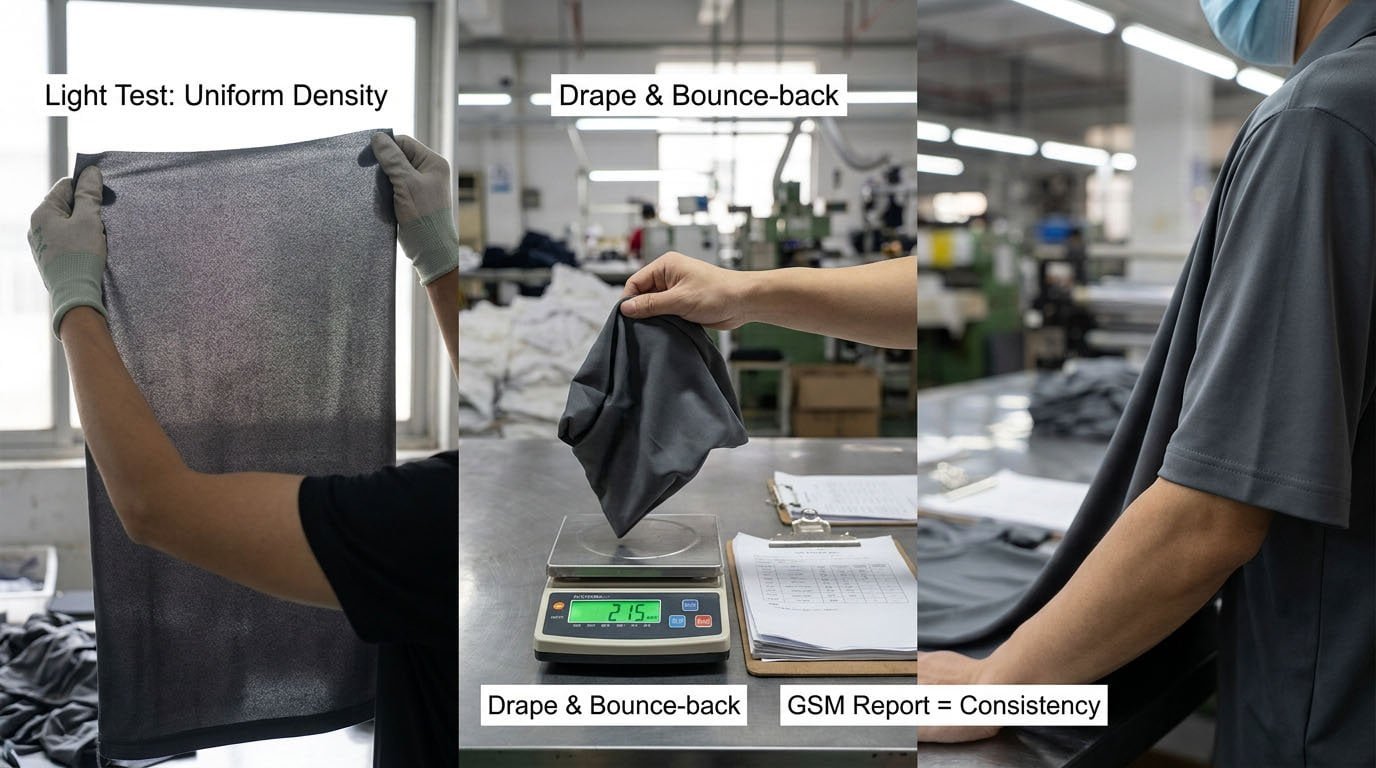
When brand buyers visit our factory floor, the first thing I tell them is: feel the fabric, but don't stop there. Here's what I actually check:
I hold the fabric panel against a light source. Quality fabric shows uniform density—no lighter patches that signal thin spots. Then I crumple a corner in my fist and release it. Good moisture-wicking fabric bounces back within 3-5 seconds. If it stays wrinkled, that polyester blend has quality issues.
Fabric weight matters, but here's what buyers miss: a 180gsm polo can fail if the knit structure is loose. I've handled disputes where brand buyers said "your fabric feels thin" even though lab tests showed correct weight. The problem? Loose knitting creates air gaps that reduce durability and handfeel.
What to Verify On-Site
| Check Point | Quality Standard | Red Flag |
|---|---|---|
| Fabric weight | 160-220gsm for golf wear | Under 150gsm or inconsistent across panels |
| Handfeel | Smooth, no slubs or pulls | Rough texture or pilling after light rub |
| Drape test | Hangs naturally over arm | Too stiff (excess resin) or too limp |
| Stretch recovery | Returns to shape in 3-5 seconds | Stays stretched or wrinkled |
I tell buyers: ask the factory for their fabric GSM test reports from incoming inspection. If they can't produce reports dated within the same production batch, they're not monitoring fabric consistency. That's when quality disputes happen after shipment.
Fit, Mobility and Patterning: Shoulders, Sleeves, Length and Ease?
Proper fit shows in three areas: sleeves that don't restrict shoulder rotation, body length that stays tucked during swings, and side seams that sit straight without pulling. These come from accurate pattern engineering, not fabric choice.
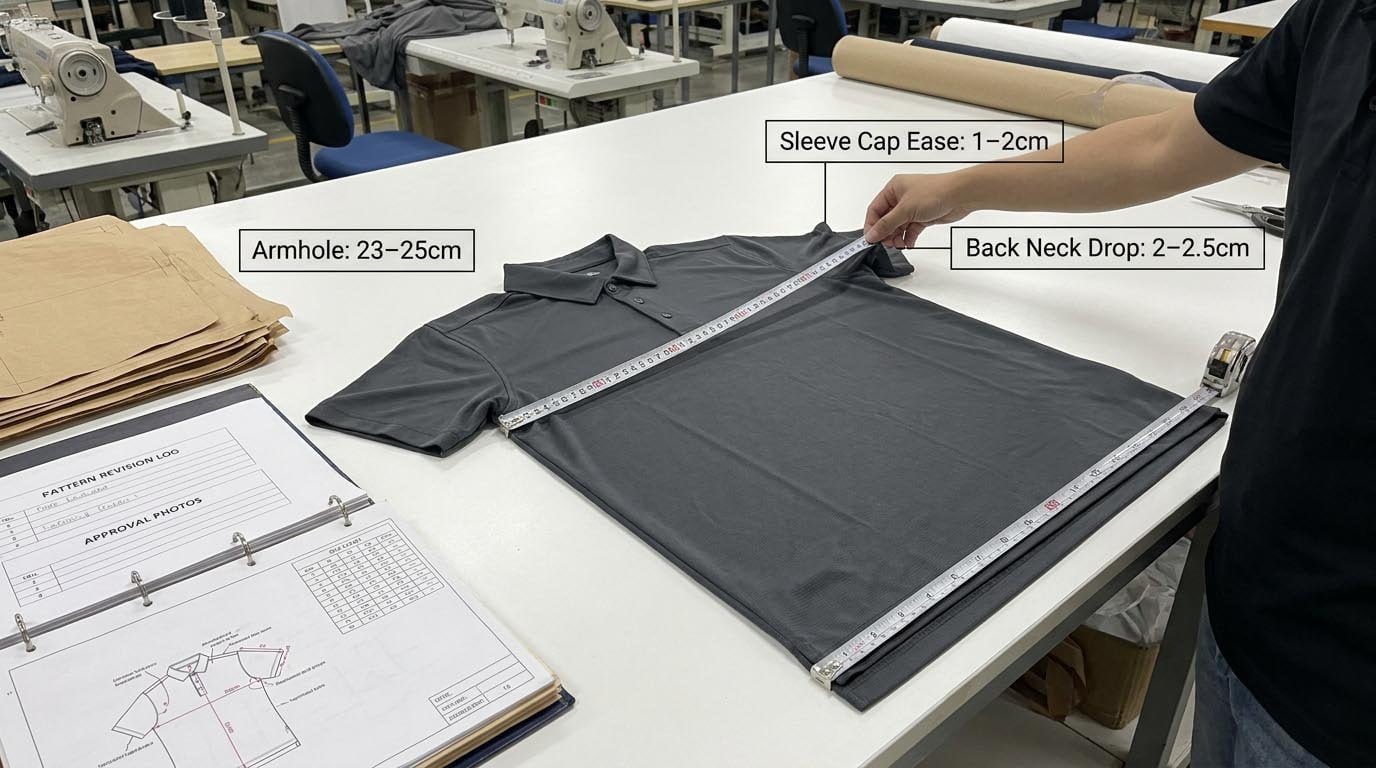
In my experience handling fit complaints, most issues trace back to pattern making—not sizing. Here's what I verify during production line inspections:
I pick up a sample from the cutting table and check the armhole depth. For golf polos, it should be 23-25cm from shoulder seam to underarm. Too shallow, and the wearer can't swing freely. Too deep, and the sleeve rides up awkwardly. I've seen brand buyers reject entire orders over 2cm armhole errors.
Sleeve length is another dispute point. I measure from shoulder seam to cuff edge—should hit mid-bicep (18-20cm for standard sizes). But here's what matters more: sleeve cap ease. I pinch the sleeve cap while the garment lies flat. There should be 1-2cm of fabric ease to allow arm movement without pulling the body panels.
Critical Pattern Points Buyers Should Check
- Shoulder seam placement: Should sit exactly on shoulder bone, not forward or back
- Side seam angle: Must be vertical when garment hangs—if it pulls forward, pattern is unbalanced
- Hem circumference: 10-12cm wider than chest measurement for proper drape and tucking
- Back neck drop: 2-2.5cm lower than front to prevent collar from choking during swing
I always tell brand buyers: ask to see the factory's pattern approval records. Quality factories keep pattern revision logs with photos. If they say "we use the same pattern for all brands," that's a risk signal. Each body type and brand fit philosophy needs adjusted patterns.
The biggest fit complaint I've handled? Polo bodies that ride up during golf swings. The cause was always insufficient body length (under 70cm for size M) or tight hem circumference. These are pattern errors that fabric quality cannot fix.
Stitching and Construction: Seams, SPI, Reinforcements and Clean Finish?
Quality stitching shows flat seams with 12-16 SPI, no skipped stitches under magnification, and clean thread tails inside. This reveals whether a factory controls tension settings and trains operators to standard.
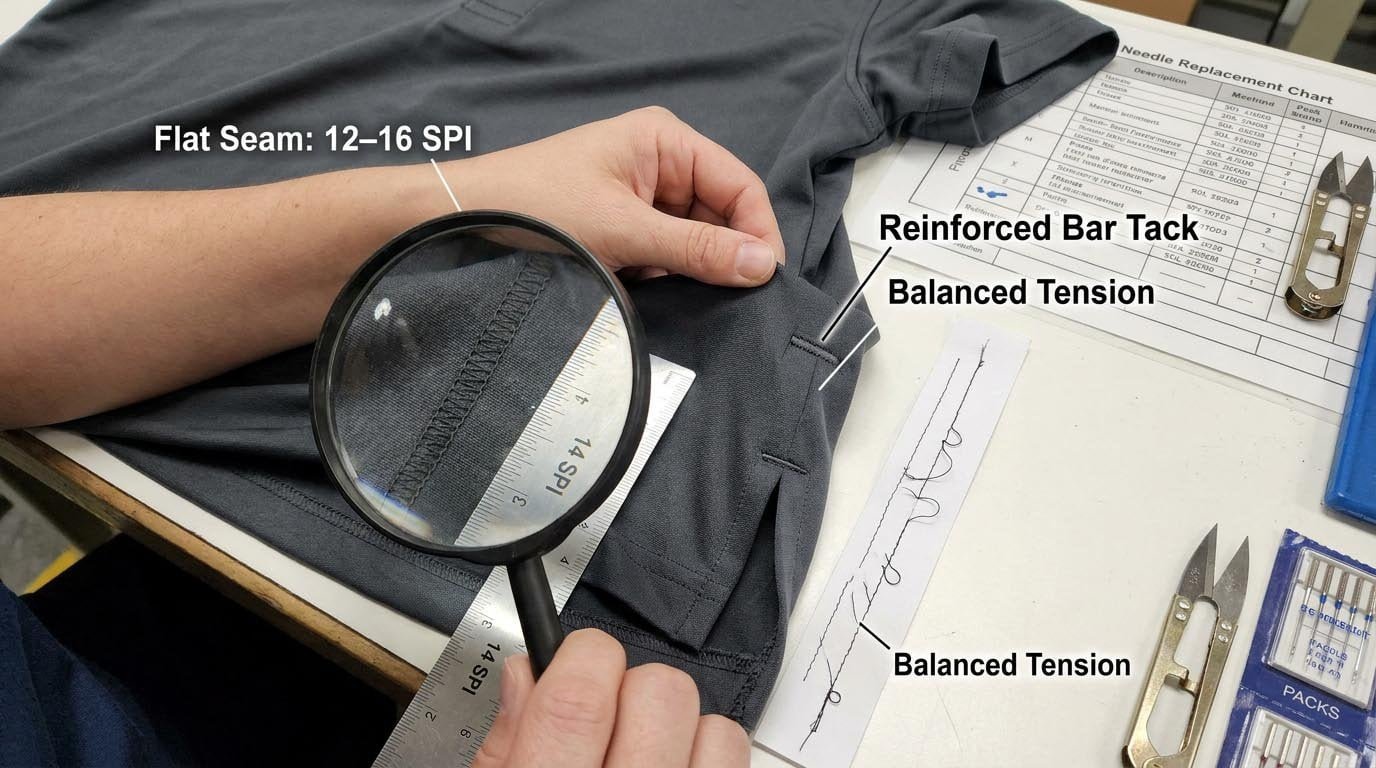
This is where I catch most quality issues during in-line inspections. Stitching problems are process failures—and they're the top reason brand buyers lose trust in a supplier.
I run my fingernail along seams from inside the garment. Quality stitching feels flat, no ridges or puckers. Then I check stitch density with a ruler: main seams should have 12-14 stitches per inch, collar and placket need 14-16 SPI. Lower counts risk seam failure during wear.
Here's what brand buyers often miss: thread tension consistency. I pull the seam gently to see if thread loops appear on one side. Unbalanced tension shows loose loops on top or bottom—this causes seam failure after washing.
Stitching Inspection Checklist
| Seam Type | SPI Standard | Common Defect | Quality Impact |
|---|---|---|---|
| Side seams | 12-14 | Skipped stitches | Seam splits open |
| Shoulder seams | 12-14 | Puckering | Fabric distortion |
| Collar attachment | 14-16 | Uneven tension | Collar waves or twists |
| Hem edge | 12-14 | Thread tails | Unprofessional finish |
I check reinforcement stitching at stress points: side slit openings, shoulder seam ends, and placket bottom. These spots need bar tacks or reverse stitches—without them, seams tear during normal wear.
The most common stitching complaint I resolve? Skipped stitches. Brand buyers count more than 2 skipped stitches per 10cm as a major defect. This happens when factories don't maintain needle sharpness or adjust tension for different fabric weights.
I tell buyers: ask to see the factory's needle replacement schedule. Quality factories change needles every 8 hours of production for synthetic fabrics. If they say "we replace when broken," expect stitching defects in your shipment.
Collar, Placket, Hems and Trims: Details That Hold Shape and Last?
Quality collars keep their shape through 20+ washes because of proper interfacing weight (40-60gsm), correct stitching tension, and collar band width of 3-3.5cm. Plackets should lie flat with aligned button spacing and clean buttonholes.
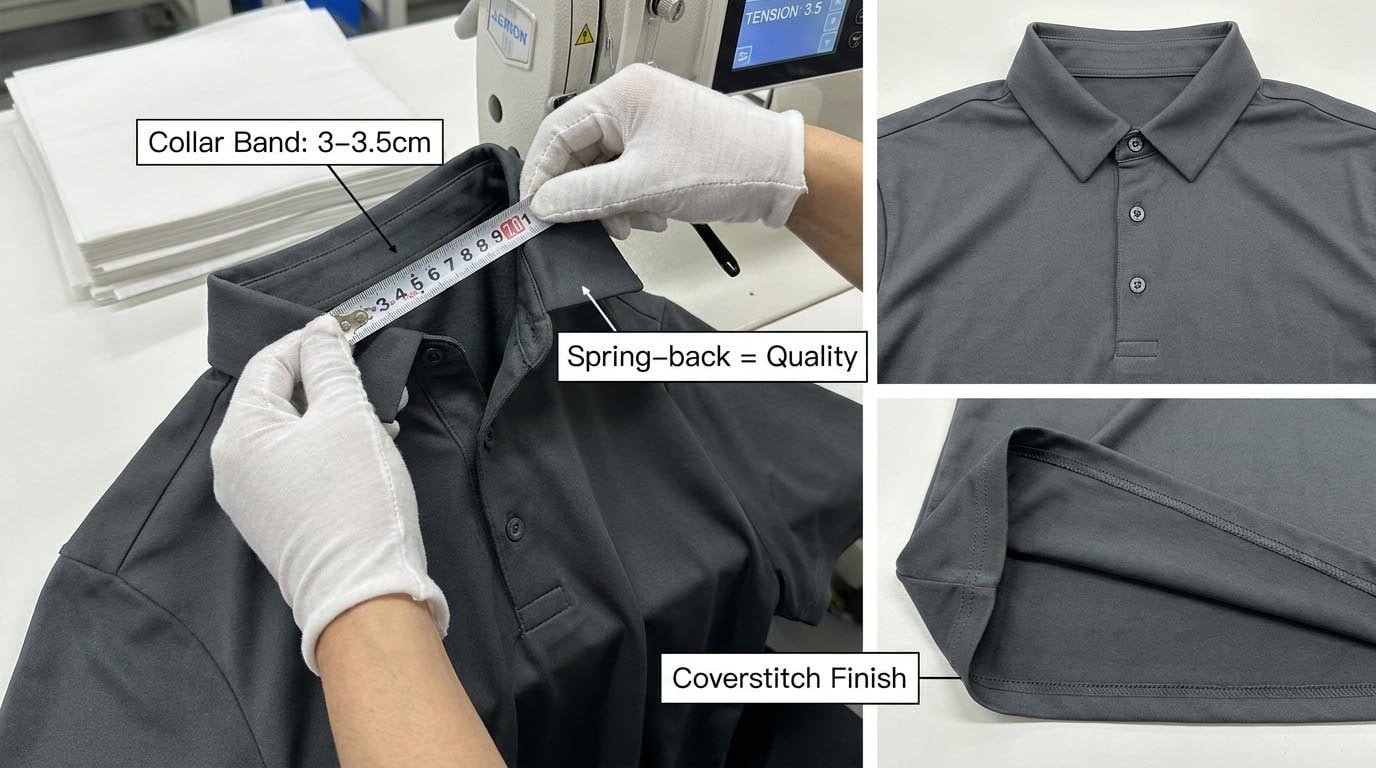
I've handled more quality disputes over collar deformation than any other issue. After explaining the same root causes dozens of times, I know exactly what to check.
I fold the collar in half lengthwise and release it. Quality collars spring back to shape immediately. If the collar stays folded or shows a crease line, the interfacing is too light (under 40gsm) or wasn't fused properly.
Collar band width matters more than buyers realize. I measure the band from fold line to seam—should be 3-3.5cm. Narrower bands lose structure faster. I've seen factories try to save fabric by cutting bands at 2.5cm. Those collars curl after 5 washes.
Critical Trim Quality Points
- Interfacing weight: Should be 25-30% of outer fabric weight for balance
- Collar points: Must be sharp and symmetrical, no rounded corners
- Placket width: 3cm standard, stitched 0.5cm from edge on both sides
- Button spacing: 8-10cm between center points for standard 3-button design
- Hem width: 2.5-3cm with coverstitched or double-needle finish
I check placket alignment by laying the polo flat and buttoning it completely. The buttonhole centers should form a straight vertical line. If they zigzag, the pattern or cutting was off—this is a structural defect that can't be fixed in production.
Hem finishing reveals factory attention to detail. Quality golf polos use coverstitch machines that create three visible lines on the outside and flat coverage inside. I run my hand inside the hem—it should feel smooth, no raw fabric edges or thread loops.
The trim complaint I explain most often? Collar edges that wave or ripple. Brand buyers think it's fabric quality. Actually, it's stitch tension being too tight. When collar stitching has higher tension than the fabric can handle, it compresses the edge and creates waves. I show buyers the tension settings on our machines—each fabric type needs different calibration.
Proof of Performance: Tests, Labels, Care and Sustainability Signals?
Reliable suppliers provide test reports (colorfastness, shrinkage, pilling resistance) dated within 30 days of production, care labels that match fabric content, and transparent records of any rework or rejected materials.
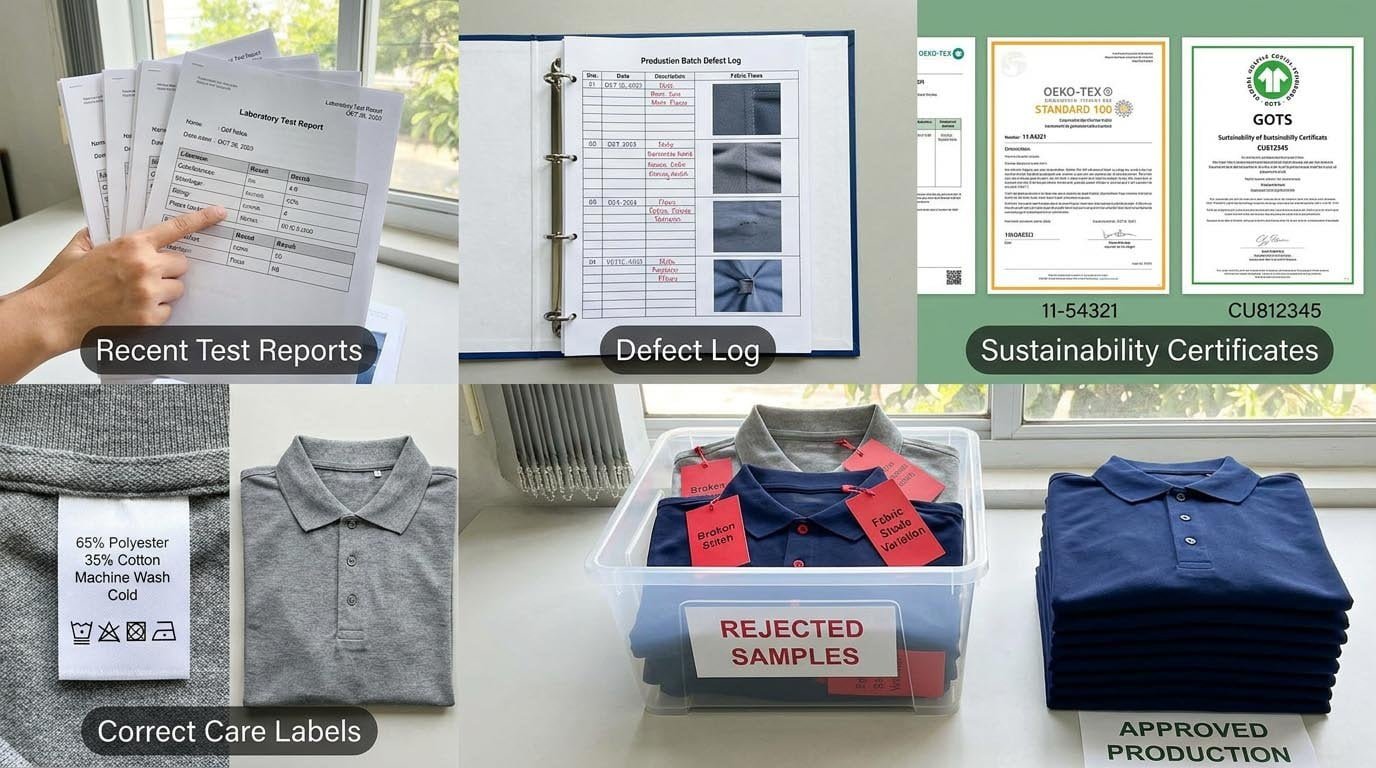
When brand buyers ask me "how do I know your quality is consistent?", I show them our defect tracking log from the past 90 days. That document tells the real quality story—not marketing promises.
I walk buyers through three documents that reveal a factory's quality system:
Test reports: I verify that lab reports are dated within the same production month. Key tests for golf polos include:
- Colorfastness to washing: Grade 4 minimum (scale 1-5)
- Dimensional stability: Max 3% shrinkage after 3 washes
- Pilling resistance: Grade 3-4 after 5,000 rubs
- Moisture wicking: Drying time under 30 minutes for 2ml water drop
If a factory shows you test reports from 6 months ago, those results don't represent your current production batch. Fabric suppliers change. I insist buyers ask: "Can I see reports from this month's production?"
Quality Documentation Checklist
| Document Type | What to Verify | Red Flag |
|---|---|---|
| Fabric test report | Date within 30 days, supplier name visible | Generic reports with no batch tracking |
| Care label accuracy | Matches actual fiber content | Says "100% cotton" when fabric is blend |
| Defect log | Shows specific issues, quantities, photos | Empty or vague entries |
| Rework records | Lists root cause and corrective action | No records or says "no rework needed" |
I check care labels against actual fabric composition. I've caught suppliers using generic labels (saying "100% polyester") when the fabric is 65/35 poly-cotton blend. This creates legal compliance risk for brand buyers in regulated markets.
Sustainability signals are becoming critical. When buyers ask about eco-claims, I show them:
- Fabric mill certifications (Oeko-Tex, GOTS, GRS) with valid certificate numbers
- Dye chemical test reports (restricted substances must be within limits)
- Water consumption records from washing and dyeing processes
But here's what I emphasize: don't trust claims without documents. I've seen factories put "eco-friendly" on hangtags with zero proof. Quality buyers ask: "Can I see the recycled content certificate from your yarn supplier?"
The most valuable quality indicator? A factory's willingness to show you rejected samples and explain what went wrong. If they only show perfect samples, they're hiding their real quality control process. I keep a box of defective samples to show buyers exactly what we catch and fix.
FAQ: Identifying a Well‑Made Golf Polo Shirt
How quickly can I assess quality during a factory visit?
I can do a basic quality check in 15 minutes: examine 3 random samples from production line, check stitching under light, test collar and cuff recovery, review this month's test reports. If factory hesitates to show in-line samples, that's a warning sign.
What's the difference between acceptable and critical defects?
In my experience processing quality claims, critical defects make the garment unwearable (large holes, missing buttons, seams coming apart). Acceptable defects are minor issues that don't affect function (slight thread tails, small color variations within tolerance). I use a 3-point scale: critical (reject entire piece), major (rework possible), minor (accept with documentation).
Should I trust factory claims about fabric grades?
Not without verification. I've handled disputes where factories claimed "premium grade fabric" but test reports showed 15% below stated GSM. Always ask for incoming fabric inspection reports with actual weight and composition measurements.
How many samples should I inspect before approving bulk production?
I recommend checking 10 random samples from pre-production. But more importantly, verify the factory's first-piece inspection process. Ask to see their checklist—quality factories measure every spec point on the first 3 pieces before starting bulk production.
Can a small factory deliver the same quality as large ones?
Yes, if they have transparent quality systems. I've worked with 50-person factories that keep detailed defect logs and 500-person factories with no tracking. Size doesn't equal quality—process discipline and documentation do.
What's the most overlooked quality indicator?
Thread quality. Buyers focus on fabric but ignore thread. I've seen entire shipments with seam puckering because factories used cheap thread with inconsistent thickness. Ask about their thread supplier and tension calibration schedule.
Conclusion
After 15 years explaining quality disputes to brand buyers, I know this: the best polo quality check happens before you place the order. Ask the factory to show their defect logs, test their samples yourself, and verify their processes. These simple field checks have saved my buyers from costly shipments and built partnerships that last.