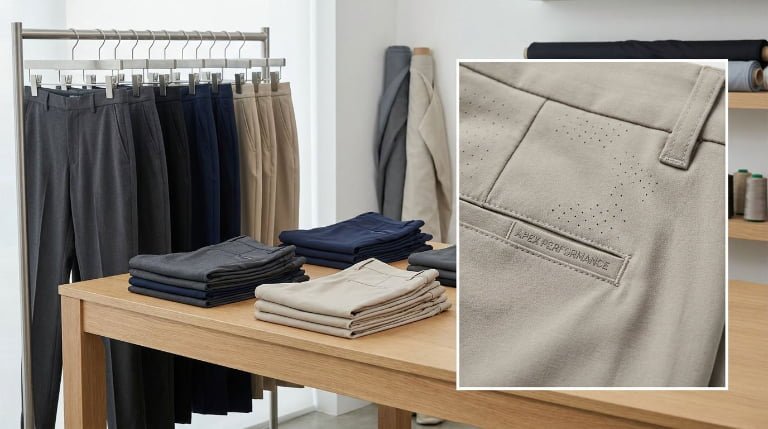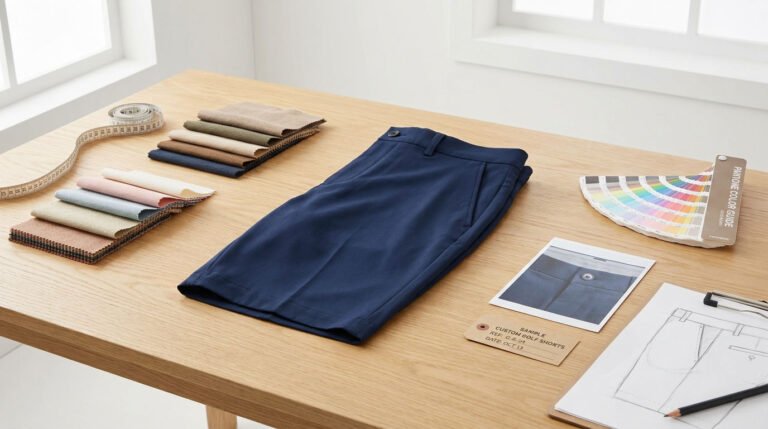
Too many colors. Not enough inventory depth. Your best-selling golf shorts run out of popular sizes, while slower colors sit in storage.
Effective golf shorts color planning means investing more inventory in dependable core colors and testing seasonal colors with controlled commitments. The right balance depends on your target customers, sales history, size distribution, fabric availability, and reorder capacity—not a fixed core-to-seasonal ratio.
For private-label golf apparel brands, color planning is more than an aesthetic decision. It determines how many SKUs you carry, how much fabric you need, and whether you can replenish winning colors before the selling season ends.
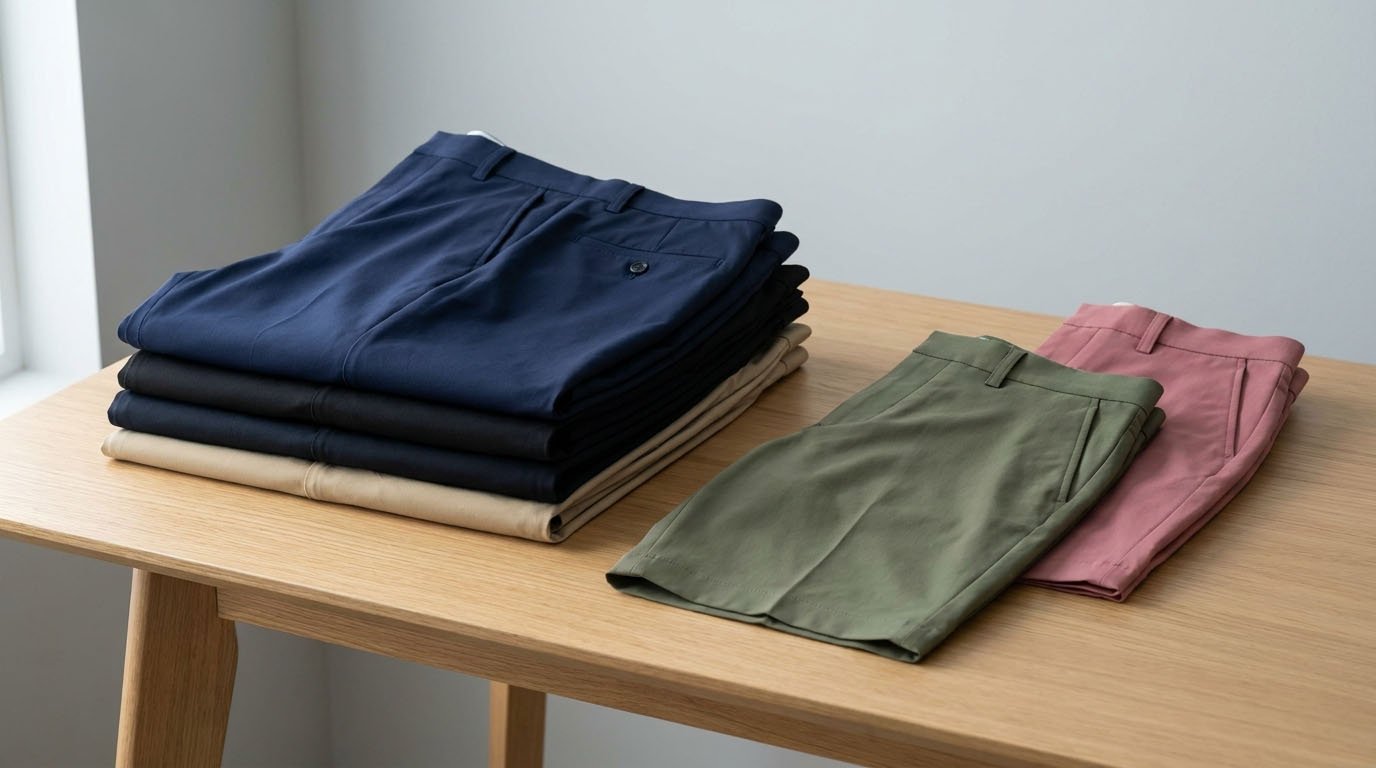
Quick Answer: Core vs Seasonal Golf Shorts Colors
| Planning Factor | Core Colors | Seasonal Colors |
|---|---|---|
| Primary purpose | Repeat sales and replenishment | Variety and market testing |
| Common examples | Navy, khaki, black, grey | Olive, light blue, coral, seasonal accents |
| Inventory strategy | Deeper, based on demand | Smaller initial commitments |
| Reorder approach | Planned replenishment | Reorder after demand validation |
| Main risk | Overestimating ongoing demand | Unsold seasonal inventory |
| Best evidence | Historical sell-through and reorders | Controlled testing and customer response |
The key rule: Buy inventory according to expected demand and replenishment needs, not simply the number of colors you want to offer.
Core colors are defined by their commercial performance. A distinctive olive or blue shade can become a core color if customers consistently buy it. Likewise, black or navy should not automatically receive the largest inventory allocation without supporting demand evidence.
Step 1: Choose Core and Seasonal Colors for Your Golf Shorts
Before deciding how many colors to manufacture, identify what each color is supposed to accomplish.
A useful golf shorts collection can contain three types of colorways:
- Core: Colors intended for ongoing sales and replenishment.
- Supporting: Versatile colors that expand assortment options without necessarily requiring year-round stock.
- Seasonal: Limited or experimental colors introduced for a specific collection, market, or selling period.
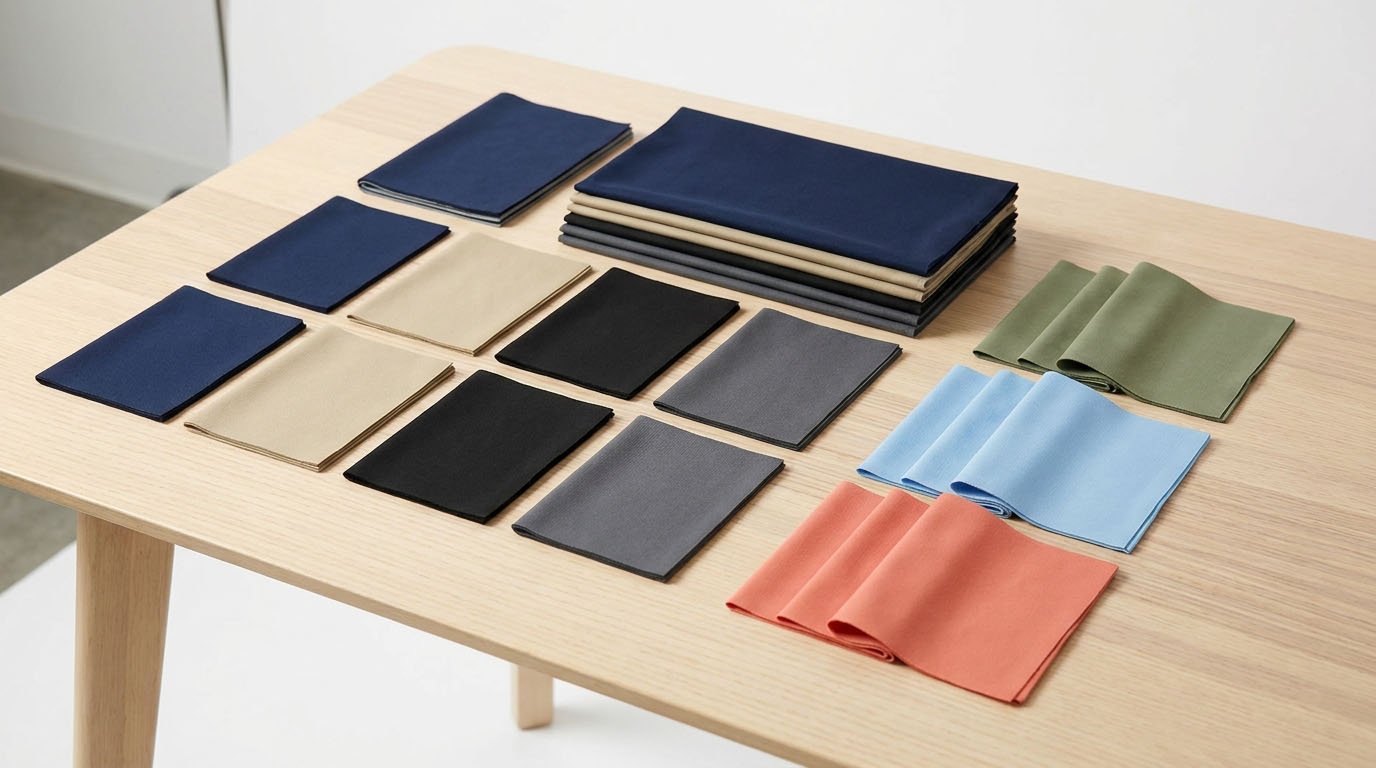
Which Golf Shorts Colors Should Brands Consider?
The following table provides a starting point for evaluating color options.
| Golf Shorts Color | Potential Role | Suitable Positioning | What to Check |
|---|---|---|---|
| Navy | Core candidate | Classic golf, pro shops, everyday wear | Reorder shade consistency |
| Khaki / Stone | Core candidate | Traditional golf, resort collections | Undertone and fabric color matching |
| Black | Core candidate | Modern performance, corporate apparel | Fading and colorfastness |
| Grey | Core / Supporting | Performance and lifestyle collections | Shade consistency and light-fabric appearance |
| Olive / Sage | Supporting / Seasonal | Lifestyle and resort-inspired brands | Demand evidence and repeatability |
| Off-white | Supporting / Seasonal | Premium and warm-weather collections | Opacity, staining, and fabric suitability |
| Light Blue | Seasonal candidate | Spring and coastal collections | Customer response and inventory exposure |
| Coral / Pink | Seasonal / Capsule | Resort, tournament, and limited drops | Demand uncertainty and markdown exposure |
These are commercial planning examples, not universal sales rankings.
For an established brand, a color's sales history should determine whether it belongs in the core range. A new brand can only identify core candidates until actual customer behavior provides stronger evidence.
Coordinate Golf Shorts Colors With Your Polo Collection
Shorts rarely exist as isolated products. Customers often consider how they pair with polos, quarter-zips, and outerwear.
For example, navy shorts can support several polo color options, while a distinctive seasonal shade may work best within a coordinated capsule collection.
However, avoid developing a completely separate color system for every product category.
For broader brand-level palette development, see our Golf Apparel Color Matching Guide.
For this golf shorts collection, the immediate decision is which colors deserve inventory commitments—not how to build the entire brand identity.
Step 2: Decide How Many Colors Your Brand Should Launch
There is no ideal number of golf shorts colors for every brand.
Launching two colors might be appropriate for a startup with a limited budget. An established brand with several retail channels and reliable sales data may justify a broader collection.
The important question is whether each additional color has enough expected demand, inventory depth, and production feasibility.
New Brands vs Established Brands
| Brand Stage | Core Color Approach | Seasonal Color Approach | Main Priority |
|---|---|---|---|
| New brand | Start with a few versatile candidates | Test one or a small number of accents | Protect initial inventory |
| Growing brand | Increase depth in proven colors | Test new shades based on customer feedback | Improve sell-through |
| Established brand | Adjust allocation using sales history | Introduce planned seasonal or capsule ranges | Coordinate replenishment and assortment |
For a new brand, two core candidates and one seasonal test could be a reasonable starting scenario—but only if the production quantities are commercially and technically viable.
Do not automatically apply an 80/20 or 70/30 split. Those allocations may be useful as planning examples, but they are not manufacturing standards or guaranteed inventory strategies.
Plan Inventory Depth Before Color Count
Many brands choose a palette first and divide their production budget afterward.
A more reliable approach is to reverse that process:
- Estimate expected demand for your golf shorts style.
- Determine the size range and expected sales mix.
- Calculate the inventory needed to support each color.
- Check fabric availability and applicable minimums.
- Remove or postpone colors that cannot support a viable production and sales plan.
This prevents a visually attractive collection from becoming an inventory problem.
Step 3: Calculate Color × Size Inventory Depth
Every additional golf shorts color increases the number of SKUs when offered across multiple waist sizes.
For example, if one golf shorts style comes in seven sizes, introducing six colors creates 42 individual color-size SKUs.
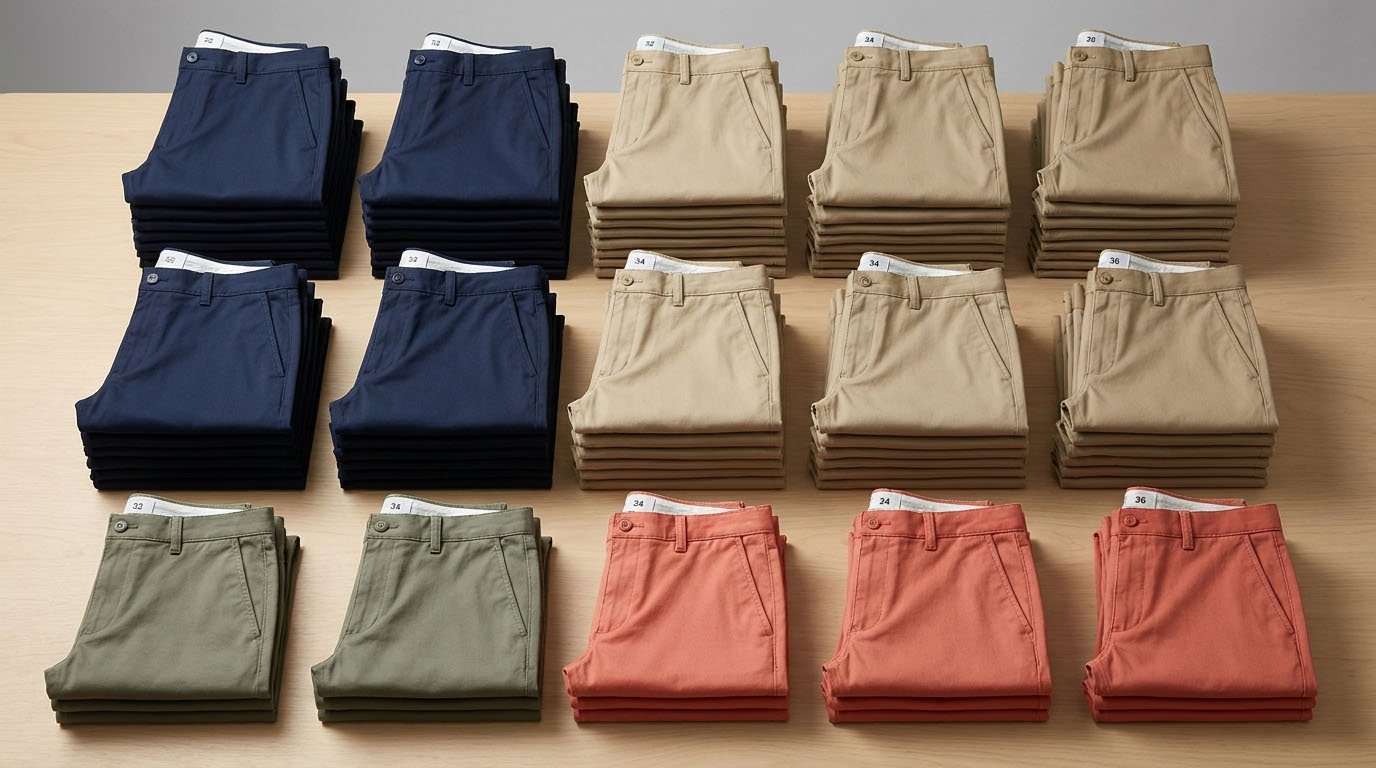
Example: How Color Count Changes Inventory Depth
Assume a hypothetical production order of 1,200 pairs of golf shorts, with seven sizes available in every color.
| Colors | Total SKUs | Average Units per Color | Average Units per SKU |
|---|---|---|---|
| 3 | 21 | 400 | 57 |
| 6 | 42 | 200 | 29 |
| 10 | 70 | 120 | 17 |
Illustrative calculation only. This assumes an equal allocation across colors and sizes. Actual purchase orders should use a demand-based size curve.
The total order remains unchanged, but inventory depth decreases as more colors are introduced.
A color can perform well overall and still lose sales because its most popular waist sizes run out early.
Use a Realistic Size Curve
Equal quantities across all sizes are rarely the best starting point.
Suppose your brand plans to order 480 pairs of navy golf shorts. An illustrative size allocation could be:
| Waist Size | Allocation | Quantity |
|---|---|---|
| 30 | 10% | 48 |
| 32 | 20% | 96 |
| 34 | 25% | 120 |
| 36 | 20% | 96 |
| 38 | 15% | 72 |
| 40 | 10% | 48 |
| Total | 100% | 480 |
The size percentages are examples, not universal golf apparel demand figures.
Your actual size curve should reflect previous sales, customer demographics, channel requirements, and wholesale commitments.
Example: Allocate Inventory Across Four Colors
Consider another hypothetical 1,200-unit golf shorts order:
| Color | Role | Planned Quantity |
|---|---|---|
| Navy | Core candidate | 480 |
| Khaki | Core candidate | 420 |
| Olive | Supporting / Seasonal | 180 |
| Coral | Seasonal test | 120 |
| Total | 1,200 |
This example concentrates more inventory in two primary colors while reserving smaller commitments for less-proven shades.
It is not a recommended universal allocation. The olive and coral quantities, for example, would still need to satisfy the applicable fabric and garment production requirements.
For a broader explanation of how style count, colors, and factory minimums interact, see Golf Apparel MOQ Explained.
Step 4: Check Fabric Availability and Color-Specific MOQs
Color planning is not complete until the manufacturer confirms whether the proposed colors can actually be sourced and produced at the required quantities.
For golf shorts, this is particularly important when using performance stretch-woven fabrics.
A color that looks good in a digital mockup may not be available in the preferred fabric composition, weight, finish, or order quantity.
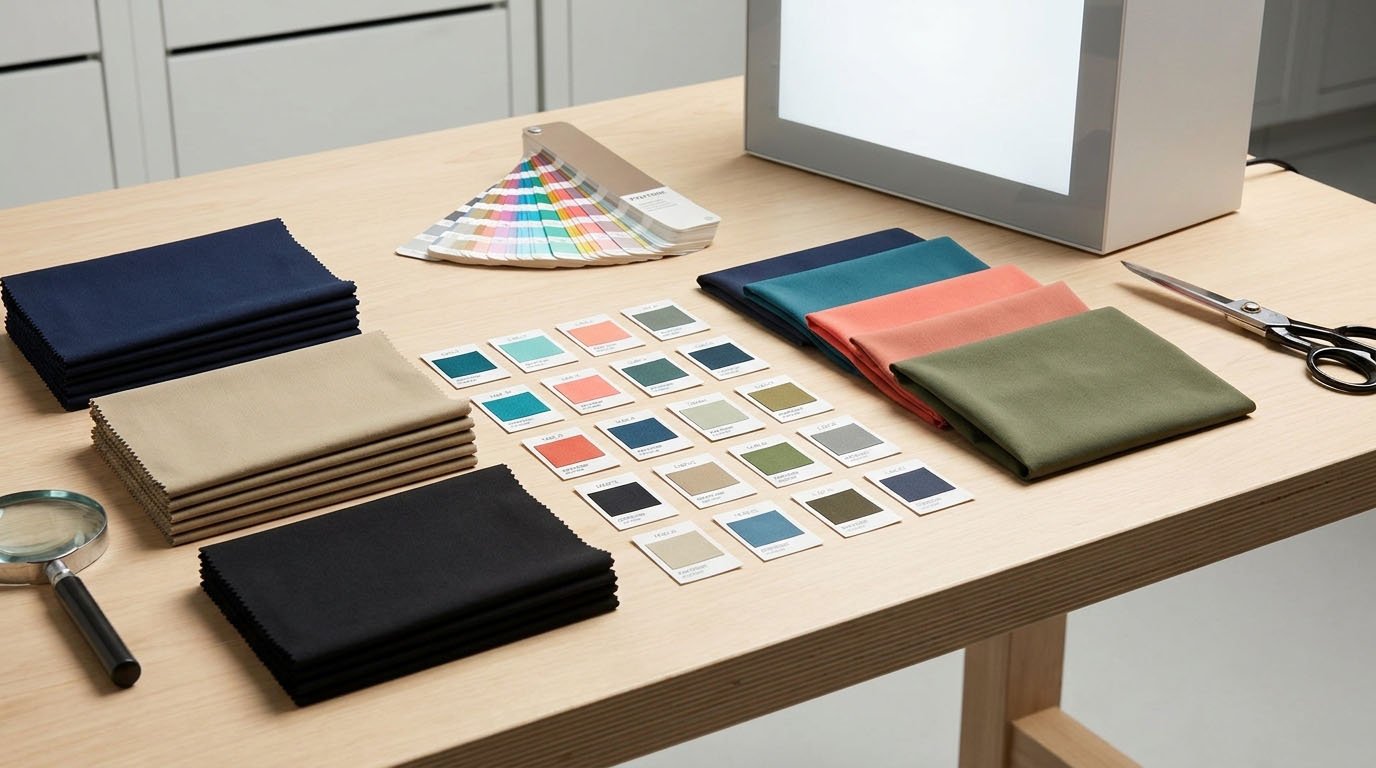
Stock Fabric Colors vs Custom-Dyed Colors
| Production Factor | Stock Fabric Color | Custom-Dyed Color |
|---|---|---|
| Color selection | Limited to available shades | Developed against an approved reference |
| Fabric sourcing | Depends on supplier inventory | Requires dyeing feasibility confirmation |
| MOQ | Based on available stock and garment requirements | May involve a separate dyeing minimum |
| Color approval | Physical swatch or fabric approval | Lab Dip or other agreed color approval process |
| Repeatability | Depends on continued stock availability | Depends on dye records, standards, and future mill capacity |
| Best use | Testing and smaller collections | Brand-specific colors and planned repeat programs |
Stock fabric is not automatically the better solution.
It can simplify color sourcing, but a shade may become unavailable between orders. Conversely, custom-dyed fabric can provide stronger control over a brand-specific color, but it may require larger material commitments.
Why Garment MOQ and Fabric MOQ Are Different
A garment manufacturer may support relatively small production quantities, while a fabric mill may require a larger minimum for a custom color.
For suitable FUWAY projects, the starting garment MOQ is commonly around 100 pieces per style, subject to the design, material, and order configuration.
However, that does not mean every custom color can be produced at 100 pieces.
For example, a buyer may request four custom Pantone shades using the same stretch-woven material. Before confirming production, the manufacturer must determine whether each shade meets the mill's dyeing conditions.
Possible alternatives include selecting existing fabric colors, using a suitable shared fabric base, reducing the number of custom shades, or adjusting the order quantities.
For help identifying suitable materials, explore FUWAY's Fabric Sourcing Services.
Confirm Color Performance Before Approval
Physical color appearance is not the only consideration.
For performance golf shorts, buyers should also review:
- Colorfastness: Resistance to fading or color transfer under agreed test conditions.
- Opacity: Particularly relevant for lighter-colored fabrics.
- Shade consistency: Acceptable variation between approved samples and production fabric.
- Fabric behavior: Whether the selected shade and finishing process affect the intended appearance or performance.
For repeat orders, retain the approved physical color standard and relevant fabric details. Any numerical shade tolerance should be agreed for the specific project rather than assumed to be universal.
Step 5: Test Seasonal Colors Before Expanding Inventory
Seasonal colors can refresh a golf shorts collection, support marketing campaigns, and help identify new customer preferences.
However, a successful test requires more than ordering a small quantity and waiting for it to sell.
The test needs sufficient inventory, an appropriate size range, and meaningful exposure to customers.
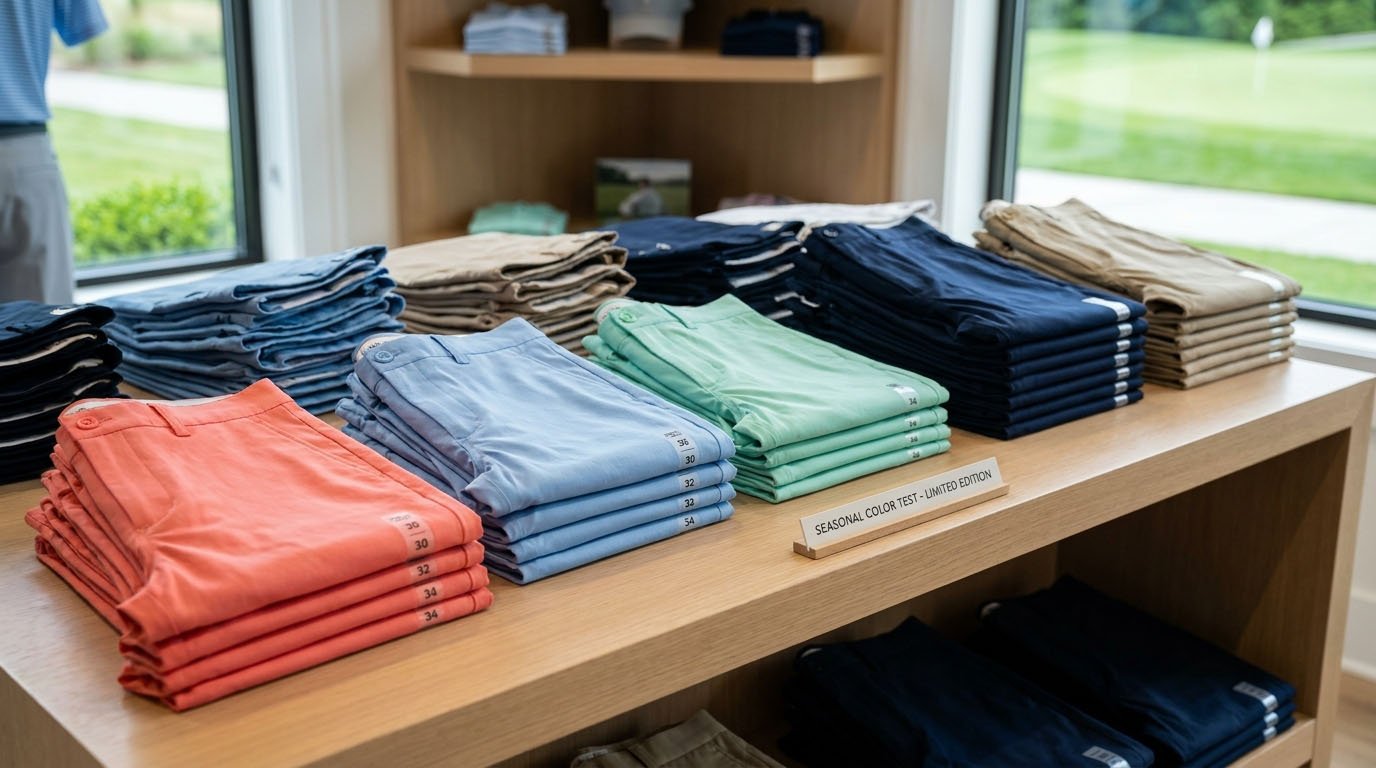
Avoid Misleading Test Results
| Testing Problem | Why It Matters | Better Approach |
|---|---|---|
| Too many seasonal colors | Each color receives limited inventory and attention | Test fewer colors |
| Unequal marketing exposure | Higher sales may reflect promotion rather than preference | Compare reasonably similar exposure |
| Missing popular sizes | Stockouts can distort demand | Plan a representative size range |
| Heavy discounting | Sell-through may not indicate full-price demand | Track full-price sales separately |
| No reorder review | A promising color may never become available again | Confirm sourcing before scaling |
A seasonal color selling out quickly can be encouraging, but it is not sufficient proof that the color should become permanent.
Check whether demand was spread across relevant sizes and whether promotions, retail placement, or limited availability affected the outcome.
Which Metrics Should Brands Track?
Three useful measurements are:
1. Full-price sell-through
The percentage of the initial available inventory sold at the regular selling price during a defined period.
Compare colors across similar sales windows and promotional conditions.
2. Size-level availability
Identify whether a color underperformed because customers did not want it or because important sizes were unavailable.
3. Markdown dependency
Measure how much discounting was required to clear the color.
A seasonal shade that sells primarily after steep markdowns may not justify a deeper repeat order.
When Should a Seasonal Color Become Core?
Consider promoting a seasonal color into the core collection when it demonstrates:
- Consistent demand across a meaningful selling period.
- Acceptable full-price sell-through and margin.
- Repeat customer or wholesale interest.
- A commercially viable size distribution.
- Reliable fabric availability and color reproducibility.
One successful launch may justify another controlled order. Multiple positive selling periods provide stronger evidence for a longer-term commitment.
Step 6: Approve Colors and Plan Reorders Before Bulk Production
A good color plan should end with an approved production specification, not just a mood board.
Before bulk fabric is committed, the brand and manufacturer should confirm how each chosen color will be sourced, produced, identified, and replenished.
Golf Shorts Color Approval Checklist
| Approval Item | What the Brand Should Confirm |
|---|---|
| Color role | Core, supporting, or seasonal |
| Color reference | Approved physical shade or agreed color standard |
| Fabric specification | Composition, weight, stretch, finish |
| Sourcing method | Stock fabric or custom-dyed fabric |
| MOQ | Relevant minimum per style, color, and fabric |
| Quantity breakdown | Approved units by color and waist size |
| Sample approval | Color appearance and relevant performance checks |
| Reorder feasibility | Fabric continuity, minimums, and lead time |
| Production reference | Recorded fabric, shade, and approval information |
Ask About Reorder Lead Time Before the First Order
A core color only provides reliable replenishment when the required material and production capacity are available.
Before placing the first order, ask:
- Will the same fabric and shade remain available?
- Does a repeat order have the same MOQ?
- Could a future dye batch create a visible shade difference?
- How long would a realistic reorder take?
- Can fabric be reserved when recurring demand is established?
These questions matter particularly for brands with short selling seasons or confirmed retail delivery windows.
Approve Changes Before Bulk Cutting
Adding another color after fabric purchasing or cutting has begun can involve additional sourcing, approvals, costs, and schedule changes.
Final color quantities and approvals should therefore be completed before the relevant production commitments.
For the wider process—from golf shorts specifications and sampling to pre-production approval—see FUWAY's Golf Shorts OEM Process Guide.
Common Golf Shorts Color Planning Mistakes
Even carefully designed collections can run into avoidable problems.
Choosing colors before checking inventory depth. A broad palette can leave too few units available in popular sizes.
Assuming traditional neutrals are guaranteed best sellers. Navy, black, and khaki are useful starting candidates, but actual demand varies by brand and channel.
Treating every seasonal color as a future core color. Strong early interest should be validated through sales quality, size availability, and reorder feasibility.
Ignoring fabric continuity. A popular color becomes difficult to replenish if the exact material and shade are no longer available.
Approving colors from digital images alone. Screens and lighting can distort shade appearance. Use agreed physical references when accurate matching matters.
FAQ: Golf Shorts Color Planning
How many colors should a new golf shorts brand launch?
There is no fixed number. A focused launch with two core candidates and one seasonal test may work for some brands, but the final selection depends on expected demand, size-level inventory, production MOQ, and available budget.
Are navy, black, and khaki always core golf shorts colors?
No. They are common starting candidates because of their versatility, but core status should be confirmed through actual customer demand and replenishment performance.
An unconventional shade can become core if it consistently sells in the brand's market.
Should seasonal golf shorts be produced in every waist size?
Ideally, seasonal testing should cover a representative range of sizes so the results are meaningful.
A reduced size range may be suitable for a specific customer group or preordered channel, but it should not be based on assumptions about which sizes will sell.
Can brands use custom Pantone colors for small orders?
Sometimes. Feasibility depends on whether the required fabric is available, whether custom dyeing is necessary, the mill's minimums, and the order configuration.
Ask the manufacturer to compare existing stock colors with custom-color development before confirming the assortment.
What if a seasonal golf shorts color sells out quickly?
Review size-level sell-through, marketing exposure, pricing, and customer feedback before deciding to reorder.
A quick sellout is a useful signal, but it may reflect limited stock or stronger promotion rather than sustainable repeat demand.
How can brands keep core colors consistent across reorders?
Maintain approved physical color standards and fabric specifications. Confirm repeat sourcing conditions and agree on shade evaluation requirements before each production order.
Where material availability or dye lots change, additional sample approval may be necessary.
Conclusion: Build a Golf Shorts Color Plan Around Demand, Not Guesswork
Successful golf shorts color planning does not require a large color assortment.
It requires clear distinctions between dependable core colors, supporting shades, and controlled seasonal tests.
Start with realistic color candidates, allocate inventory around expected demand, verify fabric MOQs, and approve physical color standards before bulk production.
Most importantly, treat replenishment feasibility as part of the original color decision.
Planning a private-label golf shorts collection?
FUWAY supports golf apparel brands with OEM/ODM manufacturing, performance fabric sourcing, custom color development, sampling, and bulk production coordination.
Contact FUWAY to review your proposed colors, quantities, fabric requirements, and production options before committing to your next collection.